
Figure 5.1. The outline on the board.
1. The domain and its dominant paradigm - formation as competency
Figure 5.1 stands before the argument rather than after it. A workshop pegboard, seen straight on and impeccably kept: every tool hangs on its hook inside a painted silhouette of its own shape, so that the board records what belongs where and would show at a glance if anything had gone. Nothing has gone. The objects hanging in their outlines are the instruments of this work rather than of a workshop - a candle, a small book, a folded stole, a pen on a cord, a clipboard, a hand bell, a plain bowl, a folded cloth - each one alone in its place, evenly spaced, in rows. One silhouette is larger than the rest and sits near the middle of the board: the outline of a standing person, head, shoulders, arms held a little away from the body. Its hook is empty. In front of the board, with their back to us, stands the caregiver in coat, lanyard and ordinary shoes, looking up at that outline, arms at their sides and not yet raised into the shape. There is no bed in the panel, no ward, nobody being cared for, and no word anywhere on the wall. The drawing does not say whether the outline is a diminishment or a home, and it is drawn so that it cannot be made to say. The chapter is the argument for a third reading it withholds.
Modern spiritual care has professionalised, and with professionalisation has come a particular answer to the question of what a spiritual-care giver is: a holder of competencies. The caregiver is specified, trained and assessed as the bearer of an inventory of knowledge, attitudes and skills, and to be formed as a caregiver is to acquire that inventory. This is the dominant paradigm of formation in the contemporary field, and before it is questioned it should be stated at its strongest, because it is a serious and well-motivated achievement.
The Dutch professional standard, the Beroepsstandaard geestelijk verzorger (VGVZ 2016, as digested in the SpiCaQuest competencies note), is exemplary and fair-minded. It articulates the work along three axes. It names four interrelated dimensions of meaning and worldview that the caregiver must be able to work across - the existential (the human confrontation with contingency, fragility and the search for coherence), the spiritual (orientation toward the transcendent and toward connection with something greater than oneself), the ethical (the domain of values, norms and responsible action) and the aesthetic (VGVZ 2016, p. 10). It distinguishes three levels of practice - the micro level of individualised support in the face of personal questions of meaning, suffering and resilience; the meso level of consultation and education within care teams and institutions; and the macro level of contribution to the formative and spiritual dimensions of institutional life (VGVZ 2016, p. 11). And it sets out six professional roles the caregiver may fulfil: companion, representative, ritual leader, educator, advisor and coordinator (VGVZ 2016, p. 12). The standard is, in short, a careful map of everything a competent caregiver must be able to do.
Education and palliative-care frameworks fill the same shape. Ganzevoort et al. (2014) build spiritual-care education for an interfaith context as a curriculum of competencies; Costeira et al. (2024) specify the competencies required in palliative settings, and both, on the competencies note's own reading, converge on a common quartet - 'knowledge, attitudes, skills, and reflective practices across multiple spiritual and religious traditions'. The convergence is itself significant: across national standards, interfaith education and palliative practice, formation is construed as the building-up of a specifiable repertoire.
The paradigm's virtue is accountability, and it should not be underrated. Construing formation as competency makes it teachable, examinable and portable. A competency can be written into a curriculum, demonstrated in supervised practice, certified and carried by a practitioner from one institution to another; it can be required of a religiously and philosophically plural workforce without presupposing that its members share a faith. In a field that serves everyone and recruits from everywhere, this is no small thing. The competency turn is the field's honest attempt to make good care reliable rather than a matter of luck in who happens to sit by the bed. The argument of this chapter is not that the inventory is wrong, but that it is not yet formation - and that the difference is exactly where spiritual care is most likely to fail its practitioners.
Table 5.1. The Caregiver Formation Triad: each member's discipline, its test, and what a stall looks like.
Member of the Triad | What is practised - the discipline | The test, which is a sign of subtraction | What a stall at this member looks like in a working week | What this row is NOT, and where it stops |
|---|---|---|---|---|
1. Self-regulation - the formation that comes before care, and is not a reward for it. | The daily cultivation of the four attitudes: maitrī (friendliness) toward the happy, karuṇā (compassion) toward the suffering, muditā (gladness) toward the virtuous, upekṣā (equanimity) toward the non-virtuous (Yogasūtra 1.33), practised as the clarifying and settling of your own mind rather than as a manner adopted at a bedside. Alongside it, the subtraction of the ariṣaḍvarga, the six inner enemies - kāma (lust), krodha (anger), lobha (greed), māna (pride), mada (arrogance), harṣa (heedless excitement) (Arthaśāstra 1.6.1, in Kangle 1965). A sādhana, a sustained personal practice, and not a syllabus. | Not what you know but what you have let go. Was this encounter met from an even regard, or from one of the six? upekṣā is the hard one to read: it is neither indifference nor professional detachment but an even regard that neither approves nor withdraws. The subtler failure is rarely anger - it is māna, the pride of the helper who needs to be needed. | Anger at a patient that outlasts the visit and is carried to the next one. A person you find repellent, quietly given less. Irritation at a family who will not do what you would do. Needing to be thanked, and noticing the day was worse because you were not. Adopting a manner of calm you do not have, and being tired by holding it. | Not thought-policing and not a demand that you feel nothing. Finding a patient difficult is data about a stall, not evidence of unfitness, and a page that made it a confession would be worse than no page. This row cannot tell you whether a sādhana suits you or how one is chosen for your temperament and your life; that is a conversation with a teacher, a supervisor or a spiritual director, not a table. |
2. Care - the field's inventory of competencies, recovered and reordered, and discarded in no part. | The roles and skills the professional standard enumerates, and the training that builds them: companioning, representing, leading ritual, teaching, advising, coordinating. Practised so that they issue from the stance as the situation calls, rather than being selected from a repertoire and performed. The skills are real, needed, and to be learned properly; what changes is where they come from. | Whether one caregiver can move among the roles without the roles fragmenting the person who plays them. Read it as continuity of the same person across two very different visits in one afternoon, not as competence in each. | Running a script: the encounter is answered with an intervention chosen before the person had finished. Feeling like a different person in each role, and none of them quite you. Reaching for the register you know rather than the one this person needs. Being fluent and afterwards unable to say who you had just been sitting with. | Not a substitute for training, supervision or qualification. Nothing here licenses practising beyond your competence, your remit or your registration; a stance does not make an unqualified person safe, and the chapter is explicit that the inventory is retained in full. Where a person's need is clinical - untreated pain, a psychiatric emergency, safeguarding - the correct expression of this member is a referral today. |
3. Transcendence - engagement without ownership of the outcome, which is what makes the first two carryable for a working life. | Full engagement with no ownership of the result: niṣkāma karma, action without attachment to its fruits (Bhagavadgītā 2.47). Practised as a deliberate relinquishing, before and after a visit, of the outcome you would have chosen - the recovery, the reconciliation, the peaceful death - while giving the encounter everything you have. | Whether you can meet the full range of those in your care, including the repellent and the dying who will not recover, without either withdrawal or depletion. The bedside you could not mend is the test case: did you leave it depleted, and was it the outcome you were carrying? | Measuring your week by outcomes that were never yours to produce. A death that felt like your failure. Withdrawing early from a person who cannot be helped, or staying and breaking against it. Grinding on with the private conviction that a better caregiver would have got somewhere. Depletion that no amount of further skill relieves. | Not an explanation of your exhaustion, and not a verdict on you. Depletion in this work is often produced by workload, understaffing, rota, isolation and moral constraint, and no inner practice is the correct remedy for those; they are the employer's to fix and yours to name. This row also has no competence over clinical territory: exhaustion that persists through rest, an encounter that returns unbidden into your sleep, hopelessness, or the thought of not going on, is for a clinician now and not for this table. |
2. The fragmentation diagnosis (4H) - when the inventory replaces the person
The competency paradigm fragments at the point where every list-based account of care in this book has been shown to fragment (the running diagnosis of Chapters 2 to 4): it fixes the extension of good caregiving - the roles to be played, the skills to be evidenced - but not the intent that holds those roles and skills together in a single person. A list sums competences; it does not align them under a stance. This is the integral-not-Integrative error (Chapter 4) relocated from the definition of care to the formation of the carer: an inventory of parts is assembled in the hope that a caregiver will emerge from the sum, when what makes the parts cohere is precisely what the inventory cannot name. The fragmentation shows itself in three connected stalls.
The first is the self that is named but not formed. The field's own vocabulary concedes that the caregiver is the instrument of the care: the pastoral and chaplaincy traditions speak of the 'use of self' and the 'ministry of presence', and the competency frameworks themselves list attitudes and reflective practice alongside knowledge and skills (Costeira et al. 2024). But an attitude entered on a checklist is an output to be evidenced, not an inner disposition to be cultivated, and a requirement to practise reflectively can specify that the practitioner reflect without being able to say what the practitioner is being formed into. The standard reaches for the inner life - it knows the self is at stake - and then can only record its traces as further items on the list. The interiority is named and left unformed.
The second is the professionalisation-charisma oscillation. Against the competency model stands an older and stubborn intuition: that spiritual care is a calling and that presence is a charism - genuinely formative of the person, but innate, untransmittable and therefore unaccountable. The field oscillates between these poles without composing them. The competency model is teachable but instrumentalises the caregiver, reducing a person to a repertoire; the charism model forms the person but cannot be taught, examined or required, and so cannot answer to a public that needs care to be dependable. Each pole holds half of the truth - that formation must be both of the person and capable of method - and neither can reach the other half. The oscillation is the symptom; a formable stance, neither checklist nor charism, is what the field lacks the vocabulary to specify.
The third is burnout as the structural residue, and it is the most consequential. When care is construed as a set of things the caregiver does in order to secure outcomes, the caregiver who cannot secure them - and in this work the dying do not recover and the despairing are often not consoled - is left to carry the shortfall as personal depletion. On this reading compassion fatigue and burnout are not incidental occupational hazards to be managed at the edges of the work (Figley 1995; Maslach 1982; engaged directly in §5); they are the predictable residue of a doing-and-outcome construal of a relation that, on the Integrative reading developed below, was never the caregiver's to complete. A formation that equips the caregiver with more competencies, but leaves intact the assumption that the outcome is theirs to produce, does not relieve this residue - it accumulates it.
These three stalls share one root, which the chapter's diagnostic frame names. In the 4H idiom of Philosophy of the Integrative (Bindlish 2026): what is to be discerned and let go (Heya) is the construal of formation as the accumulation of competencies for outcomes; its cause (Heya-hetu) is the professionalising pressure to make care accountable by rendering it a list of measurable doings; the desired state (Hāna) is a caregiver formed in a stance that holds the competencies without being reduced to them; and the means to it (Hānopāya) is a formation practice - a sādhana - and not a curriculum alone. The first three are stated here; the means is the burden of §§6 and 7. What the diagnosis establishes is that the competency paradigm is not so much false as incomplete in a way it cannot repair from within: it can enumerate the caregiver's doings with great care, and still leave the caregiver unformed, oscillating and exposed to depletion, because the one thing it cannot put on a list is the intent that would make a person of the parts.
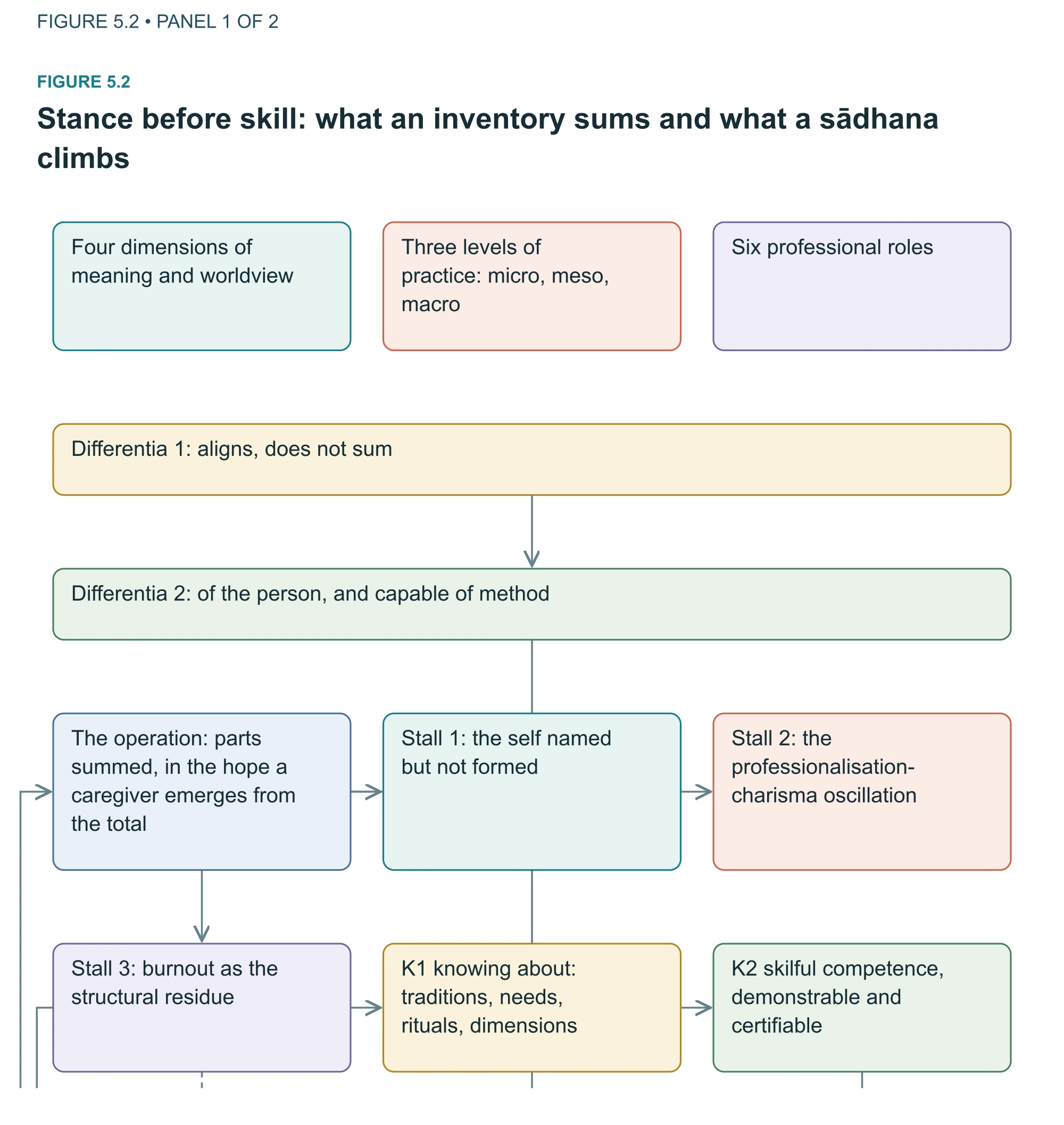
Figure 5.2. Stance before skill: what an inventory sums and what a sādhana climbs. Panel 1 of 2.
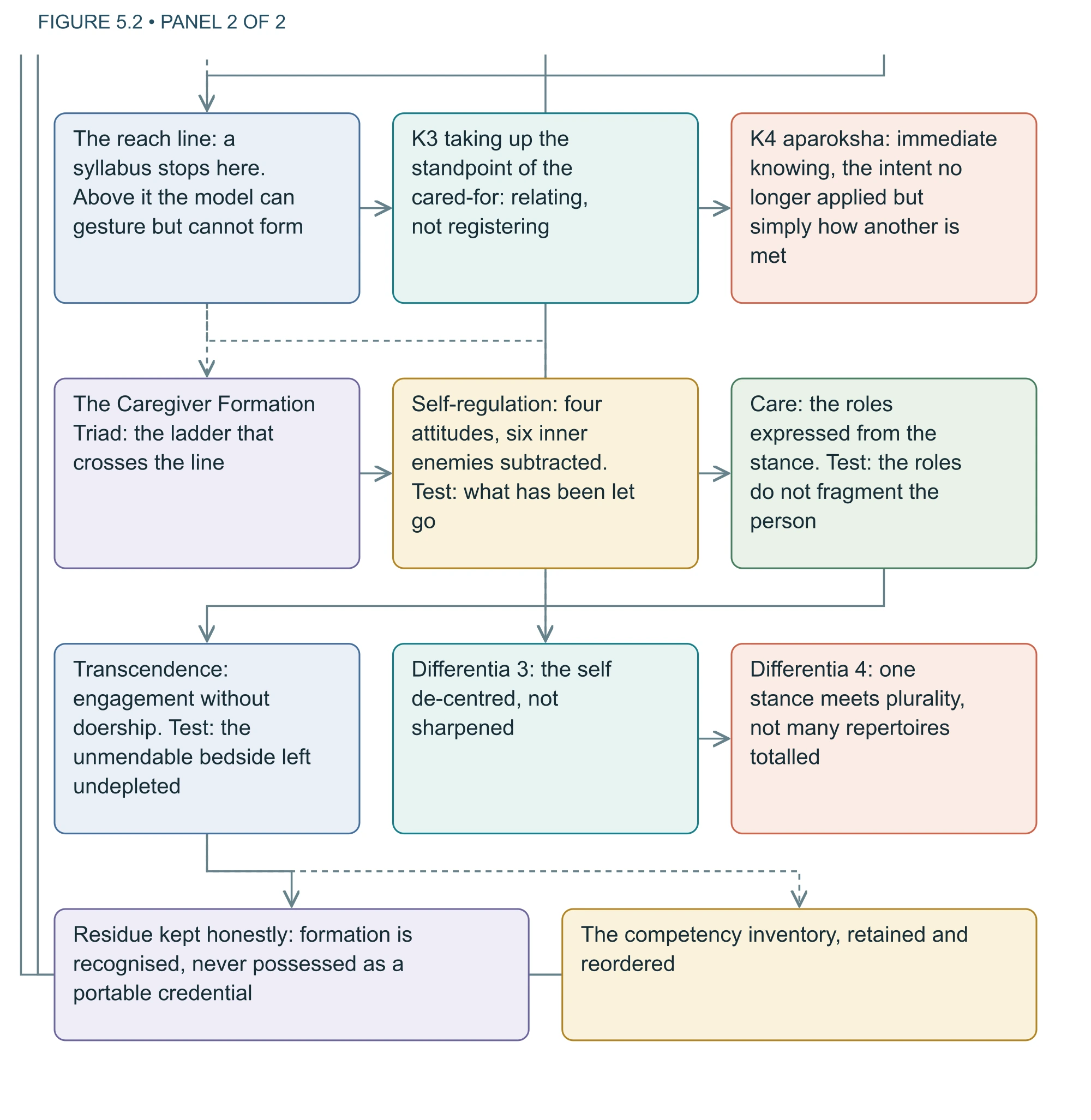
Figure 5.2. Stance before skill: what an inventory sums and what a sādhana climbs. Panel 2 of 2.
3. The Integrative reframe - stance before skill, and the differentia
The Integrative reframe does not add a missing competency to the inventory; it relocates formation to a different ground. It asks not what the caregiver must be able to do but what intent the caregiver must learn to hold, and it identifies that intent with the Integrative itself. A spiritual-care giver's stance is the Integrative definition enacted in the inner life. Recall the definition: 'the intent of relating all possible aspects, perspectives and purposes under holistic understanding of any context towards a Coherent View among all observers of the context in focus, without discarding any aspect, perspective and purpose' (Chapter 4). Read as a description of a person rather than of a method, this is a portrait of the formed caregiver: one disposed to relate every aspect of the person before them - the existential, the spiritual, the ethical, the aesthetic that the standard names (VGVZ 2016, p. 10) - toward a coherence that is the cared-for's, not the caregiver's, and to do so without discarding anything the person brings, including what the caregiver would not have chosen for them. Formation, on this reading, is the cultivation of that intent until it is a stable disposition and no longer an effortful resolve - which is to say, the cultivation in the caregiver of Integrative Intelligence (Philosophy of the Integrative, Bindlish 2026), the 'ability to apply oneself to holistically interrelate all aspects, all perspectives and all purposes of other entities in one's adopted context, with an a priori intention to achieve a Coherent View' (Chapter 4), seasoned by the five principles of the Integrative Paradigm (Chapter 4) into a settled way of meeting another.
What then becomes of the competencies the field has so carefully enumerated? They are not discarded; they are recovered as expressions of the stance and reordered beneath it. This is precisely the move Chapter 4 made for the definition of care - the inventory of interventions retained, but subordinated to the intent that gives it coherence - now applied to the person of the carer rather than to the concept of care. A caregiver who holds the Integrative intent will, in a given encounter, companion, represent, lead ritual, teach, advise or coordinate (VGVZ 2016, p. 12) as the situation calls; the roles are real and the skills are needed, but they issue from the stance rather than constituting it. The difference is the difference between a list of things a person can do and the single disposition from which the appropriate doing flows. The competency turn assembled the parts and hoped a caregiver would emerge from the sum; the Integrative reframe forms the intent and lets the parts express it.
Four differentiae fix the reframe against its nearest neighbours, in the differentia-first manner this book requires. The first is against the competency checklist itself. Formation cultivates a capacity - the intent, stably held - of which the listed competencies are situational expressions; it does not sum competencies in the hope that a caregiver will be their total. This is the integral-not-Integrative spine (Chapter 4) at the level of the person: an inventory sums roles and skills, whereas formation aligns them under a stance, directional rather than merely additive. A checklist can grow without end and never compose a carer; a stance composes the carer and then deploys the list.
The second differentia is against the older rival the field never quite silences: the intuition that spiritual care is a calling and presence a charism - genuinely formative of the person, but innate, untransmittable, and therefore beyond teaching or accountability. The Integrative stance answers the charism camp's truth while refusing its fatalism. It concedes that formation must be of the person and not merely of a repertoire; but it holds that the stance is formable - that it has a method, the sādhana developed in §6 - and so can be taught, practised and held to account without being reduced to a checklist. The stance is thus the missing third term in the professionalisation-charisma oscillation diagnosed in §2: neither the teachable-but-instrumentalising list nor the formative-but-unteachable gift, but a disposition that is both of the person and capable of method.
The third differentia is the most delicate, because its nearest neighbour is the best the helping professions have produced: the person-centred and pastoral construal of the carer's self as the instrument of care - Rogers's 'use of self', the chaplaincy 'ministry of presence'. Where these models deploy the self as the instrument, refining it the better to wield it, the Integrative stance de-centres the self: the ahaṃkāra, the doer-sense, the 'I' that would own the wielding, is not sharpened but removed (Principle 4, the activity 'without doership'; Chapter 4). The instrument metaphor still leaves an actor standing behind the instrument; the Integrative stance dissolves the actor into the act. This is also, and not incidentally, the reply to the burnout that §2 found to be the structural residue of a doing-and-outcome construal of care. Where there is no over-identified actor claiming the outcome as his own production, there is no one left to be depleted when the outcome - the recovery that does not come, the consolation that does not land - fails to arrive. The de-centring of the self is at once the spiritual content of the stance and its occupational protection.
The fourth differentia is against the paradigm's own answer to the plurality of traditions, and it is the one a book on spiritual care can least afford to leave undrawn. A caregiver serves a religiously and philosophically plural population, and the competency model meets that plurality in the only way an inventory can: by widening the inventory. Interfaith formation becomes a curriculum of competencies acquired 'across multiple spiritual and religious traditions' (Ganzevoort et al. 2014, §1), a repertoire keyed by tradition - the knowings, rituals and sensitivities proper to each faith - which the caregiver learns severally and carries as a portable cross-cultural competence, reaching for the right set at each bedside. This is the summation of §2 recurring in the register of worldview: the many traditions are met by holding many repertoires and totalling them. The Integrative stance meets the same plurality without accumulating a repertoire at all. Under Principle 1, Respect for Integral Unity - 'there is one truth, the knowledgeable speak it in many ways' (ṚV 1.164.46; Chapter 4) - the difference between the dying Muslim, the grieving Hindu and the avowed unbeliever is met as difference of perspective on one reality, not as a demand for three competences; the single de-centred stance relates each person's aspects, perspectives and purposes toward their own coherence, without discarding any (Chapter 4), whatever the tradition through which those purposes are spoken. Two guards keep this from collapsing into its counterfeits. It is not synthetic unity - the stance neither dissolves the traditions into one nor asks the caregiver to profess them all; Principle 1's Integral Unity is expressly contrasted with the synthetic kind (Chapter 4), and each tradition is kept as itself. And it does not dispense with the tradition-specific knowings the curriculum imparts: as with the roles and skills of the first differentia, they are retained and recovered as expressions of the stance, the K1 and K2 of §4, needed and used, but issuing from one disposition rather than constituting a shelf of parallel competences. What the caregiver is formed into is not a polyglot of worldviews but a single way of meeting whatever worldview the person carries - the formation that the practice of care across traditions will presuppose (Ch 8; Note 13).
4. Knowing in formation (K1-K4) - the ascent the competency model stops short of
The same reframe can be stated in the vocabulary of the Knowledge Model, and stating it there makes precise exactly where the competency paradigm stops. Formation is most exactly described as movement up the levels of knowing K1 to K4 (Philosophy of the Integrative, Bindlish 2026). The competency curriculum is, in these terms, a delivery system for the lower two levels. It conveys K1 - informational knowing about traditions, needs, rituals, and the four dimensions of meaning and worldview - and it builds K2, the skilful competence that can be demonstrated in supervised practice and certified: the examinable repertoire of what a caregiver can do. Within its own reach the curriculum is genuinely effective; one can be taught the religions one will meet, and trained in the skills of assessment, listening and referral, and these are real acquisitions at real levels of knowing.
But the stance does not live at those levels. It lives at K3, the contextual level at which the knower actually takes up the standpoint of the cared-for - not merely knowing that the dying woman has a standpoint, which is K1, nor how to elicit it, which is K2, but holding her aspects, perspectives and purposes together within her adopted context toward coherence, which is the distinctively Integrative level at which the knower relates rather than registers. And the stance is realised at K4, the level the tradition names aparokṣa - immediate, unmediated knowing in which the distance between knower and knowable is closed, the intent so fully internalised that it is no longer applied but is simply the caregiver's spontaneous way of meeting another. The K4 caregiver does not decide to relate without discarding; relating-without-discarding is what meeting another person has become for her. This realised level is continuous with what Polanyi (1966) described as indwelling - knowing from particulars one cannot fully specify by dwelling in them, rather than holding them at propositional arm's length - of which the formed stance is the limit case in the register of care.
The diagnosis of §2 can now be restated with full precision. The competency model can certify K1 and K2, and it knows that something more is wanted: it reaches for the higher levels in its own vocabulary, listing 'attitudes' and requiring 'reflective practice' (Costeira et al. 2024). But it can only gesture at K3 and K4, because it has no means of forming them. K3 and K4 are not contents that can be added to an inventory; they are a transformation of the knower. One cannot put 'takes up the other's standpoint' on a checklist as one more item to be evidenced, because the taking-up is not an item but a change in the one who would hold the items - a deepening of the relation in which the caregiver stands to the person, not an accumulation of further competence (the levels being ordered by depth, not by content). This is why formation requires a sādhana and not only a syllabus. A syllabus can deliver K1 and K2; only a disciplined inner practice can carry a knower up to K3 and toward K4. The competency paradigm is not wrong about the lower levels; it is silent, of necessity, about the ascent that makes a caregiver of the one who has mastered them - and that ascent, not the inventory it presupposes, is what formation names (Figure 5.2).
5. Western interlocutors
The field has not been silent about the carer's person; its best accounts know that the caregiver is the medium of the care, and several of them say so with care. The task here is to credit those accounts in their own terms and then to mark, in each, the residue the Integrative stance is built to address.
The closest Western near-match is Carl Rogers's account of the helping relationship. Rogers (1957) makes the helper's way of being - congruence, unconditional positive regard, empathic understanding - the active ingredient of help, and subordinates technique to it, so that what changes the other is not what the helper does but the quality the helper brings. This is rightly foundational to spiritual-care training, and it is a genuine stance account in everything but reach. Its residue, from the Integrative side, is twofold. The core conditions are qualities the helper offers to a client within a dyad; they do not carry the 'all aspects, perspectives and purposes... among all observers' span of the Integrative intent (Chapter 4), which holds a whole context and not only the person across the table. And they leave the helper's self in place as the bearer of the conditions - the very 'use-of-self' construal that §3 set against the de-centring of the doer (Principle 4).
Donald Schön's reflective practitioner names a second indispensable thing. Reflection-in-action - the thinking skilled practitioners do in the doing, revising their grip on a problem as it resists them - underwrites the competency frameworks' requirement of 'reflective practice' (Schön 1983). But reflection-in-action describes a cognitive operation performed on practice; it is silent on the formation of the stance that the reflection expresses. It tells us that the formed practitioner reflects, not how the practitioner is formed, and so it presupposes exactly the question this chapter asks.
The most serious formation pedagogy the field has produced is Clinical Pastoral Education, and it must be honoured as such. Through supervised practice, the action-reflection cycle and sustained group reflection, CPE forms the 'self as instrument' by encounter rather than by syllabus, and on the reading of §4 it is a genuine K3-forming method - it does take the practitioner up into the contextual level the competency curriculum can only gesture at. The Integrative reservation is not that CPE fails to form but that the self it forms is still figured as an instrument to be wielded: the 'self as instrument' keeps a doer standing behind the doing, the frame that Principle 4 removes. CPE forms the K3 caregiver and stops at the threshold of the K4 self that no longer owns its own use.
Finally, the 'ministry of presence' literature names, from inside the field, the very thing the competency list cannot hold. In Swinton's recovery of a non-generic spirituality (Swinton 2012, via Erşahin 2021) and the wider presence tradition, being-with is irreducible to anything the caregiver does, and the field's reaching for the word 'presence' is its own admission that the inventory has a hole in it precisely where the carer's person should be. The presence literature marks the gap of §2 with great fidelity; what it does not supply is a method by which presence is formed rather than merely possessed, which is the want the Dharmic resource is brought to meet.
Deeper than the presence literature, because it does not merely name the gap but sets out to close it, is the one Western tradition that has tried to give the formation of presence an actual method: Henri Nouwen's account of the wounded healer. Nouwen (1972) refuses the construal of the carer as an intact helper who ministers to the wounded other from a position of repair; the minister is a wounded person too, and the formation he describes is the slow work of coming to terms with one's own woundedness so that it becomes, in his phrase, a source of healing rather than a source of need. The carer who has faced their own loneliness can offer the other a home rather than a demand; the carer who has not will, however skilled, use the encounter to meet their own unmet wants - the māna of the helper who needs to be needed that §6 will name in another idiom. And in Reaching Out (1975) Nouwen gives this formation its inward sequence: the movement from loneliness to solitude (the carer reaching into their own innermost self), from hostility to hospitality (reaching toward the other) and from illusion to prayer (reaching toward God) - with solitude the ground of the whole, for only the carer at home in their own house can offer hospitality in it. Hospitality he defines, strikingly, as 'the creation of free space where the stranger can enter and become a friend', a space whose purpose is 'not to change people, but to offer them space where change can take place'. Of all the §5 interlocutors Nouwen reaches furthest toward the Dharmic resource of §6: he supplies the method the others lacked (a sādhana of solitude and prayer, not a syllabus), he locates formation in subtraction before skill (the loneliness faced before the hospitality offered, in exact parallel to the Heya of §2), and his hospitality - space offered without the intention to change the guest - stands remarkably close to the four attitudes of Yogasūtra 1.33 and to the without-doership that lets the other's coherence be their own. The residue is correspondingly subtler than the others', and it falls at a single point. Nouwen's formation makes the carer's own wound the healing instrument: the self, reconciled to its woundedness, remains the host who keeps the house and offers the space. It is the 'self as instrument' of Clinical Pastoral Education returned at a deeper and sanctified register - a wounded self rather than a competent one, but a self that still stands, as host and owner, behind the hospitality. What Principle 4 removes is precisely that standing owner: the niṣkāma karma stance does not perfect the doer's wound into an instrument but de-centres the doer altogether, so that the space held open is held by no one who could be depleted by holding it (§6). Nouwen forms, by the deepest Western road available, the K3 caregiver who hosts from a reconciled woundedness, and stops - as CPE did, but having travelled much further - at the threshold of the K4 self that no longer owns its own use.
Where Nouwen forms the caregiver on a solitary road - loneliness turned to solitude, and only then to hospitality - a second and equally serious Western tradition insists that the stance cannot be formed alone at all, and it is Parker Palmer who has stated it most fully. Palmer's diagnosis reaches the same fault the competency model leaves unaddressed but names it from the side of the caregiver's integrity: the divided life, the standing gap between the self that performs a professional role and the inner truth it has learned to keep offstage. 'The divided life is a wounded life', he writes, 'and the soul keeps calling us to heal the wound' (Palmer 2004). Formation, on this account, is the slow reclaiming of an undivided life - a way of working in which one's outer conduct and one's inner truth are no longer at odds - and its telos is precisely the wholeness the field's inventory cannot name and §2 found it reaching for. Two features make Palmer irreducible to the five accounts already credited. The first is his diagnosis of depletion, which is neither Maslach's mismatch of person and job nor the doing-and-outcome construal of §2 but a third thing, and the sharpest of the three for a formation chapter: burnout, in his formulation, 'does not result from giving all I have' but 'merely reveals the nothingness from which I was trying to give in the first place' (Palmer 2000) - the exhaustion of a caregiver spending from a self not yet reclaimed. The second is his method, which is the one axis none of the five occupies. Rogers, Schön, Nouwen and even the 'ministry of presence' form the caregiver as an individual; CPE alone works in a group, but as supervised apprenticeship toward an accrediting standard. Palmer makes the community itself the forming instrument: the circle of trust, a disciplined communal practice grounded in the twin premises that each person carries an inner teacher and that none can hear it unaided, whose whole art is to hold open 'a space between us that honors the soul' - a space, in deliberate echo of Nouwen's hospitality, whose rule is never to fix, advise or set the other straight, but to let the inner teacher be heard (Palmer 2004). Here the caregiver's stance is formed not by solitude and not by assessment but by a company disciplined to non-invasion, which is nearer to the Integrative 'without discarding' than anything else in §5.
And yet the residue survives, at the two points where Palmer stops short of the stance this chapter builds. The first is the one drawn already against Nouwen and CPE, arriving now from the angle of integrity rather than woundedness: the undivided life is still a self - reclaimed, made whole, brought into single-heartedness, but standing and owned, the integrated 'I' that now gives from its recovered fullness. The Integrative stance does not integrate the self into a fuller owner of the act; it de-centres the owner, dissolving the ahaṃkāra that would claim the giving at all (Principle 4; niṣkāma karma, Bhagavadgītā 2.47), so that the space held open is held by no self that could be spent - which is why Palmer's own burnout, the emptiness of a self giving from what it does not possess, is answered at a depth his remedy cannot reach: not by filling the self before it gives, but by removing the one who was counting the cost. The second point is more particular to Palmer, and it turns his own strength into its limit. The circle of trust is a bounded and protective community - a chosen few, met apart under strict ground rules, precisely not the ward, the family, the team and the tradition among whom the caregiver's stance is finally answerable. Its coherence is achieved among those inside the circle; the Integrative stance is aligned 'among all observers of the context in focus' (Chapter 4), the wider and unchosen circle §8 will name as the community of accountability the formation must ultimately face (Philosophy of the Integrative, Bindlish 2026). Palmer forms the undivided self in a company that honours the soul, and stops - as Nouwen did in solitude, and CPE in supervision - at the threshold of the de-centred self answerable not to a circle of trust but to everyone the care touches (Note 11).
Taken together, these six establish a consensus and a limit. The field knows that the carer's person is the medium, and it has learned to describe that person (Rogers), to credit the thinking that runs through the person's practice (Schön), to form the person by encounter (CPE), to name the non-instrumental core the person carries (the presence literature), in Nouwen, to give that formation an inward method that begins in subtraction and ends in hospitality, and, in Palmer, to seek that same formation in a community disciplined to keep the undivided self honest. With Nouwen and Palmer the older complaint - that the field can describe the stance but not form it - can no longer be the charge: they form it, and by deep roads. The limit that survives even his account is therefore a single and precise one. The formation they provide perfects or reintegrates the self - Nouwen's wounded self made a healing instrument, Palmer's divided self made whole - where the Integrative stance de-centres the self altogether; what none of the six reaches is a formation that both has a method and dissolves the doer it forms - that makes the carer accountable and removes the owner who would otherwise be depleted. That is the limit the field's six stance accounts leave standing.
Beside these six stance accounts stands a seventh body of work, of a different kind. It does not describe or form the caregiver's person; it measures what happens to that person when the stance is absent - the occupational-health research on burnout, compassion fatigue and moral distress. It is credited here first-hand, because it supplies the strongest available warrant for the claim §2 made structurally: that the depletion of caregivers is not incidental to a doing-and-outcome construal of care but its predictable residue. Christina Maslach's account of burnout is the anchor. Maslach and Jackson (1981) operationalised the syndrome as three measurable dimensions - emotional exhaustion (the draining of one's affective resources), depersonalisation (a cynical, distancing detachment from the very people one serves) and a diminished sense of personal accomplishment - and the Maslach Burnout Inventory built on that triad became the field's standard instrument. Maslach (1982) gave her book the exact title the diagnosis warrants, Burnout: The Cost of Caring, locating the injury in the caring relation itself; and Maslach and Leiter (1997) relocated its cause decisively from the individual to the fit between person and job, naming six areas of working life - workload, control, reward, community, fairness and values - whose mismatch produces the syndrome. Charles Figley's (1995) compassion fatigue names the more specifically empathic form of the same injury, the secondary traumatic stress a carer takes on precisely by attending to another's suffering; and Andrew Jameton's (1984) moral distress names its ethical form, the residue left in a caregiver who knows what a situation asks but is institutionally constrained from providing it. Between them these accounts map the wound the missing stance leaves with a rigour the stance literature never attempted.
Their standing as interlocutors is high and their diagnosis is accepted here without reservation; the residue falls, as it has throughout, on the remedy. Two features locate it. First, the cause each account isolates lies in the doing - the exhausting workload, the mismatch of person and job, the accumulated exposure, the thwarted right action - and the remedies follow the diagnosis and stay within the doing: reduce the load, restore organisational fit, build resilience, hold boundaries, secure the practitioner's self-care. These are real goods, and this chapter does not gainsay them; but they manage the conditions of the doing without touching the construal that makes the doing deplete, which §2 located one level deeper - the assumption that the outcome is the caregiver's to produce. Second, and more tellingly, the syndrome's own middle dimension is a de-centring gone wrong. Depersonalisation is the carer's involuntary defence against exhaustion: a withdrawal of the self from the relation, a distancing from the person in the bed in order to survive the work. It is the exact counterfeit of the de-centring §3 named - a subtraction of presence where the Integrative stance subtracts ownership. Where burnout's depersonalisation withdraws the caregiver from the patient to protect a self that still claims the outcome, the without-doership stance (Principle 4; niṣkāma karma, Bhagavadgītā 2.47) keeps the caregiver wholly present to the patient while removing the actor who could be depleted by the outcome. The occupational-health literature thus supplies at once the measure of the wound and the confirmation that it is structural; what it approaches from the side of the symptom - self-care against exhaustion, distance against over-exposure - the Dharmic resource of §6 addresses at the root, by forming the very de-centred engagement whose absence the inventory of burnout records. That is the door at which the Dharmic resource is brought alongside.
Beside this occupational-health cluster, and drawn from a different literature again, stands a remedy its secular proposals do not offer but the field increasingly does: not the management of the conditions of the work but the introduction of spirituality itself as the answer to the depletion the work produces. The organisational-behaviour literature on workplace spirituality has become, over the last two decades, the field's own spiritual reply to burnout, and in vocabulary it is the nearest of all the §5 interlocutors to the resource §6 brings, because it names the very thing the competency inventory could not hold - the inner life of the one who cares. On the widely adopted definition of Ashmos and Duchon (2000), workplace spirituality is 'the recognition that employees have an inner life that nourishes and is nourished by meaningful work that takes place in the context of community' - a construct of three dimensions, inner life, meaningful work and a sense of community - and the bibliometric consolidation of the field by Raamkhumar and Swamy (2024) states its practical motto without embarrassment: workplace spirituality is 'a pragmatic strategy' that firms 'can indoctrinate... into management practices to deal with work stress and prevent burnout, exhaustion, and turnover'. Here is a Western literature that reaches past the doing to the spirit, names the inner life the burnout research could only measure the loss of, and proposes to cultivate it rather than merely to shield it. It is, in words, the closest the field's own remedies come to §6, and for exactly that reason its residue is the most instructive.
The residue falls at the point where the vocabulary of §1 returns in a new register. Workplace spirituality is spirituality construed as an instrument, and construed for a particular and openly disclosed end. Raamkhumar and Swamy's framework aligns the three dimensions of workplace spirituality with the reduction of work stress and, above all, of turnover intention: the spiritual is cultivated so that the employee does not quit, so that the organisation retains its people and sustains its performance. The inner life is valued for what it yields; meaningful work is a lever on retention; the sense of community is a buffer against exhaustion. This is the integral-not-Integrative error (Chapter 4) in its subtlest form: spirituality is summed into the organisation's inventory of wellbeing provisions - set beside the wellness programme, the resilience training and the employee-assistance line the occupational-health remedies already supply - rather than becoming the stance under which the person is aligned. A firm that indoctrinates workplace spirituality has added one more item to the list, and the item is now the spirit itself.
Two differentiae fix the stance against it. The first is the one drawn against every interlocutor in this section, arriving now from its most spiritual angle: workplace spirituality strengthens the doer rather than de-centring him. Its formed employee is a more spiritually resourced self - one who finds meaning, belongs to a community, and therefore endures - but a self still standing as the owner of the work and the bearer of its outcome, fortified against depletion rather than relieved of the ownership that depletes. Principle 4 removes the very owner the workplace-spirituality remedy fortifies (niṣkāma karma, Bhagavadgītā 2.47; §§3, 6): where workplace spirituality makes the self resilient enough to keep giving, the without-doership stance removes the one who was counting what the giving cost. The second differentia is of telos, and for a book about care it is decisive. Workplace spirituality is directed, by its own account, toward the organisation's coherence - performance, retention, the prevention of turnover - and the employee's spiritual flourishing is sought because it serves that coherence. The Integrative stance is directed toward the cared-for's coherence, the Coherent View 'among all observers of the context in focus' (Chapter 4), of which the caregiver's own sustained presence is a consequence and never the aim. To cultivate a caregiver's spirituality in order to keep her at her post is to have mistaken, at the last and most spiritual step, whose coherence the care is for.
So the door §6 opens is not the door workplace spirituality opens, though the two stand side by side and speak much of the same language. Workplace spirituality brings spirituality to the self, as a resource the self and the organisation deploy against the cost of caring; the Dharmic resource brought alongside in §6 forms a sādhana that de-centres the self, so that the cost has no one left on whom to fall. The near-match that comes closest to §6 in vocabulary is thus also the clearest confirmation of its differentia: one can name the inner life, honour meaningful work and community, make spirituality a serious and practised part of formation - and still keep the self at the centre, an instrument spiritually refined rather than an owner dissolved. That is the residue the whole of §5 has been circling, met here in the one literature that reached furthest in naming the spiritual and stopped, like all the others, at the threshold of the doer's dissolution (Note 12).
6. Dharmic resources, brought alongside
The deepening move begins, fittingly, from within the authors' own scholarship. Nandram and Joshi (2016) induce an ethics of care from Kauṭilya's Arthaśāstra whose order is the burden of this whole chapter: 'an ethics of care starts with the leader's self-regulation... righteous living, self-purification, and awareness of a dual mindset', and only then issues in the mechanism of care and, beyond it, the mechanism of transcendence - of one's own interest. Formation precedes care, and the sequence is not optional but constitutive: one is formed as a carer before one is equipped as one. Self-regulation is glossed concretely as indriya-jaya, mastery of the senses, secured not by addition but by the subtraction of the ariṣaḍvarga, the six inner enemies - kāma (lust), krodha (anger), lobha (greed), māna (pride), mada (arrogance) and harṣa (heedless excitement) - that the king, and the carer, must conquer before any outward work can be trusted (Arthaśāstra 1.6.1, in Kangle 1965). The caregiver is formed by what is let go, in exact parallel to the Heya of §2, before being equipped by what is acquired.
What the self-regulated carer cultivates positively is given with unusual precision at Yogasūtra 1.33: the four attitudes of maitrī (friendliness) toward the happy, karuṇā (compassion) toward the suffering, muditā (gladness) toward the virtuous and upekṣā (equanimity) toward the non-virtuous, practised as citta-prasādana, the clarifying-and-settling of the carer's own mind. This is a stance specified as a daily discipline rather than as a competency to be evidenced: it forms how the caregiver meets the full range of those in their care - including the repellent and the unreachable - and upekṣā, in particular, is neither the indifference nor the professional 'detachment' it is easily mistaken for, but an even regard that neither approves nor withdraws (see Note 4). The four attitudes are the inner shape of the 'without discarding' that the Integrative stance enacts toward persons.
The engagement so cultivated is engagement without doership. Acting in the awareness of the observer-in-us, unattached to the fruits of the act (niṣkāma karma; Bhagavadgītā 2.47, 3.19; Principle 4), is at once the dissolution of the burnout-bearing actor diagnosed in §2 and the positive content of the stance: full engagement, no ownership of outcome. Its inner sequence - Samarpan (surrender), issuing in Santulan (balance), issuing in Sukh (conscious happiness) - is the movement by which the carer who has relinquished the outcome is sustained rather than depleted by a work whose results were never theirs to produce (Chapter 4).
That this is formation as a graded ascent, beginning in humility rather than in skill, is the express teaching of the Subhāṣita wisdom cards developed for the SpiCaQuest formation game. One card draws the cascade explicitly: vidyā dadāti vinayaṁ vinayāt yāti pātratām, pātratvāt dhanam āpnoti, dhanāt dharmaḥ tataḥ sukham - learning gives humility (vinaya); from humility, worthiness (pātratā); from worthiness, the means of life; from those means, dharma; and from dharma, happiness (sukha). Formation is a ladder whose first rung is humility, not competence. A second card carries the Kauṭilyan root directly into the cards, tracing comfort back through dharma, artha and self-rule to indriya-jayasya mūlaṁ vinayaḥ - the root of mastery of the senses is humility - and humility back to the service of elders and the knowledge of Self, until 'the self-conquered becomes joined to every purpose' (jitātmā sarvārthe saṃyujyate). And a third gives Principle 5 its formation-content: ayaṃ nijaḥ paro veti gaṇanā laghu-cetasām, udāra-caritānāṃ tu vasudhaiva kuṭumbakam - 'this is mine, that a stranger' is the reckoning of the petty-minded; for the noble-hearted, the whole world is one family. The stance enlarges the circle of 'mine' until the distinction the caregiver might draw between the deserving and the undeserving of care simply dissolves.
The portrait toward which all this tends is the sthitaprajña, the one steady in wisdom of Bhagavadgītā 2.54-72 - unshaken in pleasure and pain, withdrawing the senses as a tortoise draws in its limbs - which is the Dharmic figure of the formed caregiver and the bridge forward to Integrative Wisdom (Philosophy of the Integrative, Bindlish 2026). And the means by which the portrait is approached - the Hānopāya the diagnosis of §2 left open - is antaraṅga yoga, the inner limbs of practice (Yogasūtra 1.12-2.1), the disciplined sādhana by which the four attitudes and self-regulation are cultivated from effortful resolve into the spontaneous, K4 stance of §4. Held under the five principles - the cared-for's truth as one truth differently spoken (Principle 1, ekaṃ sat), embodied knowing (Principle 3), action without doership (Principle 4) and our connectedness (Principle 5) - this is a formation that has, at last, both a method and a de-centred self: the two things the Western interlocutors of §5 reached for severally and never held together.
7. Models, frameworks and practices (the chapter's contribution to the inventory)
The chapter contributes one named, reusable construct of its own: the Caregiver Formation Triad, the formation arc self-regulation → care → transcendence that Nandram and Joshi (2016) induce from Kauṭilya and that §6 recast as the order in which a spiritual-care giver is made. Stated as an instrument a practitioner can hold rather than as a doctrine, the Triad has three members, each with its own discipline and its own test of whether formation has taken.
The first member, self-regulation, is the formation that precedes care. Its discipline is the daily cultivation of the four attitudes (maitrī, karuṇā, muditā, upekṣā; Yogasūtra 1.33) and the subtraction of the ariṣaḍvarga, the six inner enemies (Arthaśāstra 1.6.1, in Kangle 1965) - a sādhana, not a syllabus. Its test is not what the caregiver knows but what the caregiver has let go: whether the encounter is met from an even regard rather than from kāma, krodha, or the subtler māna of the helper who needs to be needed. The second member, care, is the field's inventory of competencies recovered and reordered - expressed from the formed stance rather than performed as a checklist. The Triad discards nothing the standard enumerates; the companioning, representing, ritual-leading, teaching, advising and coordinating it lists (VGVZ 2016, p. 12) are retained in full, but they now issue from the stance as the situation calls rather than constituting it. The test of this member is whether one caregiver can move among the roles without the roles fragmenting the person who plays them. The third member, transcendence, is the without-doership engagement (niṣkāma karma; Bhagavadgītā 2.47; Principle 4) that makes the first two sustainable. Its test is the one the whole chapter has built toward: whether the caregiver can meet the full range of those in their care - including the repellent, and the dying who will not recover - without either withdrawal or depletion. A formation that passes the first two tests and fails the third has produced a skilled carer who will burn; the third member is what converts competence into a practice carryable for a working life.
So stated, the Triad is a diagnostic as much as a curriculum. Faced with a caregiver in strain, it asks at which member the formation has stalled: whether the trouble is an un-relinquished enemy (self-regulation), a role performed rather than expressed (care), or an outcome being owned (transcendence) (Table 5.1). The appendix carries the Triad as a worked entry, with a reflective-practice prompt that walks a caregiver through the four attitudes against a named encounter and surfaces where the doer-sense, rather than the situation, is the source of the strain (Appendix, 'The Caregiver Formation Triad'). It cross-refers to the M-model and the 4H diagnosis already in the inventory: the 4H names what is to be let go, and the Triad is the formation by which the caregiver lets it go.
8. Applicability and cases
The stance formed in this chapter is not one practice among the others Part II describes; it is what those practices operate. The point can be put as a set of dependencies. Assessment and discernment (Ch 6) are conducted from a stance: what a caregiver can notice in another is a function of what the caregiver has been formed to hold, and an assessment instrument in unformed hands records data without discernment (Ch 6 §6, the sovereignty of śabda, the patient's own word). Presence and accompaniment (Ch 7) are the stance made visible: presence is not a technique added to the encounter but the formed disposition becoming perceptible to the one accompanied. Working across traditions (Ch 8) draws on the enlarged circle of vasudhaiva kuṭumbakam (§6) - the caregiver who has dissolved the reckoning of 'mine' and 'stranger' is the one who can sit with a worldview not their own without either annexing or refusing it. And the limits of care (Ch 10) are bearable only from the without-doership stance: the caregiver who does not own the outcome is the one who can remain at a limit they cannot move, neither fleeing it nor breaking against it. And the two chapters on the care of the carers (Chs 22 and 23) stand in a relation to this one that the four just named do not, because there the formed caregiver is not the practitioner operating a practice but the person the practice is about; that reversal is taken up below.
A short illustration fixes how the formation bites. Consider a caregiver called to sit with a dying man who is angry - at his family, at his God, at the caregiver who can mend none of it. On the competency construal of §1, the encounter is a problem to be solved with the right intervention, and its likely residue is the caregiver's own sense of failure when no intervention lands (the burnout of §2). On the Triad, the same encounter is met differently at each member: self-regulation has already subtracted the caregiver's need to be thanked or to succeed (the māna and the harṣa of Arthaśāstra 1.6.1), so the anger is not taken personally; care offers what the moment asks - a presence, a silence, perhaps a ritual - from the stance and not from a script; and transcendence holds the truth that the man's reconciliation, if it comes, is his and not the caregiver's production (niṣkāma karma; BG 2.47). The caregiver leaves undepleted, not because the encounter went well by any outcome measure, but because the outcome was never theirs to carry. This is the formation doing its protective work in the place the field most needs it.
That last sentence is where this chapter has to be read against Chapter 23, because taken by itself it states the case for the stance in exactly the register Chapter 23 refuses. Protective work is work done on behalf of something else. The formation is justified there by what it lets the caregiver go on doing, and a warrant of that shape belongs to whoever owns the doing. Chapter 23 puts the point as a test, and it is a test this chapter does not pass on its own terms: the offer must remain worth making if she resigns tomorrow. The without-doership of §3 and §6, offered here as the reply to burnout, would not survive it, because a stance whose credential is that it keeps a caregiver at the bedside is a stance held on the employer's warrant. Nothing in §§1 to 7 is retracted by the observation. What is added is that the same de-centring is described twice in this book, once as the condition of good care and once as the caregiver's own spiritual life, and that only the second description is about her.
Two forward dependencies therefore run out of this chapter that the roll above did not name. The occupational-health literature credited at §5 - Maslach's burnout, Figley's compassion fatigue, Jameton's moral distress - is taken up again at Chapter 23 §5, where the residue this chapter located in the remedy is located one step further back, in the question itself: every one of those literatures can be answered in full without anybody having asked the caregiver what her own life is for. And the guard §7 built into the Triad's third member, that the caregiver meet the dying who will not recover without either withdrawal or depletion, is the guard Chapter 23 finds most often defeated by the very teaching that was to supply it. Non-attachment to the fruit of an action is heard as detachment from the person, and a numbness that is arriving anyway is then received as an attainment. The test that chapter offers is the one the present chapter should be read as having assumed throughout: equanimity that can still be moved is the teaching, and equanimity that cannot be moved at all is the injury wearing the teaching's clothes.
Chapter 22 reaches this chapter from a different side and makes the sharper demand of it. Everything in these pages is written for a person who chose the work, trained for it, and can be re-formed inside an institution that at least in principle owes them something. The daughter allocated the role by proximity chose nothing, trained for nothing, and has no employer to address a demand to; and the formation set out here - a daily sādhana, a cultivated evenness of regard, the subtraction of the six inner enemies - assumes a shape of day that a person whose hours are broken into pieces by another's needs does not have. That is not a reason to withhold it. It is a reason to say, as Chapter 22 does, which of these practices is already hers, which changes form in her hands, and which was never sized for her at all. The third differentia of §3 is what carries the obligation. If the objection to construing the carer's self as the instrument of care is that the instrument metaphor leaves an actor standing behind the instrument, then a book that forms the professional's stance at this length and never asks after the one formed by it has reproduced the figure it objected to, at one remove and in its own favour (Note 14).
Three of the Integrative's own commitments are discharged here in the register of care. The stance is praxeology's 'formation not prescription' carried to the bedside: a pillar that asks how a practitioner is made rather than what a practitioner should be told is answered by a formation and not by a protocol, and the question that pillar opens toward the practitioner is the question this chapter has been answering. It is Integrative Intelligence - the ability to interrelate all aspects, perspectives and purposes of another within one's adopted context, with an a priori intention toward a Coherent View - cultivated until it is a person's settled way of meeting another rather than a capacity exercised on occasion. And it is the sthitaprajña of Integrative Wisdom seen from the side of formation rather than of attainment: the same figure the wisdom literature draws as a steadiness already achieved, described here as the thing a sādhana is for. Each of the three is argued at length in Philosophy of the Integrative (Bindlish 2026), and each is stated here in the form the care of persons needs, so that nothing in this chapter waits on a reader having met it there.
One open research question is carried, unresolved, from the philosophical work behind this one (Philosophy of the Integrative, Bindlish 2026) and stated here at the level of the carer: can formation be assessed without collapsing back into the competency-checklist it is meant to displace? The Triad reframes the question but does not yet answer it. An Integrative assessment of formation would have to certify a capacity by its expressions without mistaking the expressions for the capacity - the alignment-not-summation problem (Chapter 4) relocated one level inward, from the definition of care to the formation of the carer. Whether such an assessment is possible, or whether formation can only ever be recognised and never measured, is the question this chapter now takes a first step toward answering.
A first step toward that answer is already present in the field's oldest formation practice, which was built to assess precisely what a competency list cannot. Clinical Pastoral Education (CPE), the supervised apprenticeship through which most chaplains are still formed, began when Anton Boisen set students to read the 'living human document' - the person in crisis - rather than a textbook, and made the student's own reactions the material of learning (Boisen 1936). The method that grew from this is not an examination but a supervised action-reflection cycle: the student brings a verbatim, a near-verbatim reconstruction of a real encounter, to a peer group and a supervisor who attend less to whether the correct intervention was made than to what the encounter disclosed about the student - where anxiety closed them, where a need to fix intruded, where they could not stay. Assessment in CPE is written against a set of formation outcomes - the capacity to attend to one's own inner responses, to be present to another's suffering, to work within one's limits - and is reached through narrative evaluation, self-evaluation and the reflected judgement of the group over months, not through a scored inventory. In its oldest practice the field already possesses an assessment that reaches the stance and not merely the skill.
On the Integrative reading, CPE gets right the very thing §8 required: it certifies a capacity by its expressions without mistaking the expressions for the capacity. It reads formation from the fruits - the verbatim, the group's experience of the student's presence - back to the disposition, and it treats a lapse of stance, the intrusion of the doer-need, as the datum rather than as a deviation from a checklist. It is, in the register of assessment, the sibling of the dialogic, formative quality-assurance the Integrative reaches for wherever an institution must account for work it cannot count: the audit reconceived 'as a conversation, not a command', the metric kept but subordinated to a judgement it cannot itself make (Philosophy of the Integrative, Bindlish 2026). Formative rather than summative assessment, in the vocabulary the evaluation literature owes to Scriven (1967), is assessment that forms what it examines rather than only certifying it; CPE is that principle carried into the making of a carer.
Yet CPE stops short of the Integrative requirement at two points, and naming them shows what an Integrative assessment of formation would add. First, its outcomes are normed to the accrediting body's statement of the competent chaplain - a settled specification the student is formed toward - so that at the limit the assessment still measures conformity to a given standard rather than a person's direction of travel toward a stance whose full form no standard contains. Second, the discerning community is the bounded peer group and supervisor: a genuine community of accountability, the condition the discernment literature de Jongh represents sets on any such judgement (Philosophy of the Integrative, Bindlish 2026), but not yet the wider circle - patients, families, colleagues, the tradition - among whom the stance is finally answerable. The verdict is coherent within the appreciator's own system, the residue the Integrative draws against Vickers's appreciative system, rather than aligned among all observers (Chapter 4).
The Integrative move is to conceive the assessment of formation as itself an act of discernment rather than of measurement, and the Caregiver Formation Triad (§7) supplies its form. Because each member of the Triad is defined by what is let go rather than by what is added, each is assessed by a sign of subtraction and not by a tally of acquisition: self-regulation by whether provocation is met from an even regard, the ariṣaḍvarga subtracted rather than merely managed; care by whether the roles issue from the stance without fragmenting the person who plays them; transcendence by whether the caregiver leaves a bedside they could not mend undepleted. These are discernments, not scores - readings of a direction - and the one who reads them must themselves be formed, so that a caregiver's formation is assessed by a community that is itself under formation, each member at once assessed and assessing, and the assessed person's own word is kept sovereign within it (the śabda of Ch 6 §6). Assessment so conceived is viveka, discernment turned on the carer, and not pramāṇa, a measurement applied to them; its verdict is never a final grade but a naming of where, on the Triad, the formation has and has not yet taken - the diagnostic use §7 already gives the instrument.
So framed, the question §8 carried is answered in part and sharpened in what remains. Formation can be assessed, if assessment is discernment among a formed and accountable community reading a stance back from its expressions: the CPE tradition is standing proof that it is done, and the Triad is the form that keeps the reading from collapsing into a tally. What cannot be done - and here the residue is retained honestly - is to measure formation in the sense a competency inventory promises, to produce a portable, observer-independent score that certifies the stance once for all. A formation is recognised, and its lapses are named, but it is never possessed as a credential; the alignment-not-summation constraint (Chapter 4) forbids at the level of assessment exactly what it forbids at the level of care. The operational instrument - what such an assessment looks like in the caregiver's own audit of an encounter once it is over and in supervision - is handed to Ch 6 (§7's listening audit and §8's community of viveka specialised to discernment), where assessment is conducted from a stance; and its hardest form, whether a disposition can be evidenced in a system that cannot be formed at all, to the chapters on machine care (Ch 24 §6; Ch 26 §8).
Notes
1. On the professionalisation of chaplaincy and spiritual care and the competency turn (§1). The four dimensions of meaning and worldview (existential, spiritual, ethical, aesthetic), the three levels of practice (micro / meso / macro) and the six professional roles (companion, representative, ritual leader, educator, advisor, coordinator) are taken from the Beroepsstandaard geestelijk verzorger (VGVZ 2016, pp. 10-12) as digested in the SpiCaQuest competencies note, which locates the dimensions at p. 10, the levels at p. 11 and the roles at p. 12; the standard itself has since been read at first hand from the archive's copy (cover title 2015, imprint December 2016), and the loci stand as printed: the printed folio matches the PDF page, dimensions at p. 10 (§II.1), levels at p. 11 (micro) and p. 12 (meso and macro, §1.3), roles at p. 12 (§1.5). Ganzevoort et al. Costeira et al. (2024) is still engaged at second hand through the SpiCaQuest note, and a direct reading of it remains owed. The standard's own inclusion of attitudes and reflective practice among the competencies (Costeira et al. 2024) is, on this chapter's reading, the place at which the stance-question surfaces from inside the field: the standard reaches for the inner life it cannot, in the idiom of a competency list, form.
2. The integral-not-Integrative error relocated to formation (§2). The claim that a list fixes the extension of good caregiving without the intent that holds it in a person is the formation-level instance of the Integrative's primary differentia (Chapter 4): an inventory sums roles and skills, whereas the Integrative aligns them under a stance - directional, not merely additive. The same trap was diagnosed one level up in Chapter 3, via Hummel et al.'s (2009) content-analysis of 'spiritual care' as an enumeration of discrete interventions; §2 carries that exhibit from the definition of care to the formation of the carer.
3. The burnout and compassion-fatigue residue and the without-doership reply (§2). The construal of the residue as structural rather than incidental is stated here against the occupational-health literature on compassion fatigue (Figley 1995) and burnout (Maslach 1982); these, with Maslach & Jackson (1981), Maslach & Leiter (1997) and Jameton (1984) on moral distress, are engaged first-hand in §5 (see Note 10). The positive reply - that the over-identified actor whom outcomes deplete is precisely what the without-doership stance (Principle 4; niṣkāma karma, BG 2.47) removes - is developed in §§3 and 6, and should be read with the formation framework of §7.
4. On upekṣā (equanimity) as neither indifference nor approval - its role in the four-attitude practice (YS 1.33) and its difference from professional 'detachment'.
5. On the §6 wisdom-card engagement and Nandram & Joshi 2016. The three Subhāṣita verses quoted in §6 - vidyā dadāti vinayaṁ (the humility-first formation cascade), the Kauṭilyan sukhasya mūlaṁ dharmaḥ... indriya-jayasya mūlaṁ vinayaḥ... jitātmā sarvārthe saṃyujyate cascade, and ayaṃ nijaḥ paro veti... vasudhaiva kuṭumbakam - are taken first-hand from the SpiCaQuest Wisdom Cards (Neeti - Subhāṣita) corpus and given in IAST with gloss; Devanāgarī to be set. Nandram & Joshi (2016, in Chatterji & Zsolnai 2016, pp. 53-69) is the lead resource, read in full, supplying the self-regulation → care → transcendence order behind the chapter's Caregiver Formation Triad (§7); the ariṣaḍvarga / indriya-jaya loci follow Arthaśāstra 1.6.1 in Kangle (1965), as relied on there.
6. On the Caregiver Formation Triad as both curriculum and diagnostic (§7). Its three members answer to the 4H diagnosis of §2: self-regulation discharges the Heya (what is to be discerned and let go), care is the competencies aligned beneath the Hāna (the formed stance that holds them), and transcendence is the Hānopāya carried into the work (the without-doership engagement that sustains it).
7. On the worked encounter and the open question (§8). The dying-and-angry encounter is a constructed composite, not a documented case - the documented case studies are reserved for Part III (Chs 11-21); it is offered to show the Triad's three members operating at a single bedside. The open research question - whether formation can be assessed without collapsing into a competency tally - is the formation-level form of the alignment-not-summation problem carried from Philosophy of the Integrative (Bindlish 2026) (Chapter 4); it recurs at Ch 6 (assessment from a stance) and in the AI chapters (Ch 24 §6, where the outward form and the formed disposition come apart, and Ch 26 §8, where the assurance question returns to this chapter's formation question).
8. On the engagement with Nouwen (§5). Nouwen's Out of Solitude (1974) is already engaged in Ch 7 for the ministry of presence; the books brought here are the formation works, distinct in subject - how the carer is made, not how presence is described - which is why Nouwen belongs in §5 of this chapter and not only in Ch 7. The placement against the Dharmic resource turns on a single differentia: Nouwen forms a wounded self into a healing instrument, whereas Principle 4 / niṣkāma karma (§6) de-centres the doer; this is the K3-to-K4 threshold of §4 reached by the deepest Western road and not crossed.
9. On the §8 worked answer and its Western near-ally (Clinical Pastoral Education). The formative/summative distinction follows Scriven (1967) at standard statement. The answer advances the open question of Note 7 from named to a worked partial answer (the credit-residue-reframe method of §§1-6 applied to assessment itself): CPE credited as the field's existing formation-assessment, its residue drawn on two axes (outcomes normed to a settled standard; the bounded discerning community), and the Integrative reframe - assessment as viveka among a formed community, each Triad member evidenced by a sign of subtraction - supplied from §7. The residue is retained honestly (formation recognised and its lapses named, but never measured as a portable credential; Chapter 4), the operational instrument handed to Ch 6 §§7-8 (the audit after the encounter and the supervision of discernment; Chapter 6 gives no bedside instrument, and does not pretend to) and the machine-care form to Chs 24, 26. This is the formation-level discharge of the assessment question Philosophy of the Integrative (Bindlish 2026) develops on the organisational and the educational axes and explicitly hands forward to this chapter.
10. On the §5 occupational-health engagement (Maslach, Figley, Jameton). The burnout, compassion-fatigue and moral-distress literature is engaged here from the standard statements of its founding works. The discussion uses established formulations rather than page-specific quotation. Maslach and Jackson (1981) are cited for the three-dimensional operationalisation of burnout - emotional exhaustion, depersonalisation and reduced personal accomplishment - and the Maslach Burnout Inventory; Maslach (1982) for the 'cost of caring' framing; Maslach and Leiter (1997) for the six areas of working life and the person-job mismatch model that relocates cause from the individual to the organisational fit; Figley (1995) for compassion fatigue / secondary traumatic stress; and Jameton (1984) for moral distress as the ethical form of the same residue. A first-hand reading, with editions and page references, is still owed, as Chapter 20's Note 7 also records for Figley and Maslach. The placement as a 'sixth interlocutor of a different kind' is deliberate: unlike the five stance accounts (Rogers, Schön, Clinical Pastoral Education, the presence literature, Nouwen), this body of work does not describe or form the caregiver's person but measures its injury when the stance is absent, so its residue is drawn not on its diagnosis - accepted in full - but on its remedy, which manages the conditions of the doing where the without-doership stance (Principle 4; §§3, 6) reforms the doer. The depersonalisation dimension is read as the counterfeit of the Integrative de-centring: a subtraction of presence to protect a self that still owns the outcome, against a subtraction of ownership that keeps the carer present.
11. On the engagement with Parker Palmer (§5). Palmer's two formation works - Let Your Life Speak (2000) and A Hidden Wholeness: The Journey Toward an Undivided Life (2004) - are engaged here from their standard statement (the divided/undivided life; the circle of trust as a communal formation practice; burnout as the emptiness of a self not yet reclaimed), and are added as the sixth §5 stance account and the one that holds the communal-formation axis the other five leave open. Exact wording, edition and pagination to verify, on the same footing as the Rogers, Nouwen and CPE engagements in this section. Palmer is placed after Nouwen and before the occupational-health body (Maslach, Figley, Jameton, now the seventh body of work) so that the two method-bearing formations - Nouwen's solitary and Palmer's communal - stand together, and the section's single surviving limit (a formation that both has a method and dissolves the doer, answerable among all observers rather than within a bounded community) is stated once against both. No claim is made that Palmer influenced or was influenced by the Dharmic sources of §6; the parallel between his non-invasive 'space that honors the soul' and the four attitudes of Yogasūtra 1.33 is drawn as a convergence, not a lineage.
12. On the workplace-spirituality engagement (§5). The three-dimensional definition of workplace spirituality - inner life, meaningful work, sense of community - is Ashmos and Duchon's (2000), quoted by Raamkhumar and Swamy at their point of use; the 'pragmatic strategy' and 'indoctrinate... into management practices' framing, and the alignment of the three dimensions with reduced work stress and turnover intention, are Raamkhumar and Swamy's own. The strand is added as an eighth §5 body of work, standing beside the seventh (the occupational-health cluster, Note 10) as the field's spiritual rather than secular remedy for burnout, and its residue is drawn on the same spine: workplace spirituality instrumentalises the spiritual toward the organisation's retention and performance, fortifying the outcome-owning self where Principle 4 de-centres it, and directs the cultivation toward the organisation's coherence where the Integrative stance is directed toward the cared-for's (Chapter 4). No claim is made that workplace spirituality is insincere or that its goods are unreal; the differentia is of intent and of whose coherence the spirituality serves, not of the seriousness of the practice.
13. On the fourth differentia and the interfaith-competency near-match (§3). Ganzevoort et al. The differentia draws Principle 1 (Respect for Integral Unity; 'there is one truth, the knowledgeable speak it in many ways', ṚV 1.164.46; Chapter 4) into the formation register of §3 for the first time, where §6 had carried it only as the 'one truth differently spoken' under which the sādhana is held: the plurality of traditions is met as difference of perspective on one reality rather than by a per-tradition repertoire summed into a cross-cultural competence - the integral-not-Integrative spine of §2 (Chapter 4) in the register of worldview. Two guards are stated in the text: the stance is not synthetic unity (Principle 1's Integral Unity is expressly contrasted with the synthetic kind), and it does not dispense with the tradition-specific K1/K2 knowings (§4), which are retained as expressions of the stance. The differentia is of formation and is distinct from the practice of care across traditions, which is Chapter 8's business and which this formation presupposes; the enlarged circle of vasudhaiva kuṭumbakam (§6) supplies the breadth of care, where this differentia supplies the unity-of-truth under which that breadth is met.
14. On the forward seam into Part IV (§8). The seam was absent until: before it, Part IV, Chapter 22 and Chapter 23 each returned zero occurrences in this file, although §5 credits the burnout literature at length as its seventh interlocutor and §7's third Triad member is written expressly against depletion. The chapter held the whole of the material and had no destination for it.
CHAPTER 6