
Figure 10.1. On the threshold.
1. The domain and its dominant paradigm
A caregiver who has run out of things to do stands in a doorway (Figure 10.1), one hand on the frame and her weight on neither foot, one foot either side of the threshold, her head turned slightly toward the room. Behind her a lit corridor recedes toward a trolley and a desk, the ordinary business of the ward, and nothing in it summons her. Inside the room a person sits on the edge of the bed in their own clothes, hands loose, looking at nothing in particular, an ordinary chair pushed back beside them; they are not appealing to her either. Nothing in the drawing says whether she goes in, or what she would do there if she did. What it leaves standing is the question: whether there is anything left to be, at the point where there is nothing left to do.
The care of suffering is the place where spiritual care is least able to fall back on technique, and where the field's working paradigm is therefore most exposed. That paradigm is meaning-restoration: suffering is read as a disturbance of the person's meaning-system, and the care task is taken to be its repair. Erşahin (2021) sets the clinical horizon plainly - being in a hospital 'can be a time of pain and distress, cure and relief, fear and hope, loss, and celebration' - and reports the operative clinical definition of spiritual distress as an 'impaired ability to experience and integrate meaning and purpose in life', with its named markers of 'hopelessness, anger towards God, and inability to pray or practice' (Kuebler et al. 2005, in Erşahin 2021). The process model of spiritual care makes the mechanism explicit and graded: an existential crisis can run 'to a complete collapse in meaning, followed by doubt, guilt', and care proceeds by gauging 'to what degree the meaning-making process is stable or has collapsed' and then working the person through a structured instrument, 'the Meaning-Making Matrix' (Damberg Nissen, Viftrup & Hvidt 2021). On this account the spiritual life is something the instrument can locate, stage, and act upon; suffering is the disturbance, restored meaning the cure.
Three Western lineages own this terrain and earn their authority before they are questioned. Cassell (1982) draws the distinction the whole field rests on: suffering is not pain. Suffering is the distress of a person whose intactness is threatened - a state of the whole self, not a symptom an instrument reads off the body - and medicine, trained to find and abolish pain, characteristically fails to recognise it, sometimes inflicting suffering in the very act of relieving pain. Saunders' hospice tradition answers with the concept of total pain: physical, psychological, social, and spiritual distress woven into one experience, the recognition that founded modern palliative care and that refuses to treat the spiritual as separable from the bodily. Frankl (1959), from the logotherapeutic side, makes meaning the human being's primary motivation and holds that suffering 'ceases to be suffering at the moment it finds a meaning'; Park's (2010) meaning-making model formalises the same intuition as a measurable discrepancy between a person's global meaning and their appraisal of a particular situation, a discrepancy the person labours to reduce. Each of these is humane, hard-won, and frequently right; none is a straw figure.
Yet across positions that otherwise differ sharply there runs a single construal: suffering is a problem to be resolved. It is resolved by relieving the pain (Cassell, Saunders), by restoring or constructing the meaning that pain has disrupted (Frankl, Park, the Meaning-Making Matrix), or by moving the person through to acceptance (Kübler-Ross 1969). The caregiver's success is in every case framed as the removal of a deficit - less pain, more meaning, a stage reached. The difficulty is not that any of these aims is wrong; each is worth pursuing wherever it can be reached. The difficulty is structural: a paradigm built entirely on deficit-removal has no settled account of what care is at the point where pain cannot be relieved and meaning will not rebuild. There, where the instruments run out, the construal turns against the sufferer - the suffering that does not resolve and the meaning that does not return read back as failures of care. That residue, and not the many cases the paradigm handles well, is this chapter's subject.
Table 10.1. Kinds of suffering, and what care is at each: a topology instead of a distress screen.
The kind, as the chapter names it | How you know you are in it | What care is here, and what it is not | Where your competence ends |
|---|---|---|---|
Pain, and the suffering that is not pain (Cassell 1982). Pain is a symptom read off the body; suffering is the distress of a whole person whose intactness is threatened. | The analgesia works and the person is no better. Medicine, trained to abolish pain, misses this and sometimes inflicts it in relieving pain. | Ask what is threatened, not only what hurts: the role, the body they recognised. Pain relief is pursued fully and is still not what you came for. | Analgesia, sedation and symptom control are the clinical team's. Report what you heard, in the person's words, the same day, and do not advise on a dose or promise anything. |
Total pain (Saunders 1988). Physical, psychological, social and spiritual distress woven into one experience, not separable into four caseloads. | A symptom that will not settle to the drug that should settle it; distress that shifts when a debt, a rift or an undone rite is named. | Carry the whole to the team as one thing, in the order the person put it, rather than sorting the strands into yours and others' first. | The social strand carries money, housing, immigration status, custody or a family dispute. Route it to the worker whose job it is; you are not the person's legal or financial advocate. |
The avoidable - heya, the suffering yet to come (heyaṃ duḥkham anāgatam, YS 2.16; heya, what is to be averted). What can genuinely still be relieved. | Something is fixable and nobody has been told: an interpreter, a visitor barred by a rule, a symptom wrongly accepted as inevitable. | Relief is pursued with full energy wherever it can be had. The chapter demotes it from the goal to a means serving the alignment; demoted is not discouraged. | Nearly all of the avoidable is somebody else's - the pain team, the social worker, the interpreter, a chaplain of the person's own tradition. Notice and route it fast; do not hold it. |
The unavoidable - the suffering that simply is. The body that will not recover, the loss that will not be undone: one of the things care relates, not the residue it could not reach. | You have run out of moves and the person has not run out of suffering. The pull arrives to sedate again, refer again, or say there must be a reason. | Care does not stop; it changes form into accompaniment, since alignment continues where abolition cannot. Relief is neither demanded as the condition of care nor mourned as its failure. | You do not declare a suffering unrelievable. Clinically that reading is the team's; elsewhere it stays provisional and goes to a formed and accountable community and, where it can be had, to the person's own word. |
The second arrow - the suffering that compounds. The duḥkha the grasping 'I' adds to the duḥkha that simply is, told from it by viveka. | The illness has become a verdict: I deserved this, I am a burden. The pain is one thing; the self-account built on it is doing today's damage. | Discernible, sometimes loosened, never argued away. Do not correct the account; ask what it is made of and stay while they look. It may also be left standing. | Fixed, total self-blame, worthlessness and hopelessness are clinical as well as spiritual. Ask directly about thoughts of self-harm and route to the clinical team the same day. |
Spiritual struggle (Pargament 2007), in three forms: divine, the anger at or abandonment by God; interpersonal, with a faith community; intrapersonal, doubt. | The markers the clinical literature records as distress: 'hopelessness, anger towards God, and inability to pray or practice' (Kuebler et al. 2005, in Erşahin 2021). | A crossroads, not a deficit to be cleared: struggle predicts growth and decline both. It need not resolve for the care to be going well, and an anger unreconciled can be held rather than discarded. | Hopelessness is a suicide-risk marker as well as a spiritual one, one item is not a diagnosis, and it is not yours to carry alone. Coercion or harm by a community is a safeguarding referral, not a mediation for you. |
Where it comes from - the duḥkha-traya (Sāṃkhya;): ādhyātmika, arising within the person; ādhibhautika, from other beings; ādhidaivika, from the world or the transpersonal. | Ask rather than assume. A screen has one axis and puts everything inside the individual; two or three of these sources commonly run at once. | The topology is the point: suffering is located relationally, so its care is never reducible to repairing a private meaning-system. What arrives from others is not answered by better inner work. | Ādhibhautika can become a duty. Where harm from another person is ongoing - a violent partner, a member of staff - it is a safeguarding referral. Do not promise a confidentiality you cannot keep; say so first. |
The baseline - duḥkha as the ordinary condition (duḥkham eva sarvaṃ vivekinaḥ, 'to the discerning, all is suffering', YS 2.15): pariṇāma, the pain of change; tāpa, the anxiety shadowing satisfied craving; saṃskāra, the grooves of habit. | The person who finds no redeeming meaning and is not consoled by the offer of one. On the chapter's reading they are not failing a task; they are seeing something true. | Care begins without a silver lining being found first. Do not treat clear sight as a symptom, and do not trade śreyas, the good, for preyas, the pleasant that soothes by discarding the truth. | Not a licence to leave a treatable depression untreated. Lucidity and depression look alike from outside and you are not the one who tells them apart. Where sleep, appetite or function have gone, route it. |
Your own suffering - finitude, and what the literature calls compassion fatigue (Ch 5) - and the intervention that has become about your own need not to have failed. | Two pulls, one refusal seen from two sides: the reaching to fix, and the reaching to close. Both flee the not-yet-knowing of where the line falls. | Hold both in suspense until the situation, and not your discomfort, discloses the line. Action without doership is the safeguard: it is by not being the doer that a finite carer can stay. | Your own suffering is supervision's business, not the cared-for person's. When you cannot see your drift is exactly when you cannot see it: take it to someone. |
2. The fragmentation diagnosis (4H)
Run the 4H / caturvyūha (YS 2.16-26; Vyāsa on 2.15) reflexively on the care of suffering. This chapter is the framework's homecoming. The caturvyūha is not, in its source, a generic problem-solving template later borrowed for suffering; it is Yoga's own four-membered structure for the cessation of duḥkha (suffering): heyaṃ duḥkham anāgatam (YS 2.16) - 'the suffering yet to come is what is to be averted'. To diagnose the care of suffering with it is therefore to apply the instrument to the very material it was cut for, and the diagnosis is recovered from the domain rather than imported into it.
What is to be set aside (heya) is the construal of all suffering as a deficit to be eliminated, and of all distress as meaning waiting to be restored. So construed, the suffering that cannot be relieved and the meaning that does not return become indictments of the caregiver - and the caregiver, to escape that verdict, has only two evasions available: manufacture a consolation ('there must be a reason for this'), or retreat into the technical (a further round of sedation, a referral, a completed assessment). Either way the sufferer is left alone with precisely the part of the experience the paradigm cannot hold.
Its cause (heya-hetu) is the curative-and-corrective worldview - the worldview fallacy, in which the inferencer's own frame is left out of the account of what it infers (Philosophy of the Integrative (Bindlish 2026)), here in the register of relief - which takes the proper end of care to be the abolition of a negative state, and treats meaning as a content to be supplied rather than a coherence the person reaches. Because there is no account of the self that suffers, the only moves the paradigm can make are on the suffering (remove it) or on the meaning (replace it); it cannot work on the relation of the person to either, which is where the care of refractory suffering actually turns. This is why a more thorough assessment never reaches the difficulty: it adds resolution to a picture whose framing is the problem.
The desired state (hāna) is care that relates the whole situation - including the unrelieved suffering and the thinned meaning - toward the person's own Coherent View, 'without discarding any aspect, perspective and purpose' (Chapter 4). The decisive shift is that the Coherent View may be reached with the suffering, and not only by its removal: coherence here is a direction the person can face, not a quantity of meaning that has been restored. A person can be aligned toward a view that holds their suffering without that suffering having been abolished or explained.
The means (hānopāya) are three, and each is supplied from elsewhere in the apparatus rather than invented here. First, viveka - discernment - of avoidable from unavoidable suffering (YS 2.16), so that relief is pursued with full energy wherever it can be had and is not demanded, as the condition of care, where it cannot. Second, the de-centred ahaṃkāra (ego-sense; Paradigm Principle 4, action without doership) that frees the caregiver from having to be the one who fixes, and so lets them remain at the limit without either abandoning the person or coercing a resolution. Third, accompaniment (Chapter 7) as the form care takes once relief and meaning-repair are exhausted - a going-with that is not a doing-to.
The differentia, made concrete in this domain, is then exact. Meaning-restoration produces meaning to fill a void: a summation of content. The Integrative aligns the person toward a Coherent View that can hold the suffering: a direction, which may itself include the recognition that some suffering is not for solving. Directional, not additive - the integral-not-Integrative line (Chapter 4) drawn inside the care of suffering itself.
3. The Integrative reframe
The Integrative move relocates the caregiver's governing intent. Where the meaning-restoration paradigm sets out to relieve distress and to restore or construct the meaning that suffering has disrupted, the Integrative caregiver sets out to relate all aspects of the person's situation - the pain, the loss, the thinned or collapsed meaning - toward a Coherent View that is the cared-for's own. The genus is the Integrative's own core definition: the Integrative is 'the intent of relating all possible aspects, perspectives and purposes under holistic understanding of any context towards a Coherent View among all observers of the context in focus, without discarding any aspect, perspective and purpose' (Chapter 4). The species restricts that context to the inner life of a person in suffering, and reads its load-bearing terms at the bedside. 'Without discarding' now means that the unrelieved pain and the unrestored meaning are not edited out of the picture in order to declare a result; they are among the aspects to be related, not the residue the paradigm cannot hold. Relief and meaning are not abandoned by this move - they are demoted from being the goal to being means that serve the alignment wherever they can be reached.
The differentia becomes concrete in three near-matches. Against meaning-making and logotherapy (Frankl 1959; Park 2010), the pivotal near-match, the contrast is sharpest. Meaning-making labours to close the discrepancy between a person's global meaning and their appraisal of a particular situation (Park 2010) by constructing or restoring meaning as content; Frankl's (1959) claim that suffering 'ceases to be suffering at the moment it finds a meaning' makes the supply of meaning the very condition of relief. The Integrative instead aligns the person toward a coherence they can face, a coherence that may include naming some suffering as not-for-solving - a recognition meaning-making cannot reach without recording it as failure. This is precisely the distinction the Integrative draws between its key term and its nearest rival: 'we intentionally use integrative instead of integral, as the latter usually refers to an approach that sums up various views in a management context, usually not followed by adequately providing a clear direction. Whereas with Integrative we refer to an intention to align diverse perspectives and purposes, not necessarily a summation' (Chapter 4). To produce meaning is a summation of content; to align toward a Coherent View is a direction - and the integral-not-Integrative line is here drawn inside the care of suffering itself.
Against the curative and total-pain relief model (Cassell 1982; Saunders), the Integrative does not contest the pursuit of relief but refuses to make it the condition of care. Saunders' insight that physical, psychological, social and spiritual distress are woven into one total pain, and Cassell's (1982) that medicine is structurally apt to miss the suffering of the whole person, are honoured and retained; relief of total pain is right wherever it is possible. But where relief reaches its limit, Integrative care does not stop. It changes form - into the accompaniment of Chapter 7 - because its intent was alignment, not abolition, and alignment can continue where abolition cannot. Against stage and closure models (Kübler-Ross 1969), finally, the Integrative requires no terminus. To make 'acceptance' an end-state to be reached is to make the person's grief answerable to a schedule and to read the suffering that does not resolve as a stage not yet completed. Alignment toward the Coherent View is ongoing and may never close, which is exactly what lets it remain with suffering that does not resolve.
The hinge that keeps the move from collapsing back into a subtler imposition is carried from Chapter 4 §4: the Coherent View is the cared-for's. The caregiver does not install meaning, supply a theodicy, or require a reconciliation. Case 007 (Hermine) shows the shape. A Creole woman of Surinamese descent with a long medical history that 'various medical treatments' could not improve, she had grown up in a Christian environment but, 'due to the many setbacks in her life', had 'put her faith in the background'. Coherence returned neither by restoring the old faith nor by the caregiver prescribing a new one, but by relating her toward 'peace, connection and inner strength' through practices she herself chose - meditation, yoga and 'satsang' meetings which, though 'not tied to a specific religion', 'met her need'. The suffering was not abolished; she was aligned, on her own terms, toward a coherence that could hold it.
4. Knowing in this domain (K1-K4)
The Knowledge Model exposes why a more thorough assessment never reaches the difficulty. Read against the domain, the field certifies the lower reaches of the model and stalls before the top. The informational level, K1, is the distress screen - the distress thermometer, the symptom inventory, the named markers 'hopelessness, anger towards God, and inability to pray or practice' (Kuebler et al. 2005, in Erşahin 2021) read off as checkable items. The skilful level, K2, is meaning-centred technique - logotherapy, dignity therapy, the 'Meaning-Making Matrix' (Damberg Nissen, Viftrup & Hvidt 2021) run as a structured method. Both are real competences, teachable and documentable, and a caregiver may possess them in full while the care of refractory suffering still fails, because the level at which it turns lies above them.
The contextual level, K3, is reached when the caregiver attends to the person's own meaning-horizon and narrative - the standpoint from which this suffering means what it means to this person, rather than what the screen records or the technique presupposes. It is the level the process model gestures toward in its own insistence that 'needs are always individual' and that care 'depends on the relationship' (Damberg Nissen, Viftrup & Hvidt 2021), though its instruments cannot secure it. But the realisational level, K4, is what neither a screen nor a technique nor even an attentive grasp of the person's standpoint can manufacture: the settled equanimity that can be with suffering without being destroyed by it or driven to abolish it. This is the sthitaprajña of Bhagavadgītā 2.54-72, the samatva of 2.48, taken up in §6 - a disposition of the knower, not a further content the knower acquires. Dispositions of this kind are formed (Chapter 5) and accompanied (Chapter 7), not administered; the nearest Western articulation is Polanyi's (1966) tacit knowing, the indwelling by which one attends from a settled ground to what is before one, a knowing that cannot be reduced to the explicit markers of K1 or the procedures of K2.
The caturvyūha, read as a knowing-ascent rather than only as a diagnosis, maps the same climb: from naming the suffering (K1), through the discernment of avoidable from unavoidable (the viveka of §2, operative at K3), to the steady seeing that relates the whole situation toward coherence through the suffering rather than around it (K4). The pay-off is exact and is the epistemic centre of the chapter: more thorough assessment - more K1, more K2 - cannot reach the level at which the care of refractory suffering actually turns, because that level is a transformation in the knower and not an increment of content. To suppose otherwise is the deficit-removal error of §2 restaged in the register of knowledge, the integral-not-Integrative line drawn one storey up: accumulating at the lower levels is a summation, while the ascent to K4 is a change of kind. This is why the means named in §2 - discernment, the de-centred ahaṃkāra, accompaniment - are formation and not method, and why the chapters on the caregiver's stance (Chapter 5) and on presence (Chapter 7) carry the weight that assessment (Chapter 6) cannot.
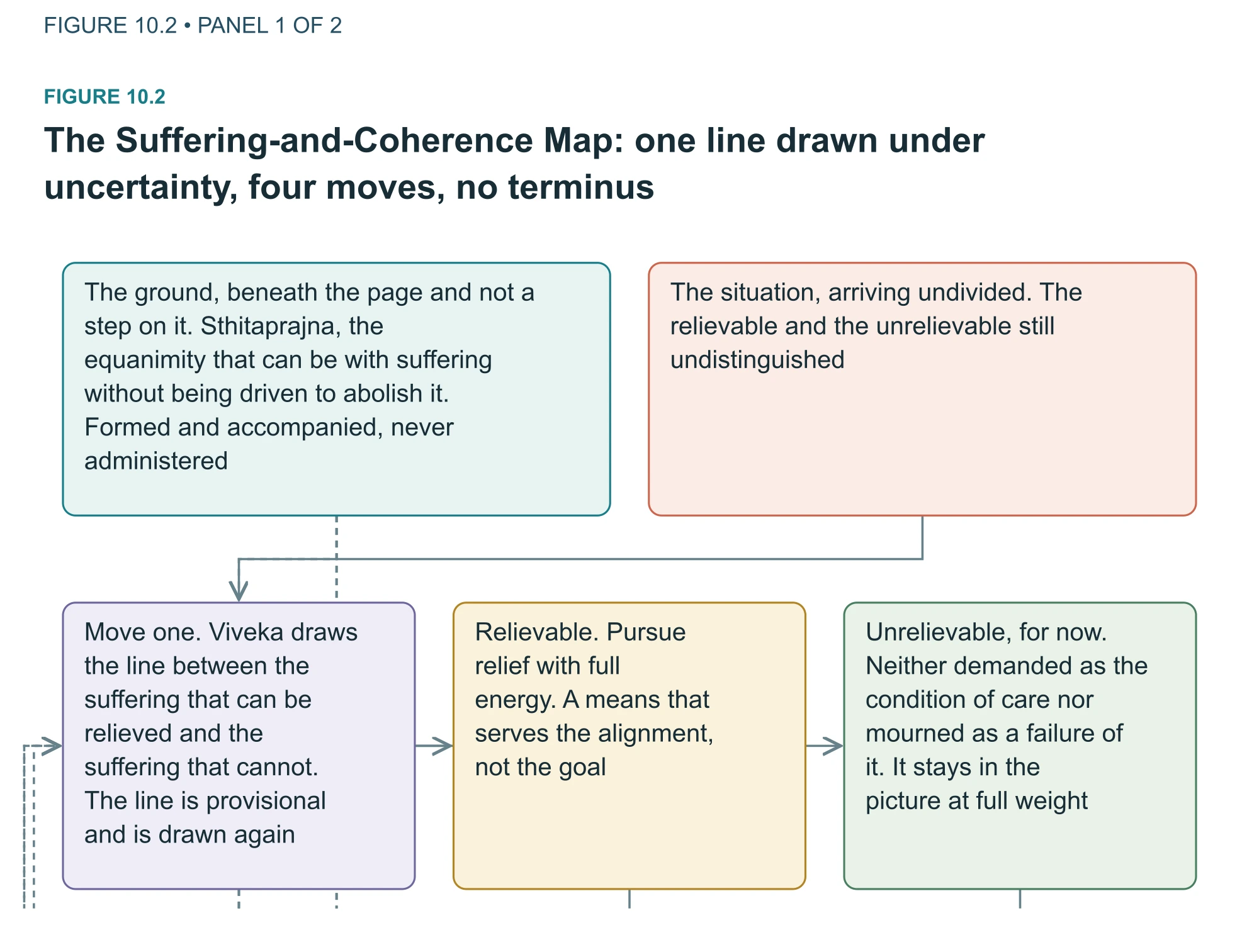
Figure 10.2. The Suffering-and-Coherence Map: one line drawn under uncertainty, four moves, no terminus. Panel 1 of 2.
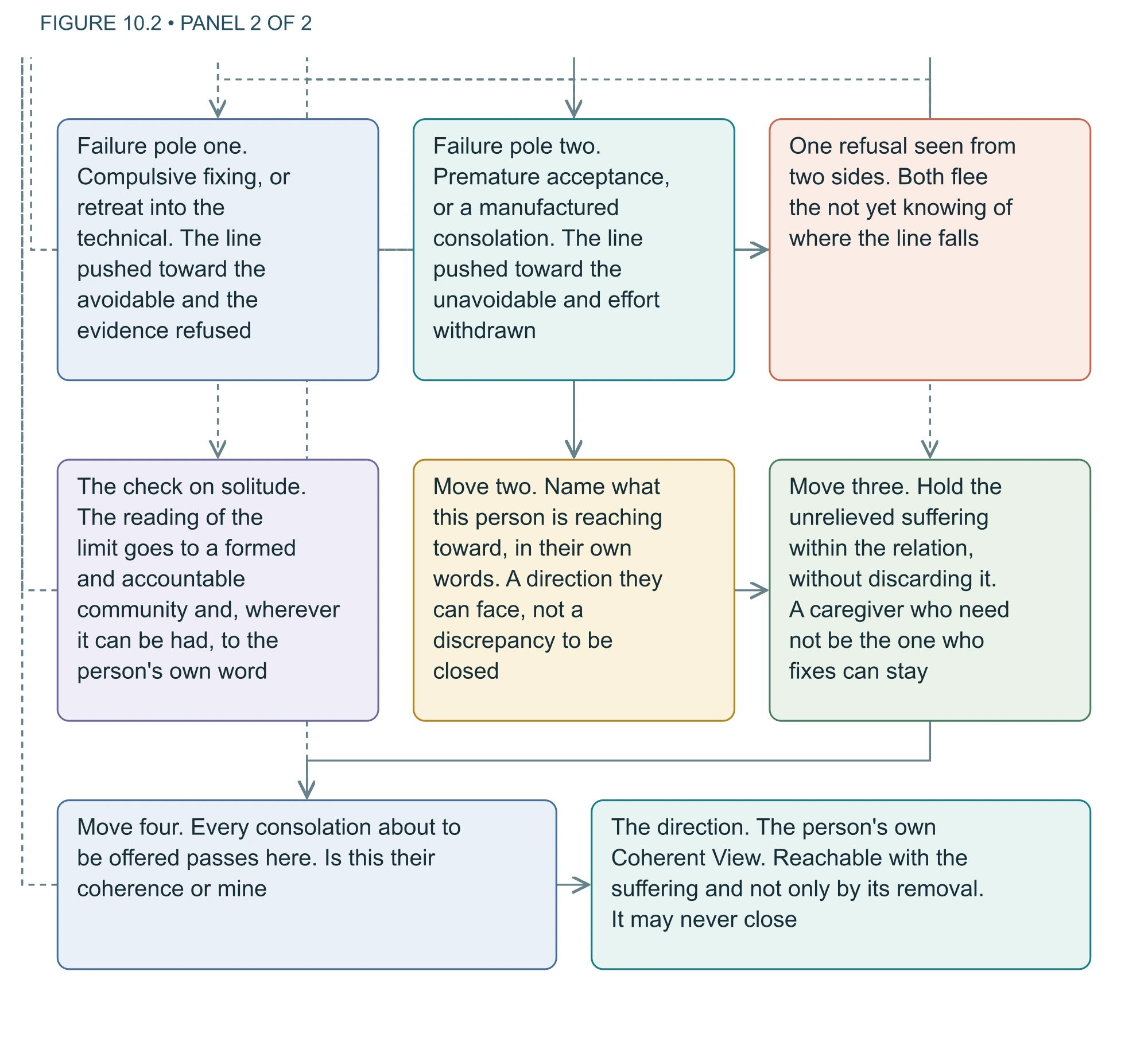
Figure 10.2. The Suffering-and-Coherence Map: one line drawn under uncertainty, four moves, no terminus. Panel 2 of 2.
5. Western interlocutors
The interlocutors named in §1 can now be engaged in their own right and set, one by one, against the Dharmic resources of §6 - which supply the two things the meaning-restoration paradigm structurally lacks: an account of the self that suffers, and a disposition that can be with a suffering it cannot abolish.
Cassell (1982) is the indispensable point of departure. His thesis that suffering is not pain - that suffering is the distress of a whole person whose intactness is threatened, a state medicine trained to abolish pain is structurally apt to miss and sometimes to inflict - is inherited by the Integrative without reservation; it is the very premise that makes the care of suffering irreducible to symptom management. The differentia is in the remedy. Cassell's response to the threat to personhood is to repair the threatened intactness; but a great part of refractory suffering arises from threats to intactness that cannot be reversed - the body that will not recover, the loss that will not be undone. The Integrative question begins exactly where Cassell's frame closes: not how the threatened intactness is restored, but how a person may be related toward coherence with an intactness that will not return. The clinical literature that codifies Cassell's insight as 'spiritual distress' - the 'impaired ability to experience and integrate meaning and purpose in life', with its markers of 'hopelessness, anger towards God, and inability to pray or practice' (Kuebler et al. 2005, in Erşahin 2021) - inherits both the insight and the limit: it can name the distress but, reading it as a deficit, has no account of care once the deficit will not close.
Saunders' concept of total pain - physical, psychological, social and spiritual distress woven into a single experience - is the founding insight of modern hospice and is retained here without qualification (Saunders 1988). But total pain names the object of care; it does not by itself supply the disposition of the carer at the point where the total pain cannot be relieved. The Integrative adds what the concept presupposes but leaves unstated: the formed steadiness (K4, §4) that lets a caregiver remain present to total pain rather than flee it into sedation or referral.
Frankl (1959) is the pivotal near-match and earns the fullest hearing. The will to meaning as the human being's primary motivation, the 'tragic optimism' that finds a stance toward unavoidable suffering, the claim that suffering 'ceases to be suffering at the moment it finds a meaning' - this is the deepest statement of the case that meaning can bear what relief cannot reach, and the Integrative keeps its core: a person aligned toward what they can affirm suffers differently from one who is not. Yet the very formula that makes meaning the condition of relief lays a demand upon the sufferer. If suffering ceases to be suffering only when meaning is found, the suffering that finds no meaning is left doubly bereft - unrelieved, and now also failed. The Integrative declines to make the finding of meaning the price of care: alignment toward a Coherent View may include the recognition that some suffering is not for solving (§3), a recognition Frankl's frame can register only as meaning not-yet-found.
Park (2010) gives the paradigm its most precise psychology. On the meaning-making model, distress is a measurable discrepancy between a person's global meaning and the situational appraisal of a particular event, which the person labours to reduce by assimilating the event to the global frame or by accommodating the frame to the event. As description this is exact and the chapter relies on it. As a norm of care, however, it installs discrepancy-reduction as the goal, and so cannot of itself distinguish the discrepancy that ought to be closed from the one that ought to be borne. The viveka of §2 and §6 - the discernment of the avoidable from the unavoidable (heyaṃ duḥkham anāgatam, YS 2.16) - is precisely the judgement Park's model presupposes a carer to have but does not contain.
Damberg Nissen, Viftrup and Hvidt (2021) give the meaning-restoration paradigm its most developed clinical form, and because §1 met them as the paradigm's explicit mechanism they must now be met in their own right. Their achievement is to refuse the very fragmentation this chapter's §2 diagnoses: against a field in which spiritual care has been built as 'stand-alone instruments... questionnaires or interview guides assessing spiritual needs' that 'do not approach spiritual care as an ongoing and integrated part of patientcare', they set out spiritual care as a single process of 'organically linked phases' - the identification of needs and resources, the understanding of the patient through the Meaning-Making Matrix, the developing of an individual treatment plan, the provision of care, and the evaluation that loops back to the earlier phases (Damberg Nissen, Viftrup & Hvidt 2021). The Matrix itself, set within a model of the patient's unique 'ontological grounding', arrays meaning-making across Knowing, Doing and Being and across the secular, spiritual and religious, so that the caregiver may 'gage from which perspectives and to what degree the existential meaning-making of the individual patient has collapsed'. Two of its concessions bring it strikingly close to the Integrative. It grants that 'spiritual needs are always individual' and that how care is given 'depends... on the relationship between patient and provider', and it grants that the patient's ontological grounding is 'unique', that 'we do not have access to the "inner life" of each other', and that approaching it 'is not easily put into formulae or practice'. This is the paradigm at its most self-aware: it knows that the relationship it needs and the interiority it addresses exceed any instrument.
The residue is that the process cannot pay for the concessions it makes, and the shape of its failure is instructive on two joints the chapter has already drawn. The first is the terminus. The process is defined by its direction of travel - from a collapse of meaning identified at phase one to a provision evaluated at phase five, the whole ordered 'to help the individual human being through crisis' - so that its success is the crisis passed and the meaning re-secured. Where the crisis does not pass and the collapse will not reverse, the loop from evaluation back to the earlier phases can only re-run the assessment; the model has, on its own terms, no phase for a suffering that is not en route to resolution, and the sufferer whose meaning will not rebuild is returned, as before, as a plan that failed at phase five. The Integrative question opens exactly here: alignment toward a Coherent View is ongoing and has no phase five (§3; Chapter 4), which is what lets it stay where the process must close. The second joint is the fate of the relationship the model concedes it depends upon. Having granted that care 'depends... on the relationship' and that the inner life is inaccessible, the model can nonetheless carry the relationship only as a 'force field' of barriers and facilitators around the phases - a condition acknowledged but never made the medium of the work, because the apparatus that does the work is, of necessity, a matrix and a plan. The relationship is named as indispensable and then handed to an instrument that cannot hold it: precisely the K3 gesture §4 marked, the process model reaching toward the person's own standpoint and unable to secure it. What it lacks is not sophistication - it is the most developed instrument the field has - but a disposition: the formed steadiness (K4, §4) by which a caregiver can be with the collapse the Matrix stages as the thing to be reversed, the sthitaprajña (§6) whose presence is not a phase in a plan but a way of standing that the plan presupposes and cannot manufacture. The Matrix locates and grades; the Dharmic resources of §6 supply the self that can remain when there is nothing left to locate.
Pargament (1997, 2007) supplies the interlocutor the chapter most conspicuously owed - the field's dominant empirical psychology of how people actually cope with suffering when the sacred is in play - and he is engaged here in his own right for the first time, having until now been flagged only for the assessment chapter (Chapter 6). His achievement is to have made religious and spiritual coping a rigorous, measurable construct rather than a pious hope. Religion and spirituality, on his account, are a 'search for significance in ways related to the sacred' (Pargament 1997), and coping with adversity proceeds along two great pathways: conservation, which works to preserve a significance the suffering has threatened (through, for example, benevolent religious reappraisal, or collaborative religious coping with a divine partner), and transformation, which changes the significance itself when it can no longer be held (religious conversion, forgiveness, the re-centring of one's ultimate concern). The RCOPE inventory codified these into positive and negative patterns whose differential effects on adjustment are among the most replicated findings in the psychology of religion. Crucially for a chapter on the limits of care, Pargament (2007) then named the phenomenon the meaning-restoration paradigm has no vocabulary for: spiritual struggle - the divine struggle of anger at or abandonment by God, the interpersonal struggle with a faith community, and the intrapersonal struggle of doubt - and showed it to be not a mere symptom to be cleared but a fork in the road, empirically predicting both growth and decline. This is the evidential ground beneath the very markers the chapter has quoted twice from the clinical literature: 'hopelessness, anger towards God, and inability to pray or practice' (Kuebler et al. 2005, in Erşahin 2021) are, in Pargament's terms, the signature of divine and intrapersonal struggle, and the Integrative gains from him a name and a warrant for treating them as a crossroads rather than a deficit.
The differentia is nonetheless exact, and it falls on the axis the whole chapter has drawn. Coping, however sophisticated, is defined by its function: it is measured by the adjustment it secures, and its two pathways both terminate in a restored significance - the sacred either conserved or transformed. It is therefore the meaning-restoration paradigm given its most refined religious form, and it inherits the paradigm's limit at exactly the point this chapter is about: where significance can be neither conserved nor transformed - where the person can neither get their old faith back nor find a new one - coping has, on its own terms, failed, and the sufferer in unresolved spiritual struggle is returned to the deficit-reading §2 diagnosed. Two further seams confirm the placement. First, Pargament's own clinical programme is spiritually integrated psychotherapy (2007) - the integration of the sacred into the work of therapy, a summation of the spiritual dimension with the clinical - and the Integrative's lexical distinction bites here at the level of the name: to integrate the sacred into treatment is precisely the additive move the Integrative is not (Chapter 4, integral-not-Integrative). Second, and most tellingly, spiritual struggle is framed as a problem-state whose health is its resolution toward one of the two termini; but the Integrative does not require the struggle to resolve. Alignment toward the cared-for's Coherent View can hold an unresolved struggle - the anger at God left unreconciled, the doubt unclosed - as one of the aspects related, 'without discarding' it (Chapter 4), rather than as a coping process that has stalled. Here Pargament meets the §6 resources with unusual directness: his negative spiritual struggle is the indigenous 'second arrow', the duḥkha that the grasping self adds to the duḥkha that simply is, which the caturvyūha's viveka discerns and the sthitaprajña can be with without being driven to abolish; and his two coping pathways, read through the Kaṭha Upaniṣad, are alignments toward preyas - the restoration of a significance that consoles - where the harder alignment toward śreyas may leave the struggle standing because what it faces is truer than the comfort it declines.
Kearney (2000) is the interlocutor closest to the Integrative move, and the alliance deserves to be stated as warmly as the differentiae. His distinction of healing from curing, and his concept of soul pain - the pain of a person out of touch with their own depth - already locate care beyond the abolition of symptoms, and already grant that one may be healed without being cured. The Integrative reads Kearney as a fellow-traveller who has reached the threshold of the alignment move; what it adds is the apparatus - the 4H discernment, the K1-K4 ascent, the formed disposition of §4 - that turns his hard-won clinical wisdom into something transmissible rather than charismatic.
Kübler-Ross (1969) is engaged most cautiously. Her achievement - naming the inner movement of the dying and insisting it be attended to rather than managed away - is permanent. The risk, widely noted since, is the reading of her five moments as a required sequence whose terminus is 'acceptance'. The Integrative declines the terminus: alignment toward the Coherent View is ongoing and need not close, which is exactly what lets it remain with the person whose grief does not resolve on schedule (§3) without filing their unfinished sorrow as a stage not yet reached.
Frank (1995) brings the one register the theorists so far have left unspoken: not a theory of what suffering is, nor of how meaning restores it, but an account of what the sufferer does with it in the telling. His The Wounded Storyteller reads serious illness as a demand upon narrative - the ill person set the task of reassembling a life-story that disease has interrupted - and sorts the stories the ill actually tell into three types. The restitution narrative ('yesterday I was healthy, today I am sick, tomorrow I shall be healthy again') is the story medicine prefers and the culture rewards; the quest narrative accepts the illness and sets out to find in it a journey from which something is brought back, the sufferer remade into one who has learned. Between and beneath them lies the chaos narrative - the anti-narrative of a life that has lost its sequence, the story that cannot be told because the teller is still inside the undoing, its grammar the flat 'and then and then and then' of a present without a horizon. Frank's ethical demand is that this third story, the hardest to hear and the one listeners most want to hurry past, be honoured and heard rather than corrected into one of the other two; and that the ill person is not a patient reporting symptoms but a witness whose testimony has a claim on us, a teacher in what he calls the pedagogy of suffering.
Little of this the Integrative would revise, and much of it converges with the chapter's own commitments so closely that Frank belongs among its nearest allies. The chaos narrative is the refractory suffering this chapter exists to keep in view, described from the inside: the body that will not recover and the loss that will not be undone (§3), rendered as the story that will not resolve into a plot. Frank's refusal to privilege the redemptive quest is the narrative form of the chapter's own refusal to make the finding of meaning the price of care (the Frankl differentia, above): the demand that the sufferer produce a quest - an illness redeemed by the gift it yields - is the meaning-restoration paradigm (§1) transposed into the key of story, and Frank names and resists it in his own terms. And his insistence that the ill person is the authority on their own telling meets, almost exactly, the sovereignty of the cared-for's own word that the assessment chapter defends (śabda, Ch 6 §6): the story is theirs to tell, and the listener's task is to receive it, not to re-author it.
The differentiae are two, and both fall on axes the chapter has already drawn. The first is the telos. What Frank's wounded storyteller reclaims is a voice - narrative agency recovered, the capacity to bear witness restored to a person whom illness and medicine had reduced to the object of others' stories. This is a real good and the Integrative keeps it; but a recovered voice is still the voice of one teller, and the Coherent View toward which Integrative care aligns is a coherence among all observers of the sufferer's context (Chapter 4) - the sufferer's world related, with them, among all who attend it, not the sufferer's own story reclaimed for the sufferer's own telling alone. Frank reaches the recovery of the first-person testimony; the Integrative moves from there to the alignment of that testimony with the perspectives around it, discarding none. The second differentia is subtler and turns on how the chaos narrative is characterised. For Frank the chaos story is defined by a lack - it is the anti-narrative, the absence of the sequence and horizon that make a story a story - so that even when honoured it is honoured as a privation, a not-yet-narratable void awaiting the return of narrative order. The Integrative reads the same refractory suffering not privatively but as a direction: what looks, on the narrative axis, like a story that has lost its plot is, on the axis of alignment, a person facing the void with an intent toward coherence that no restored plot is needed to vindicate (Chapter 4, a direction and not a quantity; cf. the measurement point below). Coherence here is not the recovered arc of a tellable life but the orientation of a self that can stand within the untellable - which is why the chapter can be with the chaos narrative without waiting for it to become a quest.
Here Frank meets the §6 resources at the very word on which he builds. His wounded storyteller is a witness, and the witnessing is the sufferer's: the ill person testifies. The Dharmic resource brings alongside a second and answering sense of the same word - the sākṣī, the witness-consciousness (§6; Ch 7 §6) that the caregiver is disciplined to become, the de-centred awareness that can receive the chaos narrative without being drawn into its undoing or driven to repair it. Frank's witness is the one who suffers and tells; the sthitaprajña is the one who is present and holds. The two witnesses are the two poles of the encounter the chapter is about, and reading them together names what Frank's account, resting wholly on the sufferer's side, leaves for its listener to supply: the formed steadiness (K4, §4) by which the chaos narrative can be heard to the end.
Beneath all nine theorists of suffering lies a voice of a different order - not another account of suffering but the empirical research programme that gives the whole field its licence to be in the clinic at all. Over the fifteen years to 2013 the study of 'spirituality, religion and health' consolidated from what had been called an 'emerging research field' into a vast and still-accelerating literature; Lucchetti and Lucchetti's (2014) bibliometric survey counts more than twelve thousand PubMed articles carrying 'spiritual*' or 'religio*' in the years 2009-2013 alone - an output they set beside 'bipolar' and well above 'meditation' or 'anger' - dispersed across palliative care, psychiatry, nursing and the highest-impact general journals. It is this body of evidence, the demonstrated correlations between religious or spiritual involvement and better mental- and physical-health outcomes, that the meaning-restoration paradigm invokes when it claims that attending to the spiritual is not a courtesy but a clinical necessity - the very warrant Erşahin (2021) reports in §1. The Integrative does not dispute the finding. A great deal of suffering is in fact eased by the resources the field measures, and to deny it would be to repeat, in reverse, the deficit-blindness this chapter diagnoses. What the Integrative reads is the shape of the warrant - and here the survey records, against its own field, the observation that turns the evidence back upon the paradigm.
For the measures are compromised at exactly the seam this chapter runs along. Relaying Koenig's (2008) methodological warning, Lucchetti and Lucchetti note that 'spirituality measures are heavily contaminated with questions assessing positive character traits or mental health (optimism, forgiveness, gratitude, meaning and purpose in life, peacefulness, harmony, and general well-being)', so that 'their results should be considered with caution' (Koenig 2008, in Lucchetti & Lucchetti 2014). The consequence is decisive for a chapter on the limits of care. If 'spirituality' is operationalised partly as meaning, peace and well-being, then the instrument that certifies spirituality's benefit has built the wanted outcome into its measure of the thing supposed to produce it: the well-being it 'finds' is in part the well-being it has already counted as spirituality. This circle is not merely a statistical embarrassment - the confound-and-conflation charge the survey catalogues from the field's own critics (Sloan, Bagiella & Powell 1999) - it is the deficit-removal norm of §2 installed at the level of measurement. And it inherits the paradigm's limit at precisely the point the chapter is about. The person in refractory suffering - whose meaning has thinned, whose peace has gone, who is at war with God (Pargament's negative struggle, above) - scores low on a spirituality so defined, not because their spiritual life has failed but because the scale was built to read spirituality off the very positive states that suffering has stripped away. The sufferer the chapter exists to keep in view is the one the measure is constructed to lose. Alignment toward a Coherent View that can hold unrelieved suffering 'without discarding' it (Chapter 4) is, on such an instrument, not a low score but no score - an unregistered quantity, because it is not a quantity at all but a direction (Chapter 4): the scale sums states, and cannot record the direction a person faces with the void still in view. So the field's own most rigorous self-criticism arrives, independently and from the opposite methodological pole, at this chapter's differentia - measured, outcome-defined spirituality is the meaning-restoration paradigm rendered as a variable, and it cannot see the care of the suffering that does not resolve. It is, moreover, the Western-methodological echo of the Yogic premise of §6 (duḥkham eva sarvaṃ vivekinaḥ, YS 2.15): a scale contaminated with well-being cannot register the discerning sufferer who sees truly and finds no silver lining, and reads that clarity as a deficit of spirit.
None of this licenses a retreat from evidence. The Integrative keeps the empirical programme for the work it genuinely does - locating where spiritual resources relieve what can be relieved, which is the first move of the §7 Map and the whole of what §2 calls the avoidable. What it declines is the inference from 'unmeasured' to 'absent': the settled equanimity that can be with suffering (the K4 disposition of §4, the sthitaprajña of §6) leaves little trace on a well-being scale precisely because it is not a state the scale was built to see, and its near-invisibility to the instrument is a fact about the instrument, not about the care.
Across all ten interlocutors, and across the clinical distress literature that systematises them, the missing term is the same - a self that can stand within suffering without being defined by the deficit it represents. That self, and the discipline that forms it, is what the Dharmic resources bring alongside.
6. Dharmic resources, alongside
Indian philosophy begins where this chapter begins - with duḥkha - and so meets the domain not as an exotic supplement but as a tradition that took suffering for its first datum. The resources are brought as deepening, transliterated and glossed, never as authority asserted.
The honest starting point is duḥkha itself. Patañjali's pariṇāma-tāpa-saṃskāra-duḥkhaiḥ... duḥkham eva sarvaṃ vivekinaḥ (YS 2.15) - 'to the discerning, all is suffering' - names its three registers: the pain of change (pariṇāma), the anxiety that shadows even satisfied craving (tāpa), and the deep grooves of habit (saṃskāra). Far from morbid, this is the refusal of the paradigm's optimism-by-default; it does not require the sufferer to locate a silver lining before care can begin. Where the meaning-restoration model treats distress as the disturbance of a normally meaningful life, the Yogic premise is that unexamined existence is already shot through with duḥkha - so that the sufferer who can find no redeeming meaning is not failing at a task but seeing something true. This is the deepest ground of the §3 refusal to make restored meaning the condition of care.
The caturvyūha (YS 2.16-26) then supplies a soteriology of suffering, not merely a problem-solving template later applied to it (Note 1; Philosophy of the Integrative (Bindlish 2026)). heyaṃ duḥkham anāgatam (YS 2.16) - it is the avoidable, yet-to-come suffering that is to be averted, not pain as such. The array thereby distinguishes the suffering that compounds - the 'second arrow' of false identification, the duḥkha added to duḥkha by the grasping 'I' - from the suffering that simply is; and this is the indigenous form of the avoidable-from-unavoidable discernment that §2 made the first of the means. The Buddhist Four Noble Truths - dukkha, samudaya, nirodha, magga - are the better-known structural parallel and are noted as such, but the lead resource here remains Yogic, per the author's apparatus (Philosophy of the Integrative (Bindlish 2026), which reconstructs the 4H framework from the same caturvyūha).
The account of the self that suffers - the term §5 found missing in every Western interlocutor - comes from the Bhagavadgītā. It opens in existential collapse: Arjuna's viṣāda (BG 1), the paradigm case of a meaning-system that has failed at the very moment of decision. The answer is not to remove the battlefield but to reconstitute the self that must meet it. samatvaṃ yoga ucyate (BG 2.48) - equanimity is what is called yoga; duḥkheṣv anudvigna-manāḥ... sthita-prajña (BG 2.54-72, esp. 2.56) - the one of steady wisdom, unshaken in sorrows, neither grasping after relief nor crushed by its absence. This sthitaprajña is the K4 disposition named in §4: not a content the sufferer or the caregiver acquires, but a transformation in the knower - formed (Chapter 5) and accompanied (Chapter 7), never administered.
Two further resources guard the move against its characteristic distortions. The Kaṭha Upaniṣad's distinction of śreyas from preyas (Kaṭha Up 1.2.1-2) - the good from the merely pleasant - guards against collapsing meaning into comfort, and so against the consolation that soothes by discarding the truth of the situation; an alignment toward śreyas may be harder to bear than the preyas it declines, which is precisely why it can hold a suffering the consolation cannot. And the Sāṃkhya duḥkha-traya - the threefold map of suffering as ādhyātmika (arising within the person), ādhibhautika (from other beings) and ādhidaivika (from the world or the transpersonal) - offers a richer topology than the single axis of distress-screening, and one that locates suffering relationally rather than only inside the individual, so that its care is never reducible to the repair of a private meaning-system (Table 10.1).
The resources gathered so far answer the how of care and name the self that suffers, but they leave unanswered one question the whole chapter has circled: the meaning the paradigm labours to restore, and the coherence the Integrative aligns toward, are a meaning and a coherence of what? Every Western interlocutor names the good that suffering has disturbed and leaves its content open. Frankl's (1959) will to meaning does not say what the meaning is a meaning of; Park's (2010) global meaning is a frame whose content is whatever the person happens to hold; the meaning-restoration paradigm sets out to rebuild a significance it never specifies. The placeholder is exactly the one the Integrative's own account of wisdom found in that field, where every channel declared wisdom to be for a well-being none would name (Philosophy of the Integrative (Bindlish 2026)); and it is filled here as it was filled there, by the second principle of the Integrative Paradigm.
Principle 2 holds that a life is well lived by the holistic attainment of four goals held together - Dharma (righteousness), Artha (the means of prosperity), Kāma (worldly desire) and Mokṣa (liberation) - which secure at once abhyudaya, worldly flourishing, and niḥśreyasa, the higher good or meaningfulness (Chapter 4, Principle 2). The classical statement of the pairing is Kaṇāda's: yato 'bhyudaya-niḥśreyasa-siddhiḥ sa dharmaḥ (Vaiśeṣika Sūtra 1.1.2) - that from which the accomplishment of both worldly flourishing and the highest good follows is Dharma. The meaning the Western channel gestures at is, on this account, not a single restorable content but a four-fold good; and niḥśreyasa - the very word the tradition uses for the higher good - is meaningfulness named as one of the goals a life is to attain, not a private significance the sufferer must manufacture on pain of being failed.
This gives the chapter's central differentia its missing half. Section 3 drew the line at the level of form: meaning-restoration produces meaning to fill a void (a summation of content), where the Integrative aligns the person toward a Coherent View (a direction). Principle 2 supplies the content of that direction, and in doing so shows why the alignment can hold a suffering the restoration cannot. For the good the person is related toward is not a quantity of meaning to be recovered but a four-fold goal to be reordered: when Artha and Kāma are stripped by an illness that will not lift - the body that will not recover, the loss that will not be undone (§3) - the puruṣārtha is not thereby cancelled but re-weighted, its centre of gravity shifting toward the niḥśreyasa and Mokṣa that a failing body cannot take away. The chapter on the end of life names this exactly: flourishing reordered under the pressure of dying rather than abandoned, the puruṣārtha held open so that a Coherent View need not purchase peace by discarding the person's worldly attachments (Ch 13). The sufferer whose meaning 'will not rebuild' (§1) is, on the meaning-restoration reading, a task that has failed; on the Integrative reading they are a person whose good is being re-proportioned across its four dimensions, and care's work is to relate them toward the whole of that good rather than to reinstate the one dimension the suffering has closed.
The characteristic failure Principle 2 guards against is the same summation §2 diagnosed, now at the level of the end itself. To read the meaningful life as a maximised Artha - the recovery-and-return the restitution narrative demands (Frank 1995, §5) - is summation at the level of the goal; but so, and more insidiously in a care setting, is its pious inversion: a spiritualised Mokṣa that discards the worldly three, the consolation that hurries the sufferer past their unhealed body and unfinished attachments toward a 'higher' acceptance they have not reached. Both buy a single goal by discarding the rest, and both are refused by the word holistic in Principle 2's own statement. Wise care holds the four together without collapsing them to one, which is why it can neither demand recovery (the Artha-only error) nor prescribe transcendence (the Mokṣa-only error), but relates the person toward a Coherent View of their whole good - guarding, at the level of the goal, the same non-imposition the §7 Map guards at the level of the offered consolation.
So Principle 2 answers the question the chapter has kept open - meaning toward what? - as the duḥkha-traya answered suffering of what kind? and the sthitaprajña answered held by what disposition? It names the content of the good the meaning-restoration paradigm reaches for and cannot specify, and it does so without making that content a doctrine the caregiver installs, for the four goals are the person's own to attain and to re-weight, never the caregiver's to assign.
One principle named at the chapter's outset remains to be drawn, and the domain of the limit is the place to draw it. Principle 3 holds that our actions follow embodied knowing - that the integral view on action 'requires the amalgamation of gyaan (knowledge), karma (action), bhakti (dedication)', a performing of one's duty, abandoning attachment, equipoised in success and failure (Chapter 4, Principle 3; samatvaṃ yoga ucyate, BG 2.48, and yogaḥ karmasu kauśalam, 'yoga is skill in action', BG 2.50). Chapter 7 (§6) observed that this principle is everywhere at work in how accompaniment is done and nowhere drawn as such, and left it to the chapter on the limits of care to name, on the reasoning that embodied knowing shows itself for what it is precisely where explicit knowing runs out - where nothing can be fixed, no meaning restored, and no next technique remains. It is at that limit that the caregiver's action must still follow something, and the something is not a further plan but a formed, tacit, dedicated knowing-in-the-doing: the gyaan that has become karma under bhakti, so that the caregiver knows how to remain, how to receive, how to be with, without first working out what to do.
The nearest Western statement of a knowing that survives the exhaustion of the explicit comes from within care itself. Pia Kontos's account of embodied selfhood, developed from Merleau-Ponty's lived body and Bourdieu's habitus against the cognitivist grain of dementia care, holds that selfhood is not extinguished when memory and reason fail but persists in the pre-reflective, habituated body - in the gesture that still reaches for dignity, the hand that still meets a hand, the bodily grace that no loss of narrative erases (Kontos 2004; 2005). No Western source names more exactly the datum the limit forces on this chapter: that there is a knowing which remains when there is nothing left to know, borne in the body and not in the discursive mind, and that it is a knowing worthy of the name and not a mere residue. Kontos's contribution is taken whole. It warrants treating the person at the far limit - the one who can no longer tell their story or follow an argument - as a knower still, addressed in the body they still inhabit; and it warrants treating the caregiver's own tacit, formed craft, the indwelling Polanyi named in §4, as real knowledge rather than the soft remainder left when protocol is subtracted.
The differentia falls on two axes, and both turn on what the embodied knowing is for. The first is direction. Kontos's embodied selfhood is a descriptive thesis: it establishes that selfhood and its knowing persist in the body, and it is content to have secured the person against the erasure cognitivism performs. It does not, and need not, say toward what the caregiver's own embodied knowing is exercised. Integrative embodied knowing is directional by constitution - it is knowledge become action under dedication, the gyaan-karma-bhakti amalgamation aimed at the cared-for's own Coherent View 'without discarding' any of their reality (Chapter 4) - so that the body's knowing is not only preserved but pointed, and the caregiver's tacit craft is a craft of relating the person toward their coherence, not a habitus reproducing itself. The second axis is the amalgamation and its surrender. Kontos's selfhood is habitus - sedimented, involuntary, laid down by a social history; the Integrative knowing is cultivated, the deliberate amalgamation of knowledge, action and dedication formed in the caregiver of Chapter 5, and it culminates in a move the descriptive frame has no place for. Principle 3 specifies that embodied knowing involves 'experiential knowing of... when to replace the thinking process with Samarpan (devotional surrendering)' (Chapter 4) - the recognition, at the very limit, that the time for figuring-out is past and that action must now proceed from a dedicated, surrendered knowing rather than a calculating one. This is the kauśala, the skill-in-action of BG 2.50, carried to the place the chapter has been describing: when relief is exhausted and meaning will not rebuild, the caregiver neither withdraws into the technical nor coerces a resolution, but acts from an embodied knowing that has already given up the demand to know - which is why the four moves of the Suffering-and-Coherence Map (§7) can be a formation made operable and not a checklist to be worked. Embodied knowing is, in the exact sense Chapter 7 promised, what the caregiver has left, and has enough, when there is nothing left to know.
Brought together, these resources answer §5's two lacks exactly, and a third question the domain forced open. The duḥkha-traya and the personhood of the Gītā supply the account of the self that suffers; the sthitaprajña supplies the disposition that can be with suffering; the caturvyūha's viveka supplies the discernment of what, in any given suffering, is to be averted and what is to be borne; the four puruṣārtha supply the content of the good toward which the whole is related; and the gyaan-karma-bhakti of embodied knowing supplies the how of the caregiver's action at the limit itself. They answer, in turn, to four of the five principles the paradigm names - Integral Unity (Principle 1), embodied knowing (Principle 3), action without doership (Principle 4), and the holistic attainment of the four life-goals (Principle 2) - and it is these, not a further technique, that the next section gathers into the chapter's named practice.
7. Models, frameworks and practices (the chapter's named contribution)
The chapter's named, reusable contribution is the Suffering-and-Coherence Map, also called the duḥkha discernment: a four-move practice for the caregiver who meets a suffering that may not resolve (Figure 10.2). It is deliberately neither a relief protocol nor an assessment instrument. It is a formation-grounded discernment, the disposition of §4 made operable, and it presupposes the steadiness it cannot itself install - the sthitaprajña equanimity (BG 2.54-72) that can be with suffering without being driven to abolish it, formed in Chapter 5 and accompanied in Chapter 7.
The four moves run as follows. The first is to discern the avoidable from the unavoidable - viveka, governed by heyaṃ duḥkham anāgatam (YS 2.16): relief is pursued with full energy wherever it can genuinely be had, and is neither demanded nor mourned as a failure of care where it cannot. The move refuses both evasions of §2 at once - it neither abandons the relievable to a premature 'acceptance', nor reads the unrelievable back as the caregiver's defeat. The second is to name what the person is reaching toward - their own Coherent View - rather than the meaning the caregiver would supply; this is the discernment of Chapter 6 carried into suffering, the listening that hears a direction the person can face rather than a discrepancy to be closed (against Park 2010). The third is to hold the unrelieved suffering within the relation, without discarding it - the accompaniment of Chapter 7, made possible by the de-centred ahaṃkāra (ego-sense) of Chapter 5, since a caregiver who need not be the one who fixes can remain at the limit without either fleeing into the technical or coercing a resolution. The fourth is to test every consolation as alignment, not imposition - to ask, of each comfort one is about to offer, whether it is their coherence or mine, guarding the non-imposition hinge of Chapter 4 §4.
What makes the Map a contribution rather than a checklist is that its differentia is built into its design. A relief protocol sums interventions until the deficit closes; the Map instead aligns the whole situation - including the part that will not close - toward the person's own coherence, 'without discarding any aspect, perspective and purpose' (Chapter 4). It is therefore directional, not additive: 'an intention to align diverse perspectives and purposes, not necessarily a summation' (Chapter 4), the integral-not-Integrative line drawn inside the care of suffering. The Map composes with the other Part II instruments - the Caregiver Formation Triad (Chapter 5), the Discernment Ladder (Chapter 6) and the Accompaniment Arc (Chapter 7) - and together the four name a single formation seen from four angles, not four separate techniques. Its appendix entry (Part II) carries a worked reflective-practice prompt that turns the four moves inward on the caregiver's own pull to console or to withdraw.
One presupposition of the design belongs here, where the design is stated, because §8 turns it into a question the Map cannot answer for itself. The four moves assume three things the Map does not supply: a formed steadiness, an accompaniment in which the unrelieved can be held, and a community to which a reading of the limit can be submitted. A professional in a formed practice has all three. A family carer making the identical discernment alone at three in the morning has none of them, and the third is the one that cannot be carried into a house - the check on solitude being the whole safeguard against a limit privately declared. The Map is therefore offered here as an instrument of a practice, and the question of whether it is available to the one doing the caring on her own behalf - and what is owed her where it is not - is asked at §8 and worked in Chapters 22 and 23. That question is not a coda to the Map. It is the same alignment-not-summation line the paragraph above draws through the care of suffering, asked once more with the caregiver inside the frame rather than holding it.
8. Applicability, cases and open question
The Map's bite is clearest where one encounter is met three ways. Case 007 (Hermine), read at first hand, is a Creole woman of Surinamese descent who 'continues to struggle with her health despite various medical treatments' and who, having 'grown up in a Christian environment', had 'due to the many setbacks in her life... put her faith in the background'. Met, first, by a meaning-restoration caregiver, she would be read as a lapsed faith to be rebuilt - the move that files her lost Christian confidence as the deficit care must repair, and her failure to recover it as care's failure. Met, second, by a relief-only caregiver who, finding that the medical treatments have not improved her health and that no cure is on offer, has nothing left to do and withdraws to the technical. Met, third - as she actually was - by an Integrative caregiver who neither restores the old faith nor prescribes a new one, but relates her toward what she herself reaches for: 'peace, connection and inner strength' through practices she chose, meditation, yoga and 'satsang' meetings which, though 'not tied to a specific religion', 'met her need'. The decisive marks are in her own words. She valued that the caregiver would 'not immediately offer solutions' and 'let me finish', so that 'I really feel heard'; the satsang became for her 'a place of healing, without religious obligations'; and by the close she could say she felt 'stronger, calmer and have more hope for the future'. Crucially, the suffering was not abolished - she continues to struggle with her health - and yet she was aligned, on her own terms, toward a coherence that could hold it. That is the differentia of §3 made concrete at the bedside: not meaning supplied to fill a void, but a direction the person can face with the void still in view.
Every Part III case chapter instances this same structure at or near the limit of relief. End-of-life (Chapter 13), mental health and moral injury (Chapter 14), grief and bereavement (Chapter 19), and crisis and trauma (Chapter 20) are each a region of suffering where the Map's discernment - relieve what can be relieved, accompany what cannot - is the governing move, and each is read in this book as an instance of the structure named here rather than a separate problem. The philosophical backstops are given in Philosophy of the Integrative (Bindlish 2026): there 'heal' and 'whole' are shown to share a root, so that healing is read as alignment toward wholeness rather than as cure, and there niṣkāma karma - action released from attachment to its fruit - is defended as licensing a care whose success is not measured by the deficit it removes. Both are stated in this book where they bear: healing-as-alignment is what the Map's second move means by accompanying what cannot be relieved (§7), and the released fruit is what §8 means by a care that is complete in its intent.
The open question is the discipline of the limit. How does the caregiver hold the limit of relief without sliding either into a premature 'acceptance' that closes down legitimate hope and relief too early, or into a compulsive fixing that denies the limit and so abandons the person to it? This is the suffering-domain form of the alignment-versus-summation tension that recurs wherever the Integrative is put to work, and that is argued at length in Philosophy of the Integrative (Bindlish 2026).
That question can now be given a worked answer of the kind its Part II siblings received (Chs 5-7 §8), deliberately partial: the discipline of the limit is not a rule that locates the limit in advance but viveka turned on the caregiver's own impulse to close the situation prematurely.
Begin with the structural point the question conceals. The two failures it names - premature 'acceptance' and compulsive fixing - are not two errors but one seen from opposite sides. Each is a refusal to remain in the uncertainty of a suffering whose relievability is not yet settled. The caregiver who pronounces 'acceptance' has judged the suffering unavoidable before the discernment is complete, and withdraws effort that might still have relieved it; the caregiver who fixes compulsively has judged it avoidable and refuses the evidence that it is not, battering the person with interventions that have quietly become about the caregiver's own need not to have failed. Both flee the same discomfort - the not-yet-knowing of where, in this suffering, the line between heya (the avoidable) and the unavoidable actually falls. The discipline is therefore the capacity to stay at that line while it is still being drawn, pursuing relief with full energy and reading, honestly and continuously, whether it is in fact being reached.
The Western canon has a name for that capacity, engaged here as the near-ally the question calls for (Note 7): Keats's negative capability, the condition of one 'capable of being in uncertainties, mysteries, doubts, without any irritable reaching after fact and reason' (Keats 1817). The 'irritable reaching' is exactly the compulsive fixing of the first failure - the intolerance of an unresolved situation that drives a premature closure - and Keats's claim that the finest work is done by those who can forgo it is the aesthetic statement of what the caregiver at the limit must sustain. It is retained without reservation as far as it goes.
Yet negative capability, taken alone, underdetermines the care of suffering on the two axes this book always tests. First, it is a capacity for tolerating uncertainty, but it is not yet directional: it counsels staying in the doubt, but not toward what. Held without a telos it slides into the very quietism §2 warned against - a cultivated composure that tolerates a suffering it ought to be relieving, negative capability curdled into passivity. The discipline of the limit is not indifference to how the situation resolves; it is a staying-in-the-uncertainty oriented toward the person's own coherence, poised to move the instant relief becomes reachable. Second, negative capability is a solitary virtue - the poet's, the individual knower's - and so cannot of itself secure the 'among all observers' the definition requires (Chapter 4): whose reading decides that the limit has genuinely been reached? Left to the caregiver alone it becomes one more private verdict, exposed to the blind spot Chapter 6 §8 named.
The Integrative reframe supplies both the missing direction and the missing check, and does so by importing the apparatus the chapter has already built rather than adding a technique. The direction is the cared-for's Coherent View: the caregiver holds the uncertainty of the limit not for the sake of equanimity but because a premature closure either way would betray the person's own coherence - foreclosing a relief they might still reach, or imposing an endurance they have not chosen. The discernment is the first move of the Suffering-and-Coherence Map (§7), viveka governed by heyaṃ duḥkham anāgatam (YS 2.16), now turned reflexively on the caregiver: to notice, in oneself, both the reaching-to-fix and the reaching-to-close, and to hold them in suspense until the situation - not the caregiver's discomfort - discloses where the line falls. The check on solitude is the supervision of accompaniment worked in Chapter 7 §8: the judgement that a limit has been reached is submitted to a formed and accountable community and, wherever it can be had, to the cared-for's own word, so that 'the limit' is a reading answerable among all who observe the situation and not a sentence one carer passes alone (Chapter 4). And the safeguard against the caregiver's need is action without doership (Paradigm Principle 4): the carer who is not the doer holds no stake in being the one who resolves, and is thereby freed from both the fixing that serves that stake and the acceptance that relieves the strain of failing - the two failures dissolve together once the ego's investment in the outcome is set down.
So reframed, the discipline of the limit is the alignment-not-summation line drawn at its sharpest (Chapter 4): it neither sums the caregiver's interventions until the deficit closes nor accumulates composure until the suffering is 'accepted', but holds the whole unresolved situation - the relievable and the unrelievable still undistinguished - oriented toward the person's coherence until the discernment, made with others and with the person, can honestly be drawn. It stays partial by design, and the residue is the chapter's most honest admission: the line between avoidable and unavoidable suffering is frequently knowable only in retrospect, so the caregiver must act, and re-discern, under irreducible uncertainty, and will sometimes hold on too long or let go too soon. What the discipline secures is not the elimination of that error but its correction - a staying-answerable that catches the drift, where the two solitary failures, each sure it has read the limit rightly, cannot. The residual question it hands forward is whether the cared-for's own reading of the limit can be brought systematically into the caregiver's discernment without instrumentalising the person - the seam already handed from Chapters 6 and 7 to Part V (Chapters 24, 27) and to Chapter 4 §4.
A second limit is the caregiver's own - finitude, and what the literature calls compassion fatigue (Chapter 5 §2) - for which Paradigm Principle 4, action without doership, is offered not as a slogan but as the structural safeguard that lets a finite carer remain present at a need they cannot exhaust: it is precisely because the caregiver is not the doer that they can stay.
That sentence, left to stand alone, would be this chapter's own differentia turned against it. Every clause in it values the caregiver's finitude for what it does to somebody else's care - remain present, they can stay - so that the caregiver enters the chapter as a condition of the cared-for's coherence and not as an observer with a coherence of their own. That is a summation, and it is the one the definition will not license: a care arrangement that reaches a Coherent View for the cared-for at the cost of the caregiver's has not reached what this book means by care (Chapter 4; Chapter 23 §3). The chapter that draws the alignment-not-summation line at its sharpest had drawn it, in its last sentence, around everyone but the caregiver.
So the second limit is stated again, and stated whole. Non-doership is not a retention strategy. Offered as the thing that lets a caregiver stay, it sits one step from the conclusion the compassion-fatigue literature has no principled way to refuse - that if empathic engagement is the mechanism of the harm, the remedy is less of it (Chapter 23 §5.1) - and a caregiver who has heard non-doership recommended as a way of not minding will arrive at that conclusion sooner, not later. Principle 4 releases the caregiver from the fruit of the action; it does not release them from its cost, and the cost is a separate question with an answer of its own. That answer is Chapter 23's, where the caregiver's spiritual life is worked not as the maintenance that keeps a practice running but as a subject in its own right, and where the movement from Samarpan to Santulan to Sukh is offered to the caregiver on their own account - owed to them, in that chapter's own test, if they resigned tomorrow.
The Map of §7 has not yet been asked the question this book puts to every practice it offers: whether what is offered to a care recipient is available to the carer as well, and why not wherever it is not (Chapter 22 §7.5). The Map presupposes a formed steadiness, an accompaniment, and a community to which a reading of the limit can be submitted (§7; Chapter 7 §8). A daughter making the identical discernment at three in the morning - relieve what can be relieved, accompany what cannot - has none of the three, and no shift that ends in which to acquire them. She is doing this chapter's work without this chapter's conditions, and the difference is not that she is untrained. It is that the check on solitude, which is the whole safeguard against a limit privately declared, is the part of the instrument that cannot be photocopied into a home. What she is owed at that point is worked in Chapter 22, and it is mostly not a practice.
Notes
1. The Buddhist Four Noble Truths are noted as the better-known parallel, not as the source; the lead resource remains Yogic, per the author's apparatus.
2. Case provenance and anonymisation. Case 007 (Hermine) is drawn from the case archive, which follows the published case-study format for chaplaincy care (Walton and Körver 2017). Neither the archive, the institution in which the encounter took place, nor the caregiver who wrote the case is identified, here or anywhere in this book; the English-language version of the case is the one used. The names and identifying particulars here are altered for this book, and the mapping is held privately and is not stated, in either direction: a name flagged as the record's own is an instruction for finding the record, which is the opposite of what such a disclosure intends. Quoted phrases ('peace, connection and inner strength'; 'not tied to a specific religion') are verified against the source document.
3. Sections 1-2 draw directly on Erşahin (2021) and Damberg Nissen, Viftrup and Hvidt (2021). The discussions of Cassell (1982), Saunders (1988), Frankl (1959), Park (2010), Kearney (2000) and Kübler-Ross (1969) rely on their standard formulations and secondary discussion. The Dharmic references in §6 include Yogasūtra 2.15-2.26; Bhagavadgītā 1, 2.48 and 2.54-72; and Kaṭha Upaniṣad 1.2.1-2.
4. The §7 inventory. The Suffering-and-Coherence Map is the chapter's single named contribution; its four moves gather the means of §2 (the viveka of YS 2.16; the de-centred ahaṃkāra of Paradigm Principle 4) together with the cross-chapter instruments (the Caregiver Formation Triad, Ch 5; the Discernment Ladder, Ch 6; the Accompaniment Arc, Ch 7) rather than adding a fresh technique.
5. Case handling and disclosure. Case 007 (Hermine) was read at first hand (python-docx; the English-language variant, 395 paragraphs); the quoted phrases - 'continues to struggle with her health despite various medical treatments', 'put her faith in the background', 'peace, connection and inner strength', 'not tied to a specific religion', 'met her need', 'not immediately offer solutions', 'I really feel heard', 'a place of healing, without religious obligations' and 'stronger, calmer and have more hope for the future' - are verified against the source document. The third handling (the Integrative caregiver) follows the case as recorded; the first two handlings (the meaning-restoration and relief-only caregivers) are counterfactual constructions framed to isolate the differentia, not events in the record.
6. Pargament engaged in Chapter 10. Pargament's religious and spiritual coping theory (Pargament 1997, The Psychology of Religion and Coping) and the spiritual-struggle construct (Pargament 2007, Spiritually Integrated Psychotherapy) are engaged in §5 as the seventh Western interlocutor, from their standard formulations is thereby partially discharged and cross-referenced.
7. Keats's negative capability (letter to George and Thomas Keats, 21 December 1817) is engaged at standard statement as the Western near-ally for tolerating unresolved uncertainty, credited, then residued on two axes - it is non-directional (risking the quietism of §2) and solitary (not yet 'among all observers', Chapter 4) - and reframed by importing the chapter's own apparatus: the viveka of the Suffering-and-Coherence Map (§7; YS 2.16), the supervision of accompaniment (Ch 7 §8), and action without doership (Paradigm Principle 4). The answer is kept partial by design: the avoidable/unavoidable line is often knowable only in retrospect, so the discipline secures the correction of drift, not its elimination. Keats 1817 added to the bibliography; the exact printed edition and letter text to verify.
8. The empirical S/R-health programme engaged as §5's eighth interlocutor. Lucchetti & Lucchetti (2014), Spirituality, Religion, and Health: Over the Last 15 Years of Field Research (1999-2013) - already read first-hand for Chs 2 and 4 - is engaged here in Ch 10's own right as the field's empirical/bibliometric register: the outcome-evidence warrant the meaning-restoration paradigm invokes (§1), and the source of the measurement-contamination datum that turns that warrant back on the paradigm. Koenig's (2008) 'Concerns about Measuring "Spirituality" in Research' (the 'heavily contaminated' measures) is cited at second hand via the survey per the chapter's standing convention (cf. Notes 2, 5, 8), as is the earlier confound-and-conflation critique the survey catalogues (Sloan, Bagiella & Powell 1999, Lancet). Both are added to the bibliography (secondary, via Lucchetti & Lucchetti 2014); exact loci to verify. discharges the standing Chapter 3-pass obligation to capture lucchetti for Ch 10.
9. Frank engaged in Chapter 10. Arthur W. Frank's The Wounded Storyteller: Body, Illness, and Ethics (1995) is engaged in §5 as the ninth Western interlocutor and the eighth theorist of suffering - the narrative and testimony register none of the standing voices occupies - from its standard scholarly formulation. The reading turns on two differentiae (a recovered voice is one teller's, not a Coherent View among all observers; the chaos narrative characterised privatively as anti-narrative, where the Integrative reads the same suffering as a direction) and one convergence (the two senses of witness: Frank's testifying sufferer and the sākṣī of §6).
10. §6 completes its principle accounting with Principle 2. Alongside Paradigm Principles 1, 3 and 4, the question of meaning toward what brings Principle 2 (the holistic attainment of the four life-goals, Dharma / Artha / Kāma / Mokṣa securing abhyudaya and niḥśreyasa, Chapter 4) alongside, supplying the content of the 'meaning' the meaning-restoration paradigm (Frankl 1959; Park 2010; §§1, 5) names but leaves unspecified - the same placeholder Philosophy of the Integrative (Bindlish 2026) filled with Principle 2 for the 'well-being' the wisdom literature left open, and filled here the same way (Principle 2 answers toward what; there, Principle 5 answered for whom). The classical locus for the abhyudaya / niḥśreyasa pairing is Kaṇāda's yato 'bhyudaya-niḥśreyasa-siddhiḥ sa dharmaḥ (Vaiśeṣika Sūtra 1.1.2), cited by locus in the manner of the chapter's other primary Sanskrit sources (YS, BG, Kaṭha Up). The differentia is the reordering-not-restoration point: a good stripped in its Artha / Kāma dimensions is re-weighted toward niḥśreyasa / Mokṣa, not cancelled (cross-ref Ch 13, flourishing reordered under dying), and the holistic in Principle 2 refuses both the Artha-only (restitution) and the Mokṣa-only (premature transcendence) summations at the level of the goal. Principle 5 is not invoked here: this chapter turns on toward what, not for whom (cf. Chapters 4 and 26).
11. §6's principle accounting completes with Principle 3, cashing Chapter 7's forward-promise., §6's closing summary listed embodied knowing (Principle 3) among the principles the chapter's resources answer, and Note 10 recorded that '§6 previously drew on Paradigm Principles 1, 3 and 4' - yet no passage of §6 had drawn Principle 3 as such; the principle was named in the summary and implicit in the disposition-talk without being stated. Chapter 7 §6 had meanwhile observed that Principle 3 is 'everywhere at work... and nowhere yet drawn as such' and left it 'to the chapter on the limits of care... to name it'. draws it: the limit - where relief is exhausted and meaning will not rebuild - is named as the place embodied knowing shows itself for what it is, the gyaan-karma-bhakti amalgamation (Chapter 4, Principle 3) that acts when explicit knowing runs out, grounded in samatvaṃ yoga ucyate (BG 2.48) and yogaḥ karmasu kauśalam (BG 2.50) and culminating in the replacement of the thinking process with Samarpan (devotional surrender). The fresh Western near-match is Pia Kontos's embodied selfhood (Kontos 2004; 2005) - selfhood persisting in the pre-reflective habitus when cognition fails, the nearest statement of 'a knowing that remains when there is nothing left to know' - conceded whole and differentiated on two axes: direction (Kontos's is a descriptive thesis that selfhood persists; Integrative embodied knowing is knowledge-become-action toward the cared-for's Coherent View) and the amalgamation and its surrender (Kontos's habitus is sedimented and involuntary; the Integrative knowing is cultivated and issues in Samarpan, a move the descriptive frame has no place for). Polanyi's indwelling (§4) is carried alongside as the Western name for the caregiver's tacit craft; no other new source is engaged.
12. The five 'organically linked phases' (identification, understanding via the Meaning-Making Matrix, treatment plan, provision, evaluation), the Matrix's Knowing / Doing / Being by secular / spiritual / religious array set within the patient's unique 'ontological grounding' (inspired, in the source, by la Cour & Hvidt 2010), and the model's own concessions ('spiritual needs are always individual'; care 'depends... on the relationship'; the ontological grounding 'unique'; 'not easily put into formulae or practice') are quoted from the source PDF at first hand, re-using the §§1-2 extraction (no new pass). The differentia turns on two joints the chapter has already drawn - the terminus (a process from identified collapse to evaluated provision, closing where refractory suffering does not, against alignment toward a Coherent View that has no phase five) and the unpaid relationship (a dependence on relationship conceded but carried only as a barrier / facilitator 'force field', the K3 gesture §4 marked its instruments cannot secure). The two count-bearing sentences in §5 are updated accordingly (eight to nine theorists of suffering; nine to ten interlocutors).