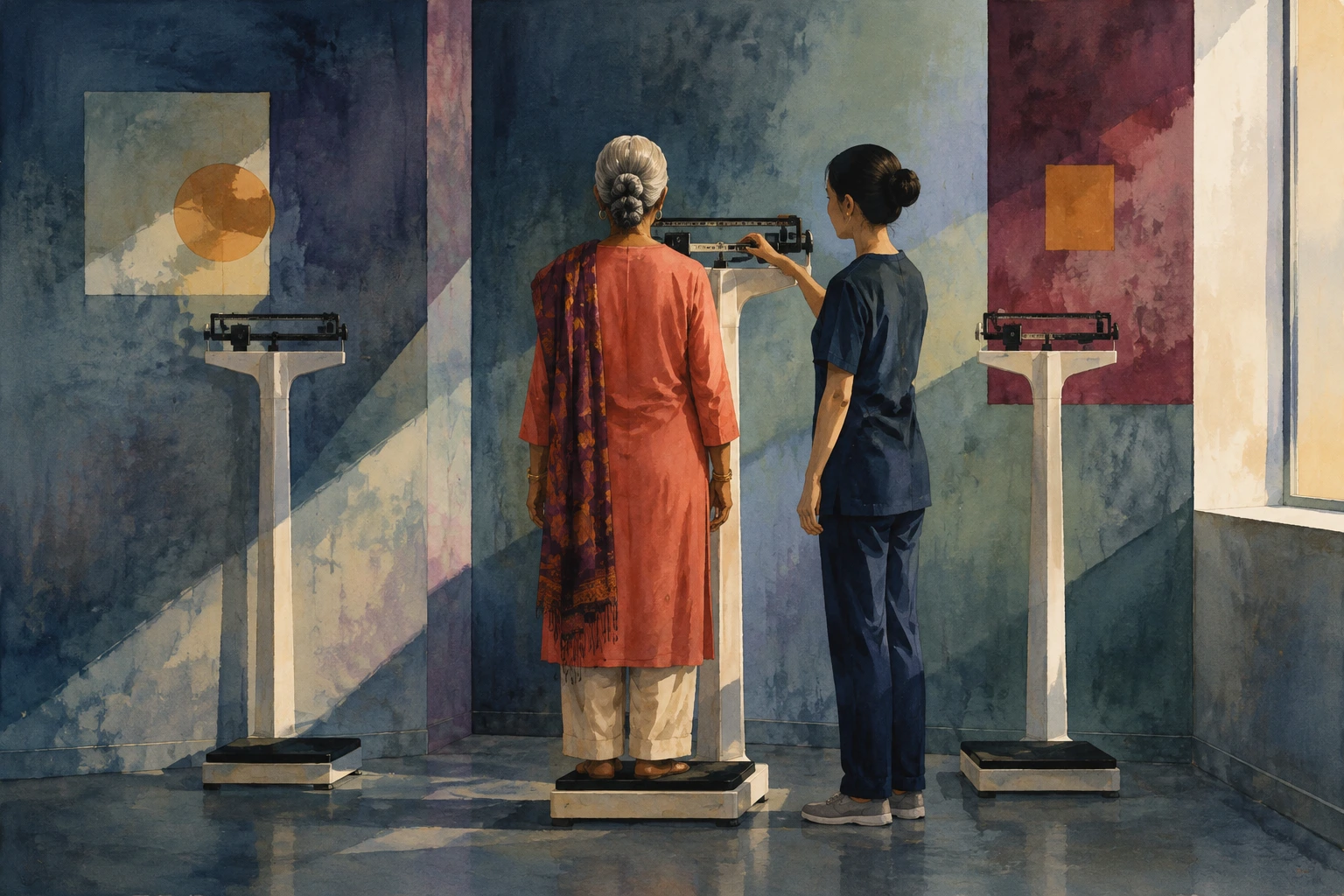
Figure 16.1. What the building can weigh.
How does a caregiver accompany a woman mourning five losses that no institution will record as a bereavement, and that she believes she has forfeited the right to mourn?
2. Case card
Case title. I have blackened my own face - a grandmother in a women's prison, mourning what she believes she gave away.
Table 16.1. Case card: I have blackened my own face.
Care context | The women's wing of a closed penitentiary institution in the Netherlands. Regime: standard closed, shared recreation, single cells, open flame and incense prohibited. |
Primary care recipient | Sumitra, 66, born and raised in Suriname; Surinamese-Hindustani; married, five adult children, nine grandchildren. Serving a sentence for carrying drugs into the country as a courier. |
Spiritual caregiver | Nirmal, Hindu spiritual caregiver in the national prison service; Surinamese-Hindustani himself; fluent in Sarnami; academically trained and traditionally schooled; endorsed by the national Hindu council. |
Other significant participants | Her husband, seriously ill in Suriname and unaware that she is in prison; five adult children, contact strained; a former son-in-law who stole her wedding gold; unit staff, the medical service and the prison psychologist; younger women on the unit. |
Tradition or worldview | Sanatana Dharma in its Surinamese-Hindustani form; daily puja, devotion to Hanuman and Krishna, household festival calendar. Religiously literate rather than textually trained. |
Presenting concern | Not eating, not sleeping, crying, no eye contact, refusing contact with other prisoners; read by staff as depression or as refusal to cooperate. Underneath: shame, moral injury, and a conviction that God is not present in a cell. |
Stage of care | First weeks after placement; five recorded sessions across roughly three months, then continuing contact. |
Central spiritual-care tension | Five large losses, none of them a death, in a person who believes she caused them and therefore has no standing to mourn them. Whether the caregiver may reframe a prison sentence as a life stage without that reframing becoming acquiescence in an injustice she has stopped feeling. |
Integrative Care Model dimensions | Bodily (exhaustion, appetite, sleep, panic), psychological (shame, self-condemnation), social (family standing, unit relationships), ethical (the offence, and the lie to her husband), existential (a role ended before she was ready to end it), spiritual (ritual impurity, felt abandonment by God, contaminated karma). |
Confidentiality note | Composite and adapted. All personal names are pseudonyms; the institution, its location and its regime details are altered; family particulars are shifted where nothing analytical depends on them. Her age is not shifted, because the case turns on it. |
3. Learning objectives
After working through this chapter, readers should be able to:
• Recognise mourning in losses that carry no death, and name why an institution organised around sentences and diagnoses will not see them.
• Apply the Integrative Care Model to a person whose bodily, social, ethical and spiritual losses arrived in a single event.
• Distinguish situational despair and moral injury from depressive disorder, and say what would change the judgement.
• Explain why language choice functions as a diagnostic instrument and not only as a practical accommodation.
• Judge when a reframing of suffering opens meaning and when it closes down a legitimate grievance.
• Identify the caregiver's limits in a total institution, and the referral and safeguarding duties that survive them.
• Reflect on how their own worldview shapes what they hear as a reason and what they hear as an excuse.
4. Key concepts
Lajja (लज्जा). Shame that attaches to a family's standing and not only to an individual's conscience. In the Surinamese-Hindustani setting it is bound up with izzat, family honour: what one member does, the household carries. Silence is one of its ordinary expressions, which is why it is so often misread as refusal.
Stridhana (स्त्रीधन). A woman's own property, most often the gold given to her at marriage. It is hers, not the household's; it is her security and her tie to her marriage. Its theft is an injury to standing, not a financial setback, and reading it as materialism loses the whole case.
Disenfranchised grief. Loss that a person's world will not acknowledge, publicly mourn or support (Doka 1989). The form this case carries is the hardest of them, because it needs no help from anybody else: the mourner disallows the grief in herself, on the ground that she caused what she has lost, and the community's verdict merely ratifies a judgement she has already passed on her own behalf. Where a loss is disenfranchised from outside, a caregiver can at least name the disenfranchising to the person. Here the naming has to be done to the mourner about herself.
Moral injury. The lasting wound of having acted, or failed to act, against one's own deepest moral commitments. It is not a symptom to be reduced but a wrong to be sorted, and the sorting is a spiritual-care task before it is a clinical one.
Pravrtti and nivrtti (प्रवृत्ति, निवृत्ति). The outward-turned path of action in the world - providing, holding, arranging - and the inward-turned path of withdrawal and release. Not better and worse, but two directions a life can face, and a tradition's account of when the facing ought to change.
Vanaprastha (वानप्रस्थ). The third of the four asramas, the life stage in which a householder loosens the duties that have defined them. Its use here is a reframing, and section 15 examines what that reframing risks.
The three gunas (गुण). Sattva (clarity), rajas (drive and agitation) and tamas (obscurity): the qualities whose proportion the Samkhya tradition uses to describe a mind's condition at a given moment. Used in this case to separate a deed from an identity without removing responsibility for it.
Seva (सेवा). Service given without expectation of return. In this case it is not an ethical instruction but the actual mechanism by which a woman stopped being someone who needed help.
Part I - Entering the case
5. Introduction to the care context
Grief is the word English reserves for the dead. The wider word is loss, and the two do not overlap as tidily as a bereavement literature built on funerals assumes. A woman of sixty-six sits in a prison interview room having lost her standing in her family, the gold that was hers and no one else's, the daily worship that had organised forty-five years of mornings, and the right to be told the truth about her dying husband, because she has told him a lie about herself. Nobody has died. Every one of those losses behaves like a bereavement: the disbelief, the returning at a fixed hour of the day to the moment it happened, the sense that a person she used to be is now somewhere she cannot reach. Her file records a sentence. It records no death, and so nothing in the institution around her is organised to notice that she is in mourning (Figure 16.2). A fifth loss is larger than the four and she will not name it for two months; section 6 comes to it.
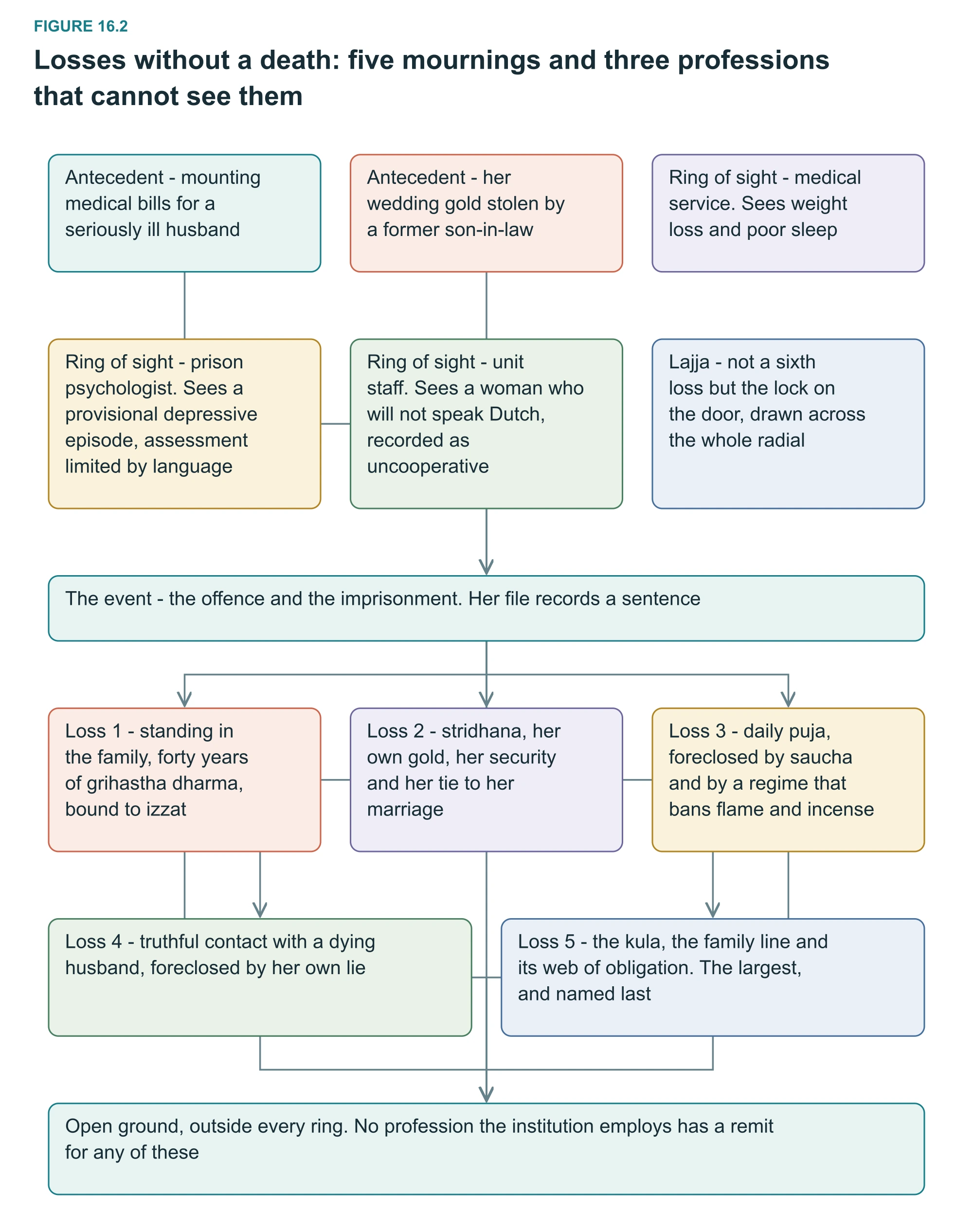
Figure 16.2. Losses without a death: five mournings and three professions that cannot see them.
This chapter therefore opens on a loss that is not a death, and only then moves to the deaths. The order is the argument. Were the chapter to begin where the field begins, the reader would learn the classical shape first and meet this case afterwards as an interesting exception. Read the other way round, the classical shape arrives as a particular case of something wider: a life dis-integrated around an absence, whether or not the absence has a grave.
The setting is a total institution in the strict sense - a place where sleeping, eating, working and recreation happen under one authority, to one schedule, in the company of the same people (Goffman 1961; standard statement, primary text not independently checked, Note 1). Two features of it matter for grief in particular. The first is that a total institution allocates care by category, and there is no category for mourning a role. The medical service can address appetite and sleep; the psychologist can address depression; social work can address contact with home. A woman grieving her own deposition as head of a family falls between all three, and what each of them can see of her - that she is not eating, that she is flat, that she will not telephone - are the symptoms of the grief rather than the grief. The second is that the institution forecloses the ordinary technology of mourning. Incense and open flame are prohibited; a prayer bead string may or may not be permitted; a funeral cannot be attended; a body cannot be washed. Bereavement care outside the walls can assume that ritual is available and ask how the mourner is using it. Inside, the first question is what is left.
Dutch prisons employ spiritual caregivers of the recognised traditions, and this case turns on the peculiar position such a caregiver holds. The Dutch term is geestelijk verzorger, spiritual caregiver, and it is the last Dutch this chapter will leave standing. He carries keys and knows the security protocols; he sits in the staff corridor and attends the multidisciplinary meeting. He is also, by professional confidentiality, outside the disciplinary line: he writes nothing that reaches the file on which release decisions are made. That double position is not a curiosity of Dutch practice. It is the exact condition under which anything in this chapter became sayable at all. A woman who has decided that every other member of staff is a person with keys will tell one of them the truth only if telling it cannot be used, and she has to be able to see that it cannot.
Two further features of the population make the case less exceptional than it looks. Women in prison are disproportionately there for offences with a relational motive - money for a household, a partner's debts, a sick relative's bills - rather than for acquisition, so that the offence itself is frequently continuous with a caring role rather than a departure from it (Slotboom, Kruttschnitt and Bijleveld 2011; standard statement, primary text not independently checked, Note 1). And older prisoners of migrant background are institutionally close to invisible: withdrawal reads as compliance, and compliance attracts no attention (Crawley and Sparks 2005; standard statement, primary text not independently checked, Note 1). A grieving older woman who goes quiet is, from the wing's point of view, a woman causing no trouble.
That is the room. What follows is the field the caregiver carries into it, and it was built somewhere else.
Three of that field's assumptions are worth naming before the case begins, because all three fail here. It assumes a death, and there has not been one. It assumes a mourner left holding a bond whose other pole has been removed - so that unlike illness (Ch 15) or suffering at the bedside (Ch 10), the cared-for is not the person whose life is failing but the one left holding the relation - and this woman is the pole that was removed: nobody has been taken out of her life, she has been taken out of theirs, and the bond she is missing runs to a household that is still going on without her. And it assumes a mourner whose right to mourn is not in question, which is the assumption this case breaks hardest, because she disenfranchises herself before anybody else gets the chance and the community's verdict merely ratifies it. What makes the case difficult is therefore not that the field has no answer for her. It is that the field has no question for her, and the institution she is in has no category, so that a woman in full mourning can pass three professional assessments and be written down as uncooperative.
6. Background
The care recipient. Sumitra is sixty-six. She was born and raised in Suriname, in a close Hindu community descended from indentured labourers brought from the Gangetic plain, and she has been in the Netherlands for less than a year. She is the mother of five adult children and the grandmother of nine. Her husband is in Suriname and is seriously ill.
For four decades her life ran on grihastha dharma (गृहस्थ धर्म), the obligations of the householder. She managed the house, organised the religious festivals, took in the grandchildren after school, and kept the household shrine. Her identity is not merely associated with the role of carer and keeper of the tradition; it is made of it. She is not a person who asks for help. She was the person help came from. The move to a cell, where she depends on strangers for food and for her medication, is therefore a loss of freedom second and a loss of standing first.
Physically she has the ordinary complaints of her age, sharpened by the strain of detention. Psychologically there is acute stress with crying, insomnia and social withdrawal - the presentation of situational despair and moral injury rather than of a psychiatric disorder, though section 13 sets out what would change that judgement. Religiously she is devout in the ordinary, unliterary way: she grew up on the Ramayana and the Mahabharata, performed puja (पूजा, ritual worship) at home every day, and is devoted to Hanuman and to Krishna. In prison she feels ashuddha (अशुद्ध, ritually impure) and therefore cut off from God. Her guilt is theological before it is legal. She believes she has accumulated bad karma that will touch not only her own next life but the welfare of her sick husband.
She speaks Dutch. Her emotional language is Sarnami, the Hindustani of the Surinamese diaspora, and under stress she falls back into it. In Dutch she becomes flat and evasive, not because she has nothing to say but because the words for her shame and her grief are not in that language for her. This has repeatedly been recorded as unwillingness to cooperate.
One fact runs underneath the whole case. Her husband does not know she is in prison.
Two losses preceded the offence and explain nothing about its legality while explaining everything about its origin. Her husband's medical bills were mounting and the family had run out of money. And shortly before, her former son-in-law had stolen all her gold, including her wedding jewellery. In this community that gold is not an investment. It is stridhana: her own property, her security, and the material tie to her marriage. Its theft was an assault on her standing. A reader who does not know this hears her account as an excuse. A reader who knows it hears where the desperation came from, which is a different thing from hearing it excused.
The spiritual caregiver. Nirmal is a Hindu spiritual caregiver employed within the national prison service. He is himself of Surinamese-Hindustani descent, speaks Sarnami fluently, and knows the unwritten rules of family hierarchy and of a shame culture from the inside rather than from a course. He is academically trained and also traditionally schooled in the Vedic texts, and he is endorsed by the national Hindu council, which is what legitimates him in Sumitra's eyes: he represents her religious community to the institution rather than the institution to her.
His position is that of a border-walker. He carries a key ring and knows the security protocols; his professional confidentiality places him outside the disciplinary line. For Sumitra he is the outside world - home, culture, religion - appearing inside a hostile inside. He is the one person in front of whom she need not hold a face, because he writes nothing that affects her release.
His stance follows the four attitudes of Yogasutra 1.33: maitri (मैत्री, goodwill), karuna (करुणा, compassion), mudita (मुदिता, gladness at another's good) and upeksha (उपेक्षा, equanimity). The last is the difficult one here. He does not judge her offence. He also does not judge the fact that she is lying to a dying man about where she is, and section 15 returns to whether he should.
He carries one exposure that the case does not resolve. The cultural fluency that makes him effective also makes him legible to her as family, and family is a role with expectations attached. Section 12 takes this up under the caregiver's use of self.
The wider circle of care. Her husband, ill, at a distance, and uninformed, so that a telephone call is not a comfort but a performance. Five adult children, contact strained by the theft and by the disgrace; the loss of the kula, the family line and its web of obligation, is the largest of her losses and the one she names last. A former son-in-law, absent from the case except as its cause. On the institutional side, the medical service, the prison psychologist, social work and the unit staff, all of whom have met a barrier and named it a language barrier. And the younger women on the unit, who at the start of the case are a category she is frightened of and by the end of it are something else entirely.
7. The presenting situation
Nobody asked for spiritual care. Sumitra did not request it, and in the Dutch system she did not have to: a spiritual caregiver may approach a prisoner without a referral, which in this case is the whole reason contact happened at all. What existed instead was a note in the unit's handover. She was not eating. She cried a great deal. She made no eye contact and would not come to recreation. She spoke almost no Dutch to staff, and the handover recorded that she seemed unreachable because of the language barrier and the grief.
Asked how she is, she says that she is fine, that everything is fine, and looks at the floor.
The institution around her has formed three readings. The medical service sees an older woman losing weight and sleeping badly. The psychologist's provisional formulation is a depressive episode, with the caveat that assessment is limited by language. The unit staff, whose job is order rather than diagnosis, see a woman who will not speak Dutch and record her as uncooperative. Each reading is defensible on the evidence in front of it. None of the three has been told about the jewellery, the debts, the husband, or the lie, and none of them is likely to be, because telling would require her to say aloud, in the language of the authorities, the sentence she cannot say in any language.
Four things are urgent. She is not eating, and she is sixty-six. She has episodes of acute anxiety, at night, about her husband. She holds the settled theological conviction that God cannot be present in the place where she is, which removes at a stroke the resource that carried her through every earlier trouble in her life. And she is carrying a secret alone, in a building where she trusts no one, in a language she has decided not to use.
The central question facing the caregiver is not what is wrong with her. It is why a woman with this much to say has stopped speaking, and whether the reason is capacity, refusal, illness or something none of the three professions watching her is set up to name.
Decision point. What should the caregiver attend to first? Four courses are open, and each has a reasonable case. He could treat the food refusal as the acute problem and work with the medical service, on the ground that a woman who does not eat will shortly not be available for anything else. He could support the psychologist's assessment and press for an interpreter, on the ground that a depressive episode in an older prisoner is a serious clinical risk and language is the removable obstacle. He could begin where chaplaincy conventionally begins, by offering the resources of her tradition - a prayer text, a service, a festival - and let her take what she wants. Or he could do something that none of the three readings suggests, and that will look, in the handover note, like nothing at all.
Hold the answer. What he in fact did takes one sentence, and the rest of the chapter is an argument about why it worked.
Part II - The care encounters
Five recorded sessions across roughly three months, and one further visit after them, are narrated in this Part, and the judgement on them is held back until Part III. All five run the same compact sequence: what the caregiver expected, what happened, what he noticed in himself, an interpretive pause, the choice in front of him, what followed, and a provisional lesson. The fifth, at section 11, runs it and then goes further: it follows the case out past the last session, and it closes on the one generalisation this Part allows itself, because what it arrives at is a habit of speech a caregiver can change on the next shift rather than a conclusion about Sumitra. The dialogue is reconstructed from the case record and translated. Where the language being spoken is itself the event, the chapter says which language it is.
8. Session one: the language of the heart
Before the encounter. Nirmal read the handover note in the corridor outside the unit, standing up, the way he read most of them. Not eating. Crying. No eye contact. Poor Dutch. He had seen the same four lines written about a dozen women and they had meant a dozen different things. He had one piece of information the note did not carry, which was her surname, and the surname told him where her grandparents had come from and roughly what her grandmother would have called her.
He expected an interview of the kind he had had many times: twenty minutes of politeness, a refusal of anything he offered, and a name on a list to come back to. He had learned not to mind that. He had also learned that the second visit went better than the first far more often than the first went well, and he had allowed himself no plan beyond turning up.
The encounter. The interview room on the women's wing had a window of reinforced glass set high in the wall, and at two in the afternoon in November the light came through it grey and without direction, so that nothing in the room cast a shadow. There were four chairs and a low table with a ring on it. Somewhere along the corridor a door was being opened and closed, opened and closed, on a mechanism that sighed each time. She was already sitting when he came in, and she did not look up.
She was small and she had made herself smaller. Her hands were in her lap and the fingers of the right hand were working at a loose thread in the seam of her sleeve, turning it and turning it. Her hair was pulled back and it had not been oiled. He noticed, because it was his business to notice, that there was nothing at her throat and nothing on her wrists and nothing in her ears, and that the holes in her ears had the stretched look of forty years of weight.
"Good afternoon, Mrs Sumitra," he said in Dutch. "I am the spiritual caregiver. How are you?"
"Good," she said, to the floor. "Everything good."
He let the silence sit. Down the corridor the door sighed twice more. She did not fill it, which told him she was not being difficult; a difficult woman fills a silence with an account of what has been done to her. She held the thread in her sleeve.
Then he said, in Sarnami: Mata-ji, ham Hindustani baat samdjhila. Mother, I understand our language.
Her head came up so fast he thought for a moment she was frightened. Her eyes were already wet.
"Oh, beta," she said. Son. "You speak my language?"
"I am here for you," he said, and stayed in Sarnami, and everything that follows was said in it. "Tell me. What is lying so heavy on your heart?"
And she broke, all at once, the way a wall gives rather than the way a tap opens.
"I have blackened my own face. I am an old woman, a grandmother, and I am sitting here among criminals. What will my children think? And my husband. He is so ill. He knows nothing."
"The shame is burning," Nirmal said. "And you feel guilty that you cannot be there for him."
"I wanted to help him." She was not looking at the floor now. "The doctors' bills. We had nothing left. And then that thief, my own son-in-law, he stole all my gold. My wedding jewellery. Everything my husband ever gave me. I was so angry. So desperate. I thought: I will do this one time, and then I will have it all back."
"That was not badness," he said. "That was desperation, and grief for what was taken from you. You wanted to repair what had been broken."
She wept for a long time after that, and he did not speak, and the door down the corridor went on sighing. When she had finished she asked him, in a practical voice, whether he would come again on a Tuesday, because Tuesday was Hanuman's day.
Inner response. Nirmal noticed relief, and then he noticed that he did not entirely trust the relief. Something had opened in eleven minutes that three professions had not opened in three weeks, and the part of him that had been trained to be careful observed that a door which opens that fast has not been unlocked so much as pushed. He also noticed something less comfortable and closer to home. When she called him beta he had felt himself accept it, immediately and without deciding to, and he was aware that he had just been handed a role in a family, and that roles in families come with obligations he might not be able to meet.
What is happening here? One sentence changed the situation, and it is worth being precise about what the sentence did, because the obvious answer is not quite right. The obvious answer is that she could not express herself in Dutch and could in Sarnami. But she speaks Dutch; she had been speaking it, minimally, for three weeks. What changed was not her vocabulary but her position. In Dutch she was a prisoner accounting for herself to an authority. In Sarnami she was an older woman speaking to a younger man, and the form of address Mata-ji did at least as much work as the language, because it restored a hierarchy in which she stood at the top. From that position she could speak without losing face, because a mother does not lose face by telling her son that she is in trouble.
Notice how fast the story came once it came. The motive, the theft, the lie to her husband: everything that weeks of formal interviews had not surfaced arrived inside a minute. That says something about her. It says considerably more about the interviews.
Notice too the exact dose of the caregiver's last intervention. That was not badness, that was desperation. This is not an acquittal. It is a statement about who she is rather than about what she did, and the difference will matter for the rest of the case.
And notice what is still unsaid. She has not asked for anything. She has not mentioned God, or prayer, or her cell. She has named her husband's illness and the bills it left, and her own offence once. What would you ask next?
Decision point. He could stay with the offence, which is where her shame is loudest and where a confession might be forming. He could go to the husband and the lie, which is the live ethical problem and the thing she has now said aloud to somebody. He could take the Tuesday she offered him and let the next move be a religious one on her terms. Or he could report to the multidisciplinary meeting that the language barrier is not what it has been taken for, and let the assessment be redone properly.
What followed. He took the Tuesday, and he also did the fourth thing, carefully. At the multidisciplinary meeting he said that in his judgement the presentation was situational and cultural rather than depressive, that he had reached her in her first language, and that he would continue. He said nothing about the jewellery, nothing about the husband, and nothing about the lie. The psychologist asked, reasonably, what he had based the judgement on, and he said that she had spoken freely for half an hour and that the content was grief. The provisional diagnosis was not withdrawn but it was marked for review, and the pressure to start medication came off.
Between the sessions she began to eat, not well, but enough that the medical service stopped weighing her weekly.
Practice insight. Language in this setting was not an accommodation to be arranged; it was the diagnostic instrument, and using the wrong one had produced a wrong reading in three separate professions at once. That is a finding about the professions rather than about her. It is also a finding with an uncomfortable edge, which the chapter returns to in section 15: the reason it worked was that this particular caregiver happened to share her language, her region and her community's rules of address, and no service can staff itself on that basis. What can be generalised is not the Sarnami. It is the suspicion a professional ought to feel on hearing that a person is unreachable because of a language barrier, when nobody has yet tried the language.
9. Session two: praying in an unclean place
Before the encounter. He came back on the Tuesday. He had spent part of the intervening week expecting the collapse that often follows a first disclosure, when a person who has said too much retreats and has to be found again, and he had decided in advance not to push if it had happened. He was also aware that she had given him a religious appointment - Hanuman's day - and that she had not yet told him what she wanted done on it.
The encounter. She looked worse than the week before. The eating had improved and the sleeping had not; her eyes had the bruised, glazed look of somebody running on four broken hours a night, and she had brought the thread in her sleeve to the point of coming away.
"You look tired, Mata-ji," he said. "The thoughts keep going round."
"It does not stop. Day and night." She said it flatly, as a fact about the weather. "I want to pray to Hanuman-ji for strength. But how can I, here? In this dirty place? God is not here."
He did not answer at once. It was, he thought, the most serious thing anybody had said to him that month, and it had been said in the tone people use for practical complaints.
"Bhagavan is everywhere, Mata-ji," he said. "He does not look at the walls. He looks at the cleanliness of your heart. Your bhav. Shall we try to invite him here, together?"
She looked at him. "Can we?"
"Let us recite the Hanuman Chalisa. Hanuman is the one who brings calm and takes suffering away. Close your eyes."
He began. She came in a beat behind him and for the first four or five verses she was barely audible, feeling for words she had known since she was six. Somewhere around the tenth her voice found its level and after that she was ahead of him as often as behind. The recitation takes a little under ten minutes at the pace they took it. The room did not change. The grey light did not change. The door along the corridor sighed twice, and neither of them heard it.
When they stopped she sat with her eyes closed for a while longer. Then she wiped her face with the flat of her hand, the way a person does when they are not crying any more.
"It feels lighter," she said. "As if he laid his hand on my head for a moment."
"That calm is inside you," Nirmal said. "The mantra is the key that opens that door. Even in here."
Inner response. He was moved, and he distrusted being moved, and he made himself write down afterwards what had actually happened rather than what it had felt like: forty verses, ten minutes, a slowed breath, a woman who stopped crying. He was aware that he wanted this to have been a large event. He was aware, too, that he had just done something that would look on paper like leading a religious service for one person in an interview room, and that if he could not say clearly why it was care rather than devotion, he should not have done it.
What is happening here? God is not here is not a theological proposition. It is a distress call, and it should be heard as one. For an observant Hindu, ritual cleanliness - saucha (शौच) - is a precondition of worship, and a cell does not meet it by definition: shared plumbing, a closed door, no place to wash before prayer, no place to keep an image where it will not be handled. The consequence is cruel in a specific way. At the precise moment she needs her faith most, the ordinary machinery for reaching it has been taken away, and she has concluded not that the machinery is unavailable but that she has been abandoned.
Nirmal did not answer the proposition with a counter-proposition. He answered it with an action, and the action did three things at once. Physiologically the metre of the recitation pulled her breathing into a regular, slightly extended pattern, which is the mechanism by which a great deal of contemplative practice calms a nervous system, and which is why the effect arrived in her body before it arrived in her thinking. Theologically it relocated the holiness of prayer from the place to the intention - bhav (भाव), the disposition of the heart - which is a move the tradition itself licenses rather than a concession improvised for prison. And relationally it turned two people in an interview room into two people doing something together, which is not a small thing for someone who has not touched another human being with her consent in a month.
Her own formulation is worth staying with. As if he laid his hand on my head for a moment. That is not an argument and she was not offering one. What she reports is an experience, and an experience is what she had gone looking for.
Two cautions before the reader moves on. First, this worked because she already had the text; forty verses she has known since childhood are a resource, and offering the same practice to someone without it would be teaching, not care. Second, an intervention that reliably calms acute distress is also an intervention that can be used to make distress stop being audible, which is convenient for an institution. Nothing in this session tells us which of the two it was. Section 14 asks the question properly.
Decision point. With the panic now partly manageable, three directions were open. He could work outward into her practical situation - the telephone calls, the children, the possibility of telling her husband the truth - on the ground that the acute distress had lifted enough to allow it. He could work inward into the offence itself, which she had named once and not returned to, and which was still doing most of the damage to her sense of herself. Or he could consolidate: teach her to use the recitation without him, so that the calm was hers rather than his, and accept that this would take several weeks and produce nothing visible.
What followed. He consolidated, and it took three weeks. Because open flame and incense are prohibited, he taught her manasa puja (मानस पूजा, mental worship), in which the lamp is visualised rather than lit and the offering made in the mind; a printed copy of the Chalisa, which the regime does permit, became her physical anchor. A prayer bead string was not permitted on her unit, so she was shown kara mala, counting on the finger joints, which requires nothing and cannot be confiscated. By the end of the third week she was reciting on her own when the panic came at night, and reporting that her heart slowed. The medical service noted, without connecting it to anything, that she had stopped requesting something to help her sleep.
What did not change: she still would not go to recreation, she had not telephoned her husband, and she had not said one word about her children.
Practice insight. The provisional lesson is about improvisation and its limits. Everything Nirmal offered was a substitute for something the institution had removed - a visualised lamp for a lit one, finger joints for beads, a printed page for a shrine - and each substitute was drawn from inside her own tradition rather than invented for the occasion, which is why she could accept them without feeling that her religion had been downgraded to fit a prison. That is the discipline: recover what the foreclosed practice was for, and find the tradition's own second way of doing it. It is not the same as making something up that feels spiritual, and the difference is visible to the person receiving it long before it is visible to the person offering it.
10. Sessions three and four: the fall analysed, and the crossroads
The first two sessions had done what the first two sessions of a case like this can do. A woman who had not spoken had spoken; a woman who could not pray had prayed. Neither achievement touched the thing that had put her in the room. Between the second session and the third, Nirmal made four visits that produced nothing worth recording, and in the fourth of them Sumitra asked him a question and then said she would keep it until the next time, which is how he knew what the next time was going to be about.
Session three: the fire and the cloud
Before the encounter. He expected a maintenance visit. In his experience the weeks after an acute distress settles are quiet ones, and the useful work is small: keeping the practice going, watching the sleep, waiting. He also knew, without having formulated it, that the question which arrives after the panic subsides is generally worse than the panic, because a person in panic has no attention to spare for herself and a person who has stopped panicking has nothing else to look at.
He had one piece of information from the unit and did not know what to do with it. She had asked a guard for a second blanket. She had asked in Dutch.
The encounter. It was the last week of December and the heating in the wing had been turned up past comfort, so that the interview room was warm in the dry, headachy way of a building that cannot regulate itself. The radiator under the high window ticked at intervals. Someone had put a plastic chair in the corner that did not match the others.
She had come in and sat down before he had finished closing the door, and she was sitting differently. Upright, hands still, feet flat. The thread had gone from her sleeve; the seam had been mended, badly, with the wrong colour.
"I kept my question," she said in Sarnami.
"I know. I have been thinking about what it might be."
"It is not a difficult question." She looked at him directly, which she had done only for a moment in the first session. "Who was that woman who got on the aeroplane?"
He waited.
"I have been saying to myself: I did that. I put it in my bag and I got on the aeroplane. And every time I say it I do not believe it, because I do not know that woman." Her hands came off her lap for the first time. "I was not myself. I was blind."
"May I offer you something?" he said. "Not an excuse. A way of looking. It is from our own philosophy and it may fit or it may not, and if it does not fit you will tell me."
"Tell me, beta."
"You know the three gunas."
"I have heard the word. In the satsang, the pandit used it. I never understood it properly."
"Then let me say it plainly. The tradition says that a mind is not one thing but a mixture, and that the mixture changes. There is sattva, when a person is clear and steady and can see what is in front of her. There is rajas, which is heat and drive and wanting. And there is tamas, which is the dark, when a person cannot see the consequences of anything." He let that sit. "Most of your life you have lived out of sattva. Steady. The one everybody came to. Now tell me. What happened in you when your gold was taken?"
She did not answer at once. When she did, her voice had changed.
"Fire," she said. "I felt fire. Here." She put her hand flat on her chest. "I wanted him punished. I wanted my things back. I wanted my husband to have his medicine and I wanted that man to be nothing. I could not think straight for months, beta. Months. I would be cooking and my hands would be shaking."
"That is rajas," he said. "The heat and the wanting. And then what came after the heat is tamas, the dark, in which a woman who has managed a household for forty-five years does not see what is obvious to a child, which is what happens to a person who carries drugs through an airport."
"So I am not a bad woman."
There it was, and it had arrived faster than he wanted it to.
"You are a good woman whose seeing was covered for a while by a cloud," he said. "The cloud has moved. I know it has moved because of what you feel now. A bad woman does not sit in a room in December and ask who she was."
She began to cry, and it was a different crying from the first session: quiet, and not distressed, and over in under a minute.
"Mata-ji," he said. "One more thing, and then I will stop. The cloud explains the day. It does not carry the bag." She looked up. "The bag was carried. It is still carried. What the cloud tells you is that you are not made of that day. It does not tell you that the day did not happen."
The silence after that was long enough for the radiator to tick twice.
"Then what do I do with it?" she said.
"I do not know yet. I think there is something to do with it. I think it will take us a while to find out what."
She nodded as if that were a satisfactory answer, which he thought it was not.
At the door, with her hand already on the frame, she said: "Beta. Does He know what I did?"
"Yes."
"Then why did He let me?"
She did not wait for an answer, and he did not have one, and he carried the question around for the next eight days.
Inner response. Nirmal noticed, first, how much she had wanted the answer he gave her, and second, how quickly she had come to it. He had built the frame carefully and she had gone straight past the construction to the one sentence that let her off, which is what people do and is not a criticism of them. He wrote in the record that evening: watch whether this becomes a way of not looking. He was also aware of something he liked less, which was that offering a classical model to a woman with no textual training had felt good to him. She had been given the concepts by him. She had not found them. He noted that too, in fewer words, and underlined it.
What is happening here? A deed has been separated from an identity, and it is worth being exact about how, because a reader trained in another vocabulary will recognise the move and may mistranslate it. This is not reframing a thought as unhelpful. The guna account is not a technique for managing self-criticism; it is a claim about what a person is and what a person's worst hour is made of, and it is offered as true rather than as useful. That distinction is invisible in the outcome and decisive in the ethics.
Notice also the danger sitting inside the relief. An explanation that lifts shame will, if it is not held carefully, lift responsibility along with it, and she reached for exactly that: so I am not a bad woman. Nirmal's last intervention was an attempt to hold the two apart, and the reader should judge whether it worked. He gave her a sentence about what she is and a sentence about what she did, in that order, and the second is the one she did not repeat.
Notice what she still has not said. In three sessions she has spoken about her husband's illness, her gold, her son-in-law and her offence. She has not spoken about her children, except in the first minute of the first session, and she has not returned to the lie since the first minutes of the first session. She has now asked a question about God that she has been carrying for weeks, and she asked it standing up, with her hand on the door frame, in the seven seconds when a conversation cannot continue.
And notice the second blanket. Somewhere in the four unrecorded visits, a woman who was recorded as unreachable in Dutch asked a guard a question in Dutch. Nobody in the building noticed. What would you make of it?
Decision point. What should the caregiver do with the eight days he now has? He could bring the question about God back himself at the next session, on the ground that she asked it and it is the largest thing she has said. He could leave it, on the ground that she chose to ask it in a doorway and that a question asked in a doorway is a question a person is not ready to have answered. He could return to responsibility while her shame is low enough to bear the weight, and begin the slow business of what a person does with a wrong that cannot be undone. Or he could go to the practical and untouched: the children, the telephone, and the man in Suriname who does not know where his wife is.
What followed. He did none of them, because the following week the situation changed and made the choice for him. Her lawyer had been to see her. The sentence would be long enough that she would leave prison at seventy. And a letter had come from Suriname, from her sister, saying that her husband had been admitted to hospital and was asking for her.
Practice insight. The provisional lesson concerns the instruments a tradition supplies, and it cuts against the way they are usually praised. A classical model deployed in a care conversation is doing work that in another building would be called clinical, and it is doing it without the consent procedures, the supervision or the outcome measures that the other building would require. That is not an argument against using it. It is an argument for testing it, and the test is not whether the model is sound - the guna account is old, coherent and internally rigorous - but what the person does with it over the following week. An interpretation that reduces shame has to be checked for whether it has also reduced accountability, and the check cannot be made in the session where it is offered.
There is a smaller lesson underneath. The frame that lifts a person is also the frame a person can lean on, and the caregiver who supplied it is not well placed to notice the leaning, because he is pleased with it.
Session four: two paths
Before the encounter. He came expecting to spend the hour on the letter, and had decided in advance that he would not raise anything else. He had also failed, over eight days, to settle her question, and had arrived at the position that he was not going to settle it and should not pretend otherwise.
The encounter. January, and the light through the high window had the hard white quality of a cold day, and for once the room had a shadow in it. She had the letter with her, folded into a square small enough to hold in one hand, in the way of a document that has been read many times in a place where paper is not private.
They spent forty minutes on it. He read it aloud in Sarnami because her sister had written in Dutch, which was itself a small unkindness nobody had intended. Her husband was in hospital. He was asking where she was. The family in Suriname had been told she was working in the Netherlands and sending money, and the story was becoming difficult to maintain, and her sister wanted to know what to say.
She did not cry. She sat with the letter open on her knee and said, twice, that he must not be told.
Then, in the way that the real subject of an hour often arrives after the announced subject is finished, she said: "Four years, beta. I will be seventy. What am I supposed to do with that?"
"May I answer that with something large, or would you rather I answered it with something small?"
"Large," she said. "Small I can do myself."
"You are sixty-six. In our tradition there is a name for this time of life. Vanaprastha. It is the stage where a householder begins to put down the duties that have been the whole of her, not because she has failed at them but because they are finished." He watched her. "And the tradition says there are two directions a life can face. The first is pravrtti, the path of action turned outward. Providing. Arranging. Holding a family together, keeping the festivals, minding the money. You have walked that road for forty-five years and it is an honourable road, and it is also the road that brought you here, because at the end of it you were still trying to solve a problem with money."
"That is true." She said it without hesitation. "I have always run. My mother said it. I never sat down in my life."
"The second is nivrtti. The path turned inward. Letting go, and the release that the tradition says is at the end of it. Perhaps this situation is forcing you to stop running."
She was quiet for a long time.
"So God put me here to stand still," she said.
He should have stopped there. He has said since that he should have stopped there.
"Perhaps this is not a prison," he said. "Perhaps it is an ashram. A place where, with no money to worry about and no gold to lose, you can turn the whole of your attention to Bhagavan. You have the time now that you never had at home."
She looked at him for a moment with an expression he could not read.
"Beta," she said. "In an ashram you may leave."
The radiator did not tick. The room was very quiet.
"That is true," he said. "I have no answer to that."
Inner response. He had been ready to be pleased and was not. Her sentence went through him and stayed. What he noticed in himself, in order: that he had wanted the reframe to land; that the wanting had not been for her; that he was the only person in the building who could offer this woman any way at all of thinking about four years, and that this was not comfort, it was power, and he had been enjoying the exercise of it. He also noticed that he had produced the ashram sentence at the end of a week in which he had carried her question about God and failed to answer it, and that a caregiver who has failed to answer something will often give a person something else instead, and call it care.
What is happening here? A legal fact has been converted into a spiritual assignment. Four years of a sentence handed down by a court have been re-described as a stage of life entered at the appropriate age, and the re-description is not a trick: the asramas are a real part of the tradition, sixty-six is a plausible age for the third of them, and the pravrtti and nivrtti division is not something Nirmal made up for a prison. He is not offering her a comforting fiction. He is offering her a true thing that happens to fit.
But hold the fit up to the light. An asrama is entered voluntarily, and this was not. Vanaprastha traditionally follows a householder stage that has been completed, and hers was not completed, it was broken off, and by her own act. And the reframe supplies a complete account of why she is in this cell in which the words court, sentence, theft and justice do not appear at all. Sumitra's own objection is the sharpest instrument in the chapter and it took her four seconds to find it: in an ashram you may leave.
Ask, before going on, who is served by a spiritual reading of a punishment. It may be the prisoner, who gets a life back. It may equally be the institution, which prefers a settled prisoner to an aggrieved one, and which has just acquired one at no cost. Nothing in this session distinguishes the two, and a reader who feels certain which it was should notice that Nirmal, who was in the room, did not.
One more thing to notice, and it is easy to miss because it happened between sessions. She asked why did He let me, which is a question about God's responsibility, and a week later she was given an answer about her own vocation. Those are not the same question. Whether the move from the first to the second is a genuine turning or the fastest available exit from something unanswerable is not decidable from here, and the chapter will not pretend that it is.
Decision point. What would you do with the sentence she has just spoken? Let the ashram frame stand and build a daily order on it, on the ground that she needs something to do with the next four years and this is the only offer on the table. Withdraw it, and stay instead with the injustice she has stopped mentioning: the theft, the son-in-law who is not in prison, the medical bills of a country's health system that made a courier of a grandmother. Set both aside and take the practical decision that is actually urgent, which is what her sister is to be told. Or take up her objection directly, which means agreeing with her that the door is locked, and finding out what is left of the frame once that is admitted.
What followed. He did not choose cleanly, and the record shows it.
He took the letter first. He helped her compose a reply, in Sarnami, which he then wrote out for her in Dutch so that her sister could read it, and the reply said that she was well, that she was working, that she sent her love and that she could not telephone this month. He wrote the sentences down himself. What he had done did not become clear to him until he was in the car, and section 15 takes it up properly, because a caregiver who maintains a dying man's ignorance in his own handwriting has done something that requires more than a note in a file.
Then, in the last ten minutes, he came back to what she had said.
"You are right about the door," he said. "So let us not call it an ashram. That was my word and it was too easy. Let me say something smaller instead. You are sixty-six. The running has stopped, and it did not stop because you chose it. Whether that is a punishment or a stage is not something I can settle for you, and I do not think anybody can settle it for you." He stopped. "But you will wake up tomorrow at half past five, because you always have. And that hour belongs to you. Nobody in this building has any use for it. What do you want it to be for?"
She said she would think about it.
Practice insight. A reframe is a gift with a hook in it, and the hook is usually in the giver's hand. The provisional test a caregiver can apply is uncomfortable and worth applying anyway: would you offer this frame to somebody who could refuse it at no cost? A person in a cell, dependent on you for the only conversation she has in her own language, is not well placed to say that your interpretation of her suffering does not suit her.
The second lesson is the one the session actually turned on. The recipient's objection was better than the caregiver's frame, and the case moved because he could hear it. The best outcome of an intervention is that it works. The second best, and the more common, is that the person receiving it corrects it, and a caregiver who cannot be corrected has converted a relationship into a delivery.
11. Follow-up and outcome
Nothing was decided at the end of the fourth session, and the fifth did not follow for seven weeks. Nirmal was moved to another institution for a period of cover, came back in the last week of February, and found a note in the handover that he read twice. She was attending recreation.
Before the encounter. He expected a dip. Seven weeks is a long time in a place where the days are identical, and he had left her with an unanswered question, a maintained lie and an hour of the morning she had not yet decided what to do with. He had also, in his absence, been the only person she had this conversation with, and he was aware that a care plan resting on one man's diary is not a care plan.
The encounter. The first week of March, and the light had changed. It came through the high window at a lower angle now and reached the far wall, and for the first time since he had known her the room had somewhere brighter than the rest of it.
She was standing at the window when he came in, which he had not seen her do.
"You are walking taller, Mata-ji."
"I turned the wheel," she said. "I have stopped crying for what is gone."
He sat down. "Tell me what your day looks like."
"I get up before the guards. Before the trolley, before anybody." She counted it off, and she counted it on the joints of her fingers without appearing to notice that she was doing it. "First I sit. Dhyana." She said the word carefully, the way people do with a word they have recently begun to use about themselves. "Not long. As long as I can. Then I do my japa. On my hands, the way you showed me. Every count is a prayer for my husband. And one for my own soul, at the end. Then I make my bed and then the day can have me."
"And the restlessness?"
"It comes." She said it evenly. "When it comes I sing. Quietly, because of the wall. Bhajan. The ones from home." She looked at him. "And I sit with the young ones."
"The young ones."
"There is a girl on this unit who is twenty-two and she has a baby outside. She screams at night. Nobody goes." She shrugged, and it was the shrug of a woman describing something obvious. "So I go. I do not have the words in Dutch. It does not matter. She puts her head here." She touched her own shoulder. "They call me nani now. All of them."
Nirmal said, and he has been quoted on this since, and the chapter will come back to it: "You have embraced nivrtti, Mata-ji. You are locked in, and your mind is freer than it was outside when you lay awake over the jewellery."
She smiled at him. "Krishna says in the Gita: do your work and do not hold on to the fruit. I give my sentence to Him now."
He went home pleased with the session, wrote it up, and read it back a week later with a feeling he did not immediately identify as unease.
Inner response. What he had written was a success story, and he could not find anything false in it, and it still read wrongly. He worked out eventually what the wrongness was. Every sentence in his record described a state she had reached. Not one described a thing she was doing daily and might stop doing. He had written her a destination and she had four years to spend in it.
What is happening here? Two developments in this session are worth separating, because they are usually praised together and they are not the same kind of thing.
The first is the daily order, and it is unremarkable in the best sense. She rises early, sits, counts, sings when she needs to. None of it was invented for her; all of it is what a devout Surinamese-Hindustani woman of her generation would do at home, minus the objects the regime has removed. The interesting question is not where the practice came from but who owns it. In the second session the calm belonged to Nirmal, because it arrived when he was in the room and left when he did. It now belongs to her, and the evidence that it does is precisely that it happened while he was in another building for seven weeks.
The second is the shift on the unit, and it is the development the case is usually remembered for. Return to how it happened, because the obvious account is wrong twice over. The obvious account is that her Dutch improved. It did not, materially. The other obvious account is that she overcame her isolation, which makes it sound like a decision she took. What actually occurred has three parts. Her silence in the first weeks was not an incapacity but a defence, because the language of the institution was the language in which she was a criminal, and saying nothing was the only face-saving available. Then, in her own language and addressed as somebody's mother, she stopped needing the defence. And then, given something to do for people worse off than herself, she found that the work required no Dutch at all: sitting with a frightened twenty-two-year-old at two in the morning is not a linguistic act.
The language barrier was not solved. It was made irrelevant. That is a general finding and it is worth taking out of this cell. A great deal of institutional effort goes into removing the obstacle that has been named, and a great deal of care consists in finding the route that does not pass the obstacle at all. What made her legible to the unit was not vocabulary. It was seva: the resumption, in a form the prison could not confiscate, of the only role she had ever wanted, which is the one where she is the person help comes from.
And now the sentence Nirmal wishes he had not said. You have embraced nivrtti. It is generous, it is meant as encouragement, and the tradition has a name for what it is doing - mudita, gladness at another's good, which is one of the four attitudes he works from. It is also, as a description, wrong, and wrong in a way that matters more than a compliment usually does. It reports a completed transition in a woman who has spent sixty-six years on the other path. Nivrtti is not somewhere a person arrives. It is something a person is doing, on the days she manages it, and the tools she has been given are not the proof that she has arrived but the rope she has to take hold of again each time the reality of the place comes up over her. The chapter states this here rather than in the analysis because it did not stay a matter of description for very long.
Decision point. What should the caregiver do with a chapter that appears to have ended well? He could close the file and move to open referrals, which is what his caseload wanted. He could keep the visits but reduce them, on the ground that she now has a practice, a role and a unit that knows her, and that continuing at the same frequency risks making her dependent on him. He could go back to the two things that have never been touched - the lie to her husband, and her five children, four of whom have not written - on the ground that a woman who is well enough to hold a frightened girl at night is well enough to look at those. Or he could take the sentence he now regrets back to her and correct it, which means telling a woman who is doing well that his best line about her was not accurate.
What followed. The question was answered for him at the end of March, during Phagwa.
She had organised Holi for her family for four decades: the food, the colours, the chowtal singing that starts weeks before. The prison marked it, after a fashion, because the institution's chaplaincy calendar has it in the calendar; there was an activity room, and there was food that was not quite right, and there were nine women from three different backgrounds, and it was well meant. She attended for eleven minutes and went back to her cell.
Nirmal found her on the following Tuesday sitting on the floor with her back against the bed, which is where she had spent most of two days.
She did not have much to say. What she did say was: "Everything you taught me. It was gone. I could not even remember the words."
He sat down on the floor as well, which is not in any protocol.
"I want to take something back," he said, after a while. "I told you that you had embraced nivrtti. That was too quickly said, and it was my fault, not yours. Nivrtti is not a place where you arrive and then you are safe there. It is a thing you do. You did it in February and you could not do it this weekend, and that is not a failure, that is what it is like." He waited. "The Chalisa is not a certificate. It is a rope. You take hold of it again."
"And if I cannot remember the words?"
"Then I will say them and you will listen, and that is also holding the rope."
They recited it that afternoon, and it took a good deal longer than ten minutes, and it did not produce a lighter and it did not produce a hand on her head. She said afterwards that it was like eating when you are not hungry, and that she had done it anyway. He wrote that sentence down exactly as she said it, and it is the most useful sentence in the file.
What improved, and what did not. She eats. She sleeps, badly on the bad weeks and adequately on the others. The provisional diagnosis of a depressive episode was reviewed in the spring and set aside, with a note that the presentation had been situational, and nobody in the multidisciplinary meeting recorded what had changed or why, so that a reader of her file in two years will find a diagnosis that appears and disappears without explanation. She attends recreation. Three of the younger women on the unit go to her, and the staff have begun, informally and without anyone deciding it, to send them.
That last development is not straightforwardly good, and this chapter is not going to pretend otherwise. A sixty-six-year-old prisoner is now performing unpaid pastoral labour on a unit which the institution has not staffed for it, and the institution has noticed that it works. Nobody asked her. Nobody supervises it. If the twenty-two-year-old harms herself at two in the morning, Sumitra will be the one who was there, and there is no arrangement whatsoever for what happens to Sumitra afterwards. The book returns to this in Chapter 23, because it is the same problem in a smaller and less protected form: a care system that discovers a carer, and then organises itself around her without ever counting her as a person who is owed anything.
What did not change. Her husband still does not know where she is, and Nirmal is now implicated in that, having written the letter in his own hand. Four of her five children have not written; the fifth, her second daughter, sends a card at festivals and has not visited. She has never once described her offence in Dutch. She has never gone back to the question she asked in the doorway in December, and neither has he. The gold has not been recovered and no one has been charged with taking it, and Sumitra, who is serving four years, has stopped mentioning that her son-in-law is not.
The care relationship did not end and has not ended. At the time of writing Nirmal sees her every second Tuesday, less often than in the winter, and she has twice asked whether he will still come when she is transferred to an open regime, and he has said yes both times without knowing whether the service will let him.
Practice insight. The most useful moment in three months of work was not the language, and not the recitation, and not the reframing of the sentence. It was a caregiver sitting on the floor of a cell saying that his best sentence about her had been wrong. Everything he had built was recoverable after that afternoon, and it is not obvious that it would have been recoverable if he had responded to a bad weekend by reminding her how far she had come.
There is a general form of this and it is the one thing from the case worth carrying to a completely different bedside. Every account a caregiver offers of a person's progress can be written as a state or as a practice, and the two are often only a verb apart. You have accepted it. You have found peace. You have embraced nivrtti. Said as states, they are given as gifts and received as standards, and the day the person fails to meet the standard she concludes that the whole thing was never true and that she has lost it. Said as practices, they can be resumed on a Tuesday afternoon by somebody who cannot remember the words.
Table 16.2 sets the commonest of these sentences out in both forms. It is placed here rather than among the learning points because it is not a conclusion about this case; it is a habit of speech a caregiver can change on the next shift, and it costs nothing.
A caregiver's account of somebody's progress is heard as a standard. Said as a state it can be lost; said as a practice it can be resumed. The third column is what the person is likely to conclude on the first bad day.
Table 16.2. State or practice: the same encouragement, said two ways.
Said as a state | Said as a practice | What the state version leaves her thinking on a bad day |
|---|---|---|
You have accepted it. | You have been finding, most days, that you can let it be there without fighting it. | It has come back, so I never accepted it, so the last three months were nothing. |
You have forgiven yourself. | You are practising putting it down, and you are having to pick it up and put it down again. | I hate myself again this morning, so the forgiveness was false. |
You have found peace. | You have somewhere to go when it is bad, and you went there. | There is no peace in me today, so I have lost it. |
You are so strong. | You have got yourself through some very hard weeks. | I am on the floor, so I am not strong, so I have disappointed him. |
You have embraced nivrtti. | You are letting go, on the days you manage it, which is what letting go is. | I could not even remember the words, so I have fallen back to the beginning. |
You have moved on. | You are living alongside it, and the shape of that keeps changing. | I dreamt about her again, so I have not moved on and something is wrong with me. |
Your faith is carrying you. | You take hold of the practice, and some days it holds and some days you do it anyway. | I felt nothing when I prayed, so my faith has gone. |
How to use it. Before offering the sentence in the left column, say the one in the middle instead, and notice that it is longer, less quotable and harder to say warmly. That difficulty is the cost of the accuracy, and it is worth paying. Where a state has already been offered - and it will have been, because the left column is how people encourage each other - the repair is the one Nirmal made: say plainly that it was too quickly said, name it as your own error rather than her relapse, and put the practice back in her hands the same afternoon.
Part III - Interpreting the case
The case has been narrated and no judgement has been passed on it. This is where the judgement is made. The order of the five sections that follow is not decorative: the analysis comes before the assessment because an assessment is only as good as the account of the person it is made about, and the ethical section comes after the interventions because an intervention has to be described before it can be examined. The chapter's own view is stated in section 12 and then, in section 16, deliberately unsettled.
12. Integrative case analysis
Four parties watched the same woman for three months and produced four accounts of her. The unit staff, whose remit is order, saw a prisoner who would not speak Dutch and recorded her as uncooperative. The medical service, whose remit is the body, saw a woman of sixty-six losing weight and sleeping four hours a night. The psychologist, whose remit is the mind, saw a probable depressive episode and said honestly that the assessment was limited by language. The spiritual caregiver saw a woman in mourning for five things, none of which had died. Figure 16.3 sets the four readings side by side with what each one could and could not see from where it stood.
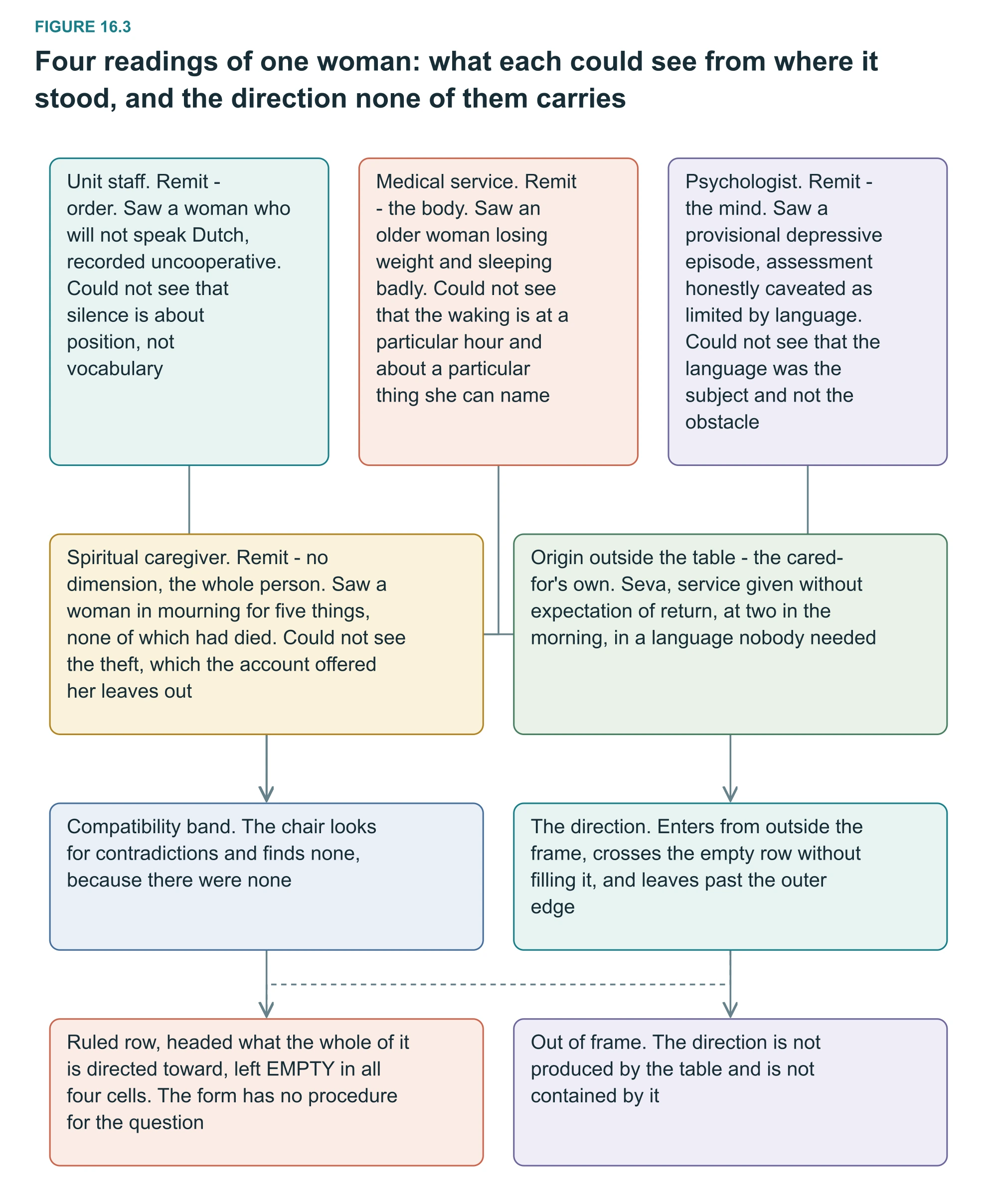
Figure 16.3. Four readings of one woman: what each could see from where it stood, and the direction none of them carries.
None of the first three was wrong about what it saw. Each was wrong about what it was looking at, and the error was identical in all three: each read a symptom of the grief as the thing itself, because each was equipped to see one dimension of a person and the multidisciplinary meeting was the only place where the dimensions were ever put together. What that meeting does with them is the point. It collects. Each profession contributes its column; the columns are placed beside one another; the chair looks for contradictions and finds none, because there were none. Not eating, not sleeping, flat affect and poor Dutch are perfectly compatible findings. The meeting can add a fourth column when the spiritual caregiver arrives, and it did. What it has no procedure for is asking what the whole of it is directed toward.
This is the book's differentia at its most concrete, and it is worth stating without the vocabulary before stating it with. A care system that adds a chaplain to a list of professions has become more comprehensive. It has not become more directed. Comprehensiveness is what an integral approach delivers: one more domain covered, one more discipline at the table, the person's file now complete across the bodily, the psychological, the social and the spiritual (Chapter 4section 2). The Integrative claim is not that a fifth column was missing. It is that four columns aligned toward nothing are not care, and that the direction has to come from the person, not from the table. Integrative Spiritual Care relates all the aspects, perspectives and purposes of a person's inner and outer life toward a Coherent View which is the cared-for's own, without discarding any (Chapter 4section 1). The operative words in this case are the cared-for's own, and what makes the case teachable is that the caregiver got them right twice and wrong once, in the same three months.
The care recipient. What Sumitra wanted was never stated as a want, because a woman who has spent forty-five years as the person help comes from does not have a working vocabulary for asking. It has to be inferred from what she reached for. She reached for a Tuesday, because Tuesday is Hanuman's day. She reached for a recitation she had known since she was six. She reached, in the end, for a twenty-two-year-old who screamed at night. Her hopes are all of one kind and they are not therapeutic: she wants to be, again, somebody with standing and something to give. Her fears are theological before they are practical - that she is ashuddha and therefore out of reach of God, that her karma has been contaminated in a way that will reach her sick husband, that her children have finished with her. Her agency, which the institution has almost entirely removed, survives in exactly two places: what she does with the hour before the trolley, and whom she sits with. Both are where the case turns.
Her worldview is not a set of beliefs she holds. It is the shape of a life, and the shape is grihastha dharma: the householder's obligation, discharged daily, in a house, for people who arrive. The single sharpest fact in the assessment is that her offence was continuous with that obligation rather than a departure from it. She carried drugs to pay for her husband's medicine. A reading that treats the offence as a rupture in her character will not find the grief, because the grief is precisely that the obligation is still live and the means of discharging it have all been removed.
The caregiver. Nirmal's competence in this case is largely a competence of position. He held three advantages that no amount of training supplies: he shared her first language, he was legible to her as a member of her community rather than of the institution, and he was outside the disciplinary line, which meant that what she told him could not be used. It is worth being blunt that the first of these is luck. The service did not deploy a Sarnami speaker to a Sarnami-speaking prisoner; it deployed the Hindu caregiver it had, and he happened to be the right one. Section 15 takes up what follows for the woman whose language nobody in the building speaks.
His use of self is the more interesting half. He accepted the word beta in the first minutes of the first session, without deciding to, and he noticed himself accepting it. That acceptance is the mechanism of the whole case and it is also its central exposure. In Sarnami, addressed as Mata-ji by a younger man, she recovers a position from which speaking does not cost her face; that is why the story came out in a minute after three weeks of silence. But the position she recovers is a position in a family, and families have obligations both ways. He is now, in her ordering of the world, a son. He cannot decline the role without withdrawing the thing that made her speak, and he cannot fully occupy it either, because he leaves the building at five and his caseload is forty.
His emotional and spiritual responses are recorded in the case with unusual candour and they are not flattering, which is what makes them useful. He noticed relief and distrusted it. He noticed that offering a classical model to a woman with no textual training had felt good, and underlined the note. After the fourth session he named, in order, that he had wanted the reframe to land, that the wanting had not been for her, and that being the only person in the building who could offer her any way at all of thinking about four years was not comfort but power, and that he had been enjoying its exercise. That is the countertransference in this case and it does not present as hostility or as rescue. It presents as interpretive pleasure: the satisfaction of having a frame that fits, offered to somebody who has none and cannot shop elsewhere.
The context. The institution is not a backdrop here; it is the second care recipient's second parent, so to speak, in that it produces most of what has to be cared for. It forecloses the practice: no open flame, no incense, no bead string on that unit, no shrine, no place to wash before prayer. It allocates by category and has no category for the mourning of a role. It runs a handover note in which four lines of behavioural description travel further and faster than any interpretation of them. It ends by absorbing the outcome of the care into its own operation, which is the darkest thing in the case: having discovered that a sixty-six-year-old prisoner can settle a screaming twenty-two-year-old at two in the morning, it began sending them to her, without asking her, paying her, supervising her or making any arrangement whatever for what happens to her afterwards.
Two further contextual facts are load-bearing. The first is Dutch professional confidentiality, which is what made disclosure possible at all; remove it and there is no case, because the sentence she cannot say to anyone with keys stays unsaid. The second is that she is a first-generation migrant of the second migration, Suriname to the Netherlands, in a community whose religious life is organised communally and whose language of feeling is not the language of the state. Her isolation is not a personality trait. It is the ordinary consequence of putting a person whose selfhood is constituted by a household into a place that has no households in it.
The care relationship. Presence and trust were established in a single sentence and then tested three times: by an interpretation that fitted too well, by a reframe that did not fit at all, and by an absence of seven weeks. Power and dependency run one way and the chapter should not pretend otherwise. He can end the relationship; she cannot. He is the only person in the building who speaks to her in the language in which she is not a criminal. Under that asymmetry, her agreement to anything he offers is worth less as evidence than it would be outside, and this is exactly why the one moment she disagreed carries so much analytical weight. Beta, in an ashram you may leave is the only sentence in three months that was not shaped by the asymmetry, and it was better than anything he had said.
Collaboration and shared decision-making, honestly appraised, were thin. She was not offered choices; she was offered frames, and she took them. The decision points set out in Part II were his. The one thing genuinely handed over was the practice: after three weeks she could recite without him, and the proof that it had become hers rather than his is that it survived seven weeks in which he was in another building.
The alignment, and the one aspect that was discarded. Read through the Integrative Care Model, her losses were never five separate problems requiring five services. They were a single dis-integration around a single event, presenting simultaneously in the bodily dimension (appetite, sleep, the night panic), the psychological (shame turned to self-condemnation), the social (standing in the family and on the unit), the ethical (the offence, and the lie), the existential (a role ended before she was ready to end it) and the spiritual (impurity, and a God she had placed outside the building). What aligned them was not an intervention. It was the recovery of the one purpose the whole of her life had been organised around, in a form the regime could not confiscate: seva, service given without expectation of return, performed at two in the morning in a language nobody needed. That is what alignment toward the person's own Coherent View looks like in a cell. It is not a technique and it cannot be prescribed; it can only be recognised when a person reaches for it.
The 4H reading follows from that and can be stated compactly. What is to be released, heya, is not the sentence and not the not-eating; it is her conviction that having caused her losses she has no standing to mourn them, which converts the whole of the grief into shame and seals it. What binds her to it, heya-hetu, is lajja, doubled: the shame that attaches to a family's standing and the institution's total absence of any category in which a mourned role is a real loss. The horizon of her flourishing, hana, is not the removal of the grief and not a return to who she was in Suriname, but a life in which she is again the person help comes from, holding what she did without being made of it. The means brought alongside, hanopaya, were four: the first language and the form of address that restored her position; the tradition's own second way of doing each foreclosed practice; the guna account, which separated the deed from the identity without discharging the responsibility; and the seva that made the language barrier irrelevant instead of solving it. The interlock is what matters here rather than the count. Remove the first and none of the others is reachable; remove the last and the other three produce a calmer woman in a cell with nothing to do.
And now the aspect that was discarded, which the definition's without discarding clause requires this chapter to name rather than to pass over. Sumitra was robbed. Her son-in-law took her stridhana, which in her community is not an asset but her own standing made material, and he has not been charged with anything. That theft is the proximate cause of everything the chapter has narrated, and it appears in the record as a wrong done to her for the last time in the first session. Nobody suppressed it. It simply had no place to go: there is no profession in the building whose remit includes a woman's grievance about a crime committed against her in another country, and the spiritual reading offered to her in January - a life stage entered, a running that has stopped, an attention now free for God - supplied a complete and consoling account of her situation in which the words court, sentence, theft and justice do not occur. She stopped mentioning it. A care that aligns everything except the injustice has aligned toward a Coherent View that is missing a piece, and the piece is the one the person came in with. Whether that is a failure of the care or a limit of the setting is section 15's question. That it happened is section 12's finding, and what catches it is a question worth running on any case that appears to be going well: what does this account of the person leave out, and who is more comfortable for its being left out?
13. Spiritual-care assessment
An assessment made in the third week would have been wrong. An assessment made in the third month has the advantage of knowing how the case came out, which is not an advantage a practitioner ever has. What follows is written as of the fifth session, and the last part of it says plainly which items are known, which are inferred and which would have to be checked by somebody else.
Meaning and purpose. Her purpose has been single and unchanged for forty-five years: to be the one who provides, arranges and holds. The sentence did not alter the purpose; it removed every instrument for discharging it. The despair of the first weeks is best read not as an absence of meaning but as a meaning with nowhere to land.
Identity and belonging. She is Mata-ji and she is Nani, and in the first weeks she was neither. Her belonging is triple and each layer was cut: the household in Suriname, from which she is absent and to which she has lied; the community of her tradition, from which she believes ritual impurity has excluded her; and the unit, on which she initially recognised no one she could be anything to.
Relationships and community. Her husband, ill, at a distance, deceived, and therefore not available as a comfort. Five adult children, four of whom have not written. A former son-in-law, absent except as cause. Nine grandchildren she does not mention. From the fifth session onward, three younger women on the unit who come to her, and the beginnings of a role she did not ask for.
Values and moral concerns. She holds herself responsible and wants to be held responsible; the crisis of the third session was not that she felt guilty but that she could not recognise herself as the person who had acted. Her concern about the lie to her husband is not that it is a lie but that it is the only way she can protect him, and she has no framework in which protecting somebody by deceiving them is anything other than what a wife does.
Hope, fear, grief and suffering. Hope is short-range and concrete: that he lives until she is out, that one of her children writes. Fear is nocturnal and specific to her husband. Grief is the substance of the case and is five-fold: standing, stridhana, daily worship, truthful contact, and the kula, which she named last and which she called the largest. Suffering runs in two layers - the loss itself, which must be borne, and the self-condemnation on top of it, which need not.
Beliefs and worldview. Devout, practised, unliterary. Hanuman and Krishna; the household festival calendar; a karma held in the ordinary way, which is to say available at any moment to be misread as a verdict on her. Her theology under stress produced one proposition, God is not here, and one question, why did He let me, and the first was answered and the second was not.
Rituals and spiritual practices. At intake, none, and the reason is not disinclination: flame and incense are prohibited, a bead string was not permitted on her unit, and she held that a cell cannot meet the condition of saucha. By the fifth session: rising before the trolley, seated dhyana for as long as she can manage, japa counted on the finger joints, bhajan sung quietly because of the wall, and the Hanuman Chalisa from a printed copy when the panic comes.
Sources of strength. Forty verses learned at six and never lost, which is a resource nobody in the building knew she had. A capacity for practical arrangement that has survived intact. And the thing that turned the case, which is that being needed restores her faster than being helped does.
Spiritual distress. At intake, acute and correctly named: exclusion from the divine, attributed to the place and to her own impurity, at the exact moment when the divine was the only resource she had left. By March, episodic rather than settled, and demonstrated by the Phagwa weekend to be fully capable of returning.
Immediate risks. At intake: weight loss in a woman of sixty-six, night panic, and a settled belief that her karma had been contaminated in a way that would reach her husband, which is the belief that would have made a request for medical help pointless in her own eyes. Not present at intake and specifically checked: any expression of wanting to die. By March, one new risk that the institution created rather than found, which is that an unsupported prisoner is now the first responder for other prisoners in distress at night.
Desired form of support. Never requested and, at the fifth session, still not requested. What she has accepted is a fortnightly visit in her own language and a role on the unit. What she has twice asked for, which is as close to a request as the case contains, is that he continue to visit her after transfer.
Known, inferred, uncertain, and not ours to judge. Known, in the sense of stated by her: the theft, the debts, the offence, the lie, the exclusion from God, the four-year sentence and her age at release. Inferred, and the inference should be visible as one: that her silence in Dutch was face-saving rather than incapacity - strongly supported by the speed of disclosure in Sarnami and by the second blanket she asked a guard for in Dutch, but an inference nonetheless; that the seva on the unit is a resumption of grihastha dharma rather than a new departure; and that her acceptance of the guna reading was partly relief-driven, which the caregiver himself flagged and then did not test. Uncertain: whether the January reframe was received as consolation or as instruction, since she neither adopted nor rejected it in terms; whether the December question about God is closed or merely unasked; and what she believes about her children, on which she has said nothing at all in three months, which is itself the most conspicuous silence in the record. Not the spiritual caregiver's to settle, and referred: whether a depressive disorder is present, which is the psychologist's judgement and was reviewed and set aside in the spring; the nutritional and cardiac consequences of the winter's weight loss, which are the medical service's; and the safeguarding question of whether a prisoner may be relied upon at night by other prisoners, which is nobody's at present and should be somebody's.
The discernment the whole institution got wrong, and how to make it at the bedside. Six observations carried three professions to three wrong readings in this case, and none of the six is a bad observation. They are the observations anybody would make. What was missing was the second question, and the second question is not about the behaviour but about whether the behaviour moves when the person's own frame is offered back to them. A mourning that is situational shifts, sometimes within minutes, when a person is addressed in the terms in which she is somebody; a depressive disorder does not shift because it is not a response to being unaddressed. That is not an infallible test and it is not a substitute for a clinical opinion. It is the one discrimination a spiritual caregiver is in a position to make and the clinician usually is not, because the clinician does not have the frame to offer.
The discriminating question in every row is the same, and it is not the behaviour. It is whether the behaviour moves when the person's own frame is offered back to them. Use the third column as a threshold for asking, not as a diagnosis.
Table 16.3. Mourning and depression at first contact: what the same six observations mean, and what would change the reading.
What you are seeing | Reads as mourning when | Reads as illness, or needs a clinical opinion, when |
|---|---|---|
Not eating | Refusal is selective and has a reason she can give if asked in the right language - the food is wrong, she is fasting, she does not eat with strangers - and intake improves within days of one conversation in which she is somebody again. | Refusal is indiscriminate and persists across settings and moods; weight loss continues after contact is established; she cannot say why and does not seem to be withholding a reason. Weight loss in an older adult is a medical question in its own right, whatever else is true. |
Not sleeping | The waking is at a particular hour and about a particular thing, and she can name it. It eases when the thing is spoken about or when she is given something to do at that hour. | Sleep is broken without content, or she wakes early with the day at its worst and improving toward evening; unbroken insomnia continues after the acute situation has settled. |
Flat affect, no eye contact | It lifts, visibly and within one exchange, when she is addressed in her first language or by a term that gives her standing; the flatness is toward the institution and not toward everybody. | It does not lift for anybody, in any language, over weeks; she reports no feeling rather than too much feeling; nothing that mattered to her before matters now, including her faith. |
Withdrawal from company | The company available is company in which she is only a prisoner. She withdraws from that and moves toward company in which she has a role, as soon as one exists. | She withdraws from the people who give her standing as well, including family contact she previously valued, and continues to withdraw once a role is available. |
Not using an available language | The first language, when tried, produces speech immediately and abundantly; the silence was about position rather than vocabulary. Check the negative case too: has she used the institution's language for anything, however small? | Both languages produce the same poverty of speech; she is slowed and effortful in her own language as well; comprehension itself seems impaired, which is a clinical question and may not be a psychiatric one. |
Self-blame | The blame is about a real act with a real consequence, and it moves when the act is separated from the identity without being excused. She wants the responsibility; what she cannot bear is being made of it. | The blame is global, counterfactual and unfalsifiable - she is bad, she ruins what she touches, everything is her fault - and it does not move when the frame is offered, or it moves and returns unchanged within the day. |
How to use it. Take the six observations you have, put them in the left column, and then do the thing the middle column requires, which is one conversation in the person's own terms. Read the right column afterwards rather than before. If two or more rows sit in the right column after that conversation, ask for the clinical opinion and say what you saw, not what you concluded. And record the reasoning either way. The most avoidable failure in this case was not the wrong provisional diagnosis, which was reasonable on the evidence available; it was that the diagnosis was later set aside without anyone writing down what had changed, so that a reader of her file in two years will find a depressive episode that appears and disappears for no stated reason.
14. Approaches and interventions
Nine things were offered in this case and two were withheld. Each is set out the same way, because an intervention described only by what it is for cannot be judged: why it might be appropriate, what consent it needs, how it stands to the person's own worldview, how it can be adapted, what it may do well, what it may do badly, and when it should not be used at all. The order is the order of increasing risk rather than the order in which they were offered: the last of them was done in the week of the first session.
Speaking the first language, and using the form of address that goes with it. Why. Because the presenting problem was silence, and because silence in an institution is almost always about position rather than about vocabulary. Consent. None is required to speak, but a caregiver should notice that changing the language of an encounter changes the relationship inside it, and should be prepared for what that releases. Worldview. In a community organised by seniority, being addressed as Mata-ji by a younger man restores a hierarchy in which she is at the top; that is not politeness, it is the removal of the reason she could not speak. Adaptation. Where the caregiver does not share the language - which is the ordinary case - the transferable part is not the Sarnami. It is refusing to accept the phrase language barrier from a handover note until somebody has actually tried the language, and it is finding the form of address that gives the person standing, which can be done in any language and is done far too rarely. Benefits. In this case, three weeks of failed assessment reversed in eleven minutes. Harms. A door that opens that fast has been pushed rather than unlocked. A person who discloses more than she meant to may retreat, and the caregiver should expect the second session to be worse than the first rather than better. Do not use it as a technique for obtaining information that the person has decided not to give in the institution's language. If the disclosure would go into the file, the language of the encounter is a means of circumventing her refusal, and the fact that it works is not a defence.
Reciting a familiar text together. Why. Because she had said that God was not present, and a proposition of that kind is a distress call rather than a position in theology, and is not answered by argument. Consent. Explicit, and she gave it as a question - can we? - which is the form consent takes when somebody believes the thing has been forbidden to them. Worldview. The forty verses were hers before they were anybody's professional instrument; the caregiver supplied the occasion, not the text. Adaptation. The regime permits a printed copy where it does not permit a shrine; the recitation can be done seated, silently, and alone once it has been done aloud and together. Benefits. The metre draws the breath into a slower and slightly extended pattern, which is why the effect reached her body before it reached her thinking, and why she reported it as a hand laid on her head rather than as a conclusion. Harms. This is the intervention in the chapter most open to institutional capture. A practice that reliably quiets acute distress is also a practice that makes distress inaudible, and an institution that has noticed this will ask for more of it. Do not use it with somebody who does not already have the text. Teaching a text to a distressed person and then reciting it with them is teaching, and it belongs to a different relationship with different consents. And do not use it as the answer to a theological objection that the person is entitled to have taken seriously; the recitation answered God is not here, and it did not answer why did He let me, and the case is honest about the fact that the second question was never answered at all.
Substituting for a foreclosed practice from within the tradition. Why. Because the institution had removed the ordinary machinery of her devotional life and she had read the removal as abandonment rather than as prohibition. Consent. Practical rather than formal, but the caregiver should check the substitution against the person's own sense of adequacy rather than against his own: a substitute the caregiver finds elegant may be experienced as a downgrade. Worldview. Manasa puja, in which the lamp is visualised and the offering made in the mind, and kara mala, counting on the finger joints, are not improvisations for prisons. They are the tradition's own second way of doing what the first way does, which is why she could accept them without concluding that her religion had been adjusted to fit a cell. Adaptation. This is the adaptation, and the discipline that governs it is a single question: what was the foreclosed practice for, and does the tradition already have another way of doing that? Benefits. Portability, and confiscation-proofness. Nothing she now uses can be taken from her. Harms. A substitution invented rather than recovered - a candle-shaped thing, a mindfulness exercise offered in place of a rite - is legible as a substitution to the person receiving it long before it is legible to the person offering it, and it teaches her that her practice was never the point. Do not use it to smooth over a prohibition that should be challenged. Where a regime forbids something it need not forbid, the caregiver's first task is to say so to the institution, and the substitution is what is done while that argument is lost.
Offering a classical account of a person's worst hour. Why. Because she had asked a question - who was that woman who got on the aeroplane - that no clinical vocabulary answers, and because the tradition has a serious answer to it. Consent. Sought explicitly and correctly: may I offer you something, not an excuse, a way of looking, and if it does not fit you will tell me. That formula does most of the ethical work and costs eight seconds. Worldview. The guna account is a claim about what a mind is made of and how its proportions change; it is offered as true, not as useful, and that distinction is invisible in the outcome and decisive in the ethics. A caregiver who offers it as a technique for managing self-criticism has misdescribed it to the person receiving it. Adaptation. It can be given without the Sanskrit and without the Samkhya, as three plain words for clarity, heat and darkness, which is how it was given here. Benefits. It separated a deed from an identity, which is the specific work that shame requires and that reassurance cannot do. Harms. It lifts responsibility along with the shame unless the two are deliberately held apart, and she reached for exactly that within one exchange - so I am not a bad woman. The counterweight used here was a single sentence, offered second: the cloud explains the day, it does not carry the bag. Do not use it where the person's account of themselves is the only thing keeping a real responsibility in view, and do not use it at all without a plan to check, in a later session, whether it has become a way of not looking. That check is the intervention's second half and it cannot be made in the session where the frame is given.
Reframing a sentence as a life stage. Why. Because she asked what she was supposed to do with four years, and because the tradition does have an account of what a person of sixty-six is doing with the rest of her life. Consent. Not obtained in any meaningful sense, and this is the case's clearest failure of process. She was asked whether she wanted a large answer or a small one; she was not asked whether she wanted her sentence interpreted. Worldview. Vanaprastha is real, the pravrtti and nivrtti division is real, and sixty-six is a plausible age for the third asrama. Nothing was invented. Adaptation. What survived, after she objected, was a much smaller version, and it is the version worth transferring: not a name for the four years but a question about one hour of one day, which is the largest unit of her life she actually controls. Benefits. A person with four years and no account of them is in a worse position than a person with a contestable account. Harms. Three, and they are serious. It supplies a complete explanation of her situation from which the court, the sentence, the theft and the justice are all absent. It is offered by the only person who can offer her anything, to somebody who cannot decline at no cost. And it is available to the institution, which prefers a settled prisoner to an aggrieved one and has just acquired one for nothing. Do not use it on a suffering that somebody else has imposed, unless the same conversation can hold the injustice - and if the injustice cannot be held in the room, that is a finding about the room and not a reason to proceed. The test worth carrying out of this chapter is the one section 15 states as a rule: would you offer this frame to somebody who could refuse it at no cost?
Building a daily order. Why. Because a practice that exists only when the caregiver is in the room is his and not hers, and because the hour before the trolley was the only part of the day the institution had no use for. Consent. She built it; he asked what she wanted the hour to be for. That is the difference between a care plan and an offer. Worldview. Every element of it - the sitting, the japa, the bhajan - is what a devout woman of her generation and community would do at home, minus the objects the regime removes. Adaptation. The order is hers to change, which is what makes it survivable; a schedule prescribed by a caregiver acquires his authority and fails when he is unavailable. Benefits. It survived his seven-week absence, which is the only real test of ownership and one that no case can arrange deliberately. Harms. A daily order can become one more standard to fail, and it did, over a weekend in March. Do not use it as a substitute for the things that have not been addressed; a person with a full morning routine and an unanswered question about God has been given an occupation, not care.
Making room for service. Why. Because being needed restored her faster than being helped had, and because her whole identity was constituted by being the person help comes from. Consent. She began it herself, unprompted, and the caregiver's contribution was to recognise it rather than to arrange it. That order is not incidental. Worldview. Seva is service given without expectation of return, and in her case it was not an ethical instruction but the actual mechanism by which she stopped being someone who needed help. Adaptation. The general form is not seva and is not Hindu: find what the person's life was organised around and ask what version of it the setting still permits. Benefits. It made the language barrier irrelevant rather than solving it, which is a general finding worth taking out of this cell, because a great deal of institutional effort goes into removing the obstacle that has been named and a great deal of care consists in finding the route that does not pass it. Harms. This is the intervention that went wrong, and it went wrong outside the care relationship. The institution noticed that it worked and began sending distressed young women to an unpaid, unsupervised, unasked sixty-six-year-old prisoner with no arrangement for what happens to her afterwards. Do not use it without asking, at the outset, who will carry the cost if the person becomes load-bearing for somebody else's care. Chapter 23 is where this book takes that question up properly.
Retracting a formulation. Why. Because he had told her she had embraced nivrtti, which described a completed transition in a woman who had spent sixty-six years on the other path, and because when the description failed in March she concluded that everything had been lost. Consent. Not applicable, and that is the point: this is the one intervention in the chapter that costs the caregiver rather than the recipient. Worldview. Nivrtti is not a place a person arrives at. It is something a person does on the days she manages it, and the correction restored the tradition's own grammar rather than softening its claim. Adaptation. The general form is Table 16.2: every account of somebody's progress can be said as a state or as a practice, and the two are usually a verb apart. Benefits. Everything built over three months was recoverable after one afternoon on the floor of a cell. It is not obvious that it would have been recoverable if he had answered a bad weekend by reminding her how far she had come. Harms. Very few, and the ones there are belong to the caregiver: naming an error to a person who depends on you costs authority, and the authority is sometimes load-bearing. Do not use it as a way of managing your own discomfort. The retraction is for her use, and the test is whether it puts the practice back in her hands in the same conversation. His did, that afternoon, and it took considerably longer than ten minutes and produced no lightness at all.
Speaking for the person at the multidisciplinary meeting, and choosing what not to say there. Why. Because a provisional diagnosis was hardening and medication was being discussed on evidence he now knew to be an artefact of the language of the interview. Consent. Not sought, and it should have been. He told the meeting what his judgement was and withheld the material it rested on, which protected her and left the meeting unable to evaluate him. Worldview. Not applicable, except that his standing in her eyes depends entirely on his being outside the disciplinary line, and every appearance at that table is a small withdrawal from that account. Adaptation. The generalisable form is to report the discrimination rather than the disclosure: the presentation shifts when she is addressed in her first language is sayable without a word of what she said. Benefits. The pressure to medicate came off and the diagnosis was marked for review. Harms. An assertion that cannot be examined is an assertion the meeting has to take on trust, and a caregiver who is trusted on that basis this year will be resented on it next year. Do not use it where a colleague's clinical judgement would change if they knew what you know and you have decided they may not know it. That is a situation to bring to supervision, not to a meeting.
Two things not offered, and why. No formal pranayama (प्राणायाम, regulated breathing) was taught. The temptation was obvious - a woman with nocturnal panic, a caregiver with a tradition full of breath practice - and the reasons against it were three. She already had a practice with a respiratory effect that she trusted and had not been taught by anybody in this building. Breath practices with retention are not safe to run unsupervised in a person with untreated night-time panic and no cardiac assessment, and there was no cardiac assessment. And a new practice offered at that moment would have arrived with his authority attached, at a point when the case's whole difficulty was how much authority he already had. Where a breath or movement practice is indicated in a case of this kind, the detail belongs to Appendix D and the contraindications travel with the practice and not in a footnote: acute psychosis and dissociation, trauma histories destabilised by retention or by eye-closed practice, cardiac and respiratory limits, and the standing-balance limits that apply to older practitioners and to movement disorders. Second, no work on forgiveness was attempted, in either direction - neither her forgiveness of the son-in-law nor her forgiveness of herself. She had not asked for it, the wrong done to her had never been acknowledged by anybody, and forgiveness offered to a person whose grievance has not been heard is a way of closing a subject rather than opening one.
15. Ethical tensions and limitations
Six tensions in this case are worth setting out, then a question the chapter cannot resolve, and last the question this book puts to every case about what may be delegated to a machine.
The letter. In January the caregiver helped a woman compose a reply to her sister in Suriname, translated it into Dutch, and wrote out in his own hand the sentences saying that she was well, that she was working, that she sent her love and that she could not telephone this month. Her husband is seriously ill and does not know where his wife is. This is not a boundary question and it is not solved by observing that the deception was hers. Three things are true at once. She has the right to decide what her family is told about her; nobody else in the building has standing to overrule that, and a caregiver who breached it would destroy the only relationship in which she is not managed. Her husband has an interest in knowing where his wife is, and it is not a trivial one; a man may want to spend what is left of his life differently if he knows. And the caregiver, by holding the pen, moved from respecting her decision to executing it, which is a different act with a different owner. The distinction matters practically rather than only morally: had he declined the pen and helped her find another way to send the letter, everything protective about the arrangement would have survived and his own implication would not. What he should have done next is clearer than what he should have done then. This belonged in supervision the same week, and the record does not show that it went there.
Whether a spiritual reading of a punishment serves the prisoner or the prison. The January reframe gave a woman with four years an account of what the four years were for. It also produced, at no cost to anybody, a settled prisoner where there had been an aggrieved one, and it did so by supplying an explanation of her situation in which no court, no sentence and no theft appear. Nothing in the session distinguishes the two effects, and a reader who feels certain which it was should notice that the caregiver, who was in the room, did not. The usable test is the one he arrived at afterwards and it is uncomfortable: would you offer this frame to somebody who could refuse it at no cost? A person in a cell, dependent on you for the only conversation she has in her own language, is not well placed to tell you that your interpretation of her suffering does not suit her. The second test is narrower and easier to apply on a shift: does the frame leave room in it for the person to be angry about what was done to her? The ashram did not, which is why her four-second objection was better than the whole construction he had built, and why the smaller version that survived - one hour, yours, what do you want it to be for - is the one worth carrying.
The vanishing of the injustice. Section 12 recorded that Sumitra was robbed, that nobody has been charged, and that she stopped mentioning it. It is the chapter's most uncomfortable finding because no one did anything wrong to produce it. There is no profession in that building whose remit includes a woman's grievance about a crime committed against her in another country, and a grievance with nowhere to go is a grievance that goes quiet. But the book's own definition requires alignment without discarding, and this aspect was discarded. Two things follow for practice. The first is that a caregiver should notice when a person stops raising something, and should treat the cessation as information rather than as progress; the record shows her grievance about the theft stated once, in the first minutes of the first session, and never pressed again in three months. The second is that where the setting has no channel for a legitimate grievance, saying so out loud to the person is itself care: nobody here is going to do anything about what he did to you, and that is a wrong on top of a wrong is a sentence that costs nothing, changes nothing, and prevents a person from concluding that her sense of injustice was itself a symptom she has now recovered from.
Competence, luck and equity. The case worked because this caregiver shared this prisoner's language, region and rules of address. That is not a competence a service can require, recruit for at scale, or distribute fairly, and the chapter would be dishonest to present it as a model. The uncomfortable corollary is the woman on the same unit whose language nobody in the building speaks, whose silence will therefore be read exactly as Sumitra's was, and for whom no Nirmal exists. What is generalisable from this case is small and worth naming precisely: a professional suspicion of the phrase language barrier; the practice of finding a form of address that gives a person standing, which is possible in any language; and a service-level obligation to notice that its ability to assess a prisoner correctly currently depends on coincidence. The equity question is not in the case. It is in the establishment, and it belongs to the institution rather than to the caregiver.
Interpretive authority without any of the apparatus that ordinarily accompanies it. The guna account did work that in another building would be called clinical. It was offered without a consent procedure, without supervision, without an outcome measure and without a second opinion, by a practitioner whose profession does not have the concept of an adverse event. That is not an argument for not offering it; the account is old, coherent, internally rigorous and, on the evidence of this case, was more use to her than anything the other three professions had. It is an argument for testing it, and the test is behavioural and delayed: what does the person do with the frame over the following weeks, and has the reduction in shame been accompanied by a reduction in accountability? The caregiver made the note and did not make the check. There is a smaller and harder point underneath it. The frame that lifts a person is also the frame she can lean on, and the caregiver who supplied it is the person least well placed to notice the leaning, because he is pleased with it.
Cultural fluency as a dual relationship. The word beta was accepted in the first session, and it did the work that made the case possible. It also placed the caregiver in a family role with obligations attached, in a relationship where he holds all the exit. This is the ordinary form that dual relationships take in community chaplaincy and it does not have a clean solution; the fluency that makes a caregiver effective is the same fluency that makes him legible as kin. What can be done is to say it out loud in supervision, to watch for the three symptoms - visits that lengthen, a caseload that quietly reorders itself around one person, and a reluctance to hand over - and to plan the ending from the beginning. She has twice asked whether he will still come after transfer and he has twice said yes without knowing whether the service will let him, which is a promise made by a son and not by a professional.
And a question the case leaves open, which is when a caregiver may stop witnessing and start intervening. In the first two sessions the caregiver's discipline is to hold the space and solve nothing. By the third he is offering a classical model, and by the fourth he is interpreting a criminal sentence as a stage of life. Both postures are defensible and the record contains no criterion for moving between them; it simply moves. The same discontinuity appears, more starkly, in the perinatal case at Chapter 12, where the caregiver states in one session that she is there only to be the witness of the unbearable and in the next that she must now take theological authority. Two practitioners, two cases, the same unstated switch. The book cannot supply a rule here that would survive contact with a real bedside, but it can supply the question, and the question is not am I ready to intervene but what has changed in the person, rather than in me, that now makes an offer receivable? In this case something had: she asked. The offer in the third session followed a question she had carried for a week and kept deliberately for him. The offer in the fourth session followed nothing she had asked for at all, and it is the one that went wrong.
What must remain in human hands, and what could responsibly be supported by technology. The template puts this question to every case and this one answers it unusually clearly, because most of what mattered here is precisely what a machine cannot do. The recognition that a surname carried a language, and the decision to use it, are pattern-matching of a kind a system could in principle perform; a service could flag, automatically and usefully, that a prisoner's recorded first language has never been used in any assessment interview. That would be a real improvement and it is the sort of thing institutions are bad at noticing and software is good at. A printed text, a recording of a recitation at the right pace, a calendar that knows when Phagwa falls and which festivals a person's household kept: all of these are provisionable and none of them requires a person. What cannot be delegated is the part where a woman was addressed as somebody's mother by a person who could plausibly be somebody's son, and meant it. The thing that changed her position was not that the words were in Sarnami. It was that a member of her community was in the room and had chosen to be. A system that says Mata-ji has performed the form of the act with the content removed, and the content was the act. Nor could any system have sat on the floor of a cell and said that its best sentence about her had been wrong, because that intervention consists entirely in a person having been wrong and minding. Part V takes this up as a general question at Chapters 24 to 27, and Chapter 26 in particular; the case's contribution to it is the observation that the interventions here divide cleanly, and that the divide does not run where a reader might expect. The routine, ritual and informational parts are the delegable ones. The relational parts are not, and the relational parts are the whole of the case.
16. Alternative perspectives
The reading in section 12 is this chapter's and it is not the only one available. Six others are worth stating in their own terms, because a case chapter that offers a single correct reading has taught the reader to look for correct readings.
Hers. Sumitra would not describe any of this as care and would be surprised to find herself in a book about it. Asked what happened to her, she would say that God sent her a son who spoke her language, that she started to pray again, and that she is looking after the girls on her unit because somebody has to. She would not say that her language was a diagnostic instrument or that her identity was reconstituted through seva. It is worth holding on to how much of the analytical apparatus in this chapter is invisible to the person it is about, and how little of it she would need.
His. Nirmal's own account, in the record, is more critical of him than this chapter has been. He believes the first session was luck, that the guna frame was offered partly because it pleased him to have one, that the ashram sentence was a failure and that the retraction in March was the only thing he did that he would defend without qualification. A caregiver reading this chapter should notice that the practitioner's self-assessment and the chapter's assessment differ, and that neither is obviously the more reliable.
The family's. Her children have not written, and the chapter has treated that as part of her loss rather than as a position anybody holds. It is a position. From the point of view of an adult child in Suriname, a mother who was the moral centre of a household committed a serious offence, brought disgrace on a family in a community where disgrace is collective, and is now lying to a dying man about it, with the help of a religious professional. The daughter who sends a card at festivals and does not visit is not necessarily failing her mother. She may be holding a line that the chapter, standing where it stands, has not even represented. And her husband, who has not been consulted about the arrangement made on his behalf, has the strongest claim of anybody in the case and no voice in it at all.
The institution's. The prison would describe the outcome as a success and would be entitled to. A prisoner who was not eating is eating; a provisional diagnosis was reviewed and set aside; a woman who did not attend recreation now attends it and has a settling effect on the wing. Every one of those is a real good and none is cynical. The institution would also, fairly, point out that it employed the caregiver, released him onto the unit without a referral, gave him access, and protected his confidentiality against its own interest in what he knows. The criticism this chapter makes of it is narrower than it may have sounded: not that it failed to care, but that its only mechanism for assembling a person is a meeting that places columns beside one another, and that it took the seva without ever asking who carries the cost.
A secular colleague's. A humanist or non-religious counsellor reading this case has a serious objection and it should be put at full strength. Everything achieved here, they would say, was achieved by ordinary relational means - a shared language, a form of address that restored dignity, a structured daily activity, a social role, and a professional who admitted an error - and none of it required Hanuman, the gunas or the asramas. The religious content is a delivery vehicle for interventions that could have been delivered without it, and dressing them in theology makes them unavailable to the majority of prisoners who hold no such beliefs. The reply is not that the objection is wrong about the mechanisms. It is that the objection assumes a person can be given a form and a content separately, and Sumitra's case is a demonstration that she could not: the daily order works because it is her daily order, the text works because she has known it since she was six, and the standing she recovers is standing inside a specific moral world with specific obligations in it. What is transferable is the structure of the move, not the content of it, which is why section 14 states each intervention twice, once as what was done and once as what it is a case of.
A criminological one, and it is the one this chapter has least room for. A sixty-six-year-old woman with no history became a drug courier because a family member robbed her and a health system in another country presented a bill she could not pay. She is serving four years. The man who took her gold is serving nothing. A reading that attends to the spiritual reconstruction of the courier and not at all to the arrangement that produced her has, whatever its intentions, made the arrangement easier to live with. This chapter has done that, and says so.
Forward. The informal arrangement by which this prison now routes its most distressed young women to an unpaid sixty-six-year-old is taken up in Part IV, where it is no longer a detail of one case but the book's own question turned on the people who do the caring - on the informal carer who never chose the role as much as on the professional who did.
Part IV - Learning from the case
17. Results and conclusions
What changed. At the close of the record Sumitra is eating. She sleeps badly in the bad weeks and adequately in the others. The provisional diagnosis of a depressive episode was reviewed in the spring and set aside as situational. She attends recreation, which she had refused from her arrival. She recites the Hanuman Chalisa without the caregiver present, and went on doing so through a seven-week absence in which he was in another building, which is the best evidence available that the practice is hers rather than his. And she has a role again: three of the younger women on the unit go to her, and she goes to them, and what she is doing when she does it is seva.
Read against the presenting situation in section 7, that is not a small change. A woman who would not look at anyone is now the person other people are sent to. Two of the changes would appear in no service audit. She has a form of address in which she is not a criminal, and she has an account of her own worst act that separates the deed from the doer without letting the doer off. Neither of those shows up in a file.
What did not change. Her husband still does not know where she is, and the lie is now maintained in a letter written in the caregiver's own hand, so that part of what did not change has been actively preserved by the care. Four of her five children have not written. She has never once described her offence in Dutch, which means that the institution which sentenced her has never heard her account of what she did. She has not gone back to the question she asked in the doorway in December, and neither has the caregiver. And the gold has not been recovered, nobody has been charged with taking it, and the woman serving four years has stopped mentioning that the man who robbed her is serving none.
That last item is the one this chapter declines to record as an improvement. Section 12 named it as the aspect this care discarded, and it belongs here as well, because it is the shape of the outcome and not a qualification of it: the presenting concern resolved, and the originating injustice went quiet in the same three months, and nobody in the building could say whether those two facts are related.
What contributed to the outcome, ranked as honestly as the record allows. Four things did the work, and they are not equally transferable. The first was a shared first language and a form of address, and it was luck. The service did not deploy a Sarnami speaker to a Sarnami-speaking prisoner; it deployed the Hindu caregiver it had, and he happened to be the right one. The second was the tradition's own second way of performing each foreclosed practice - the recitation that needs no flame, the purification that needs no water - which is method rather than luck and is the most portable thing in the case. The third was the guna account, which gave her a way of holding what she had done without being made of it. The fourth was the seva, which did not solve the language barrier but made it irrelevant, and which is what actually aligned the case.
There is a fifth, and it is the one intervention in this chapter that cost the caregiver rather than the recipient. In March the caregiver sat down on the floor of a cell and told a woman who had just failed that his best sentence about her had been wrong. Everything he had built before that afternoon was recoverable afterwards. It is not obvious that any of it would have survived the alternative, which was to answer a bad weekend by reminding her how far she had come.
What remains unknown. Whether the vanaprastha reading holds when the sentence ends and a woman approaching seventy walks out of an open regime into a country where the household that gave the reading its sense no longer exists. Whether the seva is sustainable, or whether an unpaid and unsupervised sixty-six-year-old will one morning be found to have absorbed more than she could carry. What her children hold, since nobody has asked them and this chapter has represented them only through her account and her silence. Whether the depressive presentation would have lifted anyway, in time, with nothing done at all; there is no counterfactual here and there cannot be one. And what her file will say, since the diagnosis appears and disappears in the record with no note of what changed, so that a clinician reading her in two years will find a woman who was depressed and then was not, and no reason given.
What the case teaches about integrative spiritual care. Section 12 has already put it in a sentence and it will not be improved by repetition: a care system that adds a profession has become more comprehensive, not more directed, and the direction has to come from the person rather than from the table. What turned this case was not the fifth column at the multidisciplinary meeting. It was that somebody recognised the single purpose the whole of her life had been organised around and helped her find a version of it that the regime could not confiscate. That is what alignment toward the cared-for's own Coherent View looks like when it actually happens, and the reason it cannot be written as a protocol is that nobody could have prescribed seva to her. She reached for it. The caregiver's contribution was to notice, and then not to interrupt.
What should not be generalised, and the list is longer than the one above. Five things in this case are local and a reader who lifts them will be lifting the wrong thing.
The shared language and the shared community are the first. They are the condition of almost everything that followed, and most caregivers will not have them. Section 15 sets out what is owed to the person whose language nobody in the building speaks, and the answer is not that her caregiver should improvise a version of this case.
The classical apparatus is the second. A guna reading landed here because the recipient was religiously literate, because it was offered in her first language, and because it named something she already half believed. Offered to a person without that formation it is an imposition wearing the clothes of a resource, and the record is candid that part of what made it attractive was the pleasure of having a frame that fitted.
The reframe is the third, and it carries the strongest warning in the chapter. Vanaprastha must not leave this chapter as a technique for prison sentences. It consoled a woman by supplying an account of her situation in which the word injustice does not occur, she objected to it herself in the only unshaped sentence in three months, and the caregiver had to narrow it in response. What is transferable is the objection, not the reframe.
The evidence base is the fourth. This is one caregiver's record of his own work, five recorded sessions across roughly three months, with no independent account from the recipient and no follow-up past the writing. It is a case, and a case shows that something is possible and how it went. It does not show that it works.
The jurisdiction is the fifth and it is easy to miss. Dutch professional confidentiality is what made the first disclosure possible at all. Where a chaplain's notes are discoverable, or where the chaplain sits inside the disciplinary line, the sentence she cannot say to anyone with keys stays unsaid, and there is no case here to learn from.
18. Key learning points
Seven points, drawn from this case, and a distillation rather than a summary of everything above. What follows is what a practitioner should be able to carry out of this chapter without the apparatus.
One. Mourning does not require a death, and a setting organised around sentences and diagnoses will not see it. Sumitra lost her standing, her stridhana, her daily worship, truthful contact with her husband and her place in the family line, and not one of those has a form to be recorded on. The caregiver's first act was not an intervention. It was to give the losses a name and to say out loud that they were losses. Where a setting has no place for what a person is grieving, supplying the account is care and not preamble.
Two. Language can be a diagnostic instrument, and language barrier is a phrase to be suspicious of. Three professions read the same woman wrongly for three weeks, each correctly from its own remit, and the reading changed in eleven minutes when somebody used her first language and the form of address that goes with it. What is transferable is not the Sarnami, which was luck and which section 15 refuses to present as a model. It is the refusal to accept that a person is unreachable because of a language barrier until somebody has actually tried the language, and the practice of finding a form of address that gives a person standing, which is possible in any language and is done far too rarely.
Three. Say a person's progress as a practice and never as a state. You have accepted it. You have found peace. You have embraced nivrtti. Offered as states they are received as standards, and the first bad day tells the person that the whole of it was false. Table 16.2 sets the commonest of these sentences out in both forms; the difference is usually a verb, and it costs nothing to change. Where a state has already been offered, and it will have been, the repair is the one made on the floor of a cell in March: name it as your own error rather than her relapse, and put the practice back in her hands the same afternoon.
Four. A cessation is information, not progress. When a person stops raising something they raised at the beginning, the useful question is what account replaced it and who is more comfortable now that it has gone quiet. Sumitra named the wrong done to her in the first minutes of the first session and never returned to it as a wrong, and in between she had been handed a complete and consoling reading of her situation in which theft has no place. Nobody suppressed anything, which is exactly why it is worth checking for, and the check is a return rather than a technique.
Five. A reframe is a gift with a hook in it, and the test is whether the person could refuse it at no cost. Vanaprastha is real, sixty-six is a plausible age for it, and nothing was invented. The reframe still supplied a complete account of a punishment in which the words court, sentence, theft and justice do not occur, offered by the only person in the building who could offer her anything, to somebody who could not decline without losing the only conversation she had in her own language. Her four-second objection was better than the whole construction he had built. Ask, before offering a frame, whether it leaves the person anything she is still allowed to be angry about.
Six. Where a regime forecloses a practice, recover what the practice was for and find the tradition's own second way of doing it. A prison that forbids flame, incense and water has not forbidden what the worship was for. A visualised lamp, counting on the finger joints, a printed page in place of a shrine: each was the tradition's own alternative rather than an improvisation for a cell, which is why she could accept them without concluding that her religion had been adjusted downward to fit a building. A substitution invented rather than recovered is legible as a substitution to the person receiving it long before it is legible to the person offering it.
Seven. Being needed restores a person faster than being helped does, and a service that discovers this has to count what it has found. What aligned this case was not an intervention. It was seva, resumed at two in the morning in a form the regime could not confiscate, by a woman whose whole identity was made of being the person help comes from. And the institution, having noticed that it works, began sending distressed young women to an unpaid, unsupervised, unasked prisoner of sixty-six, with no arrangement whatever for what happens to her afterwards. Both halves of that are the point, and a chapter that reported only the first would have taught its reader to read for successes.
19. Reflection questions
Eight questions, all arising from this case, personal and formation-oriented rather than analytical, and none of them has an answer this chapter would recognise.
1. When you first read the presenting situation in section 7, what did you take the problem to be? Compare that with what section 12 says the problem was, and notice which of your professional habits produced the difference.
2. Which of the four professional readings in section 12 is closest to the one you would have written, and what would you have been unable to see from there?
3. The caregiver recorded that offering a classical model to a woman who could not shop elsewhere felt good, and distrusted the feeling. When have you enjoyed being the person with the frame, and how would you know if you were doing it now?
4. He accepted the word beta without deciding to. What forms of address do the people you care for offer you, what do those forms make possible, and what do they oblige you to?
5. The chapter says the theft went quiet because there was no profession in the building whose remit included it. What grievance goes quiet in your setting for the same reason, and what would it cost you to name it out loud to the person carrying it?
6. Sumitra believed she had no standing to mourn losses she had caused. Whose grief have you found it hardest to take seriously because of what they did, and what did you do with that difficulty?
7. Read the March retraction again. When did you last tell somebody in your care that you had been wrong about them, and if the answer is that you have not, what has been protecting you from it?
8. The institution began sending distressed young women to an unpaid prisoner because it worked. Where does your own service quietly rely on somebody it has not counted, and are you one of them?
20. Practice questions and activities
Nine activities, keyed to this case rather than generic. Several are better done in a pair or a small group than alone, and the eighth of them should not be attempted without somewhere to take the answer.
1. Map the case. Complete an Integrative Care Model map for Sumitra at the end of session one, using only what the caregiver knew at that point. Then complete a second at the end of session five. The instructive part is not the second map but what moved between them, and how much of the movement was information rather than change.
2. Write the assessment the psychologist could have written. Using section 13's known, inferred, uncertain and not-ours-to-settle distinction, draft a one-page spiritual-care assessment that a colleague with no Hindu formation could act on. Then mark every line that depends on a claim you could not defend in a review.
3. Three interventions, compared by risk. Take any three of the nine interventions in section 14 and write, for each, the harm it could do and the person it would do it to. Rank them by risk rather than by likely benefit, and notice whether your ranking would have changed the order in which you offered them.
4. The next three questions. It is the Tuesday after the March retraction. Write the three questions the caregiver should ask next and the one he should not ask yet, with a sentence on why each is timed as it is.
5. Role-play the objection. One participant plays the caregiver offering the ashram reframing; the other plays Sumitra and must object to it, in her terms, without the professional vocabulary. Run it twice, the second time with the caregiver instructed to narrow rather than defend. Debrief on what the narrowing cost him.
6. Write the referral note. Draft the note that should have gone to the multidisciplinary meeting in the spring when the depressive diagnosis was reviewed, saying what changed and why, in language a clinician will accept and without disclosing anything told in confidence. This is harder than it looks and it is the omission section 17 records.
7. Rework the case for a different recipient. Rewrite sessions one and two for a woman on the same unit who is Moroccan-Dutch and observant, and again for a woman who holds no religious commitment at all. Keep the structure of every move and change all of the content. What survives the translation is the transferable part; what does not is the local part, and the exercise is a test of section 17's list.
8. Find what is missing. List everything a reader still does not know about this case that would change the assessment. Then mark which items could have been found out, by whom, and what stopped them. At least one item on your list should be something the caregiver could have asked in December and did not.
9. Read the farewell alongside. Appendix C, case B3, is a widow of sixty-six who could not take her leave of a husband who died suddenly, and the ritual described there - a familiar prayer, the Hanuman Chalisa sung together, a message spoken to him at the heart, and his figure visualised as a flame rising out of it - is built entirely of things this unit permits, because it needs no open flame, no incense and no object. Sumitra is the same age, her husband is seriously ill in Suriname, and he does not know where she is; the farewell that never came is, in her case, the one that has not come yet. Decide whether, and when, Nirmal could offer her the first half of that ritual before there is a death, what the offer would say to her about the lie she is still keeping, and which of the four practice questions attached to B3 is the one that changes when the mourner is also the person who was not there.
21. Read more
The works below are the ones this chapter actually leans on. A caution about their status is owed and is stated once rather than repeated: the case record and its two companion documents were read at first hand, and the moral-injury literature was read directly for the mental-health chapter, but the setting literature and the bereavement interlocutors named here are engaged at the level of their standard scholarly statement because the archive does not hold them, and first-hand reading remains owed at Note 1. Where that is so, the annotation says so.
Spirituality and spiritual care. Frankl (1959) is the shortest route into meaning that holds suffering rather than closing it, and the distinction it draws between a meaning discovered and a meaning supplied is the distinction the third and fourth sessions of this case turn on. Park (2010) supplies the meaning-making machinery - global meaning, situational meaning, and the distress that lives in the discrepancy between them - and is worth reading alongside this chapter's observation that the model is directionless by design, and that here the direction came from a purpose the recipient had held for forty-five years and nobody had thought to ask about.
Hindu spiritual care and the Dharmic sources. For the guna account offered in the third session, Bhagavadgita 14.5 to 14.18 is the accessible classical statement of the three qualities and of the changing proportion between them; it should be read before the account is used on anybody, because a caregiver who cannot say what the model claims is offering a technique and calling it a teaching. Bhagavadgita 2.47 to 2.51 carries the niskama karma that the recipient quotes back to the caregiver in the fifth session, and the instructive thing is that she reached it without being taught it. Yogasutra 1.33 gives the four attitudes this caregiver works from - maitri, karuna, mudita and upeksha - and the fourth is the difficult one in a prison, for the reasons section 15 sets out. Nandram, Bindlish and Joshi (2024) is the source of the H-model apparatus used in section 12; it is cited here at second hand, with direct reading flagged as owed in Note 1.
Clinical and contextual literature. Doka (1989) names disenfranchised grief, which is the single most useful category in this chapter and which appears here in its hardest form, because the mourner disenfranchises herself before anyone else does it to her. Prigerson et al. (2009) is the prolonged-grief-disorder criteria and should be read by anyone who intends to be careful about the referral threshold, so that the care is informed rather than merely reluctant; this chapter uses it for section 13's discernment and not as a description of what happened to this woman. For the setting, Goffman (1961) on the total institution, Crawley and Sparks (2005) on the institutional invisibility of older prisoners, and Slotboom, Kruttschnitt and Bijleveld (2011) on the relational rather than acquisitive motive structure of women's offending in Dutch detention are the three this chapter rests on, all at second hand and all recorded at Note 1. A reader who takes only one should take the third, because it is what makes this offence continuous with a caring role rather than a departure from it, and a reader who does not know that hears her account as an excuse.
Ethical and professional guidance. Litz et al. (2009) and Shay (1994) are the moral-injury sources, read directly for Chapter 14, and they are what allow this chapter to treat a woman's self-condemnation as a wrong to be sorted rather than as a symptom to be reduced. Beyond the literature, the guidance a reader of this chapter most needs is institutional: the confidentiality regime under which they work, the referral and safeguarding routes available to them, and their own service's position on whether a spiritual caregiver may write anything on behalf of a person in custody. Section 15 puts the last of these as a question this book cannot answer for a reader.
Narrative and scriptural sources for the case itself. The Hanuman Chalisa is the text at the centre of this case and is worth reading, in translation if necessary, by anybody who intends to sit with somebody reciting it; the point is not its doctrine but that it is forty verses long, is known by heart across a whole community, and needs nothing that a prison forbids. The Ramayana's Hanuman is the figure the recitation calls on, and the relevant thing about him for this case is that he is the servant, which is why the practice and the seva are the same movement and not two.
Notes
[The case record and its two companion documents were read at first hand and are cited by code only. The setting literature and the published bereavement interlocutors named in section 21 are not held in the project archive; they are cited from their standard statements, cited at second hand wherever a copy can be obtained.]
1. On the setting literature, all cited from standard statements cited at second hand: Goffman (1961) for the total institution and its levelling of the ordinary boundaries between sleep, work and recreation; Slotboom, Kruttschnitt and Bijleveld (2011) for the relational rather than acquisitive motive structure of women's offending in the Dutch prison population, which is what makes this case's offence continuous with a caring role rather than a departure from it; Crawley and Sparks (2005) for the institutional invisibility of older prisoners, whose withdrawal is read as compliance. Two further works were consulted through the case record's own reading list and are not cited in the prose because they have not been read at first hand: Choenni (2011) on social stratification and family hierarchy among Surinamese Hindustanis, which is where the izzat and lajja material would be grounded, and Damsteegt (2002) on Sarnami as an immigrant koine, which is where the claim that the language switch is emotional rather than practical would be grounded. Both are owed a direct reading before the differentia argument in section 12 leans on them. The H-model applied in this chapter is the authors' own (Nandram, Bindlish and Joshi 2024).
CHAPTER 17