
Figure 21.1. The open bag and the closed one.
Winston: a secular man in an emergency shelter asks a Hindu spiritual caregiver for anything that will help him sleep and finish his degree. He does not want a faith, and the caregiver has nothing to offer that did not come from one. What is given, and how would either of them know when an offer had quietly become a campaign?
Orientation
In the chapters before this one there was always a tradition somewhere in the room. The person was living inside one, or had been thrown out of one, or was at war with one, and whatever else was uncertain the caregiver could ask what it held and work from the answer. This chapter takes that footing away, and takes it away in three different directions.
A man in his thirties, in an emergency shelter for the homeless, asks a Hindu spiritual caregiver for anything that will help him sleep and finish his degree. He was brought up Christian, does not practise, does not believe in any way he could state, and by his own account has not thought about it much. He has not come for a faith. The caregiver has a full and articulate tradition and, professionally speaking, nothing else; every offer he can make comes out of it.
A woman of a different living faith, cast out by her husband and made homeless, is cared for by someone from outside that faith who knows rather little about it.
A man born into the caregiver's own tradition, who respects it and does not practise it, comes about a tendon injury and a manager who will not let him be ill.
Three seekers, and the same question put from three sides: what does a caregiver do with their own formation when it is the only formation in the room and the person in front of them has not asked for it? The question is not answered by saying nothing, which would leave the caregiver with no work; and it is not answered by saying offer it and see, which is how a tired person in a dependent position acquires somebody else's religion.
The first of the three is carried in full, because the difficulty is hardest to see where the person has no frame at all and hardest to manage where the setting is already doing something to the word no. He was a resident of the building his caregiver worked in. In the first hour he said that he would try anything.
How the chapter is built, and why it withholds. The case is narrated first and read afterwards. Sections 5 to 7 enter it, Sections 8 to 11 narrate five encounters as they happened, and the interpretation does not begin until Section 12. That order is deliberate and it costs something: a reader who wants the framework in advance will not find it here. It buys the one thing this book is trying to teach, which is the experience of meeting a situation before anybody has told you what it means, and then having a judgement of your own to set against the chapter's. Readers who want the apparatus first will find assessment at Chapter 6 and cross-traditions method at Chapter 8. The argument these three cases make together is at What the cluster teaches, after all three have been met.
Two things are worth carrying into the reading, and neither is a conclusion. The first is that the caregivers here are practitioners working at the edge of their own competence, not authorities dispensing certainties: the caregiver in the anchor case says versions of everyone is different repeatedly, and keeps what he offers experimental. The second is that the three cases run in opposite directions, which is a constraint rather than a convenience: anything the chapter finds has to hold for a man with no frame, a woman with a whole one, and a man who has set down the frame his caregiver still stands in, or be given up.
2. Case card
Case 21.1. Winston is this chapter's anchor case and the one carried in full. Two further seekers follow him in shorter form, later in the chapter, and put the same question from the other two sides.
Table 21.1 is Case 21.1 at a glance. It is the constant of every case chapter in this book: the card is always the first table, and the chapter's discussion tables begin at the second.
Table 21.1. Case card: a secular seeker in an emergency shelter.
Case title | Winston: a secular seeker who borrows what fits |
Care context | Non-formal spiritual care in a municipal emergency shelter for the homeless, in a Dutch city; five sessions over roughly a year, in the shelter's spiritual care room |
Primary care recipient | Winston, a master's student in his thirties, in the final phase of his degree; Christian by upbringing and not practising; a Surinamese-Creole father and a white Dutch mother; a cancer survivor, on hormone and sleep medication; ADHD, and autism identified in adulthood |
Spiritual caregiver | Ashwin, a Hindu spiritual caregiver working across the shelter's resident population; trained and registered in the Dutch professional system; not a member of the clinical team |
Other significant participants | A fellow resident who shared Winston's room; the shelter's personal counsellor, who handled his municipal and financial affairs; a psychologist seen elsewhere; an aunt and a cousin whose home he visited at weekends; the Hindustani friends he ran with; a university supervisor, off-stage throughout |
Tradition or worldview | Secular in practice, Christian in formation, culturally mixed and by his own account open to whatever works; no faith community, no practice, no observance |
Presenting concern | Overwhelming stimulus load, broken sleep, and an inability to concentrate on a research proposal he had already bought a ticket for |
Stage of care | Self-referred after two suggestions from within the shelter; first contact through to a review after his fieldwork abroad |
Central spiritual-care tension | A caregiver whose tradition is the whole of his own formation, and a man who wants none of it and is in no position to say so freely: a shelter resident asking a member of shelter staff for help |
Relevant care dimensions | Bodily and psychological, most visibly; social and existential, most heavily; the sacred present only as something set down long ago and not missed |
Confidentiality note | Composite and adapted. All names are pseudonyms written for this book. The institution, the university, the destination of the fieldwork and several incidental particulars are altered; the sequence of the care, the practices tried, kept and dropped, and the words quoted in the encounters are drawn from the case record and its later refinement. Two elements of the care recipient's own account of himself are withheld, on the ruling set out at the end of Section 6. |
3. Learning objectives
After working through this case, readers should be able to:
• Recognise the spiritual-care needs of a person who reports no religious belief, no practice and no faith community, and say what a standard assessment instrument would have recorded about him.
• Describe what it changes when the caregiver's own tradition is the only tradition in the room.
• Distinguish, in this case, what belonged to medicine, to psychiatry, to social services and to spiritual care, and say where the boundaries were genuinely unclear.
• Follow the reasoning by which a practice offered in good faith was dropped, and state the principle that governed the dropping.
• Identify the pressures on consent that arise when a caregiver is part of the institution the person depends on for a bed.
• Reflect on how their own formation would shape what they offered a person who asked them for anything that helps.
4. Key concepts
Non-formal spiritual care. Care given outside a treatment relationship and outside a religious community: not clinical, not congregational, and in the Dutch system a distinct and registered profession. The caregiver has no treatment mandate, keeps no clinical record, and answers to a professional standard rather than to the ward.
Sevā (सेवा, service). Care offered as service rather than as intervention, and so measured by what the person needed rather than by what the caregiver was able to do.
Upekṣā (उपेक्षा, equanimity). The caregiver's steadiness in the presence of a situation they cannot fix. In the classical list of four attitudes it is paired with karuṇā (करुणा, compassion), and the pairing matters: warmth without steadiness becomes rescue, and steadiness without warmth becomes distance.
The religion-default. The habit, built into much of the field's apparatus, of taking the religious person as the standard case, so that a person with no tradition registers on the form as a set of empty fields.
Spiritual but not religious. The now large population who report an inner life of meaning, value and connection while refusing religious affiliation. The term is contested, and Winston would probably not have used it of himself.
Overstimulation. The condition, familiar to many autistic and ADHD adults, in which ordinary sensory and social input arrives faster than it can be processed. It is not a metaphor for stress and does not respond to the things stress responds to.
Neurodivergence. The framing of conditions such as autism and ADHD as variations in how a nervous system is built rather than as deficits in a person. It bears on spiritual care directly, because a good deal of contemplative practice assumes a nervous system that settles when asked.
Part I - Entering the case
5. The care context: an emergency shelter, and a caregiver with no mandate
Ashwin worked in a municipal emergency shelter for the homeless: eighty or so beds, most of them in shared rooms, a canteen, a smoking area, a corridor of small offices for the staff who managed the residents' benefits, debts and housing applications. He was there two days a week and saw whoever asked for him.
The picture most people carry of such a place is the one the newspapers supply, and it is wrong in a way that matters for spiritual care. The shelter Ashwin worked in did have residents with long addictions and long histories of rough sleeping. It also had, on any given morning, a man who left at seven for a shift in a warehouse, a woman doing an administrative job she had held for eleven years, and two or three students. For them the shelter was not a life but an address: a place to eat and sleep while something else was being sorted out, and a place they did not tell their colleagues about. Homelessness in a wealthy country is very often this - not the absence of work or of ambition but the absence of a tenancy, produced by a relationship ending, a landlord selling, an illness, a queue for housing that runs to several years.
What the setting takes away is not primarily comfort. It is privacy, quiet and the ordinary power to arrange one's own hours. A resident sleeps in a room with people they did not choose, keeps their possessions in a locker, eats when the canteen is open, and is subject to a house rule about visitors and one about being in by a certain hour. For someone whose difficulty is that ordinary sensory and social input already arrives faster than they can process it, this is not an inconvenience. It is a continuous load, applied by the very arrangement that is supposed to be helping.
Spiritual care in the Dutch system is a registered profession with its own standard and its own confidentiality, and in a shelter it is non-formal care in the book's sense: outside the treatment relationship, outside any religious community, and available to a resident who has asked for nothing else. Ashwin held no treatment mandate. He could not prescribe, could not diagnose, wrote nothing into anyone's file, and could not get anyone a house. What he had was time, a room and a professional standing that let him offer both without asking what they were for.
That is worth stating positively, because the register of the work follows from it. A spiritual caregiver in this system is not a spiritual therapist handing out lists of techniques as quick answers to psychological or medical conditions. The register is presence, meaning-making, the capacity to stay with existential pain without hurrying it, and work conducted with the person's own sources of meaning rather than the caregiver's. This case will show a caregiver offering a good many concrete practices, and the offering is not a departure from that register: what governs it is whose material the practices are being fitted to, and what happens when they do not fit.
Four features of the setting bear on the case directly, and the last is the hardest.
The professional roles are crowded and the boundaries are real. Winston already had a personal counsellor in the shelter, who dealt with the municipality, the benefits and the housing application. He had a general practitioner and a specialist managing his medication. He had seen a psychologist. He had a university supervisor waiting on a research proposal. Spiritual care was the sixth or seventh relationship in his week, and it was the only one with nothing to administer. A caregiver in that position has to be clear, first with themselves, about what they are not: not the psychologist, not the counsellor, not the doctor adjusting the dose that was wrecking his sleep.
Typical needs in this setting are not typically religious. People in shelters more often present with shame, with the loss of a role, with rupture from family, and with the specific exhaustion of having to explain themselves repeatedly to institutions. Very few arrive asking about God.
The care is voluntary in name and asymmetrical in fact. Ashwin was staff. Winston was a resident whose bed, benefits and housing prospects were administered by the organisation Ashwin worked for. Nothing in the arrangement compelled Winston to accept anything. But a man in a shared room in a shelter, invited by a member of staff to try something, is not perfectly free to say that he would rather not, and both of them knew it or should have.
And the caregiver's tradition was the only tradition in the room. Ashwin is Hindu. Winston was not, was not looking to become so, and had come to a Hindu caregiver largely because his friends were Hindustani and had spoken well of the practices. This is the feature that makes the case an anchor rather than an illustration. Every offer Ashwin made came out of a formation Winston did not share, to a man who had asked for help in flatly secular terms, in a building where the caregiver was staff. There was no neutral ground to stand on and no way to avoid offering something.
6. Background
Winston. He was in his thirties, and by the time he reached the shelter he had lost, in about four years, most of the things that had located him. He had had cancer and survived it. The hormone therapy that followed brought side effects heavy enough to reorganise his days, and in the course of that treatment autism was identified in him for the first time - a diagnosis arriving in adulthood, offered as an explanation of a life already lived. He had ADHD. His relationship ended, and with it went the flat, because the tenancy had not been his. He was on sleep medication that worked poorly and left him thick-headed in the mornings.
None of that had stopped him. He was in the final phase of a master's degree, and he intended to do his fieldwork abroad - had, in fact, already bought the ticket and arranged somewhere to stay, before the proposal that would authorise the trip had been approved. He commuted to the university by train, which cost him more than the journey time: he described arriving home in the afternoon carrying the crowd with him, the noise of the carriage and the press of other people still going in his head after he had shut the door of a room he shared.
His father was Surinamese-Creole and his mother white Dutch, and he spoke of that mixture as the reason he was open to things. He had been brought up Christian. He did not practise, did not believe in any way he could have stated, and did not experience this as a loss or a question. There was no church, no prayer and no observance in his week, and nothing in the record suggests he had thought about it much. What he did have, densely, was a set of things that mattered to him: finishing the degree, staying well, the friends he ran with at weekends, and an aunt and a cousin at whose house he sometimes stayed the night.
His route to spiritual care ran through the friends. Several of them were Hindustani, and they had introduced him to breathing exercises and to meditation, in the informal way that friends do. He had tried both before he ever met Ashwin.
Ashwin. He was a Hindu spiritual caregiver, trained and registered, working across a resident population that was mostly not Hindu and mostly not religious at all. His own practice was his own, and he had learned - the record shows him saying versions of it repeatedly - that what steadied one person was of no use to the next. He was careful about the difference between what he could offer and what he could treat, and he did not think of the shelter's residents as people with a spiritual deficit. He was also, and this is the pressure the case puts on him, a man with a full and articulate tradition sitting in a room with someone who had none and was asking for help.
The wider circle. A fellow resident, who shared Winston's room and became a friend, was one of the two people who told him to go and see the spiritual caregiver. The personal counsellor was the other. His aunt and his cousin were at the centre of what he had; his running friends were the rest of it. His mother and father do not appear in the record at all, and their absence is not explained.
A note on the record, and on two things this chapter withholds. The case exists as a written record made by the caregiver, with a later refinement by a second reader. Between them they run to a few thousand words and include reported dialogue from five sessions. That is a good deal more than most cases in this book supply and it is still a reconstruction: the encounters narrated in Part II are composed from that material, with the sequence, the practices and the quoted lines taken from the record, and the rooms, the weather and the silences supplied by the writing. The record contradicts itself twice: over whether the grounding visualisation helped him, which this chapter reports both ways rather than choosing, and over how often he ran at the start, monthly in the session dialogue and weekly in the record's own summary, where this chapter follows the dialogue and says so here.
Two elements of Winston's own account of himself are in the record and are not printed here. Both concern his identity; the record describes them in two ways that cannot both be right; and the care did not turn on either, in the sense that each is mentioned once, by him, in passing, while he was explaining something else. Set against a case already specified to an unusual degree - a shelter resident who is also a postgraduate, a cancer survivor, of a described parentage, doing named fieldwork abroad - printing them would narrow the set of people this could be to very few, which a changed name does not repair. The judgement here is that a chapter cannot settle a person's self-description from a third party's summary, in that person's absence, and should not. What is kept instead is what he said about where he could rest, which is in Section 10 and which the case needs.
7. The presenting situation
Winston did not ask for spiritual care. He was sent, twice: once by the man he shared a room with, and once by the personal counsellor who was trying to get his housing application moving and could see that he was not sleeping. He went, he said later, because two people had told him to and because he would try anything.
What he said the problem was, when he sat down, was concentration. He could not hold his attention on the proposal. The stress was overwhelming. His health was poor and the medication was making it poorer. And there was a deadline underneath all of it that he had made worse himself: the ticket was bought and the accommodation booked, and the proposal that would justify both was not approved.
What the others thought the problem was, was different in each case and none of them was wrong. The personal counsellor thought the problem was that he was homeless and that everything else followed. The doctors thought the problem was a hormone regimen with a poor side-effect profile in a patient who also needed to sleep. A psychologist had thought about ADHD and autism. His friends thought he was doing too much. Winston himself put the degree first and everything else second, consistently, in every session.
There were no urgent risks. He was not suicidal and did not present as depressed; the record contains nothing that would have obliged a referral on safety grounds, and Ashwin did not make one. What there was, instead, was a slow accumulation with no single point of failure: broken sleep, a nervous system taking more than it could clear, an academic deadline he had committed to financially, a bed he could be asked to leave, and no quiet anywhere in the day.
The central question facing Ashwin at the end of the first hour was not what to offer. He had a repertoire and could have started anywhere in it. It was narrower and less comfortable than that. Everything he had came from a tradition this man did not hold, and the man in front of him had said, in effect, I will try anything - which sounds like consent and is also what exhaustion sounds like.
What should the caregiver attend to first?
Part II - The care encounters
Five sessions are on the record, spread over about a year. All five are narrated here, in four encounters: the second and third are taken together, because what happened in them was one movement with a pause in the middle, and the last is the review after Winston came back from his fieldwork.
8. Session one: I will try anything
Before the encounter. A Tuesday morning in the room the shelter called the spiritual care office, which was a converted store cupboard on the ground floor with a desk, two armchairs and a lamp that somebody had brought from home because the ceiling light was fluorescent. The connecting doors on both sides were locked and stayed locked; the room had been chosen because nothing said in it could be heard from the corridor. Ashwin had been given a name by the personal counsellor and one line of description: a student, not sleeping, running out of time.
The encounter. Winston sat down, put a rucksack between his feet, and started talking before he was asked.
I am supposed to be preparing my research and I cannot do it. My concentration is gone. I have ADHD, so that is normal for me, but this is worse than normal. And my health is not good. I am on hormones and sleep medication and the side effects are bad. He stopped, and then added the thing that was actually pressing. The proposal has not been approved. I have already bought the ticket. I have somewhere to stay when I get there.
Ashwin asked him how he had come to be in the shelter.
My family is mixed. My father is Surinamese-Creole, my mother is white. A few years ago I had cancer. I am clear now. But since the hormone therapy they found the autism as well, which nobody had picked up before. Then my relationship ended and the flat was not mine, so I ended up here. I am at university and I am nearly finished.
He said it in one breath, in order, like a form he had filled in before.
It is important, Ashwin said, that whatever we look for fits you and not somebody else. Have you tried anything of this kind before?
Yes. I have Hindustani friends. They taught me breathing exercises and meditation. He shifted. When I come back from university in the afternoon I can still feel the people from the train. The energy off them, and all the noise on the way. It stays in my head after I get in.
Inner response. In Ashwin's own words afterwards. He answered every question fully and he did not once ask me what I believed, or what he was supposed to believe, which is the question I usually get in the first ten minutes. I noticed I was relieved by that and then I noticed I should not be. What was in front of me was a man in a hurry who had been told twice to come and see me, and I had a whole tradition in my hands and no idea yet what he would let me near. The sentence I kept hearing was that he would try anything. It sounded like an open door. It is also the flattest thing a tired person says.
What is happening here? Stop before reading on, and notice.
• What Winston has asked for is concentration, sleep and a working body. He has not asked for meaning, and he has not asked about God.
• Everything he has described has a professional already attached to it. The medication is the doctors'. The housing is the counsellor's. The concentration is arguably the psychologist's. What is left for this hour?
• He gave a great deal of biography in the first four minutes, unprompted and in order. What does the fluency of a story like that tell you, and what does it not tell you?
• He is a resident of the building his caregiver works in. What does that do to the word no?
• Where, in what he has said, has he told you what he already has that works?
Decision point. Ashwin could have spent the hour on assessment, which would have been defensible in a first session and would have produced a fuller picture. He could have addressed the sleep directly, which was the most tractable thing on the list. He could have started with the deadline, which was the loudest. He did something less obviously useful: he listened for the whole hour, said very little, and at the very end offered one small practice by name.
What followed. In the last minutes he showed Winston a grounding visualisation, Kriya Visarjan, described plainly as a way of putting down what he was carrying home from the train, and said they would look at it next time. He did not explain where it came from. Winston said that was fine and picked up his rucksack.
Practice insight. The first session established that the man was not empty and not asking to be filled: he arrived with a dense working world - a degree, a body, friends, a family he liked, a deadline he had made himself - and with a specific request. A caregiver who had gone looking for beliefs would have found nothing and might have concluded there was nothing to find. What is less clear, and this encounter does not settle it, is whether ending on a practice was the right shape for a first hour or whether it answered the caregiver's own discomfort at having offered nothing.
9. Sessions two and three: what failed, and what he already had
Before the encounter. Three weeks later, the same room, late afternoon; the second session ran into a third about a month after that, and they belong together. Ashwin had prepared a range of things to try, and had told himself he would go slowly.
The encounter. He began where they had left off.
Last time you said you had tried breathing exercises and meditation before, and I showed you the Kriya Visarjan. How has it gone?
The breathing does not work for me. Winston was definite about it. It does not resonate. And the meditation was hard - a couple of times I ended up hyperventilating.
And the visualisation?
He hesitated over it. He said it had helped him reset, that he could use it to check where his energy was; and later, in the same conversation, he said he had never been entirely comfortable with it. Both of those are in the record and the record does not reconcile them.
That is all right, Ashwin said. Every person is different. He did not press the breathing again, then or afterwards. He offered instead something that asked nothing of Winston's attention: listening to recorded mantras at night, before sleep.
I do not understand Hindi.
You do not have to. The sound and the rhythm can settle a person even when the words mean nothing to them. Try it and tell me next time.
A month later Winston reported back. It helps. I sleep better. In the morning I have a better feeling, even though I do not understand the words. He said the Hindi still took getting used to - and so does the noise in my head.
Ashwin had also asked, that session, about the rest of his life, and Winston mentioned running.
It means a lot. It clears my head and I see my friends at the same time. Afterwards we have tea and coffee together.
How often?
About once a month. At the weekend.
Make it more often than that, Ashwin said. Several times a month, if you can.
Inner response. In Ashwin's own words afterwards. The hyperventilation was the useful thing that happened in this case and it did not feel useful at the time. I had given him something that made him worse. What I wanted to do was explain it, because I can explain it: the instruction to hold the attention still is the wrong instruction for a nervous system already carrying too much, and there are gentler ways in. I did not say any of that. I said that everybody is different and I dropped it, and I have thought since about how close I came to defending the practice instead of the man. The running was the part I nearly missed. It was already there, it was already working, and it had nothing to do with me.
What is happening here?
• Of the three things first offered from the caregiver's own repertoire - the visualisation, the breathing and the seated meditation - two failed, and one of them did harm. What does the response to a failed offer reveal that a successful offer never can?
• The mantra was accepted on terms that emptied it of its content: no language, no meaning, no belief, no ritual context. Is what Winston received the same thing the caregiver thought he was giving? Does it matter?
• The most effective element in the whole case - a monthly run with friends and a pot of tea afterwards - was already in Winston's life before any caregiver appeared. What is the caregiver's contribution when the intervention is do more of what you already do?
• Which dimensions of the person are actually being worked on here, and which are being left to others?
• Notice what Ashwin did not do when the meditation failed. He did not offer a modified meditation. Why might that restraint be more than caution?
Decision point. Faced with a practice that had made his client hyperventilate, Ashwin had three ordinary options: adapt it, which is what most manuals advise; postpone it, which keeps it on the table; or drop it. He dropped it, permanently, and did not raise it again in the remaining three sessions, although Winston later said he was open to trying other Hindu practices.
What followed. The mantras stayed and became the one thing Winston did every night. The running went up in frequency. The visualisation stayed in ambiguous use. Positive affirmations were offered as something to put against intrusive thought and were used, by his own account, rarely. Nothing else from the repertoire was introduced.
Practice insight. A practice offered and dropped without argument teaches something a practice that lands cannot: it shows the person that the offering is theirs to refuse and that refusal costs nothing. That is worth more in a shelter, where a resident is refusing a member of staff, than it would be elsewhere. The provisional lesson is that the dropping is part of the care rather than a failure of it. What this case does not show is where the limit of that principle lies - a caregiver who drops everything at the first difficulty has abandoned the person to whatever they already do.
10. Session four: the kitchen at his aunt's
Before the encounter. Some months in. Winston came in and sat down without the rucksack, and Ashwin noticed before either of them had spoken that the man in the chair was moving differently, less braced.
The encounter. You seem calmer today. How are you?
The mantras and the running help a lot. I still have bad days. But I feel a bit more in control.
That is good to hear. Keep what is working, and stay open to new things. Are there other Hindu practices you would like to try?
I am open to ideas. But for now I will stay with the mantras and the running.
Ashwin left it. He asked instead about the rest of Winston's life, about the people in it.
I am close to my aunt and my cousin. I go to them at weekends, and sometimes I stay the night. I really like it.
What makes it so good, staying there?
Winston thought about it for a moment. He said that at the shelter he slept in a room with other people, that he had made a friend there. And then, without being asked anything further:
It is different at my aunt's and my cousin's. I feel welcome and safe there. It is like I can get away from the everyday worries and just be myself. There is a lot of warmth and understanding. I do not have to pretend to be anything other than who I am. That is what lets me really relax, which I find difficult in other situations. Being with them clears my head. It recharges me.
Later in that period the proposal was approved and the fieldwork could go ahead.
Inner response. In Ashwin's own words afterwards. He answered a question about his weekends and gave me the most important sentence in the whole case, and I did not realise it for a long time. He said that at his aunt's he does not have to pretend, and therefore he can rest. I was sitting in a room I am rather proud of. It is quiet, the doors are locked, nobody can hear, I chose the lamp. It is a good room. It is not the kitchen at his aunt's, and it never will be, and what he is describing there I cannot manufacture and should not try to. The other thing I noticed, and then set aside, is that he said pretend about somewhere that was not the shelter, and I did not ask.
What is happening here?
• He was asked what makes a place good and he answered with what he does not have to do there. What is the difference between a place that is safe and a place where a person is unguarded?
• The room where the spiritual care happens is private, warm and confidential, and it is not on his list. What follows for the claims a caregiver may make about their own setting?
• The thing that does most for him is supplied by relatives, without training, without a mandate and without payment. Where does that leave the professional?
• He declined an open invitation to try more of the caregiver's tradition, politely and without giving a reason. How should that be read, from a man who some months earlier said he would try anything?
• Something is being gestured at in the word pretend and it is not pursued. Would you have pursued it? What would have made it right to, and what would have made it an intrusion?
Decision point. There were two invitations in the room, one from each man, and neither was taken up: Ashwin's, to try more of his tradition, was declined without a reason; Winston's is the one that matters here. He had opened a door, in a general way, on what it costs him to be seen a certain way in some places and not others. Ashwin could have gone through it. He could have asked what the pretending consists of, and where else he has to do it, and whether the shelter is one of those places. He did not. He received it, said nothing about it, and moved on. Whether that was restraint or avoidance is the question this session leaves open, and the case does not answer it.
What followed. Nothing was added to the care. The mantras and the running continued. The proposal cleared the university and Winston went abroad for his fieldwork.
Practice insight. A setting can be made private, warm and confidential and still not be a place where a person is relieved of the work of being seen a certain way. That relief is a property of a relationship and not of a room, and in this case it is supplied entirely outside the care system, by two relatives with a spare bed. The provisional lesson for practice is not that professional care is worth less than a kitchen. It is that the question worth asking is not only what helps you but where, if anywhere, are you already unguarded - and then whether anything in the care can be arranged so as not to compete with it.
11. Follow-up and outcome
Before the encounter. The final session on the record, after Winston had returned. The fieldwork had been done. The thesis was still to write.
The encounter. Ashwin asked him to look back over what they had tried.
The mantras, the visualisations and running more often. And time with friends and family. Those are the ones. I say that because I feel fitter and better, and I can see progress in my life now. Then, with more energy than he had brought to anything else: And I am in line for a house through the municipality.
That is a solid plan. It is about finding a balance and what makes you feel steady.
I will keep doing the mantras and the visualisations every day. Maybe new things later.
Inner response. In Ashwin's own words afterwards. He was calmer. His face was calmer and his speech was less pressured, and I had watched that come in over a year, which is the sort of change no questionnaire I know of would have registered at either end. I also want to be exact about what I did. He finished a degree, he flew to another continent and back, and he got to the top of a housing list. I helped with none of that. What I contributed was some sound at night, permission to do more of something he was already doing, and a year of somebody paying attention. I do not think that is nothing. I think it is smaller than the story wants it to be.
What is happening here? He is listing what worked, and every item on the list is either something he brought with him or something whose content he never took on. The one thing that has changed most in his circumstances - the housing - came from an application made by somebody else.
Decision point. The care did not so much end as thin out. There was no closing conversation, no review of what the year had been, no naming of what was still unresolved. That is common and it is not obviously right.
What followed. He kept the mantras and the visualisations daily. The medication side effects were unchanged and the pressure of the thesis was unchanged; the record is explicit that both remained. What had shifted was his capacity to carry them, and his own account of being able to see progress. He remained in the shelter, on a list, waiting.
Practice insight. The outcome here is ambiguous in the way most outcomes are: a man measurably steadier, with none of his circumstances resolved and one of them improving for reasons unconnected with the care. Note also what the case leaves as a loose end. He was still homeless when the record stops.
Part III - Interpreting the case
The reading begins here. Everything before this point was the case as it happened, and readers who formed a judgement in Part II are asked to hold on to it, because the value of what follows lies partly in where it disagrees with them.
12. Integrative case analysis
The analysis runs first through the three terms of the Care Trinity - the person, the caregiver, and the setting the two of them met in - and then through the relationship those three made between them. None of it needs a Dharmic term, and none is used until the fifth movement beyond the two attitudes Section 4 has already glossed.
The care recipient. What Winston brought was not an absence. It was a life with a great deal in it, arranged around one commitment that had survived everything else: he intended to finish the degree. Around that stood a body recovering from cancer and being managed with a hormone regimen whose side effects had reorganised his days; a nervous system that took in more than it could clear, and a shelter that supplied more input than any building he could have chosen; an autism diagnosis arriving in adulthood as an explanation of a life already lived; a friendship with the man he shared a room with; a monthly run and a pot of tea afterwards; and two relatives with a spare bed at whose house he could stop performing. His agency was intact and was in fact the striking thing about him - he had bought a plane ticket for fieldwork not yet authorised, which is either determination or denial and is probably both.
What he did not bring was any of the material a spiritual assessment is built to collect. No belief he could state, no practice, no community, no observance, no felt loss of any of these. Read against the field's own instruments (Chapter 6), the fields come back empty; read as a life, almost nothing is empty. That gap between the instrument and the person is the case's first finding and it is available before any Dharmic term is used at all.
His sources of suffering were cumulative rather than acute: broken sleep, a deadline he had made worse himself, the daily cost of a commute he could not avoid, and the particular exhaustion of having to explain himself to a series of institutions. His sources of resilience were the degree, the friends, the aunt and the cousin, and a temperament he attributed to his own mixed parentage, which he described as the reason he was open to things. His life stage matters and is easy to miss: a man in his thirties in the final phase of a qualification, who ought by the ordinary run of things to be establishing himself and is instead in a shared room in a shelter, is carrying a discrepancy between where he is and where he expected to be, and he never once mentions it.
The caregiver. Ashwin's stance was patient and deliberately unhurried, and his competence showed most clearly in what he declined to do. He had no treatment mandate, no diagnostic standing and nothing to administer; he was the only person in Winston's week with nothing to arrange. That is a weak position institutionally and an unusually strong one relationally, and it is the position from which non-formal spiritual care actually works.
His limitations were real and he named some of them. He could not adjust the medication that was wrecking the sleep. He could not get anyone a house. He was not equipped to work with the specific mechanics of overstimulation in an autistic adult, and the case shows him discovering this rather than knowing it in advance. And he was carrying a formation that was, in that room, the only formation available - which is a limitation of a stranger kind, because it is also everything he had to offer.
His own responses are on the record and they are the most useful part of it. He noticed relief when Winston did not ask him what to believe, and then noticed that he should not be relieved. He wanted to explain the hyperventilation and did not, and has thought since about how close he came to defending the practice rather than the man. He heard the sentence about not having to pretend, recognised that his own carefully arranged room would never be that kitchen, and also noticed that the word pretend had been used about somewhere else and that he had not asked. This is upekṣā paired with karuṇā in the ordinary working sense: warmth that does not rush in to fix, steadiness that does not go cold. Where his stance is questionable is at the end of the first session, when he offered a practice in the last few minutes of an hour in which he had otherwise only listened, and it is worth asking whose discomfort that offer answered.
The context. A municipal emergency shelter is not a hospital and not a hostel, and its particular pressure on spiritual care is that it removes privacy, quiet and control over one's own hours while supplying a bed. Winston's difficulty was that ordinary input arrived faster than he could process it, and the arrangement designed to help him was applying that input continuously. The professional roles were crowded: a personal counsellor for the municipality and the debts, a general practitioner and a specialist for the medication, a psychologist seen elsewhere, a university supervisor waiting on a proposal. Spiritual care was sixth or seventh in the week. And the caregiver was staff of the organisation that administered the bed - which is the context's sharpest feature and is taken up at Section 15.
Two further contextual facts do work in this case. The friends who introduced Winston to breathing and meditation were Hindustani, so the practices reached him through a social route before they reached him through a professional one, and he arrived already disposed toward them. And the aunt and the cousin were outside every system: unpaid, untrained, unmandated, and supplying the thing the case identifies as most restorative.
The care relationship. Trust built quickly and was never dramatic. Its foundation was laid, on the evidence, in two moments: the first hour, in which Ashwin mostly listened, and the moment after the hyperventilation, in which he dropped a practice without argument. The second is the load-bearing one. A man who has said he will try anything has told you very little; a man who has refused something and found that the refusal cost him nothing has been told a great deal. Power in the relationship was asymmetrical throughout and was never neutralised, only handled. Dependency did not develop, and that is not a small thing, because the ingredients were present: a lonely man in a precarious setting with a professional paying him sustained attention. The care ended by thinning out rather than closing, which is common and is not obviously right.
The 4H read on this case. The heya (हेय, what is to be discerned and let go) is not Winston's secularity, and not his cancer, his ADHD, his autism or his homelessness, each of which belongs to a profession that has it. It is the dis-integration of a life under several simultaneous loads with nothing holding them in any relation to each other: a body, a deadline, a diagnosis, a bed and a nervous system, each making demands, none of them ordered. The heya-hetu (हेय-हेतु, what binds him to it) is partly circumstantial and partly, for the caregiver, professional. Circumstantially it is the shelter itself, which supplies the load it is meant to relieve. Professionally it is the religion-default: an apparatus that looks for belief, practice and community would find a blank in this man and would then do one of two things with the blank, fill it or dismiss it, and both are errors of the same kind. The hāna (हान, the horizon of his flourishing) is not his conversion and not a restored pre-collapse life, both of which are unavailable: it is a working order among the goods he actually holds - the degree, the body, the friendships, the few practices that fit - which he can operate as the secular, culturally mixed man he is. The hānopāya (हानोपाय, the discernment brought alongside) is the patient fitting of resource to person, viveka (विवेक, discriminative discernment) to tell what genuinely helps from what merely sounds spiritual, and a stance formed well enough to offer without needing the offer accepted. The interlock is what does the work here rather than the count of four: the heya is only visible once the heya-hetu is named, because a caregiver still inside the religion-default will locate the trouble in the missing tradition and never see the disorder that is actually present.
What a standard reading would have summed, and what an Integrative reading aligns. This is where the case earns its place in the book, and it can be stated without any technical vocabulary at all. A competent standard reading of Winston produces a list. He needs sleep, so treat the sleep. He needs concentration, so refer to the psychologist. He needs housing, so support the application. He needs stress management, so teach him three techniques. He reports no religion, so record no spiritual needs, or alternatively offer some generic spirituality to fill the gap. Each item is correct. The list is a sum, and it has a characteristic weakness: nothing in it says which way the life is meant to be pointing, so the items cannot be traded off against each other, and a caregiver adding a sixth item to the list is, by the list's own logic, doing more good. That is comprehensiveness standing in for direction, and it is the integral, not the Integrative, move.
The Integrative reading fixes the direction first and reads the items against it. Winston has told everyone who asked, consistently and in every session, that the degree comes first. That is not a symptom to be managed and it is not a defence; it is the closest thing he has to a stated horizon, and everything else in the case can be ordered by it. The sleep matters because he cannot write without it. The mantras matter because they fix the sleep. The running matters more than any of it, because it does three things at once - it moves the body, it keeps the friendships alive and it puts a rhythm into a week that has none - which is why do it more often is a better intervention than any of the practices Ashwin brought with him, and is also why it would score badly as a spiritual-care intervention on any form. The breathwork is dropped not because it failed a technique test but because it pulled against the direction: it made him worse, and there was no reading of his own horizon on which being made worse was a stage of anything.
The difference between the two readings is not that one is longer. They contain the same items. The difference is that the sum has no way of saying that a monthly run is worth more than a meditation, and the alignment does.
The K1-K4 read. The medical, psychiatric and social facts are K1 and are necessary and insufficient; the standard stress-management and spiritual-care repertoire is K2 and, in this case, conspicuously fails at two of its first three offers, the breathing and the meditation. The work is carried at K3, inside Winston's own meaning-world - his determination, his pragmatism, his openness attributed to his parentage, his refusal to treat his own secularity as a question. It reaches toward a K4 that Ashwin cannot deliver and, in this case, cannot even name, because the steadiness Winston arrives at is not the tradition's sthitaprajña (स्थितप्रज्ञ, the one of steady wisdom) under another description; it is whatever Winston himself would call feeling fitter and able to see progress. The caregiver worked at K3 toward a K4 that was wholly the seeker's.
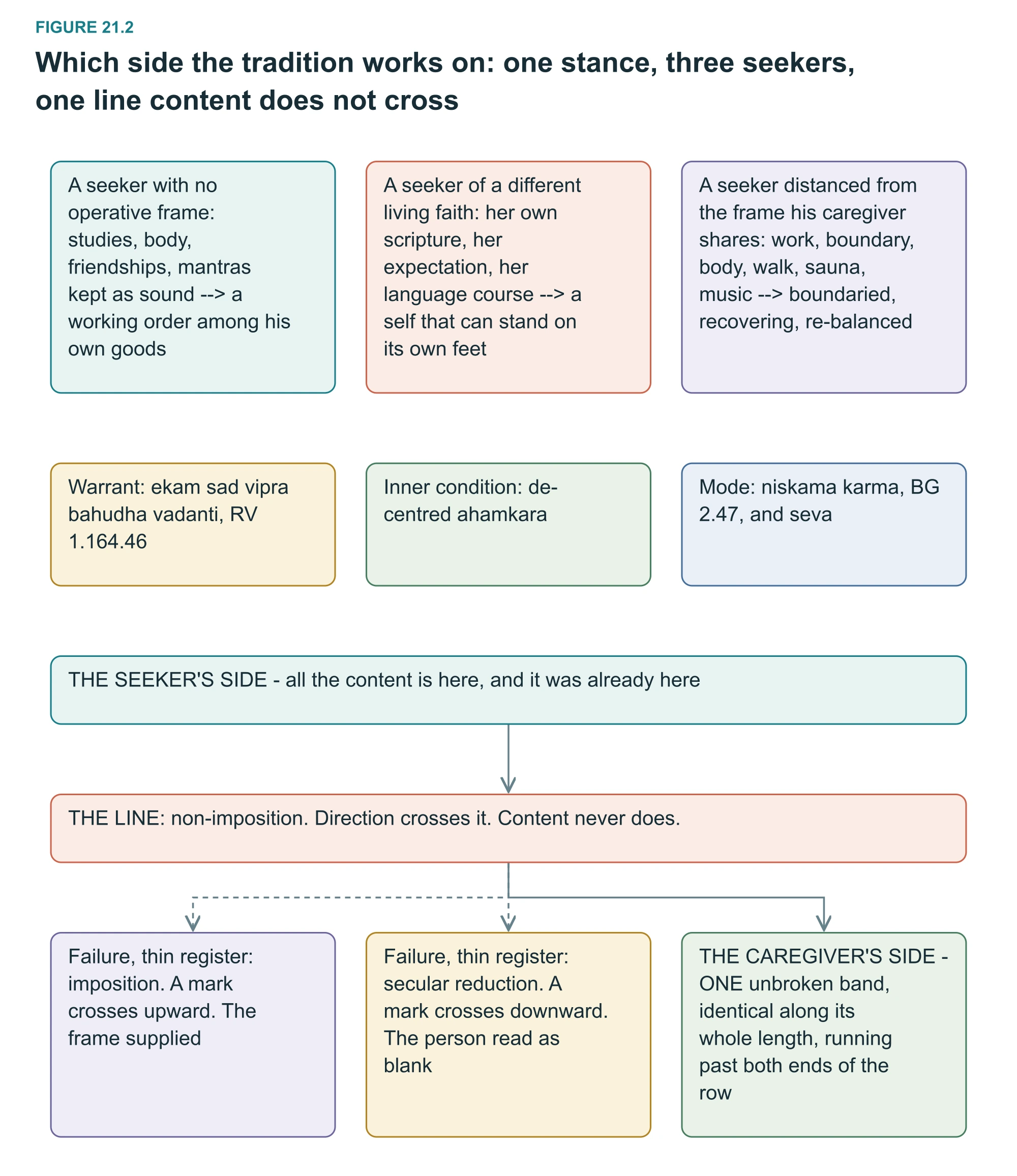
Figure 21.2. Which side the tradition works on: one stance, three seekers, one line content does not cross.
Table 21.3. What to ask, and what to refuse to do with the answer.
The move, and what it is for | What to ask, in the seeker's own words | What the answer licenses you to do | What to refuse, and the name of the error | The tell that you have already crossed |
|---|---|---|---|---|
1. Surface the frame, or its absence - so that a life without a religion registers as full rather than blank | What matters to you? Who are your people? What are you trying to hold together at the moment? | Work from what they said, in the words they used, and treat those words as the whole of what you have been given | Refuse to score the answer against a screen of beliefs, practices and a faith community, and refuse to hear none as a deficit. The religion-default, and the deficit reflex | You could have filled the row in before they spoke, or you have begun looking for the spiritual thing they have not yet mentioned |
2. Inventory what already bears weight - the goods that are load-bearing now, not the ones a frame would predict | What is keeping you going? What would you not want to lose? What did you manage this week? | Take health, work, study, relationships, cultural belonging, a scripture, a routine, a run with friends, as material of equal standing. Nothing is too worldly to be in the inventory | Refuse to partition the worldly from the spiritual and then rank the halves. The bolt-on error. The chapter's fifth claim is that worldly re-grounding can be the care and not a prelude to it | You have set the practical things aside as the social work part and reserved the word spiritual for something else |
3. Fit the resource to the person, and let the fit be theirs to judge - viveka (विवेक, discriminative discernment) applied to the offer | Would you like to try this? Did it help? Shall we drop it? | Offer, watch, and keep what serves. Drop without protest and without a second attempt what does not | Refuse to press, to re-offer what was declined in a different wrapper, or to read a refusal as resistance to be worked with. Imposition by persistence | You have explained why the thing they dropped would have worked if they had stayed with it |
4. Where the frame is a different living faith: strengthen theirs, do not lend yours | Is there anything in your own practice that has helped before? Who from your own community could you talk to? | Point back into their own tradition, name that it holds a path, and refer to someone who can walk it with them | Refuse to supply your tradition's content as her resource, and refuse the opposite retreat into a neutrality that gives her nothing. Assimilation, and its mirror, withdrawal into blankness | The resource you named is one you hold, or you have said nothing at all because you were afraid to say the wrong thing |
5. Where you share the natal frame the seeker has set down: the discipline is sharper, not slacker | What do you want from this, now? | Meet them wholly on the ground they came for - work, body, boundaries, sleep, the things they actually named | Refuse to stage a homecoming, and refuse to read the distance from the tradition as the wound. Shared-tradition over-reach: imposition disguised as homecoming, the most natural and so the most overriding of all | You have said you know this already or your own tradition says, to someone who did not raise it |
6. Align the whole toward a coherence they can own - the direction the asking is for | Where does all this need to get to, for you? What would it look like if these things sat together? | Relate the goods toward one direction the person states and owns, and let the direction be theirs | Refuse to sum. A meaning-inventory plus transferable techniques plus a respectful silence is addition. And refuse to author the direction for them. Summation, and the caregiver's coherence substituted for the seeker's | Their own words have stopped appearing in your account of where this is going |
7. Where the borrowing may be curdling - the commodification and bypass guard, offered as discernment and never enforced | Does this serve the life you are trying to live, or is it accumulating? Does it help you bear what is yours to bear, or help you avoid it? | Name the question alongside them, once, and leave the answer with them | Refuse to police it. Confiscating a practice as mere self-help or forbidding one as bypass is the deficit reflex dressed as critique. Auditing where your standing is to align | You have made a ruling about a practice the person had already decided to keep |
8. Where the body is the idiom - because a nervous system looks like neutral ground and is not | What is your body doing? What do you call this? What do you think is causing it, and what do you most fear about it? | Take the body's account in their name for it, offer breath, rhythm or posture as an offer like any other, and hold your reading correctable | Refuse to treat the physiological description as the neutral ground where all frames meet, and refuse to narrate an anthropology of the body to them as the explanation of their own skin. A frame imported below the level at which it can be declined | You know, from outside, what a settled state would look like for this person; or you have offered touch without asking who may touch |
9. Where the category itself is refused - the seeker for whom spiritual is not neutrally absent but suspect | Would you rather I did not do this? Would you like me to come back? | Withdraw the offer. Then keep the relationship: presence under a wholly secular description, and the health, the work, the study, the people, which they have not refused | Refuse to hunt for a thread they have disowned, and refuse to recast the refusal as itself a covert spirituality. The convert-the-frame move aimed at a door already closed, which violates the self-description in the act of claiming to honour it | You have told someone what their atheism really is; or you have gone, and taken the companionship with the offer |
10. Where the coherence they reach is a settled wish to die, and no tradition stands behind it | What is it that has stopped being able to bear weight? Who else is holding this with you? | Stay. Relate the goods that are there, secular and fragmentary as they are, and see whether anything comes to bear weight that had not before | Refuse both the override and the collusion: neither author his view for him, nor certify a view he reached alone and call the certification respect. And refuse to make yourself the only holder. A verdict about permissibility offered as an answer to the question of his coherence | You have a stake in which way he decides, in either direction; or the divergence is being held by you alone, and nobody else has been gathered |
13. Spiritual-care assessment
The assessment below is written as it would have stood at the end of the fourth session, when enough was known to be useful and the case had not yet resolved.
Meaning and purpose. Held almost entirely in the degree, and stated as such in every session without prompting. Secondary sources: the friendships, and a general sense of himself as someone who is open to things. There is no articulated account of what the degree is for beyond itself, and he was never asked.
Identity and belonging. Mixed parentage, named by him as the reason he is open rather than as a difficulty. Belonging is concentrated in two places, the running group and his aunt's and cousin's house, and is thin everywhere else; his parents do not appear in the record at all. He belongs to the shelter as an address and not as a community, with one exception, the man he shares a room with.
Relationships and community. A room-mate who became a friend and one of the two people who sent him to spiritual care. A monthly running group. An aunt and a cousin. A personal counsellor, a general practitioner, a specialist, a psychologist and a university supervisor, all of them professionals. The ratio is four unpaid relationships and five paid ones.
Values and moral concerns. Persistence, self-reliance and an unwillingness to be defined by any of the things that have happened to him. No moral distress is reported and none is evident. He does not describe himself as a victim of anything, including the cancer.
Hope, fear, grief and suffering. Hope is concrete and short-range: the proposal, the fieldwork, the thesis, the house. Fear is not named. Grief is not named either, and there is a good deal that might have been grieved - the relationship, the flat, the body before treatment, four years of a life. Its absence from the record is a finding and not a fact about him: nobody asked.
Beliefs and worldview. Christian by upbringing, not practising, not believing in any way he could state, and not troubled by any of this. He is not a seeker in the spiritual but not religious sense; he would probably not have used the phrase. What he does hold, functionally, is that things are worth trying and that people differ.
Rituals and spiritual practices. None on arrival. By the end, recorded mantra at night, daily, and a grounding visualisation in ambiguous use. He treats both as things that work rather than as practices belonging to anything.
Sources of strength. The running and the tea afterwards. The aunt's and the cousin's house. The degree. His own account of his openness. The room-mate.
Spiritual distress. Not present in any classical form. There is no crisis of meaning, no anger at the sacred, no sense of abandonment or punishment. What is present is a load without an order, which is a different thing and is not what most instruments are looking for.
Immediate risks. None on the safety register. He was not suicidal and did not present as depressed; no referral on safety grounds was indicated and none was made. The standing risks are attritional: sleep, medication side effects, and an academic deadline with money already spent against it.
Desired form of support. Stated by him at the outset and never revised: anything that helps him sleep, concentrate and finish. He did not ask for meaning and he did not ask about God.
What is known, what is inferred, what is uncertain, and what belongs to somebody else. Known, because he said it: the request, the history, the practices tried and their effects, the value of the running, and what his aunt's house does for him. Inferred: that the shelter itself is a significant part of the load, which follows from what he says about the train and about sleeping in a shared room but is never stated by him; and that the degree is functioning as the organising commitment of his life, which the consistency of his answers supports. Uncertain, and it is a large uncertainty: whether the grounding visualisation helped him, since the record has him saying both that it let him reset and that he was never entirely comfortable with it, and this chapter does not choose between them. Also uncertain: what he meant by pretend, and where else he does it. Belonging to another profession: the hormone regimen and the sleep medication, to medicine; the assessment and management of ADHD and autism, to psychology and psychiatry; the housing application, benefits and debts, to the personal counsellor and the municipality. Spiritual care in this case owns none of the presenting problems and has a legitimate relation to all of them.
14. Approaches and interventions
Six things were done or offered and a seventh was withheld. They are set out with the reasoning each would need before a caregiver used it, because the interest of this case is that the two most defensible interventions in the list - the recording and the run - are the two that look least like spiritual care.
Sustained listening, and the first hour spent almost entirely on it. Why it might be appropriate: a man who has explained himself repeatedly to institutions, each of which wanted one part of him, has good reason to be met by someone who wants none of it. Consent: implicit in his attendance. Relation to his worldview: neutral, which is its virtue here. Benefits: it produced the biography, the request and the disclosure about the friends' practices within four minutes, and it established that nothing was going to be done to him. Harms: an hour that produces no plan can read to an exhausted person as an hour wasted, particularly to someone counting the weeks to a deadline. When not to use: where there is an urgent risk, or where the person has come with a specific practical question that listening postpones.
The grounding visualisation, offered by name in the last minutes of session one. Why: it addressed exactly what he had described, the sensation of carrying the train home. Consent: he agreed, and the setting makes that agreement thin. Relation to worldview: it was offered without any account of where it came from, which is defensible as non-intrusion and questionable as disclosure - a person cannot decline the provenance of something he has not been told the provenance of. Adaptation: it was described in plain functional language, which is the adaptation. Benefits: he used it and continued to. Harms: the record has him uncomfortable with it as well as helped by it, and nobody pursued the discomfort. When not to use: where a person's difficulty is intrusive imagery, and where the caregiver cannot say what the practice is if asked.
Recorded mantra at night, listened to without understanding the words. Why: the presenting problem was sleep, and the offer asked nothing of an attention that had nothing left. Consent: explicit, and given on his own terms - I do not understand Hindi, answered by you do not have to. Relation to worldview: this is the case's most interesting seam. What Winston accepted was sound and rhythm; what the tradition holds a mantra to be is not sound and rhythm. He received something other than what was handed over, and it worked. The honest position is that this is legitimate and that it should be said out loud rather than glossed over: a practice may be received on terms the tradition would not recognise, and the seeker's terms govern, provided the caregiver has not misrepresented what it is. Adaptation: the adaptation was total and was made by him. Benefits: better sleep and a better feeling in the morning, sustained over months, and the single most durable element of the care. Harms: none reported. When not to use: where a person would experience unfamiliar devotional language at night as intrusion, and where the caregiver would be unwilling to say plainly what the recording is if asked.
Breath practice and seated meditation. Why: the standard repertoire for stress and broken sleep, and he had met both through friends before he met Ashwin. Consent: given. Relation to worldview: he was neutral toward them. Benefits: none in this case. Harms: real and immediate. The breathing did not resonate and the meditation produced hyperventilation more than once. This is the contraindication the chapter most wants a practitioner to carry away, and it should be stated in its own words rather than in a footnote. A nervous system that is already taking in more than it can clear does not settle when instructed to hold still, and instruction to attend to the breath can amplify what it was meant to quiet. Overstimulation in an autistic or ADHD adult is not a stronger version of stress and does not answer to what stress answers to. Breath retention, eye-closed practice and sustained attentional fixation all carry specific risk here, as they do in trauma histories, acute anxiety and cardiac and respiratory limitation. The detail of dose, posture and progression belongs to Appendix D and is not restated here. When not to use: on this presentation, and without a way of stopping that the person has been told about in advance.
Positive affirmations against intrusive thought. Why: offered as something portable to put against a specific and recurring difficulty. Consent: given. Benefits: by his own account, used rarely. Harms: none reported, though the standing objection holds - an affirmation offered to a person whose circumstances are genuinely bad can read as a request that he stop noticing them. When not to use: where the thought being interrupted is accurate.
Increasing the frequency of the running. Why: because it was already the most effective thing in his life and was happening once a month. Consent: not really at issue. Relation to worldview: it is entirely his. Benefits: movement, friendship, rhythm and a reason to leave the building, in one activity, sustained without any professional maintaining it. Harms: none, beyond the general risk of a caregiver taking credit for a person's own life. When not to use: where increasing it would displace something else that is load-bearing, or where the activity is being used to avoid something. This is the intervention a reader is likeliest to skip, precisely because it would look like nothing on a record of spiritual care. The caregiver's contribution was four words - make it more often - said in the third session, and a year of paying enough attention to leave it alone.
The intervention that was not made. In session four Winston said he did not have to pretend at his aunt's, and Ashwin received it and moved on. Treating a non-intervention as an intervention is not a trick: the choice not to follow a disclosure is a clinical act with reasons on both sides, and it should be reasoned about like any other. For following it: the man had opened a door on what it costs him to be seen a certain way, and a caregiver who never walks through such a door leaves people alone with exactly the material spiritual care exists for. Against: he had opened it while answering a question about his weekend, he had not offered it as a subject, the two withheld elements of his self-description suggest a man who has been asked to account for himself more often than he would like, and a shelter is not a place where a person can easily decline to answer a member of staff. The case does not settle it. What can be said is that the reasoning above is what a caregiver owes such a moment, and that Ashwin's own account - that he noticed and set it aside - is not quite that.
And the interventions that were never available. No adjustment to the medication, no housing, no extension on the proposal, no quiet room to sleep in. It is worth being exact about this, because a chapter that reads only the offers will overstate what the care did. The largest improvement in Winston's circumstances during the year was a place on a housing list, obtained through an application made by somebody else.
15. Ethical tensions and limitations
Nothing in Section 14 was done improperly, and that is what makes this section necessary. The difficulties in this case are not breaches of anything; they are the conditions the work was carried out under, and a caregiver who waits for a breach before thinking about them will think about them far too late to matter.
Consent, in a building where the caregiver is staff. Nothing compelled Winston to accept anything, and the arrangement was voluntary in every formal sense. It was also asymmetrical in every practical one. A resident whose bed, benefits and housing application are administered by an organisation is not perfectly free to decline an offer from a member of that organisation's staff, and I will try anything is what consent and what exhaustion both sound like. The case handles this without ever naming it, and handles it well, by the accident of the failed meditation: the moment Winston refused something and found that the refusal was accepted immediately and never revisited, the value of his subsequent agreements went up. That is the practical answer to the problem, and it is worth stating as a rule. In a setting where refusal is costly, the caregiver's first job is to make one refusal cheap. Whether it can be done deliberately, rather than by having an offer go wrong, is the open question.
A dual relationship that cannot be dissolved. Ashwin was not Winston's counsellor and had no say in his housing, but he was staff of the same organisation and worked two days a week in the building where Winston slept. Confidentiality was protected structurally - a room with locked connecting doors, chosen so that nothing could be overheard - which addresses being heard and does not address being seen going in. In a shelter of eighty beds, attendance at spiritual care is not private information.
The caregiver's tradition as the only tradition in the room. Every offer Ashwin made came out of a formation Winston did not share, and there was no neutral ground to stand on: withholding everything would have been a decision with consequences too, not an abstention. The chapter's position is that this is a condition of the work rather than a fault in it, and that what governs is whose material the practices are fitted to and what happens when they do not fit. The two places where the position is under strain in this case are the visualisation offered without its provenance, and the mantra accepted on terms that emptied it of its content. Neither is a breach. Both are where a reader should look if they want to test the principle.
Competence, and a caregiver working past the edge of it. Ashwin was not trained in the mechanics of overstimulation in autistic adults, and the case shows him finding this out through an intervention that harmed. He responded correctly - he dropped it, permanently, and did not defend it - and he never sought out what he did not know, either. The refinement of this case makes the point sharply: forcing sustained attentional fixation on an overloaded nervous system works against itself, which is a thing that can be known in advance and was not.
The temptation to explain, and the restraint that also has a limit. Ashwin wanted to explain why the meditation had failed and did not, on the ground that explaining would have been defending the practice rather than staying with the man. That is the right call in the moment. It is not obviously the right call three sessions later, when an explanation would no longer be a defence and might have spared Winston the reasonable inference that contemplative practice is something he cannot do. A caregiver who drops everything at the first difficulty has left the person with whatever they already had.
Two elements withheld from the manuscript. Two things Winston said about himself are in the record, are described there in two ways that cannot both be right, and are not printed in this chapter. The ruling and its reasons are at the end of Section 6. It is repeated here because the ethical point belongs to this section: a case chapter cannot settle a person's self-description from a third party's summary in that person's absence, and a case already specified as narrowly as this one - a postgraduate in a shelter, a cancer survivor, of a described parentage, doing named fieldwork abroad - is not made safe by a changed name.
Dependency, and its absence. The ingredients were present and nothing came of them. Winston kept his own goods at the centre, declined an open invitation to try more, and left with practices he could do without anybody. That outcome is partly the caregiver's doing and partly the man's, and the chapter should not claim more of it than that.
The ending that was not one. The care thinned out. There was no closing conversation, no review of the year, no naming of what remained unresolved, and no formal transfer of anything to anyone. This is extremely common in non-formal care and it is a real loss: the person is left without a marked end to a relationship that mattered, and the caregiver is left without the information that a proper ending produces.
What must remain in human hands, and what could responsibly be supported by technology. The seam into the chapters on technology and care is unusually clean in this case, because the most effective element of the whole intervention was a recording. Winston listened to mantras from a device, alone, at night, without understanding the words, and slept better. Nothing about that requires a caregiver present, and a good deal of what is now offered as digital wellbeing is exactly this: an audio file, a reminder, a breathing prompt. The case therefore concedes a great deal to the machine and then draws the line in an unexpected place. What could not have been supplied by a device is the fitting: the judgement that this man should have sound and not silence, that the breath practice should be stopped and never raised again, and that the intervention with the highest value was one he was already doing. That judgement was made by someone who had spent an hour not offering anything, and it depended on his noticing a monthly run mentioned in passing. A recommender system optimising for engagement would have offered a modified meditation. The other thing no device supplies is the one Winston named himself: a place where he did not have to pretend to be anything other than who he is, which he located in a relative's kitchen and not in the room with the good lamp. Chapters 24 to 27 take up the general form of this question; the local version is that the deliverable part of this care was already technological, and the part that decided which deliverable to use was not.
16. Alternative perspectives
The reading in Sections 12 to 15 is this book's, and it is not the only competent one available. The readings below are set out at their strongest rather than as positions to be answered, and one of them is sharper than anything the chapter has managed in its own voice. The chapter says so where it comes.
Winston's. He would say, and did say, that he came for help sleeping and concentrating, that some of what he was given worked and some of it made him worse, that the man listened to him, and that he finished his degree and got on a housing list. He would not describe the year as spiritual care and might be mildly surprised to find it in a book about it. He would put the aunt and the cousin first, and he would probably resist the whole apparatus of this chapter, on the reasonable ground that he was a man trying to write a thesis.
Ashwin's. He would say that he contributed some sound at night, permission to do more of something the man already did, and a year of paying attention; that this is not nothing and is smaller than the story wants it to be; and that the most useful thing that happened in the case was the intervention that went wrong. He would also, on the evidence of his own notes, still be turning over the moment he did not follow.
The institution's. The shelter would record a resident who used a voluntary service, whose sleep improved, who completed a degree while resident and who moved up a housing list. It would count spiritual care as a service delivered and would have no field for the running or the aunt. It would also, in fairness, point out that it was the personal counsellor who moved the housing application, and it would be right.
The clinical view. A physician would read this as a hormone regimen with a poor side-effect profile in a patient who also needed to sleep, and would want to know why nobody escalated it. A psychologist would read the concentration and the overstimulation as the presenting problems and might reasonably observe that an untrained person ran an attentional intervention on an autistic adult and caused hyperventilation. Both readings are correct and neither accounts for the year.
A Christian reading. Winston was baptised into a tradition that would say he remains within it whether or not he practises, and that what he received - sound at night, company, a table with tea after exertion - has ordinary names in that tradition and could have been offered from inside it by someone who shared his formation. A chaplain of his own upbringing might have asked whether the absence of any felt loss of faith was a settled peace or a subject nobody had opened. That question is not asked anywhere in this case.
A secular or humanist reading. A humanist counsellor would recognise this case entirely and would object to the framing rather than the content. On that reading the man had a stress problem, a sleep problem and a housing problem; what helped was exercise, friendship, rhythm and audio; and calling it spiritual care adds a layer of interpretation the man himself never asked for and did not use. The chapter's answer is not that this reading is wrong about the facts. It is that the reading has no way of saying why the running mattered more than the meditation, and this one did.
A neurodiversity reading. An autistic adult would very likely read this case as another instance of a familiar pattern: a well-meaning practitioner offering a regulation technique designed for a differently built nervous system, the technique going badly, and the person being expected to be grateful for the offer. On that reading the important moment is not that Ashwin dropped the practice but that it was offered at all without anyone having asked what overstimulation actually does. It is the sharpest of the alternative readings and the chapter does not have a full answer to it.
Part IV - Learning from the case
Part III read the case. What follows takes from that reading the part of it that travels: what actually changed over the year and what did not, what a practitioner could carry into a room this book knows nothing about, and what a reader should do with the things here that do not resolve, of which Section 17 lists five. The sections run from the narrowest claim to the widest, and the widest of them is still a claim about one man in one building.
17. Results and conclusions
What changed. Winston slept better, and did so consistently and over months, on the strength of an audio recording he did not understand. He ran more often, which put movement, friendship and rhythm into weeks that had previously had them once a month. He became visibly less braced - his own words were that he felt fitter and could see progress, and his caregiver's were that his face was calmer and his speech less pressured, a change that came in over a year and that no instrument in ordinary use would have registered at either end. He completed a research proposal, flew to another continent and came back. And he acquired, without anyone naming it as an aim, the experience of refusing something offered by a member of staff and finding that it cost him nothing.
What did not change. He was still homeless when the record stops. The medication side effects were unchanged and the record is explicit about it. The pressure of the thesis was unchanged. He had no more privacy, no more quiet and no more control over his hours than on the day he arrived. He was on a housing list, which is better than not being on one and is not a house.
What contributed. In rough order of contribution: two relatives with a spare bed; a monthly run that became more frequent; a recording; a year of sustained attention from someone with nothing to administer; and an application for housing submitted by a personal counsellor. Only two of those five are the spiritual care, and the second of the two consists largely of not getting in the way of the first three.
What remains unknown. Whether the grounding visualisation helped him; the record says both and this chapter does not choose. What he meant by pretend, and where else he does it. Whether the year did anything for him that a good friend and better housing would not have done. Whether the practices survived the end of the care. And whether an ending that had been marked as an ending would have left him differently.
What the case teaches about integrative spiritual care. Three things, and they are stated here as findings from one case rather than as principles, which is Section 18's business. First, an assessment instrument built around belief, practice and community returned a blank for a man whose life was full, which means the blank was a property of the instrument. Second, the interventions with the highest value in this case were a recording and a run - one of them content-free by the time he received it, the other already his - and both would score poorly on any account of spiritual care that measures what the caregiver contributed. Third, the moment that established the relationship was a failure: a practice offered in good faith made him worse, was dropped without argument, and thereby told him more about what this care was than any successful offer could have.
What should not be generalised. Almost everything about the specific offers. Mantra worked for a man who came to a Hindu caregiver through Hindustani friends and arrived already disposed toward the practices; it is not a sleep intervention. The breath practice failed for reasons specific to an overloaded and differently built nervous system, and its failure is not an argument against breath practice. Dropping a failed offer permanently was right here, with three sessions still to come and a man in a dependent position; it would be wrong with a person who needed the same thing offered three times before they could take it. And one case cannot support any claim about what secular people generally need, since this secular person did not experience his secularity as a question at all, and many do.
18. Key learning points
The findings in Section 17 belong to Winston. What follows is the portion of them a caregiver could take into a room he has never been in, put as briefly as it can be put and no more confidently than one case allows.
1. A blank on the form is a fact about the form. Where an assessment returns no belief, no practice and no community, the finding is that the instrument has no field for what this person actually holds. Ask what the person is organising their life around, and record that.
2. Fix the direction before adding to the list. A sum of correct interventions cannot say which of them matters most. Winston said the degree came first, in every session; once that is taken as the horizon, the sleep, the mantra and the running fall into an order, and the meditation that made him worse falls out.
3. A refusal that costs nothing is worth more than an offer that lands. In any setting where the caregiver is also staff, the person's freedom to decline is thin until it has been tested. Make one refusal cheap, early, and do not revisit what was refused.
4. The best intervention is often already in the person's life. Do more of what is already working looks like nothing on a record and was, in this case, worth more than everything brought in from outside. Noticing it is the skill; it took a question in the third session about the rest of his life, and a year of leaving it alone.
5. Carry the contraindication with the practice, not in a footnote. A nervous system already taking in more than it can clear does not settle when instructed to hold still. Overstimulation is not strong stress and does not answer to what stress answers to, and attentional and breath practices carry specific risk for autistic and ADHD adults, in trauma histories, and where there are cardiac or respiratory limits.
6. A practice may be received on terms its tradition would not recognise, and the seeker's terms govern. What Winston accepted was sound and rhythm, not a mantra as the tradition understands one. That is legitimate, provided the caregiver has not misrepresented what it is and would say plainly what it is if asked.
7. A room can be private, warm and confidential and still not be where a person is unguarded. That relief is a property of a relationship, not of a setting, and in this case it was supplied by two relatives with no training and no mandate. Ask not only what helps a person but where, if anywhere, they are already unguarded, and then whether the care can be arranged so as not to compete with it.
19. Reflection questions
These are for answering privately and slowly. Several of them ask about the reader rather than about the case, which is deliberate: what a caregiver notices first in a record like this one is a fact about the caregiver before it is a fact about the record.
1. When Winston said he would try anything, what did you hear - consent, or exhaustion, or both? What in your own formation decided that?
2. Which of the two of them did you find yourself defending as the case went on, and what does that tell you?
3. What did you assume about a man in a homeless shelter before Section 5 corrected it, and how long did the correction take to work?
4. If a practice you valued made someone worse, would you drop it, adapt it, or explain it? Answer honestly, and then ask whose comfort each option serves.
5. Ashwin heard the word pretend and let it go. Would you have followed it? What would have made following it care, and what would have made it an intrusion?
6. The most restorative thing in this man's life was supplied by relatives, for nothing. What does that do to your sense of what you are for?
7. Where in this case would you have felt out of your depth, and what would you have done about it at the time rather than afterwards?
20. Practice questions and activities
These can be done alone, though most are better in a pair or a supervision group, where the distance between two readings of the same page is the whole exercise. Each works on the case rather than about it.
• Write a one-page spiritual-care assessment of Winston as it would have stood after session one, using only what he said in that session. Then write the same assessment after session four, and mark every line that changed.
• Map the case on the Integrative Care Model: the person within family, community, institution, society, nature and the sacred, across the bodily, psychological, social, ethical, existential and spiritual dimensions. Identify which dimensions the spiritual care actually touched and which it left to others, and say whether the division was right.
• List the seven interventions in Section 14 and rank them by value to Winston. Then rank them by how much they would be visible on a service record. Account for the difference.
• Draft the three questions you would ask at the start of session five, given that the care is about to thin out and nobody has said so.
• Write the referral note Ashwin might have sent about the hyperventilation - to whom, saying what, and with what consent.
• Role-play the moment after the failed meditation, twice: once dropping it in silence, once explaining why it failed. Compare what each does to the man's sense of himself.
• Rework the case for a person of a firm and different faith, and again for someone who has told you that they consider spiritual care a waste of public money. Say which of the seven interventions survives each rewrite.
• Identify what information is still missing that you would need before writing any of the above, and note which of it could ethically have been asked for.
• Three of the short cases in Appendix C turn on the question this chapter's three cases turn on, and are the shorter route to it for a group with one session. In A1 a detainee of mixed Christian and Hindu parentage loses his mother to a violent death while inside and asks for the Catholic chaplain, not the Hindu caregiver who has known him for most of his two years inside; in A16 a detainee who cannot be present at the funeral of his partner, who was of another tradition, has no way to say goodbye and no alternative of his own to propose; in B1 a dying woman of eighty-four who went over to Catholicism years ago, because in her reading a widow has no good life in the Hindu tradition, keeps the Hindu caregiver the ward has sent and asks for the conversation in Hindustani. For each, say whether the person's own account of what they were asking for was elicited before it was answered, which is what Section 13 asks of an assessment; name the strategy the caregiver in the case used to cross the difference, in the terms of the sources at Section 21; and say what a caregiver who had read Winston's, Yasmin's or Dennis's case would have done differently, if anything. The instructive result is usually that A16's caregiver, who asked first what the man himself saw as a possible leave-taking and offered nothing until he had no answer, is already doing what this chapter took five sessions to learn.
21. Read more
Nothing below is new to the book. Every work here has been read at first hand and used somewhere in these pages already, and the reason for gathering them again is that this case is a reasonable place from which to begin any of them. Full details are in the bibliography.
Spirituality and spiritual care. Koper et al. (2018) for the broad, deliberately non-religious definition of spirituality that makes a case like this one legible at all. Fuller (2001) for the long history of the unchurched, which is useful against the assumption that the non-religious are a recent problem. Mercadante (2014) for interview-based types of the spiritual-but-not-religious, and for the finding that most of them hold all religions to be the same at their core, which this book declines. Ammerman (2013) for the argument that religious and secular self-descriptions are porous in practice and sharp only as moral boundary-work - the best corrective to reading Winston's Christian by background as a datum.
Hindu and Integrative spiritual care. Bindlish, Nandram and Joshi (2025) for the meta-definition of integrative spiritual care and its religious, philosophical and secular perspectives, which are this chapter's three vectors. Nandram, Bindlish and Joshi (2024) for the inter-philosophical account of chaplaincy in a plural society. Philosophy of the Integrative (Bindlish 2026) for the underlying account of alignment against summation, and for the caution that integral unity is not borderless sameness.
Clinical and contextual literature. Kleinman (1988) for the explanatory model - the person's own account of what is wrong with them, elicited rather than read off a template - which is what Section 13 is trying to do. Tervalon and Murray-García (1998) for cultural humility against cultural competence, and for why arrival is the wrong metaphor. Fitchett and Nolan (2015) for how a chaplaincy case study should be built and what it may and may not claim.
Ethical and professional guidance. Beauchamp and Childress (1979) for the principlist vocabulary a caregiver needs in order to be intelligible to a team they do not lead, and for its limits when the question is direction rather than permission. Liefbroer, Alma and Coppens (2024) for interreligious and inter-worldview chaplaincy, Liefbroer et al. (2017) for the systematic review whose broad definition places the secular seeker inside interfaith spiritual care, and Schipani (2024) for the three strategies by which a caregiver navigates religious difference. Carrette and King (2005) and Purser (2019) for the critique of spirituality sold as technique, which is the standing risk wherever practices are selected and kept as this man selected and kept his.
Scriptural and narrative sources. Ṛg Veda 1.164.46, ekaṁ sad viprā bahudhā vadanti, for the ground on which a caregiver may hold their own tradition without imposing it. Bhagavad Gita 2.47 for action released from its fruit, which is what lets an offer be made and then let go.
One source this chapter needed and does not have. There is no first-hand literature engaged anywhere in this book on contemplative and breath practice with autistic and ADHD adults, and the sharpest of the alternative readings at Section 16 turns on exactly that gap. The contraindication stated at Section 14 rests on this case, on the case's own refinement document and on general clinical caution, which is thinner ground than a printed contraindication should stand on. It is flagged here rather than papered over, and the reading is owed.
That debt marks the end of what this case can be made to yield.
Two further seekers
Winston is carried in full because the discipline is hardest to see where the seeker has no frame at all. The two who follow put the same question from positions he could not occupy, and they are given in short form: a woman with a different living faith, cared for from within it (21.2), and a man distanced from his own natal tradition, cared for without it by the one caregiver who shares that tradition (21.3). Each follows the compact form the chapter used before its anchor case was laid onto the template: Situation → Discernment → Integrative move → Action → Reflection → Transferable principle, Case 21.3 taking action and reflection together in one movement. Whether either of them should be brought onto the template as well, or whether the shorter form is right for a case read as a contrast, is an open question and is flagged rather than settled.
Names and identifying details are anonymised or composited; the underlying cases are drawn from the project's case archive (Cases 002, 012 and 006), and every name used here is a pseudonym written for this book (Note 18). Consent and confidentiality per practice ethics. Figure 21.1, the chapter's opening image, holds the tension the whole chapter turns on and does not resolve it; Figure 21.2 sets the three grounds of Table 21.2 against the single posture the caregiver holds across all of them.
Case 21.2: Yasmin - cared for from within her own faith
[Situation] Yasmin (pseudonym), a woman in her forties of Pakistani origin and a mother of several children, was cast out by her husband and ended up, quite literally, on the street; through the municipality she was placed in homeless accommodation. Her wound is multiple: the loss of her marriage and her settled expectation - formed in her village in Pakistan - of growing old with her husband and children; her husband's new partner; and, hardest of all, that her children do not come to see her - she goes to them, but is unwelcome, and the children, she believes, have been turned against her, with even the authorities taken in. Behind this lies a trauma: her husband once took her to Pakistan, ostensibly on holiday, and abandoned her there without the children; she was helped home through the embassy and, because her children were in the Netherlands, obtained a residence permit. Her social network is thin - a friendship lapsed, her family reachable only by phone in Pakistan. She remains, in the caregiver's reading, within her traditional norms and values, and her faith is intact: she is a Muslim woman, and the question is not whether she believes but how a spiritual caregiver - here working from outside her tradition - can serve her without overriding it.
[Discernment - 4H / K1-K4] The heya is not Yasmin's faith, nor her traditional frame, as something to be modernised or replaced, but the dis-integration of a life that has lost its entire structure (husband, children, home, country-of-belonging) and a self that has only ever stood in relation to her husband - a dependence that now leaves her without ground. The heya-hetu is the conjunction of her traumatic abandonment and deracination with that lifelong dependence: she has no practised capacity to stand on her own, no language fluency, no work, and a frame (the village expectation of growing old within an intact family) that the facts have shattered. The acute heya-hetu for the caregiver is the standing temptation of cross-tradition care - to assimilate her to the caregiver's own idiom, or, conversely, to withdraw into a 'neutral' secularity that gives her nothing. The hāna (desired state) is a Coherent View Yasmin can own from within her own faith and her own agency: not a new worldview, but a re-grounded self that can stand on its own feet, recover her children's contact by recovering her own footing, and hold her losses within a meaning her own tradition supplies. The hānopāya (means): listening and reflection that strengthen her awareness and capacity (self-development as the vehicle); concrete worldly re-grounding (the language course, the prospect of work and her own home); and - the decisive, counter-intuitive move - the caregiver pointing her back toward her own resources, advising her to listen to the Quran for her sleeplessness, so that the spiritual comfort comes from within her faith, not from the caregiver's. In K1-K4 terms, the social and legal facts (K1) and the standard psychosocial-support and self-development protocols (K2) are necessary; the work runs at K3 (entering Yasmin's own meaning-world - her faith, her grief, her village expectations, her motherhood) and reaches toward K4 (a settled standing-on-her-own that her own tradition can name and bless; the caregiver cannot administer it and, sharing neither her faith nor her frame, cannot even name it in the tradition's terms - Yasmin must reach and name it from within Islam).
[Integrative move] Alignment-not-summation, with non-imposition in its sharpest interfaith form. The caregiver does not assemble a self-development plan plus a borrowed relaxation technique plus a vague spirituality (the additive error), and - the rarer discipline - does not offer Hindu content to a Muslim woman, nor secularise her faith away. The Integrative move is to relate every thread - her abandonment and trauma, her lost children, her dependence, her faith, her village frame, her residence and her future - toward a coherence Yasmin can own as a Muslim woman recovering her own agency. The differentia made concrete: a Coherent View aligned from her own goods and her own faith, the caregiver strengthening her access to her tradition rather than supplying one - directional, not a summation of services, and emphatically not a quiet transfer into the caregiver's frame (Chapter 4). This is the inversion of Case 21.1 made vivid: where Winston has no frame and the caregiver helps him build coherence from secular and selected goods, Yasmin has a full frame and the caregiver helps her return to it - the same non-imposition discipline, opposite vectors. The Dharmic resource is, once again, on the caregiver's side: ekaṃ sad viprā bahudhā vadanti (ṚV 1.164.46, Principle 1) is the explicit warrant for sending a Muslim woman to the Quran - her way is a way of speaking the one truth, and the caregiver has no standing to override it; de-centred ahaṃkāra (Principle 4) is what makes the self-effacing move possible; the caregiver's own note that encouraging self-development is itself a way of working interreligiously - so that people can, 'from their own faith conviction', be willing to receive spiritual care - is precisely the Integrative stance stated in the practitioner's own words.
[Action] The strengthening of Yasmin's own ground, by both worldly and faith-internal means. Listening, attention and reflection 'on the basis of Western perspectives' (the caregiver's own description), aimed at awareness and at the encouragement of self-development - not as a substitute for her faith but as the recovery of an agency her lifelong dependence had never allowed. Concretely: support toward the language course (which she completes and passes), toward the prospect of work and her own home (which the municipality holds out, and which gives her hope), and toward the small re-openings that follow - her contact with her children improving as she becomes, in the caregiver's words, 'happier and somewhat more positive', the outer change following the inner work. And, as the signature faith-internal move: the advice to listen to the Quran for her sleeplessness, and positive affirmation and visualisation offered only as far as they sit comfortably beside her practice - the spiritual comfort routed through her own scripture. What is refused: any offer of the caregiver's own (Hindu) content as her resource; any secular 'self-development' that would quietly displace her faith; any pressure to abandon her traditional frame; and any pretence that worldly re-grounding (language, work, housing) is separate from the spiritual care - it is, here, the very form the care takes.
[Reflection] This case states the cross-cultural / interfaith and non-imposition disciplines in their hardest and most instructive form. Three things govern it. First, the caregiver works from within Yasmin's own faith, not from their own: the advice to listen to the Quran is the paradigm of strengthening the seeker's own resources, and it is warranted directly by ekaṃ sat (ṚV 1.164.46) - her way is valid, and the caregiver's standing is to align, not to override. Second, self-development is here a spiritual intervention, not a secular substitute for one: for a woman who has only ever stood in relation to her husband, the recovery of her own agency is the re-grounding of a self that can then hold its losses and its faith - and the caregiver's own gloss (that encouraging self-development is a way of acting interreligiously, freeing people to receive care from within their own conviction) states the Integrative principle exactly. Third, the case is the inversion of Winston's and with it sets the chapter's bracket: Winston has no frame and builds coherence from secular and selected goods; Yasmin has a full frame and is returned to it - the same discipline, opposite vectors, both refusing imposition. The standing risks the case surfaces, flagged for the cluster, are the propriety and competence of a caregiver of one faith recommending the practice of another (does the Hindu caregiver know enough of Islam to point well?), and the danger that 'self-development' becomes a covert Western individualism imposed on a woman whose traditional frame is her own to keep.
[Transferable principle] With the cross-cultural seeker of a different living faith, care from within her own frame, not yours: strengthen her access to her own resources - even pointing her back to her own scripture and practice - rather than supplying yours, and let ekaṃ sat (one truth, many ways) be the explicit warrant that her way needs no overriding. Treat the recovery of agency - self-development, language, work, a home - as itself spiritual care for one whose self has had no ground to stand on, not as a secular substitute for it. Hold your own tradition on your side as the stance (ekaṃ sat, de-centred ahaṃkāra) that makes the self-effacing move possible. And watch two risks: that you may lack the competence in her tradition to point well (consult, refer, stay humble), and that 'self-development' can smuggle in an individualism that overrides a traditional frame she has every right to keep.
Case 21.3: Dennis - a distanced son of his own tradition, cared for without it
[Situation] Dennis, a banking professional in his thirties, is a Hindu by birth who, in the case record's own words, 'keeps a distance from his faith and traditions': he 'respects heydays and customs, but does not actively participate in them himself'. His network is small - few friends, little contact with family. An active man (gym, cycling, walking), he developed a tendon injury in his arm after a long spell of high work pressure compounded by a new and manipulative team leader who, even after Dennis reported sick, kept pressing him to return to full duties and ignored the medical advice; the result was overstimulation, physical complaints and mental exhaustion. He comes to a Hindu spiritual counsellor not for his faith but to 'learn how to handle the situation better', to be 'stronger towards' his team leader, and to 'regain control over' his life. Across the sessions the counsellor offers assertiveness against the manipulation (naming the tactics, the 'I-message', the calm restatement of a boundary), stress regulation (the 4-7-8 breath, a beach visualisation, progressive muscle relaxation), the structuring of Dennis's own restorative goods (the daily walk, the sauna, cycling, music), and concrete re-grounding at work (an adjusted schedule, more sedentary tasks, a prepared conversation with the company doctor and manager). Dennis keeps what fits and adds, tentatively, 'maybe meditate occasionally, if I can find the peace' - to which the counsellor answers, 'start small, two minutes a day'. He ends more boundaried and a little calmer, his recovery in the source's words 'not yet complete' but now equipped.
[Discernment - 4H / K1-K4] The heya (what is to be discerned and worked with) is not Dennis's distance from Hinduism as a lapse to be repaired, but the dis-integration of a life under injury, exhaustion and an unjust pressure, with no settled capacity to hold it. The heya-hetu (cause) carries a temptation sharper here than in either preceding case: the caregiver shares Dennis's natal tradition, and the religion-default would whisper that the cure is to bring a distanced Hindu home to his roots - imposition disguised as homecoming, the most natural and so the most overriding of all. The hāna (desired state) is a Coherent View Dennis can own as the distanced, secular-leaning man he is: boundaried against the manipulation, recovering in body, re-balanced between work and rest. The hānopāya (means): assertiveness and boundary-setting (a worldly good, the standing firm against an adharmic pressure that the source frames as safeguarding 'your own boundaries and well-being', not winning a confrontation), the regulation of stress, the structuring of his own restorative goods, and viveka (विवेक, discriminative discernment) to fit each tool to the man - the two-minute meditation taken on trial, nothing pressed. In K1-K4 terms, the medical and occupational facts (K1) and the assertiveness-and-relaxation repertoire (K2) are necessary and, unlike Winston's failed breathwork, here largely land; the work runs at K3 (entering Dennis's own world of pressure, his guilt at burdening colleagues, his wish to stay engaged without breaking) and reaches toward a K4 (a settled steadiness) that is Dennis's own to reach and name.
[Integrative move] This is the purest instance of the chapter's structural inversion - tradition governs the caregiver's stance, not the seeker's content. A Hindu counsellor, caring for a fellow if lapsed Hindu, offers none of his own tradition's content: no mantra, no scripture, no re-initiation, only the secular tools of resilience and the seeker's own restorative goods. Where with Winston (21.1) the caregiver's restraint is the restraint of not converting a stranger, here it is the harder restraint of not re-claiming one's own. The differentia made concrete: a Coherent View aligned from Dennis's own goods and pointed at the life he wants to keep living, neither a summation of techniques (the integral/additive error, Chapter 4) nor a homecoming engineered for him. The Dharmic resources work wholly on the counsellor's side - sevā (सेवा, selfless service) and niṣkāma karma (निष्काम कर्म, action without attachment to its fruit, BG 2.47, Principle 4) as care without a re-conversion-fruit; de-centred ahaṃkāra (अहंकार, the ego-sense of being the doer, Principle 4) as the inner condition that lets a caregiver hold his shared tradition lightly enough to withhold it. The counsellor's reframe of Dennis's reduced output - 'not a matter of "not wanting to", but of "not being able to do it at the moment"' - is itself the de-centring of guilt, the loosening of a false self-as-failing-doer.
[Action / Reflection] The experimental, fitting work across the sessions, with Dennis's response sovereign throughout: assertiveness rehearsed against the team leader's tactics and tried 'at the next meeting'; the 4-7-8 breath and the beach visualisation kept because they soothe; the sauna, cycling, music and daily walk structured into a routine rather than displaced by 'spiritual' content; meditation added only as a two-minute trial. What is refused: any appeal to Dennis's natal Hinduism as the lever of his recovery; any reading of his distance from faith as the wound; any technique pressed past its fit. The case completes the chapter's bracket as a third vector: Winston has no operative frame and builds coherence from secular and selected goods; Yasmin has a full and different frame and is returned to it; Dennis stands at a distance from his own natal frame, and the caregiver who shares that frame cares for him entirely without it. The standing risk it surfaces, flagged for the cluster, is shared-tradition over-reach - the particular ease with which a caregiver may import a tradition the seeker was born into but has set down.
[Transferable principle] When you share the seeker's natal tradition but the seeker has set it down, the discipline is sharper, not slacker: do not stage a homecoming. Read the distanced believer neither as a lapse to repair nor as a blank, but as a person whose coherence is to be assembled from the goods they actually own - work, body, boundaries, the few practices that fit - and align those toward a Coherent View they can own as the distanced person they are. Let assertiveness and worldly re-grounding be the spiritual care where that is what the life needs, and hold even your shared tradition on your side, as the sevā and de-centred ahaṃkāra that let you withhold what you could so easily impose.
Table 21.2 is the chapter's one-page form of that discipline, and it is written to be used without the chapter: a caregiver who reads only the table should be able to place the person in front of them and know what the next move is and what the characteristic error would be.
Table 21.2. Three grounds a caregiver does not share, and what each asks of them.
The person in front of you | What a standard reading records | What it therefore misses | What the caregiver does instead | The error this guards against |
|---|---|---|---|---|
No operative religious frame. Secular by conviction or simply by life; may borrow a practice if it works. | No tradition, no practice, no faith community: the fields are blank. | A dense working world of meaning - the qualification being finished, the body being steadied, the friends, the routine - that the instrument has no field for. | Align the goods the person already holds toward an order they can own and operate as the secular person they are. Offer practices as theirs to keep or drop. | Reading blankness as emptiness, and filling it. The offer becomes a quiet campaign. |
A different living faith. The frame is intact, load-bearing, and not yours. | The tradition, correctly named, and the caregiver logged as a mismatch. | That the person's own tradition already holds the answer being looked for, and that the caregiver's job may be to point at it rather than supply anything. | Send the person back into their own frame, with the specific thing named. Ask what their tradition says before offering what yours does. | Supplying your own content because it is the content you have. Also its mirror: referring the person away when you could have accompanied them. |
Distanced from a natal tradition, which happens to be yours. Respects it, does not practise it, did not come about it. | A shared tradition, and therefore a shared frame: the easiest match on the form. | That the shared tradition is precisely what the person has set down, and that your recognising it is not the same as their wanting it. | Work in wholly secular terms and leave the tradition unnamed, even where it would fit. Especially where it would fit. | The homecoming nobody asked for. A Sanskrit name put on something that was working fine without one. |
Three cautions attach to the table and are not optional. The rows are situations, not types, and one person moves between them within a single course of care. The last column is the useful one: the errors are what a competent, well-meaning caregiver does, not what a careless one does, which is why they are worth printing. And none of the three rows licenses assessment by category - the row is a guess to be given up the moment the person says otherwise, and the person's own response is sovereign over anything in this table.
What the cluster teaches
Across the three seekers - the secular man with no operative frame who borrows what fits, the Muslim woman of a different living faith cared for from within it, and the distanced Hindu cared for without the tradition he shares with his caregiver - the cluster makes sixteen claims, each a thread back to the foundations (the book's Part I) and the practice chapters (the book's Part II).
First, secular and cross-cultural care is the alignment of the seeker's own goods toward the seeker's own Coherent View, never the supply of a frame and never the reduction of the non-religious to nothing. The three cases bracket the setting between them, and each refuses the two opposite errors the setting invites: imposition (supplying or smuggling in the caregiver's tradition) and secular reduction (treating the non-religious person as having no care-able inner life). The Integrative reading completes the field's own move from the religion-default toward broad, non-religious definitions of spirituality (Koper et al. 2018; the SBNR literature, Fuller 2001, Mercadante 2014, Ammerman 2013) by supplying the direction those definitions leave open: not 'whatever gives you meaning' affirmed indiscriminately, but the seeker's own goods related toward a Coherent View they can own (Chapter 4). This is the integral-not-Integrative line drawn inside secular care - a meaning-inventory plus transferable techniques plus a respectful silence is addition; relating the seeker's own goods toward a Coherent View is alignment (Chapter 4).
Second, non-imposition is the chapter's spine, and it is the direct entailment of ekaṃ sat, not a liberal scruple bolted on. Ekaṃ sad viprā bahudhā vadanti (ṚV 1.164.46, Principle 1) means that a secular way, a Muslim way and a Christian way are ways of speaking the one truth, no observation among them invalid, so the caregiver has no warrant to override the seeker's frame with their own. Non-imposition therefore falls out of the Dharmic resource itself (cross-ref Ch 4 §4; Ch 8) rather than being imported as an external rule of professional neutrality. It cuts in more than one direction: for the no-frame seeker, do not supply one (Winston); for the different-frame seeker, strengthen hers (Yasmin, sent to the Quran); for the seeker who has set his own frame down, do not pick it up on his behalf (Dennis). The same discipline, three vectors. The reading is decidedly not the perennialist 'all religions are really one' that would dissolve the seeker's particularity into a synthetic unity (refused in Philosophy of the Integrative, Bindlish 2026); it is that diverse frames are valid as diverse, and so may not be flattened or overridden.
Third, the caregiver's tradition governs the caregiver's stance, not the seeker's content - the chapter's structural inversion. Unlike every preceding chapter, the Dharmic resources here work almost wholly on the caregiver's side of the encounter: ekaṃ sat as warrant, de-centred ahaṃkāra (Principle 4) as inner condition, sevā and niṣkāma karma (BG 2.47) as care without a conversion-fruit, vasudhaiva kuṭumbakam as welcome (tempered by the Differentia-1 caution that Integral Unity is not borderless sameness, Philosophy of the Integrative, Bindlish 2026). The content is the seeker's own - Winston's mantras and running, Yasmin's Quran and recovered agency. This is what lets a caregiver of one tradition serve a secular or differently-faithed person with integrity, and it is why the chapter's resources connect first to Ch 5 (the caregiver's formation) and to the praxeology on which action follows embodied knowing, without doership (Philosophy of the Integrative, Bindlish 2026), before they connect to any content the seeker receives. Case 21.3 states this most starkly: a Hindu caregiver, caring for a distanced Hindu, offers none of the tradition they share, withholding by sevā and de-centred ahaṃkāra what would have been the easiest content of all to supply - the inversion holds even when caregiver and seeker were born to the same frame. The published category already contains all three encounters: the one systematic review of the empirical literature defines interfaith spiritual care broadly as any situation in which caregiver and patient hold different spiritual, religious or non-religious worldviews, its own example being a Catholic nurse and an agnostic patient, and it reports that for most patients the caregiver's religious orientation does not play a major role in spiritual caregiving, though it may for a minority - with the caution, which this cluster takes as its own, that only five of the twenty-two studies asked a patient at all and that the authors draw no definitive conclusion (Liefbroer et al. 2017, pp. 1777, 1784, 1790). Figure 21.2 is this inversion drawn: the three grounds of Table 21.2 across the page, and the tradition shown on the caregiver's side of each encounter rather than in the space between the two chairs.
Fourth, the seeker's own response is sovereign, and selectivity is the form of non-imposition. Winston keeps the mantras and drops the hyperventilating breathwork; Yasmin takes the self-development and the Quran; Dennis keeps the breath and the boundary and leaves the meditation at two minutes on trial. That practices are kept or left by the seeker is not a defect of the offering but its right form - ekaṃ sat at the scale of a single life, and the viveka (Ch 6) that fits resource to person. The counsellor's recognition that 'everyone reacts or experiences differently' is this principle stated in a practitioner's own words: the caregiver offers, the seeker disposes (links to Ch 6, discernment; Ch 5, the caregiver's stance). The standing risk the discipline must guard is commodification - the reduction of borrowed practice to a kit of self-help techniques accumulated for their own sake - and the test against it is whether each kept practice genuinely serves the seeker's coherence or merely adds to a heap.
Fifth, worldly re-grounding and selected practice can be the spiritual care, not a prelude to it. For Yasmin, the language course she completes and passes, the prospect of work and a home, and the recovery of an agency her lifelong dependence had never allowed are the spiritual care for a self that has never had ground to stand on; the caregiver's own gloss, that encouraging self-development is itself a way of acting interreligiously so that people can receive care 'from their own faith conviction', states the Integrative principle exactly. For Winston, the monthly run with friends and the studies he is determined to finish are woven in as load-bearing goods, not displaced by 'spiritual' content. For Dennis, the adjusted schedule, the sauna and the daily walk are not the scaffolding around the care but the greater part of it. The Integrative caregiver does not partition the worldly from the spiritual (the bolt-on error one last time) but relates the whole toward the seeker's Coherent View - the four life-goals held together, artha (अर्थ, the means of prosperity) and kāma (काम, legitimate desire) within dharma (Principle 2).
Sixth, the field's own literature on the non-religious, read at first hand, both vindicates the chapter's refusal of secular reduction and exposes a synthetic-unity temptation the Integrative reading must decline. Four bodies of work the chapter has so far leaned on at second hand are engaged directly here, and together they let the chapter draw its differentia more sharply than a broad definition alone allows. Robert Fuller's Spiritual, but Not Religious (2001) shows that the unchurched are not a recent anomaly but the heirs of a long American 'unchurched tradition' running through Transcendentalism, Emerson, mesmerism and the metaphysical movements of the nineteenth century; the seekers in that tradition hold, on Fuller's reading, a mature and dynamic set of convictions - inner rather than institutional sources of the spiritual, an orientation to this world rather than the afterlife, a felt unity of science and spirit. This is the historical body behind the 'no secular reduction' guard: Winston's borrowing and Dennis's set-down Hinduism are not symptoms of a thin or deficient life but recognisable positions within a structured, centuries-deep way of being spiritual without being churched, and to read either man as empty is to miss a whole tradition. Charles Taylor's A Secular Age (2007) supplies the same point's philosophical form: the secular is not the absence of religion but a condition - the 'immanent frame' within which belief and unbelief alike have become contestable options, and within which the modern self is characteristically 'buffered' against a once-porous openness to the transcendent. The secular seeker inhabits a fullness-seeking condition, not a void; this is why the Integrative move is the alignment of goods that condition already holds, never the supply of a fullness imagined to be missing.
Linda Mercadante's Belief without Borders (2014), built on nearly a hundred in-depth interviews, offers a typology that maps the chapter's cases with instructive precision and one instructive failure: her Dissenters, Casuals, Explorers, Seekers and Immigrants chart the varieties of the non-religious, and Winston sits among the Casuals whose practices are 'primarily functional' - kept for what they do, never committed to as a tradition - while Dennis, the distanced son of his natal faith, sits toward the Dissenter end. Yasmin, by contrast, fits nowhere in the typology, and rightly so: she is not non-religious at all but differently-faithed, which marks exactly the chapter's second axis (the cross-cultural, not the secular) and shows why the two cannot be folded into one problem. But Mercadante's most consequential finding for this chapter is a warning. Her interviewees overwhelmingly reject religious exclusivism, and most affirm that 'all religions are essentially the same at their core' - which is precisely the perennialist, synthetic-unity claim the chapter has refused (Note 2). The first-hand reading therefore sharpens the differentia rather than softening it: ekaṃ sad viprā bahudhā vadanti is not 'all religions are really the same'; it is that one reality is spoken in genuinely different, non-interchangeable ways, each valid as different. The caregiver who mistook Integral Unity for the SBNR's same-at-the-core would dissolve the very particularity - Yasmin's Islam, Winston's secularity - that non-imposition exists to protect (Chapter 4; the Differentia-1 caution, Philosophy of the Integrative, Bindlish 2026). Nancy Ammerman's 'Spiritual But Not Religious? Beyond Binary Choices' (2013) completes the picture by dismantling the either/or itself: her discourse analysis finds four cultural 'packages' through which people actually construct the spiritual - theistic, extra-theistic, ethical, and a contested belief-and-belonging package - and shows that the empirical boundary between 'spiritual' and 'religious' is porous while the moral and political boundary is sharp, so that to call oneself 'spiritual but not religious' is to do 'moral boundary work', not to report a clean fact about one's inner life. This is directly useful at the bedside: Winston's 'Christian by background but secular' is exactly such a porous, boundary-working self-description, and the caregiver who hears it as a hard datum - 'not religious, therefore nothing spiritual to care for' - has mistaken a moral boundary for an empirical one, the religion-default error in its subtlest form. Finally, Fitchett and Nolan's Spiritual Care in Practice: Case Studies in Healthcare Chaplaincy (2015) warrants the chapter's own method: their volume gathers nine paediatric, psychiatric and palliative cases, each followed by critical commentary from chaplaincy, psychology, psychiatry and nursing that names the deficits and missed openings the writing chaplain did not see. That external-review discipline is the published analogue of this chapter's practice of closing each case with a frankly-stated standing risk (commodification, cross-tradition over-reach, shared-tradition over-reach) - the case held open to critique rather than offered as a success story. The Integrative case method and the chaplaincy case-study movement thus share a conviction: that practice knowledge is built and tested in the disciplined, self-critical reading of singular encounters, not deduced from a protocol.
Seventh, the chapter's three vectors are precisely the three perspectives the project's own published meta-definition of integrative spiritual care sets out to hold together, and reading that definition at first hand both warrants the chapter and sharpens its differentia. The authors have, in Understanding and Defining Hindu and Integrative Spiritual Care (Bindlish, Nandram & Joshi 2025), a peer-reviewed meta-definition arrived at by design-science research and the classical Tarka method of iterative argument and counter-argument, and validated by Hindu spiritual-care practitioners against ten real cases from their own practice (Note 7). Its meta-definition reads: integrative spiritual care is 'a holistic approach that synthesizes religious, philosophical, and secular perspectives to provide comprehensive support for individuals' spiritual well-being', a definition 'intentionally inclusive and adaptable' so as to be applied 'across different cultural and religious settings while preserving the integrity of each individual's beliefs' (Bindlish, Nandram & Joshi 2025, 173). The three perspectives it names - religious, philosophical, secular - are not an idle list: they are the very axes this chapter's three seekers fall along. Yasmin (21.2) is the religious perspective, a Muslim woman of a living faith; Dennis (21.3) is the philosophical perspective, a man who 'respects heydays and customs, but does not actively participate', holding his natal tradition at the distance of a considered stance rather than a practice; Winston (21.1) is the secular perspective, the culturally-mixed, Christian-by-background but essentially non-religious seeker. The chapter is, read against the meta-definition, the bedside enactment of exactly the three-fold scope the definition stakes out - which is the strongest possible warrant that the cluster's seekers are not an arbitrary trio but a deliberate spanning of the field's own declared range.
The meta-definition also supplies, at first hand, the non-imposition spine the chapter has until now drawn only from ekaṃ sat. The paper's generic integrative definition specifies care offered 'using spiritual and/or religious practices compatible with one's own worldview that help one connect with one's existential beliefs on the meaning and/or purpose of life' (Bindlish, Nandram & Joshi 2025; emphasis added) - the seeker's own worldview, not the caregiver's, is the measure of what may be offered, which is the structural inversion of the third claim stated in the project's own published terms. And the clause 'preserving the integrity of each individual's beliefs' is the same non-discarding commitment the chapter has called non-imposition: the integrity of each belief is kept, Winston's secularity and Yasmin's Islam alike, neither flattened into the caregiver's frame nor dissolved into a common essence. The paper makes the practical repertoire explicit too, carrying over Schipani's (2024) three strategies for navigating religious difference - the seeking of common ground, collaborative accommodation, and the caregiver's judicious code-switching - 'for judicious use throughout the steps of the care process' (Bindlish, Nandram & Joshi 2025). These are the named moves behind what the cases show without naming: the Hindu caregiver who sends Yasmin back to her Quran is code-switching into her idiom and accommodating her frame; the counsellor who meets Winston on the common ground of sleep, stress and study seeks common ground rather than converting it.
The first-hand reading does, however, expose one term that must be read with this book's differentia firmly in hand, and saying so is itself the sharpening. The meta-definition's verb is 'synthesizes', and synthesis - a summing of perspectives into a new third thing - is exactly the integral-not-Integrative move this book defines itself against (Chapter 4; Philosophy of the Integrative, Bindlish 2026). Taken alone, 'synthesizes religious, philosophical, and secular perspectives' would describe a caregiver who melts the three into a hybrid spirituality - the very 'all religions are essentially the same at their core' the sixth claim refused. But the definition does not stand alone: its own second clause, 'while preserving the integrity of each individual's beliefs', is incompatible with synthesis in the summative sense, for one cannot both melt the perspectives together and keep each one's integrity intact. The two clauses are reconciled only if 'synthesizes' is read as this book reads it - as alignment toward a Coherent View without discarding any (Chapter 4), the holding-together that keeps each perspective whole and standing rather than the blending that consumes them. This is precisely the continuation-and-sharpening the project intends: the published meta-definition gives the field a holistic, inclusive scope, and this book's intent-based definition supplies the directional reading - synthesis as alignment, not summation - that the 'preserving the integrity of each individual's beliefs' clause already demands. The caregiver who reads the meta-definition's 'synthesizes' as summation would, at the bedside, do the one thing the whole chapter forbids; the caregiver who reads it as alignment does what Winston's and Yasmin's and Dennis's caregivers actually did. **
Eighth, where the seeker refuses the very category of the spiritual, non-imposition reaches its own limit and respectful withdrawal becomes the care - but withdrawal without abandonment, the offer set down and the door left open. The chapter's spine has so far been tested against three seekers who each, in their way, still permit the work: Winston borrows, Yasmin returns to her own faith, Dennis is met on wholly secular ground. Its hardest case is the seeker the archive does not supply but every practitioner meets - the one who does not merely lack a frame or hold one elsewhere but positively rejects the category, for whom 'spiritual' is not neutrally absent but suspect, and an offer of spiritual care is an intrusion to be declined. Charles Taylor's A Secular Age (2007), engaged above for the immanent frame, names this seeker's position precisely: within that frame some dwell in a closed world structure and hold an exclusive humanism that forecloses transcendence not by oversight but by conviction - the buffered self at its most fortified, sealed by choice against the porousness the spiritual would presume. This is not the fullness-seeking secular of the sixth claim, whose inner life is full rather than blank; it is the seeker who has heard the category named and refused it. Linda Mercadante's (2014) Dissenters, defined by what they set themselves against, mark the near edge of this type, and the practitioner will meet its sharper, sometimes militant pole.
Here the field's own better instincts and the Integrative discipline converge on restraint. Good spiritual care has always held that the right to decline it is part of it - that assessment must leave 'no' a real and unpenalised answer, and that Fitchett and Nolan's (2015) case-critique conscience cuts as much against the chaplain who presses an unwanted presence as against the one who misses an opening. The published cases of the same series show the restraint at work: Roberts (2018, pp. 168, 182), a hospital chaplain caring for a colleague who had not been inside a church for years, sets out to meet the need in front of her rather than mould the person to her own spiritual stance, and dates the relationship's turning point to the moment Daisy trusted that support would come 'without the pressure to conform to a frame of religious expression' she did not share; and Hanson (2018, p. 100), reviewing a single visit with a veteran estranged from her church, counts as the visit's one lapse not any spiritual offer withheld but the grief the veteran had herself named as her concern and the chaplain left under-attended - the critique cutting, precisely, against the presence that overrides the seeker's own agenda. The Integrative reading gives this restraint a warrant deeper than professional courtesy. Ekaṃ sad viprā bahudhā vadanti (ṚV 1.164.46, Principle 1) makes the refusal of the category itself a perspective that may not be discarded or overridden - the one truth is spoken in many ways, and a convinced 'there is nothing here to care for spiritually' is one of the ways it is spoken. To press on - to hunt for a spiritual thread the seeker has disowned, or to recast the refusal as itself a covert spirituality ('your atheism is your faith') - is the deficit reflex in its final costume, the 'convert the frame' move now aimed at a person who has explicitly closed it, and it violates the seeker's self-description in the very act of claiming to honour it (the synthetic-unity error of the second and sixth claims, one storey up). Non-imposition, the chapter's spine, therefore entails that at this limit the caregiver withdraws the spiritual offer - and does so not as defeat but as the discipline's completion.
Yet withdrawal is not abandonment, and the distinction is the whole of the Integrative residue at the limit. The discipline of holding a limit without sliding into either premature closure or abandonment is Chapter 10's - the caregiver who neither forces meaning nor deserts - and it is imported here intact. The caregiver withdraws the frame, not the relationship: presence remains, offered now under a wholly secular description, and because the Integrative refuses to partition the worldly from the spiritual (the fifth claim), there is almost always something still care-able that the seeker has not refused - the health, the work, the study, the relationships, Winston's monthly run with friends - aligned toward the seeker's own coherence without ever the contested word. Respectful withdrawal is thus rarely a total withdrawal: it withdraws the imposition and keeps the companionship, leaves the door unlatched, and holds the caregiver ready to be recalled. Where even the worldly companionship is refused, the residue is barer still - availability rather than activity, a silent presence and a standing readiness to return - but it is not nothing, and it is not the shrug of secular reduction ('no religion here, then, nothing to do') that would abandon the person the moment the label failed.
The Dharmic resources that the third claim placed on the caregiver's side are exactly what make this withdrawal possible without wound. Niṣkāma karma (निष्काम कर्म, action without attachment to its fruit, BG 2.47) and sevā (सेवा, selfless service) let the caregiver offer and then release the offer when it is declined, so that the refusal lands as an honourable and complete answer rather than a personal failure; and the de-centred ahaṃkāra (अहंकार, the ego-sense of the doer, Principle 4) is what keeps the caregiver from the two ego-driven errors the refusal tempts - pressing harder to win the frame, or retreating in pique. The caregiver's adhikāra (अधिकार, fitness or standing) reaches here its own honest edge: the standing is to align what the seeker owns, and where what the seeker owns is a refusal, the alignment can be offered but never administered - the K4 point of the chapter (a realised coherence is formable, not deliverable) pressed to its furthest instance, for here even K3, the seeker's own meaning-horizon, may be one the seeker declines to open to the caregiver at all. The near-match to hold the differentia against is the purely secular counsel of professional neutrality - 'respect autonomy, note the decline, move on'. The Integrative withdrawal is not that indifference: it does not close the file but leaves the relationship open and the door unlatched; it neither reduces the person to a blank now that the category has failed (the sixth claim's guard) nor overrides the refusal by baptising it as hidden spirituality (the second claim's guard). It sums nothing and calls the sum care (the integral-not-Integrative line, Chapter 4, drawn even at the vanishing point); what it holds, when almost everything else has been set down, is the a priori intention toward the seeker's own Coherent View - kept alive as an open door even where its spiritual expression is exactly what the seeker has refused, without discarding that refusal (Chapter 4). Winston's own micro-refusals rehearse the posture in miniature: the breathwork that 'caused him to hyperventilate' was offered and set down without protest, and 'I don't understand Hindi, but I am willing to listen' is a seeker disposing of the offer on his own terms - the same structure that, at its limit, becomes the refusal of the category itself. The neighbouring case is Hermine (Case 007, carried by Chapter 10), whose inherited faith collapses rather than being militantly refused; the anti-spiritual seeker is the further pole of the same axis, and the two mark the boundary at which this chapter hands the general discipline of the limit back to Chapter 10.
Ninth, the cross-cultural axis proper - the migrant or diaspora seeker whose culture the caregiver does not share, or only appears to - is held not by cultural competence but by cultural humility, and the Integrative supplies the direction that humility alone leaves open. The chapter's title names three registers - secular, non-religious and cross-cultural - but its three cases fall mainly along the first two: Winston is secular, Yasmin is differently-faithed, Dennis is distanced from his natal frame. The cross-cultural register in its own right - the seeker formed in a culture other than the caregiver's, the migrant, the second-generation child of a diaspora, the refugee whose idiom of suffering the caregiver has never inhabited - is the register the chapter has so far deferred, and it turns on a hazard the secular and interfaith registers do not fully expose: the caregiver's own cultural location, taken unawares as the measure of what is normal. Two bodies of clinical work name the hazard and its remedy. Arthur Kleinman's explanatory models (Kleinman 1988, engaged for Ch 15) instruct the caregiver to elicit this person's account of what is happening to them - its name, its cause, its likely course, its meaning, what they most fear and what they hope for - rather than to read off what 'their culture' is supposed to hold; the explanatory model is a mini-ethnography of the individual, and its whole force is that a culture is worn singularly, never as a template stamped on all who bear its name. Melanie Tervalon and Jann Murray-García's cultural humility (Tervalon & Murray-García 1998, standard statement) draws the sharper distinction: cultural competence, construed as a masterable body of knowledge about groups - the customs of 'the Muslim patient', 'the Hindu family', 'the Chinese elder' - breeds a false sense of having arrived and quietly licenses the stereotype; cultural humility is instead a lifelong commitment to self-evaluation and self-critique, to redressing the power imbalance between caregiver and cared-for, and to a non-paternalistic partnership in which the cared-for remains the authority on their own life.
The differentia is by now familiar in shape but newly placed. Cultural competence taken as an accumulated inventory of a culture's traits is the additive, integral-not-Integrative move (Chapter 4) in its cross-cultural dress - and worse than merely additive, for the sum dissolves the individual into the aggregate, discarding the very particularity Principle 1 forbids discarding (ekaṃ sad viprā bahudhā vadanti, ṚV 1.164.46: the one reality is spoken in many ways, and this seeker's way is one of them, not a specimen of a type). Cultural humility, by contrast, supplies almost entire the caregiver-side apparatus the third claim placed on the caregiver's side - self-critique, the de-centring of one's own standing, the refusal of mastery - which is why it sits so naturally beside a de-centred ahaṃkāra (अहंकार, the ego-sense of the doer, Principle 4). But, exactly like the broad definitions of the first claim, it leaves the direction open: humility toward what? A humility that only ever defers, that never relates the seeker's cultural goods toward anything, curdles into the same vacuous 'whatever-your-culture-holds' that affirms everything and aligns nothing. The Integrative move supplies the a priori intention the stance leaves unfilled - the seeker's own cultural goods related toward a Coherent View the seeker can own - and Kleinman's explanatory-model interview is precisely its operational form: the seeker's own model elicited as the working material, never the culture's supplied in its place.
So placed, the Integrative reading holds off the two opposite failures this register invites, and holds them off with a single move. Over-identification - assuming that a shared culture, or a shared natal tradition, means a shared frame - collapses the seeker's particularity into an assumed sameness; it is vasudhaiva kuṭumbakam (वसुधैव कुटुम्बकम्, the world is one family) as welcome let slip into vasudhaiva kuṭumbakam as erasure, the Differentia-1 caution untended (Integral Unity is not borderless sameness, Philosophy of the Integrative, Bindlish 2026). Case 21.3 already stands as this claim's exhibit: a Hindu caregiver and a Hindu-by-birth seeker share a natal tradition and share almost nothing of a frame, and the whole discipline of that case is the caregiver's not presuming otherwise. Exoticising - reading the seeker as their culture, a vivid specimen of difference - is the mirror error, over-marking difference until the person disappears into the type; it is the cultural-competence-as-inventory failure seen from the other side, and Ammerman's warning (2013, the sixth claim) that a cultural self-description is porous moral boundary-work and not a hard datum is exactly the guard against it. The one move that holds off both is Principle 1's: honour difference as difference - neither dissolved into sameness nor frozen into a type - aligned toward the seeker's own Coherent View, with the caregiver's own cultural location held on the caregiver's side and de-centred (Principle 4). Without discarding here cuts, characteristically, in two directions at once: do not discard the seeker's difference by assimilating it, and do not discard the seeker's individuality by exoticising it into a representative case (Chapter 4). Viveka (विवेक, discriminative discernment) does the fitting work - telling a genuine cultural resource the seeker actually owns from a trait the caregiver has projected onto them from a book about 'their people'.
The claim is kept, as the chapter keeps its claims, honestly partial. Cultural humility's own insistence is that the caregiver's cultural location can never be finally neutralised nor the account of the other ever completed - it is a lifelong discipline, not an achieved competence (Tervalon & Murray-García 1998), and the Integrative reading takes the point rather than pretending to a vantage above all cultures. Two things sit beyond the individual encounter and are handed on: the power imbalance between a majority-culture institution and a minority or migrant seeker is structural, not dissolved by any amount of bedside humility, and belongs with the political-economy register this book hands to Chapter 26 and with the cross-worldview method of Chapter 8; and the hardest joint case - the caregiver who does share the seeker's diaspora culture but not their generation, class or migration history, so that the over-identification hazard and the humility remedy press at once - is named here and left open, the cross-cultural sibling of Case 21.3's shared-tradition restraint.
Tenth, the secular seeker does not become spiritually empty at the very end either, and a Coherent View can be built on wholly secular ground at the limit - the field's own secular meaning-therapies show how far, and the Integrative supplies the direction they stop short of. The chapter's hardest deferred question, carried from Chapters 13 and 15, is the genuinely secular dying or declining seeker with no articulated frame: when the losses are terminal and no tradition is reached for, can the alignment the chapter has practised reach a person at the edge of a life, or does secular care run out exactly where care is most needed? The field has answered, from within an avowedly secular register, that it does not. Irvin Yalom's existential psychotherapy (Yalom 1980, engaged for Ch 13) sets the four 'ultimate concerns' - death, freedom, isolation and meaninglessness - as the givens every person meets at the limit without recourse to a transcendent frame, and his later work (Yalom 2008) offers the distinctively secular consolations of rippling - the trace a life leaves in those it has touched - and connection, held out with no appeal beyond this world. William Breitbart's meaning-centred psychotherapy (Breitbart et al. 2010; 2015) secularises Frankl's will-to-meaning into a manualised intervention for advanced cancer, and Harvey Chochinov's dignity therapy (Chochinov et al. 2005) elicits, near the end, a patient's own account of what has mattered and gathers it into a generativity document for those they leave. Together these are the strongest evidence that the secular seeker at the limit has a full inner life to be cared for, not a void to be filled or a frame to be supplied at the last - the sixth claim's no-secular-reduction guard carried to the deathbed, where the temptation to supply a frame is at its most acute and its most excusable.
Each of these near-allies reaches the very edge the chapter works at, and each stops one step short of the Integrative move on the axis the chapter has drawn throughout (this is a cross-reference to the Ch 13 engagement, not a re-counting of it). Yalom's rippling and connection are consolations offered - goods held out to ease the terror of death - and, taken as the therapist's provision, they can become one more thing supplied to the dying rather than aligned from what the dying person already holds; where they are genuinely the seeker's own (the relationships they in fact value, the trace they in fact wish to leave), the Integrative reading keeps them, but as material for the seeker's own coherence, not as a secular liturgy administered. Breitbart's programme constructs meaning toward a measurable outcome - improved psychological well-being, a lowered desire for hastened death - and a meaning built to lift a score is meaning summed and delivered, the integral-not-Integrative move (Chapter 4) in clinical dress, however humane. Chochinov's dignity therapy is the nearest of the three, and the chapter should say so plainly: it elicits rather than supplies, drawing the coherence from the patient's own life-review rather than importing one, which is exactly the alignment posture. Its residue is only that its terminus is a legacy - the generativity document, a possession composed and handed on - where the Integrative hāna is a direction the dying person is aligned toward, an a priori intention to a Coherent View they can own even where nothing is left to be composed or handed on (Chapter 4). The difference is small in the ordinary case and decisive in the extreme one.
For the extreme case is Chapter 10's, brought now to wholly secular ground. Where the secular seeker's suffering is refractory and no meaning forms - no rippling consoles, no legacy composes, the losses simply unredeemed - the meaning-therapies face the same limit the chapter met at the anti-spiritual pole (the eighth claim): pressed past their fit, they become imposition in secular costume, a manufactured consolation urged on a person for whom it has gone false. The Integrative discipline here is the one Chapter 10 supplies and the eighth claim rehearsed - the caregiver who neither forces meaning nor deserts. A Coherent View can indeed be built on wholly secular ground, and usually is: the dying secular seeker's relationships, the work they completed, the people their life has touched, the ordinary goods they in fact hold, aligned toward a coherence they can own as the secular person they are, without the contested word and without a borrowed frame. But where no coherence forms, the residue is again availability rather than activity - presence offered under a wholly secular description, the void held without discarding it (Chapter 4), never a secular meaning summed and called care (the integral-not-Integrative line drawn at the vanishing point, as at the eighth claim's). The Dharmic resources stay, as the third claim requires, entirely on the caregiver's side: niṣkāma karma (निष्काम कर्म, action without attachment to its fruit, BG 2.47) and sevā (सेवा, selfless service) are what let a caregiver accompany a secular death toward no named horizon and want nothing from it, and the de-centred ahaṃkāra (अहंकार, the ego-sense of the doer, Principle 4) is what keeps the caregiver from needing the dying to reach for the frame the caregiver holds. So the deferred question is answered: secular ground bears a Coherent View as far as any other, and where it will not, the caregiver's task is not to import one but to stay.
Eleventh, the fitting, pragmatic borrowing the chapter affirms and the consumerist accumulation it warns against are told apart not by a practice's provenance or its selectivity but by its direction, and naming that line is the caregiver's business only as discernment offered, never as policing enforced. The fourth claim made the seeker's own response sovereign and selectivity the very form of non-imposition; but that same sovereignty opens a question the cases press without settling. Winston borrows pragmatically - mantras kept for the sleep they bring, breathwork dropped, meditation set aside - and Dennis assembles a routine of sauna, cycling, music and a meditation taken on two-minute trial. When does such fitting borrowing curdle into consumerist accumulation, a kit of self-help techniques hoarded for their own sake, or into spiritual bypass, practice used to vault over what must instead be borne? And is the policing of that line the caregiver's business at all, or does the sovereignty of the seeker's response forbid the caregiver to judge it? The field names the danger sharply. Jeremy Carrette and Richard King's Selling Spirituality: The Silent Takeover of Religion (2005) argues that 'spirituality', prised loose from the traditions that once disciplined it, has been quietly remade into a product of consumer capitalism - a private good sold for well-being and self-improvement, stripped of the ethical demand and social critique its source traditions carried, and so perfectly suited to leave unjust structures untouched. Ronald Purser's McMindfulness (2019) presses the same charge on a single practice: mindfulness extracted from its Buddhist ethical context and marketed as a value-neutral technique of stress-reduction and self-optimisation, one that individualises what is structural - counselling the exhausted worker to breathe rather than naming the workplace that exhausts them. The spiritual-bypass sibling of the accumulation charge is John Welwood's (1984), engaged for Chapter 20: the use of spiritual ideas and practices to sidestep unresolved wounds and unfinished developmental tasks, devotion turned into anaesthesia.
Each critique names a real danger, and the chapter's no-commodification and no-bypass guards (the Seeker's-Own-Ground Map) already resist it; but each, taken to its maximum, over-reaches in a way the chapter must decline, and the shape of that over-reach locates the differentia exactly. Read maximally, the commodification critique condemns all extraction of a practice from its home tradition as consumerist theft - which would forbid a Hindu caregiver to offer mantras-as-sound to a secular man, or a Western self-development method to a Muslim woman, and so would collapse straight back into the religion-default the whole chapter refuses (a practice may be used only inside its native frame). Ekaṃ sad viprā bahudhā vadanti (ṚV 1.164.46, Principle 1) licenses the borrowing the purist would forbid: Winston's mantras-as-sound are a way of speaking the one reality, valid for him without conversion. So the line between fitting borrowing and consumerist accumulation cannot be drawn at provenance (borrowed versus native), nor at selectivity (kept versus dropped, which the fourth claim already vindicated). It is drawn at direction. A borrowed practice becomes commodified precisely when it is detached from any toward-what - accumulated as a heap of discrete techniques summed beside one another with nothing they are aligned upon, the integral-not-Integrative move in its consumer dress (Chapter 4). The very mantra that serves Winston's coherence is commodified the moment it is hoarded as one more item in a self-optimisation kit; the practice does not change, its direction does. This is why Purser's diagnosis and the Integrative reading are allies against a single enemy - the technique severed from its telos - and why the Integrative supplies the positive criterion the critique states only in the negative: not 'practice must stay in its home tradition' but 'practice must be related toward the seeker's own Coherent View' (Chapter 4). Viveka (विवेक, discriminative discernment, Ch 6) does the fitting work it has done throughout - telling a resource that genuinely serves the seeker's coherence from one that merely accumulates or, worse, anaesthetises. The Dharmic distinction beneath is between sādhana (साधन, disciplined practice undertaken toward a realised end) and bhoga (भोग, consumption for the relief or pleasure it yields) - the same act read as the one or the other by whether it is tethered to a direction or spent for its immediate return; and niṣkāma karma (निष्काम कर्म, action without attachment to its fruit, BG 2.47) is itself the refusal of bypass, for the Gītā's whole counsel to Arjuna is to act in the field he would flee, not to use a spiritual height to escape it.
Whether policing the line is the caregiver's business is answered by the fourth claim and the third together: policing it is not, for to override the seeker's sovereign disposition of a practice - to confiscate Winston's mantra as 'mere self-help' or to forbid Dennis his sauna as 'bypass' - would be the imposition the chapter exists to refuse, the deficit reflex now dressed as critique. But discernment offered is exactly the caregiver's business, and the distinction is the whole of the Integrative residue here. The caregiver's adhikāra (अधिकार, fitness or standing) is to align, not to audit: to name the question alongside the seeker - does this practice serve the life you are trying to live, or merely accumulate; does it help you bear what is yours to bear, or help you avoid it - and then to leave the seeker sovereign over the answer, as Winston is sovereign when he keeps the mantra and drops the breath. The no-commodification and no-bypass guards are held this way, as viveka extended to the seeker rather than a prohibition enforced upon them. One consequence reaches past the bedside and is handed on. Carrette and King's and Purser's sharpest point is structural: the market in 'spirituality' individualises public wounds, selling a private technique for a condition that is political - and the seekers of this chapter wear precisely such wounds, Winston's precarity and Yasmin's homelessness being structural before they are spiritual. The Integrative caregiver who relates worldly re-grounding into the care (the fifth claim) must therefore guard the alignment against becoming complicity - a serene coherence sold to a person as a substitute for the housing, the income or the justice the situation actually demands. That guard is the same one Purser presses, and its structural half - the political economy of a marketised spirituality - is handed, with the ninth claim's power-imbalance residue, to Chapter 26. The bedside half stays here: keep every borrowed and selected practice tethered to the seeker's own Coherent View, and the commodity dissolves back into a resource.
Twelfth, the caregiver's whole capacity to act well across a frame not their own is a matter of embodied knowing - Principle 3, the one principle of the Integrative Paradigm the cluster has leaned on throughout and never named. The chapter's structural inversion (the third claim) turns entirely on how the caregiver acts: a Hindu caregiver sends Yasmin back to her Quran, withholds from Dennis the very tradition they share, meets Winston on the ground of sleep and study - and does all of it without a rule that could have told them, in advance, when to offer and when to withhold, when a mantra-as-sound serves and when it intrudes. That competence is not a body of statable knowledge about secular or cross-cultural seekers (the chapter refused, at the ninth claim, exactly the inventory model of competence); it is a knowing displayed in the act and answerable to this encounter. Donald Schön's The Reflective Practitioner (1983), already engaged in this book for the formed practitioner (Ch 5 §5) and the supervision of accompaniment (Ch 7 §8), names it precisely: against technical rationality - the picture of practice as the application of general rules to instances - Schön sets professional artistry, the knowing-in-action and reflection-in-action by which a skilled practitioner reads and reshapes an unfolding situation whose particulars no rulebook anticipated. The cross-cultural bedside is Schön's 'indeterminate zone of practice' in its sharpest form: the caregiver cannot deduce from 'the Muslim patient' or 'the secular seeker' what this Yasmin or this Winston needs, and must think in the doing, adjusting the offer as the seeker discloses what fits.
But Schön names the form of the caregiver's knowing and leaves its direction open - the recurring shape of this chapter's differentia. Reflection-in-action is a mode, and a mode can be exercised with equal skill toward a seeker's own coherence or toward the caregiver's quiet need to be needed, to convert, to have been useful. A reflectively skilled caregiver can impose artfully, reading the room precisely in order to slip a frame past a seeker who never asked for one; technical mastery is no guard against the deficit reflex and may be its most effective vehicle. What the form lacks, and what Principle 3 supplies, is the equipoise that fixes the direction. Our actions follow embodied knowing (Principle 3), and the embodiment the Gītā specifies is action performed as duty with attachment to its fruit abandoned, 'equipoised in success and failure - such equanimity is termed yoga' (Chapter 4; niṣkāma karma, निष्काम कर्म, action without attachment to its fruit, BG 2.47). It is this that turns the caregiver's artistry toward the seeker rather than the caregiver: a reflection-in-action unattached to the fruit of the encounter - to whether the seeker takes up the offer, returns to a faith, reaches a settled peace - is exactly a skill that can withdraw an offer without wound (the eighth claim), strengthen a frame that is not the caregiver's own (Yasmin), and stay by a secular death that reaches no named horizon (the tenth claim) without needing any of it to resolve. Principle 3 governs the 'how?' as Principle 1 governs the 'what is?' and Principle 4 the internal 'who acts?'; the chapter has leaned on that 'how' at every case - sevā offered and released, the mantra fitted and the breathwork dropped - while crediting only the doership half (Principle 4) of the pair its own third claim quotes whole ('action that follows embodied knowing, without doership', Philosophy of the Integrative, Bindlish 2026).
Named, Principle 3 also gathers the caregiver's competence into the amalgamation the paradigm requires - gyaan (ज्ञान, knowledge: the field's real learning about secular and cross-cultural care, kept as a genuine competence and not despised), karma (कर्म, the action itself: the sessions, the offers, the withdrawals) and bhakti (भक्ति, dedication: the sevā that wants nothing back) - held together as one rather than summed, which is why a caregiver rich in cultural knowledge but poor in equipoise, or devoted but rule-bound, fails the encounter in the way the cases quietly show. The formation this asks is Chapter 5's, and the sthitaprajña (स्थितप्रज्ञ, the one of steady wisdom) the chapter has already named belongs first to the caregiver, not to the seeker: an embodied equanimity that can hold Winston's borrowing, Yasmin's return and Dennis's distance at once without needing any of the three to become the same. So the Dharmic resources the third claim placed on the caregiver's side are, fully named, three principles working there together - Integral Unity (Principle 1) as the warrant, de-centred doership (Principle 4) as the inner condition, and embodied, equipoised knowing (Principle 3) as the mode - and only with the third named is the caregiver-side apparatus of this chapter complete.
Thirteenth, the non-imposition spine meets its hardest test not where the seeker refuses the spiritual but where the coherence a seeker reaches is a settled wish to die and no tradition stands behind it - and there the ethics of autonomy against safeguarding, which the field settles by balancing principles, must be settled otherwise, by a direction rather than a verdict. Chapter 14 works this question within a frame: Roshni's longing to be collected by her Adja is at once a wish to die and a wish for safe-haven and reunion, and the caregiver widens it by threads she already holds - her children, the experience of being heard, an afterlife-idiom some part of which is already hers. That chapter's seventh lesson answers the question in that form and then hands two residues here by name: the cross-tradition and no-tradition form of the wish, and the fuller ethics of autonomy against safeguarding (Ch 14, What the cluster teaches, closing paragraph; Note 7 there). Both belong here rather than to Chapter 10, and for the same reason: each turns on precisely what this chapter's seekers lack. The no-tradition seeker who wants to die holds no Adja to be collected by, and no scripture a thread of whose consolation is already his; and, more sharply, the secular seeker's own idiom for the wish is the very word the ethics turns on - autonomy, which in the secular register is not one consideration among several to be weighed but the whole of the case he makes.
The field has a settled grammar for the conflict, and it is one this book has already met from another side. Principlism (Beauchamp & Childress 1979) offers four mid-level principles - respect for autonomy, non-maleficence, beneficence, justice - held to command assent across rival ethical theories, then specified and balanced downward to the case; the wish-to-die case is its paradigm instance, respect for autonomy standing against the beneficence and non-maleficence that ground the safeguarding frame, the resolution reached by weighing the two at this bedside rather than by ranking them in advance. The framework earns its standing and the Integrative caregiver should not pretend otherwise. It refuses both absolutisms - the paternalism that would override a competent person's settled judgement about her own life, and the abandoning libertarianism that would receive every declared wish as final - and it supplies a public vocabulary the caregiver shares with the clinicians, the psychiatrist and the ethics committee, which is no small thing in a setting where spiritual care must be intelligible to a team it does not lead.
The differentia falls where this book drew it once already, and the earlier drawing now pays. Chapter 1 engaged principlism not for its content but for its architecture, as the paradigm case of the two-layer template that relates an applied practice to its philosophy by bolting the second onto the first - and the Integrative rejects that structure (Ch 1 §2, §§3-4). Carried into this case the structural charge becomes a practical one, on three joints. First, what balancing produces: weighing autonomy against beneficence yields a verdict about what may permissibly be done to this person - whether to detain, whether to insist, whether to stand back - and a verdict, however finely balanced, settles the caregiver's question, not the seeker's. The balance may be struck impeccably and leave the person exactly as alone inside her wish as she was before it was struck. Second, what autonomy means there: in the principlist register autonomy is a permission, a boundary drawn around a self taken as already constituted, whose whole force is to license non-interference. It answers who decides and is silent on toward what - and the seeker who has reached a settled wish to die has not mislaid a decision-procedure, he has lost a field in which anything else can bear weight. Third, what the framework has no place for: balancing is a discipline of the caregiver's decision, where this chapter's structural inversion (the third claim) is that the caregiver's tradition governs the caregiver's stance. Principlism is silent on the stance because on the two-layer picture the caregiver is the instrument that applies the principles, not a formed person whose formation is what the seeker actually meets.
The no-tradition form has, in one jurisdiction, an explicit legal shape, and the chapter names its location without adjudicating it. The Dutch statute (Termination of Life on Request and Assisted Suicide (Review Procedures) Act 2002), carried here from Chapter 13's treatment of the dying, reaches the psychiatric case as well, and its due-care criterion of ondraaglijk en uitzichtloos lijden - unbearable and hopeless suffering - is frame-independent by design: it does not ask after the sufferer's religion, and it is exactly that which makes it the no-tradition form of the question. The neutrality is a genuine achievement and it is also the whole of its limit. A criterion can certify that a suffering is, on the evidence before it, without prospect; it cannot widen the field within which a prospect might yet be found, and it was never built to. Where such an assessment is under way the spiritual caregiver's work is not a second opinion upon it: as in Chapter 13, the hastened-death decision is located with patient, physician and the law, and this chapter neither ratifies nor contests it. What the chapter claims is narrower and it is not in competition with the assessment - that the person undergoing one is still a person whose goods can be related, and that no verdict about the permissibility of his death is an answer to the question of his coherence.
The Integrative answer is the chapter's own apparatus run at its furthest point. The direction is unchanged: the alignment of the seeker's own goods toward a Coherent View he can own (Chapter 4) - which is not a vote on whether he lives, and that is precisely why the caregiver may stay. To override is to author his view for him, the imposition the definition forbids; to collude is to certify a view he has reached alone and call the certification respect; and the third and only honest posture is the one the eighth claim established in another register - the offer set down, the door left open - here become presence without verdict. What the caregiver does is what he did for Winston and for Dennis, with nothing added for the gravity of the occasion: he takes the seeker's own goods, secular and fragmentary as they are, and relates them; and if in the relating something comes to bear weight that had not borne weight before, that is the care, and not a rescue effected under its cover.
The Dharmic resources sit, as this chapter's inversion requires, wholly on the caregiver's side. Niṣkāma karma (निष्काम कर्म, action without attachment to its fruit, BG 2.47, Principle 4) is the load-bearing one: a caregiver who has genuinely released the fruit holds no stake in which way the person decides, and it is only such a caregiver who is safe to be near at such a moment - for a stake in her living becomes the override, and a stake in being her unshockable affirmer becomes the collusion. Samatva (समत्व, evenness, BG 2.48) is what lets him remain inside a divergence he cannot close without discharging its tension onto her, and the sākṣī (साक्षी, the witness) is what keeps him correctable while he does. And ekaṃ sad viprā bahudhā vadanti (ṚV 1.164.46, Principle 1) does the work here that it does everywhere else in this chapter: a wholly secular reckoning of one's own life is a way of speaking, an observation not invalid, and the caregiver holds no warrant to override it with a Hindu one - which is why the Integrative refusal of the override is not a liberal scruple borrowed from the ethics committee but the same entailment the second claim drew.
That leaves the ethics of autonomy against safeguarding not balanced but re-read. Principlist autonomy is the boundary of a self already complete; the Integral Unity of Principle 1 gives instead a person constituted in relation, so that a coherence is not something reached alone and thereafter respected. The safeguarding frame is then not an intrusion upon his autonomy but the plural holding of a person whose view was never his to reach in isolation - which is why Chapter 14's formula, that the divergence be held by more than one and authored by none, is not a compromise struck between two principles but a third thing neither of them names. Vasudhaiva kuṭumbakam (वसुधैव कुटुम्बकम्, the world is one family) is its bedside face, and the plural frame - clinical safeguarding, kin, whatever community can be gathered, the caregiver among them and none of them sovereign - is what keeps the holding from collapsing into one carer's verdict on whether a life should continue. Kept honest, the answer stays partial exactly where Chapter 14's did: the divergence may not close, the person may not remain, and a caregiver who promised otherwise would have rebuilt the override under a gentler name. He accompanies at the limit (Ch 10), the clinical floor held, the door open. The structural half - what a society owes a person for whom life has become unliveable for reasons that are not medical - goes, with this chapter's other structural residues, to Chapter 26.
Fourteenth, the formed practice of moral repair is not the property of any one tradition, and where the seeker's frame carries no path of atonement the repair is neither imported from the caregiver's frame nor abandoned as unavailable, but given its shape by the tradition and its content by the seeker's own ground. Chapter 14 works the moral wound within a frame. It marks moral injury off from post-traumatic fear (Litz et al. 2009; Shay 1994), observes that a violated relation to what is right is not extinguished but must be repaired, and finds in prāyaścitta (प्रायश्चित्त, expiation) the formed path the secular clinic lacks - named there in the caregiver's own working vocabulary and offered, never levied. That chapter's sixth lesson answers the question in that form and then hands its cross-tradition and no-tradition form here by name (Ch 14, What the cluster teaches, closing paragraph; Note 6 there). The residue belongs to this chapter and not to Chapter 10 for the reason all this chapter's residues do: it turns on exactly what these seekers lack or hold otherwise. And the three vectors give it three different shapes. Winston has no atonement-path at all and no community that would constitute one. Yasmin has a full one that is not the caregiver's to administer. Dennis has one he was born to and has set down - and his caregiver shares it, which makes the offer at once the most apt and the most overriding thing that could be said to him.
The field has a grammar for this too, and it is a good one. Margaret Urban Walker's Moral Repair (2006) gives the philosophical account: what wrongdoing damages is a set of moral relations - responsibility acknowledged, trust in others' answerability, hope that the standard still holds - and what repair restores is those relations, in communities and between persons, rather than a transaction settled privately between a soul and a deity. Litz et al. (2009) title their model 'moral injury and moral repair' and specify its moves: disclosure to a benevolent moral authority, the making of amends. Shay (2002) names the communal condition - the 'communalization' of the trauma, a narrative received by a circle prepared to be changed by hearing it - and Brock and Lettini (2012) add the demand that the community own its own share of what it sent its people to do. Together these refuse the two errors the setting invites: the punitive construal that reads repair as penalty owed, and the therapeutic dissolution that reads the wound as a symptom to be extinguished rather than a claim to be answered. And Walker's account is available to Winston precisely because it asks nothing of his belief. The Integrative caregiver takes all of this and should not pretend it is thin.
The differentia falls on three joints, and the first was drawn in Chapter 14 and needs restating here because this chapter's seekers strain it hardest. First, what repair terminates in. Walker's terminus is stabilised moral relations within a moral community; the Integrative terminus is a Coherent View the person can own, reached among all observers without discarding any thread (Chapter 4). The two come apart wherever a community can settle by discarding - re-integrating its member on terms that quietly write out the very threads whose violation was the wound - which is the integral-not-Integrative settlement in its moral form (Chapter 4). But there is a sharper form of the gap in this chapter than in Chapter 14, and it is not a defect in Walker's account so much as a limit of its address: an account whose terminus is the moral community presupposes a community that exists and will hold. Winston lives in an emergency shelter, his relationships thinned to a monthly run and a cup of tea; Yasmin's children will not see her and her family is a telephone line to Pakistan; Dennis has few friends and little family contact. For all three the moral community is not the setting of repair but the thing that would first have to be built - and a repair-path that begins by presupposing it begins one step past where these seekers stand.
Second, formedness. The secular frame names repair and does not hand one down: it surfaces in the clinic as a component to be improvised case by case, and improvisation is exactly what a person in the grip of a moral wound cannot supply for himself, since the faculty that would design the path is the faculty the wound has disordered. The Integrative does not close that gap by lending prāyaścitta as content - this chapter's structural inversion (third claim) forbids it, and Chapter 14's own discipline is that the path is offered where the frame carries it, never imposed where it does not. What the tradition contributes here is the form it knows a repair-path to have: accountability owned before a hearer; expiation enacted and not merely felt; amends directed where they can still reach; and, decisively, an end - a point at which the thing is done and conscience is permitted to rest. That last is the feature secular repair most often lacks and most needs, because a remorse with no terminus is not repair but a sentence served indefinitely. The shape is the tradition's; the content that fills it is the seeker's own - Winston's studies finished and a debt named to the friends who carried him, Dennis's boundary held against a manipulation he had let stand.
Third, the hearer. Litz et al. specify a benevolent moral authority; they specify the role and not the formation, and the role without the formation is where disclosure goes wrong. A hearer with a stake in absolving will absolve too early; a hearer with a stake in his own steadiness will flinch and the flinch will be read; a hearer with a stake in the community's preferred ending will steer the narrative toward it. What the caregiver brings is the formation of the book's Part II: the de-centred ahaṃkāra (अहंकार, the ego-sense of being the doer, Principle 4) that holds no stake in being the one who absolves, and the samatva (समत्व, evenness, BG 2.48) that can receive an atrocity-narrative without discharging its own discomfort back onto the person who told it. Niṣkāma karma (निष्काम कर्म, action without attachment to its fruit, BG 2.47, Principle 4) is again load-bearing: released from the fruit, the caregiver can hear a wrong without needing it resolved on his watch.
Run across the chapter's three vectors, the claim comes out differently each time. For Winston, with no path and no community, repair is assembled relationally: the caregiver stands in at first as a proxy for a moral community that does not yet exist for him - which is what the beach walk was in Chapter 14 - and the work is to grow the circle past the proxy, because a caregiver who remains the sole moral community has made himself the condition of another person's conscience. Under a secular description this is friendship and honesty; under the chapter's description it is satsaṅga (सत्सङ्ग, the company of the good) doing load-bearing work, and the name is the caregiver's, not something Winston is asked to accept. For Yasmin, the move is exactly the Quran move of her own case: her tradition carries tawba (توبة, the turning back) and the seeking of forgiveness, and the caregiver's standing is to point her toward her path, not to administer it. The competence caution her case surfaced applies at full strength here - a caregiver may not know a tradition well enough to guide a repentance within it - but the caution has a floor: he can know that her tradition holds such a path, say so, and refer to someone who can walk it with her. For Dennis, the discipline is sharpest, because the apt offer and the overreach are the same sentence. To propose prāyaścitta to a distanced Hindu carrying a wrong is a homecoming staged through the door of guilt, and its aptness is what makes it dangerous. The caregiver offers the shape and withholds the rite; and if Dennis asks for the rite, it was his to ask for, and the asking is not the caregiver's achievement.
One formed path deserves naming here because it belongs to no tradition and is not improvised: the Twelve Steps of Alcoholics Anonymous (2001), whose fourth to ninth steps are a moral-repair technology in all but name - a searching and fearless moral inventory, admission of the exact nature of the wrongs to another human being, a list of all persons harmed, and direct amends wherever they can be made without injury. Its achievement is precisely the formedness the clinic lacks: graded, enacted, witnessed and completable. Its warrant clause - a Power greater than ourselves, as we understood Him - is a deliberate accommodation of the seeker with no frame, and it represents the field's own most successful attempt at the very problem this claim treats. Its limit, for the seekers here, is that a theistic warrant thinned to a placeholder is still a theistic warrant, and the convinced secularist may find the placeholder itself the obstacle; the fellowship's own answer, that the group may serve as the higher power, concedes the point by relocating it. The addiction thread proper - the recovery frame as such, and the cross-tradition form of the craving - is a separate residue Chapter 14 hands here and is taken up at the fifteenth claim (Note 15).
Kept honest, the claim stays partial where Chapter 14's did. Some wrongs admit no amends that can reach: the person harmed is dead, or will not receive it, or the harm was structural and has no address. Repair that is relational before it is doctrinal still needs relations, and a person may have none that will hold. And a caregiver who promised a cleansed conscience would have rebuilt the deficit reflex in its subtlest form, offering absolution as the thing that was missing. He accompanies at the limit (Ch 10), the shape held out, the door open. The structural half - what an institution owes a person it asked to carry a wrong alone, and whether repair can be demanded of the individual while the body that arranged the wrong is untouched - goes, with this chapter's other structural residues, to Chapter 26.
Fifteenth, recovery from dependency is not the property of a recovery frame, and where the seeker's frame carries no path out of it - or carries a different one - the dependency is met neither by importing the tradition's vairāgya as content nor by delegating the person to a programme whose warrant clause he cannot honestly say, but by growing a life load-bearing enough, in the seeker's own idiom, that the craving loosens its hold. Chapter 14 works the addiction thread from within a frame, and works it well: the disease construal (Leshner 1997) is honoured for lifting blame and funding treatment, then corrected as the deficit reflex - subtract the substance, return the person to the dis-integrated life the drinking medicated; the Twelve-Step fellowship (Alcoholics Anonymous 2001) is honoured for the already-spiritual amends-structure that is prāyaścitta's cousin, then differentiated on frame and on direction; and the dependency is read, at root, as rāga (राग, grasping attachment) mistaken for refuge, answered not by amputating the craving but by making the life load-bearing enough that it loosens. What that chapter hands here, by name and at its close, is 'the person whose recovery frame is AA's God-as-they-understand-Him, or none at all', together with the harm-reduction and trauma-model literature it cross-referenced rather than argued (Ch 14, Note 8). Both halves are taken up now.
The field's grammar for this is large and, in its clinical registers, good. Relapse-prevention (Marlatt and Donovan 2005) supplies the most durable of its instruments: lapse distinguished from relapse, the abstinence-violation effect named so that a single drink is not permitted to become a verdict on the person, high-risk situations mapped and coping rehearsed - and, in the same lineage, the harm-reduction commitment that a person not yet ready to stop is still owed care. Motivational interviewing (Miller and Rollnick 2013) supplies the interview technique nearest to this chapter's own discipline: elicit rather than instal, roll with resistance, and let change-talk come from the person's mouth rather than the clinician's. And Gabor Maté (2008), writing from a decade in Vancouver's Downtown Eastside, supplies the trauma model that most nearly states Chapter 14's own reading - the question is not why the addiction but why the pain; the substance is not the disease but an attempted solution to a wound laid down early, so that dependency is a form of self-medication and never a moral failure.
The differentia falls on three joints. First, what recovery terminates in. The relapse-prevention terminus is a maintained abstinence, or a reduced harm, and both are stated as an away-from; Maté's terminus is the healing of the underlying wound, which is a further and better away-from but is still specified by what it removes. The Integrative terminus is the Coherent View the person can own, reached among all observers without discarding any thread (Chapter 4) - under which sobriety is fruit and not target. This is not a softening of the clinical demand. It is the reason the demand survives a relapse: where abstinence is the terminus, the drink taken is the whole project falsified, which is precisely the abstinence-violation effect the literature itself warns against; where a coherence is the terminus, the drink taken is a thread that has come loose in a life still being related, and the work is continuous across it. Vairāgya (वैराग्य, dispassion) is exactly not enforced abstinence - it is the falling-away of a want that no longer has a hollow to fill - and it is therefore the one recovery-word in either vocabulary that cannot be stated as a subtraction.
Second, the warrant clause. The fellowship's 'a Power greater than ourselves, as we understood Him' is a real and deliberate generosity, and the fourteenth claim credited it. But generosity of that shape still requires the seeker to have something to put in the slot, and for the seeker with genuinely none it is a stile rather than a gate: Winston can perform the formula or he can decline the programme, and performing it would be, in the chapter's own terms, an imposition he administers to himself. The secular substitutes solve the difficulty by deletion - the group in the Power's place, or the warrant struck out altogether - and deletion is the integral-not-Integrative settlement in its recovery form (Chapter 4): a coherence bought by writing out the thread whose loss was half the trouble. The Integrative move is neither. What holds the recovering person is not a Power he must first affirm but the relations that already bear his weight and the ones that can be grown to - which is a claim about connectedness and not about theology, and is therefore Principle 5's own register rather than a borrowing from a creed. Vasudhaiva kuṭumbakam underwrites it, and the seeker need never hear the phrase for the thing to hold.
Third, direction under a floor. Motivational interviewing is the sharpest near-match in the whole cluster and therefore needs the sharpest line drawn. Its method is person-centred; its architecture is not. Miller and Rollnick are explicit that the approach is directional - the practitioner elicits the person's own motivation in the service of a change target the practitioner is holding, and the eliciting is a technique for getting the person to voice what the clinician already wants said. The Integrative widens the field without fixing the terminus in advance, and its test is the one Chapter 14 states against both banks: not a moralised sobriety installed from outside, which is the override, and not a resigned management that leaves the incoherence untouched, which is the collusion. This does not soften the clinical floor by a millimetre. Detox where the body needs it, the referral the aggression warrants, the safeguarding under a wish to die - these are held as a floor and never overridden by any spiritual reading whatever, exactly as the thirteenth claim held them.
Run across the chapter's three vectors, the claim reads differently each time. For Winston, with no frame, the fellowship is offered for its formedness - graded, enacted, witnessed, completable - while its warrant clause is left unsaid rather than performed, and the caregiver's work is to grow the relations that will do the warrant's actual load-bearing: under a secular description, people who will answer the telephone; under the chapter's description, satsaṅga (सत्सङ्ग, the company of the good) doing real work under a name Winston never needs to use. For Yasmin, the recovery path is sought first inside her own living faith, which carries both a prohibition and a structure of repentance and return, and the caregiver - who does not share it - strengthens hers rather than lending his; the failure mode here is the well-meant secular referral that quietly treats her frame as the obstacle rather than the resource. For Dennis, who shares his caregiver's natal tradition and has set it down, the danger is the reverse and is the chapter's signature one: vairāgya named aloud is the caregiver's frame smuggled back in under a Sanskrit word, and the discipline is that the tradition governs the caregiver's seeing and not the seeker's vocabulary - the falling-away is worked for and never announced.
Kept honest, the claim stays partial where the cluster's others did. It guarantees no sobriety, as it guaranteed no will to live and no cleansed conscience; the drink may return, and a caregiver who promised otherwise would have rebuilt the deficit reflex in its most seductive form. Some dependencies are held in place by conditions no bedside reaches - the shelter, the debt, the unpayable rent - and Maté's own argument is that the Downtown Eastside is a social diagnosis before it is an individual one; that structural half goes, with the ninth and eleventh claims' residues, to Chapter 26. He accompanies at the limit (Ch 10), the clinical floor held, the door open.
Sixteenth, the wound written on the body is not read across frames by importing the sheath-anthropology as content, nor by retreating to a physiology that claims to need no frame at all, but by receiving the body as an idiom the seeker already speaks - so that the terminus is not a system returned to baseline but a person realigned toward a coherence they can own. Chapter 14 works the somatic thread from within a frame, and works it well: van der Kolk's (2014) trauma-and-the-body view is honoured without qualification for refusing the split that files the soldier's skin away from his war, and then corrected on the cluster's constant axis - its frame remains a therapeutics of regulation, the aroused body settled and the score at last wiped clean, which is the deficit reflex displaced from mind to body; and the pañcakośa (पञ्चकोश, the five sheaths) of the Taittirīya Upaniṣad (2.1-2.5) comes alongside with the anthropology regulation lacks, the person read as one being layered through five nested sheaths so that what befalls one is felt through all. What that chapter hands here, by name and at the close of its ninth lesson, is 'the cross-tradition and no-tradition form - the person for whom the sheath-anthropology is not a live frame, or whose somatics belong to another tradition'. It is the fourth and last of the four residues Chapter 14 hands this chapter, and it is the one whose difficulty is sharpest, because the body is at once the most universal thing a caregiver meets and the most particularly formed.
The field's grammar here has two halves that do not usually speak to each other, and the claim needs both. The first is the somatic-therapeutic half, which extends van der Kolk's insight into a working method. Peter Levine's In an Unspoken Voice (2010), the standard statement of Somatic Experiencing, reads traumatic stress as an incomplete defensive response held in the body and worked through by titration and pendulation - small, tolerable oscillations between activation and settling - rather than by narrative recall. Stephen Porges's The Polyvagal Theory (2011) supplies the physiological account beneath it: neuroception, the pre-conscious appraisal of safety and threat, and the ventral-vagal social-engagement system through which safety is signalled by face, voice and prosody before any word is understood. The force of this half, for a chapter about frames, is its apparent frame-independence: a nervous system is a nervous system, and Winston's hyperventilation, Yasmin's sleeplessness and Dennis's braced arm can all be described without reference to anything either seeker believes.
The second half is the medical-anthropological one, and it is the half that stops the first from being taken at its own valuation. Mark Nichter's idioms of distress (1981) shows that the body is a language in which suffering is said, and that which complaints are available to be suffered, how they are voiced and to whom, is culturally patterned - so that a somatic presentation is not the raw substrate beneath a culture but already a communication within one. Thomas Csordas's 'Embodiment as a Paradigm for Anthropology' (1990) presses this to its constitutive form: the body is not an object the self inhabits and culture then decorates, but the existential ground of culture and self alike, so that bodily experience is culturally constituted rather than merely culturally interpreted. Arthur Kleinman's explanatory models (1988), already engaged at the ninth claim, supply the bedside instrument - elicit this person's account of what is happening in their body, its name, its cause, its likely course - and the same instrument now serves the somatic register it was first devised for.
The differentia falls on three joints. First, what somatic work terminates in. Levine's terminus is a completed defensive response and a settled system; Porges's is a physiology restored to ventral-vagal safety; both are states of the organism, and both are specified as a return. The Integrative terminus is the coherence the person can own among all observers without discarding any thread (Chapter 4), under which a settled body is fruit and not target. This is not a softening of the somatic demand but the reason it survives its own failure: where the settled system is the terminus, the body that will not settle - the psoriasis of Chapter 14's soldier, Winston's medication side effects, Dennis's tendon that heals on its own schedule - falsifies the project; where a coherence is the terminus, the unsettled body is a thread still being related, and the work continues across it.
Second, where the frame is lodged. The somatic half's claim to frame-independence is its greatest practical strength and its one blind spot. Breath, rhythm, touch and posture are never delivered bare: they arrive with a provenance, a permitted degree of contact, a sense of what the body is for, and a tacit theory of what a settled person looks like - which is precisely Csordas's point and Nichter's. A caregiver who believes the somatic register is the neutral ground on which all frames can meet will import a frame at the very moment they think they have escaped one, and will do it below the level at which the seeker can decline. The Integrative move is not to abandon the physiological description, which is true and useful, but to deny it the last word about meaning: the body is read in the seeker's own idiom, and the sheath-anthropology governs the caregiver's seeing - the discipline of never treating skin, breath, mind, discernment and hope as five separate problems - without ever being required as the seeker's vocabulary. This is the chapter's structural inversion (the third claim) carried into the one register where it is easiest to forget, because the body seems too physical to be anyone's tradition.
Third, who names what the body is saying. A regulation frame licenses the caregiver to read the body as data and to know, from outside, what a settled state would be. Nichter's idioms and Kleinman's explanatory models forbid it: the sleeplessness that means one thing in a clinic means another in a life, and the authority on which it is remains the person whose body it is. The caregiver offers a reading and holds it correctable - the viveka (विवेक, discriminative discernment) of Chapter 6 turned on the somatic offer as the fourth claim turned it on the practice offer, with the seeker's response sovereign in exactly the same way.
Run across the chapter's three vectors, the claim reads differently each time. For Winston, whose frame is absent, the discipline is already demonstrated in his own case and was not, until now, named as somatic: the breathing exercises are dropped the moment they worsen his state, and the mantras are kept for the sleep they bring and not for the meaning he does not hold - body-work received as body-work, in an idiom he can operate, with the annamaya and prāṇamaya registers doing real work under names he never needs to use. The failure mode is the sheath-anthropology narrated to him as the explanation of his own skin. For Yasmin, whose frame is full and not the caregiver's, the somatic offer is the most intimate an interfaith caregiver can make and therefore the most exposed - modesty, permitted contact, the propriety of who may touch and be seen, and the fact that her own tradition already carries a somatic discipline of prayer, ablution and posture; the caregiver's advice to listen to the Quran for her sleeplessness is the somatic intervention, routed through her own practice, and the ninth claim's cultural humility is what keeps it from becoming a technique lent across a line the caregiver cannot see. For Dennis, who shares his caregiver's natal tradition and has set it down, the danger is the chapter's signature one in its bodily form: the 4-7-8 breath and the progressive muscle relaxation he keeps are unnamed prāṇāyāma (प्राणायाम, the regulation of the breath) and are perfectly proper as long as they stay unnamed, since to supply the Sanskrit would be the homecoming he did not ask for, staged through his own nervous system.
Kept honest, the claim stays partial where the cluster's others did. Aligning the sheaths no more guarantees clear skin, a healed tendon or an unbroken night than it guaranteed a will to live, a cleansed conscience or a lasting sobriety, and a caregiver who promised the body's healing would have rebuilt the deficit reflex in its most tangible form. Some bodies are held where they are by conditions no bedside reaches - the shelter, the hormone therapy, the team leader still in post - and the structural half of that goes, with this chapter's other structural residues, to Chapter 26. He accompanies the whole person, body included, at the limit he cannot dissolve (Ch 10), the clinical floor held, the door open.
One principle of the five the cluster names only in passing (the fifteenth claim) and does not work, and the omission is better flagged than hastily filled: Principle 5 - we are all connected, with its higher comfort with chaos, its appreciation of non-translatable knowledge, and its striving for Shubh Laabh (शुभ लाभ, welfare for all) - is the register in which the structural residues this chapter keeps handing onward actually belong: the power imbalance of the ninth claim and the marketised spirituality of the eleventh, both sent to Chapter 26, are failures of a connectedness the bedside alone cannot repair. The cluster's lessons hold Principle 5 implicitly - vasudhaiva kuṭumbakam (वसुधैव कुटुम्बकम्, the world is one family) is its bedside face - but leave its social and epistemic reach to the book's later argument and its conclusion, where the welfare-for-all half of the paradigm is drawn out in full.
The 4H runs reflexively on secular and cross-cultural care as a whole, and it diagnoses the religion-default precisely. The heya (what is to be discerned and let go) is the construal of the secular seeker as a deficit and of the cross-cultural seeker as a gap to be bridged into the caregiver's idiom. The heya-hetu (its cause) is the conjunction of the field's religion-default (instruments and 'needs' presuming a tradition) with the worldview fallacy (Philosophy of the Integrative, Bindlish 2026): the caregiver's own frame taken, unawares, as the measure of what counts as spiritual, so that what does not appear in that frame appears as nothing. The hāna (the desired state) is a Coherent View the seeker can own, assembled from the seeker's own resources - secular, cultural, fragmentary, borrowed, or of a different faith - without discarding the secularity and without importing a frame (Chapter 4). The hānopāya (the means) is the worldview-surfacing of Chapter 8 carried to the individual register, the seeker's own goods taken as the working material, viveka (विवेक, discriminative discernment) to tell a genuine resource from an ill-fitting borrowed technique, and the de-centred, sevā-oriented stance that can care without converting.
The K1-K4 reading: the field certifies K1 (the spiritual screen, which records the non-religious seeker as a blank and the cross-cultural seeker as a label) and K2 (the secular-care and interfaith competencies, the transferable techniques, several of which simply fail for Winston); it reaches K3 (the seeker's own meaning-horizon, however unreligious or differently-framed, the level at which all three cases are actually carried); and it cannot administer K4 (a realised, settled coherence), which here is doubly out of the caregiver's hands - formable not deliverable, and nameable only in the seeker's own idiom (Winston's own steadiness, which is not the tradition's sthitaprajña (स्थितप्रज्ञ, the one of steady wisdom) named as such; Yasmin's own faith), since the caregiver shares neither frame. The caregiver works at K3 toward a K4 that is wholly the seeker's.
For the LLM-using practitioner
The chapter contributes one named instrument to the book's inventory: the Seeker's-Own-Ground Map (appendix entry, with three worked prompts), a non-imposition-governed alignment tool for the secular, non-religious and cross-cultural seeker, and the individual-register sibling of Chapter 8's Worldview-Surfacing Map. It walks the caregiver through six moves. First, surface the seeker's frame or its absence without coding it religiously - meaning, purpose, connection, belonging and value, asked in the seeker's own terms, so that the non-religious life registers as full rather than blank (the Ch 8 map carried to the secular, individual register). Second, inventory the seeker's own load-bearing goods - health, work, study, relationships, cultural belonging, selected practices, or a different scripture and community. Third, apply viveka to fit resource to person, telling a genuine resource (Winston's mantras-as-sound) from an ill-fitting borrowed technique (the hyperventilating breathwork) and from a practice at risk of becoming commodified self-help. Fourth, where the seeker has a different living faith, identify and strengthen their access to their own resources (Yasmin and the Quran), never substituting yours. Fifth, check the stance: is your own tradition staying on your side, as the sevā and de-centred ahaṃkāra that let you care without converting, and out of the seeker's content; and are you competent in the seeker's frame or should you consult or refer, without referring away someone you could have accompanied? Sixth, align the whole toward the seeker's own Coherent View, never supplying, converting or reducing.
The Map carries four guards. A non-imposition / non-proselytising guard keeps the work directed toward the seeker's own coherence and, for the different-frame seeker, toward strengthening theirs; ekaṃ sat is the warrant, not a liberal afterthought. A no-secular-reduction guard insists that the non-religious have a real spiritual life of meaning and coherence, so that the blank screen is never read as an empty person. And a no-commodification / no-bypass guard keeps selected practices in service of the seeker's coherence rather than accumulated as a kit of self-help techniques or used to bypass what must be borne. And a cultural-humility guard holds the caregiver's own cultural location on the caregiver's side and de-centred, eliciting this person's own account rather than mastering their culture from a template, so that difference is neither assimilated into sameness nor exoticised into a type (the ninth claim). The Map cross-refers the Worldview-Surfacing Map and the ekaṃ sat Stance (Ch 8), the viveka Listening Audit (Ch 6) and the Caregiver Formation Triad (Ch 5); the first worked prompt is Winston's case, where the temptation to supply a frame to a vulnerable, dependent shelter resident is the very thing the Map sets down in favour of aligning the goods he already has; the second is Dennis's, the shared tradition withheld; the third is Yasmin's, a different living faith strengthened from within.
One question the chapter raises and does not settle, and it is opened by the chapter's own best moment. A caregiver of one faith who points a seeker back into another - the Hindu counsellor who sends Yasmin to her Quran - is doing the rarest thing in these three cases, and is doing it at the edge of what he can know. How much of a tradition must a caregiver hold before pointing into it is help rather than a guess dressed as help? When is the right move to consult someone inside that tradition, when to refer, and when to say nothing at all? Case 21.2's reflection raises the question, and the fourteenth claim runs into it again at tawba, where the same caregiver would be pointing toward a path of repentance he has never walked. The chapter's answer is a floor rather than a rule: a caregiver may know that a tradition holds such a path, may say so, and may refer to someone who can walk it, and should not improvise inside a frame in which he cannot be corrected. Where the line falls above that floor belongs to the cross-traditions competence Chapter 8 builds, and to the judgement of a caregiver who knows how much of another tradition they actually hold.
Notes
1. On the religion-default and its correction: spiritual-assessment instruments (the FICA, HOPE and 7×7 families discussed in Ch 6) and the 'spiritual needs' vocabulary historically presume a religious subject, so that the non-religious seeker registers as a deficit. The broad, deliberately non-religious definitions of spirituality (the 'meaning, purpose and connectedness' family, Koper et al. 2018, carried from Ch 2; the international consensus tradition) and the 'spiritual but not religious' literature (Fuller 2001; Mercadante 2014; Ammerman 2013, who criticises the very SBNR/religious binary) are read as genuine corrections that nonetheless leave the direction of alignment unspecified - the gap the Integrative intent fills. Engaged at first hand (see 'What the cluster teaches', sixth claim): Fuller 2001 supplies the historical depth of the 'unchurched tradition' (Transcendentalism, Emerson, the nineteenth-century metaphysical movements) and the mature belief-set behind the 'no secular reduction' guard; Mercadante 2014, on nearly 100 interviews, supplies the Dissenter/Casual/Explorer/Seeker/Immigrant typology (Winston ≈ Casual, Dennis ≈ Dissenter end, Yasmin outside it because differently-faithed, not non-religious) - and her finding that most SBNRs hold 'all religions are essentially the same at their core' is logged here as the synthetic-unity claim the chapter must decline (Note 2), sharpening rather than softening the ekaṃ sat differentia; Ammerman 2013 supplies the four discursive 'packages' (theistic, extra-theistic, ethical, belief-and-belonging) and the porous-empirical-versus-sharp-moral boundary, against which Winston's 'Christian by background but secular' is read as moral boundary-work, not an empirical blank.
2. On non-imposition as the entailment of ekaṃ sat: the claim that ekaṃ sad viprā bahudhā vadanti (ṚV 1.164.46) warrants non-imposition - rather than merely permitting tolerance - is the chapter's load-bearing move and is carried from Philosophy of the Integrative (Bindlish 2026), Ch 7, and from Chs 4 §4 and 8 here. The reading is not the perennialist 'all religions are really one' (synthetic unity, refused in Bindlish 2026, Chs 5 and 21): it is that diverse frames are valid as diverse, and so may not be overridden - alignment, not summation (Chapter 4). The Differentia-1 caution (Integral Unity is not borderless sameness, Bindlish 2026, Ch 7) guards against dissolving the seeker's particularity into a vague oneness.
3. On the three cases as vectors of one discipline: Winston (Case 002) has no operative frame and the caregiver helps him assemble a Coherent View from secular and selected goods; Yasmin (Case 012) has a full (Muslim) frame and the caregiver helps her return to it, even pointing her to the Quran; Dennis (Case 006) is distanced from his own natal (Hindu) frame, and a caregiver who shares that frame cares for him entirely without it. Same non-imposition discipline, three vectors - no frame, different frame, set-down frame - the bracket the chapter is built on, now a triad. The Yasmin and Dennis cases both illustrate the project authors' own 'inter-philosophical' / inter-religious spiritual-care work (Nandram, Bindlish & Joshi 2024, in Liefbroer, Alma & Coppens 2024), in which care proceeds from within (or without overriding) the cared-for's own conviction; the Yasmin caregiver's own gloss - that encouraging self-development is itself a way of acting interreligiously - is quoted to this effect. Case 006's own 'More references/resources' list independently cites the Liefbroer, Alma & Coppens 2024 volume and the Nandram, Bindlish & Joshi chapter at 'Chapter 6... pp. 147-167' (Eburon, Utrecht), confirming the bibliographic locus held in the References; the volume itself remains to be read in full.
4. On the sources and their limits: Case 002 (Winston) is a full case with five sessions of caregiver-client dialogue and a reflective apparatus, read in full (English-language version); Case 012 (Yasmin) is a shorter Dutch case (situation, anamnesis, interventions, reflections), read in full. Both case primaries were verified at first hand against the originals (python-docx): the Winston file confirms the Shiv Ashtakam and SitaRam mantras (from the Mooji movement), the counsellor's gloss that 'everyone reacts or experiences differently', Winston's 'I don't understand Hindi, but I am willing to listen', the breathing exercises that 'caused him to hyperventilate', and the kept run-with-friends; the Yasmin file confirms the advice 'naar de koran te luisteren (ivm slaapproblemen)' (to listen to the Quran for her sleeplessness), the completed-and-passed language course ('taalcursus gedaan en geslaagd'), the prospect of an 'eigen woning' (her own home), her learning to 'op haar eigen benen leert staan' (stand on her own feet), and the caregiver's gloss that encouraging self-development is a way of acting 'interreligieus'. The published secular- and cross-cultural-care interlocutors (Fuller 2001; Mercadante 2014; Ammerman 2013; Taylor 2007; Fitchett & Nolan 2015), none held in the archive, are engaged at first hand from their published statements and are now woven into 'What the cluster teaches' and Notes 1 and 7; the Liefbroer/Alma/Coppens 2024 volume remains to be read in full where obtainable. No source silently dropped.
5. Carried forward: the Liefbroer/Alma/Coppens 2024 volume in full where obtainable.
6. On the Western interlocutors engaged at first hand: Fuller's Spiritual, but Not Religious: Understanding Unchurched America (2001) traces the unchurched 'metaphysical' lineage and credits its seekers with a coherent, this-worldly belief-set, and is used here against the secular-reduction reflex. Taylor's A Secular Age (2007) is used for the immanent frame and the buffered self - the secular as a condition of contestable fullness, not an absence - grounding the claim that the non-religious register as full, not blank. Mercadante's Belief without Borders (2014) is used both for its five-type typology and, more pointedly, for its finding that SBNRs commonly affirm 'all religions are essentially the same at their core': the chapter logs this as the perennialist synthetic-unity position it refuses (Note 2; Bindlish 2026, Chs 5 and 21), so that ekaṃ sad viprā bahudhā vadanti is read as one-truth-in-genuinely-different-ways, not sameness. Ammerman's 'Spiritual But Not Religious? Beyond Binary Choices' (2013, JSSR 52(2)) supplies the four discursive packages and the porous-empirical / sharp-moral boundary, against which secular self-description is read as moral boundary-work. Fitchett & Nolan's Spiritual Care in Practice (2015) warrants the chapter's case method: their nine cases, each opened to external critical commentary that names the chaplain's missed openings, are the published analogue of this chapter's frankly-stated standing risks. All five are engaged from their published statements (works not held in the archive); page-level engagement is owed only if the books are later obtained. Addendum: the eighth claim now also rests on two chapters of Fitchett and Nolan's later volume, Case Studies in Spiritual Care (2018), which is held and was read in full for this chapter: Roberts (2018, pp. 168-184), a hospital chaplain's care of a former colleague estranged from church, engaged at pp. 168 and 182; and Hanson (2018, pp. 87-101), a single visit with a veteran estranged from her church, engaged at p. 100. These two are page-level engagements and are the chapter's only first-hand cases from that editorial series; the 2015 volume's standing remains as stated above.
7. On the project's own published meta-definition (seventh claim): Bindlish, Nandram & Joshi (2025), 'Understanding and Defining Hindu and Integrative Spiritual Care', Journal of Management, Spirituality & Religion 22(2), 151-182, is engaged here at first hand for the first time in this chapter (the paper is already engaged in Chs 1, 2 and 4). The integrative meta-definition is quoted from p. 173; the generic integrative definition and the three Schipani (2024) strategies for navigating religious difference - the seeking of common ground, collaborative accommodation, and the caregiver's code-switching - are quoted from the body of the paper. The definitions were derived by design-science research (Hevner 2007; Vom Brocke et al. 2020) using a novel adaptation of the classical Tarka method of iterative argument and counter-argument , and validated through three expert focus groups and the application of the definition to ten practitioner cases. The reading of the published verb 'synthesizes' as alignment-not-summation follows Chapter 4 and the standing bibliography annotation; the marker in the body flags the one wording the author may wish to gloss explicitly in print. This paper is distinct from Nandram, Bindlish & Joshi (2024), the authors' inter-philosophical chapter in Liefbroer, Alma & Coppens (2024), already cited at Section 21 and Note 3.
8. Taylor 2007 supplies the closed world structure, exclusive humanism and the fortified buffered self - the secular held as conviction rather than as the fullness-seeking condition of the sixth claim; Mercadante 2014's Dissenters mark the near edge; Fitchett & Nolan 2015's case-critique conscience is read as cutting against the pressed, unwanted presence as much as against the missed opening. The governing move is that ekaṃ sad viprā bahudhā vadanti (ṚV 1.164.46) makes the refusal of the category itself a perspective that non-imposition may not override, so that withdrawal of the spiritual offer is the discipline's completion, not its failure; the withdrawal-without-abandonment distinction, and the non-abandonment it protects, are carried from Ch 10 §8 (the discipline of the limit). No new published interlocutor is introduced: a first-hand engagement with the right-to-refuse / non-abandonment literature (the medical-ethics tradition on non-abandonment) and with the militant-secular / anti-theist self-understanding is owed should the chapter cite it directly.
9. Arthur Kleinman's The Illness Narratives (1988, already engaged at first hand for Ch 15) supplies the explanatory model - the individual's own account of illness elicited as a mini-ethnography, against the reading of the person off a cultural template. Melanie Tervalon and Jann Murray-García's 'Cultural Humility Versus Cultural Competence' (1998, Journal of Health Care for the Poor and Underserved 9(2), engaged at standard scholarly statement) supplies the competence/humility distinction: competence-as-mastery breeds stereotype and false arrival; humility is lifelong self-critique, the redress of the caregiver-cared-for power imbalance, and non-paternalistic partnership. The differentia is drawn twice - competence-as-inventory as the additive integral-not-Integrative move that dissolves the individual into the aggregate (Chapter 4), and humility as the near-match that supplies the caregiver-side stance (with de-centred ahaṃkāra, Principle 4) but leaves the direction open, the a priori intention toward the seeker's own Coherent View being the Integrative addition. The two failure modes - over-identification / assimilation (vasudhaiva kuṭumbakam as erasure, the Differentia-1 caution untended, Bindlish 2026, Ch 7; Case 21.3 the exhibit) and exoticising / over-marking (the cultural-competence-as-inventory failure, guarded by Ammerman 2013's porous-empirical / sharp-moral boundary, Note 1) - are held off by the single Principle 1 move of honouring difference as difference. The structural power imbalance is handed to Ch 26 (§8, third edge, where it is named and absorbed into the arrangement-level mechanism rather than argued on its own) and Ch 8 (which supplies the cross-worldview method, not the imbalance); the hardest joint case (shared diaspora culture, unshared generation / class / migration history) is named and left open. Tervalon & Murray-García 1998 is archive-absent; a first-hand page-level reading is owed.
10. It is developed not from a new case (the archive holds no secular-deathbed exhibit for this chapter) but by turning to the field's secular end-of-life meaning literature already engaged at standard scholarly statement for Chapter 13, cross-referenced to that chapter to forestall double-counting. Irvin Yalom's Existential Psychotherapy (1980) supplies the four ultimate concerns - death, freedom, isolation, meaninglessness - met without transcendent recourse, and Staring at the Sun (2008) the secular consolations of rippling and connection; William Breitbart's meaning-centred group psychotherapy (Breitbart et al. 2010; 2015) the manualised secularisation of Frankl's will-to-meaning; Harvey Chochinov's dignity therapy (Chochinov et al. 2005) the elicited (not supplied) life-review and generativity document, the field's nearest approach to a Coherent View drawn from the patient's own life. The differentia is drawn on the chapter's constant axis (Chapter 4): consolation-offered (Yalom) and meaning-constructed-to-outcome (Breitbart) are provision and summation; dignity therapy's elicited legacy is the nearest, its residue only that a composed legacy is a possession where the hāna is a direction. The extreme case - refractory secular suffering where no meaning forms - is handed back to Chapter 10's discipline of the limit (neither forcing meaning nor deserting), the withdrawal-without-abandonment of the eighth claim now on wholly secular ground: availability rather than activity, the void held without discarding it. All four works are engaged at standard scholarly statement, archive-absent, cross-referenced to Ch 13; first-hand page-level reading is owed jointly with Ch 13's standing debt (Ch 13 Notes 6-7).
11. Jeremy Carrette and Richard King's Selling Spirituality: The Silent Takeover of Religion (2005) supplies the 'silent takeover' thesis - spirituality remade as a consumer-capitalist product detached from its traditions' ethical and social demands; Ronald Purser's McMindfulness (2019) supplies the single-practice case - mindfulness severed from its Buddhist ethical telos and sold as value-neutral self-optimisation that individualises structural harm; John Welwood (1984, engaged Ch 20 lesson nine) supplies spiritual bypassing, practice used to avoid unresolved wounds. The differentia is drawn at direction, not provenance or selectivity: a practice is commodified when detached from any toward-what and accumulated as a heap (the integral-not-Integrative move, Chapter 4), and the maximal reading of the critique - that borrowing as such is illegitimate - is declined as a relapse into the religion-default that ekaṃ sad viprā bahudhā vadanti (ṚV 1.164.46) forbids. The Dharmic distinction is sādhana (साधन, disciplined practice toward a realised end) versus bhoga (भोग, consumption for immediate return), with niṣkāma karma (BG 2.47) as the refusal of bypass (action engaged, not escaped) and viveka (Ch 6) as the fitting discernment. Policing the line is refused as imposition (the fourth claim); discernment offered alongside the sovereign seeker is the caregiver's adhikāra to align, not to audit. The structural half of the critique (the market in spirituality individualising public wounds) is handed to Ch 26 with the ninth claim's power-imbalance residue - discharged there as the third edge of that chapter's open question, where Carrette & King 2005 and Purser 2019 are met at the arrangement rather than the bedside, the market's offloading of care's diagnosis is shown to be one mechanism with Tronto's privileged irresponsibility, and asteya and aparigraha are turned onto the vendor; the bedside half - keep each practice tethered to the seeker's own Coherent View - stays here. Carrette & King 2005 and Purser 2019 are engaged at standard scholarly statement, archive-absent; first-hand page-level reading is owed. Welwood 1984's primary text not independently checked jointly with Ch 20.
12. On embodied knowing and the naming of Principle 3 (twelfth claim): the claim names the one principle the chapter's lessons had drawn on throughout without crediting - Principle 3, 'our actions follow embodied knowing' (Chapter 4), which governs the approach (the 'how?') and asks the amalgamation of gyaan, karma and bhakti and the equipoise (yoga) of action unattached to its fruit (niṣkāma karma, BG 2.47). The move completes the caregiver-side apparatus the third claim placed but left at two principles (Integral Unity, Principle 1; de-centred doership, Principle 4), adding the third (embodied, equipoised knowing) that the third claim's own quotation - 'action that follows embodied knowing, without doership' (Bindlish 2026, Ch 8, praxeology) - had carried unnamed. The claim adds no bibliography entry.
13. No new work enters the bibliography. Beauchamp & Childress (1979) is engaged here for its content for the first time: Ch 1 §2 and §§3-4 read it for the principlist architecture - the two-layer template whose bolt-on assumption the Integrative rejects - and never for the four principles themselves, so the differentia drawn here extends the Chapter 1 charge to the case where principlism is at its strongest rather than repeating it; canonical, engaged at standard scholarly statement, primary text not independently checked (as Ch 1 Note 9 records). The clinical suicidology engaged at Ch 14 lesson seven (Shneidman 1996; Joiner 2005) is cross-referenced rather than re-argued, to forestall double-counting, the present claim's work being the no-tradition and autonomy forms of the question rather than the psychology of the wish. Chapter 14's remaining residues to this chapter - the cross-tradition form of moral repair where a frame offers no path of atonement, the addiction thread, and the somatic register - are named here as still open and are not addressed by this claim. (All three are since discharged, as the fourteenth, fifteenth and sixteenth claims; see Notes 15, 16 and 17.) Principle 5 remains flagged rather than filled (see the paragraph following the sixteenth claim), and the structural half of the present claim is handed to Ch 26 on that same ground.
14. On moral repair beyond a frame that carries atonement (fourteenth claim): the claim discharges the second of the residues Chapter 14 hands this chapter by name - 'the remaining carried question - the cross-tradition and no-tradition form of all of this - goes to Ch 21' (Ch 14, Note 6; and What the cluster teaches, closing paragraph) - and which had stood undischarged. (2009) for the clinical model and its disclosure-and-amends moves, Shay (2002) for communalization, Brock and Lettini (2012) for the community's own share of responsibility. Of these, Litz et al. Nothing in this claim turns on a disputed reading of any of them. Alcoholics Anonymous (2001) is engaged here for its fourth-to-ninth steps only, as a moral-repair technology and not as a recovery frame - the addiction thread proper is Chapter 14's third residue to this chapter and is taken up at the fifteenth claim (Note 15), as is the fourth (the somatic register, where the sheath-anthropology is not the seeker's live frame) at the sixteenth (Note 16). The restorative-justice cousins (Zehr 2002; Braithwaite 1989) are engaged in Ch 20's ninth lesson and cross-referenced rather than re-argued, exactly as Chapter 14 handles them. The Islamic tawba is named at the level at which the chapter's own competence caution permits - that Yasmin's tradition holds a repentance-path and that her caregiver may point toward it and refer - and no ruling on its performance is offered; the caution is the one Case 21.2's reflection already raised. No new work is added to the bibliography: Walker 2006, Litz et al. 2009, Shay 1994 and 2002, Brock and Lettini 2012, Alcoholics Anonymous 2001, Zehr 2002 and Braithwaite 1989 are all present from Chapters 14 and 20. Zero new sources engaged.
15. On dependency across frames (fifteenth claim): the claim discharges the third of the four residues Chapter 14 hands this chapter by name - 'the cross-tradition and no-tradition form of all this - the person whose recovery frame is AA's God-as-they-understand-Him, or none at all - goes, with the cluster's other residues, to Ch 21' (Ch 14, What the cluster teaches, lesson eight) - together with the first-hand engagement of 'the clinical relapse-prevention and harm-reduction literature and the trauma-model of addiction (Maté 2008)' that Chapter 14's Note 8 records as 'cross-referenced rather than argued' and expressly owes to this chapter. Three works are engaged here for the first time. G. A. Marlatt and D. M. Donovan (eds), Relapse Prevention: Maintenance Strategies in the Treatment of Addictive Behaviors (2nd edn, 2005), is the standard statement of the cognitive-behavioural relapse-prevention model and the source of the lapse/relapse distinction and the abstinence-violation effect drawn on above; the harm-reduction commitment referred to belongs to the same lineage (Marlatt's later work) and is cited here through it rather than separately. W. R. Miller and S. Rollnick, Motivational Interviewing: Helping People Change (3rd edn, 2013), is the standard statement of MI and is the chapter's nearest near-match on method; the differentia turns on the authors' own explicit characterisation of the approach as directional, which is quoted in substance and not in words. G. Maté, In the Realm of Hungry Ghosts: Close Encounters with Addiction (2008), is the standard statement of the trauma / self-medication model. Notes 5, 14, 15, and Ch 14 Notes 5, 7, 8, 9). Leshner 1997 and Alcoholics Anonymous 2001 are already in the bibliography from Chapter 14's lesson eight and are not re-argued. The fourth and last of Chapter 14's residues - the somatic register, 'the person for whom the sheath-anthropology is not a live frame, or whose somatics belong to another tradition' (Ch 14, lesson nine; van der Kolk 2014 and the pañcakośa reading) - is discharged at the sixteenth claim (Note 16).
16. With it, the Ch 14 → Ch 21 hand-over is complete: the thirteenth claim took the wish to die and the autonomy/safeguarding ethics, the fourteenth moral repair beyond a frame carrying atonement, the fifteenth dependency across frames, and this one the somatic register. Four works are engaged here for the first time. P. A. Levine, In an Unspoken Voice: How the Body Releases Trauma and Restores Goodness (2010), is the standard statement of Somatic Experiencing and the source of the titration/pendulation method drawn on above. S. W. Porges, The Polyvagal Theory: Neurophysiological Foundations of Emotions, Attachment, Communication, Self-Regulation (2011), is the standard statement of neuroception and the ventral-vagal social-engagement system, and is engaged here for the apparent frame-independence of the physiological description rather than for its contested neuroanatomical claims, which the chapter does not adjudicate. M. Nichter, 'Idioms of Distress: Alternatives in the Expression of Psychosocial Distress' (Culture, Medicine and Psychiatry 5(4), 1981, 379-408), is the canonical statement of the culturally patterned somatic expression of suffering, and is the interlocutor that makes the residue's cross-cultural half tractable. T. J. Csordas, 'Embodiment as a Paradigm for Anthropology' (Ethos 18(1), 1990, 5-47), supplies the constitutive form of the same point - the body as the existential ground of culture and self, not an object culture decorates. Notes 5, 14, 15, 16, and Ch 14 Notes 5, 7, 8, 9, 10). van der Kolk 2014 and the pañcakośa locus (TaU 2.1-2.5, Radhakrishnan 1953) are already in the bibliography from Chapter 14's lesson nine and Chapter 25 §6, and are not re-argued here; Kleinman 1988 is already engaged at this chapter's ninth claim and is carried to the somatic register rather than newly introduced. The somatic thread is case-grounded in all three vectors at first hand - Winston's hyperventilating breathwork dropped and his mantra-improved sleep kept (Case 002), Yasmin's sleeplessness answered through her own scripture (Case 012), Dennis's tendon injury, overstimulation and the 4-7-8 breath and progressive muscle relaxation he keeps (Case 006) - so the claim is drawn from the cluster and not imported to it.