A bibliometric survey of research on spiritual care, 1835 to 2026
Why this comes before the cases
This is a book of cases. What follows the front matter is one encounter after another, drawn from the working practice of Hindu spiritual caregivers in the Netherlands, and that is deliberate: spiritual care shows better than it defines, and a reader who wants to know what happens in a consulting room, a cell or a neonatal unit will learn more from a conversation than from a model.
And yet the book does not begin with a case. It begins with a map.
The reason is simple. Every field has a history, and that history settles what passes for obvious - which questions count as normal, which terms need no explaining, and which experiences get marked as unusual or deviant. Anyone providing spiritual care in the Netherlands from within a Hindu frame notices this daily. Not because anyone obstructs them, but because the language, the models and the protocols came from somewhere else.
This piece makes visible where they came from. It does so not by argument but by counting: a bibliometric analysis of nearly two centuries of scholarly publication on spiritual care. What has been studied? By whom? From which institutions? Which themes sit at the centre of the field, and which at its edge?
The result is not surprising. It is sharper than most people expect, and it explains something about what the cases in this book show.
How the analysis was made
The Scopus database was searched for publications on spiritual care. The results were analysed and visualised with Bibliometrix, a widely used package for work of this kind, through its web interface Biblioshiny.
The field in numbers
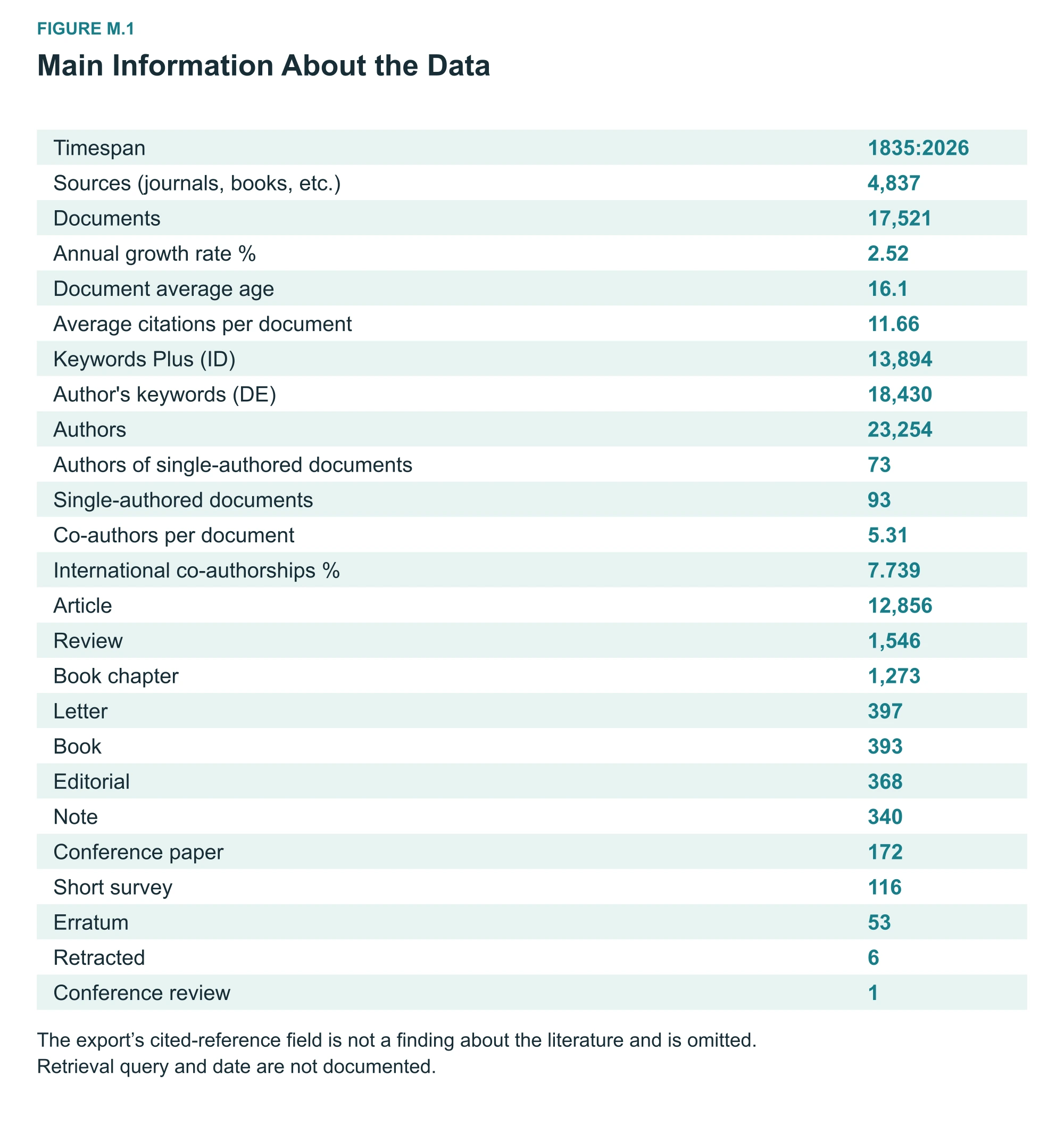
Figure M.1. Main information about the retrieved set. Scopus records on spiritual care, 1835 to 2026: 17,521 documents in 4,837 sources by 23,254 authors, with a 2.52 per cent annual growth rate, 5.31 co-authors per document and 7.7 per cent international co-authorship. Redrawn from Bibliometrix / Biblioshiny output.
The analysis covers a long period: 1835 to 2026. That alone says something, for research on spiritual care turns out to have a considerable historical base. One article appears in 1835. Not until 1962 does the annual count reach double figures, with sixteen.
Across the whole period there are 17,521 documents, published in 4,837 sources - journals, books and conference proceedings - by 23,254 authors.
Annual growth runs at 2.52 per cent, which indicates steady development rather than an explosion. The mean age of a publication is 16.1 years, so the literature combines historical depth with relatively recent contribution. At an average of 11.66 citations per document, scholarly impact is moderate.
The collaboration pattern points to a collective research culture: 5.31 co-authors per document on average, with only 93 single-authored documents. What stands out, though, is that international collaboration remains limited, at 7.7 per cent. Researchers work together a great deal, but largely within their own countries.
The type of publication is telling too. Of the seventeen thousand-odd documents, 12,856 are journal articles, against 393 books and 1,273 book chapters. The peer-reviewed journal article is by a wide margin the dominant vehicle for knowledge in this field. That is not a neutral fact: it helps decide which forms of knowledge count, and which - worked case material among them - stay less visible.
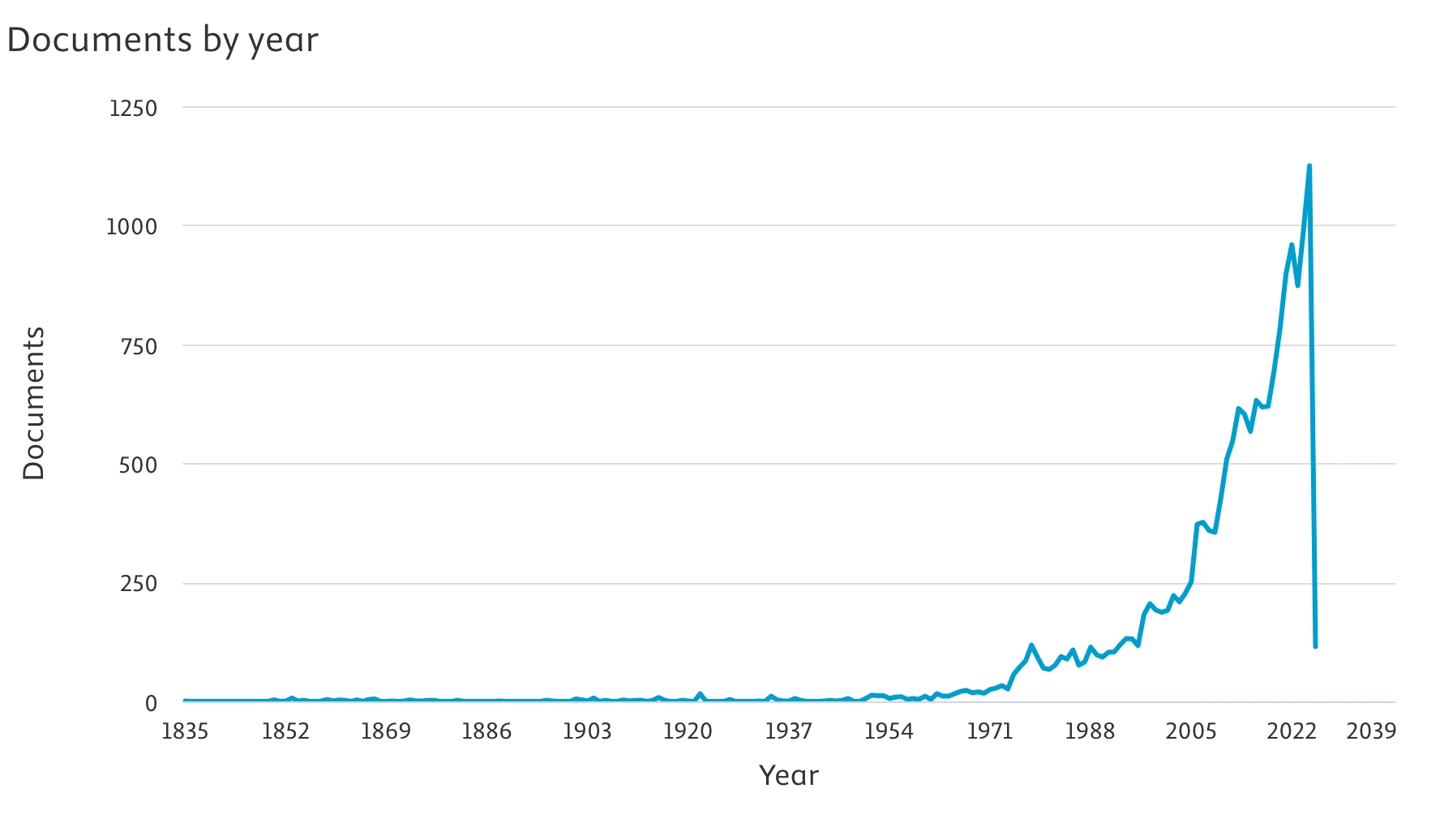
Figure M.2. Annual scientific production, 1835 to 2026. One article in 1835; double figures first reached in 1962; sustained growth from about 1971 to a peak near 1,130 documents in a year. The final year is partial and reflects the retrieval date, not a decline. From Bibliometrix / Biblioshiny output.
The overall picture is of a mature and steadily growing research field, marked by collaboration, with room for more international connection.
Figure M.1 reports 4,837 sources and 23,254 authors. These exhibit counts are used throughout this account.
Who publishes, and where
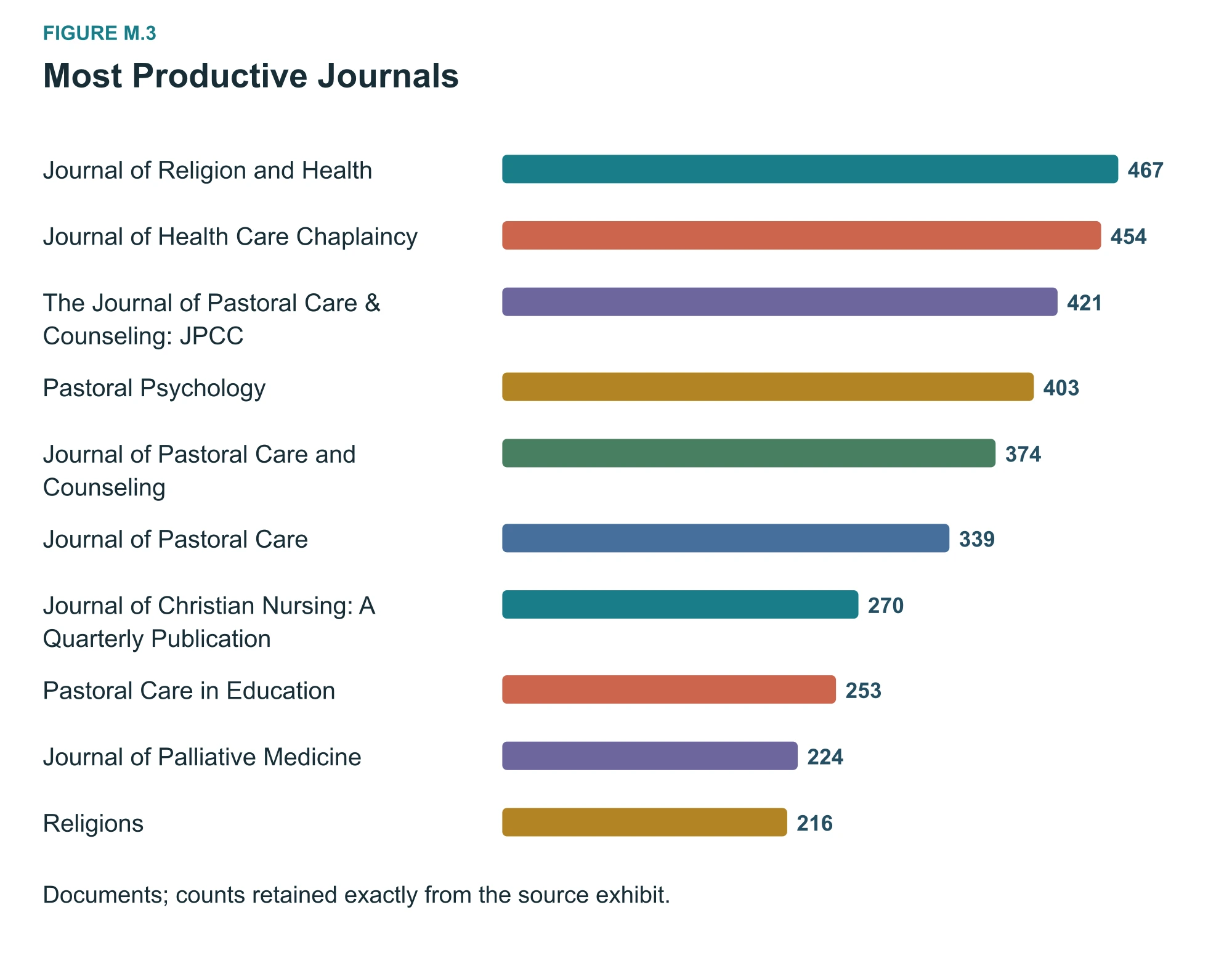
Figure M.3. The ten most productive sources. Nine of the ten are pastoral, chaplaincy or religion journals; the Journal of Palliative Medicine is the single medical title, in ninth place. Ranks 3, 5 and 6 are one continuing journal under three Scopus source names. Redrawn from Bibliometrix / Biblioshiny output.
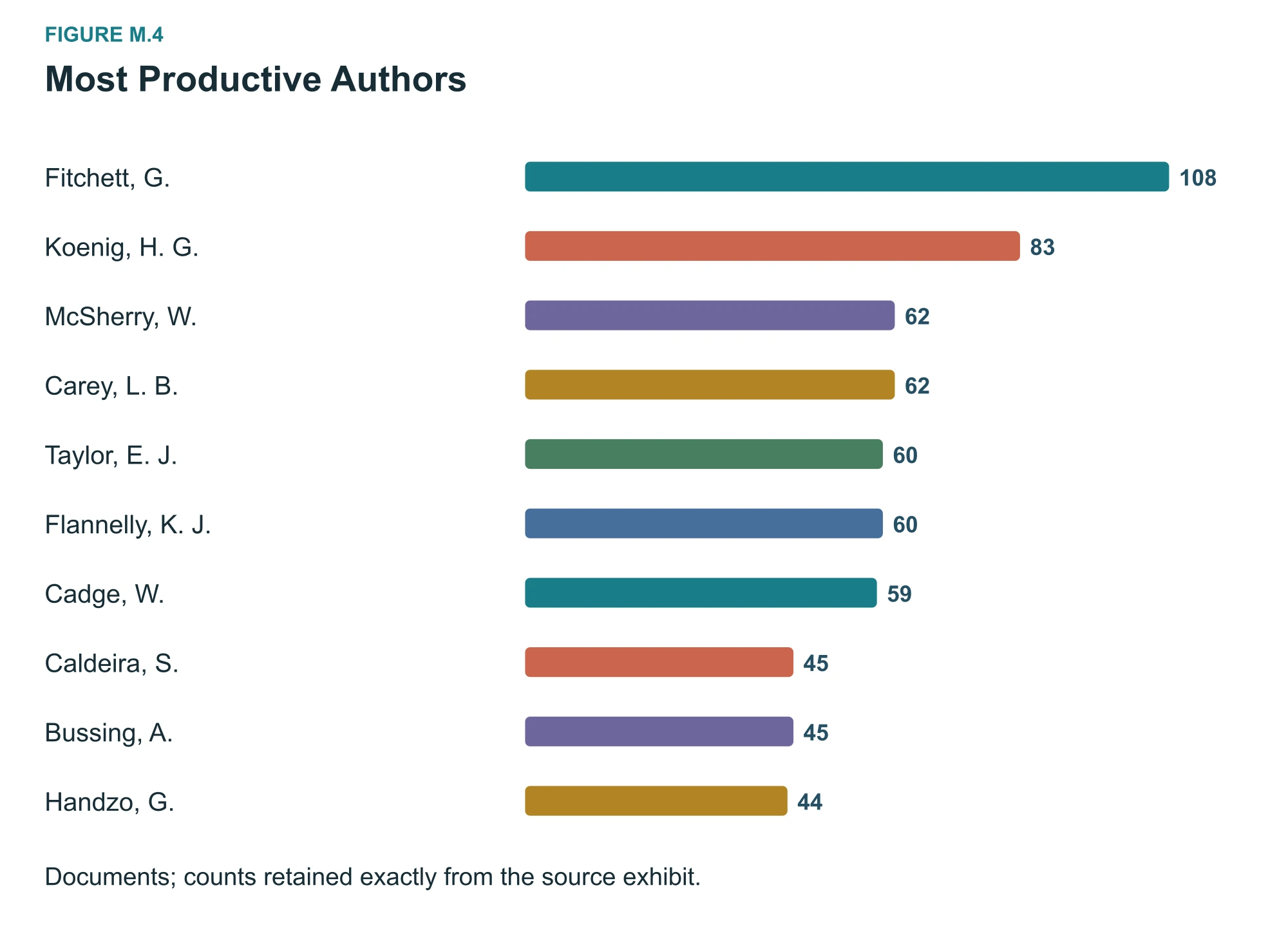
Figure M.4. The ten most productive authors. G. Fitchett leads with 108 publications and H. G. Koenig follows with 83; five further authors sit between 59 and 62. All ten publish from North America, Western Europe or Australia. Redrawn from the analysis output.
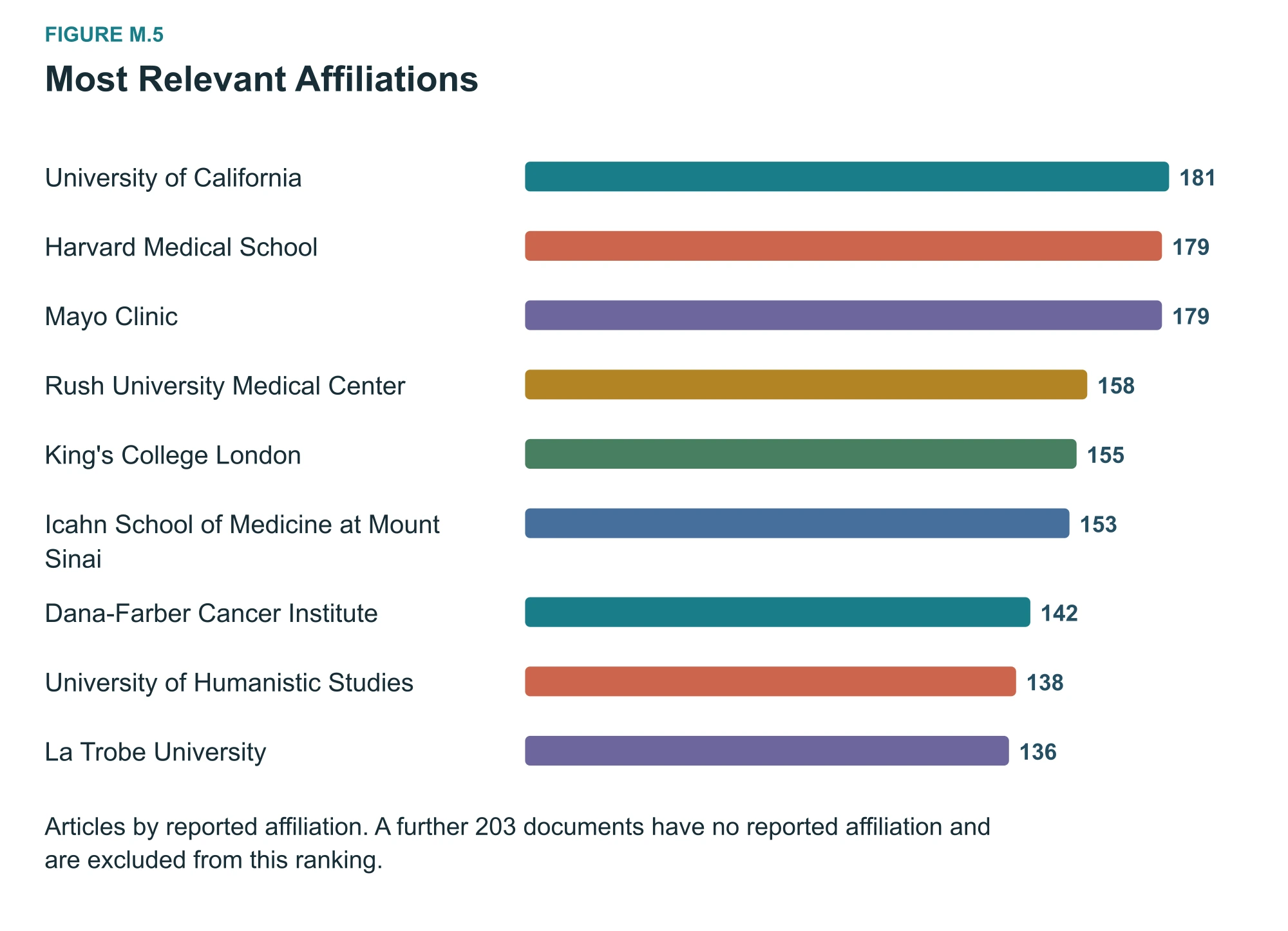
Figure M.5. The most productive affiliations. Seven of the nine reported affiliations are medical schools, hospitals or cancer centres; the Universiteit voor Humanistiek and La Trobe University are not. A further 203 documents carry no affiliation and are excluded from the ranking. Redrawn from Bibliometrix / Biblioshiny output.
Research on spiritual care is heavily concentrated in large medical and research institutions. The University of California, Harvard Medical School and the Mayo Clinic are among the leading contributors, and King's College London, Mount Sinai, the Dana-Farber Cancer Institute and Rush University Medical Center follow them.
What is striking is not only who appears but who does not. There are scarcely any faculties of theology, seminaries or religious institutes on the list. There are hospitals and medical research centres.
Spiritual care as a field of research is therefore embedded in health care and not in theology. Palliative medicine, psychology and clinical research give the field its shape. To anyone working in practice this is immediately recognisable: the questions put to a spiritual caregiver usually come from a treatment team.
What it is about
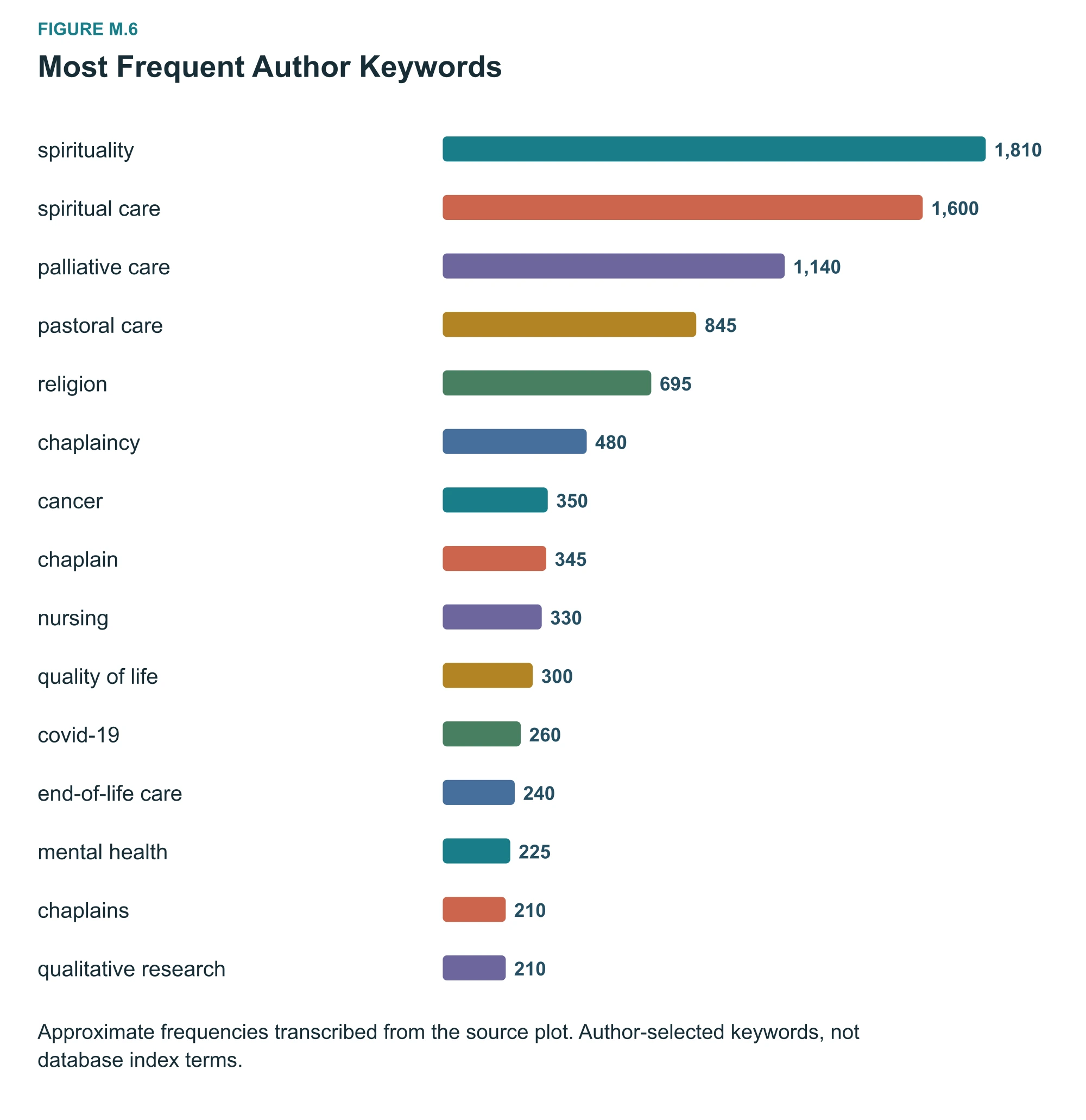
Figure M.6. The fifteen most frequent author keywords. The words researchers choose for their own work: spirituality and spiritual care lead, followed by palliative care, pastoral care and religion. Chaplaincy, chaplain and chaplains are counted separately and together would rank third. Redrawn from the analysis output.
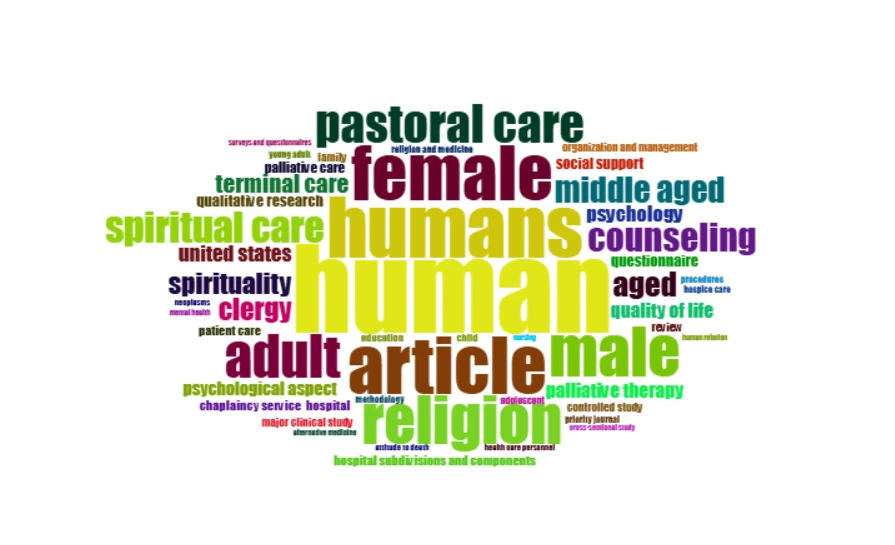
Figure M.7. Word cloud of database index terms (Keywords Plus). Prominent demographic and indexing terms are conventions of clinical records rather than necessarily subjects of this literature. Compare the authors’ own keywords in Figure M.6.
The word cloud shows human(s), female, male and adult as its most dominant terms. Research on spiritual care is strongly person-centred and firmly anchored in clinical and demographic contexts.
Beyond those, the keywords that stand out are pastoral care, religion, spirituality, counseling and palliative care. They confirm the picture from the previous section: the field is closely bound to health care, psychology and end-of-life support.
The thematic map
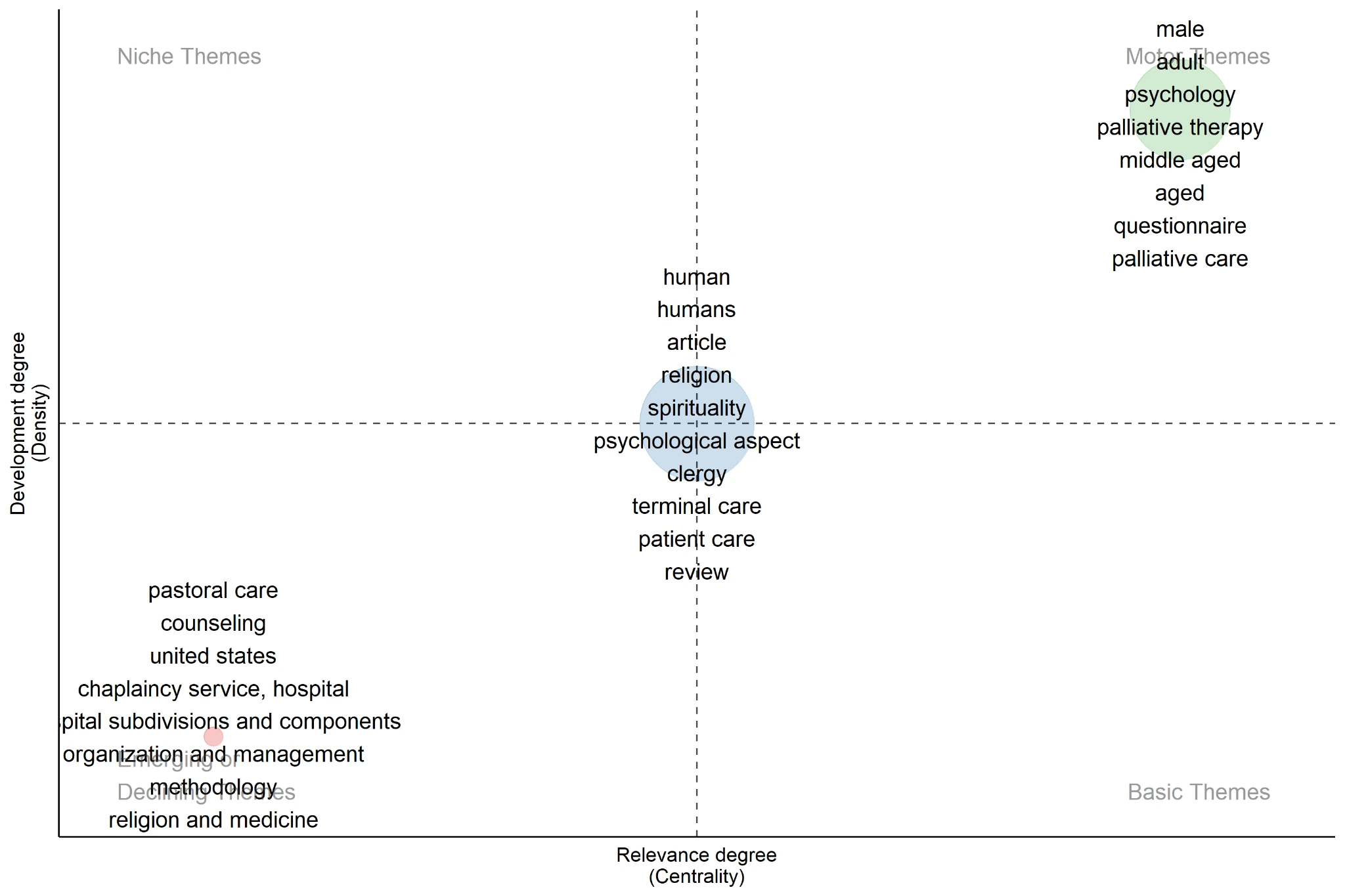
Figure M.8. The thematic map. The source plot locates clusters by centrality and density. Indexing conventions appear alongside substantive themes; an emerging-or-declining position alone does not distinguish emergence from decline.
The central cluster - around spirituality, religion, psychological aspect, clergy and terminal care - lies close to the middle of the map. These are the field's core themes: well integrated, moderately developed, and strongly connected to other subjects. Spirituality in relation to psychological care and to care at the end of life forms the conceptual backbone of the literature.
In the upper-right quadrant, the motor themes, appear terms such as psychology, palliative therapy, adult and aged. They are both highly central and well developed. Empirical, health-oriented and demographic research, above all in palliative care, is at present the engine of the field.
Lower right are the basic themes: fundamental to the structure of the field, but less worked out internally.
Lower left, in the quadrant of emerging or declining themes, are pastoral care, chaplaincy service, religion and medicine and organization and management. These are areas that are either coming up, or specialised, or losing a centrality they once had.
Taken as a whole, then, the map shows research on spiritual care to be firmly anchored in health care and psychology, with growing empirical refinement, while the classical pastoral and organisational dimensions sit nearer the edge or are still developing.
What the map does not show
So far a description. Now the question that matters for this book.
What is conspicuous from a Hindu perspective is a lacuna. Spirituality is central to this field, but non-Western religious ontologies, ritual frames and dharma-based models of care are under-represented in the global research architecture.
More is at stake here than representation. The dominant frame proceeds from particular conceptions of personhood, of suffering and of care that differ ontologically from dhārmika or Hindu-centred models. The bibliometric structure of this research field therefore exhibits not only a thematic dominance but an ontological consolidation.
The central and adjacent clusters - psychology, palliative care, clergy, pastoral care - show a field operating within historically grown Western assumptions about what a human being is, what suffering is, and what care is. Assumptions such as: an individual, interior self; a linear conception of time; and meaning arrived at through a professional. In the literature these assumptions are treated, implicitly, as universal.
The absence of non-Western frames is thus not merely a matter of diversity. It is a structural epistemic limitation, built into the architecture of the field itself.
An example makes the difference between describing and analysing clear. The descriptive statement runs: Western spiritual care focuses on psychological counselling. The analytical statement runs: the dominance of psychological terminology in the bibliometric core indicates that spiritual care is conceptualised primarily within an individual, interiorised model of the self - a model that presupposes an anthropological separation of psyche from cosmos, which differs ontologically from a dhārmika understanding of the self as relational and cosmically embedded.
Introducing a dhārmika ontology therefore does not simply add cultural diversity. It invites an ontological pluralisation that would reset the conceptual foundations of research on spiritual care. That is what opens room for contributions beyond the dominant pastoral paradigms: conceptual depth, a ritually grounded understanding of suffering, and holistic conceptions of the person.
What this means for the rest of the book
The numbers above are abstract. The cases that follow are not. The connection between them is more direct than it looks.
Take the woman in Chapter 16, sixty-six years old, read in a penitentiary as withdrawn and possibly depressed. That is a correct application of a model which assumes an individual, interior self whose state can be established through questionnaires and conversation. What the model does not see is lajjā (लज्जा, shame): shame that is not hers alone but a whole family's. It is not that the professionals involved were careless. It is that their instruments presuppose a certain kind of person.
Or take the bereaved parents of Chapter 12. In the dominant literature, grief is understood as an individual psychological process with phases and outcomes. In a collectivist setting, grief is a family event, and the question is not only how the parents are but whether the rite has been performed. Measure only the first and you miss where the suffering is.
The cases in this book are therefore not merely illustrations of good practice. Each of them is also an instance in which the dominant frame fell short and another frame proved necessary. Sometimes because a language was missing, sometimes because a rite was missing, sometimes because a concept such as karma consoles within one frame and can only be read as superstition within another.
That is why this book begins with a map. Not to complain about what is absent, but to show where the cases that follow are situated: at the edge of a well-developed field, in a place where little research has been done and where practice runs ahead of theory.
The accounts that follow are not an addition to the existing research. They are material for the research still to be done.