iSpicaIntegrative Spiritual Care Spiritual care around the world

Research in progress

Tuvalu

This working profile presents the evidence collected so far. Each account identifies the community, service or study it describes.

Informal spiritual care

Family care during mourning

Tuvalu’s 2008 report to the UN describes members of a kaitasi, an extended kin group, preparing refreshments while others mourn.[1] On the evening of the funeral, relatives gather for prayer and a meal.[1]

Scope · National report’s account of customary practice in 2008.[1]
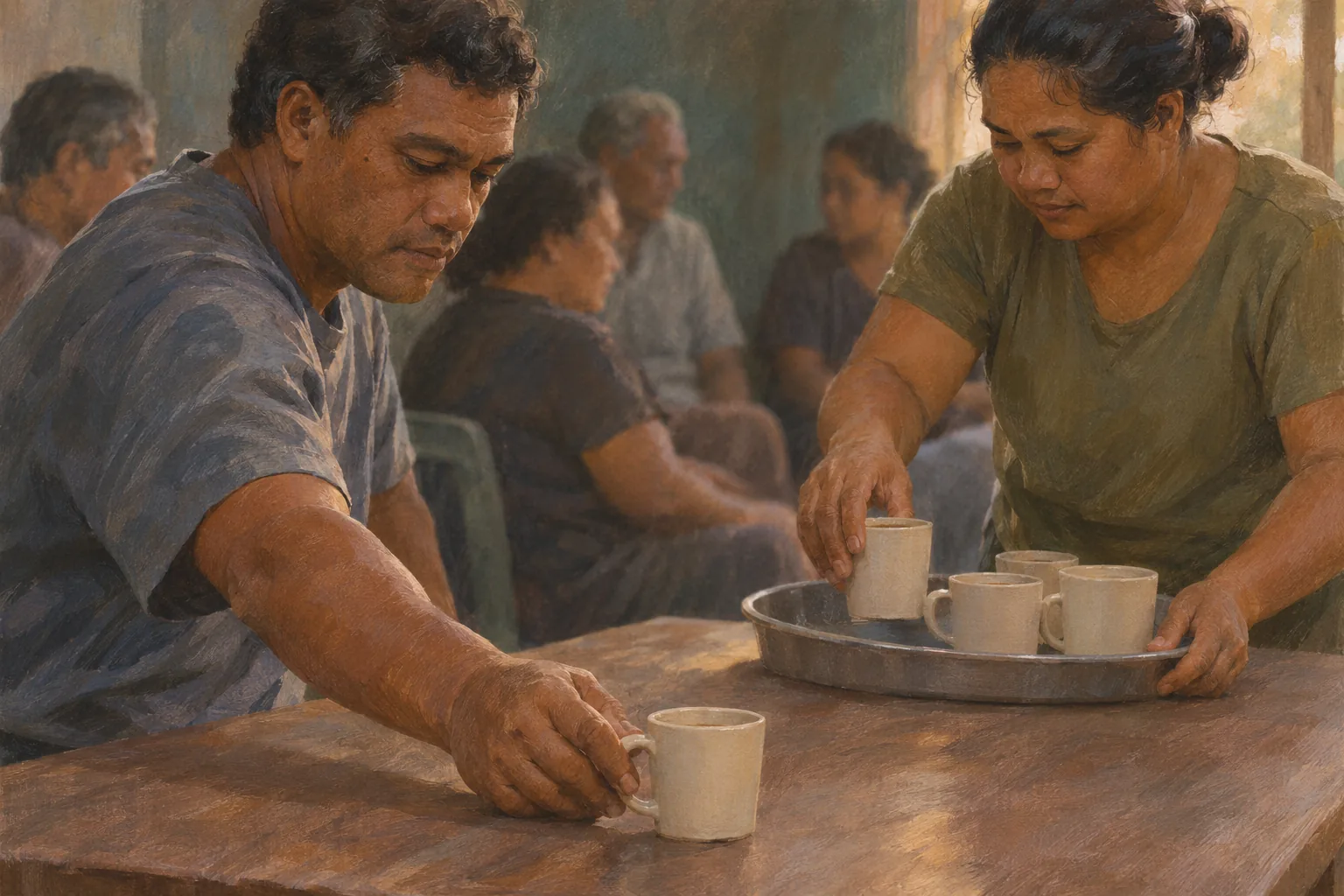
Two adults arrange cups and a tray while other visitors sit together in the background.
Preparing refreshments for mourners.[1] Tuvalu’s 2008 report describes relatives in the kaitasi, or extended kin group, looking after guests while others grieve.[1] The people and room are imagined.[1] AI-generated illustration for Spica[1]

Case studies

Pastors and post-cyclone support

For a study of psychosocial support after Cyclone Pam, researchers obtained local approval from both island chiefs (Pule Fenua) and resident pastors of the Church of Tuvalu on Nui and Funafuti.[2] Lay coaches delivered the programme.[2]

Scope · Study on Nui and Funafuti; pastoral involvement concerned local approval.[2]

Vocabulary

Aitagi

The same Tuvaluan account names the feast concluding mourning aitagi.[1] It says the matai, the kin group’s head, determines how long the mourning period lasts.[1]

Scope · Traditional account presented in the state report, §5.3.[1]

Kaitasi

Tuvalu’s 2008 account uses kaitasi for the extended kin group, whose members help provide refreshments during mourning.[1]

Scope · National report’s account of customary practice in 2008.[1]

Matai

In Tuvalu’s account, the matai is the head of the kin group and determines the duration of mourning.[1]

Scope · Traditional account presented in the state report, §5.3.[1]

Worldwide vocabulary

Interventions

Evening prayer and a shared meal

Tuvalu’s report describes relatives meeting for prayer and a meal on the evening of the funeral.[1]

Scope · National report’s account of customary practice in 2008.[1]

A feast at the end of mourning

Tuvalu’s 2008 account identifies aitagi as the feast which closes the mourning period.[1]

Scope · Traditional account presented in the state report, §5.3.[1]

Worldwide interventions

Open research questions

  • Check how contemporary funeral practice varies by island and church.
  • Seek a Tuvaluan description of spiritual care in hospitals, including local role titles.

Country references

  1. Tuvalu, Combined initial and second periodic reports to CEDAW (2008), §5.3 · § 5.3, p. 39
  2. Gibson et al., Piloting a scalable, post-trauma psychosocial intervention in Tuvalu (2021), §2.1