
Figure 1.1. The full shelf.
1. The question and why it matters now
Spiritual care is among the oldest of the helping practices and one of the least sure of its own foundations. It is delivered daily in hospitals, hospices, prisons, the military and community settings; it is increasingly professionalised, certified and audited; and yet, asked what it is and what holds its many activities together, the field tends to answer with a list rather than an account (Nandram, Bindlish, vander Wal & Kaur n.d.). The governing question of this book is therefore not whether spiritual care works - six decades of evidence associate attention to spiritual need with better well-being in palliative and oncology settings (Erşahin 2021) - but on what understanding of the person, and of care, the practice rests. Stated sharply, the question is this: what paradigm can ground the care of a person's inner life, and what does that grounding change at the bedside?
The paradigm this book grounds care on is the Integrative, and it is set out here rather than presupposed. Its central concept is 'the intent of relating all possible aspects, perspectives and purposes under holistic understanding of any context towards a Coherent View among all observers of the context in focus, without discarding any aspect, perspective and purpose' (Chapter 4); with it come its primary differentia against the integral, the construct of Integrative Intelligence, the five principles of the Integrative Paradigm, and the four-pillar scaffold of ontology, epistemology (the K1-K4 knowledge model), axiology and praxeology, with the 4H diagnostic as the standard statement of need. The full philosophical case for the paradigm is made at length in Philosophy of the Integrative (Bindlish 2026), and a reader who wants that case will find it there; but nothing in what follows depends on their having read it. This chapter states the apparatus plainly, and in enough words to be used, so that nothing in Parts II to IV has to rebuild it: the later chapters deploy it, they do not re-derive it.
Why spiritual care, and why now. Three contemporary pressures - documented at length in Chapters 2 and 4 - turn the question of what holds care together from an academic one into a practical one. The first is professionalisation and the competency turn, which slices care into assessable units, standards and role descriptions (VGVZ 2016; Koper et al. 2018; Ganzevoort et al. 2014); the gain in accountability is real, but a competency list presupposes an account of the practice it itemises and does not itself supply one. The second is pluralisation and secularisation, which make the very content of 'the spiritual' contested at the bedside, so that the caregiver can no longer assume a shared religious frame with the cared-for (Schipani 2024; Erşahin 2021). The third is machine care - the prospect of agentic and embodied artificial systems taking on care roles (Part V) - which forces the field to say what care is before it can responsibly delegate any of it.
These pressures share a structure: each exposes a missing foundation rather than a missing technique. That is the wager of an applied philosophy of care, and it sets the differentia-first signpost for the chapter. By its end the reader should be able to say how an Integrative account of spiritual care differs from the nearest things they already know - care grounded by competency, by clinical sub-speciality, or by bracketed religion - and why what the field lacks is a philosophy it can stand inside, not another instrument to add to the shelf.
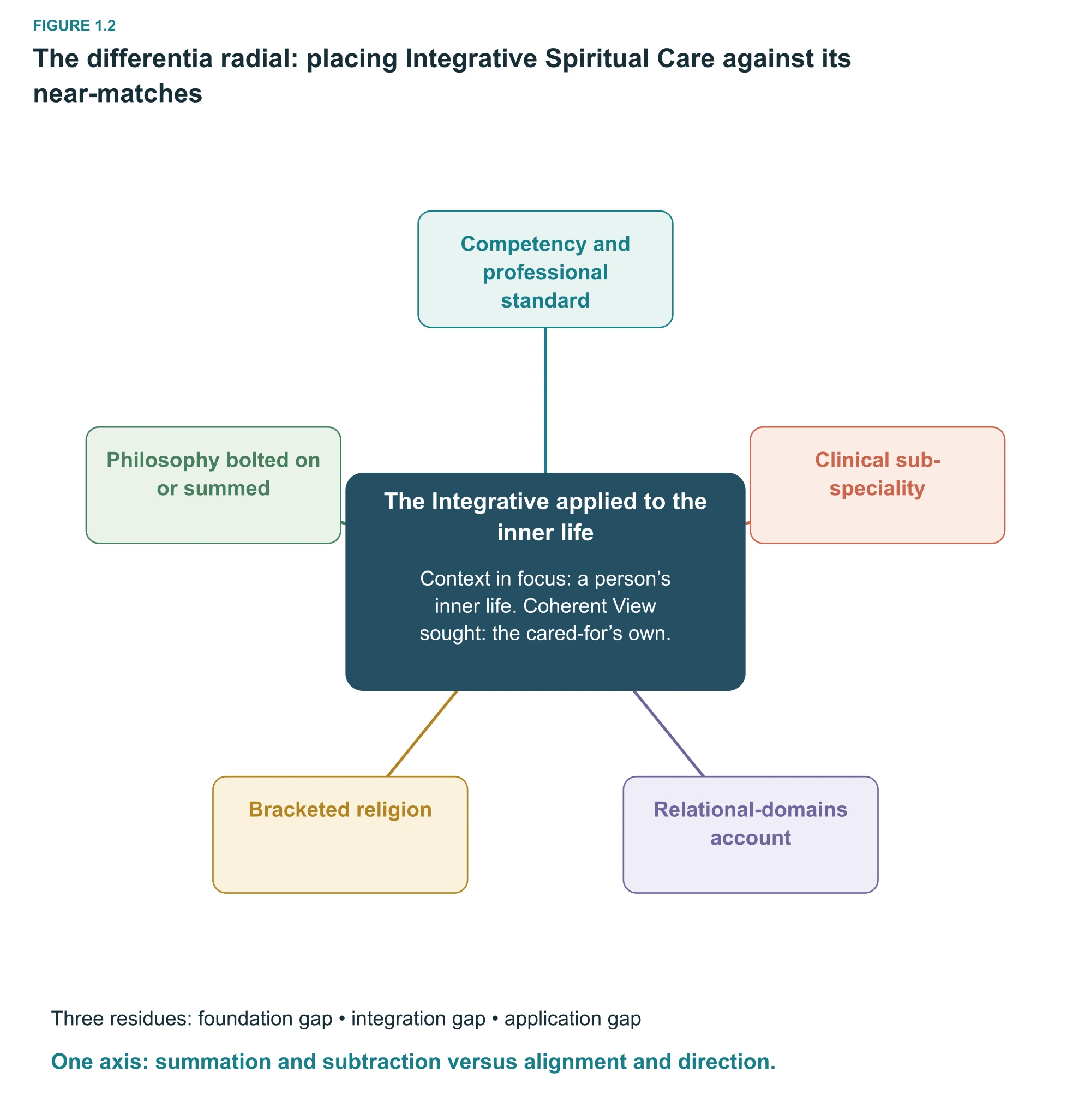
Figure 1.2. The differentia radial: placing Integrative Spiritual Care against its near-matches.
2. The state of the Western debate
The first thing to notice about spiritual care is that it grounds itself on several foundations at once, none of which it has chosen over the others. Asked what authorises the practice, the literature does not point to a single theory but to a small library of imported ones, each carried in from a neighbouring field and each doing real work without ever claiming to subsume the rest. It is worth setting these out in their own terms before asking what their coexistence costs, because the plurality is not a failure of scholarship - the field is, if anything, over-supplied with foundations - but a structural feature that an Integrative account must explain rather than merely deplore.
The most influential of the imported foundations is the biopsychosocial-spiritual model, which extends Engel's (1977) biopsychosocial medicine by adding a fourth, spiritual dimension to the person the clinician treats (Sulmasy, secondary - via Erşahin 2021). Its appeal is that it secures a place for the spiritual inside a recognised medical ontology: the spiritual becomes one domain of the whole person alongside the biological, the psychological and the social. Standing beside it is person-centred care in the Rogerian lineage, which grounds care not in a model of the person's parts but in the quality of the helping relationship - unconditional regard, empathic accompaniment, the practitioner's authentic presence (Rogers, secondary). Where the biopsychosocial-spiritual model answers 'what is the person?', the person-centred tradition answers 'how is the relationship to be held?', and the two have never been welded into one account. A third foundation is pastoral-theological: care as the cure of souls, with its own anthropology of finitude, guilt and ultimate concern (Tillich 1967, via Erşahin 2021), now necessarily detached from the confessional setting that once made it intelligible. A fourth, the relational-domains model, maps the spiritual as a set of relationships - to self, others, the world and the transcendent - that care seeks to keep in health (Fisher 2010). A fifth recasts care as a process: a sequence of 'organically linked phases', beginning with 'the identification of spiritual needs and resources' and 'understanding the patient's specific needs' and proceeding through accompaniment to evaluation (Damberg Nissen, Viftrup & Hvidt 2021). And a sixth, increasingly the field's centre of gravity, is the professional-standard and competency model, which grounds care not in a theory of the person at all but in an enumerated set of assessable capacities, roles and standards (VGVZ 2016; Koper et al. 2018; Costeira et al. 2024). Each of these is a genuine foundation; each is load-bearing somewhere; and none of them is offered as the integration of the others.
Beneath this plurality sits a meta-question the field rarely makes explicit but cannot avoid: how should an applied practice stand to its philosophy at all? The mainstream literature on applied disciplines offers two templates, and both have names, canonical statements and a long quarrel with one another; spiritual care has borrowed from each without adjudicating between them. The first is the principlist route, whose paradigm case is the four-principle biomedical ethics of Beauchamp and Childress (1979) - respect for autonomy, non-maleficence, beneficence and justice - a set of mid-level principles held to command the assent of adherents of rival ethical theories, and then specified and balanced downward until they meet the case. The attraction, for a practice seeking a hearing in the clinic, is considerable: such principles are public, teachable, auditable and portable across the worldviews a plural bedside brings together, and they promise that the hard work of foundations can be done once, at the top, and thereafter drawn upon rather than redone. Spiritual care's imported groundings enter the field on precisely this template - pastoral-theological and biopsychosocial-spiritual accounts of the person, from which practice is to be read off.
What the template does not supply is the step that makes it look easy. Principles pitched at that altitude are consistent with incompatible acts, and the specification that brings them down to a particular bedside is exactly the work they were introduced to spare the practitioner. The most exact measurement of this shortfall comes from the neighbouring field in which the same template has most recently been tried at scale: a global survey of eighty-four sets of artificial-intelligence ethics guidelines finds a striking nominal convergence on five principle-names and, beneath it, 'substantive divergence' in how those names are interpreted, why they are held to matter, and how they are to be implemented (Jobin, Ienca & Vayena 2019; the same finding is put to work in Chapter 26). Agreement on the principle turns out to be compatible with disagreement about everything that would make the principle act-guiding. This is not a failure of drafting to be repaired by drafting better; it is the structural cost of settling the theory first and delegating the descent to the cases.
Hence the second template, which arrives as a standing polemic against the first. On the practice-first route warrant runs upward. Schön's (1983) attack on what he names technical rationality - the picture of professional practice as the application of research-based theory to instrumental problems - replaces it with professional artistry: a knowing-in-action displayed in competent performance and not fully statable in advance of it, together with the reflection-in-action by which a practitioner reframes a situation while still inside it. On this account theory does not descend to practice at all; it trails behind, codifying after the fact what skilled practitioners already do, and formation proceeds not by the teaching of principles but by a practicum and a coach. Spiritual care has adopted this template as thoroughly as the first - in its supervised clinical formation, its reflective-practice literature, and its competency-by-doing (Schön is engaged directly, for the recognition of accompaniment, in Chapter 7).
Naming the two matters here because the field has quietly run on both at once, and because their quarrel has concealed what they agree about. Read as rivals they answer opposite questions - does warrant descend from principle, or ascend from practice? - and the choice looks exhaustive. But an option that is exhaustive along one axis leaves the axis itself unexamined, and this one does. Both templates take philosophy and practice to be two layers, separable in thought, whose relation is a matter of direction: the principlist runs the arrow downward, the practice-first theorist runs it upward, and each takes the other's arrow to be the error. Neither asks whether they are layers at all. That shared assumption is what makes the field's borrowing from both untroubling to it - one may, after all, take one's principles from above and one's warrant from below and simply add them - and it is the assumption this book will reject (§3, the application gap; §4). It also explains why the addition never yields what either template promised: philosophy layered on top of care produces principles no caregiver consults under pressure, and care left to generate its own theory produces competence without a horizon, skill that cannot say what it is for. Those two failures are not opposites. They are one failure, met from each end (Note 10).
Two further positions widen the frame. The first theorises spirituality beyond the individual interior: organisational and collective spirituality is by now a research-active if contested construct, and its reviewers concede at the outset that 'there is no agreed-upon, unique concept of spirituality; its dimensions and characteristics depend on the approach used' (Rocha & Pinheiro 2020). That admission, made about the workplace, generalises to the bedside and matters for an Integrative account that will refuse to treat the cared-for as an enclosed interior (Principle 5; Part V). The second is the field's own meta-reading of itself. A bibliometric mapping of the spiritual-care literature across healthcare, the military and community settings identifies the influential works and thematic clusters of the field and, decisively for this chapter, names an explicit gap in theoretical framing - the absence of a shared account adequate to the practice's own holistic self-description (Nandram, Bindlish, vander Wal & Kaur, Mapping the Landscape of Spiritual Care). The field, in other words, has diagnosed its own foundation problem; what it has not had is a paradigm with which to answer it. The same team has since moved from diagnosis to proposal, deriving - by design-science research and the Tarka method of classical Hindu philosophical debate - a meta-definition of integrative spiritual care, 'a holistic approach that synthesizes religious, philosophical, and secular perspectives to provide comprehensive support for individuals' spiritual well-being' (Bindlish, Nandram & Joshi 2025). This book takes up that published proposal and supplies the paradigm the bibliometric reading found wanting, giving the meta-definition the determinate form §4 will state.
This meta-reading does not rest on the author team's own diagnosis alone. An independent bibliometric review of the healthcare-chaplaincy literature - 199 publications between 2000 and 2018, 84 per cent of them chaplain- or theologian-authored - reaches the same verdict from inside the profession it maps: the field 'would benefit from greater conceptual clarity, common research standards, and more critical research designs' (Poncin et al. 2019; Note 6). Its finding is precise about why the imported foundations do not compose. Forty-three per cent of the literature consists of theoretical discussions and informal analyses 'informed by authors' personal experiences and anecdotal evidence', and where studies do assess the spiritual they tend to adopt 'a concept by default, often the one presupposed by the research instrument they employed', so that 'divergences in concepts, as well as in assessment methods' make the outcomes of different projects incomparable (Poncin et al. 2019). The competency and process models catalogued above inherit exactly this defect: an instrument that presupposes its concept of the spiritual cannot supply the account the field lacks - it can only multiply accounts. Poncin and colleagues recommend, as the route to a mature field, study designs that combine 'in-depth theoretical analysis with empirical enquiry to establish a stronger link between the field and the meta-level of analysis and reflection' - a call, from outside the author team, for exactly the foundational work this book undertakes. One phrase carried in that review is worth marking now, because it anticipates the paradigm to come: assessments, Rumbold observes, 'tend to impose particular views or definitions of spirituality, instead of eliciting "the thoughts, memories and experiences that give coherence to a person's life"' (Rumbold 2007, p. S61, via Poncin et al. 2019). Named from within the mainstream literature, before any Dharmic resource is brought alongside, is the very thing an Integrative account will make its centre - the coherence of the cared-for's own view - and the very thing an imposed instrument forecloses (the non-imposition safeguard, Note 2).
Table 1.1. Summed, or aligned: the six stalls as they meet you at the bedside, and the move each one invites.
The stall, as it meets you at the bedside | What the standard response adds - the summing move | What an Integrative reading asks instead - the aligning move | The tell, afterwards: which one you just did |
|---|---|---|---|
The foundation gap - a full shelf and no direction. You can say precisely what you assessed, which phase of the process you were in and which competency you exercised. Asked what the care was for, you find you have a list where an account should be, and the list does not say what holds its items together. | Add another item to the shelf: a further instrument, a further competency, a further phase, a further standard (VGVZ 2016). Each addition is defensible on its own and none of them supplies what is missing, because an inventory of capacities is intelligible only against an account of the practice it itemises, which the inventory does not contain. The shelf grows and the gap is restated at greater length. | Ask what this person's situation is for them, across the whole field of a life's goods rather than the one your role can see - the four puruṣārtha, the goods a human life is oriented toward: dharma (righteousness), artha (the means of prosperity), kāma (worldly desire) and mokṣa (liberation, the higher good), held together and contextually weighted rather than ranked on one scale. The clinical eye tends to see only artha, the restoration of capacity; the pastoral eye only mokṣa. Attending to the spiritual never means peeling one of the four off from the rest. | If what you added lengthened your account of what you did and left your account of what it was toward exactly where it was, you summed. If you can now say, in the person's own words and not in your role's, what the care is moving toward, you aligned. |
The integration gap, met in the assessment form. The instrument has its domains and the person's weight is not in any of them. A life whose whole spiritual burden is a quarrel with a dead parent, or with one's own failing body, arrives at a page that holds no cell for it. | Score the domains and take the sum of their well-being as the spiritual whole; press the unfitting relation into the nearest available category, or leave it out of account. The instrument brings its concept of the spiritual with it - the field's own reviewers find that studies tend to adopt a concept by default, the one presupposed by the instrument they employed, so that divergences in concepts and in assessment methods leave projects incomparable (Poncin et al. 2019). What the page cannot hold does not survive the writing-up. | Fix no domains ahead of the encounter. Elicit, in the chapter's own borrowed phrase, the thoughts, memories and experiences that give coherence to a person's life (Rumbold 2007, via Poncin et al. 2019), and relate what this person actually presents toward their own coherent view, discarding none of it. The map a person's life presents is the map you work with; the whole point of the without-discarding clause is that the ill-fitting aspect is the one most likely to be load-bearing. | If something the person said had nowhere to go on your page and so is not in the record, you summed - and you will not notice, because an aspect discarded leaves no trace of itself. If the record changed shape to hold what was said, in their words, you aligned. |
The integration gap, met in the referral. The spiritual is a slot on a rota. A need is identified, a referral is made, a specialist attends. Meanwhile the person is already deep in conversation with whoever happens to be in the room, which is usually not the specialist. | Treat care as the preserve of a referral specialism - one more service added to the list of services - so that the encounters the ward is already having carry no spiritual weight until the right professional arrives, and the caregiver who is present treats what they are hearing as somebody else's material to collect. | Take the stance to be available to any caregiver in any setting that deals with human beings and their interdependence and interconnectedness, and refer where the authority genuinely belongs to someone else - to the person's own tradition, to a clinician - as a move made inside a relation you continue to hold, and not as the handing over of the relation itself. | If the referral ended your involvement, you summed: you added a service. If you made the referral, said why you were making it, and were still the one relating what the person brought, you aligned. |
The integration gap, met in the bracket. No religious frame can be assumed at this bedside, so you set your own tradition aside, do not raise the confessional question unbidden, and offer something specified thinly enough that anyone at all may receive it. The motive is exactly right: what care serves is the cared-for's view and not yours. | Buy shareability by subtraction - strip the content until what is left is what all parties have in common. But the remainder is not neutral, it is emptied, and an emptied ground can authorise no act; the field's much-lamented vagueness is the measured residue of the subtraction and not a failure of definition-writing (Swinton 2012, via Erşahin 2021; Rocha and Pinheiro 2020). Worse on the settlement's own terms, neutrality is not the absence of a construal but a construal that has forgotten it is one - an immanent frame inhabited by a buffered self (Taylor 2007) - so the person for whom an illness is God's dealing with them must now render that life in a register that has no word for it. | Buy shareability by direction instead: fix the intent under which a life is related and leave its content free. An intent so specified is shareable across a plural workforce without being emptied, because it prescribes no content any tradition would have to surrender; and the content was always the cared-for's to supply and never the caregiver's to authorise. Principle 1, Integral Unity - ekaṃ sat viprā bahudhā vadanti, there is one truth, the knowledgeable speak it in many ways - takes the many frames met at a bedside as perspectives on one reality, to be related rather than levelled or adjudicated. | If an aspect of the person's situation was ruled out of the relation in advance of your meeting them, you summed, and the chapter's sharpest sentence applies: to bracket is to discard. If the person's own frame entered the room in the person's own words and you supplied none of your own, you aligned. Refusing to bracket is not permission to supply, and the two failures are told apart by whose words are in the room. |
The integration gap, met in ad hoc provision. Every caregiver who came did something kind, and each thing was different. Nothing accumulates. Thursday's caregiver inherits a list of what was done and no statement of what any of it was toward, so the good acts sit side by side and point nowhere. | Add another well-meant act to the sequence. Each is individually defensible and the collection aligns nothing, which is one of the three ways the chapter says care fails: perspectives merely juxtaposed, the additive shelf. Holism is proclaimed at the level of principle and undone here, at the level of what is actually handed over. | Hand over the direction and not only the acts: what this person is moving toward, in their words, kept visibly apart from what the team has inferred. Alignment is a property of the sequence and not of any act in it, so it is carried between caregivers or it is not carried at all - which is also why the chapter treats the unit of the context in focus, whether the person alone, the person and kin, or the whole care system, as a live question rather than a settled one. | If your handover is a list of what was done, you summed. If the next caregiver can state what the person is moving toward, and whose words that statement is in, you aligned. |
The application gap - two counsels and no ground. You are caught between the principle, which everyone agrees to and which tells you nothing about the next ten minutes, and your own practised competence, which knows what to do and cannot say what it is for. | Choose a direction for the arrow between two layers. Run it down from principle to case (Beauchamp and Childress 1979), and you get principles no caregiver consults under pressure - the measured finding from the neighbouring field being nominal convergence on a handful of principle-names with substantive divergence beneath it (Jobin, Ienca and Vayena 2019). Run it up from practice to codification (Schön 1983), and you get competence without a horizon, skill that cannot say what it is for. The two are not opposites; they are one failure met from each end, and the shared error is the layering. | Refuse the layering. Treat what you did well as already a philosophy in act, and make its intent explicit - which is a different operation from codifying a performance afterwards, because a codification abstracts a description from the act and leaves the act as it was, whereas an intent made explicit can correct the act, showing you that you discarded an aspect or put your coherence in place of the person's. The stance in which the work is held has a classical name, niṣkāma karma, work undertaken without desire for its fruits: done wholly, held lightly, offered rather than administered, because the resolution is not yours to author. | If your account of the encounter is a description laid over it after the fact, true and inert, you summed. If it named the intent you were already acting under, and could therefore have told you that you had gone wrong, you aligned. |
3. Where the debate fragments or stalls
Set side by side, these positions do not compose. They are not rival answers to one question that a careful adjudication could rank; they are answers to different questions - what the person is, how the relationship is held, what the soul needs, which relations to tend, what phases to follow, which competencies to certify - laid alongside one another without an account of how they bear on a single act of care. Three residues fall out of this, each of which the field records but cannot resolve from within its present frame.
The first is the foundation gap. Spiritual care possesses competencies, processes and instruments in abundance, but no shared account of what a person is and what care is for. It can specify how to assess and which roles to fill (VGVZ 2016) without ever saying what holds these together - and 'what holds them together' is precisely the question a philosophy, not a protocol, exists to answer. The competency turn does not close this gap; it presupposes it, since an inventory of capacities is intelligible only against an account of the practice it itemises, which the inventory itself does not supply.
The second is the integration gap, carried forward from the field literature engaged in Chapters 2 to 4. The practice is committed, in its own self-description, to holism and to relationship: it insists that the person is a whole and that care is relational. Yet its operative tools - discrete assessment instruments, a clinical sub-speciality reachable by referral, religion bracketed for neutrality, provision individualised ad hoc - keep fragmenting the very wholeness the self-description proclaims (Damberg Nissen et al. 2021; Erşahin 2021; Hummel et al. 2009). Holism is espoused at the level of principle and undone at the level of instrument. The field knows this about itself; what it lacks is a way to make its tools express its holism rather than betray it.
The third is the application gap, the residue distinctive to an applied book and owned here. Both conventional routes from theory to practice fail care. Bolt a philosophy onto a practice, principlist-fashion, and you produce principles no caregiver consults under pressure (Beauchamp & Childress 1979; and see the measured under-determination of the principle by its own adherents, Jobin, Ienca & Vayena 2019); let practice generate its own theory, and you produce competence without a horizon - skill that cannot say what it is for (Schön 1983). The residue, however, is not that one of the two routes is mistaken and the other sound. It is that the choice between them is a quarrel about the direction of an arrow between two layers, and it is the layering that is the error. Schön's own diagnosis is the tell: he saw, correctly, that technical rationality could not account for what a competent practitioner actually does, and concluded that theory must therefore follow practice - when the conclusion available to him was that a practice done well already is a philosophy in act, and stands in need not of a theory trailing behind it but of a paradigm it can be seen to be the form of. That conclusion was unavailable to him because the two-layer picture is the one thing his polemic left standing.
The third residue implicates this book as much as it does the field, and it is better said here than discovered later. A book that set a philosophy beside a practice and called the pair an application would be standing in the very residue it has just described; what it owes is not one more foundation added to the shelf but a direction the shelf does not have.
The compressed residue is this. The field discards by design at the level of its foundations: it keeps importing partial groundings and setting them side by side without aligning them, so that its very self-understanding fragments the wholeness it preaches. The stall is not for want of another model - the shelf is full - but for want of a paradigm the practice can stand inside, one in which the person's wholeness and the relational form of care are not two commitments to be reconciled but a single thing seen from two sides. Supplying that paradigm, and showing that it is the form good care already takes, is the work of §4.
4. The Integrative move
The Integrative move is to put that paradigm to work as the foundation of care rather than as commentary upon it. The thesis can be stated in a line: spiritual care is, at root, the Integrative applied to the inner life. Unfolded through the canonical definition, care is 'the intent of relating all possible aspects, perspectives and purposes under holistic understanding of any context towards a Coherent View among all observers of the context in focus, without discarding any aspect, perspective and purpose' (Chapter 4), where the context in focus is a person's inner life in need and the Coherent View sought is the cared-for's own. On this account care is not a discrete intervention added to clinical work but the relational practice of helping a person move toward a coherent view of their situation - illness, meaning, relationship, transcendence - with no aspect, perspective or purpose discarded along the way. This thesis names, and grounds, an account already proposed in the spiritual-care literature: the author team's own meta-definition of integrative spiritual care (Bindlish, Nandram & Joshi 2025). Where that published definition speaks of a holistic approach that synthesizes religious, philosophical and secular perspectives, this book supplies the differentia its 'synthesis' leaves open - the directional intent of relating those perspectives toward the cared-for's Coherent View, alignment rather than summation (Chapter 4) - so that the present book is the determinate, paradigm-grounded working-out of the same line of thinking (Note 5).
So understood, each pillar becomes a lens on one relationally constituted person. Ontology takes the cared-for to be constituted by relations rather than enclosed as a bounded interior; epistemology renders the caregiver's discernment as graded knowing, the K1-K4 model applied at the bedside (Ch 6); axiology supplies the account of the goods a life is for, against which a person weighs their situation (§5, first resource); and praxeology casts care as action that follows embodied knowing, performed without doership (§5, fourth resource). Each of the four is argued at length in Philosophy of the Integrative (Bindlish 2026) and is stated here in the form care needs. The 4H diagnostic structures each practice and case chapter's statement of need, and Integrative Intelligence - 'an entity's ability to apply oneself to holistically interrelate all aspects, all perspectives and all purposes of other entities in one's adopted context, with an a priori intention to achieve a Coherent View' (Chapter 4) - names the caregiver's core capacity (Ch 5).
The differentiae make the move concrete. Against the competency and professional-standard model, the Integrative supplies the very intent that a competency list presupposes but never states; competencies then read as expressions of one orientation rather than as a checklist that fragments it (VGVZ 2016; Ganzevoort et al. 2014). Against the clinical-sub-speciality model, care is a stance available to any caregiver in any setting 'that deals with human beings and their interdependence and interconnectedness' (SpiCaQuest competencies note), not the preserve of a referral specialism.
Against the relational-domains model - one of §2's imported foundations, and of the six the nearest to the Integrative, so the one most easily mistaken for it - the differentia must be drawn with the most care and the agreement granted at full strength. Fisher's account already refuses to treat the spiritual as an enclosed interior and casts it as constitutively relational, mapping spiritual well-being across four relationships: with self, with others, with the world and with the transcendent (Fisher 2010, via Erşahin 2021). That is the very relational ontology §4 has just stated, and it is kept. The differentia falls on two joints. First, the four domains are a set to be kept in health - an inventory of relationship-types each tended in balance, the sum of their well-being taken as the spiritual whole - which is the integral move in the register of the person, a whole reduced to the aggregate of its catalogued parts, where the Integrative relates all aspects, perspectives and purposes 'towards a Coherent View... without discarding any' (Chapter 4), aligning the domains a person's life actually presents toward one coherence rather than maintaining four separate ledgers: alignment, not summation (Chapter 4). Second, the four domains are fixed in advance and applied alike to every person, so that well-being is scored against a template the caregiver brings; a relation for which the map holds no cell - a life whose whole spiritual weight is a quarrel with a dead parent, or with one's own failing body - must be pressed into an ill-fitting category or left out of account. The Integrative fixes no domains ahead of the encounter and aligns toward the cared-for's own Coherent View (Chapter 4); the relational-domains instrument, like the assessment tools §3 indicts, tends to 'impose particular views or definitions of spirituality' where an Integrative account elicits 'the thoughts, memories and experiences that give coherence to a person's life' (Rumbold 2007, via Poncin et al. 2019; §2) - the non-imposition safeguard once more (Note 2; Note 14).
Against care grounded by bracketed religion - the settlement the second contemporary pressure has made the field's default (§1) - the Integrative fixes the intent under which a life is related and leaves its content free. The near-match must be stated at its strongest, because it is a decent position held for a decent reason and it is the operative ground of most publicly funded chaplaincy and of the nursing and medical literature that has taken spiritual care up. Faced with a bedside at which no religious frame can be assumed, the caregiver sets their own tradition aside, does not raise the confessional question unbidden, and offers a spirituality specified thinly enough that anyone at all may receive it (Maugans & Wadland 1991; King et al. 1992, both via Erşahin 2021; Schipani 2024). Its motive is precisely the one an Integrative account must honour: that what care serves is the cared-for's view and not the caregiver's (Note 2). As with Schön, then, what is owed here is a differentia and not a refutation, and it turns on three things (Note 11).
First, the bracket is a subtraction, and what it subtracts is the ground. Chapter 3 presses this at the level of foundations: strip the confessional content from the pastoral-theological grounding so that a plural and largely secular workforce may share it, and what remains is attention to the transcendent dimension of the person - which is exactly the generic spirituality the field's own critics indict, 'with no identifier of a culture, class, religion or specific content', an 'add-on to the biomedical model' (Swinton 2012; 2007, both via Erşahin 2021). The much-lamented conceptual vagueness of the field is then not a failure of definition-writing that a better definition would repair. It is the measured residue of the subtraction: 'there is no agreed-upon, unique concept of spirituality; its dimensions and characteristics depend on the approach used' (Rocha & Pinheiro 2020) is what a ground reads like once the thing that grounded it has been lifted out. Bracketing does not leave a neutral remainder. It leaves an emptied one, and an emptied ground can authorise no act - which is why a field that brackets must then go looking for its direction in the only registers still open to it, the instrument, the competency and the phase (§2), and why each of them arrives already fragmenting the wholeness it was recruited to serve (§3, the integration gap).
Second, and more damaging to the settlement on its own terms, neutrality is not a standpoint-free position but a standpoint that has forgotten that it is one. The secular is not the absence of a construal of the world; it is a construal - an 'immanent frame', inhabited by a 'buffered self' for whom meaning is generated within rather than received from beyond, and lived as a condition of contestable fullness rather than as blankness (Taylor 2007; engaged at first hand in Ch 21). The caregiver who brackets religion has therefore not stepped out of every frame; they have stepped into the one whose furniture is invisible to them, and they have supplied it to the bedside as the default in which the encounter will proceed. At which point the settlement turns against its own motive. It was adopted to protect the cared-for from imposition, and it imposes: the person for whom an illness is God's dealing with them must now render that life in a register that does not have the word for it, and the rendering is demanded by the very move that was meant to leave them free. This is the worldview fallacy - the caregiver's own worldview taken, unawares, as the neutral baseline, so that another's difference registers as deviation from it (Philosophy of the Integrative, Bindlish 2026) - no longer as a lapse within an encounter (its form in Ch 8) but institutionalised as the practice's ground.
Third, the difference that decides it. The Integrative does not bracket content, because it never needed the content to be the caregiver's in the first place. What it fixes is intent: 'the intent of relating all possible aspects, perspectives and purposes under holistic understanding of any context towards a Coherent View among all observers of the context in focus, without discarding any aspect, perspective and purpose' (Chapter 4). An intent so specified is shareable across a plural workforce without being emptied, because it prescribes no content that any tradition would have to surrender on adopting it; and the content of a life need not be thinned, because it was always the cared-for's to supply and never the caregiver's to authorise. Indeed the without-discarding clause forbids the bracket outright, and this is the sharpest thing that can be said against the settlement: to bracket is to discard. It rules an aspect of the person's situation out of the relation - the aspect under which their suffering is a reckoning, or the aspect under which there is nothing beyond the immanent and that is not a lack - and it does so in advance of meeting them, for the sake of a safety neither party asked for. Principle 1's Integral Unity supplies what the settlement was reaching for and could not reach: ekaṃ sat viprā bahudhā vadanti, 'there is one truth, the knowledgeable speak it in many ways' (ṚV 1.164.46) - so the many frames met at a bedside are perspectives on one reality, to be related rather than levelled, and the caregiver is required neither to adjudicate between them nor to retreat into a register that has no purchase on any of them.
So the settlement and the paradigm reach for the same shareability by opposite means, and the contrast is the cleanest statement of the primary differentia this chapter can give. Bracketed religion buys shareability by subtraction; the Integrative buys it by direction. The one empties the ground until all may stand on it, and finds that no one can act from it; the other leaves every ground intact and aligns them toward the cared-for's own Coherent View. Which is to say that bracketing is the integral move in its most respectable dress - a whole reduced to what all its parts have in common, so that the remainder may be summed and shared - where the Integrative aligns without discarding (Chapter 4). This is the third of the three near-matches §1 undertakes that the reader will be able to name and differentiate by the chapter's end; and it is the differentia on which working across worldviews (Ch 8) and the care of the secular and cross-cultural seeker (Ch 21) both stand.
Against both the bolt-on and the summative-pluralist relation of philosophy to practice, this book follows the integrative-not-integral differentia: it seeks alignment toward a Coherent View, not summation; directional, not merely additive (Chapter 4). An applied book that merely summed a philosophy and a practice would reproduce precisely the additive error the differentia names; the Integrative instead makes philosophy and practice one directional movement, not a theory layered over a technique.
This last differentia answers the meta-question raised in §2 about how an applied book should stand to its philosophy. The principlist route settles the theory and applies it downward to cases (Beauchamp & Childress 1979); the practice-first route lets reflective practice generate its own warrant, with theory trailing behind to codify it (Schön 1983). Both assume a bolt-on relation in which theory and practice are separable layers to be added together. The Integrative rejects the separation: the paradigm is not applied to care from outside but is the form care already takes when it is done well, made explicit so that it can be taught, examined and, where appropriate, designed into machine systems.
It is worth saying precisely what this concedes to Schön, since the Integrative account stands closer to him than to the principlist and must therefore be distinguished from him with care (the differentia-first discipline the whole book holds to). That a competent practitioner's knowing is displayed in the act and cannot be fully stated in advance of it is not denied here; it is asserted, and given its Dharmic depth-structure as embodied knowing in §5 (Principle 3) and as the praxeological pillar of §4. What is denied is the inference Schön draws from it - that because the knowing lives in the action, philosophy can only arrive afterwards, as codification. A knowing displayed in action and not statable in advance is exactly what a paradigm looks like when it is lived rather than consulted; it is not evidence that there is no paradigm there. The Integrative names that paradigm and makes it explicit, which is a different operation from codifying a performance after the fact: codification abstracts a description from the act and leaves the act as it was, whereas making the paradigm explicit exhibits the intent under which the act was already ordered, and so can correct the act - can show a caregiver that what they did discarded an aspect, or imposed their own coherence in place of the cared-for's. That corrective purchase is the thing a trailing theory can never have, and it is why the horizon Schön's account cannot supply is supplied here without giving up a word of what he saw. This book is therefore the paradigm at work in care, carried in usable form down a deliberate register gradient from these foundations to bedside practice, to worked cases, and to the design of agentic and embodied care.
5. The Dharmic resource, brought alongside
The four pillars §4 has just stated give care its shape; what they do not yet give it is depth. Four things the Western debate leaves under-described are precisely the four a caregiver stands in need of at a bedside: what a life is for, what the interior the caregiver accompanies actually consists of, why care reaches beyond the person in front of one, and how the one who cares is to act without being consumed by the caring. The Dharmic resource supplies a depth-structure for each, and it enters here as it does throughout the book: as deepening, not as authority asserted; argued in the dominant register first and offered alongside, never in place of it. Transliteration follows IAST with an English gloss at first use, and the soteriological claims of the source traditions are bracketed - their structure is borrowed to articulate care, not their promise of liberation.
First, the map of a life's goods. The four puruṣārtha - dharma (righteousness), artha (the means of prosperity), kāma (worldly desire) and mokṣa (liberation, the higher good) - give care a non-reductive account of what a person's life is oriented toward, the four held together and contextually weighted rather than ranked on a single scale (Chapter 4, Principle 2; Philosophy of the Integrative, Bindlish 2026). The clinical eye tends to see only artha, the restoration of capacity; the pastoral eye only mokṣa, the ultimate concern. Each, taken alone, discards what the other holds. An Integrative account refuses the amputation: it treats the four as one field across which a person weighs an illness, a loss or a decision, so that 'attending to the spiritual' never means peeling one puruṣārtha off from the rest. This is the depth beneath §4's first differentia - the competency list fragments the goods of a life precisely because it has no map of them held together.
Second, the inner-life vocabulary. Where the Western models name the spiritual as a domain (the biopsychosocial-spiritual model) or a set of relations (Fisher 2010), the Dharmic resource offers a differentiated anatomy of the interior itself: the antaḥkaraṇa, the 'inner instrument', articulated as buddhi (the discerning intellect), manas (the sensing, deliberating mind), ahaṅkāra (the I-sense) and citta (the store of memory and affect) (Philosophy of the Integrative, Bindlish 2026). This is not a metaphysical extravagance but a working vocabulary: it lets the caregiver distinguish a person's considered judgement (buddhi) from their reactive identification (ahaṅkāra), and so attend to the level at which a coherent view is actually formed. The movement of care, in these terms, is toward Sukh - conscious happiness - by way of Santulan, a coherent and balanced existence, and, where a person is ready and inclined, Samarpan, a devotional letting-go (Principles 3-4). The de-centring of ahaṅkāra that Principle 4 describes is the same move that, in the practice chapters, protects the caregiver from the projection and depletion that follow when care is routed through the I-sense rather than offered without doership.
Third, why care exceeds the individual. Principle 5 - we are all connected - grounds the conviction that the welfare a caregiver seeks is never private: it is Shubh Laabh, welfare that, because we are connected, benefits all. And Principle 1's Integral Unity - ekaṃ sat viprā bahudhā vadanti, 'there is one truth, the knowledgeable speak it in many ways' (ṚV 1.164.46) - grounds the conviction that the diverse worldviews met at the bedside are perspectives on one reality, not rival units to be summed or ranked. This is the depth-structure beneath the field's own pluralisation problem (§2): what looks, from inside a content-based account, like an unmanageable proliferation of belief becomes, under Integral Unity, the expected and welcome multiplicity of a single truth differently spoken. The caregiver need neither adjudicate between worldviews nor retreat into neutrality; the task is to relate them, without discarding any, toward the cared-for's own coherent view.
Fourth, how the one who cares is to act. The three resources so far describe what a life is oriented toward, what its interior consists of, and why its welfare is shared; none yet says how the caregiver is to hold the work itself, and it is here that the Western debate is thinnest - competency and process models specify what the caregiver should do without a vocabulary for the stance in which it is done. The Dharmic resource supplies the depth-structure beneath §4's fourth pillar - praxeology, care as 'action that follows embodied knowing, performed without doership' (Principles 3-4). Its classical name is niṣkāma karma, work undertaken without desire for its fruits: the discipline of the karmayogin who does the work fully and holds its fruit lightly (Bhawuk 2011, 105-13; BG 2.47, 3.7). The Gītā states the stance directly - yogasthaḥ kuru karmāṇi saṅgaṃ tyaktvā... samatvaṃ yoga ucyate, 'perform your duties by giving up attachment... be balanced in success and failure, for such balancing is yoga' (BG 2.48, in Bhawuk 2011, 98) - and names its excellence yogaḥ karmasu kauśalam, skill in action understood as precisely this equipoise (BG 2.50). Brought to the bedside, the resource makes care something offered rather than administered: the caregiver acts wholly and competently, yet does not grasp at the outcome - a resolution, a reconciliation, a good death - which is not theirs to author, because the Coherent View care serves is the cared-for's own (Note 2). This is the same de-centring of the ahaṅkāra named under the second resource, now given its form as action: what Principle 4 calls acting without doership, Bhawuk analyses as the slow erosion of kartā bhāva, 'the sense of being an agent' with its 'cognitive, affective, and behavioral aspects' (Bhawuk 2011, 96). Its practical yield is exactly what the second resource only gestured at - the protection against projection and depletion. A caregiver who routes care through the I-sense, staking their own sufficiency on the sufferer's improvement, is spent by every outcome they cannot command; one who offers care without doership is freed to attend fully without being consumed, sustained not by results but by the equipoise the discipline itself confers. The soteriological promise of the source - that this path leads finally to mokṣa - is bracketed here (Note 4); what care borrows is the structure of a stance that can be given wholly and held lightly at once. The pillar is developed as praxeology in Philosophy of the Integrative (Bindlish 2026) and operationalised as the caregiver's stance and formation in Chapter 5 (Note 9).
Held together, these four resources do not so much add content to the Western account as supply the direction it lacks - which is the integrative-not-integral distinction (Chapter 4) restated at the level of the foundations themselves. One of the five principles, however, has entered on a single clause of itself, and the two clauses left standing are the two a foundation for care has most reason to need.
Principle 5's second face - comfort with chaos and the non-translatable. The third resource took Principle 5 in a single clause of it. We are all connected grounded Shubh Laabh, the welfare that, because we are connected, benefits all, and Integral Unity (Principle 1) grounded the welcome of diverse worldviews as one truth differently spoken. But the canonical statement of Principle 5 carries two further clauses that a foundation for care has particular reason to need: the principle translates, the definition says, into 'higher comfort with chaos and an epistemological appreciation of indigenous non-translatable knowledge' (Chapter 4). Where the welfare clause tells the caregiver for whom the work is done, these two discipline what the caregiver may expect to resolve and what they may expect to render into words - and spiritual care, more than most of the helping practices, works precisely where both expectations fail. Two Western voices, each from a register this book must inhabit, reach toward the same instinct and stop short of it; the paradigm's own resource carries it the rest of the way (Note 12).
The first is comfort with chaos, and its nearest Western partner is Donald Winnicott's account of holding and of the unintegrated state it protects (Winnicott 1965). Winnicott's carer provides a holding environment in which the one held need not yet be organised: a person may rest in a formless, unintegrated condition without being pressed to make sense of themselves, and it is exactly this permission not to cohere that lets a self, in its own time, come together. For spiritual care this is real kinship, and the chapter takes it whole - the caregiver who hurries a frightened or grieving person toward a tidy account of their situation withdraws the very holding Winnicott describes, and the assessment instruments §3 faults for fragmenting the person are, at bottom, a refusal to let them remain for a while unintegrated. Yet Winnicott's holding is developmental: the formlessness is tolerated because integration is coming, the unintegrated state a stage on the way to a self that will cohere. Principle 5's comfort with chaos asks for something steadier and less expectant. Much of what spiritual care accompanies is not a disorganisation awaiting integration but a condition that will not resolve - the suffering that has no repair (Ch 10), the dying for whom no further coherence is in prospect (Ch 13) - and there the caregiver needs a ground that does not depend on resolution's arrival. Its Dharmic name is the equanimity of not-knowing that the Kena Upaniṣad makes a discipline: na vidmo na vijānīmaḥ - 'we know not, we understand not' (KeU 1.3) - said not as a confession of ignorance to be cured but as the settled posture of one who can attend fully to what exceeds their comprehension. Where Winnicott holds the unintegrated so that it may integrate, the Integrative asks the caregiver to be even amid what will not integrate at all, because the coherence care serves is the cared-for's own (Note 2), and it may never come.
The second is the appreciation of non-translatable knowledge, and its nearest Western partner is Rudolf Otto's analysis of the holy as the numinous (Otto 1923). Otto's achievement is to have named a dimension of religious experience that the moral-rational vocabulary of his contemporaries could not hold: the mysterium tremendum et fascinans, the wholly other (das ganz Andere) before which one is at once daunted and drawn, a content he insists 'completely eludes apprehension in terms of concepts' and can be evoked but never defined. For a foundation of spiritual care this is indispensable, and the chapter takes it in full - what a person meets at the edge of illness or loss is very often just this non-conceptual surplus, and a practice whose only vocabulary is the assessable domain will hear none of it. Yet Otto's numinous, for all its non-rationality, is finally routed back toward the concept: his schematism pairs the numinous feeling with rational and moral ideas, so that the holy becomes, over time, a knowable category of the mind. Principle 5's appreciation of the non-translatable declines even that homecoming. The knowing it credits is not a non-rational content awaiting schematisation into an idiom the caregiver commands; it is a meaning-horizon whose worth is not owed to any prospect of its being rendered into the assessment vocabulary at all. Its Dharmic form is the Kena's refusal of every predication: na tatra cakṣur gacchati na vāg gacchati no manaḥ - 'there the eye goes not, speech goes not, nor the mind' (KeU 1.3) - the discipline of holding that what most matters in a person's knowing is real, and that every commensurating description of it falls short. This is the precise point at which Principle 5 must be distinguished from Principle 1, with which §5 has already been at work. Integral Unity holds the many worldviews to be inter-translatable - one truth the knowledgeable speak in many ways (ekaṃ sat, ṚV 1.164.46) - and so licenses the caregiver to relate them without discarding. Principle 5 adds what that welcome, taken alone, would miss: a remainder in the cared-for's knowing that is not another way of speaking one shareable truth but a knowing that does not translate, and that the caregiver is to appreciate rather than to convert, elicit for the record, or commensurate away.
So completed, Principle 5 does two kinds of work in the foundations of care, not one. In its welfare clause it grounds the shared, non-zero-sum good the caregiver seeks (the third resource, above); in its epistemic clause it disciplines what the caregiver may expect of the work itself - a comfort with chaos that can stay with the unresolved without forcing a resolution, and an appreciation of the non-translatable that keeps assessment from mistaking the sayable for the whole of a person. The first is the welcome that relates worldviews; the second is the reticence that knows when to stop relating and simply to hold. Neither is a technique to be bolted onto §4's pillars; both are the stance in which the pillars are inhabited - which is why they belong to the foundations stated here and are carried, as standing dispositions, into assessment (Ch 6), accompaniment (Ch 7) and the case chapters where they are put under load (Note 12).
6. Objections and replies
Nine objections meet the thesis at the threshold; each is worth stating at full strength before reply.
First, that bedside care needs no philosophy. The practitioner, on this view, helps a frightened person and has no use for an account of what a person is; theory is a scholar's luxury that dissolves at the bedside. The reply is that there is no philosophy-free care, only care whose philosophy is unstated. Every act of accompaniment carries assumptions about what a person is and what their good consists in, and a practice that leaves these implicit does not escape them - it imports whichever incoherence its borrowed foundations happen to contain (the foundation gap, §3). Making the paradigm explicit is not an ornament added after the real work; it is what lets a caregiver act coherently under pressure, when the unexamined assumptions of rival models would otherwise pull in different directions.
Second, that importing a Dharmic-inflected paradigm parochialises a universal practice. If the foundations are Hindu, the worry runs, then the care built on them can only be offered to those who share the frame, and the claim to universality is lost. The reply has two parts. Methodologically, the Integrative is argued in the dominant Western register first and the Dharmic resource is brought alongside, never instead, so that nothing in the account waits on the reader's prior assent to a tradition. Substantively, the convergence of independently developed value-structures - the Stoic and the Hindu, for instance (Bishop 1970) - is offered precisely against the charge of parochiality: such structures recur across traditions because they track something general about a human life, not because one tradition is being smuggled in as the measure of the rest. The decisive safeguard is internal to the definition: the Coherent View care serves is always the cared-for's own, never the caregiver's tradition imposed under another name (Note 2; developed as the non-imposition clause, Ch 4).
Third, that the Integrative is too abstract to act on. A definition built from 'aspects, perspectives and purposes' and 'a Coherent View' may be philosophically respectable and practically inert. The reply is that abstraction is discharged by construction, not by assertion. Parts II and III convert the paradigm into caregiver stance and formation (Ch 5), assessment and discernment (Ch 6), presence, dialogue and accompaniment (Ch 7), work across worldviews (Ch 8), the practices and interventions care is made of (Ch 9), and the care of suffering at its limits (Ch 10), then test it against worked cases (Chs 11-21), then turn the whole apparatus on the carers themselves (Chs 22-23); the appendix supplies an LLM-usable version of every named model with at least one worked prompt. The register gradient is the mechanism by which the philosophy is carried, in usable form, from these foundations down to the bedside - so that what is abstract here becomes a question one can actually ask a person there.
Fourth, that the evidence question has already been settled empirically. Spiritual care, the objection runs, does not lack a foundation; it has an evidence base. Six decades of study associate attention to spiritual need with better well-being in palliative and oncology settings (Erşahin 2021), and where a practice can show that it works, a philosophy of what it is adds nothing an outcome trial has not already secured. The reply is that an efficacy finding answers whether a practice works, not what it is - and that it cannot be produced at all without first rendering 'the spiritual' in some measurable form. That rendering is never neutral: the field's own reviewers find that studies tend to adopt 'a concept by default, often the one presupposed by the research instrument they employed', so that 'divergences in concepts, as well as in assessment methods' leave the results of different projects incomparable (Poncin et al. 2019). Every outcome study therefore imports, silently, one of the partial foundations §2 catalogues and §3 shows do not compose; the evidence base presupposes the foundation question rather than settling it. A body of findings that cannot be aggregated because each measures a different construal of its object is the symptom of a missing shared account, not its cure. A philosophy of care does not compete with outcome research; it supplies the account of the person and of care's end without which the research cannot say what it has measured, still less align its findings toward a Coherent View of the practice (Chapter 4).
Fifth, that holism is already the field's own commitment, so the Integrative merely relabels it. Spiritual care describes itself as holistic and relational at every turn - the biopsychosocial-spiritual model adds the whole-person fourth domain, the relational-domains model maps the person's relations to self, others, world and transcendent, the consensus statements speak of whole-person care - so to announce a 'holistic' paradigm is only to tell the field what it already believes. The reply is that the objection mistakes an espoused value for an operative one. The field proclaims holism at the level of principle and undoes it at the level of instrument - discrete assessment tools, a sub-speciality reached by referral, religion bracketed for neutrality, provision individualised ad hoc - so that the wholeness it preaches is fragmented in the very tools meant to deliver it (the integration gap, §3; Damberg Nissen et al. 2021; Erşahin 2021). What the Integrative adds is not the word but the direction the word lacks. Holism as summation - the whole taken as the sum of named domains set side by side - is exactly the integral, not the Integrative (Chapter 4); holism as alignment toward the cared-for's own Coherent View, with no aspect discarded, is the differentia. The paradigm's contribution is thus to make the field's holism operative: to convert an aspiration its additive instruments repeatedly betray into a directional intent those instruments can be rebuilt to serve - Integral Unity, in which the many are one truth differently spoken, rather than a synthetic unity summed from parts (Principle 1; §5).
Sixth, that a paradigm which discards nothing forbids nothing, and so says nothing. This is the objection from vacuity, and it is the sharpest logical challenge the thesis faces. A framework that undertakes to relate all aspects, perspectives and purposes and to discard none appears to purchase its comprehensiveness at the price of content. The mark of a claim that does real work - empirical or action-guiding - is that it rules something out and thereby exposes itself to refutation; a theory compatible with every possible state of affairs prohibits none of them, and a theory that prohibits nothing informs us of nothing (Popper 1959; 1963). 'Relate everything, discard nothing' looks like exactly such a theory: any episode of care, and any outcome, can be redescribed after the fact as an instance of the Integrative or as a falling-short from it, so that the paradigm can never be shown to have failed and therefore never does any discriminating work. The charge carries a moral edge as well as a logical one. A stance that promises to accommodate every perspective can become intellectually imperial - absorbing rival views as 'partial perspectives on one truth' (Integral Unity, §5) rather than meeting them as possibly correct and the Integrative as possibly mistaken - which is precisely the complaint pressed against grand synthesising systems, and the one the Integrative presses against integral theory itself (Philosophy of the Integrative, Bindlish 2026).
The reply turns on three distinctions, and each shows the paradigm ruling something out. First, not discarding a participant is not endorsing every claim as true. The without-discarding clause governs aspects, perspectives and purposes as things to be related - it forbids writing any observer or standpoint out of the context to be aligned; it does not assert that every belief held is correct or every purpose good. A caregiver may judge a perspective mistaken - a patient's conviction that their illness is a deserved punishment - while refusing to discard either the person or the perspective from the relation, the work being to relate it toward a coherent view that may well include its revision. Non-discarding is a constraint on method - whom and what care must keep in view - not a thesis of relativism that all views are equally true. So the paradigm is not the all-accommodating solvent the objection pictures. Second, the account is falsifiable in the register proper to a normative claim, because it specifies how care fails: care fails when it discards an aspect to purchase a tidy resolution (the summative integral error, Chapter 4), when it imposes the caregiver's coherence in place of the cared-for's own (the non-imposition breach, Note 2), and when it aligns nothing, leaving perspectives merely juxtaposed (the additive shelf, §3). These are not redescribed away: a given encounter either kept the person's own view as its horizon or overrode it, either held a troubling aspect or amputated it - and the differentia-first discipline exists so that each later chapter can be shown to have missed the Integrative, which an unfalsifiable framework could never permit. Third, the imperialism worry is answered by direction, not by comprehensiveness. What separates the Integrative from an absorptive synthesis is that it does not resolve the many into a higher unity of its own devising - that is the integral (Ch 3) - but aligns them toward the cared-for's Coherent View, a horizon the caregiver does not own and cannot author. A system answerable to its own synthesis would indeed be imperial; one answerable to the other's coherence is its opposite, self-displacing rather than self-aggrandising (Principle 4, without doership; §5). The paradigm's reach is thus disciplined by whose view it serves, and it is on that discipline - not on accommodating everything - that it can be judged, and can fail (Note 8).
Seventh, that making a 'Coherent View' the end of care imposes a unity some persons neither have nor should seek. This is the sharpest form of the non-imposition worry, and it comes not from a rival model of care but from the philosophy of the self. A powerful strand of recent work holds that the demand that a life form a single, coherent, narratable whole is neither descriptively true of everyone nor normatively innocent. Galen Strawson's 'Against Narrativity' (2004) distinguishes the Diachronic self-experience, in which one grasps one's life as a unified story running from a remembered past through the present to an imagined future, from the Episodic, in which one has little sense of that past or future as belonging to the self now living - and insists that the Episodic life is not defective but simply another way of being a person, lived fully by some of the most humane. Against the ethical Narrativity thesis - that a person must constitute their life as a narrative unity in order to live well, in its classic statement the 'narrative unity of a human life' (MacIntyre 1981) - Strawson argues that the demand can positively harm: it presses the fragmentary, the plural and the discontinuous toward a coherence that falsifies them. If care sets 'a Coherent View' as its end, the objection runs, it enlists exactly this demand, and the non-imposition safeguard collapses at the root - for the caregiver now imposes not a particular content but the form of coherence itself, pathologising the person for whom a life is not, and need not be, one story.
The reply turns the objection into a specification of what the Coherent View is not, and three distinctions carry it. First, the Coherent View of the canonical definition is a horizon held as intent among all observers, not a narrative unity the cared-for is required to author and possess (Chapter 4). What care moves toward is a relation in which no aspect, perspective or purpose is discarded, not the smoothing of a life into a single arc. Second, and decisively, the clause without discarding any aspect, perspective and purpose forbids the very flattening Strawson fears: a caregiver who pressed an Episodic person into a Diachronic story would be discarding the episodic aspect - committing the additive, summative error that marks the integral rather than the Integrative (Chapter 4). Integral Unity - 'there is one truth, the knowledgeable speak it in many ways' (Principle 1; §5) - holds irreducible multiplicity as multiplicity and has no stake in reducing a plural or discontinuous self to one whole; the Episodic life is itself an aspect the Integrative is bound to keep, not a disorder it exists to cure. Third, the Coherent View care serves is the cared-for's own (Note 2): where a person's own coherent relation to their situation is episodic, unintegrated, or holds a tension it will not resolve, that is the view care accompanies, not a failure of care to be corrected. The reply thus runs parallel to the answer the Integrative gives to value-pluralism - an equilibrium among plural goods, not the sacrifice of some of them to others (Philosophy of the Integrative, Bindlish 2026) - coherence in the Integrative sense being alignment that leaves the plural plural, never a unity summed from, or imposed upon, the parts. Far from threatening the non-imposition clause, Strawson's challenge sharpens it: it names the one thing an Integrative caregiver must never do, and shows that the paradigm's own differentia already forbids it (Note 7).
Eighth, that the Integrative's 'direction' imposes where the bracket's restraint would not. The defender of bracketed religion, pressed in §4 and there answered only from the Integrative's side, is owed a hearing in its own voice, for §4's charge against the settlement is the chapter's sharpest and its differentia the most load-bearing. That charge is that 'to bracket is to discard' and that shareability is better bought 'by direction' than 'by subtraction' (§4); and it reverses, the objection runs, the true direction of the danger. Bracketing is a discipline of self-effacement - the caregiver withholds their own frame precisely so that the room belongs to the person's, and asks of a life nothing it has not invited. The Integrative puts an activity in restraint's place: a caregiver who relates 'all possible aspects, perspectives and purposes... towards a Coherent View' (Chapter 4), holding a 'holistic understanding' of the person's situation and moving it somewhere. An active relator is a more intrusive figure than a self-effacing host, not a less intrusive one; and a stance that undertakes to bring a person's frame into relation and carry it toward coherence looks, from the bracketer's chair, exactly like the caregiver authoring a view that was to have been the cared-for's alone. So the primary differentia, far from honouring the bracketer's motive as §4 promised, abandons the one safeguard the bracket was built to secure.
The reply grants the hazard and denies that it touches the differentia; three distinctions carry it, each already load-bearing in the chapter. First, the objection conflates supplying content with relating what the cared-for supplies. Refusing to bracket is not permission to supply (Note 11): the Integrative fixes the intent under which a life is related and leaves its content free (§4), so the caregiver brings no frame of their own into the relation as content. What the 'active relator' is active upon is the cared-for's own material - their aspects, their perspectives, their purposes - and not the caregiver's; the objection pictures relating as the importing of a second frame beside the person's, where it is instead the disciplined attending to the person's own frame in its plurality, which is the contrary operation. Second, the direction is not the caregiver's to own. The Coherent View care serves is the cared-for's own (Note 2), a horizon the caregiver does not author and cannot possess (Principle 4, without doership; §5); relating-toward is therefore self-displacing and not self-aggrandising, for a caregiver who has released the fruit of the encounter - a resolution, a reconciliation - has no view of their own to impose in the first place, and what the objection names 'authoring' is precisely what the without-doership stance forbids. Third, and decisively, the premise that the bracket is restraint is the very thing §4 denied and the objection has quietly re-assumed. Neutrality is not the absence of a frame but a frame that has forgotten it is one - the immanent frame of the buffered self, supplied to the bedside as the default in which the encounter proceeds (Taylor 2007; §4). The bracketer who believes they have withheld a construal has installed one, and required the person for whom an illness is God's dealing to render that life in a register that has no word for it. The restraint the objection prizes is thus itself an imposition - the worldview fallacy institutionalised as a ground (§4) - and the Integrative, which leaves every ground intact and relates them toward the cared-for's own view without discarding any, is the less intrusive stance and not the more. 'To bracket is to discard' stands: the bracket rules an aspect of the person's situation out of the relation in advance of meeting them (§4), while the Integrative rules nothing out and lets the person's own weighting govern.
What survives the reply is not a refutation of the objection but its conversion into a discipline. It fingers a real hazard of practice - that a caregiver may let 'relating' collapse into steering and carry a person toward the caregiver's coherence under cover of the person's own. That this is possible is why the cared-for's-own-view test (Note 2) is not a doctrine stated once but a standing obligation every later chapter inherits (§7), and why the stance is formed as niṣkāma karma rather than merely prescribed (§5; Ch 5): the safeguard against steering is not a rule the caregiver consults but an equanimity with nothing of its own staked on where the person arrives. The paradigm answers the objection, that is, with a formation and not a permission - which is the difference between a stance that can be trusted with direction and a restraint that must forgo it (Note 13).
Ninth, that machine care cannot be integrative. If care is the relating of a whole person toward a coherent view without discarding, then surely no built system can do it, and the very project of Part V is incoherent. The reply is that this is the open question of Part V, not a premise to be settled in the introduction. Whether an agentic or embodied system can hold a Coherent View without discarding - or whether it can, at most, serve a human who bears that relation - is examined directly (Chs 24-27), under explicit safeguards and limits (Ch 26), rather than assumed in either direction. To prejudge it here, for or against, would be to abandon the differentia-first discipline the book asks of every chapter.
7. What this commits us to
Stating the apparatus commits the rest of the book to a definite shape, and the architecture follows it. Part I - Foundations of Integrative Spiritual Care establishes the ground: this chapter states the paradigm and the problem it answers; Chapter 2 sets out the field and its fault lines; Chapter 3 imports the Integrative as the missing foundation for care; and Chapter 4 fixes the definition of Integrative Spiritual Care that the rest of the book instantiates and tests. Part II - The Formation and Practice of Care carries the definition into the work itself - the caregiver's stance and formation (Ch 5), assessment as discernment (Ch 6), presence, dialogue and accompaniment (Ch 7), working across traditions and worldviews (Ch 8), the practices and interventions the work actually consists of (Ch 9), and suffering, meaning and the limits of care (Ch 10). Part III - Contexts and Cases (Chs 11-21) puts the definition under load across end-of-life, mental health and moral injury, chronic illness and disability, grief, crisis and trauma, and secular and cross-cultural seekers. Part IV - The Care of the Carers (Chs 22-23) turns the account on the ones who carry it - the family member who never chose the role, and the professional who did - and takes each as a care recipient in their own right rather than as a resource for someone else's care; which is this chapter's own differentia applied reflexively, since a system that counts a carer only as an input has summed a person into a function. Part V - Technology, AI, and the Future of Care (Chs 24-27) submits the whole account to its hardest portability test - whether care can be designed into agentic and embodied systems, and within what safeguards and limits. A Conclusion (Ch 28) gathers what the apparatus made visible.
With the architecture come standing obligations that every later chapter inherits from this one. Each runs differentia-first: the reader can always name the nearest near-match - the model, instrument or tradition the chapter stands closest to - and say precisely how the Integrative differs from it. Each tests every move against the cared-for's Coherent View, not the caregiver's preference or the institution's protocol (Note 2). And each gives every named model or framework it introduces an appendix entry with at least one worked prompt, so that the inventory remains usable and reusable rather than merely described.
One open research question is owned here and carried forward: what is the unit of 'the context in focus' when the context is care - the patient alone, the patient-and-kin, or the whole care system within which both stand? The canonical definition speaks of 'all observers of the context in focus' (Chapter 4), and care makes the question unavoidably concrete, since the answer conditions how assessment is bounded (Ch 6), whether collective and organisational spirituality fall within care's remit (Principle 5; Rocha & Pinheiro 2020), and what exactly a machine system would have to relate toward if it were to assist (Part V). The Introduction owns the question; the book tests the answer.
Notes
1. On the apparatus and where its full argument is made. The Integrative apparatus this chapter states - the concept and its primary differentia against the integral, Integrative Intelligence, the five principles of the Integrative Paradigm, the four pillars, the 4H diagnostic and the K1-K4 knowledge model - is argued at length in Philosophy of the Integrative (Bindlish 2026), and is cited to that work at the points where a reader may want the full case. It is not presupposed here. The apparatus is stated in this chapter once, in full and in the form care needs, so that no later chapter has to re-derive it and no reader has to go elsewhere to follow the argument: where a claim of that work is load-bearing for care, the claim is made here in enough words to stand on its own and the citation locates its fuller defence rather than substituting for it. Where that work and this one draw on the same source, the source is engaged afresh from each chapter that uses it and carries its own entry in this book's bibliography.
2. The non-imposition clause. Throughout this book the 'Coherent View' that care serves is the cared-for's own coherent view of their situation, never the caregiver's worldview or tradition imposed under another name. This is internal to the canonical definition - the context in focus is the cared-for's inner life, and the coherence sought is theirs (Chapter 4) - and it is the decisive safeguard against the parochialism objection (§6) and the standing test every later chapter inherits (§7). It is developed as the non-imposition clause in Chapter 4 and operationalised in assessment (Chapter 6) and in working across worldviews (Chapter 8).
3. On the 4H English labels and the K1-K4 knowledge model. The four-fold diagnostic (Heya, Heya-hetu, Hāna, Hānopāya) and the four-level model of knowing are load-bearing for this book's practice and case chapters. Their English glosses and level labels are the author's own and stated in Chapter 4: Hāna read as a non-attainable horizon rather than a target state, and the four levels labelled informational, skilful, contextual and realisational knowing, ordered by depth rather than content. This chapter draws on them by name and function; their definitions are stated in the chapters that apply them (Chs 3 and 6).
4. On method and the bracketing of soteriology. The book argues in the dominant Western register first and brings the Dharmic resource alongside, never instead; transliteration follows IAST with an English gloss at first use. Where the source traditions make soteriological claims - that mokṣa is liberation, that Samarpan is devotional surrender to the divine - this book borrows the structure of the analysis (the map of a life's goods, the anatomy of the interior, the movement toward balance) to articulate care, and brackets the traditions' promise of ultimate liberation, which is not care's to make (§5).
5. On the relation to the author team's published meta-definition. Bindlish, Nandram and Joshi (2025) define integrative spiritual care as 'a holistic approach that synthesizes religious, philosophical, and secular perspectives to provide comprehensive support for individuals' spiritual well-being' (p. 173). This book takes up that published account and sharpens its one open term: where the formula says synthesizes, the Integrative paradigm specifies relating those perspectives toward the cared-for's Coherent View - alignment, not summation (the integrative-not-integral differentia, Chapter 4). The paper itself glosses 'integrative' by quoting the Nandram et al. (2017) definition that Chapter 4 fixes, so the continuity is exact and the sharpening is a reading-back of the meta-definition onto its own root, not a revision of it. The same synthesis-to-alignment sharpening is made at the foundations in Chapter 3 §4 and at the definition in Chapter 4 §4.
6. Rumbold 2007 and the independent field-map. The bibliometric review engaged in §2 (Poncin et al. 2019) is an independent, non-author-team mapping of the healthcare-chaplaincy literature (2000-2018); it corroborates, from inside the profession it surveys, the theoretical-framing gap that the author team's own Mapping the Landscape of Spiritual Care names. Bruce Rumbold's phrase - that assessment should elicit 'the thoughts, memories and experiences that give coherence to a person's life' (Rumbold 2007, p.
7. On the anti-narrativity objection and its interlocutors. The seventh objection is engaged from the standard statements of Galen Strawson's 'Against Narrativity' (2004) and, as the ethical-narrativity position it targets, Alasdair MacIntyre's account of 'the narrative unity of a human life' (1981); both are canonical works taken here at their standard scholarly statement, cited at second hand. The Diachronic / Episodic distinction is Strawson's own; the reply does not contest it but denies that the Integrative's 'Coherent View' requires the Diachronic form, since the without-discarding clause protects the Episodic self as an aspect to be kept (Chapter 4). The objection is placed before the machine-care objection deliberately: it completes the challenges internal to the paradigm before Part V's forward-looking one.
8. On the vacuity / unfalsifiability objection and its interlocutor. The sixth objection is engaged from the standard statement of Karl Popper's demarcation criterion (Popper 1959; 1963): a theory compatible with every observation forbids nothing and so tells us nothing, the hallmark of a claim that does real work being that it exposes itself to refutation. Popper is taken here at his canonical scholarly statement, cited at second hand. The reply does not contest the criterion but denies that the Integrative meets its negative condition: the paradigm specifies how care fails (by discarding, by imposition, by mere juxtaposition), and the without-discarding clause is a constraint on method - whom and what care must keep in relation - not the relativist thesis that every perspective is true. The objection is placed among the challenges internal to the paradigm, before the anti-narrativity and machine-care objections, since like them it is answerable from the paradigm's own differentia (Chapter 4) rather than from the forward-looking material of Part V.
9. On the caregiver's stance and niṣkāma karma. This book borrows the structure of the stance - work done wholly and held lightly - and brackets its soteriological telos of mokṣa (Note 4). The same source is engaged first-hand from Chapters 3 §5 and 8 §5 for other work (the offered-not-applied differentia against the intervention-inventory, and praxeology proper); it is brought into this chapter to supply §4's fourth pillar its Dharmic resource, which §5 had otherwise developed only in the ontological, axiological and relational registers. The caregiver's stance and formation are developed in Chapter 5.
10. On the two templates for relating an applied practice to its philosophy. §2's meta-question paragraph names, for the first time, the two templates the applied-disciplines literature offers and spiritual care has borrowed from without adjudicating. The principlist route is engaged at its paradigm case, the four-principle biomedical ethics of Beauchamp and Childress (1979) - mid-level principles held to command assent across rival theories, then specified and balanced downward to the case - taken at its standard scholarly statement; its under-determination is measured by adherents of the template rather than asserted from outside, through Jobin, Ienca and Vayena's (2019) survey of eighty-four AI-ethics guideline sets (nominal convergence on five principle-names, 'substantive divergence' beneath; engaged first-hand for Ch 26 §5). The practice-first route is engaged from Schön (1983) - technical rationality versus professional artistry, knowing-in-action, reflection-in-action, the practicum and the coach - already read first-hand for Ch 7 §8. The gain is that §3's application gap ceases to be an assertion: the two failures (principles no caregiver consults under pressure; competence without a horizon) are shown to be one failure met from each end, the shared two-layer assumption being the error the Integrative rejects (§§3-4).
11. On the bracketed-religion differentia and its bounds. First, no imputation of motive: to say the bracket is a subtraction that removes the ground is a structural claim about what neutrality costs, not a charge of bad faith against those who adopt it for the sake of not imposing (Swinton 2012, 2007 via Erşahin 2021; Rocha & Pinheiro 2020; the neutral standpoint that has forgotten it is one, Taylor 2007, first-hand in Ch 21). Second, the differentia is distinct in level from Ch 8 §2's account of working across worldviews: this is the foundational near-match pressed in its own right, not the operational practice of the plural bedside, which inherits rather than repeats it. Third, and decisively, the non-imposition clause is untouched: refusing to bracket is not permission to supply. The Integrative fixes the intent under which a life is related and leaves its content free, so shareability is bought by direction and not by subtraction; the without-discarding clause forbids the bracket outright while the non-imposition safeguard (Note 2; Chapter 4; Principle 1, Integral Unity) forbids the caregiver's worldview being supplied in its place.
12. On the completion of Principle 5's epistemic half. This movement supplies them as an axis orthogonal to §5's four pillar-resources, leaving the §5/§6 spine intact - the four resources aligned to §4's four pillars and the eight objections of §6 are unchanged. Two fresh Western near-matches, unused elsewhere in this book, are conceded at full strength and then residued on the integral-not-Integrative line (Chapter 4): Donald Winnicott's holding and the toleration of the unintegrated state (Winnicott 1965), differentiated at unintegration-tolerated-because-integration-is-coming versus a comfort with chaos steady enough to remain where nothing will integrate (the Kena's na vidmo na vijānīmaḥ, 'we know not, we understand not', KeU 1.3); and Rudolf Otto's numinous (Otto 1923), differentiated at a non-rational content his schematism routes back to the concept versus a constitutively non-translatable remainder (the Kena's na tatra cakṣur gacchati... no manaḥ, 'there the eye goes not... nor the mind', KeU 1.3). Principle 1's inter-translatable plurality (ekaṃ sat, ṚV 1.164.46; §5, third resource) is expressly distinguished from Principle 5's non-translatable remainder, so the new material sharpens rather than duplicates the Integral-Unity welcome already in §5. No new named model or framework, so no appendix change.
13. The eighth objection supplies the omission with the strongest reply the dismantled settlement can make - that an active relating imposes where self-effacing restraint would not - and it draws on no source not already engaged in the chapter: the immanent frame and the buffered self (Taylor 2007, first-hand in Ch 21; §4), the bracketing settlement (Swinton 2012, 2007 via Erşahin 2021; §4), the non-imposition clause (Note 2), action without doership (Principle 4; §5's fourth resource; niṣkāma karma, BG 2.47-2.50), and the worldview fallacy (§4). It is placed among the challenges internal to the paradigm, before the machine-care objection, which stays last as Part V's forward-looking one (cf. Notes 7-8); the §6 count moves from eight to nine and the machine-care objection from eighth to ninth, with no earlier ordinal disturbed.
14. On the relational-domains differentia. The omission was conspicuous precisely because, of the six, the relational-domains model is the nearest to the Integrative: it already casts the spiritual as constitutively relational, the ontology §4 states, and so is the foundation most liable to be taken for the paradigm rather than differentiated from it. The differentia is drawn on the chapter's two standing axes - additive versus directional (the integral-not-Integrative line; Chapter 4) and externally-fixed domains versus the cared-for's own Coherent View (Chapter 4; the non-imposition safeguard, Note 2) - and recruits no source not already engaged in the chapter: Fisher 2010 (via Erşahin 2021; §2) and Rumbold 2007 (via Poncin et al. 2019; §2). It is placed among §4's model-differentiae, after the competency and clinical-sub-speciality models and before the bracketed-religion near-match, and disturbs no ordinal: §1's three headline near-matches (competency, clinical sub-speciality, bracketed religion) and the §6 objection count are unchanged.
CHAPTER 2