
Figure 2.1. The chair outside the circle.
1. The question and why it matters now
Spiritual care is, by now, an officially recognised component of holistic and palliative medicine. The World Health Organization counts spiritual well-being among the constituents of quality of life and holds that attending to it is vital to care at the end of life (Damberg Nissen, Viftrup & Hvidt 2021); national standards, accreditation bodies and training curricula increasingly require it. And yet a field that everyone agrees matters still cannot give a settled account of what it is. Recognition has outrun definition. The governing question of this chapter is therefore twofold: what is spiritual care - and why does a practice so widely affirmed remain so contested in its self-description?
The empirical warrant for the practice is strong and old. Erşahin (2021) summarises six decades of evidence of 'a positive relationship between religious/spiritual involvement and physical/mental health outcomes', concluding that 'addressing patients' needs in these domains is necessary for holistic health care, and highly desirable to patients'. The applied literature gathered in the field's own teaching materials makes the same case in detail: attention to patients' spiritual needs is associated with improved overall well-being (Harrad et al. 2019), better coping with chronic and terminal illness through 'hope, meaning, and resilience' (Puchalski 2001), reduced anxiety, depression and pain and higher satisfaction in palliative and oncology settings (Gijsberts 2019; Zhang et al. 2024). The point on which the field is unanimous is that the practice works; what it lacks is agreement on what the practice is.
The urgency is contemporary. Providing spiritual care 'in a global, culturally entwined, and pluralistic world' (Damberg Nissen, Viftrup & Hvidt 2021, citing Taylor 2007 and Berger 2014) means that the content of 'the spiritual' is itself contested at the bedside: caregivers must be 'sensitive to the potential variance in the secular, spiritual, and religious meaning orientations of their patients' (Damberg Nissen et al. 2021). Schipani (2024) frames the resulting difficulty as the central methodological problem of the field's next phase - how a caregiver may 'effectively engage significant difference in interreligious caregiving situations' once care has moved 'beyond the pioneering work of Christian clinicians and theoreticians'. A definitional question that an earlier generation might have left to theologians has become a practical one for every clinician at a plural bedside.
The stakes for this book are precise. It cannot define Integrative Spiritual Care (Ch 4), nor lay its foundations (Ch 3), until it has first stated fairly what 'spiritual care' already means within its own literature and located the fault lines an Integrative account must answer. This chapter is the field-defining gateway. It proceeds, per the method this book follows, by arguing first in the dominant clinical and pastoral-theological register that owns the concept, and only then bringing the Dharmic resource alongside as a deepening, never instead. And it is written differentia-first: by its close the reader should be able to say how an Integrative account of spiritual care differs from the three nearest things they already know - the assessment-instrument model, the chaplaincy-sub-speciality model, and the religion-bracketed model.
Table 2.1. Where you are standing: a locator for the field's six fault lines.
The fault line, and what it runs between | How it shows up on a ward this week | What each side is protecting | The cost of standing on one side alone | What to do while you are standing on it, and where your competence ends |
|---|---|---|---|---|
Definitional contestation. Between a settled definition of the spiritual and the non-equivalent vocabularies actually in use. | Two colleagues use the word 'spiritual' in one conversation, are not naming the same object, and neither notices. A referral is made under a criterion the receiving service reads differently from the sending one. A form asks about spiritual need and the answer is written in the vocabulary the form supplied, because a concept is often not chosen at all but inherited from the instrument in front of the writer (Poncin et al. 2019). | The side pressing for one settled definition is protecting comparability: that two clinicians naming a need are naming the same thing, and that a referral means at the receiving end what it meant at the sending end. The side keeping the plural vocabulary is protecting the particular - the content a tradition or a person actually supplies, which a term broadened until anyone of any frame can affirm it no longer names. | Settle the word by agreement alone and you get what the consensus conferences got: a valuable shared sentence, negotiated among convened professionals, amounting to an average of the positions they would jointly endorse, fixed before this person arrived and revisable at the next conference (Puchalski et al. 2009; Puchalski, Vitillo, Hull & Reller 2014). Leave the word plural and unexamined and it means whatever the last instrument meant, differently in every tool in use. | Do not try to settle the word at a bedside. Ask this person what they mean by it and write down their words rather than the form's. In handover, report what was said and what you saw rather than the label, because a label carries your vocabulary into someone else's file. Your competence ends at the service's vocabulary: a mismatch that recurs - in referral criteria, in a documentation field, in an audit definition - is not yours to repair in the room, and belongs with your team and with whoever owns the form. |
Instrument fragmentation. Between discrete stand-alone tools and an ongoing, integrated relation. | A spiritual-needs questionnaire completed once at admission and never opened again. A conversation whose agenda is the tool's item order rather than what the person has just begun to say. Care sliced into separately assessable units, each of which is recorded, and a continuity that is recorded nowhere (Damberg Nissen, Viftrup & Hvidt 2021). | The instrument side is protecting the fact that the question is asked at all, of everyone, and written down; without a tool, whether a person is asked depends on who happened to be at the bed. The relational side is protecting what the tool dissolves - the ongoing relation, and the person's own account of what gives their life coherence, which assessments tend to impose a definition upon instead of eliciting (Rumbold 2007, in Poncin et al. 2019). | Tool alone: the instrument legislates in advance what 'spiritual' will mean here, and the person is assessed against items written before they arrived. Relation alone: nothing is recorded, nothing can be audited, and provision becomes the auto-didact and ad hoc practice the field already names as its own failure - which also leaves the care undefended when a service asks what it has done. | Neither refuse the instrument nor let it stand in for the relation. Use it as a moment within the relation: ask what it asks, then ask what it did not ask, and record the person's words beside the score. The working test is whether a reading can be taken within a relation that the reading does not then govern. Your competence ends at the tool itself: you do not rewrite a service's assessment instrument at a bedside, and a tool that is deforming conversations is a matter for whoever governs it. Chapter 6 is where that practice is built. |
The medicine-spirit boundary. Between the holism a service professes and the division of clinical labour it inherited. | A policy that says whole-person care and a structure that says refer. A colleague who steers clear of the conversation because it is not their job, on an inherited training to steer clear of religious and spiritual conversation with patients (Erşahin 2021). Spirituality present in the curriculum and on the ward as a generic add-on, bolted to a model built to keep it out (Swinton 2007, 2012, in Erşahin 2021). | The boundary side is protecting a vulnerable person from an under-formed clinician improvising deep existential engagement, and protecting a specialist formation the profession has laboured for decades to establish (Poncin et al. 2019; Schipani 2024). The other side is protecting that same person from a wall that licenses every other clinician in the building to steer clear. | Keep the wall, and the spiritual is quarantined into a referral silo, so that what is said at three in the morning is said to the one professional who has been told it is not theirs to hear. Remove the wall without formation, and the under-formed over-reach: a stance can be held sincerely and practised badly, and generality of intent is no substitute for training. | Hold the intent general and the role specific. Care is given at distinct levels of formality - the trained chaplain the formal locus, the bedside nurse the non-formal, the family member or fellow patient the informal - without the intent altering as it passes between them (Bindlish, Nandram & Joshi 2025, 157). A shared stance raises the floor without lowering the ceiling. Your competence ends at your adhikāra, your fitness or qualification to undertake a given practice, and referral is part of the stance rather than a retreat from it: to over-reach is to discard the contribution a better-formed other would have brought. |
The individualisation burden. Between a practice the institution affirms in policy and provision that falls, in the event, on whoever is at the bed. | You are the one who is there, at the hour it comes up, with the time, the role boundary and the training you happen to have. Spiritual needs are always individual and depend on the relationship, so provision falls on the individual professional (Moudatsou et al. 2020, in the SpiCaQuest competencies note), and what the institution affirms in policy becomes, in the event, auto-didact and ad hoc (Damberg Nissen, Viftrup & Hvidt 2021). | Leaving it to the individual protects the individuality of the need: no protocol written in advance can specify what this person requires tonight. Pressing for institutional structure protects the practitioner from carrying alone a charge the institution has claimed in its own standards, and protects the next person from depending on who was rostered. | Individual alone, and the practice is improvisation repeated; the burden felt at the bed is not a personal deficiency but what the absence of a shared foundation feels like to the person standing there. Structure alone, and the process becomes one more content fixed before this person arrived, which is the first fault line in a new dress. | What is shared is the intent and not a script: an ongoing, non-discarding, non-imposing relating, directed toward this person's own coherent view of their own situation. That is what you carry into an encounter no protocol foresaw, and it is a frame rather than an improvisation. Your competence ends at the constraint itself. Time, staffing, role boundary and access are service matters; naming one of them out loud to your team is part of the care and not a complaint about it. Do not answer a structural gap with your own stamina. |
Pluralisation strain. Between the plurality of worldviews in a society and the plurality within the mind of one person. | Not only that the ward holds many faiths and none. The person in front of you moves between a religious and a secular construal of the same illness, holds both, has not reconciled them, and may be unable to say which mind is theirs - the second of the two pluralisms, and the one the training was not built for (Berger 2014). And each construal is held in awareness of the other pressing upon it: the believer knows she might have been the unbeliever, and cannot altogether stop knowing it (Taylor 2007). | The competence side is protecting a real and indispensable gain - cultural humility, contemplative and reverent curiosity, consultation and referral (Schipani 2024) - and nothing here is said against it. The other side is protecting the person whom no tradition unambiguously holds, and whom no increment of skill at recognising traditions reaches. | Competence alone, and you are trained for the plurality among people and meet the plurality within one. Treat that internal plurality as a confusion to be resolved, and only two moves remain: produce the coherence, which is to install an ordering that is yours, or leave the person exactly where you found them, which is a tolerance that gives the relating nowhere to go. | Take the internally plural person as the ordinary case and not the awkward one. Do not pick between their frames: picking is a discarding performed on the inside of a person. Do not exact the translation tax either - what will not convert into the ward's vocabulary of meaning, hope and connectedness is often the load-bearing content, and it may be held untranslated as a perspective in the case. Your competence ends where a point of a tradition is load-bearing for a decision: ask the person first, and then, with their consent, someone their tradition recognises. Chapter 2 re-describes this fault line rather than closing it; Chapter 8 is where the cross-traditions work is done. |
The target without the act. Between a scoreable state of spiritual well-being and the act of relating that no score records. | A well-being figure in the notes with nothing recorded about how it was reached. A person quieted into an untroubled peace and written up as settled. A summed score in which someone sound in their community and in ruins before the ultimate reads as unremarkable overall. And, at the level of the service, care drifting toward whatever moves the reading, because the reading is what gets reported. | The state side is protecting a criterion of success - it can say when care has worked, because it names a target reached or not reached - and it is protecting the construct that made the spiritual legible to medicine at all and won the field its foothold and its evidence base. The act side is protecting the how: a target is silent about the how, so a definition by state can exclude neither the proselytiser who secures a deathbed conversion nor the clinician who sedates an anguish into a peace that merely scores. | State alone, and the criterion certifies the counterfeit: the field's own review finds its spirituality measures heavily contaminated with the general well-being they were meant to be distinguished from (Koenig, in Lucchetti & Lucchetti 2014). Act alone and untested, and 'I related well' is self-certifying - a claim that cannot tell good care from a caregiver's sincere and fruitless busyness. | Keep the reading and take its sovereignty away: a reading may still be taken and may still inform, and it no longer defines the good. Then run three tests on your own conduct rather than on the person's condition. Did you relate every aspect, perspective and purpose they supplied, or quietly pick one and drop the rest? Did your own ordering of meaning overwrite theirs? Did the relating move toward their coherence, or set frames side by side and stop? Your competence ends where a score is being used to decide something - a discharge, a referral outcome, a service's evidence of its own worth. That is not adjudicated at a bedside: take it to the team and to whoever owns the measure. |
2. The state of the Western debate
Six accounts of spiritual care are live in the contemporary literature. Stated in their own terms, each answers a different sub-question, and each is partly right; the difficulty, taken up in §3, is that they do not compose into a single account.
The working clinical definition fixes the practice by its issue-domain. Spiritual care is care that 'assists individuals in addressing existential, relational, emotional, and religious issues' (Koper et al. 2018, quoted in the SpiCaQuest competencies note). Its companion definition of the object treats spirituality as 'an existential and relational concept concerned with meaning, hope, transcendence, and connectedness... broader than religion, which is structured, doctrinal, and communal' (Peng-Keller 2024, ibid.). This is the field's default working vocabulary, and this book adopts it as such; its virtue is breadth, and its characteristic cost - definition by an enumerated list of domains - is examined in §3.
The field has not accepted this contestation passively. Its most concerted attempt to stabilise the working vocabulary is definition by consensus conference - the deliberate convening of the field's leaders to negotiate a single agreed statement. The 2009 National Consensus Conference defined spirituality as 'the aspect of humanity that refers to the way individuals seek and express meaning and purpose and the way they experience their connectedness to the moment, to self, to others, to nature, and to the significant or sacred' (Puchalski et al. 2009); an international consensus convened at Geneva restated it as 'a dynamic and intrinsic aspect of humanity through which persons seek ultimate meaning, purpose, and transcendence, and experience relationship to self, family, others, community, society, nature, and the significant or sacred', expressed 'through beliefs, values, traditions, and practices' (Puchalski, Vitillo, Hull & Reller 2014). These are the most widely cited definitions in the applied literature, and their existential-and-relational breadth is the breadth this book itself adopts. But they are reached by a method - agreement negotiated among convened experts - whose limits §3 takes up: a consensus can settle what a definition says without settling how a contested definition should be fixed at all, and it settles it among professionals rather than with the person cared for.
The relational-domains account answers a prior question: what is spiritual health, the good that care serves? Following the National Interfaith Coalition on Aging, Fisher (2010, in Erşahin 2021) specifies spiritual well-being as 'the affirmation of life in a relationship with God, self, community and environment that nurtures and celebrates wholeness', articulated across four relational domains - personal, communal, environmental and transcendental. Ellison's (1983) early proposal that spiritual well-being is 'an indication of individuals' quality of life, much like a pulse rate is an indicator of good health' (Erşahin 2021) gave the construct its clinical foothold; Tillich (1967) lends the communal domain its theological depth, comprising 'morality, culture, and religion in the constitution of spirit'. This relational framing is the natural ally of an Integrative reading, and §5 takes up its four domains and supplies the ground they lack; but as a definition it specifies the target without specifying the act - an omission pressed, as the account's own residue, in §3's sixth fault line.
The process model is the field's strongest internal attempt at coherence. Against a literature of 'stand-alone instruments, such as... questionnaires or interview guides assessing spiritual needs' that 'do not approach spiritual care as an ongoing and integrated part of patient care', Damberg Nissen, Viftrup and Hvidt (2021) reconstruct spiritual care as 'a process involving a number of organically linked phases': identifying spiritual needs and resources; understanding the patient's specific needs; developing an individual care plan; providing the care; and evaluating it. Their motivating diagnosis - that needs are 'always individual', so provision 'often falls on the individual healthcare professional' (citing Moudatsou et al. 2020) and risks becoming an 'auto-didact and ad hoc' practice - is precisely the integration gap an Integrative account must repair, and they propose process as a 'recommendable default position for any institution where spiritual care is part of' routine care. The model is treated here as a peer, not a rival: §4 borrows its insistence on ongoing relation, and §6 retains its instruments as moments within that relation rather than substitutes for it.
The historical-developmental account explains how the field came to be contested. Erşahin (2021) narrates the twentieth-century separation of medicine from religion and spirituality - clinicians taught 'to steer clear of religious and spiritual conversations with the patients' (citing Maugans & Wadland 1991; King et al. 1992) - and its partial reversal as, since the 1980s, 'the emphasis began to move from curing to caring'. She tracks the succession of models that carried the reversal: the biomedical model, displaced by Engel's (1977) bio-psycho-social approach, which 'brought a more relational discourse into medical care' yet kept its 'positivist roots' and admitted spirituality only as 'a generic... add-on' (Swinton 2007, 2012); and the holistic models that finally located spirituality 'in its own voice... without minimizing its value to the treatment process'. The history matters because the present fault lines are its sediment: the field inherits both the holism it now espouses and the division of labour that keeps fragmenting it.
The interreligious-care account names the field's growing edge. Over 'the last two decades there has been growing research on intercultural and, more recently, interreligious care in the face of increased, global pluralization' (Schipani 2024), with representatives of many traditions now contributing 'beyond the pioneering work of Christian clinicians and theoreticians'. Schipani's question - how to navigate religious difference competently, through 'competencies (plural) such as cultural humility, contemplative and reverent curiosity', consultation and referral - is the one a merely additive pluralism cannot answer, and it returns in §4 and in Ch 8.
The field-mapping account reads the literature as a whole. Nandram, Bindlish, vander Wal and Kaur (Mapping the Landscape of Spiritual Care, n.d.) conduct a bibliometric analysis of scholarly work from 1900 to 2024 across healthcare, the military and other settings, tracing 'publication trends, thematic clusters, and citation networks' and the field's predecessor and synonym terms - pastoral care, chaplaincy, religious care, psychospiritual and holistic care - through co-word and citation analysis. For this chapter the salient result is the team's own fifth research question (RQ5): the identification of 'significant research gaps', and in particular the thinness of the field's theoretical and definitional framing relative to its empirical and applied output. This is the author team's own entry point, and it frames the gap an Integrative foundation is offered to fill. The same team's constructive sequel moves from mapping the gap to answering it, deriving - by design-science research and the classical Tarka method - a meta-definition of integrative spiritual care, 'a holistic approach that synthesizes religious, philosophical, and secular perspectives to provide comprehensive support for individuals' spiritual well-being' (Bindlish, Nandram & Joshi 2025). That proposal is not a seventh account set beside the six but the seed of the corrective §4 develops; it is named here so that the Integrative move reads as the field's own next step and not an import from outside it.
A second, independent field-map confirms both the richness and the thinness the author team's survey reports. Poncin, Brandt, Rouiller, Drouin and Dandarova Robert (2019) analyse 199 publications authored by chaplains and theologians between 2000 and 2018 and distil the corpus into five key areas - chaplains' practices, spirituality, research, impact, and healthcare professionals' practices of spiritual care - across twenty themes. Their verdict carries weight here precisely because it is reached from inside the chaplaincy profession and by a wholly different team: the literature is now 'rich, diverse, and methodologically rigorous', and yet 'efforts are still needed... to establish healthcare chaplaincy as a strong, unified field', for 'attempts to agree on a definition of spirituality are limited to a few publications, and authors' conceptions of spirituality often remain unclear' (Poncin et al. 2019). That two unrelated bibliometric surveys - one of management-and-healthcare provenance (Nandram, Bindlish, vander Wal & Kaur n.d.), one of chaplaincy-and-theology provenance (Poncin et al. 2019) - converge on the same diagnosis of definitional thinness is itself evidence that the gap is structural, not an artefact of any one team's vantage.
A third field-map, of a provenance different again, measures the empirical warrant §1 asserted and, in the measuring, records the same fault. Where the two surveys already cited read the management-and-healthcare and the chaplaincy-and-theology literatures, Lucchetti and Lucchetti (2014) read the medical-scientific one, analysing the whole 'spirituality, religion, and health' corpus indexed in PubMed. Their count fixes the scale that §1 could only summarise: 54,195 references by the end of 2013, of which 30,532 fell in the fifteen years from 1999, with an 'impressive growth of publications, particularly after 2007' rising to some 2,515 studies in 2012 alone - about 'seven new articles a day' - carried by journals across 'all fields of research', the highest-impact titles among them (the Lancet, Nature, the British Medical Journal). A field this large, this fast-growing and this widely dispersed is, on any reading, consolidated; the practice's empirical warrant is not in doubt. What the same survey records in the same breath is that the consolidation is empirical and not conceptual. The S/R field 'has posed great challenges to modern science (measurement, concepts, outcomes)' and has drawn 'strong criticisms', among them 'conflicting findings, and an excessive number of instruments and approaches for measuring' its object (Lucchetti & Lucchetti 2014, reporting the field's own methodological literature). That the medical-research corpus indicts itself on precisely the two counts §3 will name - contested concepts and a proliferation of non-composing instruments - and does so from a vantage neither chaplaincy nor management shares, makes it a third independent witness that the definitional thinness is structural. Three surveys, three provenances, one diagnosis: the empirical output has outrun the conceptual framing, and no further increment of output closes the gap.
Even stated charitably, the six accounts pull in six directions - issue-domain, relational state, structured process, developmental history, interreligious method, and bibliometric map. None is wrong; none is sufficient; and, as §3 shows, the field itself records their non-composition as a set of standing fault lines.
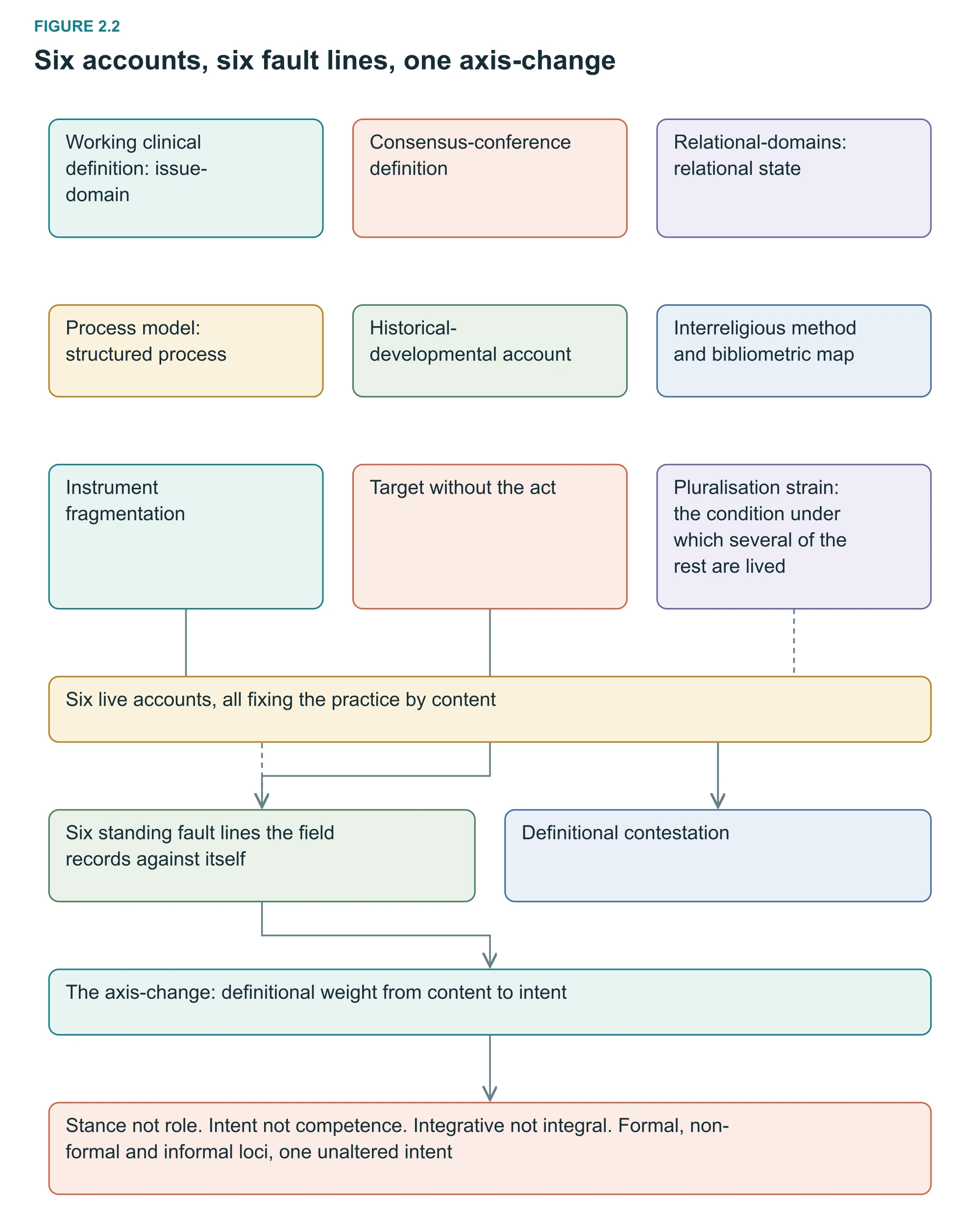
Figure 2.2. Six accounts, six fault lines, one axis-change.
3. Where the debate fragments or stalls
If the six accounts each capture something real, why do they not compose? The answer is that the field's difficulties are not casual disagreements to be settled by a better survey but standing fault lines - residues the literature itself records yet cannot resolve from within its present frame. Six recur.
The first is definitional contestation. There is no settled definition of spirituality, religion, or the existential, and the boundaries between them are drawn differently by different authors; 'the challenge of defining spiritual and pastoral care and chaplaincy' is conceded even by those who proceed regardless (Erşahin 2021, citing Gilbert & Parkes 2011). The field operates, in practice, on overlapping but non-equivalent vocabularies, so that two clinicians using the word 'spiritual' may not be naming the same object. This is not pedantry. Where the working definition fixes care by its issue-domain (Koper et al. 2018), the very domains it enumerates - existential, relational, religious - are themselves the contested terms, and the contestation is inherited wholesale by the definition built upon them. Poncin and colleagues' independent survey reaches the same finding from the chaplaincy side and adds the mechanism behind it: 'it is not uncommon for studies to adopt a concept by default, often the one presupposed by the research instrument they employed' (Poncin et al. 2019), so that 'divergences in concepts, as well as in assessment methods, may help to explain contrasting results amongst studies on similar topics'. The concept, in other words, is frequently not chosen at all but inherited from the questionnaire - which ties this first fault line directly to the second.
The medical-research literature sharpens the same point to its most uncomfortable edge. It is not only that a study inherits its concept of 'the spiritual' from whichever instrument it reaches for (Poncin et al. 2019); it is that the instruments themselves may not be measuring the distinct object they name. Reviewing the field's most-used measures, Koenig finds that 'spirituality measures are heavily contaminated with questions assessing positive character traits or mental health' - optimism, forgiveness, gratitude, meaning and purpose, peacefulness, harmony, general well-being - so that their results 'should be considered with caution' (Koenig, in Lucchetti & Lucchetti 2014). The contamination is telling in both directions. Diagnostically, it shows the first fault line is not a mere quarrel over words but a defect that reaches into the data: where a 'spirituality' score is empirically indistinguishable from a general well-being score, the concept has not been operationalised so much as dissolved into its neighbours, and the field's 'conflicting findings' are what such dissolution looks like at the level of results. Constructively, the same contamination locates with unusual precision what an Integrative account must hold apart and relate rather than fuse: the very facets the measures conflate - meaning, harmony, connectedness - are exactly the aspects a Coherent View would align without collapsing each into the others or into a single summary number. The instrument fragments the object at the level of the questionnaire item; so the demand for measurable care that §6's second objection presses must answer this contamination and not only the fragmentation named above it.
The field's most visible attempt to close this first fault line is itself instructive about why the fault line persists. Confronted with a proliferation of definitions, the response of the consensus conferences (Puchalski et al. 2009; Puchalski, Vitillo, Hull & Reller 2014) was to convene the field's leaders and negotiate a single agreed statement - to fix the definition by expert agreement. The manoeuvre relieves the symptom without removing the cause. It yields a shared sentence, and a valuable one; but it settles the contestation by summation and authority - the sum of what convened experts will jointly endorse - rather than by any principle that could say why the many sayings of 'the spiritual' cohere. A definition ratified because a conference of leaders would sign it remains, in its logic, an average of standing positions, and the next conference, or the next instrument, may ratify another. More tellingly for a chapter on care, the consensus is reached among professionals and not with the person whose spirituality is in question: it fixes in advance, at the level of the field, the very content that Rumbold (2007, in Poncin et al. 2019) warned assessment must elicit rather than impose at the bedside. The consensus definition is thus the field's own best instance of the integral, not Integrative, repair (Chapter 4): it sums perspectives into an agreed statement where the Integrative would align them, among all observers and without discarding, toward the patient's own Coherent View. That the field reaches for consensus at all is a sign it knows the fragmentation must be answered; that the consensus does not hold is a sign the answer is not summation.
The second is instrument fragmentation. Interventions are 'often developed as stand-alone instruments' - questionnaires, spiritual-needs assessment guides - that 'do not approach spiritual care as an ongoing and integrated part of patient care' (Damberg Nissen, Viftrup & Hvidt 2021; cf. Damberg Nissen et al. 2020). Care is sliced into separately assessable units and, in the slicing, loses the relational continuity that the same authors identify as its essence. That the field's strongest internal attempt at coherence - the process model of §2 - is itself a reaction against this fragmentation is the measure of how deep the fault line runs: coherence has to be reconstructed precisely because the working tools dissolve it.
This dependence of concept upon instrument is what makes the second fault line generative of the first rather than merely parallel to it. When the assessment tool fixes in advance what 'spiritual' will mean, the instrument does not only slice care into separately scorable units; it also quietly legislates the very definition the field cannot otherwise agree, and legislates it differently for each tool in use. The field's own critical literature has registered the cost to the person assessed. Reviewing what assessment does at the bedside, Rumbold (2007, in Poncin et al. 2019) observes that assessments 'tend to impose particular views or definitions of spirituality, instead of eliciting "the thoughts, memories and experiences that give coherence to a person's life"'. The remark is doubly telling. It names the imposition an instrument-led practice performs upon the patient - the non-imposition failure §4 must repair - and, in the same breath, it states the alternative, in the field's own words, as the eliciting of what 'give[s] coherence to a person's life'. Within the chaplaincy literature's most self-critical moment, that is, the positive aim is already described as coherence, reached by eliciting rather than imposing. The Integrative reframe of §4 does not import that aim from outside the field; it takes the field's own best self-correction and supplies the concept - a Coherent View, sought among all observers, without discarding - that lets the aim be stated as a method and not merely registered as a regret. A neighbouring critique sharpens the warning: Bull (2015, in Poncin et al. 2019) finds that chaplains often use case studies 'to confirm that their approach is appropriate' rather than to question 'the potentially disempowering effect of "pastoral power"', so that the directiveness the patient actually bears goes unexamined - which is precisely the worry the non-imposition clause of §4 is built to answer.
The third is the medicine-spirit boundary. The twentieth-century bracketing of religion and spirituality out of medical practice, in which clinicians were trained to 'steer clear' of such conversations, has been only partly reversed (Erşahin 2021). The result is a structural mismatch between the holism the field now espouses and the division of clinical labour it inherits: spirituality re-enters the curriculum as a 'generic... add-on' (Swinton 2007, 2012, in Erşahin 2021) bolted to a model whose positivist architecture was built to keep it out. Holism is professed at the level of doctrine and contradicted at the level of structure.
The fourth is the individualisation burden. Because spiritual needs are 'always individual' and depend on the patient-provider relationship, provision 'often falls on the individual healthcare professional' (Moudatsou et al. 2020, in the SpiCaQuest competencies note), who meets it under constraints of time, resource, role-boundary and competence. Responsibility is diffused to the bedside without a shared frame to carry it, and a practice the institution affirms in policy becomes, in the event, 'auto-didact and ad hoc' (Damberg Nissen, Viftrup & Hvidt 2021). The burden is real, but it is a symptom: it is what the absence of a common foundation feels like to the person standing at the bed.
The fifth is pluralisation strain. Models built largely by and for one tradition are stretched by multi-faith, intercultural and secular contexts, raising the still-unresolved methodological question of how a caregiver competently engages deep religious difference rather than merely tolerating its presence (Schipani 2024). This is the fault line the field most openly avows and least knows how to close, and its own meta-reading places it within a wider thinness in theoretical framing relative to empirical and applied output (Nandram, Bindlish, vander Wal & Kaur n.d.).
But the fault line as the field states it is under-described, and the under-description is why it will not close. Stated in the field's own terms, pluralisation is a fact about who is at the bedside: the ward has become multi-faith, intercultural and secular, and models built by and for one tradition are stretched by the traffic. So described, the strain admits a remedy in kind - more competence, more traditions represented at the table, a broader consensus statement - and the field has reached for exactly these. That the strain persists after two decades of reaching is the first evidence that the description is wrong.
The two authorities the field itself invokes at this point say something considerably stronger, and in this literature they are invoked without being heard. Damberg Nissen, Viftrup and Hvidt (2021) ground the pluralistic condition of care on Taylor (2007) and Berger (2014), and §1 above followed them in doing so. Neither author holds that pluralisation is a demographic fact about wards.
Taylor's (2007) thesis concerns the conditions of belief and not their distribution. A secular age, on his account, is not one from which religion has been subtracted but one in which belief has become one option among others - contestable, and known by the believer to be contestable. Within the 'immanent frame' the buffered self holds its convictions in awareness of the alternatives pressing upon them, so that faith and unbelief alike are fragilised, each lived under cross-pressure from the other. The salient fact is not that the ward contains Hindus, Muslims, Catholics and unbelievers. It is that the Catholic on the ward knows that she might have been the unbeliever, and cannot altogether stop knowing it.
Berger (2014) arrives at the same place by recanting his own earlier position. The secularisation theory he had helped to build was, he concluded, mistaken in its master category: modernity does not reliably produce secularity, it reliably produces pluralism. And the pluralism it produces is of two kinds, not one. The first is the familiar co-existence of many religious and secular worldviews within a single society - the ward as the field describes it, and the ward its competence training is built for. The second, and for Berger the more consequential, is the co-existence of religious and secular discourse within the mind of the same individual: the modern person moves between frames, holding both, without necessarily reconciling them. It is this second pluralism that the field's statement of the fifth fault line does not contain, and that its remedies therefore cannot reach.
Three consequences follow, and they run back through the fault lines already named.
First, the failure of the remedy in kind is explained. Interreligious competence - Schipani's (2024) cultural humility, contemplative and reverent curiosity, consultation and referral - is competence in meeting another's frame, and it is indispensable; nothing here is said against it. But if the plurality is also internal to the patient, then the caregiver's difficulty is not only to meet a worldview other than their own. It is to meet a patient who is, on the matter in hand, of more than one mind, and who may be unable to say which mind is theirs. No increment of skill at recognising traditions addresses a patient whose trouble is that no tradition unambiguously holds them. The field trained for Berger's first pluralism and met, at the bed, his second.
Second, the first fault line is given the cause it lacked. §3 opened by reporting that the field cannot settle what 'the spiritual' means, and traced the instability to the instruments that legislate it. But an instrument can only inherit an instability it did not create, and the account of the second fault line as generative of the first, though correct as far as it goes, stops one step short of the source. Under the immanent frame 'the spiritual' is an unstable category, and unstable in a specifiable direction: once belief is one option among others, the term loses the settled semantic field that a shared cosmology used to supply, and drifts toward whatever content remains available to everyone. The field's own definitions record the drift with candour. The spiritual is fixed as the existential and relational, 'broader than religion' (Peng-Keller 2024); as meaning, hope, transcendence and connectedness (Koper et al. 2018). Each widening is a reasonable answer to a plural ward. Taken cumulatively they are the immanent frame writing a definition: the concept is broadened until it can be affirmed by a patient of any frame or of none - which is to say, until it no longer names anything that a particular frame supplied.
Third, and most sharply, the sixth fault line below is given the cause that completes it. That section will show how the spiritual entered the clinic as a measure, and will convict the relational-domains construct of making a scoreable state stand in for the good of care. What it does not explain, and cannot from within its own materials, is why the score should come back contaminated in the particular way it does. Koenig's finding that the field's spirituality measures are 'heavily contaminated' with optimism, forgiveness, gratitude, meaning and purpose, peacefulness, harmony and general well-being (Koenig, in Lucchetti & Lucchetti 2014) is read in the field, and was read at first in this chapter, as a defect of psychometric workmanship. It is not workmanship. It is the immanent frame arriving in the questionnaire. Broaden 'the spiritual' until it is affirmable within any frame, hand the broadened concept to psychometrics, and the items that survive validation across a plural sample will be, of necessity, the ones that no particular frame owns: which are precisely optimism, gratitude, meaning and peace. The sixth fault line explains why there is a measure at all; the fifth explains why the measure returns what it does. The contamination is not noise in the measurement of a stable object. It is the measurable residue of an object that pluralisation had already destabilised, and Koenig's finding and Taylor's diagnosis are one finding, taken once in the clinic and once in the history of belief.
The fifth fault line is therefore not one strain among six but a condition under which several of the others are lived - which is why the field, addressing it as though it were a training deficit, has been unable to close it, and why an account that means to answer it must say something about what a person's coherence is before it says anything about how a caregiver should protect it. That is the burden §4 takes up, and the eighth objection of §6 is where it is made to pay.
The sixth is the target without the act, and it is the residue of the one account among the six that this chapter is most in sympathy with - which is why it has gone so long unexamined, and why it is the most instructive of the six. The relational-domains account (Fisher 2010, in Erşahin 2021; Ellison 1983, ibid.) alone answers the prior question of what good spiritual care serves, and §5 will build upon its four domains rather than against them. But what it defines is spiritual health, not spiritual care: it specifies a target and leaves the act unspecified. That omission is not a gap to be filled at leisure. Three things follow from it, and the third is the mechanism the first fault line was missing.
First, an account that names only the good licenses whatever act is alleged to produce it. If spiritual care is the care that raises a person's well-being across the personal, communal, environmental and transcendental domains, then the proselytiser who secures a deathbed conversion has, on the account's own terms, given spiritual care - the transcendental domain is exactly where his work would tell, and the account holds no clause with which to exclude him. So has the clinician who quiets an anguished patient into an untroubled peace, for peace scores. Not one of the distinctions §4 will draw - an ongoing relation rather than a stand-alone tool, a stance rather than a referral silo, alignment rather than summation, and above all the patient's Coherent View rather than the caregiver's - can be derived from a specification of the target, because every one of them is a claim about how the relating is conducted, and a target is silent about the how. A definition by state is intent-blind: it can be satisfied in full by a practice the field would repudiate, and it cannot say why.
Second, the four domains are enumerated and their coherence is never grounded. Fisher's specification - a life affirmed 'in a relationship with God, self, community and environment' - is a list of relations, and the account nowhere says why these four compose one good rather than four goods. So the summative habit this chapter has been tracking at the level of the act (the enumerated issue-domain; the negotiated consensus) reappears here, unnoticed, at the level of the good: a whole assembled by addition. A person whose transcendental domain lies in ruins and whose communal domain thrives records, on a summed score, an unremarkable spiritual well-being. Four domains totalled is not a life held together - and the account cannot say so, because it possesses no concept of the holding. That concept is what §4 must supply and §5 must ground.
Third, and decisively: the good, so defined, is a state, and a state is scoreable. Ellison's founding analogy is the tell, and it should be read as literally as he wrote it. Spiritual well-being, he proposed, is 'an indication of individuals' quality of life, much like a pulse rate is an indicator of good health' (Ellison 1983, in Erşahin 2021). A pulse rate is a reading one takes; it is not a relation one enters. And the analogy did its work: it was precisely as a reading that the spiritual entered the clinic and won the empirical warrant §1 rehearses. But once the good of care is a reading, care becomes whatever moves the reading, and the instrument that takes the reading acquires the authority to say what the reading is of. This is the first fault line's mechanism, arriving from upstream. Concepts are 'presupposed by the research instrument they employed' (Poncin et al. 2019) because the account of the good made an instrument necessary and did not say what the instrument should measure. And Koenig's contamination finding is simply what the field discovered when at last it looked: that its spirituality measures are 'heavily contaminated' with optimism, gratitude, meaning, peacefulness and general well-being (Koenig, in Lucchetti & Lucchetti 2014). That is not poor workmanship in the questionnaires. It is the relational-domains account arriving at its destination. Define the spiritual as a state of well-being across four domains, hand the definition to psychometrics, and a well-being score is what returns; anything else would have been the surprise.
The residue, then, is the hardest thing §3 has to say to the empirical strength §1 opened with. The field's foothold in the clinic was won by a measure, and the measure is the fault. The relational-domains construct is what made the spiritual legible to medicine - scoreable, correlatable, publishable at seven articles a day (Lucchetti & Lucchetti 2014) - and it is the same construct that dissolved the object it made legible, because a target without an act must be operationalised by whatever instrument comes to hand, and an instrument that measures a state cannot see an intent. The definitional thinness on which the three field-maps of §2 converge is not the price of the field's youth. It is the price of its entry ticket.
Compressed, the stall is this. The field is committed, in its self-description, to holism and to relationship; yet its operative tools - discrete instruments, a referral sub-speciality, bracketed religion, individualised ad hoc provision, and a scored state standing in for the good all of these are meant to serve - keep fragmenting what it calls whole, and keep discarding perspectives (other faiths, the secular, the patient's own ordering of meaning) that a genuinely holistic care would have to hold together. The field knows that it should not discard; the difficulty is that its instruments discard by design, and that the good they were built to track was defined, from the outset, as a sum. Naming that gap precisely, and supplying a frame in which holism is the starting intent rather than the hoped-for sum - and in which the good of care is a direction the patient is helped toward rather than a reading the caregiver takes - is the work of §4.
4. The Integrative move
The corrective is not a seventh account to set beside the six but a change in what kind of thing a definition of spiritual care should be. Each of the six fixes the practice by some content - an issue-list, a relational state, a sequence of phases, a developmental history, a method for difference, a bibliometric map - and the fault lines of §3 are, at bottom, the failure of those contents to compose into one. The Integrative move relocates the definitional weight from content to intent. The field's own critics had already named the aim - eliciting what gives 'coherence to a person's life' rather than imposing a definition (Rumbold 2007) - but lacked a concept of that coherence robust enough to direct a practice; the Integrative supplies it.
Stated directly, spiritual care is an instance of the Integrative applied to the inner life of a person in need. The Integrative is 'the intent of relating all possible aspects, perspectives and purposes under holistic understanding of any context towards a Coherent View among all observers of the context in focus, without discarding any aspect, perspective and purpose' (Chapter 4, quoted exactly). Read through this definition, spiritual care is not a discrete intervention added to clinical care but the relational practice of helping a person move toward a Coherent View of their own situation - illness, meaning, relationship, transcendence - with no aspect, perspective or purpose discarded along the way. Holism, on this reading, ceases to be an outcome assembled from domains after the fact and becomes the intent under which the relating is conducted from the first - which is exactly what the fragmenting tools of §3 could not deliver, because each secured its own unit of care by setting the others aside. (The name Integrative spiritual care is the author team's own: what Bindlish, Nandram & Joshi (2025) proposed as a validated meta-definition, this book grounds in the Integrative paradigm (Philosophy of the Integrative, Bindlish 2026) and sharpens from synthesis into non-discarding relation.)
The account earns its place differentia-first, against the three near-matches a reader is most likely to confuse it with. Against the assessment-instrument model, Integrative spiritual care is an ongoing relational orientation rather than a stand-alone tool; it answers the integration gap Damberg Nissen and colleagues name, because integration is its starting intent and not a downstream hope - and the instruments of §3's second fault line return, in Ch 6, as moments within the relation rather than as substitutes for it. Against the chaplaincy-sub-speciality model, it is a stance available to any caregiver in any 'organization that deals with human beings and their interdependence and interconnectedness' (SpiCaQuest competencies note), not the preserve of a referral specialism; this meets the individualisation burden of §3's fourth fault line by giving the individual professional a shared frame in place of a private and ad hoc charge. Against the religion-bracketed and the summative-pluralist models, it neither brackets religion out nor merely sets worldviews side by side and adds them up: following the primary differentia of the Integrative (Chapter 4), it seeks alignment toward a Coherent View, not summation - directional, not merely additive. This is precisely what Schipani's (2024) interreligious problem and the pluralisation strain of §3's fifth fault line require, and what an additive pluralism, however tolerant, cannot supply: tolerance sets worldviews next to one another, but it gives the relating nowhere to go.
A fourth distinction completes the account, and it must be drawn not against a model a reader would confuse this one with but against the one account of the six this chapter is most in sympathy with. Against the relational-domains model (Fisher 2010; Ellison 1983, both in Erşahin 2021), whose four domains §5 builds upon rather than against, Integrative spiritual care names an act and not a state. What the relational-domains account defines is spiritual health - a target reached and then read off, 'much like a pulse rate is an indicator of good health' (Ellison 1983, in Erşahin 2021); what §4 defines is the relating by which a person is helped toward coherence, a direction entered rather than a reading taken. The difference is not a refinement but a change of category, and it is the one §3's sixth fault line was built to force: a definition by state is intent-blind, satisfied in full by the proselytiser who secures the transcendental domain or by the clinician who quiets an anguished patient into a peace that merely scores, because a target is silent about the how of its reaching. Integrative spiritual care supplies that how - an ongoing, non-discarding, non-imposing relation directed toward the patient's own Coherent View - and in supplying it recovers what the measure had lost: the holding of the four domains into one life rather than their summation into one score, whose contamination with generic well-being (Koenig, in Lucchetti & Lucchetti 2014) was, as §3 showed, the relational-domains account arriving at its destination. So the good of care is restored from a reading the caregiver takes to a direction the patient is helped toward - which §5 grounds in the puruṣārtha continuum and in Principle 5's Shubh Laabh, and which no definition by state can reach.
One clarification guards the move from its most natural misreading. The Coherent View toward which care is directed is the patient's, reached among 'all observers' of the case - patient, family, clinicians, caregiver - and not a doctrine the caregiver brings and installs. Non-discarding and non-imposition are, on this account, two faces of one requirement: to relate every perspective without discarding any is also to refuse to overwrite the patient's own ordering of meaning with the caregiver's. The directionality of the Integrative is therefore not a covert directiveness; it is the orientation of a relating that has somewhere to go without already knowing where the patient must arrive. This is the hinge to the full definition of Integrative Spiritual Care in Ch 4, and to the caregiver's stance and formation in Ch 5; what heya (that which is to be discerned and let go) the inherited field must release for such relating to begin, and at what level of knowing (K1-K4) such care is held, are stated there, in the need-diagnosis's and the knowledge model's own defined terms.
5. The Dharmic resource, brought alongside
The Integrative move of §4 relocates the definition of spiritual care from content to intent; it does not, by itself, supply the deeper account of why a person's perspectives can be related without discarding any, or why care for one is care for all. That account the Integrative draws from the Dharmic resource, brought here as philosophy alongside the Western field and not as authority by assertion. The licence for bringing it is, in this instance, the field's own: the SpiCaQuest competencies note, reaching for a name for inclusive 'everyone wins' care, already glosses it as reflecting 'the concept of Dharma, emphasizing the duty to uphold harmony and interconnectedness' (SpiCaQuest competencies note; cf. the convivialist programme, Convivialist International 2020). The literature gestures at dharma; this section states what it is gesturing at.
Beneath the field's language of 'wholeness' and 'holism' lies a metaphysical claim it rarely makes explicit, and which the first principle of the Integrative Paradigm makes for it. Principle 1, Respect for Integral Unity, holds that 'There is one truth, the knowledgeable speak it in many ways' (Chapter 4; ekaṃ sat viprā bahudhā vadanti, ṚV 1.164.46) - so that difference among patients' worldviews is difference of perspective upon one reality, not a set of mutually cancelling claims to be adjudicated or averaged. This is the metaphysical underwriting of non-discarding. Where the relational-domains account (Fisher 2010, in Erşahin 2021) lists the personal, communal, environmental and transcendental domains of spiritual well-being but does not say why they cohere, Integral Unity supplies the ground: they cohere because they are facets of one whole, and no patient's framing of that whole is, in the strict sense, 'invalid'. Integral unity here is to be distinguished from synthetic unity (Chapter 4): the perspectives are not fused into a single homogenised view but aligned as many sayings of one truth - which is precisely the alignment-not-summation that the differentia of §4 requires.
The same resource reorders what the field calls 'spiritual need'. The clinical literature enumerates needs - meaning, hope, transcendence, connectedness (Peng-Keller 2024; Koper et al. 2018) - as an open and ad hoc list, and §3's first fault line showed the list inheriting the contestation of its own terms. The puruṣārtha scheme offers instead a holistic and non-fragmenting ordering of what a human being seeks: dharma (righteousness), artha (the means of prosperity), kāma (legitimate worldly desire) and mokṣa (liberation), the four to be held together rather than triaged (Chapter 4, Principle 2). Read through it, the clinical 'quality of life' and 'existential well-being' cease to be two departments and become one graded continuum, for dharma is glossed as that which secures both abhyudaya (worldly flourishing) and niḥśreyasa (the higher good, or meaningfulness). A 'spiritual need' is then not an item ticked off an inventory but a person's movement across this continuum, which is why §6 can retain assessment instruments as moments within a relation rather than as the relation's substitute.
Finally, the relational core of spiritual care - that care is enacted in relationship and is owed to the whole community of the case - is named directly by Principle 5, We are all connected, and its aim of Shubh Laabh, welfare for all: if we are indeed all connected, the welfare the caregiver seeks for the patient is not extracted from the welfare of others but continuous with it (Chapter 4). Brought alongside the convivialist 'everyone wins' that the SpiCaQuest note already invokes, Principle 5 is its deeper warrant, and it answers the residue §3 left standing under the individualisation burden: the caregiver at the bedside is not a lone provider improvising a private good but a participant in a connectedness that the care expresses.
Principle 5 carries a second clause that the field's own pluralism makes indispensable. It 'translates into higher comfort with chaos and an epistemological appreciation of indigenous non-translatable knowledge' (Chapter 4, Principle 5) - a comfort the field has been reaching for without a name for it. Schipani's (2024) interreligious problem, the pluralisation strain of §3's fifth fault line, arises exactly where a patient's meanings will not convert cleanly into the caregiver's frame, or into any shared one; Berger's (2014) plural modern holds religious and secular construals at once, and Taylor's (2007) cross-pressure keeps each in awareness of its own contestability. The dominant reflex before such difference is to translate it - to render the patient's idiom into a common clinical vocabulary of 'meaning', 'hope' and 'connectedness' in which it can be assessed and compared. But translation of this kind is a discarding performed under a courteous name: what will not reduce to the shared terms is quietly dropped, and it is often the load-bearing content - the particular god, the particular rite, the untransferable word - that resists reduction most. Principle 5 licenses the opposite posture. Because we are all connected, the many sayings of the one truth (Principle 1) need not be made to speak a single language before they may be related; the caregiver may hold a patient's non-translatable meaning as itself a perspective in the case, related toward the patient's own Coherent View without first being exchanged for a commensurable token. This is why the account can take the internally plural patient of §6's eighth objection as its ordinary case rather than its embarrassment: the coherence it seeks is a direction of relating, not a common denominator, and a relating that forbids discarding must equally forbid the translation-tax that discards by conversion. Comfort with chaos, on this reading, is not a tolerance of disorder but the confidence that perspectives may be borne together, untranslated, without collapse.
Held together - Integral Unity grounding non-discarding, the puruṣārtha continuum mapping need without fragmenting it, and Principle 5 grounding both the relating-for-all and the standing of a plurality that need not be translated to be related - the Dharmic resource gives the Integrative move of §4 its depth structure, while remaining, throughout, a philosophy offered alongside the field and never a doctrine pressed upon the patient.
6. Objections and replies
Nine objections meet the account at its most exposed points, and each is answered from within the account rather than by retreat from it.
The first is that importing dharma is the very confessional imposition the field warns against - that a book on spiritual care in plural settings has, in §5, simply installed one tradition's metaphysics as the frame for all. The reply turns on the distinction the whole series rests upon: the Dharmic resource is brought as philosophy alongside, transliterated and argued so that a non-specialist may follow it as reasoning, not as a doctrine to be assented to. More strongly, Principle 1 makes non-imposition constitutive rather than merely promised: if there is one truth spoken in many ways, the caregiver's task is to help the patient toward the patient's own Coherent View, not to substitute the caregiver's. Schipani's (2024) demand for interreligious competence is thereby met by orientation, not by conversion - the account is most directional exactly where it is most non-impositional.
The second objection is practical: without measurable instruments, Integrative care is unauditable. The reply is that the account does not reject instruments; it relocates them. The stand-alone questionnaire and the spiritual-needs guide return, in Ch 6, as moments within an ongoing relational process (Damberg Nissen, Viftrup & Hvidt 2021), where they inform discernment without standing in for it. The Integrative move repairs the instrument fragmentation of §3's second fault line; it does not abandon measurement, and an audit of relation-over-time is no less rigorous than an audit of discrete units - it is harder, and more faithful to what the field says care is.
The third objection is that this is merely holism rebranded. The reply is the differentia of §4 stated once more: holism names a goal - whole-person care - while the Integrative names the intent and method of reaching it without discarding, namely alignment toward a Coherent View rather than summation of dimensions (Chapter 4). The bolt-on holism of §3's third fault line is exactly holism-as-goal without holism-as-method; that the field can profess the whole while its tools fragment it is the proof that naming the goal is not yet supplying the means. The distinction is developed at length, against its nearest near-matches, in Philosophy of the Integrative (Bindlish 2026).
The fourth objection comes from the other side: secular patients have no 'spiritual' need at all, so an account this capacious overreaches. The reply is that the field has already framed the spiritual as existential and relational and 'broader than religion' (Peng-Keller 2024), and the resource of §5 follows suit: the puruṣārtha continuum and Principle 5 hold the secular seeker within the same map of meaning and connection without requiring any religious content of them. A patient who claims no faith still seeks coherence among the aspects of a hard situation, and it is that seeking, not a creed, which Integrative spiritual care serves - a claim tested directly in the secular and cross-cultural cases of Ch 21.
The fifth objection presses from the field's own recent history: the definitional question has already been settled by consensus. The 2009 and 2014 consensus conferences (Puchalski et al. 2009; Puchalski, Vitillo, Hull & Reller 2014) produced a widely adopted definition of spirituality and a shared model of spiritual care; if the field has an agreed account, the Integrative relocation of §4 can look redundant, a philosopher's refinement of a question practitioners have closed. The reply grants the achievement and denies the inference. What the consensus conferences settled is a statement; what they did not settle - could not, by their method - is how a contested definition ought to be fixed. Their instrument is negotiated agreement among convened experts, which is summation raised to the level of the profession: an average of the positions the participants would jointly endorse, directional nowhere in particular and revisable at the next conference. This is precisely the integral, not Integrative, move the account is built to distinguish itself from (Chapter 4) - alignment toward a Coherent View, not summation of endorsements. And the consensus is reached in the wrong company. It is agreement among experts about the patient, not a Coherent View sought among all observers of the case, the patient foremost, without discarding any perspective (Chapter 4); so that even a flawless consensus would re-perform, at the level of the field, the imposition that §3 found the instruments performing at the bedside. The Integrative account does not compete with the consensus definition for the same prize. It answers a question the consensus method cannot reach - not what shall we all agree to call the spiritual, but how is this person to be helped toward a coherent view of their own situation, with nothing that matters to them left out.
The sixth objection is the deepest, and it is aimed not at the account of §4 but at the diagnosis of §3 on which that account leans: the fault lines are not found but manufactured. The chapter has called the field's instruments fragmenting, its consensus merely summative and its holism a bolt-on precisely because it already holds the Integrative standard by which such things count as failures, so that the survey is the conclusion wearing a surveyor's coat. Name instrument-led assessment 'fragmentation' and you have presupposed that care ought to be an undivided relation; name the consensus definition 'summation' and you have presupposed that definitions ought to align rather than aggregate; name re-entered spirituality a bolt-on and you have presupposed the holism-as-intent that only §4 supplies. On this reading the field has been convicted under a law it never enacted, and the differentia-first method of the chapter is a petitio: the six near-matches look deficient only against a norm smuggled in to make them so.
The reply concedes the standard of measurement and denies the smuggling. A diagnosis begs the question only if the tension it reports is invisible from inside the frame diagnosed and visible only from the diagnostician's vantage; but the six fault lines of §3 are, each of them, residues the field records against itself, in its own vocabulary and prior to any Integrative reading. It is Erşahin (2021), not this chapter, who concedes 'the challenge of defining spiritual and pastoral care and chaplaincy'; Poncin and colleagues (2019), surveying the chaplaincy literature from within the profession, who find the concept 'presupposed by the research instrument they employed' and the resulting outcomes contrasting and incomparable; Rumbold (2007, in Poncin et al. 2019), a chaplain addressing chaplains, who warns that assessments 'tend to impose particular views or definitions of spirituality, instead of eliciting' what gives 'coherence to a person's life'; Damberg Nissen and colleagues (2021) who name the gap between the holism the field professes and the discrete instruments it uses; Schipani (2024) who avows the pluralisation method as still unresolved; and, for the sixth and newest fault line, it is Koenig - reviewing the field's own most-used measures, from within the medical-research literature that built them - who reports that they are 'heavily contaminated' with the general well-being they were meant to be distinguished from (Koenig, in Lucchetti & Lucchetti 2014), which is the relational-domains construct (Ellison 1983; Fisher 2010, both in Erşahin 2021) convicted by its own instruments. The chapter does not carve these as faults against an imported rule; it collects avowals the field has already entered against its own practice. What the Integrative supplies is not the standard by which the field fails but a name and a resolution for a tension the field states and cannot close from within - and, more pointedly, the very standard the field's own self-corrections are already reaching after. Rumbold's alternative to imposition is not summation but coherence; the consensus reflex is itself an admission that fragmentation must be answered rather than tolerated. When the diagnostician's norm turns out to be the one the diagnosed keep grasping after in their most self-critical moments, the charge of smuggling fails: the norm was already in the room, unnamed.
Two limits keep the reply honest. First, that the fault lines are the field's own avowals does not make the resolution the field's own: §4's relocation of the definitional weight from content to intent is an addition, argued and defensible, not a finding read off the surveys, and the chapter claims no more. To describe a tension in a field's own terms is not yet to have shown that this resolution is the right one, only that the problem is real and internal, so that an answer is owed and not invented. Second, the differentia-first method is a method of exposition, not of proof: it orders the argument so a reader can see how the Integrative differs from what they already know, and the seeing is not the establishing. The establishing is done, near-match by near-match, in Philosophy of the Integrative (Bindlish 2026), where each standard the present chapter leans on - alignment-not-summation, non-discarding, the Coherent View - is defended against its nearest rivals rather than assumed. This chapter borrows those results; it does not smuggle them. Pressed to its root, then, the circularity objection reduces to the true and harmless observation that a differentia-first chapter argues from a differentia it does not, in that chapter, prove - which is the ordinary division of labour between a chapter that states a differentia and the work in which that differentia is defended, cited here as any other source would be.
The seventh objection presses the account's most institutionally exposed claim, the one §4 makes against the chaplaincy-sub-speciality model: by making spiritual care 'a stance available to any caregiver', the Integrative account de-professionalises it. The field has laboured for decades, in Poncin and colleagues' words, to 'establish healthcare chaplaincy as a strong, unified field' (Poncin et al. 2019); Schipani's (2024) interreligious competence is built precisely of specialist skills - 'cultural humility, contemplative and reverent curiosity', consultation and referral - and not of an orientation any clinician may adopt at will. To hand the spiritual to 'any caregiver in any organization that deals with human beings and their interdependence and interconnectedness' (SpiCaQuest competencies note) looks, on this objection, like trading a hard-won professional standard for a stance so capacious that it protects no one: the under-formed clinician is licensed to undertake exactly the deep existential engagement the objection says requires training, and the profession's boundary - its guarantee of competence to a vulnerable patient - is dissolved in the name of holism. The charge is the sharper for coming from the same self-critical literature the chapter has leaned on throughout: the field's own reviewers want the boundary firmer, not looser.
The reply distinguishes what the objection runs together: a stance and a role, an intent and the competence - adhikāra, the fitness or qualification to undertake a practice - that discharges it well. First, the account makes the intent general without making the role uniform. That a stance of non-discarding relation is open to every caregiver does not abolish the chaplain's specialist formation; it names the orientation within which specialist and generalist alike act, each at their own level. This is exactly the formal / non-formal / informal typology the author team's meta-definition already carries (Bindlish, Nandram & Joshi 2025, 157): care is provided at distinct levels of formality - the trained chaplain the formal locus, the bedside nurse the non-formal, the family member or fellow-patient the informal - without the intent altering as it passes between them. A shared stance raises the floor without lowering the ceiling, which is the opposite of de-professionalisation; de-professionalisation would flatten the levels into one, and it is precisely the levels the typology keeps distinct.
Second, the competence the objection defends is not discarded by the account but located - in §5's formation and in the stance and formation of Ch 5 - and, tellingly, non-discarding includes not discarding the specialist. A generalist who practises the Integrative stance is by that very stance one who knows the limit of their own adhikāra and refers; Schipani's (2024) consultation and referral are retained, not dissolved, because to relate every perspective toward the patient's Coherent View without discarding any is, when the perspective needed is the specialist's, to call the specialist in. The account thus makes referral a requirement of the stance rather than a concession against it: the caregiver who over-reaches their competence has, in over-reaching, discarded the contribution a better-formed other would bring, and so failed the intent on its own terms. Far from licensing the under-formed, the stance obliges them to know when they are out of their depth.
Third, and deepest, the boundary the objection defends is itself one of §3's fault lines wearing the dress of a virtue. The medicine-spirit boundary (§3's third fault line) is the very arrangement that quarantines the spiritual into a referral silo and thereby licenses every other clinician to 'steer clear' of spiritual conversation with patients (Erşahin 2021, citing Maugans & Wadland 1991). Making the stance general is not the removal of a profession but the removal of a quarantine: the specialist chaplain remains, the specialist formation remains, but the wall that told the bedside nurse the spiritual was 'not my job' comes down. The individualisation burden of §3's fourth fault line - provision left 'auto-didact and ad hoc' on whichever professional happens to be at the bed (Damberg Nissen, Viftrup & Hvidt 2021) - is not answered by re-erecting that wall but by giving every professional, at their own level, a shared frame in place of a private improvisation. The objection mistakes the de-quarantining of care for the de-professionalising of it.
What the reply does not claim is that a shared stance substitutes for training, or that generality removes the real risk of over-reach: a stance can be held sincerely and practised badly, and the safeguards against that - formation (Ch 5), the disciplined use of instruments within relation (Ch 6), and the referral competence the account makes internal to itself - are named here and built elsewhere. The claim is the narrower and defensible one, that generality of intent and specialism of role are compatible and indeed mutually required, so that the Integrative account extends the reach of spiritual care without lowering its standard.
The eighth objection is generated by the chapter's own authorities, and it strikes §4 at its central and most exposed claim: that under the conditions §3's fifth fault line describes, there may be no 'patient's own Coherent View' for care to be directed toward. §4 relocates the definitional weight from content to intent, and fixes the intent as helping a person move toward a Coherent View of their own situation. The move presupposes that the patient has, or might have, a view that is theirs - an ordering of meaning the caregiver is to elicit and must not overwrite. Berger's (2014) second pluralism denies that presupposition its ordinary application. If the modern patient holds religious and secular frames at once, moving between them without reconciling them, and if under Taylor's (2007) cross-pressure each frame is held in awareness of its own contestability, then the 'own ordering of meaning' that §4's non-imposition clause so scrupulously protects may not be there to be protected. The account is then embarrassed at exactly its proudest point. Care directed toward a coherent view, meeting a patient who is internally plural, must either produce the coherence - which is to install an ordering, the imposition §4 forswears - or leave the patient where it found them, in which case the direction was idle and the account has, after all, delivered only the tolerance it disparaged in the summative pluralist. The objection is the more serious for being raised on the chapter's own evidence: it was §1 that summoned Taylor and Berger, and §3 that let them speak.
The reply is that the objection has read Coherent View as a possession, and the Integrative as a procedure for retrieving it, and it is neither. Take the canonical definition at its word. The Integrative is 'the intent of relating all possible aspects, perspectives and purposes under holistic understanding of any context towards a Coherent View among all observers of the context in focus, without discarding any aspect, perspective and purpose' (Chapter 4, quoted exactly). What the definition requires is an intent of relating, held by the caregiver, and a direction, toward a Coherent View. Nothing in it requires that the Coherent View be already possessed by the patient and awaiting elicitation - indeed a view one already holds is not a thing one is related towards. The objection's dilemma is exhaustive only if coherence must be either found or installed. The Integrative's entire content is the third thing: coherence sought, among all observers of the case, by a relating in which the patient's aspects, perspectives and purposes are what is related, and the caregiver's perspective is one voice among the observers rather than the author of the result.
Once this is seen, the internal plurality the objection reports is not the account's defeat but its ordinary case - and the one condition under which its difference from the five rivals of §2 actually tells. Consider what each of them does with a cross-pressured patient. The issue-domain definition asks which of its enumerated domains the difficulty falls under, and a patient of two minds falls under it twice, or under none. The relational-domains account scores four domains and returns a figure in which the patient's contradiction is averaged away: sound on the communal, in ruins on the transcendental, unremarkable overall. The consensus definition offers a statement of the spiritual negotiated among convened experts, which the internally plural patient is invited to recognise themselves in, and which was fixed before they arrived. The assessment instrument, meeting several frames, selects the one its items were written for. Each of the five requires that the patient have a frame in order to be cared for; each, meeting a patient who has more than one, quietly picks; and the picking is a discarding performed on the inside of a person. Only an account whose object is the relating of a patient's perspectives, and whose non-discarding clause forbids the picking, can take the cross-pressured patient as they actually are.
Principle 1 supplies the warrant that such relating has anywhere to go. 'There is one truth, the knowledgeable speak it in many ways' (Chapter 4) is a claim about observers, and §5 read it across persons: many patients, many traditions, one reality perspectivally seen. But the principle nowhere stipulates that the many sayings must issue from many mouths. A patient who holds a religious and a secular construal of one illness is, on the account's own terms, an observer speaking in more than one way about one situation; and the Integrative reading of their difficulty is neither that one construal is false, nor that the two are to be summed into an average, but that they are not yet related. That is a direction, and it is not an imposition. What the caregiver holds is the intent that the patient's perspectives be related without discarding any; what the patient reaches is the patient's, and is not foreseen by the caregiver. The Coherent View is the direction of the care - not its precondition, and not its deliverable.
Two limits keep this reply honest, and they are the limits the objection is entitled to. First, the account does not claim that every cross-pressured patient can be brought to coherence, nor that coherence is owed to them on any schedule. What §4 fixes is the intent of the care, not its attainment: a person may die with their frames unreconciled and have been well cared for throughout, and any account that could not say so would have made a good of the caregiver's success rather than of the patient's life. Second, it is not claimed that the plurality within a patient is the same thing as the plurality among the observers of a case, nor that one operation dissolves both. What is argued here is that the intra-personal case falls under the definition, not that it reduces to the inter-personal one; the difference between relating a ward and relating a mind is real, and it is left to the caregiver's stance (Ch 5) and to discernment (Ch 6) to say what it comes to in practice.
The ninth objection is the mirror image of the second, and it presses the one distinction of §4 that the eight preceding objections leave untouched: the fourth, against the relational-domains model, on which Integrative spiritual care names an act and not a state. Grant everything the reply to the second objection secured - that instruments are relocated rather than rejected, that an audit of relation over time is possible. A defender of the relational-domains account, the one model §4 professes to be most in sympathy with, may still press the deeper cost of the category change. A definition by state - spiritual health reached, and read off 'much like a pulse rate is an indicator of good health' (Ellison 1983, in Erşahin 2021) - supplies, whatever its faults, one thing a definition by act cannot: a criterion of success. It can say when care has worked, because it names a target the patient either reaches or does not. Redescribe care as a relating directed toward coherence, and that criterion is gone. 'Well-related' is self-certifying; the caregiver who claims to have related every perspective without discarding or imposing grades their own process, and no external fact answers to the claim. The very unfalsifiability §4 pressed against the state model - the peace that 'merely scores', secured by the proselytiser and the sedating clinician alike - rebounds on the act model, which cannot now distinguish good care from a caregiver's sincere and fruitless busyness. The account has bought its freedom from the measure at the price of any way of telling whether it ever helped.
The reply concedes the cost and denies the conclusion, and it begins by granting the danger in its full symmetry. A definition by act does forfeit the state model's clean reached-or-not criterion, and process-language is corruptible: 'I related well' can armour bad care exactly as a peace-score can be gamed. Nothing in the account makes its own abuse impossible, and a reply that claimed otherwise would repeat the state model's error in a new key. But the criterion the objection asks the account to keep is the very one §3's sixth fault line convicted. Spiritual health defined as a state invites operationalisation and cannot, of itself, constrain the instrument that performs it (Note 11); the measures built to read it are, on the field's own review, 'heavily contaminated' with the general well-being they were meant to distinguish themselves from (Koenig, in Lucchetti & Lucchetti 2014). A criterion that certifies the counterfeit - that scores the imposed quiet as spiritual health and cannot tell it from the real thing - is not an asset the account is poorer for losing. The objection offers auditability at exactly the price §4 refused to pay.
What the account refuses is not a criterion but a type of criterion. It gives up the terminal test - did the patient arrive at the target state - and keeps a directional one, run not on the patient's attained condition but on the caregiver's relating, and run from outside. The three joints §4 already fixed are the tests. The discarding test: did the caregiver relate every aspect, perspective and purpose the patient supplied, or quietly pick one and drop the rest? The imposition test: did the caregiver's own ordering of meaning overwrite the patient's, or was the direction the patient's own? The direction test: did the relating move toward the patient's Coherent View, or idle in the mere tolerance §4 charged the summative pluralist with? These are operations on conduct, not readings of an inner glow, and a relating can fail each of them visibly - the caregiver who converts a patient's untranslatable meaning into the clinical idiom fails the first, the one who settles an anguished patient into the caregiver's own peace fails the second, the one who sets frames side by side and goes nowhere fails the third. This is the same shape of answer the Integrative gives wherever it releases an outcome without releasing accountability: Philosophy of the Integrative (Bindlish 2026) meets the parallel charge against niṣkāma karma - that to release the fruit of action is to make the action unassessable - with the mithyācāra tests, which audit the deed and not the disposition. The act model is assessable on precisely that pattern.
And the state-reading is not destroyed but desovereigned. Assessment returns in Ch 6 as a moment within the relation (the second objection); a reading of a patient's spiritual state may still be taken and may still inform, it simply no longer defines the good it once monopolised. Two limits keep the reply honest. The directional criterion is harder to audit than the terminal one - the second objection already conceded as much, and called the harder audit the more faithful - and it is not, in this chapter, a finished instrument: how a reading may be taken within a relation that the reading does not then govern is §7's open question and Ch 6's charge. And the concession made to the eighth objection stands and is not regretted: a person may die with their frames unreconciled and have been well cared for throughout, because the good of the care was the quality of the relating and not an outcome no caregiver commands. What the account does not concede is that any relating counts as good. The three tests divide well-relating from its counterfeit as sharply as the state model's score failed to divide real peace from imposed quiet - which is the whole of what the objection asked for, supplied on the act model's own ground.
7. What this commits us to
Stating the field fairly and locating its fault lines is preparation, not conclusion; this chapter commits the rest of the book to specific work. It commits Ch 3 and Ch 4 to laying the foundations and fixing the definition of Integrative Spiritual Care - relational, ongoing, non-discarding, and directional toward the patient's own Coherent View - that §4 has here only set in outline. It commits Ch 5 to a caregiver stance and formation capable of holding every perspective without imposing one, the inner discipline that non-imposition demands of the one who practises it. It commits Ch 6 to an assessment and discernment practice that uses instruments within a relational process rather than as substitutes for it, discharging the second objection above. And it commits Ch 8 to the cross-traditions competence that the pluralisation strain of §3's fifth fault line requires, and Ch 21 to the secular and cross-cultural seekers of the fourth objection.
Two pieces of the apparatus are named here and fixed elsewhere. The chapter has spoken throughout of what the inherited field must let go for non-discarding relation to begin - the discrete instrument as a sufficient unit of care, the referral sub-speciality as the only locus of the spiritual, the bracketing of religion, the lone and ad hoc provider - but the formal need-diagnosis that names this as heya (that which is to be discerned and released) belongs to the 4H framework, stated at Chapter 3. Likewise the chapter has located spiritual knowing as something deeper than information recorded in a chart, held in relation rather than read off an instrument, but the level at which such care is held belongs to the K1-K4 knowledge model, applied at Chapter 6. Both are named here and done there, so that the foundation this chapter opens is completed, not foreclosed.
The single open question the chapter hands forward is whether the field's own appetite for measurable spiritual care can be satisfied without the fragmentation that measurement has so far imposed - whether, in the terms of §6's second objection, an assessable practice can be built that does not collapse back into the stand-alone instrument. §3's sixth fault line sharpens the question into its hardest form and hands it forward in that shape: the measure is not one tool among the field's others but the construct by which the spiritual entered the clinic at all, so an Integrative answer must show how a practice can be assessable without letting the assessment define the good it serves - how a reading may be taken within a relation that the reading does not then govern. That question is the charge of Ch 6, and the Mapping the Landscape team's fifth research question (Nandram, Bindlish, vander Wal & Kaur n.d.) - the field's thinness in theoretical and definitional framing relative to its empirical output - is the test bed on which an Integrative answer must prove itself.
Notes
1. The World Health Organization's treatment of spiritual well-being is programmatic rather than definitional: it affirms spirituality as a constituent of quality of life and of palliative care without resolving the content of 'the spiritual' - which is exactly the gap the field's competing accounts attempt to close. Damberg Nissen, Viftrup and Hvidt (2021) cite the WHO emphasis as warrant for treating spiritual care as a structured process; the present chapter reads the same warrant as leaving the definitional question open. Erşahin (2021) likewise traces the WHO's 1984 revision of the concept of health and its later 'Health in All Policies' framing as part of the move toward whole-person care.
2. This book follows the field's own working vocabulary, in which 'spirituality' is an existential-and-relational concept 'broader than religion' (Peng-Keller 2024) and 'the existential' names the register of meaning, hope and connectedness common to religious and secular patients alike. The terms are not equivalent and are drawn differently by different authors (Gilbert & Parkes 2011, in Erşahin 2021); where precision is required the chapter marks which sense is in play. The Integrative account does not legislate a single definition of 'spirituality' but relocates the definitional weight from the object (what spirituality is) to the act (the intent of relating a person's aspects, perspectives and purposes toward a Coherent View) - a move set out in §4 and completed in Ch 4.
3. The five-phase process model (Damberg Nissen, Viftrup & Hvidt 2021) and the Integrative ongoing-relation claim are allies, not rivals: both reject the stand-alone instrument as a sufficient unit of care. They differ in emphasis. The process model secures continuity by sequencing phases; the Integrative account secures it by a standing intent of non-discarding relation, within which the phases - and their instruments - become moments rather than the thing itself (developed in §6 and Ch 6). That the field's strongest internal attempt at coherence already leans toward an ongoing, integrated relation is itself evidence for the Integrative correction.
4. The puruṣārtha scheme is deployed here as a map of spiritual need, not as a metaphysical commitment required of the patient. Its work is diagnostic and ordering: where the clinical inventories list needs without a principle of coherence, the four life-goals - dharma, artha, kāma, mokṣa - give a single ordered field across which a person's seeking can be located and held together rather than triaged into competing departments (Chapter 4, Principle 2). The gloss of dharma as securing both abhyudaya (worldly flourishing) and niḥśreyasa (the higher good) is what collapses the clinical division between 'quality of life' and 'existential well-being' into one graded continuum. The scheme's fuller axiological development is given in Philosophy of the Integrative (Bindlish 2026); here it earns its place only as the non-fragmenting alternative to the enumerated need-list of §3's first fault line.
5. Integral Unity is to be distinguished throughout from synthetic unity (Chapter 4): the former holds the many as diverse sayings of one truth and aligns them without dissolving their difference, whereas the latter fuses them into a single homogenised view. The distinction is what lets §5's resource ground non-discarding without collapsing into the summative holism that §3's third fault line diagnoses, and it is the metaphysical counterpart of the alignment-not-summation differentia of §4. The fuller development of Principle 1 and of Integral Unity as an ontological claim belongs to Philosophy of the Integrative (Bindlish 2026); here the resource is offered as philosophy alongside the Western field, its licence the field's own gesture toward dharma (SpiCaQuest competencies note), and never as a doctrine required of the patient.
6. The convergence is worth stating precisely, because it is easy to over-read. The two bibliometric surveys are of different provenance and method - Nandram, Bindlish, vander Wal and Kaur (n.d.) span healthcare, the military and other settings from a management-research vantage, while Poncin et al. (2019) are confined to chaplain- and theologian-authored work from 2000 to 2018 - and so are not measuring the same corpus; their agreement is therefore not an artefact of shared sampling. What they agree on is narrow and load-bearing: that the field's empirical and applied output has outrun its theoretical and definitional framing. That two independent vantages reach the same verdict is evidence that the definitional thinness is structural to the field rather than a limitation of any one survey's reach - which is the warrant, in §4, for offering a foundation rather than another instrument.
7. The two consensus definitions are engaged here from their standard statements in the palliative-care literature: Puchalski et al. (2009), the report of the 2009 National Consensus Conference, and Puchalski, Vitillo, Hull and Reller (2014), the report of the international consensus reached at Geneva. Direct page references are to be fixed at the polish pass; the 2009 definition appears in the Consensus Conference report in the Journal of Palliative Medicine 12(10), and the 2014 restatement in 17(6). The same conferences also produced the interprofessional spiritual-care model and the FICA history tool engaged separately in Ch 6; the concern of the present chapter is only with their method of definition - agreement among convened experts - and not with the instruments they issued.
8. The objection is a form of the standard charge against any diagnostic that precedes its own remedy - that the description is theory-laden in the direction of the cure. The reply distinguishes two things the charge runs together: the neutrality of the data (whether the fault lines are recorded independently of the Integrative reading) and the neutrality of the remedy (whether §4's relocation follows without further argument). The first is claimed here and supported by the field-internal provenance of every fault line in §3 (Erşahin 2021; Poncin et al. 2019; Rumbold 2007; Damberg Nissen, Viftrup & Hvidt 2021; Schipani 2024); the second is expressly not claimed - the demonstration that alignment-not-summation is the correct repair, rather than one option among several, is remitted to Philosophy of the Integrative (Bindlish 2026), where the differentia presupposed here is defended at length. Cf. the parallel reply to the 'holism rebranded' objection (third above): naming a goal is not supplying a method, and reporting a tension is not resolving it.
9. The survey is not a seventh account but a third instance of the sixth (the bibliometric map); it is introduced in §2, rather than in §3, because its primary service to this chapter is to measure the empirical warrant §1 asserts and to add a third-provenance witness to the definitional-thinness diagnosis, while its second service - the measurement-contamination datum (Koenig 2008, at second hand via this survey) - is deployed in §3's first fault line. The convergence with Nandram, Bindlish, vander Wal and Kaur (n.d.) and Poncin et al. (2019) is the load-bearing point (cf. Note 6): three surveys of different corpora and methods, agreeing only that the field's theoretical and definitional framing lags its empirical output, so that the agreement is evidence of structure and not of shared sampling.
10. The formal / non-formal / informal typology of care provision is Bindlish, Nandram and Joshi's (2025, 157), engaged at first hand for Ch 4 and re-deployed here; it fixes the who of Integrative spiritual care across levels of formality and is what lets the against-sub-speciality differentia (§4) answer the de-professionalisation charge without collapsing the specialist role into the generalist stance. Adhikāra (competence, or the fitness/qualification to undertake a practice) is used here in its ordinary Sanskrit sense and glossed; it is not among the canonical terms of the Integrative (Chapter 4) and carries no load-bearing metaphysical work, serving only to name the distinction between the intent a stance carries and the trained fitness that discharges it well. The objection is the institutional counterpart of the third objection's conceptual point: as holism-as-goal is not yet holism-as-method, so a general stance is not an abolished role - the reach of an intent and the depth of a competence are different axes, and the account extends the first without shortening the second. Rocha and Fry's (2023) bibliometric of spirituality-and-culture research is examined and set aside for this chapter: its corpus is management-, leadership- and tourism-facing, and its 'cross-cultural' cluster is a Schein-style account of organisational and national culture as a group variable, not the bedside engagement of a person's religious difference that §3's fifth fault line names; adding it as a fourth field-map would also dilute the load-bearing 'three provenances, one diagnosis' point of §2.
11. (i) Bounding the causal claim. The residue of the sixth fault line - that the field's foothold in the clinic was won by a measure and that the measure is the fault - is a claim about what the relational-domains construct made available and likely, not a claim that Ellison or Fisher intended a psychometric reduction, nor that no other route into the clinic was possible. What is asserted is that a good defined as a state invites operationalisation and cannot, of itself, constrain the instrument that performs it; the counterfactual - a field that had defined the act first and reached the clinic by some other door - is not tested here and is not needed for the argument.
12. They are engaged here from their published statements: Taylor's account of secularity as a change in the conditions of belief (belief as one contestable option among others; the 'immanent frame'; the buffered self; fragilisation and cross-pressure) and Berger's recantation of secularisation theory in favour of pluralism, with its distinction between the pluralism among worldviews in a society and the pluralism within the individual mind. Berger's bibliography entry has carried the flag 'secondary - verify ' since the entry was made; the verification is performed here and the flag discharged. Three bounds. (i) The chapter engages both works for the thesis the field invokes them for, and does not adjudicate the large secondary debates around either - Taylor's periodisation and his account of the Reform master narrative, Berger's two-pluralism scheme and its critics - which are not this chapter's business. (ii) The causal claim in the third consequence is a claim of explanatory fit, not of demonstrated aetiology: no study is cited showing that the immanent frame produced the contamination Koenig reports, and none is known to the author; what is claimed is that the contamination is exactly what the immanent frame predicts, and that the field has offered no rival explanation of the pattern (as against the fact) of the contamination. (iii) The reading of the fifth fault line as a condition underlying the first and the sixth is offered as a deepening of the field's own avowal, not as a correction of it; Schipani (2024) and the pluralisation literature are not shown to be wrong about the demographic strain, only to have stopped at it.
13. On the eighth objection. The objection is stated in the strongest form the chapter can give it, and it is the strongest objection in this section: it is drawn from the chapter's own cited authorities, and it strikes the one clause of §4 - the patient's own Coherent View - on which the chapter's differentia against every summative rival depends. Three bounds on the reply. (i) It does not claim that the intra-personal case is the typical case, nor that most patients are cross-pressured in Taylor's sense; the claim is the weaker and sufficient one, that the account must be able to take such a patient without embarrassment, and that its five rivals cannot. (ii) It concedes what a reader may think the graver half of the objection - that a direction the patient never travels leaves them where it found them - and answers it by locating the good of the care in the intent of the relating rather than in the coherence attained. That is a substantive commitment of the account and not an evasion of the objection, and it is the same commitment §4 makes when it says the Coherent View toward which care is directed is the patient's and not a doctrine the caregiver installs; a reader who rejects intent as a locus of the good of care will not be satisfied here, and should be directed to Philosophy of the Integrative (Bindlish 2026), where the intent-over-outcome commitment is defended against its near-matches rather than assumed. (iii) The reading of Principle 1 within a single observer - one person speaking in more than one way of one situation - is an extension of the principle's ordinary use, which has read it across observers.
14. On the ninth objection. The objection is the mirror of the second and the counterpart, at the level of the good of care, of the seventh: where the second asks whether an act-defined practice can be measured and the seventh whether a general stance can be bounded, the ninth asks whether an act-defined practice can be judged to have succeeded. Three bounds. (i) The reply does not deny that a reading of a patient's spiritual state can be informative; it denies only that such a reading can define the good of the care, and it keeps the reading as a moment within the relation (Ch 6). (ii) The three tests - discarding, imposition, direction - are not a new apparatus but the three joints §4 already fixes, turned from marks of the account into tests upon the caregiver's conduct; they are offered as criterial, in the sense of the mithyācāra tests (the deed audited, not the disposition; Philosophy of the Integrative, Bindlish 2026), and not as a completed assessment instrument, whose construction is remitted to Ch 6 and named as the chapter's single open question in §7.
CHAPTER 3