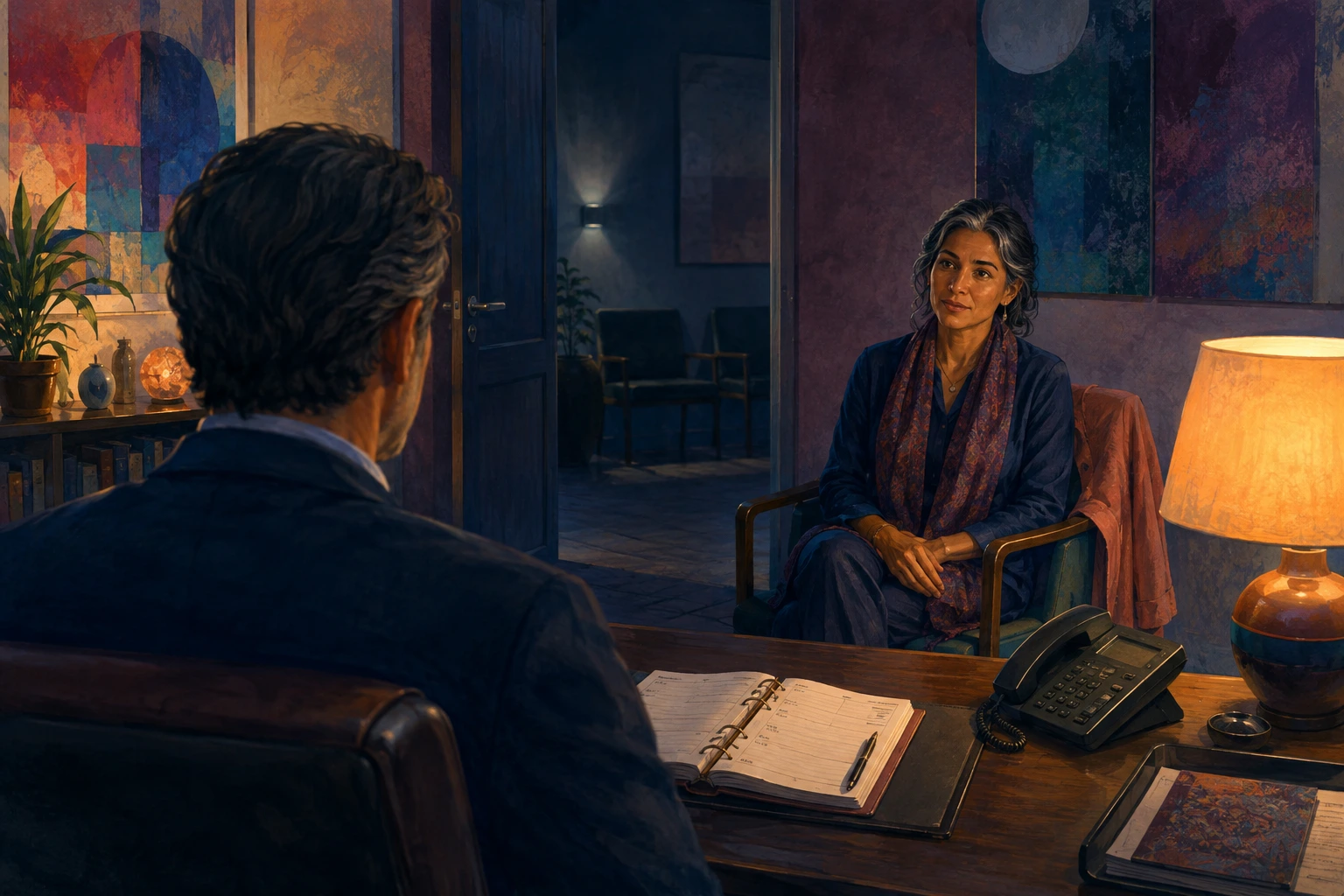
Figure 13.1. The chair the patients sit in.
Three deaths: one in the middle of a life, one that had not yet happened to a man who was perfectly well, and one that took seventy-two hours to be a whole biography. What can be learned by holding the three together that no one of them, however closely read, could teach alone?
1. The field the caregiver carries in
A private consulting room after hours (Figure 13.1), drawn from behind the shoulder of the man whose room it is, so that the reader sits on the professional's side of the desk. Three objects lie between the two figures and no others: a lamp, which is the only light left on; an appointment diary lying open, because the hour is booked and will end; and a telephone, because the referral in this case was a call the man made about himself. Across the desk, in the patient's chair, sits the spiritual caregiver, his coat over the chair back and his hands loose and empty, there being no chart anywhere for him to have read. Through the half-open door the waiting area is unlit and the chairs are straight. Nothing in the panel says which of the two men is the one in difficulty.
Before any single bedside, the field itself. Nothing in this section belongs to one death alone. Every paragraph of it argues across two or three, which is why it stands here, ahead of the case, rather than inside one: a reader entering these deaths together needs the ground under them before the first door opens. Read it as what the caregiver stands on before any particular bed comes into view.
Spiritual care at the end of life begins where the rest of the clinical team has run out of moves. The oncologist, the palliative physician, the ward nurse - all are organised, in the end, to forestall the one thing that here can no longer be forestalled. Palliative medicine has made an honest peace with this: when cure is off the table it turns to comfort, to the relief of pain and breathlessness and nausea. Sujata's case opens on exactly that boundary - 'there are no curative options left; treatment is now purely palliation'. The spiritual caregiver's terrain is what remains standing when relief has done all that relief can do.
This is the setting in which Cicely Saunders' founding hospice insight is least deniable and most often mishandled. Saunders saw that pain at the end of life is total pain - that its spiritual dimension is part of the pain and not an optional extra to be bolted on once the analgesia is titrated (Saunders 1988). It is the field's own statement of the anti-additive point this book everywhere presses: a dying person cannot be reached by adding a layer of comfort on top of a layer of medicine, because the suffering was never layered that way to begin with. Cassell's (1982) companion distinction - that suffering is a threat to the person, not reducible to physical pain - says the same thing from the other side, and explains in advance why flawless symptom control can leave a patient like Sujata entirely un-helped.
The deeper genealogy of the field carries the same lesson. Erşahin (2021), surveying how modern health care arrived at its present understanding, traces four successive models of spiritual care, each defining the spiritual by the room it is willing to give it. The biomedical model, dominant since the nineteenth century, treats health as the absence of disease and leaves spirituality no room at all - the patient is the one to be cured, and authority belongs wholly to the expert. The bio-psycho-social model (Engel 1977) admits the spiritual, but only as what John Swinton calls a 'generic' human characteristic, 'an add-on to the biomedical model' that earns its keep by whether it interferes with the treatment outcome (Swinton 2007, in Erşahin 2021). The social model raises spirituality to an inherent part of cultural identity; and only the holistic model lets it speak 'in its own voice', with the avowed goal of serving 'the humanness and wholeness of the individual' (Swinton 2012, in Erşahin 2021). The trajectory is real progress, and the Integrative reframe stands at its far end - but the genealogy also exposes the gap this chapter is written to close. Even the holistic model offers wholeness as an aspiration without a uniting horizon: it widens the resources brought to the bedside without saying toward what the widened whole is to be aligned. Erşahin's own framing of the spiritual makes the point against the additive picture from inside the field - spirituality is 'an integral component of being... encompassing life rather than... a plug-in that brings meaning into life' (Erşahin 2021). A plug-in is exactly what the Integrative refuses to make of meaning. And Rachel Naomi Remen's distinction, which Erşahin brings forward, names the same fork at the bedside: 'When you help, you see life as weak. When you fix, you see life as broken. When you serve, you see life as whole' (Remen 1997, in Erşahin 2021). The deficit reflex this chapter is about to anatomise is, in those terms, the reflex to fix; the Integrative move is to serve - to see the dying life as whole, and to align it, not to repair what cannot be repaired.
Three things follow, and the practitioner does well to carry all three into the room.
First, the deficit reflex is strongest here. Everything in the surrounding system reads the situation as a problem to be reduced: symptoms to be controlled, distress to be settled, the family to be 'prepared'. Carried unexamined into spiritual care, that reflex - what Chapter 10 named the heya, the thing to be discerned and let go - makes refractory suffering and unsettled faith read as care-failures. The burden of this chapter is that the caregiver's task is neither to remove what cannot be removed nor to supply a meaning or a consolation on top of the medicine. The first is impossible; the second is the additive, integral-not-Integrative error this book everywhere refuses (Chapter 4). The task is to help the dying or mortality-facing person relate the whole of their situation - including the death that cannot be averted - toward a Coherent View they can own (Chapter 4). Direction, not addition. Frankl (1959) is right that meaning can be found at the very limit; the Integrative correction, carried from Chapter 10, is that meaning is not a content to be administered but a coherence to be reached - and that some suffering can be named as not-for-solving without the care having failed.
Second, the setting is wider than the deathbed. End-of-life care is not only for the actively dying. The three cases of this cluster deliberately bracket the field, and they bracket it along two different axes rather than one. Sujata is in her last weeks - imminent death. The physician of the second case is well, with no serious illness, but has begun in his sixties to speak of his 'last phase of life' as friends and patients die around him - anticipatory mortality. That is the axis of when. The third case runs along the other axis, which is how much life there was to end: a boy who lived three days, a death with no anticipation in front of it and almost no biography behind it, and parents who had been a mother and a father for seventy-two hours. All three belong here. A chapter that addressed only the bedside would miss the long, lucid contemplation of one's own end that is itself a clinical reality, and a growing one; a chapter that addressed only lives with a shape would miss the deaths that most reliably leave a caregiver with nothing at all to reach for.
Third, the Coherent View is the cared-for's, never the caregiver's. This is the non-imposition hinge established at Chapter 4 §4, and it bites hardest at the end of life, precisely where a caregiver's own consolations - religious or secular - press most insistently to be offered. With Sujata the caregiver works inside her Sanātana Dharma; with the rationalist physician he must not prescribe the pandit-religiosity the man explicitly rejects. Same stance, opposite surface. The Dharmic resource is brought as the patient's own where it is theirs, and as offered philosophy - never imposed devotion - where it is not.
One framing note runs underneath all three. The diagnostic this chapter uses is not borrowed from outside the domain of dying and pressed upon it. The 4H pattern - heya, heya-hetu, hāna, hānopāya (what is to be let go, its cause, the horizon, the means) - is, as Chapter 10 showed, Yoga's own soteriology of duḥkha: heyaṃ duḥkham anāgatam, 'the suffering yet to come is to be avoided' (YS 2.16). Death-anxiety and grief are therefore read from within a tradition that took the cessation of suffering as its founding question, not imposed on the dying from some other discipline. That is what is meant, here and through Part II, by the framework's homecoming. Read directly, the process model now standard in the field is more than a phase-list. Damberg Nissen, Viftrup and Hvidt (2021) set out spiritual care as five 'organically linked phases' - identifying spiritual needs and resources, understanding the patient's specific needs, developing an individual care plan, providing the care, and evaluating it - and anchor the whole sequence in what they call the patient's ontological grounding: the secular, spiritual and religious orientation from which a person's needs and resources actually arise, which the caregiver must read before deciding from which aspects, and to what extent, care is to be offered (Damberg Nissen, Viftrup & Hvidt 2021). That is the field's own near-statement of the non-imposition hinge: care proportioned to the cared-for's grounding, not the caregiver's. The same authors name the residue the Integrative reframe is built to repair - that spiritual-care interventions 'are often developed as stand-alone instruments' such as questionnaires or interview guides and 'do not approach spiritual care as an ongoing and integrated part of patient care' (Damberg Nissen, Viftrup & Hvidt 2021, reporting Damberg Nissen et al. 2020). The phase-vocabulary is serviceable; what it still lacks, and what the 4H supplies, is a diagnostic that asks toward what horizon the phases are to bend.
A last orienting point, and the chapter's bridge to its cases, comes from reading that same literature directly. Damberg Nissen, Viftrup and Hvidt (2021) differentiate a person's ontological grounding into three 'relevance spheres' - the secular, the spiritual and the religious - and insist that a person may inhabit and move between them simultaneously, so that the caregiver's first task is to read which spheres are live and load-bearing before any care is offered. Two of this chapter's three cases are chosen to fall on opposite sides of that distinction without leaving it. Sujata's grounding is overtly religious - a Sanātana-Dharma contract with Bhagavān - and the care works inside it. The physician's is secular-and-spiritual - a rationalist who rejects pandit-religiosity yet honours 'the fundamental principles of the Vedas' - and the care must meet him there, offering Vedic principle as a life-architecture rather than a devotion. The third case sits somewhere the three-sphere scheme does not quite have a name for. The grounding of the couple in it is unambiguously religious, and it had never once required them to administer it: a tradition inherited as practice, carried by festivals and a grandmother's shrine and a pandit summoned by somebody older who knew what to summon him for, and then, in a single night, the responsibility of two people who had never had to be the one who knew. A sphere can be entirely live and load-bearing and still leave a person without any means of acting in it, and reading which spheres are live will not by itself disclose that. The Integrative claim is not that one sphere is truer than another but that, whichever is live, the work is the same: to align the whole situation toward the Coherent View the person can actually own. That single stance, holding across the religious/secular bracket, is what the rest of the chapter demonstrates.
2. How the three cases were made
All three cases are set out on the twenty-one-part case template: the case card, the care context, the background and the presenting situation, then the encounters themselves, narrated, and then the interpretation. In all three, the analysis is deliberately withheld until the encounters are over. They are not at the same depth. The cases at Chapters 11 and 12 carry all twenty-one parts; the physician's case, carried at section 3 of this chapter, carries the case card and Parts I to IV in seventeen sections and states no objectives or key concepts of its own. What differs most is its Part II, which runs to two encounters rather than the template's usual three to five, and the reason is given where it happens: the archive record of that case ends before the case does. Names and identifying details are anonymised or composite; the underlying cases are drawn from the project's case archive (the first case by its code, V03, and the third by its code, V06, both archive titles withheld for the reason given at Note 3; the physician, Case 008). Consent and confidentiality per practice ethics.
3. The case carried here: the physician who outlived his certainties - mortality before illness
The two anchor cases of this cluster have chapters of their own. This one does not, and the reason is worth stating rather than passing over. It is the case the ninth of the cluster's twelve lessons is built on, it does load-bearing work in the fourth and the eighth, and it is the only one of the three in which nobody is ill; left out, the bracket the cluster argues across would have collapsed from three points to two, and the comparison this chapter exists to make would have had one leg missing. It is also the shortest record in the cluster by a long way, and it stops somewhere the other two do not - which is a fact about an archive before it is a fact about a man. So it is carried here, entire, in the chapter whose business is the comparison.
Sujata was dying while everything in her case happened. The man in the case below is not ill at all, and that is the reason he is here. He is past sixty, his practice is busy, nothing on any scan is wrong with him, and he has begun to speak of his last phase of life because the people around him have started to die. Between those two sits this cluster's first axis, the imminent death against the anticipated one. Whether a stance that held at a deathbed can cross that axis is what the two encounters below are here to test, and the man has already told the caregiver, on the telephone and before they had met, the one thing that will make the test hard.
Note on this section. This case is laid against the twenty-one-part case template from here to the end of Part II. Its Part II runs to two encounters and not to the template's usual three to five, and that is deliberate rather than unfinished. The archive record for this case is a first consultation, the probing that opened two things the client had not come to talk about, and a sentence saying he wished to go into them more deeply at a follow-up appointment. The archive does not hold that appointment. Composing it would fill the template and manufacture record, so the case stops where the record stops and says so on the page at Follow-up and outcome, below. Template sections 12 to 21 are written for this case at sections 3.8 to 3.17 below, and the analytical band the chapter carried in its earlier working format has retired into them as it said it would, block by block, rather than being deleted.
3.1 Case card
Table 13.1. Case card: the physician who outlived his certainties.
Case title | The physician who outlived his certainties |
Care context | Independent spiritual care, purchased privately; two consultations of an hour, a fortnight apart, in the client's own consulting room after the practice had closed |
Primary care recipient | Mahendra (pseudonym), in his sixties, a doctor in long-established independent practice, of Dutch Hindustani background, divorced, three adult children of whom the youngest is living for a time at his practice premises |
Spiritual caregiver | Unnamed here by choice. A Hindu spiritual caregiver working partly through a Centrum voor Levensvragen and partly on private referral; theologically trained as a paṇḍit and academically trained in Hindu spiritual care |
Other significant participants | His mother, who died within the last two years in her nineties; his father, dead for decades; his former wife, of whom he says almost nothing; his youngest child; a professional network that reaches from medicine well beyond it, and contains nobody he has told |
Tradition or worldview | Ārya Samāj by inheritance; not practising; holds the fundamental principles of the Vedas to be true and the religious profession that transmits them to be largely discredited |
Presenting concern | A man with no illness who has begun to speak of his last phase of life, and who cannot get past a death that everybody around him regards as timely |
Stage of care | The opening of a case. A first consultation, a second, and an agreed third that this book cannot report |
Central spiritual-care tension | He asked for a spiritual caregiver because he wanted something holistic, and he had told the caregiver in advance that he has great difficulty with the religious professionals of his own tradition. The caregiver is one of them. The resource and the obstacle are the same person, and neither party can pretend otherwise |
Relevant care dimensions | Existential, spiritual, social and ethical, with the bodily conspicuously absent, across person, household and professional life |
Confidentiality note | Adapted from a practice record; names and identifying particulars changed. The care recipient's name is new; the record names nobody. His exact age, the composition of his professional network, the interval since his mother's death and her exact age, the length of his marriage, the number of his children and everything about his youngest child beyond the single fact the case turns on are altered, generalised or omitted. His community of origin and his Ārya Samāj background are kept, being analytically load-bearing. The spiritual caregiver is deliberately left unnamed. All dialogue, all interior description and all of the caregiver's inner responses are composed; the record contains no spoken line. The mapping is held privately and appears nowhere in this book |
3.2 Introduction to the care context
Almost every case in this book begins with an institution noticing something. A ward writes agitated in a handover file. A neonatology team pages the number on the laminated card. Somebody whose job it is to observe people observes one, and a referral is made about a person rather than by them.
This case begins with a telephone call from the person himself, and that single fact reorganises everything that follows.
He is not a patient. He is not in a bed, or on a list, or in anybody's caseload. There is no chart to read before the first meeting and no nurse at a desk to say what she has seen. There is no team meeting afterwards, no colleague to raise a concern with, and no institution to be accountable to or protected by. The caregiver in this case has exactly one source of information about the man he is seeing, which is the man he is seeing, and exactly one instrument for checking it, which is asking again.
The Dutch arrangement makes this possible and does not quite make it normal. Spiritual care - geestelijke verzorging - is established inside hospitals, care homes, prisons and the armed forces, where it is paid for by the institution and reaches whoever is admitted. Since 2019 a national subsidy has extended it outside those walls through the Centra voor Levensvragen, the Centres for Life Questions, so that a person at home can see a spiritual caregiver without being anybody's inpatient. But the outside-the-walls provision is built around the frail, the seriously ill and the dying at home, and it is a matter of some awkwardness for everyone involved that a well person with means can simply engage a spiritual caregiver privately, as one engages any other professional, and that the well person who does so will get an hour of undivided attention that a person on a ward may wait a week for.
Mahendra engaged one privately. He could. That is worth stating plainly rather than passing over, because it is a fact about the case and not only about the health system: the man in this cluster who is least ill is the one who received care fastest, and he received it because he bought it.
What he bought it for is the second thing worth noticing. He has, in his own professional network, psychologists and psychiatrists. He said so at the outset, unprompted, and then said why he had not called any of them: he expected more from a spiritual caregiver because of its holistic character. That is a diagnosis of an entire field, delivered by a doctor, about colleagues he refers patients to and trusts with them. He was not saying they are bad at their work. He was saying that what he had was not the shape of the thing they treat, and that he did not want it made into that shape in order to be treated.
The setting for such a case is a consulting room after hours, and it has one property no ward has: the client owns it. In every other case in this cluster the caregiver walks into a room that belongs to an institution, sits below the eyeline of a person who has been reduced to a body in a bed, and holds whatever authority the setting hands him. Here he is a visitor in a building where the other man's name is on the door, in a chair that patients sit in, opposite a man who has spent forty years on the other side of that desk conducting exactly this kind of interview and is extremely good at it.
The whole difficulty of this case is in that last sentence. The person asking for help is the most competent person in the room by every measure the room recognises. He can take his own history. He can name his own affect accurately. He can supply, unasked, a plausible formulation of his own difficulty, and the formulation will be defensible, and it will be doing work for him. Competence of that order is not a barrier a caregiver removes. It is the material.
And the setting has one further property, which no ward would have permitted and which does not become visible until the second hour: there is nobody else. On a palliative unit a caregiver who becomes worried about a person raises it with a team, and the team has routes. In a private consulting room at eight in the evening there is a caregiver, a client, an hour, and no one who will ever know the hour took place. Nothing in the first of these two hours makes that matter.
3.3 Background
The care recipient. Mahendra is in his sixties. He is a doctor in independent practice, long established and widely known in a professional world that reaches well beyond medicine. The practice runs well and his patients are satisfied with it; he is socially engaged, and his affairs, in a phrase the record uses about him and he would probably use about himself, are in good order.
He is of Dutch Hindustani background - the Indian-descended community whose great-grandparents crossed from India to Suriname as indentured labourers in the nineteenth century, and who came from Suriname to the Netherlands in large numbers around independence in 1975. The faith he inherited is the Ārya Samāj (आर्य समाज), the reform movement founded by Dayānanda Sarasvatī in 1875, which took the Vedas as authoritative and rejected a great deal of what had accumulated around them: image worship, the mediation of priests, caste as a birth-given fact. It travelled to Suriname with the indenture ships and it is one of the two main forms of Hinduism in the Dutch Hindustani community. It matters here that Mahendra's irreligion is not a departure from his tradition but an inheritance within it. He is not a lapsed devotee. He belongs, by descent, to the wing of his tradition that was already suspicious of the temple.
He is not practising. He holds, and says he holds, that the fundamental principles of the Vedas are true and worth living by. And he has great difficulty with paṇḍits. He has known religious professionals off duty and at close quarters, over years, and what he saw in private did not match what was said in public, and he has never been able to put the two together again. He states this without heat, as a finding.
His father died decades ago, and he says he did that correctly. His mother died within the last two years, in her nineties, after a long life and a decline that surprised nobody, and he has not been able to work properly since. He is aware of the disproportion. He raises it himself.
He is divorced, after a marriage that lasted most of his adult life. His children are grown, independent and leading their own lives. The youngest has moved, for a time, into a room at his practice premises.
His resources should be set down plainly here, because he will set them down himself in the second hour and they will not be plain when he does. Means. Standing. Intact working life. A wide network. An intellectual tradition he genuinely respects and can quote. Health. Time.
What is harder to set down sits on the other side of the same page. There is no one in his life to whom he is the patient. The tradition he respects has, in the form he inherited it, deliberately stripped out most of the ritual apparatus by which Hindu bereavement is ordinarily carried - the śrāddha rites, the annual observances, the priest at the door - so that the very reformism that makes his rationalism coherent has left him standing at his mother's death with his hands empty. And he has spent his whole adult life being the one who decides, which is a habit that does not switch off because the thing to be decided is his own last phase.
The spiritual caregiver. A Hindu spiritual caregiver in his fifties, working partly through a Centre for Life Questions and partly on private referral, theologically trained as a paṇḍit and academically trained in spiritual care, with a long practice in dying, bereavement and, increasingly, in what he has begun privately to call the well.
He is walking into a room having been told in advance, in the first two minutes of a telephone call, that this man has great difficulty with people like him. He has decided not to argue with that and not to apologise for it either. He is aware, without being able to do much about it, that he would like to be the exception.
The wider circle of care. The mother, who is present in every hour without being discussed for long. The father, whose death is offered as evidence of competence. The former wife, of whom Mahendra says almost nothing at all, in a manner that the caregiver notes and does not pursue. The adult children, at a distance and doing well. The youngest, in a room at the practice, for reasons that do not emerge until the second consultation. And the professional network, which is wide, which contains psychologists, psychiatrists, and people who have known him for decades, and to which he has said none of this.
3.4 The presenting situation
Nobody referred him. He telephoned, gave his name, said he would like some guidance, and asked what it cost.
Asked what he wanted to talk about, he said he wanted to think about his last phase of life. He then said, because he could hear how it sounded, that he was not ill; that there was nothing on any scan; and that he had recently watched a number of friends, acquaintances and patients die.
What he says the problem is. That he is at the end of one phase of life and has no idea what the next one is for, and that he would like to think about it with somebody whose training does not require him to be unwell first.
What others believe the problem is. Nobody else knows there is a problem. This is the most striking feature of the referral and it does not become visible until it is stated: a man with a network reaching from medicine to the law has had to pay a stranger for this conversation.
What the caregiver can see that Mahendra has not said. That the death of a woman in her nineties, after a long decline, has stopped a competent man from working, and that he has explained this to himself as a symptom of something else.
Immediate risks and urgent concerns. None, on the face of it. That is itself a risk, of a kind this book should name: a well, wealthy, articulate man who is in no danger is exactly the person a stretched service deprioritises, and exactly the person a private arrangement serves first. Both of those are true at once and neither cancels the other.
The central question facing the caregiver. What do you do when the person asking for help is not in crisis, has no diagnosis, has framed his own case competently, and is better than you are at the kind of interview you are about to conduct?
Decision point. What should the caregiver attend to first? The mother, which is where the pain is and which Mahendra has already labelled as the presenting complaint. The life-stage question, which is what he actually rang up about. Or the fact that a man surrounded by professionals has bought this hour from a stranger, which is neither of the things he came to discuss and may be the largest thing in the room.
3.5 Session one: the last patient of the day
Before the encounter. The practice was on a street of tall narrow houses with the lights coming on in them, and by the time the caregiver arrived the waiting room was dark and the chairs were straight. Somebody had switched off all but one lamp on the way out. There was the particular quiet of a place that has been busy all day and is not busy now, and under it the sound of the road.
The caregiver had two things in his head on the stairs and he knew that only one of them was useful. The useful one was a question about Saturdays that he had thought of on the train and did not yet know what he would do with. The other was that he had been told, on the telephone, that this man had great difficulty with paṇḍits, and that he had spent the intervening days composing replies.
The encounter. Mahendra was at his desk with his coat already on the back of the door, and he stood up to shake hands and then sat back down on his own side of it, which meant the caregiver took the patient's chair. Neither of them remarked on this. There was a framed certificate on the wall, turned very slightly outward, in the way that things are turned when a room has been arranged to be looked at by people who are nervous.
He made tea himself, from a kettle on a shelf behind him, and brought it round.
'I will be brief, because I know what an hour costs,' he said, sitting down again. 'I am in my sixties. I am well. I have buried a great many people this year, and none of them was mine.' He put his hands flat on the desk. 'And I would like to say one thing at the start, so we do not waste time on it. I have a problem with paṇḍits.'
'I know,' the caregiver said. 'You told me on the telephone. I am one.'
'I know that too.'
'Then I would like to understand why you called me.'
Mahendra considered this for slightly longer than a polite man would have needed.
'Because I wanted somebody who works with the whole of a person,' he said. 'I have psychiatrists in my own network. Excellent ones. I refer patients to them every month and they do good work. But if I go to them with this, they will find a disorder in it, because that is the instrument they hold, and the instrument is not wrong, it is simply the wrong size. What I have is not the shape of a disorder.' He turned his cup round on the desk. 'I called what you do. Not what you are.'
'That is fair,' said the caregiver. 'What have you buried?'
'Colleagues. Two friends. Four patients I had had for most of my working life, which is not the same as a patient.' A pause. 'And my mother.'
'When?'
He gave the interval, and then added, in the same voice, 'She was in her nineties. It was not a tragedy. It was the most ordinary thing that can happen to a man of my age.' He looked up. 'My father died decades ago. I did that correctly.'
'What does correctly mean?'
'It means I grieved, and then I stopped, and then I went back to work.' He said it without irony. 'I have not managed the second part this time. I read the same paragraph four times last week. I have never in my life read a paragraph four times.'
Inner response. The caregiver noticed, first, that he was being handed a beautifully organised case, and second, that he was enjoying the organisation. It was a pleasure to be talked to by somebody this fluent. He made a note of the pleasure, because the pleasure was doing something.
He noticed that in twenty minutes he had not been asked a single question.
And he noticed something smaller and less creditable, which was a flicker of envy at the room, the certificate, the settled competence of the man across the desk, and behind it the awareness that he had come here as the professional and had been seated in the patient's chair. He put it down where he could pick it up later.
What is happening here? Pause before the second half of the hour and notice what has been established and by whom.
Mahendra has taken his own history. He has supplied the presenting complaint, the differential, and a defensible formulation, and he has ruled out an entire discipline on grounds that are intelligent and may also be defensive. Whose language is this hour running in?
Notice the word correctly, offered about his father's death, and notice that nobody asked for it. What kind of standard is a man applying when he grades his own grief?
Notice what he has said about his mother in the same breath as the interval since she died: that it was not a tragedy, that it was ordinary, that it was the most ordinary thing that can happen to a man his age. Every one of those statements is true. What are true statements doing here?
Notice, too, that he has told you why he did not go to a psychiatrist, and that the reason is a criticism of a whole field, and that it may be entirely correct. It is possible for a defence to be accurate.
And notice the thing that has not happened: a man who has been describing his own case for twenty minutes has not once been asked what any of it was like, and has not moved to say.
Decision point. Three courses were open. The caregiver could take the grief at face value, since it was accurate, and work it directly. He could take the life-stage question Mahendra had actually telephoned about and leave the mother where she had been put. Or he could decline the frame altogether and ask why a man with this network had bought this hour from a stranger.
What followed. He did none of the three. He asked what a Saturday used to look like.
Mahendra began to answer it the way he had answered everything, briskly, and then stopped in the middle of a sentence about a supermarket car park and did not start again for some time.
When he did, the answer took most of the remaining half hour, and it was about a route. Which shops, in which order. What she would not eat and what she pretended not to want. The text message he sent from the car when he was ten minutes away, always the same three words, so that she could put the kettle on and be standing up when he came in rather than being found in her chair.
'She was not my mother by the end,' he said. 'Somewhere in the last fifteen years she stopped being my mother and became the person I told things to. I do not know when that happened. I only know that I lost both of them in the same week and I have been counting it as one.'
He looked at the clock, which had been in his eyeline the entire time.
'That is more than I intended to say,' he said.
Practice insight. Mahendra had been describing his own case for twenty minutes and had not once been asked what any of it was like. The question that stopped him was not about a feeling and was not about his mother; it asked him to walk through an ordinary Saturday, and he broke off in the middle of a sentence about a car park. What this hour cannot separate is whether the question did its work because a route through a supermarket is harder to summarise than a bereavement, or because it was simply the first thing he had been asked that he had not already prepared an answer to. A reader who is sure which of the two was operating is surer than the record.
3.6 Session two: what the weekend was for
Before the encounter. A fortnight later, the same room, the same single lamp in the waiting area, and one thing different that the caregiver saw on his way in and said nothing about: on the couch in the corner of the consulting room there was a folded blanket with a pillow squared on top of it, put away as tidily as a made bed in a room that is not a bedroom.
He had come with an intention this time, which he distrusted. He had spent part of the fortnight thinking about the four āśramas and was aware that he had a piece of the tradition ready to hand to a man who had told him at the outset what he thought of people who hand out pieces of the tradition.
The encounter. Mahendra picked up almost where he had left off, which surprised them both.
'I have been thinking about your question,' he said. 'The Saturday one. I have worked out what the trouble is and I do not like the answer.' He was not sitting behind the desk this time; he had brought a chair round. 'The trouble is that I do not know what I am for on a Saturday. That is all. It is embarrassingly small.'
'Say more about small.'
'A man of my age, a decent income, a practice that runs itself, three children who need nothing from me. There is no problem here. There is a schedule with a hole in it.' He made a short movement with his hand. 'And I cannot get out of the hole, and I am supposed to be able to get out of anything.'
The caregiver let that sit for a while.
'May I put something to you,' he said, 'on the understanding that you can throw it out.'
'Go on.'
'The tradition you say you do not practise has a name for the part of life you are in. It is not a diagnosis and it is not a consolation. It is a stage, with work in it. Vānaprastha (वानप्रस्थ) - the third of the four āśramas, the four stages of a life. Student, householder, and then this one, which is usually translated as forest-dweller and almost never means a forest. It means the point at which a person's centre of gravity moves off the household. Not renunciation. That is the fourth stage and you are not in it. This one is the loosening: handing on what you have built, carrying less of it yourself, and taking up the question of what you are for once the answer is no longer other people's needs.'
Mahendra heard him out.
'That is a stage system,' he said, 'designed for a society that has not existed for two thousand years. I have no forest. I have a practice with a lease on it.'
'Yes.'
'You agree.'
'With that part, entirely,' said the caregiver. 'I am not asking you to go to a forest. I am telling you what the scheme assumes, because the assumption is the useful part and it is the part your own arrangement does not make. The scheme assumes there is a task after the householder task. Ours assumes there is a decline after it, with hobbies laid on. You came here and told me you have a hole in your Saturdays and that it is embarrassingly small. You would not have called it small if you had a name for it.'
The silence went on well past the point where either of them would ordinarily have filled it.
'And the Vedas would say what, exactly?' said Mahendra. 'I should tell you that I mean that as a real question. I do not want a sermon and I did not think I was going to get one.'
'You are not getting one. You have already told me you take the fundamental principles seriously and that you cannot take the profession seriously, and I am not going to argue you out of the second thing.'
'Good.' A dry look. 'Several people have tried.'
They stayed with it for most of the hour: what handing on would consist of, in a practice with a lease on it; whether a man can hand anything on to children who are already independent; what he had actually been doing on those Saturdays, which was, he came to say, not shopping but reporting to someone.
At six minutes to the hour the caregiver asked who was sleeping on the couch.
Mahendra glanced at the blanket as though he had forgotten it.
'My youngest,' he said. 'For a while. It made sense - there is a shower here, and the alarm is good.'
'The alarm.'
'Yes.' He was already reaching for his diary. 'There is somebody following my child. It has been going on for some months. The police have it.' He wrote something down. 'That is not what I came to talk about.'
'No.'
'I would like to go into it properly next time, though.' He looked up. 'If that is the sort of thing you do.'
Inner response. The caregiver felt, in order and within about four seconds: alarm; a strong wish to reorganise the whole of the last two hours around a fact he had not had; and an unwelcome flicker of professional vanity, because he had thought it was a good hour and it had just been made small.
Then something colder, which stayed with him afterwards. On a ward he would have raised this with a team before he reached the car park. Here there was no team. He did not know, sitting in that chair, who he would tell, or whether he had any right to tell anyone, or what he would say if the answer next time was that it had got worse.
What is happening here? Stop at the door with the caregiver and notice how much has just changed and how little.
Which is the case now? A man's grief for his mother, a man's question about his own last phase, and a threat to his child are three different pieces of work, and it is not obvious that they are one case. It is also not obvious that they are three.
Notice the timing. This arrived at six minutes to the hour, with the diary already open, in a flat voice, followed at once by that is not what I came to talk about. What does the timing tell you about the hour that preceded it - that the hour earned the disclosure, or that the hour was, in part, a way of not making it?
Notice what the vānaprastha reading looks like from here. It was offered to a man with a hole in his Saturdays. It has just been offered, retrospectively, to a man whose child is not safe. Does it survive that, and if it does, is it doing the same work?
Notice what the caregiver has and has not got. He has an hour that nobody can interrupt and a relationship that no institution mediates. He has no team, no chart, no safeguarding route and no colleague. Which of those two lists made this disclosure possible, and which of them will matter most if it gets worse?
And notice one more thing about the man, which will look different in Part III: he described a threat to his child in the same register in which he described his mother's death, his practice and his own competence. He has one voice for everything. It is possible that this is composure. It is possible that it is the thing the whole case is about.
Decision point. Three courses were open, and the reader should choose before reading on. Hold the frame: the stalking is a police matter and a family matter, outside a spiritual caregiver's remit, and the right move is to say so, offer a referral, and keep the hour for what it was engaged for. Follow the disclosure: make it the case, on the ground that a father cannot think about his own last phase while his child is being hunted. Or ask for nothing, close the hour as agreed, and see which of the two he brings back through the door - on the ground that he has just told you, twice, which one he thinks he came for.
What followed. He said that it sounded like a great deal to be carrying alongside everything else, and that yes, it was the sort of thing they could look at. Mahendra said he would like to go into it more deeply next time. They put a date in the diary.
Practice insight. The disclosure arrived at six minutes to the hour, in the same flat voice as everything else in it, and was taken back in the same breath in which it was made. The caregiver did neither of the two things the moment invited: he did not make it the case, and he did not put it outside the hour. He said that it sounded like a great deal to be carrying alongside everything else, and left it to Mahendra to say what should be done with it. Whether that was restraint or a postponement neither of them could afford, the session does not settle. It shows only the version in which the man asked to come back.
3.7 Follow-up and outcome: the appointment this book cannot report
The archive record's narrative of this case ends one sentence after that diary entry. It says that the client wishes to go into the matter more deeply at a follow-up consultation. It does not contain the follow-up consultation.
It should be said plainly, because a reader is entitled to know when a book is showing them the end of a case and when it is showing them the end of a document. There is no third session here. There is no intervention, no turning point, no resolution and no discharge. Whether Mahendra came back, whether the stalking ended, whether he found anything for his Saturdays, whether he is still reading the same paragraph four times - none of that is known to this book, and this book has declined to invent it.
That is a loss, and it is worth being honest about the size of it. The two cases on either side of this one are complete. Sujata's ends in a room in daylight with the blinds half down; the Chapter 12 case's ends in a living room seven weeks later with a lamp lit every morning. Both can be analysed with the whole arc in view, and the analysis is stronger for it. This one cannot, and Part III below has to work with less, which is why its assessment separates what is known from what is inferred at every heading rather than at the end.
But the loss is not only a loss, and the reason is the reason this case is in an end-of-life chapter at all.
The other two cases in this cluster are about deaths. This one is about anticipation, which is a different object: a man who is not dying, has no diagnosis, and has begun to reckon with his own finitude because the people around him have started to go. Anticipation has no arc. It does not resolve, and it is not supposed to; the whole of its character is that it stands open, sometimes for twenty years, while an ordinary life goes on being lived around it. A neat third session in which Mahendra arrives at a settled view of his last phase would read well and would misrepresent the thing entirely.
So the case stops where the record stops, on an agreed appointment, with a blanket folded on a couch and a diary shut. A reader who finds that unsatisfying should notice what the dissatisfaction is made of, because it is the same dissatisfaction the man himself brought into the room: the wish for a phase of life to be a problem with a solution in it, rather than a stage with work in it. The chapter would rather leave the reader holding that than take it away with a scene nobody wrote down.
One thing can be said about outcome without inventing anything, and it is a finding about the arrangement rather than about the man. Two hours of skilled attention were purchased privately by a well man in a country whose spiritual-care provision is built around the ill, and in those two hours a disclosure was made that had not been made to a network of decades' standing. The disclosure went to the person with the fewest institutional means of doing anything with it. Both halves of that sentence are consequences of the same arrangement, and Part III will have to hold them together rather than choosing the flattering half.
A note for the reader who meets this man again. Case 008 is read a second time in Chapter 23, from the other side. This chapter reads him as a person receiving care at the threshold of a life-stage. Chapter 23 reads him as what he also is: a lifelong professional carer, in a caring profession, who has spent forty years on the other side of the desk and has no arrangement whatever for his own inner life, and who called a stranger because there was no one inside his own world he could call. The question that chapter should put to this one is whether the hole in his Saturdays and the silence in his network are two findings or one.
3.8 Integrative case analysis
Two hours, two people, one room that belongs to one of them. The Care Trinity is the book's instrument for reading a case as a relation rather than as a patient with a context attached, and it is worth running here precisely because the relation is the least conventional in the cluster.
Care recipient. What Mahendra needs is not what he asked for and not what he is short of. He is short of nothing that an instrument records. He has means, standing, health, an intact working life, a wide network, three independent children and an intellectual tradition he can quote and genuinely respects; on any scale that counts resources he scores high, and a caregiver who begins by inventorying strengths will find the inventory reassuring and useless. What he has is a life whose organising principle has quietly expired. For forty years the answer to what am I for was supplied by other people's needs: patients, a household, a marriage, and latterly a mother who had become, in his own phrase, the person he told things to. Every one of those has now either ended or become self-sufficient, and the ending of the last one is the death he cannot get past. His hope is that there is a next thing and that it is not a hobby. His fear, unstated in both hours and audible in the word small, is that there is not, and that the correct name for the rest of his life is decline with activities laid on. His agency is unusually intact and is part of the difficulty: he can decide anything except this, and he is not accustomed to the category of a question that does not yield to deciding. His worldview is coherent and he holds it consciously. He is not a lapsed Hindu adrift from a tradition; he is an inheritor of the wing of his tradition that had already stripped out the mediating apparatus, and his rationalism is a position within Hinduism rather than a departure from it. That distinction decides what may be offered to him and in what register, and a caregiver who reads him as merely unobservant will offer the wrong thing kindly.
His sources of suffering are three and they are not obviously one case. A grief he judges disproportionate and has therefore not permitted himself to have. A life stage with no name in his own vocabulary. And a child who is not safe. His sources of resilience are the same list read from the other side: he is used to holding a great deal without visible strain, he has an intellectual frame he trusts, and he has an hour a fortnight in which nobody wants anything from him.
Caregiver. He arrives holding two kinds of authority and is permitted to use neither. He is a paṇḍit (पण्डित), theologically trained, meeting a man who told him on the telephone, before they had met, that he has great difficulty with paṇḍits. He is a spiritual caregiver by academic formation, meeting a man who has spent forty years conducting the interview about to be conducted and is better at it. His competence, in this room, is not a thing he can lead with; it is a thing he has to spend the first hour not deploying.
His stance is the cluster's and its surface is unrecognisable. In the first case of this cluster the same discipline produced a theological confrontation; here it produces a question about Saturdays. What is constant is the refusal to accept the frame he is handed, and what varies is everything visible. His use of self is disciplined and he records the discipline honestly: he notices that he is enjoying the fluency of the man across the desk and marks the pleasure as doing something; he notices that he has not been asked a question in twenty minutes; he notices a flicker of envy at the room and at having been seated in the patient's chair, and he puts it where he can pick it up later rather than either acting on it or denying it. That is use of self in the technical sense, and it is the reason the Saturday question is available to him at all. A caregiver who had enjoyed the fluency without noticing it would have gone on receiving the well-organised case for the whole hour.
His limitations are institutional before they are personal, and this case makes that visible in a way no ward case can. He has no team, no chart, no colleague, no supervision on the evening in question, and no safeguarding route. He also has an hour nobody can interrupt and a relationship no institution mediates. The second list is what makes the disclosure at six minutes to the hour possible; the first list is what makes it frightening. And there is one further limitation he does not name and the chapter should: he would like to be the exception to what this man thinks of paṇḍits. He knows it. He can do very little about it, and the wish is present in the room in the second hour when he brings out the āśramas, which is a piece of the tradition offered by a member of the profession the man distrusts.
Context. Everything unusual about this case is in the context, and most of it is a consequence of one fact: no institution is present. He is not a patient. There is no referrer, no chart, no team meeting, no ward round, no handover note, and nobody whose job it is to have noticed. What that absence costs and what it buys are worked out at 3.11, where they are an ethical matter. What it does to the reading of the case is narrower and is more easily lost. The arrangement described at 3.2 does not merely permit a well man to purchase an hour; it hands the whole of the assessment to the two people in the room and supplies neither of them with a second opinion. Every judgement in the sections below therefore rests on a record made by one man about another with nobody else present, and it is worth exactly what that is worth. This is the reason the assessment at 3.9 marks known from inferred at every heading rather than once at the end.
The family context is a household that has dispersed correctly and a professional network that reaches from medicine well beyond it and contains nobody he has told. The cultural context is the Ārya Samāj inheritance set out at 3.3, and it is load-bearing here for one reason rather than for its interest: it decides what may be offered, which is why the list of interventions at 3.10 is as short as it is. The legal and economic context is a private contract between two professionals. And there is a context nobody in the room controls: an ongoing offence against a third party who has consented to nothing and is not in the room, which arrives in the last six minutes and changes what the room is.
The care relationship. It is a purchased relationship between two men of comparable standing, in a building where one of them pays the lease, and its power runs in both directions at once. Formally the caregiver has none: he is engaged, he can be dis-engaged, and he sits in the chair the patients sit in. Actually he holds the one thing the other man has not been able to get anywhere else, which is an hour in which he is not the one who decides. The trust is not established by warmth and is not asked for. It is established, in the first hour, by a single exchange in which the caregiver declines to defend himself. Told I have a problem with paṇḍits, he says he knows, and that he is one, and asks why he was called. Nothing in either hour does more work than that, and what it does is remove the argument the man had come prepared to have.
The dependency risk is low and the collaboration is real, but the interpretation is contested throughout and both parties know it. The man supplies a formulation; the caregiver does not argue with it and does not accept it; he asks about a calendar instead. Shared decision-making is exactly what does not happen at the one point it matters most, and the chapter should say so rather than smooth it: at the doorway disclosure the caregiver did not choose between the three courses open to him, and the record does not show that he recognised he was declining to. He said it sounded like a great deal to be carrying, and that yes, it was the sort of thing they could look at. That is a reasonable thing to have said and it is not a decision, and the difference matters because a caregiver who has not decided cannot notice later that he decided wrongly.
The alignment, and what a standard reading would have summed. Three threads are on the table: a grief, a life stage, and a threat to a child. A standard reading has an entirely respectable procedure for this, and it is worth writing out at full strength before it is refused, because the refusal is worthless against a weak version. It would name each thread accurately. It would observe that a bereavement of this duration and this functional cost is well described by the literature on prolonged and complicated grief, and that a psychiatric colleague could assess it properly. It would observe that a competent man at the end of his working life is undergoing a recognised transition, and that there are people who do this work well. It would observe that a stalked child is a police matter with a victim-support pathway attached. It would then make three referrals, each defensible, each to somebody better qualified than a spiritual caregiver, and it would have covered the case completely. Comprehensiveness is not the weakness of that reading. Comprehensiveness is its whole strength, and it is exactly the strength the book means by integral: holism by summation, one more domain, one more intervention, one more role, without a statement of what any of it is toward.
What the summative reading has no column for is direction: which of the three the other two are to be arranged around, and toward whose account of a life. And in this case the point has a sharper form than in either of the other two, which is why the case earns its place in the chapter rather than merely occupying it. Here the summative instrument is not the caregiver's. It is the care recipient's own, and he is already running it on himself. He arrives with the inventory made: a decent income, a practice that runs itself, three children who need nothing, no problem here, a schedule with a hole in it. That is a summation, performed competently, by the person being summed. He has even diagnosed the field he is refusing: they will find a disorder in it, because that is the instrument they hold, and the instrument is not wrong, it is simply the wrong size. He is right about the psychiatrists and he has not noticed that he holds the same instrument. He has itemised his life, found the items in order, found one gap, and concluded that the gap is embarrassingly small because nothing on the list accounts for its size.
That is what makes the ordinary Integrative move unavailable in its ordinary form. In this case a caregiver cannot align by adding the missing domain, because adding the missing domain is what the man is already doing and what he came for relief from. Offer him the spiritual as a further item, a devotion to take up, a ritual to perform, one more line on the list, and the caregiver has joined the summation and lengthened it, which is why the additive error here looks so much like generosity. Alignment, in this case, means declining to add anything at all, and instead supplying a direction under which the items he already has re-rank themselves (Figure 13.2).
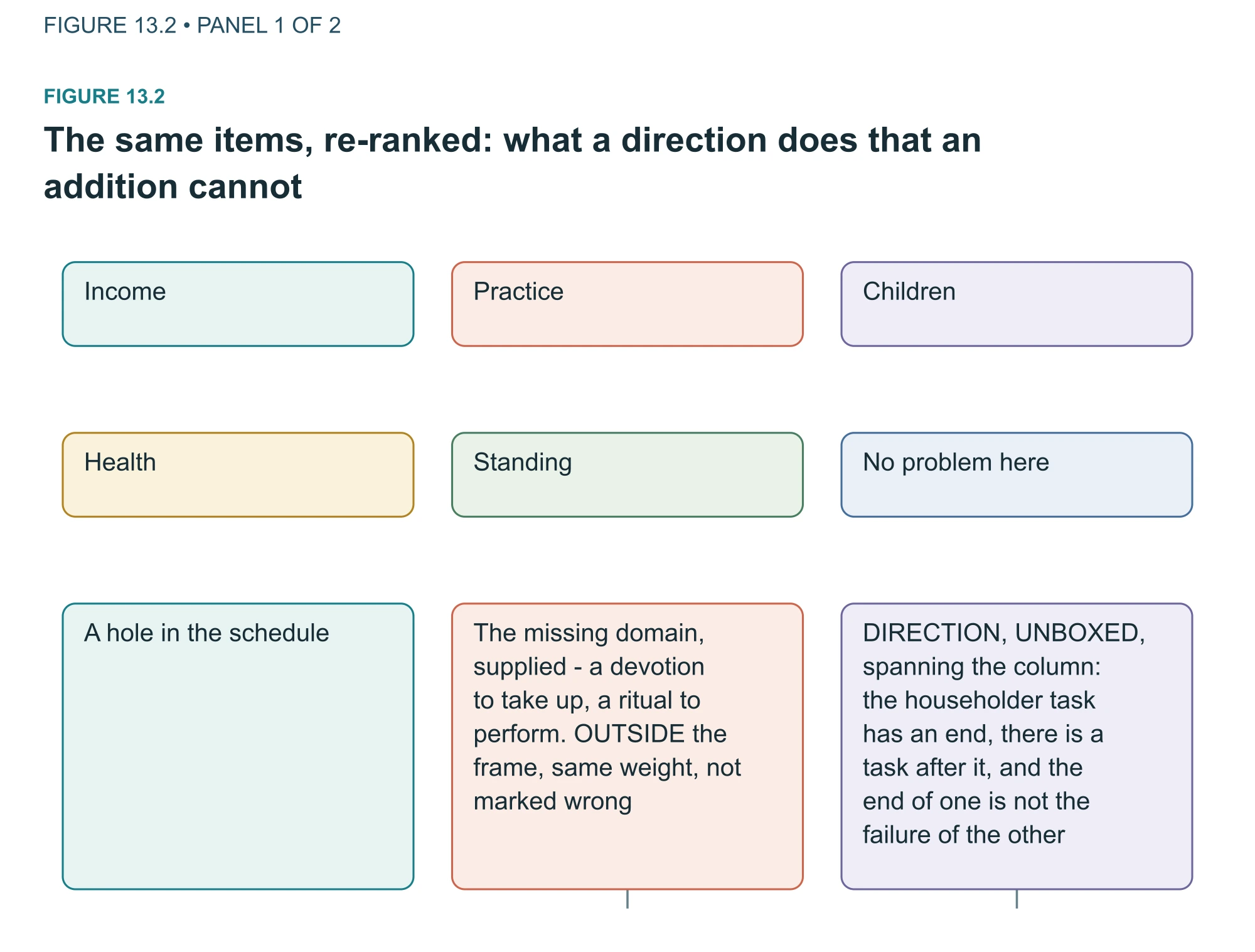
Figure 13.2. The same items, re-ranked: what a direction does that an addition cannot.
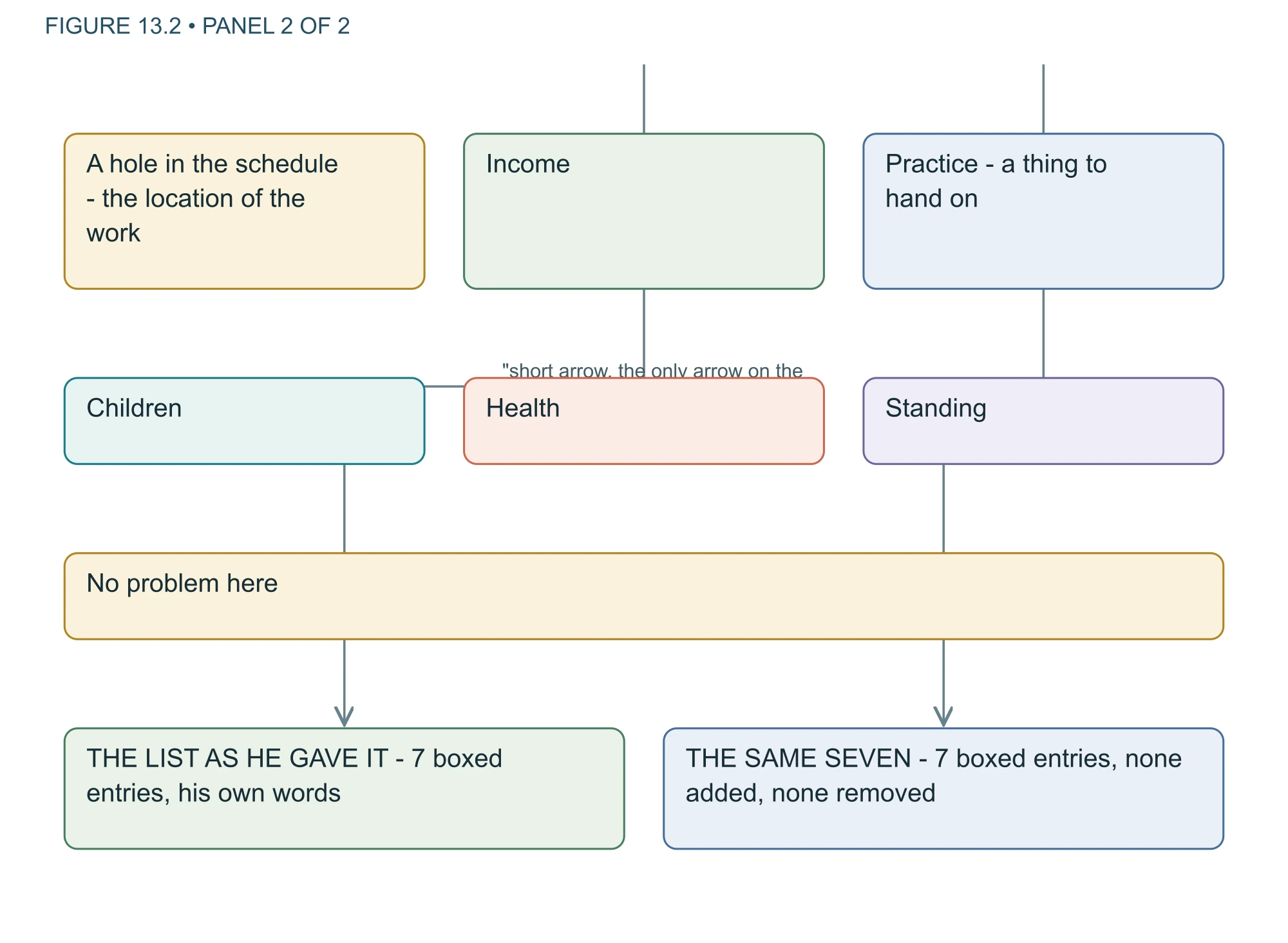
Figure 13.2. The same items, re-ranked: what a direction does that an addition cannot.
The vānaprastha (वानप्रस्थ) offer does exactly that and nothing else. It adds no practice, no observance, no belief and no obligation. It says that the household task has an end, that there is a task after it, and that the end of one is not the failure of the other. Under that single statement the man's own list reorganises without a single item being added to it or taken away. The practice stops being a thing to keep and becomes a thing to hand on. The Saturdays stop being a hole in a schedule and become the location of the work. And the mother's death stops being a symptom out of proportion to its cause and becomes the event that ended the householder task, which is a description under which grieving hard is not a failure of proportion but an accurate response to the size of what ended. Nothing has been summed. One direction has been supplied, and it is supplied in the register the man already honours: Vedic principle as a life-architecture, offered by a paṇḍit who has been told to his face that the profession is discredited, and offered on the explicit understanding that he can throw it out.
Whose Coherent View is it? His, and the test is in the exchange itself. Told that the stage system was designed for a society that has not existed for two thousand years, the caregiver says yes, and agrees that there is no forest and there is a practice with a lease on it. He does not defend the scheme. He keeps the assumption and discards the furniture, and the assumption he keeps is the one the man's own arrangement does not make: that there is a task after the householder task, where the surrounding culture assumes a decline with hobbies laid on. That is alignment toward the cared-for's own view and not toward the caregiver's, and it is discernible as such because it survived the man's objection instead of being withdrawn or argued.
3.9 Spiritual-care assessment
The assessment below is written under the book's standard headings, and each heading marks what is known from the record and separates it from what the caregiver has inferred, adding what remains uncertain and what would require assessment by another profession at the headings where those apply rather than as a matter of form. The distinction is not decoration here. This is the thinnest record in the cluster, it contains no third session, and a reader who cannot see where the evidence stops cannot judge the analysis that rests on it.
Meaning and purpose. Known: he has begun to speak of his last phase of life, is not ill, and cannot say what the next phase is for. Inferred: that the meaning he has lived by was supplied by other people's needs rather than chosen, and that the loss of the supply, rather than the loss of any one person, is the difficulty. Uncertain: whether he has ever had a purpose he chose rather than one that arrived with a role.
Identity and belonging. Known: Dutch Hindustani; Ārya Samāj by inheritance; not practising; holds the fundamental principles of the Vedas to be true; holds the profession that transmits them to be largely discredited, on the evidence of long acquaintance. Inferred: that his irreligion is a position inside his tradition rather than an exit from it, and that he is therefore reachable in Vedic terms and unreachable in priestly ones. Uncertain: how much of the paṇḍit objection is a finding and how much is a defence, and the case does not settle it, because a defence can be accurate.
Relationships and community. Known: divorced; three adult independent children; the youngest living for a time at the practice; a mother dead within the last two years with whom he kept a weekly Saturday routine; a wide professional network. Known and easily missed: he has told nobody in that network any of this. Inferred: that the mother had become his single confiding relationship and that her death removed not a parent but the only person to whom he was ever the one being asked about. For another profession: nothing. Uncertain: the former wife, of whom he says almost nothing in a manner the caregiver noticed and did not pursue.
Values and moral concerns. Known: he values the fundamental principles of the Vedas; he values doing things correctly, including grief, which he grades; he refers patients to psychiatrists monthly and trusts them. Inferred: that correctly is the operative value and the operative trap, and that a man applying a standard to his own bereavement is applying it to something that does not answer to standards.
Hope, fear, grief and suffering. Known: he cannot work properly; he read the same paragraph four times; he says the death was not a tragedy and was the most ordinary thing that can happen to a man of his age, and every word of that is true. Inferred: that the true statements are being used, and that their function is to make a disproportion unavailable for examination by making it unreasonable. Uncertain: whether the grief is prolonged in the clinical sense. For another profession: this is the one place where a psychiatric assessment would tell the caregiver something he cannot establish himself, and the case should not pretend otherwise. Nothing in this chapter's reading is inconsistent with a psychiatric assessment being appropriate; the argument is about what would remain to be done afterwards.
Beliefs and worldview. Known: Vedic principles true, priestly mediation discredited, no current practice, no ritual apparatus for bereavement. Inferred: that the reformist inheritance which cleared away the śrāddha rites, the annual observances and the priest at the door is the reason his hands were empty at the graveside, and that this is a cost of a coherent position rather than a fault in it.
Rituals and spiritual practices. Known: none current. Known and unnoticed by him: the Saturday route was one. Which shops, in which order, what she would not eat, the three-word message from the car ten minutes out so that she could be standing when he came in. That is a weekly observance with a fixed sequence, a preparatory signal and a purpose beyond its content, and its loss is a loss of practice and not only of company. Nothing in the record suggests either man named it as such, and the chapter names it here because the assessment is where it belongs.
Sources of strength. Known: means, health, standing, work, intellect, an inherited frame he respects. Inferred: the frame is the usable one, and it is usable only if it arrives as architecture rather than as devotion.
Spiritual distress. Known: a man who cannot say what he is for on a Saturday and calls the question embarrassingly small. Inferred: the distress is at the level of orientation rather than of belief. He has not lost faith in anything. He has lost the arrangement by which his days had a direction, and he has no vocabulary in which the loss is the right size.
Immediate risks. Known: a threat to his child, ongoing, with the police involved, disclosed in the last six minutes of the second hour. Uncertain and material: everything about it. For another profession, and unreachable from this room: the child is not the caregiver's client, has consented to nothing, and is a third party whose safety is being discussed in a private consulting room by two people, neither of whom has a route to anybody. On the care recipient himself there is no evidence of risk of any kind in the record, and the chapter declines to infer one.
Desired form of support. Known, and he said it in the opening minutes: somebody who works with the whole of a person, on the ground that what he has is not the shape of a disorder. That is a statement of the form of support wanted, made by the person wanting it, before any assessment had begun, and it should be read as the assessment's first datum rather than as its preamble.
The 4H reading. Under the book's need-diagnosis (Ch 6), and with the interlock rather than the count of four doing the work: the heya, what is to be released, is not a disease but a disbalance, which is the record's own word for it, and it is the condition of a man at the threshold of a life stage with no frame for crossing it. The heya-hetu, what binds him to it, is an unworked attachment, above all to a mother who had become a confidant rather than a parent, compounded by a present stress the caregiver did not have until the last six minutes of the two hours, so that the narrative is not one-dimensional and its complexity is easy to underestimate. The hāna, the horizon of his flourishing, is an Integrative coherence that can hold his rationalism, his Vedic values, his grief and the new stage together rather than treating them as four problems in a queue. The hānopāya, the discernment brought alongside, is listening and attention, probing toward what actually creates the disbalance in this professional, grief-work, and the locating of him within the four āśramas at the vānaprastha threshold. The four interlock here in a way worth marking: the hānopāya works only because the hāna was stated as a coherence and not as a resolution of any one thread, and a caregiver who had set the horizon at the grief resolved would have had a different and much narrower fourth term.
3.10 Approaches and interventions
Two of the interventions below were made and a third begun. The rest were available and were not, and the section says which is which, because a chapter that lists everything a caregiver might have done and does not say what he did has taught the reader to plan rather than to act. Each carries the template's questions: why it might be appropriate, what consent it needs, how it stands to the person's own worldview, how it could be adapted, what it might do, what it might cost, and when it should not be used at all.
1. Attentive presence, and the calendar question rather than the feeling question. (Made, in the first hour.) Asked what a Saturday used to look like, the man began to answer briskly, stopped in the middle of a sentence about a supermarket car park, and did not start again for some time. Why appropriate: when a person presents his own case competently, the presented complaint is usually accurate and rarely central, and arguing with the formulation only sharpens it. A route through a supermarket has not been organised in advance because nobody has ever asked for it. Consent: none beyond the engagement itself; it is a question, and he could have declined it. Relation to worldview: neutral, and that is the point. It commits the caregiver to nothing and asks the man to defend nothing. Adaptation: the unit is whatever the person's life is measured in. A calendar for a working man; a ward round for a patient; a mealtime for a household. Benefit: it reaches material that has not been curated. Harm: it can feel like a trick, particularly to somebody who conducts interviews for a living, and a person who feels outmanoeuvred by his own caregiver has lost something that is expensive to get back. Do not use it as a substitute for asking directly when the person has already offered the material plainly; a person who has said what hurts and is then asked about his Tuesdays has been redirected, not heard.
*2. Locating the person in the four āśramas, and naming the vānaprastha threshold. (Made, in the second hour, and it is the case's central move.)* Why appropriate: the man's own account of his difficulty was that it was too small to be a difficulty, and a thing has no size until it has a name. The four āśramas supply one that is neither a diagnosis nor a consolation: student, householder, then the third stage, usually translated forest-dweller and almost never meaning a forest, in which a person's centre of gravity moves off the household. Consent: explicit, and it was asked for in terms. May I put something to you, on the understanding that you can throw it out. That sentence is the intervention's consent condition and not a courtesy, because what follows is a piece of a tradition offered to a man who had opened the case by objecting to people who hand out pieces of the tradition. Relation to worldview: it is offered as life-architecture and not as observance, which is the only register in which this man can receive it, and it is offered by somebody who has already conceded, without being pushed, that the objection to his profession will not be argued with. Adaptation: the scheme's furniture is discardable and the caregiver discards it out loud. Asked whether he agrees that a stage system designed for a society two thousand years gone is of no use, he says with that part, entirely, and keeps only the assumption: that there is a task after the householder task, where the surrounding culture assumes a decline with hobbies laid on. Benefit: it re-ranks a life without adding anything to it, which is what this case needs and what a further domain would not supply. Harm: it can be heard as being told that one's grief is a phase, which is a dismissal wearing a Sanskrit word; and offered by a member of a profession the person distrusts, it can confirm the distrust in one sentence. Do not use it where the householder task has not in fact ended but has been taken away: a man made redundant at fifty-five is not in vānaprastha, and telling him he is dignifies a loss by misdescribing it. Do not use it to normalise a grief. And do not use it at all where the person has not been given, in advance and in words, the standing to reject it.
3. Grief-work on the mother, with the Bhagavad Gītā offered as philosophy. (Begun in the first hour; not carried through, and the record does not contain the session in which it would have been.) Why appropriate: the grief is the loudest thing in the room and the man has ruled it out of order on the grounds that it is disproportionate. Consent: he raised it himself, twice, and graded it. Relation to worldview: BG 2.22, the worn garment set aside for a new one, is available here as it is available at every deathbed in this cluster, and here it must arrive as philosophy in a text he already grants authority to rather than as comfort from a priest. Adaptation: it can be offered without a verse at all, as the proposition rather than the citation. Benefit: it lets the grief be described at its actual size instead of at the size he has ruled it down to. Harm: offered early it is a lid, and a man who has been handed a metaphysical consolation before he has been allowed to say what he lost has been managed. Do not use it to answer the disproportion. The disproportion is the finding. He lost a mother and a confidant in the same week and has been counting it as one, and any resource that makes the counting reasonable before that has been said has closed the case.
4. What was not offered, and the case is stronger for saying so. No ritual was proposed, no observance was suggested, no devotional practice was recommended, and no paṇḍitly office was performed. That is not an omission and it is the single most disciplined thing in these two hours. This man's tradition, in the form he inherited it, removed the mediating apparatus on principle; supplying it back would have been the additive error performed as kindness, and it would have been performed by exactly the professional he had warned in advance he could not take from. When would it be indicated? Where the person's own frame carries the apparatus and the loss is of access rather than of belief. That is the neighbouring case in this cluster and not this one, and the contrast is the reason both are in the same chapter.
Equally, no breath or attention practice was offered. It could have been, and the book's usual conditions would apply if it were: named precisely rather than as some breathing, offered as something a body can do without a word of Sanskrit, the tradition disclosed honestly if he asked and never smuggled in, and the detail handed to Appendix D rather than restated here. The contraindications that govern it elsewhere in the book are not engaged by anything in this record, and the chapter does not manufacture a reason to run through them.
5. Referral, and the referral that could not be made. Made: none. Available and defensible: a psychiatric assessment of the grief, to a colleague he already trusts and refers to monthly. The reason it was not made is not that it would have been wrong. It is that he had already declined it, with reasons, before the caregiver was engaged, and a caregiver whose first substantive act is to send a man to the discipline he has just explained he cannot use has confirmed that there was nothing else on offer. Not available, and this is the finding: the disclosure about his child arrived in a room with no team in it. On a ward the caregiver would have raised it before the car park. Here he did not know who he would tell, whether he had any right to tell anyone, or what he would say if the answer next time was that it had got worse. He still does not, and neither does this book.
Table 13.2 sets out the same material as a working aid, for the caregiver who meets a well person contemplating their own last phase and has ten minutes rather than a chapter. It is written to be lifted without the prose around it.
Table 13.2. Offering a life-stage frame to a person who is not ill: indications, conditions and contraindications.
Move | Offer it when | Ask for consent like this | Adapt by | Do not use it when |
|---|---|---|---|---|
Ask about the calendar, not the feeling | The person has presented a competent, defensible formulation of their own case and has not been asked what any of it was like | No consent needed; it is a question and it can be declined | Choosing the unit their life is actually measured in: a Saturday, a ward round, a mealtime, a shift | They have already said plainly what hurts. Redirecting a person who has been direct is not technique, it is avoidance |
Name the life stage as a stage with work in it | The person calls their difficulty small, embarrassing or disproportionate, and has no name for the part of life they are in | May I put something to you, on the understanding that you can throw it out - said before the content, not after | Keeping the assumption and discarding the furniture out loud. Concede the anachronism first and mean it | The role was taken away rather than completed: redundancy, illness, dismissal. A stage-name dignifies a loss by misdescribing it |
Offer the tradition as architecture, not as observance | The person grants the tradition's principles and rejects its professionals, which is a position and not a lapse | Name your own position in it before you offer anything from it | Offering the proposition without the citation where the citation would read as authority | The person has not been given, in words, the standing to reject it |
Offer a text as philosophy | The person already grants the text authority and is reasoning rather than seeking comfort | Ask whether they want the argument or the company; they are different requests | Stating the proposition and letting them find the verse if they want it | It would answer a disproportion before the disproportion has been described. The disproportion is the finding |
Offer a practice or a ritual | The person's own frame carries the apparatus and what has been lost is access to it | Ask what they have done before, not what they believe | Doing the thing they already do, at the time they already do it | The person's own tradition removed that apparatus on principle. Supplying it back is the additive error performed as kindness |
Refer | The question is one another profession can answer and the person has not already refused it with reasons | Say what you are referring for and what you are not handing over | Referring alongside rather than instead, and saying which of you holds what | The person has just explained why that discipline cannot hold this. Referring anyway confirms there was nothing else on offer |
Raise a third-party concern | Somebody not in the room may be at risk | This one is not the client's to consent to, and that is the difficulty | Nothing adapts it. Establish the route before you need it | You have no route. Then the task is to get one, before the next appointment and not after it |
3.11 Ethical tensions and limitations
The dual position, declared rather than managed. The caregiver is a member of the profession his client has told him is discredited. That is ordinarily handled by disclosure and by an offer to refer elsewhere, and here neither was possible: the man knew, said so first, and had chosen him anyway, having distinguished in terms between what the caregiver does and what he is. I called what you do. Not what you are. The tension is not resolved by that sentence. It is made workable by it, and it returns the moment the caregiver reaches for the āśramas, which is precisely the act his client's objection is about. The chapter's judgement is that the offer was ethical because its consent was asked in advance and in the right words, and that a reader who thinks otherwise has a case.
Confidentiality, and a third party who has consented to nothing. The gravest ethical fact in this case does not concern the client. The stalked child is not the caregiver's client, is not present, and did not agree to be discussed. The record's own particulars about that child are, by a distance, the most identifying material in the case, which is why this chapter carries almost none of them: no sex, no age, no occupation, no account of what the stalking consists of, and nothing about the offender. That reticence is not squeamishness and it is not only anonymisation practice; it is the same ethical fact appearing in the writing that appeared in the room. A person who has become the subject of somebody else's care is owed the protection they were never asked to waive.
Working without an institution, which is the case's structural ethical problem. Every safeguard a ward provides is absent, and every constraint a ward imposes is absent with it, and they are the same feature. There is no team to raise a worry with, no written record another professional will read, no supervision that evening, no safeguarding route, no referrer whose account of the man predates him, no accountable body or complaints procedure, and no boundary on time, access and role that anybody else has set. The freedom is what made the disclosure possible: the man told a stranger in a private room what he had not told a network of decades' standing. The exposure is what made the disclosure frightening, and it is not the caregiver's failing but the arrangement's. The practical obligation follows and belongs in a chapter rather than in a note: a caregiver working outside an institution must establish the routes before the hour in which one is needed, because there is no hour in which they can be established afterwards. This is a standing condition of independent practice and not an incident in one case. Table 13.3 sets out the seven things an institution supplies without being asked, with what the absence of each buys and what it costs in the same row, and what has to be established before the hour in which it is needed.
Table 13.3. What an institution supplies without being asked: what its absence buys, what it costs, and what has to be in place first.
What an institution supplies | What its absence buys | What its absence costs | Establish this before the hour in which you need it |
|---|---|---|---|
A team to raise a worry with | An hour in which the person is not simultaneously being discussed somewhere else | A concern has nowhere to go, and the practitioner decides alone whether it is even a concern | One named person, with a telephone number, whom you may consult about a case without breaching it, and an agreement in advance about what you may say |
A written record another professional will read | The person can say a thing that will not follow them into a file | Nothing is corroborated: every judgement rests on one person's account of another with nobody else present | Your own record, where it is kept, how long for, and who would hold it if you were ill before the next appointment |
Supervision | Freedom from a house style, and from a supervisor's habits of mind | Nobody notices your blind spot. The envy, the vanity and the wish to be the exception go unexamined because they go unreported | A contracted supervisory relationship, paid for and diarised, taken out before the caseload and not after a difficult hour |
A safeguarding route | Nothing at all. This is the one absence on this list that buys the practitioner no freedom whatever | A disclosure about a person at risk reaches the practitioner with the fewest means of acting on it | The name of the safeguarding lead you would contact, the threshold at which you would contact them, and what you would say you were acting on |
A referrer, and an account of the person that predates you | The person arrives as themselves rather than as a description somebody else has written | You have one source of information and one instrument for checking it, which is asking again | The habit of asking early who else knows, while the question is still an ordinary one |
An accountable body and a complaints procedure | No institutional defensiveness in the room, and nothing to protect but the work | The person has no route of redress that does not run through you | Your registration, your complaints route, and a written statement of both handed over at the engagement rather than on request |
A boundary on time, access and role that somebody else set | The hour is genuinely undivided. No ward round interrupts it and nothing else is owed at the end of it | Only your own judgement limits what the work becomes, and a doorway disclosure can widen it without either party deciding anything | What you are contracted to do and what you are not, said aloud at the first meeting and said again when the case changes shape |
Equity, stated without resolving it. Two hours of skilled attention were bought privately by the least ill man in this cluster, in a country whose out-of-institution spiritual-care provision is built around the frail, the seriously ill and the dying. He received care fastest because he paid. Nothing about his need is illegitimate; a well man reckoning with his own finitude belongs in this field, and the chapter's ninth cluster lesson argues that he does. Both things are true at once. A book that recorded the need and passed over the purchase would be recommending a two-tier arrangement without saying so.
The caregiver's own limits, including the unflattering one. He records a flicker of envy at the room and at the certificate, and an unwelcome flicker of professional vanity when the disclosure at the doorway made a good hour small. Neither is a failing; both are data, and the case is honest because they are on the page. The limit that matters more is the one he did not record: at the doorway he declined to decide and did not notice he was declining. The risk of spiritual bypassing sits at the same place. A life-stage frame offered to a man whose child is in danger can become a way of keeping the hour at the altitude the hour was going well at, and the chapter's own question at 3.6 is whether the vānaprastha reading survives the disclosure and, if it does, whether it is still doing the same work. This chapter does not answer it, because the answer is in the third session and nobody wrote the third session down.
What is not a tension here, said positively. Capacity is not in question. There is no religious authority being exercised over anybody. There is no karma interpreted as blame, no cultural stereotyping available to a caregiver who shares the community, and no gendered family power in play. Dependency risk is low. The chapter says so rather than leaving it to be inferred, because a list of ethical tensions that includes everything teaches a reader nothing about which ones bind.
What must remain in human hands, and what could responsibly be supported by technology. The whole of the substantive work here is unautomatable and the reason is specific rather than sentimental: the decisive act in the first hour was to ask about a supermarket route, and its power came entirely from the fact that nobody had ever asked before, in a room where the man had already established that he was the one who explains things. A system that asked the same question would be asking it because the question is in the system, which is a different act performed with identical words. And the thing to be aligned in this case is the direction of a life, which is the cared-for's to state and nobody else's to compute.
But the case names, more sharply than any other in this cluster, a place where technology has something to offer, and it is on the caregiver's side of the room. The failure here is the absence of a team, and it is a failure of infrastructure. An independent practitioner working alone at eight in the evening needs three things a hospital gives free: somewhere to record what happened, somebody competent to consult before the next appointment, and a route by which a concern about a third party can reach a person with a duty. Not one of those requires a machine to understand a life. All three are matters of connection, and their absence is why a disclosure went to the person with the fewest means of doing anything with it. The seam into the technology chapters (Chs 24 to 27) runs through the caregiver's isolation and not through the client's inner life, and that is worth stating here because the reverse assumption is the field's default.
3.12 Alternative perspectives
His own. He rang up to think about his last phase of life, said so, and said it again in the second hour when he named the trouble himself. On his own account the mother's death is real but is not the subject, the child's situation is a police matter he did not come to discuss, and what he needs is a way of thinking about a stage. Read this way the caregiver's Saturday question is a modest success and the āśrama offer is the substance of the case, and the doorway disclosure is exactly what he said it was: not what he came to talk about. This reading has the strongest evidence in the record, because it is the only one the man himself states, twice, without being asked.
The clinical one. A colleague would see a man in his sixties whose functional capacity has been impaired since a bereavement within the last two years, who has withdrawn from his network, who reports concentration failure of a kind new to him, and who has an acute family stressor. That is a picture with a name and an evidence base, and it would be assessed properly rather than reasoned about. On this reading the āśrama conversation is a pleasant hour that delayed a referral, and the caregiver's decision not to make one was a decision made on the client's stated preference rather than on the client's presentation. It is not a weak reading and this chapter does not defeat it. What it can say is that the reading is answerable: an assessment could be done, and if it were, the question of what a man is for on a Saturday would still be sitting in the room afterwards, unaltered and unaddressed by anything the assessment produced.
The family's, and it is the reading nobody in the room could give. Somewhere there is somebody sleeping on a couch in a consulting room because the alarm is good, whose father is spending evenings talking to a stranger about the third stage of life. From that couch the case looks completely different: the crisis is the stalking, the household is organised around it, and the father's inner reckoning is either a private matter of no relevance or the thing that has him elsewhere. The chapter cannot supply this reading because the record contains nobody's account but the client's, and it names the gap rather than filling it. That is itself a finding about privately purchased care: the wider circle of care exists, is affected, and has no way into the room.
An Ārya Samāj reading that rejects the intervention. A reformist of his own tradition could object that the four āśramas are precisely the sort of brahmanical scheme the movement set out to strip away, that offering them to a man who has been told they are optional is priestcraft with the priest's costume removed, and that the caregiver has done in a soft voice what his client warned him against in the first two minutes. This is the strongest objection available and it deserves its full weight. The reply is not that the objection is wrong but that the offer was made in a form the objection can operate on: stated as a scheme, conceded to be anachronistic in its furniture, and handed over with the standing to refuse it named in advance. A reader who still finds that insufficient is disagreeing with the chapter about where non-imposition ends, which is the right place to be disagreeing.
A secular life-course reading. Take away the tradition altogether and there remains a well-described transition: a professional at the end of a career, a role ending, an identity built on being needed, a bereavement that removed the last person who needed him. Coaching, retirement preparation and the psychology of the life course have all of this and would recognise every feature. What the secular reading supplies is the description; what it does not supply, and does not claim to, is a statement that the next part has work in it rather than leisure. The Integrative claim here is narrow and should be kept narrow: not that the secular account is wrong, but that a description of a transition is not yet a direction through it, and the man had the description already and had concluded from it that his difficulty was embarrassingly small.
A sixth reading exists and belongs to another chapter, and it is the one that would put the hardest question to everything above. Every reading in this section takes him as a person receiving care. He is also, and for forty years has been, a person giving it, in a caring profession, with no arrangement whatever for his own inner life, who telephoned a stranger because there was nobody inside his own world he could call. Read that way the silence in his network stops being a background fact about a lonely man and becomes the professional deformity his working life produced, and the hole in his Saturdays and that silence may not be two findings at all. That reading is taken up where it belongs, at Chapter 23.
3.13 Results and conclusions
This is the section a case with no third session can least afford to write loosely, so it is written under six headings and the third of them is long.
What changed. Two things, and both are small enough to state exactly. A man who had explained his own grief away as disproportionate said aloud, to another person, that he had lost a mother and a confidant in the same week and had been counting it as one. And a man who had called his difficulty embarrassingly small was given a description under which it is not small, and did not reject it, and came back a fortnight later having thought about it and having worked out what the trouble was. Neither is a resolution. Both are the removal of a lid.
What did not change. He still does not know what he is for on a Saturday. Nothing was decided about the practice, the lease, the handing on, or the children. No ritual was performed, no observance was taken up, and no referral was made. The network was not told. And at the end of the second hour the disclosure that changed the room was met with a sentence that kept the room the same.
What contributed, and what did not. The one thing in these two hours with anything like a claim to have caused something is the Saturday question, and its claim rests on a piece of evidence rather than on an interpretation: he stopped in the middle of a sentence. He does not stop. He is fluent in the way that people who explain things for a living are fluent, and the record contains one break in it. What made the question work is not that it was clever. It is that it was about a calendar in a conversation the man had organised as a case, and it arrived from a caregiver who had already declined the argument he had been offered. The āśrama offer has a weaker claim and should be given a weaker one: he engaged with it, objected to it, kept objecting to its furniture, and went on talking for most of an hour about what handing on would consist of in a practice with a lease. That is engagement and it is not evidence of change. What did not contribute, and the point is worth as much as the others, is everything the caregiver knows how to do and did not do. He is a trained paṇḍit who performed no office. He had a piece of the tradition in his pocket in the second hour and knew he was carrying it and said so to himself on the way in. The discipline is the intervention here, and disciplines leave no trace in a record, which is why a case like this one reads as though less happened than did.
What remains unknown, and it is most of the outcome. Section 3.7 has the list, and says what the absence of a third session costs and why the case is carried without one; 3.11 says what the arrangement it stopped inside is answerable for. What the absence leaves this section with is a discipline rather than a conclusion: every judgement above is a judgement about two hours, and a reader who wants to know whether any of it held has exactly the nothing to go on that the caregiver has.
What this case teaches about Integrative spiritual care. Chiefly one thing, which the other two cases in this cluster cannot teach because in both of them the person being cared for was too ill or too newly bereaved to be running an instrument on themselves. The summative habit is not only a professional deformity. It is available to anybody competent, it is often self-administered, and when the person in front of you is doing it to their own life, the caregiver's temptation is not to sum but to add the one item the person has left out. Adding it is the error. What alignment looked like here was the supply of a direction under which an existing inventory re-ranked itself, with nothing added and nothing discarded, offered in the register the person already honoured and with the standing to refuse it named first.
What should not be generalised from this case, and there are five.
1. Not the āśrama offer as a move. It worked here because this man holds Vedic principle to be true while holding its professionals to be discredited, which is a specific and fairly unusual position. Offered to somebody who does not grant the tradition's authority it is an imposition; offered to somebody who grants the profession's authority too it is unnecessary, because they would have been told already.
2. Not the well person as a general priority. The chapter argues that anticipated mortality is a care setting in its own right. It does not argue that a well man with means should be seen before a person on a ward, and the fact that this one was is a feature of the arrangement rather than an endorsement of it.
3. Not the independent practitioner as a model. The freedom in this case and the exposure in it are the same fact. A reader who takes from this chapter that spiritual care works better outside institutions has read half of it.
4. Not the two-session shape. The case has two encounters because the record has two, and the chapter says so on the page. Two is not a finding about how long this work takes.
5. Not the client's own framing as generally reliable. It was accurate here and it was still not the whole case. A person who formulates their own difficulty well has told you something true about themselves and something else about what they can bear to have looked at, and only the first of those is in the words.
3.14 Key learning points
The chapter's own seven learning points, at section 6, are drawn across all three cases and are the cluster's. These five are this case's alone, and they are the ones a caregiver who never meets the other two cases would still need.
1. When a person presents their own case competently, the formulation is usually accurate and rarely central, and arguing with it sharpens it. Ask about the calendar rather than the feeling. What has been organised in advance will be delivered fluently; what nobody has ever asked for has not been organised at all.
2. Where the person is already summing their own life, the additive error looks like generosity. They have made the inventory, found it in order, and found one gap. Supplying the missing domain lengthens the list and confirms the method. Alignment supplies a direction under which the existing items re-rank themselves, and adds nothing.
3. A tradition can be offered as architecture to somebody who rejects it as observance, and the consent condition is the whole of the ethics. Ask before the content, not after it, and in words that hand over the standing to refuse. Concede the anachronism yourself and mean it. What survives the person's objection was theirs; what is withdrawn under it was yours.
4. A doorway disclosure is not necessarily the true agenda. It is the thing the person was least willing to spend an hour on. A caregiver who treats it as the real case has decided something the client has not, and a caregiver who declines to decide should at least notice that this is what he is doing.
5. Where the room belongs to the person being cared for, a caregiver holds no standing the setting will lend him, and what he does with the loss of it is part of the work. He came to this one holding two kinds of authority, theological and professional, and was permitted to use neither: no institution behind the chair, no chart read in advance, and no role the room recognised above the name on the door. What surfaced in the gap was a flicker of envy at another man's settled competence, noticed and not acted on. Expect it, and expect it early. A practitioner who needs the furniture to be on his side will find that out in a room like this one, where nothing is covering it, rather than on a ward, where everything is.
3.15 Reflection questions
Section 7 puts six questions across the three cases. These five are about this one.
1. The man was seated on his own side of his own desk and the caregiver took the patient's chair, and neither remarked on it. When were you last the professional in a room that belonged to the other person, and what did you do with it?
2. He said that psychiatrists would find a disorder in it because that is the instrument they hold, and that the instrument is not wrong but the wrong size. Is he right? What is the instrument you hold, and what does it make of a person who is not unwell?
3. The caregiver noticed that he was enjoying being talked to by somebody this fluent, and made a note of the pleasure because the pleasure was doing something. What does being enjoyed do to a caregiver's judgement, and how would you know it was happening?
4. He wanted to be the exception to what this man thought of paṇḍits, knew it, and offered a piece of the tradition anyway. Where have you wanted to be the exception, and what did you offer because of it?
5. At six minutes to the hour a man told you his child is being followed and then said it was not what he came to talk about. What do you do with the remaining six minutes, and who do you telephone on the way home?
3.16 Practice questions and activities
1. Write the third session. Not to be published and not to be believed: write it, then read it and mark every sentence that exists because the template wanted a resolution. This is the exercise the chapter's own refusal to compose that session is made of, and doing it once teaches more about case-writing than reading the argument for it.
2. Draft the referral note that could not be written. A concern about a third party's safety, from an independent practitioner with no institutional standing, to somebody with a duty. Name the recipient. If you cannot name one for your own setting, you have found this section's real exercise.
3. Take the man's own inventory and re-rank it. Write out his list as he gave it: income, practice, children, health, standing, no problem here, a hole in the schedule. Now write the one sentence, from any frame you like and not necessarily this one, under which the same list reads differently with nothing added. Then say what your sentence assumes and whether he would grant it.
4. Run Table 13.2 against a case of your own in which you offered a person something from a tradition. For each row, say whether the condition was met. Where it was not, say what you would need to have said first.
5. Rework this case for a person with no tradition at all. Same man, same hole in the same Saturdays, no Vedas and no paṇḍits. What supplies the direction, and how would you know it was his and not yours?
3.17 Read more
Section 9 gathers the cluster's sources. Four are named again here because they bear on this case in particular and a reader who came for this case should not have to reconstruct which.
Spirituality and spiritual care. Cassell (1982) on suffering and personhood, for the argument that suffering is a disruption of a person rather than of a body, which is why a man with nothing wrong on any scan is in this book at all.
Clinical and contextual literature. Gawande (2014), Being Mortal, for the fullest recent statement of the case against the restitution reflex and for its own limit: it argues powerfully that the good of a person facing the end is not the prolongation of function, and it does not supply what a life is then to be arranged toward.
Ethical and professional guidance. Chochinov's dignity-conserving care and Dignity Therapy, for a worked intervention built on the person's own account of what makes them worth honouring, and for the question this case puts to it: what happens when the person's own account is competent, complete and being used to keep something out of view.
Scriptural and narrative sources. The four āśramas, treated here as a life-architecture rather than a prescription, and Bhagavad Gītā 2.22 for the worn garment, offered to this man as philosophy in a text he already grants authority to rather than as consolation from a profession he does not.
4. What the cluster teaches
A note on how the three are named below. The twelve lessons refer to the cases in the order section 1 brackets them, which runs the axis of when first and then crosses to the other: the first case is the dying mother at Chapter 11, with weeks left; the second case is the physician, carried in section 3 immediately above, who is well and has begun to anticipate an end that is nowhere in sight; the third case is the perinatal death at Chapter 12, where there was nothing to anticipate at all. That is not the order of the chapters, and the difference is worth holding rather than passing over: a reader meets the perinatal death at Chapter 12, before the physician's case in section 3 above. Where a lesson says the third case tests this one to its limit, it means the case at Chapter 12, and the limit is the point of the sentence.
A reader who has come this far has been given two sets of seven learning points, one at the close of each case chapter, and five more at section 3.14 that belong to the physician's case alone, and is about to be given twelve lessons and, after them, seven conclusions at section 6 that belong to the comparison rather than to any one case, and it is worth saying plainly why they are separate lists and not one long one. Each of the two case sevens belongs to a single case and goes no further than that case will carry it: one was drawn by asking what the record of a dying mother, and only that record, will bear being concluded from, and the other by asking the same of a death of three days. That is why each of them is followed by a longer list of what must not be generalised than of what may. The two also close on the same note by different routes - one on a frame that no outcome could have refuted, the other on being exact about the size of what care can do - and that convergence is the nearest thing the cluster can offer to a replication, which is why what follows can afford to state it once and then press on it. The twelve belong to the cluster. They are what survives being asked of three cases at once, and they can be asked only of three, because a single case cannot establish that a stance holds across a bracket - it can only show the stance working once, in conditions that were also, always, particular.
So the unit of attention changes here, and with it the standard of proof. Below the level of the cluster the question was what a caregiver did and whether it was right. At the level of the cluster the question is what holds when the surface is turned over: the same discipline producing a theological confrontation in one room and a refusal to confront in another, the same non-imposition guarding a devout woman from her family's consolation and a rationalist from the caregiver's. Where a lesson is tested to its limit by one of the three - and the third case tests two of them to the point where they have to be re-stated rather than merely illustrated - the lesson says so at that point rather than quietly selecting the cases that suit it.
The cases bracket the setting - imminent death against anticipated death against a death that arrived before any life had taken shape; devout-and-betrayed against secular-rationalist against a devotion inherited and never once administered; a young mother, a well man in his sixties, and a couple who had been parents for seventy-two hours - and across that bracket a single differentia holds. End-of-life care is alignment toward the cared-for's Coherent View; it is not the summation of medical pain-control plus religious comfort, which is the integral, bolt-on error this book everywhere distinguishes from its own (Chapter 4). Twelve lessons follow, each tying back to the foundations and to the practice chapters.
The first is that the non-imposition hinge is at its sharpest here (Ch 4 §4). The Coherent View is always the cared-for's. With Sujata the caregiver works inside Sanātana Dharma; with the physician, inside a rationalist-Vedic frame; in neither is a coherence imposed that the person does not hold. That the same stance produces opposite surfaces is precisely what shows the principle is real rather than a disguised Hinduisation of care - the point developed forward in Chapter 21 (secular and cross-cultural seekers) and alongside in Chapter 8 (working across worldviews). The third case supplies the test in its sharpest form, and it is the harder one. All three caregivers share a tradition with the people they care for, and shared tradition is the condition under which the hinge is least visible and most easily breached: nothing has to be translated, nothing announces itself as foreign, and a reading can pass from one to the other without either noticing that it has been supplied rather than found. What the case shows is that shared tradition removes none of the obligation and most of the warning. The safeguard that held was not the caregiver's restraint about a frame she and the parents both inhabited; it was that she asked a question before she offered anything, built the reading out of the mother's own account of her son, and stopped - so that the sentence the parents went on using afterwards was the mother's and not hers. Alignment and installation are separated by that sequence and by nothing else, and Chapter 12 says in terms, at its section 12, that the same words delivered ten minutes earlier and unprompted would have been the second. A hinge that is easy to honour across a difference of worldview and hard to honour inside a shared one is not two principles but one, and this is the case that shows where its weight actually falls.
Read firsthand, the field's own process literature already gestures at this: Damberg Nissen, Viftrup and Hvidt (2021) make the patient's ontological grounding the thing the caregiver must read before deciding from which aspects to offer care, so that provision is sensitive to 'the secular and pluralistic character of a culturally entwined world' rather than to the provider's commitments. The Integrative names what that literature leaves implicit: the grounding is not merely to be respected but is the very horizon - the cared-for's Coherent View - toward which every thread is aligned. Respecting a grounding and orienting a whole life toward it are not the same act, and it is the second that this chapter calls care.
The recipient's side of the same hinge is harder to document, and there is one published account of it. Caruso (2020), a Hindu chaplain called to an intensive care unit at two in the morning because a family had asked for an Orthodox priest and no Orthodox priest could be found, was met at the bedside by the dying man's wife with a sentence that gives the whole condition away: 'We don't know what Hindus do when someone is dying, but I give you permission to do it for him now. I only have one request: Whatever it is, please do it with your full heart' (Caruso 2020, 150). The account is one practitioner's, retrospective and self-assessed, and its register is Gauḍīya Vaiṣṇava rather than generically Hindu - the mantra at that bedside is the Hare Krishna mantra - so it is carried here for what a caregiver was told and how he reasoned, never as evidence of an outcome and never as the Hindu way of dying. The wife consents to a direction and not to a form. The one thing she withholds permission for is anything done at less than full attention, which is a condition on the caregiver's stance rather than on the content of the rite; and what she grants is precisely what an inventory of interventions has no column for, since such an inventory can record ten minutes of chanting and cannot record the intention the chanting was asked to carry. That is the non-imposition hinge stated from the other chair, and it is worth having in those terms, because a principle that only ever appears as a caregiver's restraint can be mistaken for professional modesty. It is not modesty. It is the cared-for naming the direction and leaving the caregiver to find the form.
The second is that the 4H is a homecoming, not an import (carried from Ch 10). Because the diagnostic is Yoga's own account of the cessation of duḥkha (heyaṃ duḥkham anāgatam, YS 2.16), death-anxiety and grief are read from within the domain of dying rather than imposed upon it. And the limit recognised in Chapter 10 returns intact: the caregiver does not save anyone from death, only - and this is no small thing - from a death in despair.
The third is that the Western interlocutors are honoured and then corrected. Saunders' total pain (1988) is the field's own statement of the anti-additive point, and it is vindicated here. Cassell (1982), on suffering as a threat to personhood distinct from physical pain, explains why symptom-control alone leaves Sujata un-helped. Frankl (1959) names meaning at the limit - but the Integrative correction is alignment toward a Coherent View that can hold death, not meaning supplied as content. Kübler-Ross (1969) gives us the language of 'acceptance' - but there is no required end-state; Sujata's peace is hers, reached on her own terms, not a mandated final stage. The process model (Damberg Nissen, Viftrup & Hvidt 2021) offers the phase-vocabulary of assessment and care, while its own instrument-fragmentation residue (Damberg Nissen et al. 2020) is what the reframe repairs. And the field's most explicit attempt to define spiritual care empirically shows, from the inside, why a reframe is needed at all. Hummel and colleagues (2009), in an exploratory study read directly, content-analysed the spiritual-care literature into 250 distinct intervention-descriptions, consolidated these to sixty-six discrete interventions, and sorted them into ten categories - religious, spiritual, counselling, emotional support, advocacy, presence, respect, communication, adjunct therapy and 'other care' - of which only two were explicitly religious (Hummel et al. 2009). This is spiritual care defined from the bottom up as an inventory of acts, and its very structure is the additive picture the Integrative refuses: a person facing death is not the sum of sixty-six things that might be done to or for them. The study's own findings betray the limit. 'Helping patients to prepare for end of life/death' - the classic ars moriendi function and the whole burden of this chapter - did not correlate with any other intervention in its category; it floated free of the taxonomy, related significantly to a single item elsewhere, 'praying with patients' (and to that one very strongly), and to nothing else (Hummel et al. 2009). An inventory can register the act of accompanying the dying, but it cannot hold that act together with the rest, because what holds it together is not another item on the list but a direction the list does not contain. That direction is precisely what the 4H supplies and what the Coherent View names. Erşahin's four-model genealogy and Swinton's 'generic add-on' diagnosis (Erşahin 2021) make the same point one level up: the field has climbed from a biomedicine with no room for the spiritual to a holism that grants it its own voice, and it still owes itself an account of the whole toward which care is to bend. The Integrative answer is not a better inventory but the missing direction.
The fourth is that the Dharmic resources come alongside, in usable form. Moha (मोह, attachment) and its loosening; the four āśramas and vānaprastha (वानप्रस्थ) as a life-architecture for mortality; BG 2.22, the embodied self casting off worn-out garments, and the Ātman/transition teaching it carries; vidveṣa-bhakti (विद्वेष-भक्ति), relationship sustained even through anger; the Mahā-Mṛtyuñjaya mantra and sadgati (सद्गति, the 'good passage'); and, beneath them, niṣkāma karma and the sthitaprajña of BG 2.54-72 (Ch 10) as the formed disposition that can face death without flinching, with śreyas/preyas (Kaṭha Up. 1.2.1-2) distinguishing the genuinely good from the merely pleasant at the threshold. Each is glossed; none is required of a patient who does not hold it.
The fifth is that the cluster leans on the practice chapters. The karuṇā/satya boundary in Sujata's case - how far to validate a dying mother's love before naming it as Moha - is a question of formation (Ch 5): the caregiver who can carry rage without sedating or sermonising is a formed caregiver, not merely a trained one. The screen-versus-discernment contrast belongs to Chapter 6: an instrument like FICA or HOPE will correctly name 'anger at God', but it is the Discernment Ladder that knows what to do with it. The dying-phase work of Sujata's final session is Chapter 7 (presence and accompaniment when conversation has ended). The limit-of-care is Chapter 10. And beneath all of them sit two claims this book takes from Philosophy of the Integrative (Bindlish 2026) and states here in its own words rather than borrowing on credit. The first is that to heal is to make whole and not to repair a part, so that a care which reached only the body would not have been a smaller care but a different activity. The second is that a human life is lived toward a plurality of ends of which release is one and is not the only one - the axiology the eleventh lesson below works out at the deathbed, where the ends a dying person can no longer reach have to be re-ranked rather than struck off.
One question stands over everything said so far, and it was left open until the field's own answer to it could be read: how does the cluster's principle hold where there is no tradition and no articulated frame at all - the genuinely secular dying patient for whom even vānaprastha offered as philosophy is foreign ground? The general case - the secular and non-religious seeker as such - belongs to Chapter 21. But the dying-specific form of the question can be answered here, in the company of the field's own instruments for exactly this patient, and that answer is the sixth lesson.
The sixth is that the principle holds where no frame is held, because coherence can be elicited from a life itself - and the field has already demonstrated it. Three Western programmes were built for precisely the patient this question names. Harvey Chochinov's dignity-conserving care (Chochinov 2002) reframed the endpoint of palliative medicine as the patient's sense of dignity - the state of 'being worthy of honour, respect or esteem' - rather than any confessional consolation, and its clinical arm, Dignity Therapy (Chochinov et al. 2005), is a brief, protocol-guided life-review in which the dying person is asked what they most want remembered, what they are proudest of, what still needs to be said and what they wish to hand on; the recorded conversation is transcribed, edited and returned as a generativity document for the patient to bequeath. William Breitbart's meaning-centred psychotherapy (Breitbart et al. 2010; 2015) takes Frankl's will to meaning - the very interlocutor lesson three corrects - and deliberately secularises it into a manualised intervention for advanced cancer, walking patients through experiential, creative, historical and attitudinal sources of meaning, with measured gains in spiritual well-being and measured reductions in hopelessness and in the desire for hastened death. And Irvin Yalom (2008), refusing every transcendent appeal on principle, offers the dying his two secular consolations: rippling, the concentric circles of influence a life leaves moving through other lives after it ends, and connection - the presence of another who does not flinch. Together these are the field's proof, from inside its own empirical canon, that the genuinely frameless dying patient is not foreign ground for coherence-work: a dying life, asked the right questions by an unflinching hearer, will supply its own threads.
What the three programmes corroborate is the non-imposition hinge at exactly the point where it might have seemed to fail. Dignity Therapy imposes nothing: the generativity document is composed of the patient's own words, ordered around what they deem worth handing on - the nearest thing the empirical literature possesses to a Coherent View elicited rather than supplied. But the differentia returns in two moves. First, each programme is an intervention - sessioned, manualised, protocol-bound, with a deliverable - and so falls back inside the residue this cluster has twice diagnosed: Damberg Nissen's stand-alone instruments, Hummel's inventory of sixty-six acts. A generativity document can be completed while the person remains dis-integrated; the Coherent View is not a product handed back but an alignment of the still-living person's threads - medical, relational, worldview, life-stage - and that alignment has no natural last session short of the last breath. Second, the Frankl correction of lesson three returns intact: Breitbart supplies sources of meaning and Yalom supplies consolations, both as content, whereas the Integrative holds the a priori intent toward the person's own Coherent View, which must be able to hold even the threads that resist consolation - the rage that wants no reframe, the refusal that is itself a kind of integrity - without discarding any (Chapter 4). Beneath both moves lies formation (Ch 5): the protocols specify the questions but not the questioner. Chochinov's own programme knows that the therapy stands or falls with the clinician's way of being present; what it does not possess is an account of how that hearer is formed - the de-centred ahaṃkāra (अहंकार, the 'I'-maker), samatva (समत्व, equanimity) and sākṣī-bhāva (साक्षी-भाव, the witness-stance) that let a caregiver be unflinching without being unmoved.
What remains of the 4H, then, when no tradition is present, is everything except its native vocabulary. The diagnostic is materially Dharmic - its homecoming is Yoga's own soteriology of duḥkha (Ch 10) - but formally frame-neutral: the heya is the dis-integration and never the dying itself; the heya-hetu for the frameless patient may be nothing more articulate than the felt incoherence of an ending life; the hāna is coherence in the person's own terms, which for a secular patient may be exactly what a generativity document gestures at - a life whose threads have been brought into an order the person recognises as their own; and the hānopāya is whatever means the person's own life supplies, which the dignity-therapy evidence shows a dying life will supply when asked. Nothing in the sequence requires of the patient the confession of the frame that produced it - only of the caregiver the discipline of working toward the cared-for's coherence and never toward his own. The general theory of that discipline among secular, non-religious and cross-culturally rooted seekers is Chapter 21's; this cluster hands it a demonstrated instance, and a warning already paid for: elicitation is not yet alignment, and an instrument, however humane, is not yet a direction.
The seventh is that the request to die, at the end of life, is met first as a communication and never first as a verdict - and the coherence-work of this chapter can sometimes dissolve it, but must never aim to. All three cases are set in the Netherlands, and a chapter on end-of-life spiritual care written in that setting cannot be honest while passing over the request for hastened death in silence: euthanasia and assisted dying are a settled, legally regulated part of the terminal landscape these caregivers actually inhabit. The dying person who says 'I have had enough - help me end this' is not a rare edge of the work but one of its recurring centres.
The field's own evidence is the first thing to carry into that moment. Breitbart and colleagues, studying terminally ill cancer patients, found that a high desire for hastened death tracked not with the intensity of physical pain but with depression, hopelessness and the collapse of meaning (Breitbart et al. 2000); Chochinov's parallel work located the same drivers in a felt loss of dignity and a fluctuating will to live (Chochinov 2002). The implication is precise, and it is the fourth-H question in its sharpest end-of-life form. In a large share of cases the heya voiced as the request to die is not the dying, and not even the request itself, but the dis-integration underneath it - the dependency experienced as indignity, the sense of being a burden, the meaninglessness of days that no longer connect to anything the person can own. Received that way - first as a communication, the move Chapter 14 makes with the psychiatric wish-to-die (lesson seven there) - the request is the opening of the coherence-work, not its foreclosure. And the field has shown that where the underlying suffering was of the dissolvable kind, the work tells: Breitbart's meaning-centred psychotherapy, met already in lesson six, produced measured reductions in the desire for hastened death (Breitbart et al. 2010; 2015). Coherence elicited from a life can loosen a request that was really a request for a different present.
But the differentia returns at exactly the point where the request does not loosen. Where the coherence-work has been done and the person, competent and unhurried, still chooses the timing of a death that cannot in any case be averted - a choice reached within their own Coherent View, no thread of it discarded - the non-imposition hinge cuts both ways at once. The caregiver must not treat the persisting request as a care-failure to be talked down (the deficit reflex in its most dangerous dress, the override: if only the spiritual care were done well enough, the wish would vanish), and must not endorse, arrange or administer it (the caregiver's own coherence imposed on the cared-for, and in any case not his to author). The Dutch framework itself locates the decision elsewhere: under the Termination of Life on Request and Assisted Suicide (Review Procedures) Act (2002), the judgement of uitzichtloos en ondraaglijk lijden - hopeless and unbearable suffering - and the acting upon it belong to the attending physician together with the patient, hedged by due-care criteria and independent review. The spiritual caregiver's viveka (विवेक, discernment) is to hold the coherence of the whole situation while that medical-legal decision sits with those whose remit it is - the placement move of Chapter 6, care for the whole by giving each thread to the right holder rather than gathering all of them into one pair of hands. (That move is stated at Chapter 6 §3, as the second office of discernment.)
The Dharmic resources here are all caregiver-side, because the one thing not on offer is a Dharmic verdict on the person's choice. Principle 4, action without doership, and samatva (समत्व, equanimity; BG 2.48) let the caregiver remain inside an unresolved divergence between a life and a will to end it without lurching to either bank - neither the rescuer's compulsion nor the spectator's detachment; the sthitaprajña (स्थितप्रज्ञ, the one of steady wisdom; BG 2.54-72) met in lesson four is the disposition that can sit at that bedside unflinching without being unmoved. The tradition is not silent on self-willed death - it contemplates prāyopaveśa and the Jaina sallekhanā, the graded, capacity-tested fasts undertaken for a spiritual end - but mapping those ascetic practices onto a medical euthanasia request is itself a contestable act of interpretation, and it belongs to the person's own frame and their own tradition's authorities, never to the caregiver's initiative; where it arises it is the cared-for's resource to reach for, not the caregiver's teaching to supply.
So the answer is kept, as Chapter 10 requires, deliberately partial. Coherence-work can and often does dissolve the request that grows from dissolvable suffering, and doing that work well is the caregiver's whole positive task. What it cannot do - and must never set out to do - is dissolve the settled request of a competent person as though that were the measure of success; there the caregiver accompanies without authoring, present at a limit the work is not entitled to cross. The limit of Chapter 10 returns once more, turned to this hardest case: the caregiver does not save the dying person from death, only from a death in despair - and here, not even from a death the person has, in a coherence that is truly their own, chosen. The fuller ethics of autonomy against safeguarding, and the cross-tradition and frameless forms of the request, are Chapter 21's; the machine-care and safeguards dimension is Chapter 26's; this cluster secures only the stance - the request heard first as communication, the coherence-work pressed as far as it will go, and the person's own settled view neither overridden nor usurped.
The eighth is that the unit of care at the end of life is not the dying individual alone but the web of relationships in which the dying happens. Every lesson so far has been drawn as though end-of-life care were a matter between two people, the caregiver and the one who is dying; the cases themselves refuse that simplification. Sujata does not die alone but as the mother of two young children, the wife of a husband, the daughter of a family who stand at her bedside urging her to 'trust Bhagavān' - and it is precisely that family, mobilised in love around her dying, whose mobilisation she experiences as a second violence, a chorus telling her to feel what she cannot feel. The physician of the second case contemplates his own end not in isolation but amid a household, with a youngest child whose hidden trouble surfaces only as the caregiver works; his 'last phase of life' is lived inside a set of relationships that his mortality reorders. And the third case does not so much illustrate the point as consist of it. There is no individual care recipient in it anywhere: the one who died was three days old, and the care went from its first hour to a couple - who then grieved in registers so unlike each other that each read the other's register as evidence about how much the other had cared, so that for some weeks the marriage was the thing most at risk. Around that couple the web was not absent but distant and inverted. The family who would ordinarily have arrived within the hour and held the grief were seven thousand kilometres away and reachable only by telephone, and what came down the line was not an embrace but a question about karma. What the caregiver stood in for there was not one missing person but a missing system - the elders, the priest, the neighbours, the plural and mutually correcting opinion of a community about what a death means - which is a different and much heavier thing to be asked to be. In all three, the dying is a relational event before it is an individual one, and a chapter that located the whole work in a dyad would have mislaid half of it.
The field has a name for the recognition that dying is social, and a movement built on it. Allan Kellehear's public-health approach to the end of life (Kellehear 2005) argues that death, dying and bereavement are not first of all clinical events to be managed by specialists but ordinary social ones that belong to communities, and that the proper response is to build compassionate communities - and, at civic scale, compassionate cities - in which neighbours, workplaces, schools and congregations recover the competence to accompany their own dying and grieving rather than surrendering them wholly to professionals. It is a needed corrective, and it presses in the Integrative direction: it refuses the reduction of dying to a bed and a chart, widens the circle of care beyond the clinician, and treats the dying person as a node in a living network rather than an isolated patient. Where the biomedical default hands death to the hospital, the compassionate-communities movement hands it back to the people among whom the death actually falls.
And there the differentia returns, in the form it has taken all through this cluster. Widening the circle of care is a widening of who cares; it is not yet a statement of toward what the widened circle is to be aligned - and a circle can be dense and devoted and still pull a dying person apart. Sujata's family is a compassionate community by any social measure: present, loving, mobilised, competent in its own idiom of consolation. Its very cohesion is what makes its misdirection unbearable, because a whole network urging one coherence on a person who cannot hold it is not the absence of community but its weight turned the wrong way. To gather more carers around a deathbed is to sum supporters; it is the integral-not-Integrative error (Chapter 4) enacted at the social scale, a larger aggregate mistaken for a directed whole. The Integrative move is not merely to enlarge the web but to align it - to ask of every relationship in play, as the End-of-Life Coherence Map asks of every thread, where it advances and where it obstructs the dying person's own Coherent View, and to work the family's love into that direction rather than against it. With Sujata this is exactly what the caregiver does when he stops the chorus of 'trust Bhagavān' and re-describes her rage as vidveṣa-bhakti the family too can honour: the web is not disbanded but re-aligned.
The Dharmic resource comes alongside here as it has throughout, offered and not imposed. Principle 5 - we are all connected - is the metaphysic beneath the whole lesson. Its claim, argued at length in Philosophy of the Integrative (Bindlish 2026) and taken here as this book's own, is that a person is constituted in relation rather than being a self-standing individual who afterwards enters into relations. If that is right of the dying person, then a care that reached only the individual would have mistaken the patient for a monad and missed the very connections in which the dying is suffered. Its ethical edge is Shubh Laabh (शुभ लाभ, welfare-for-all rather than gain for one), which forbids the caregiver from purchasing the dying person's coherence at the family's expense or the family's peace at the dying person's; and its horizon is vasudhaiva kuṭumbakam (वसुधैव कुटुम्बकम्, 'the world is one family'), the widest reading of the web, which for the person who holds it is theirs to be met within and for the one who does not is left unspoken. The connectedness is not a doctrine pressed on the dying but the fact the caregiver must work with: that no one, at the end, dies alone, and that the coherence to be reached is reached, or lost, among all who are gathered.
Two consequences follow that this cluster must hold. The first is that the 'all observers of the context in focus' left open at the foundations (Ch 1 §7) is settled, for the dying, in favour of the widest honest reading: the unit of context is the dying person together with those whose lives are bound into the dying - though the Coherent View toward which all are aligned remains, without wavering, the dying person's and never the family's (the non-imposition hinge of the first lesson, now guarding against a collective imposition as well as a caregiver's). The second is that the web outlives the death. The family aligned - or left un-aligned - around Sujata's dying is the same family that will grieve her, and the coherence reached or missed at the deathbed is the ground on which their bereavement will stand; this is the seam into the grief chapters that follow, where the unit of care is frankly the survivors, and the reason a good death is never only the dying person's good. The third case crosses that seam inside its own account rather than at the chapter's edge: the death occupies its first three encounters and its fourth is a bereavement visit to a living room seven weeks later, which is why it is read a second time in Chapter 19, and why what is assessed there is not what was assessed at the bedside.
The ninth is that the anticipated mortality of the well is a care-setting in its own right, and its most exacting Western philosophy - being-toward-death - is honoured here and then corrected. The second case has waited for this. The physician is not ill; he is well, and has begun in his sixties to speak of his 'last phase of life' as those around him die. A chapter that treated end-of-life care as the care of the actively dying alone would have no place for him, and the whole burden of section 1's bracketing - imminent against anticipated death - is that he belongs. The West has one supreme account of what he is doing, and it is not a clinical one. In Being and Time (1927) Martin Heidegger made mortality not an event at the close of a life but a structure that pervades the whole of it: to be human (Dasein) is to be being-toward-death (Sein-zum-Tode), already and always comported toward one's own end. The everyday flight from this - the consolation that says 'one dies' (man stirbt), that death is a public fact befalling anyone and so, conveniently, no one in particular - Heidegger calls the evasion of the 'they' (das Man), the levelling that lets a person defer his own dying to an indefinite later. Against it he sets anticipation (Vorlaufen), the running-ahead in which Dasein faces death as its ownmost, non-relational, not-to-be-outstripped possibility (die eigenste, unbezügliche, unüberholbare Möglichkeit), and is thereby individualised, wrested from the 'they', and freed for an authentic existence (Eigentlichkeit) it can call its own.
The physician of the second case is a living instance of exactly this move, and the caregiver does well to recognise it rather than to hurry past it. To begin at sixty, in good health, to say 'this is my last phase' is to refuse the man stirbt - to take one's mortality back from the anonymous 'everyone dies' and make it mine, now, and formative. Heidegger's insight vindicates the chapter's bracketing at the deepest level: anticipated death is not a lesser or premature version of the deathbed but the very site where a life still in its strength can be reordered by its end. A caregiver who dismissed the well man's mortality-talk as morbid or premature would be enforcing precisely the they-self's evasion that Heidegger exposes, and would miss the opening the man has himself made.
The third case stands at the far end of the same axis and has to be dealt with here rather than passed over, because it looks at first like a counter-example and is in fact the lesson's limit stated exactly. Ishaan's death admitted no anticipation whatever. He had none: three days is not a span in which a Vorlaufen is possible, and there was no authentic selfhood to be wrested from the 'they' because there had not yet been a self in the sense the analysis requires. His parents had none either, in Heidegger's sense - what they faced was not their own end but another's, which is the one thing his account holds cannot be faced at all, since no one can die another's death. Between the physician, who is well and has only begun to anticipate an end that is nowhere in sight, and a boy who lived seventy-two hours, this chapter's bracket is not a range of intensities but a range of whose death is in question and whether it could be approached at all.
That is where the lesson's second differentia stops being a correction of Heidegger and becomes the whole of the case. If anticipation is unavailable, everything Heidegger says finitude does for a person - individualise, wrest from evasion, free for an authentic existence - is simply not on offer, and what is left is precisely the register he ruled out: the relational. There was no Sein-zum-Tode anywhere in that neonatal unit and there was a marriage at risk, a father who had concluded he had killed his son by taking a job, a mother asking the oldest question there is, and grandparents seven thousand kilometres away with no one to ask it of. Every particle of what mattered lay in the web, which is the register Heidegger declares death dissolves. The physician's case corrects the non-relational claim by showing that an anticipated death reorders a household; the third case is stronger and more awkward, because in it the relational is not one dimension of the dying alongside the person's own confrontation with finitude - it is the only dimension there is.
The practical consequence for a caregiver is worth stating separately, because the temptation runs the other way. Faced with a death that offers nothing to anticipate, the reflex is to supply an anticipation retrospectively: to give the three days a shape, a meaning, an arc they can be said to have completed. The second encounter of that case does something very close to this and the chapter has already said what it cost and what safeguarded it. The lesson here is the guard rather than the move: where a death admits no anticipation, the coherence to be reached is not the dead person's and cannot be, and a caregiver who forgets that will find herself constructing a life for someone who did not have one, in front of the two people least able to refuse it.
But the differentia returns, and here it cuts three ways, the sharpest against this cluster's own eighth lesson. First, terminus. Heidegger's anticipation delivers Dasein back to itself - to an authentic selfhood won against fallenness - and to nothing beyond; death is the possibility of the sheer impossibility of existence, finitude disclosed as finitude, with no horizon past it. The Integrative aligns the whole situation toward a Coherent View the person can own (Chapter 4), a view that for the one who holds it may open onto exactly the horizon Heidegger forecloses - the Ātman that casts off worn-out garments (BG 2.22), the sadgati (सद्गति) or good passage - offered to this physician as the Vedic life-architecture he honours, never as the pandit-devotion he rejects. Second, and most tellingly, the relational. Heidegger insists that death is non-relational (unbezüglich): in dying every tie to others is undone, no one can die another's death, and authentic being-toward-death individualises, severing Dasein from the very web the eighth lesson has just established as the unit of care. This is the exact inverse of Principle 5 - we are all connected - and the Integrative reads finitude the other way about: not as the solvent of relation but as what discloses the web most sharply. The physician's anticipated end does not isolate him into resolute solitude; it reorders his household and surfaces the hidden trouble of his youngest child. His mortality is borne among those bound into it, and a care modelled on Heidegger's solitary resoluteness would have mislaid the relational reordering that is the case's actual clinical content. Third, discarding. Heidegger reaches authenticity through Angst (anxiety), the mood that discloses the nothing at Dasein's ground, and holds a person there, wrenching the authentic self from the fallen everyday it must leave behind. The Integrative discards nothing (Principle 1): it does not set an authentic self over against a fallen one but aligns the whole life, the everyday attachments included. And the disposition it forms at the threshold is not anxious resolve but samatva (समत्व, equanimity; BG 2.48) and the sthitaprajña (स्थितप्रज्ञ, the one of steady wisdom; BG 2.54-72) met in the fourth lesson - a seated steadiness that can face death without flinching, and that Heidegger's structure, having no ground beneath resolve, cannot itself supply.
The Dharmic resource comes alongside in a form this case in particular can use. The tradition already possesses what Heidegger's momentary anticipation lacks: a staged architecture for the anticipated last phase. Vānaprastha (वानप्रस्थ, the forest-dweller stage), the third āśrama met in the fourth lesson, is precisely the well person's institution - the turn, undertaken in health and lucidity, from acquisition and station toward release and preparation, the very reorientation the physician has begun to voice. Where Heidegger offers a resolve to be seized in the instant of anxious anticipation, the āśrama scheme offers a life-shape to be grown into, a graded answer to anticipated mortality that meets the physician not with a demand to resolve but with a road. Offered as philosophy and not required as devotion, it is the Coherent View reached in his own terms - the stance this whole chapter has held across the religious-secular bracket, now carried to the one who faces his end while still well.
The tenth is that the knowing at the threshold of death is, in its deepest reaches, neither masterable nor translatable - and the caregiver's task is to raise his comfort with that chaos and honour that untranslatability, not to reduce either. Every lesson so far has treated the dying as something a well-formed practice can, thread by thread, bring toward coherence; the setting's hardest truth is that the ground on which all of it stands is irreducibly uncertain and, at its core, cannot be rendered into the caregiver's own idiom without loss. Principle 5 has been read, through the eighth and ninth lessons, in its relational register - we are all connected, Shubh Laabh, the web that outlives the death. But the principle carries a second clause the canonical definition states in the same breath: connectedness 'translates into higher comfort with chaos and an epistemological appreciation of indigenous non-translatable knowledge' (Chapter 4). At the deathbed that epistemic clause is not an addendum to the relational one but its sharpest edge, and this cluster has left it, until now, unspoken.
Take chaos first. Medicine's characteristic relation to the uncertainty of dying is to abolish it. Nicholas Christakis, in the fullest study of the matter (Death Foretold, 1999), shows that physicians systematically avoid prognostication - that they will diagnose and treat with confidence but fall silent, or take refuge in a ritualised optimism, at the questions when and how long - because a prognosis is an admission of a future they cannot control, and the professional culture treats the failed prediction as a species of disgrace. The diagnosis of the flight from uncertainty is exactly right, and the Integrative keeps it. But the field's own remedy is a reduction of chaos: better predictive models, more calibrated prognostic scores, communication protocols that make the uncertain sayable by making it more precise. The Integrative does not answer the flight from chaos with a firmer mastery of it. Principle 5's clause is that connectedness raises comfort with chaos - and comfort is not control. The disposition it names is the samatva (समत्व, equanimity; BG 2.48) and sākṣī-bhāva (साक्षी-भाव, the witness-stance) already met in the sixth lesson, and as samatva in the seventh and ninth: a steadiness that can stand inside the not-knowing-when and the not-knowing-whither without either false precision or flight. Where Christakis's clinicians manage uncertainty by trying to dispel it, and where even Frank's chaos narrative (Ch 10 §5; Ch 20) is honoured as a story awaiting the return of order, the Integrative caregiver is formed to remain, unflinching, in a chaos that will not resolve this side of the death - because what the dying most need is not a companion who has mastered their uncertainty but one who is not undone by it.
Take non-translatable knowledge second, and here Sujata's case returns with new force. Her family's 'trust Bhagavān', her own rage against it, and the sadgati (सद्गति) toward which her tradition bends are not propositions the caregiver can render into the assessment register without remainder. The very apparatus this chapter has twice diagnosed as residue - Hummel's inventory of sixty-six interventions (lesson three), the stand-alone instruments, the generativity document (lesson six) - is a machinery of translation: it takes the dying person's own knowing and re-expresses it in the transferable, auditable idiom of a care that can be measured and taught. Miranda Fricker's Epistemic Injustice (2007) names a wrong this can do: a hermeneutical injustice is done to a person when the collective interpretive resources have no place for their experience, so that what they know of their own situation cannot find uptake and they are left unintelligible even to themselves. The near-match is close - the dying person whose knowing has no purchase in the clinical vocabulary suffers exactly this. But Fricker's remedy is to expand the shared hermeneutical resources until the marginalised experience can be rendered intelligible - which is to say, translated - and it is here the Integrative parts from her. Principle 5's epistemic clause does not ask the caregiver to build a wider net of concepts into which the dying person's knowing might at last be caught; it asks for an appreciation of knowledge that is non-translatable - knowing that is not a translation-deficit awaiting repair but a worth that has no rendering into the master-idiom and loses itself in the attempt. Sadgati, the Ātman casting off its worn-out garments (BG 2.22), a mother's untranslatable certainty and her equally untranslatable rage: these are met, when they are met well, within the frame that holds them, offered and received in their own terms - the non-imposition hinge of the first lesson, now turned epistemic - and not converted into the caregiver's currency and thereby spent.
The two halves are one disposition. The caregiver who has raised his comfort with chaos is the same caregiver who can let a knowing remain untranslated, because both are refusals of a single reflex to master: to master the future by predicting it, and to master another's knowing by rendering it into one's own. What the eighth and ninth lessons secured on the relational side of Principle 5, this lesson secures on its epistemic side; only with both does the principle stand whole at the one bedside where its whole weight is felt. And the indigenous resources the chapter has carried throughout - samatva for the chaos, and the appreciation of the cared-for's own non-translatable knowing for the untranslatable - are not a doctrine pressed on the dying but, once more, the discipline of the one who accompanies them.
The eleventh is that dying reorders the fourfold ends of a life, and the coherence sought is a re-ranking of those ends and not the restoration of the ones death has taken. Every lesson so far has spoken of the Coherent View as a whole to be aligned; the eleventh names the shape that whole takes when the aligning is done well. The Dharmic tradition holds that a human life is lived toward four ends together - Dharma (righteousness), Artha (the means of prosperity and security), Kāma (the goods of desire and relationship) and Mokṣa (release) - and that these are not rivals to be traded off but a single ordered structure, with Dharma the end 'from which both worldly flourishing (abhyudaya) and the highest good (niḥśreyasa) follow' (Vaiśeṣika Sūtra 1.1.2). This is Principle 2, the puruṣārtha - the holistic attainment of goals material and ultimate (Chapter 4) - and it has run implicitly through the whole cluster: in the fourth lesson's śreyas/preyas (Kaṭha Up. 1.2.1-2), the genuinely good distinguished from the merely pleasant at the threshold; in the ninth lesson's vānaprastha, the life-stage that turns from acquisition toward release; in the fifth lesson's reach back to the axiology of the four ends and the place of mokṣa among them. What dying does to this structure is not to destroy it but to re-weight it. The Artha of a career and a functioning body, the Kāma of years still expected with a spouse and children - these are precisely the goods death strips, and a life aligned toward them alone has nowhere left to stand once they are gone. The reordering the tradition describes is the shifting of a life's centre of gravity, as its end approaches, from the goods that dying removes toward the Dharma and Mokṣa that dying cannot - not because Artha and Kāma cease to matter but because they are taken up into an order that no longer rests its whole weight on them.
The West has, in the last decade, produced its own most influential statement of exactly this shift, and it is a surgeon's. Atul Gawande's Being Mortal (2014) is a sustained indictment of a medicine that meets mortality as a problem to be fixed - one more disease to be pushed back, one more function to be restored - and that, having no account of a good beyond survival and repair, delivers the dying to interventions which buy time at the cost of everything that made the time worth having. Against that default Gawande sets a plain finding, drawn in part from the palliative and psychological literature: as people near the end, what they want changes. The horizon of a life still long is filled with the pursuit of achievement and accumulation; the horizon of a life known to be short reorders itself toward being with those one loves, toward being at home, toward not suffering and not becoming a burden - toward, in his phrase, what matters in the end. Care that serves the dying, he argues, is care that stops asking only how do we fix this and starts asking what is most important to you now, and how do we serve it. It is the field's own recognition, from inside one of its most authoritative voices, that the ends of a life are not fixed across its span, and that a medicine deaf to their reordering will systematically harm the very people it means to save.
The near-match is close, and the Integrative keeps almost all of it: the refusal of the restitution reflex, the insistence that the good of the dying is not the mere prolongation of function, the turn from fixing toward serving what the person most values. And then the differentia returns, as it has all through this cluster, on the question of toward what. Gawande's reordering is a reordering toward the patient's own stated priorities, whatever they happen to be; its good is the honouring of those priorities, and it supplies, by design, no structure of ends beyond the individual's expressed preference. Ask what a life is finally for, and the account is silent - as a liberal clinical ethic must be, and rightly, at the bedside of a stranger. The Integrative names the structure Gawande leaves open: the reordering is a re-weighting across the permanent fourfold, and its direction is toward niḥśreyasa - the sadgati (सद्गति) or good passage, the Ātman casting off its worn-out garments (BG 2.22) - offered, as everywhere in this chapter, to the one who holds it and left unspoken to the one who does not. That direction guards the reordering at both ends at once. It refuses the Artha-and-Kāma-only reflex - the restitution medicine Gawande himself indicts, which would spend a dying person's last strength restoring goods that cannot be restored. But it equally refuses the opposite error, the Mokṣa-only one, the premature transcendence that would tell a dying mother her children and her rage no longer matter because only release now does. Principle 1's discarding-nothing holds the reordering to a re-ranking and never an amputation: Sujata's love for her children is not a Kāma to be renounced on the way out but a thread taken up, in its right place, into a whole that can hold both it and her dying. The puruṣārtha is a re-weighting of ends that keeps them all, under a direction; Gawande supplies the reordering and the honesty about it, and the Integrative supplies the ordered structure and the direction a preference, however scrupulously respected, cannot give itself.
This lesson meets its own limit in the third case, and the limit is instructive enough to be worth more than a concession. A boy who lived three days had no Artha and no Kāma to be re-ranked, no Dharma he had undertaken and nothing that a re-weighting could take hold of. The fourfold is the structure of a life lived toward ends, and it has no purchase on a life that had not begun to have any. A lesson stated as it stands above - that dying reorders the fourfold - simply does not reach that death, and a chapter that quietly declined to notice would be selecting its cases.
What the case shows instead is that the reordering is a property of the coherence being sought rather than of the person who is dying, and that the two come apart exactly where a death is too early to have a life behind it. The re-weighting in that case fell on the survivors and fell hard. Devan's Artha was the thing that had to be re-ranked - the eighty-hour week, entered as competence and continued as flight, corrected by the caregiver in the only vocabulary that could reach it, that acting in order to keep moving is not karma yoga. The Kāma at stake was not a good taken from Ishaan, who had not had it, but the family the parents had expected and now would not have in that form. And what took the weight the other two could no longer bear was the fourth end, in its ordinary domestic dress: a lamp lit every morning at a table in a corner, which is what a Mokṣa-ward orientation looks like when two people who have never administered their own religion begin to.
Two things follow, and the second is a guard rather than an extension. The first is that Principle 2 reaches further than the deathbed of the one who is dying: where the fourfold cannot be re-ranked in the person who died, it is being re-ranked in whoever must go on, and a caregiver working only with the dying will miss the reordering that is actually happening in the room. That is the eighth lesson's relational unit, arriving at the axiological level rather than the social one. The second is that the Mokṣa-only error has a form specific to this case and it is the likeliest thing a caregiver will say. To tell grieving parents that their son is released, that his work was done, that nothing was lost because the crossing was completed, is a Mokṣa-only reading offered to two people whose Kāma and Artha are precisely what the death has taken, and Principle 1's discarding-nothing forbids it as firmly here as it forbids telling a dying mother that her children no longer matter. The second encounter of that case walks up to this line, and Chapter 12's account of it at its own section 15 is the reason the twelfth lesson's bhakti and samatva, and not a better doctrine of ends, are what keep a caregiver on the right side of it.
The naming of Principle 2 draws together what the prose has carried unspoken from the first case: that the coherence of a dying life is not the sum of its restored goods but the re-ranking of all its goods toward an end death cannot take. One principle has run through the whole cluster enacted and unnamed - Principle 3, the embodied knowing of gyaan-karma-bhakti (Ch 10's niṣkāma karma and sthitaprajña), the how of the caregiver's formed action, worked richly in the fifth lesson's account of formation - and the twelfth lesson now draws it out as such.
The twelfth is that the knowing by which the caregiver does all of this is, at the last, an embodied one - amalgamating knowledge, action and devotion - and it cannot be delivered as technique but only formed in a person. Eleven lessons have said what the caregiver of the dying discerns and toward what he aligns the threads of a dying life; not one has yet named the how - the mode in which the discernment is actually carried and the alignment actually enacted at a particular bedside, across the uneven days of a dying. That how is Principle 3, the one this cluster has enacted from its first case and never drawn by name. The Paradigm's third principle holds that our actions follow embodied knowing, a knowing that is the amalgamation of gyaan (ज्ञान, knowledge), karma (कर्म, action) and bhakti (भक्ति, devotion) - action performed with attachment abandoned and equipoised in success and failure, 'such equanimity is termed yoga' (Chapter 4). Every earlier lesson has quietly presupposed it. The viveka (विवेक, discernment) that tells the removable symptom from the unalignable fact of dying (the second lesson's line between removing what can be removed and aligning what cannot) is gyaan; the niṣkāma karma (निष्काम कर्म) by which the caregiver stops the family's chorus or sits inside Sujata's rage without grasping at a settled outcome (the eighth lesson; BG 2.47) is karma, action released from its fruit; and the samatva (समत्व, equanimity; BG 2.48) and sākṣī-bhāva (साक्षी-भाव, the witness-stance) that let him stand unflinching in the not-knowing-when and the not-knowing-whither (the sixth, ninth and tenth lessons) are the equipoise in success and failure the principle names as yoga. What the cluster has never said is that these are not three competences to be selected among but one amalgamated knowing the caregiver embodies rather than applies - a knowing seated in the formed person and not in the protocol, which is exactly why the fifth lesson made the caregiver's formation, and not his repertoire, the instrument, and why this care runs at K3 and reaches toward K4 and can never be administered.
The West has produced, from within its own ethics of care, a precise near-match, and it must be honoured before it is completed. Maurice Hamington's Embodied Care (2004) argues that care is not first of all a principle reasoned to but a knowledge carried in the body: caring habits grooved by a life of tending others, a caring knowledge that reads another's need through a bodily attentiveness prior to any rule, and a caring imagination that extends that bodily knowing toward those one has not met. Care, on this account, lives in the doing and is deposited in the flesh; it cannot be reduced to a checklist of interventions without losing the very thing that makes it care - which is exactly the reduction the third and sixth lessons diagnosed in the intervention-inventory and the stand-alone instrument. Hamington names, from the Western side, the gyaan and the karma of Principle 3 with unusual exactness: a caring knowledge inseparable from caring action, both of them habits of an attentive body rather than applications of a theory. For the care of the dying, where so little can be fixed and so much must simply be borne well, an account that locates the competence in a formed bodily disposition rather than a technique is precisely right, and the chapter keeps it.
And then the differentia returns, on the two terms Hamington's embodied care does not reach. The first is bhakti. Hamington's caring knowledge remains, at the last, the caregiver's own - a capacity he cultivates, possesses and refines, a habit of his body and an imagination his to extend. Principle 3 binds gyaan and karma to a third term that de-centres the one who knows: the embodied knowing is offered as sevā (सेवा, service) and surrendered as Samarpan (समर्पण, devotional surrender) - the de-centred ahaṃkāra (अहंकार, ego) of Principle 4 - so that the act is given rather than owned, and the canonical statement adds that such knowing includes knowing when to replace the thinking process with Samarpan (Chapter 4). At a deathbed this is not a refinement but the crux, because the outcome is foreclosed: no habit however finely grooved, no imagination however far extended, will keep the person from dying, and a caring knowledge that stays the caregiver's own possession is exposed, when the death comes as it must, to the depletion an ownership never surrendered leaves behind, which is why the fifth lesson made formation and not repertoire the instrument, and which Chapter 23 treats as the caregiver's own occupational residue. The second term is the equanimity that governs the whole. Hamington's embodied care is keyed to responsiveness and connection - the more attuned, the better the care - and responsiveness keyed to contact is undone precisely where contact fails and the dying can no longer be reached. Principle 3's embodied knowing is folded into samatva (BG 2.48), an equipoise that acts steadily whether it succeeds or fails, and its skill is the yogaḥ karmasu kauśalam (योगः कर्मसु कौशलम्, 'yoga is skill in action', BG 2.50) that is skilful precisely because it is unattached to the fruit. The differentia, stated for the care of the dying: the competence this setting asks is not a caring habit however deeply embodied but an embodied knowing freed, by bhakti and samatva, from the outcome it cannot secure - gyaan to discern the removable from the unalignable, karma to act without clinging to a cure that is not coming, and bhakti to surrender where the doing reaches its edge - so that the caregiver can stay, skilled and undefeated, at a bedside whose one certain outcome is the death he cannot prevent. With Principle 3 named, all five principles of the Integrative Paradigm are now drawn explicitly from this cluster.
5. For the LLM-using practitioner
This chapter contributes one named instrument to this book's inventory: the End-of-Life Coherence Map. It is a worked prompt that helps a practitioner lay out, for a dying or mortality-facing person, the distinct threads in play - medical, relational, theological or worldview, and life-stage - and then ask, thread by thread, where alignment toward their Coherent View (not the caregiver's) is blocked, and what would move it. The non-imposition guard is written into the prompt's instructions, and the map keeps a firm line between removing what can be removed (symptoms) and aligning what cannot (the fact of dying). It is set out in full, with a worked example prompt, in the appendix on using this book with an LLM.
The practitioner is also pointed to the instruments this setting already draws on: the Suffering-and-Coherence Map (Ch 10), the Discernment Ladder and the viveka Listening Audit (Ch 6), and the Worldview Surfacing Map (Ch 8) - the last especially for cross-tradition and secular dying patients (Ch 21).
6. Key learning points
Seven conclusions that no single one of the three cases could have produced, and that the comparison does.
1. The stance is constant and its surface is not. The same discipline produced a theological confrontation in one room and a refusal to offer theology in another. A caregiver who has learned the moves has learned nothing transferable; a caregiver who has learned the stance can derive the moves. Judge a practitioner by what they declined to offer, not by what they offered.
2. A matched tradition raises the risk of imposition rather than lowering it. Where the caregiver holds the care recipient's own frame, the threshold for offering falls and the cost of declining rises, and both movements run the same way. The provision is still the right one; it simply needs its hazard named on the day it is made.
3. The setting is defined by whose death is in question, not by how near it is. A well man newly contemplating his own end, a woman with weeks, and a boy who lived three days belong to one field. A service organised only around the actively dying will not see the first of them at all, and will reach the other two only because somebody else made the referral. The field is wider than the point at which a referral is generated, and it is the first man who falls outside it silently.
4. Removing the institution makes the failure worse, not better. The physician bought two hours of undivided attention that a person on a ward waits a week for, and he got them with no team to raise a worry with, no record anybody else would read and no route to anywhere, while the woman on the ward and the parents in the neonatal unit had less of the attention and all of the apparatus. Freedom and exposure arrive together and are the same fact.
5. What can be looked up is not the work; what has to be earned is. In each case the decisive act was available to anyone as a sentence and to almost nobody as an act, because it was purchased in advance by silence held, an impulse suppressed, or a question asked before anything was offered. This is the whole of the boundary the design chapters inherit.
6. The request that ends a life and the request that ends a conversation are met the same way first. As a communication, never as a verdict. Coherence-work can dissolve a request that grew from dissolvable despair, and must never be undertaken in order to dissolve it, because a caregiver who needs the request withdrawn has stopped listening to it.
7. The unit of care is the web, and the web outlives the death. What the survivors carry away from the bedside is the ground their bereavement will stand on. That is the seam into Chapter 19, and it is why one of these three cases is read a second time there rather than being finished here.
7. Reflection questions
1. Which of the three cases did you find yourself resisting, and was the resistance about the case or about the caregiver in it?
2. The first caregiver confronted a dying woman with a description of her own love that she had not asked for. Would you have? If not, what would you have done with that visit instead?
3. The second caregiver declined to offer a devotion he could have supplied fluently and that the man in front of him was, arguably, circling. Where is the line between non-imposition and withholding something a person is asking for without knowing how to ask?
4. In the third case the reading that reorganised a son's death was said aloud by the mother, in her own words, after the caregiver had supplied a frame, asked a question before she offered anything and built on the mother's own account - and Chapter 12 deliberately leaves open whose reading it was by then. How would you know, in the moment, whether you were making room or waiting for a result?
5. All three caregivers shared a tradition with the people they cared for. Recall an encounter in which you shared something load-bearing with the person in front of you - a faith, a language, a diagnosis, a bereavement. What did it let you do, and what did it cost the other person to decline?
6. Which of these three cases would you least want to be called to, and what does the answer tell you about where your own formation is unfinished?
8. Practice questions and activities
1. Take the twelve lessons and mark each as demonstrated, illustrated or asserted against the three cases. A lesson that only one case supports is illustrated, not demonstrated. Name the ones you think are asserted and say what a fourth case would have to show to move them.
2. Write the referral that never happened. The physician referred himself and paid. Draft the referral route by which a well man in his sixties, with no diagnosis and no crisis, would reach a spiritual caregiver inside a public service - and then say honestly what would have to be true of the service for it to survive being used.
3. Run the boundary test of the fifth learning point on a case of your own. List what you did. Mark each item lookupable or earned. For every earned item, write down what paid for it, and when.
4. Audit the assessment at section 3.9 against the two encounters. It marks every heading as known, inferred, uncertain or for another profession. Take three of its inferences, find the sentence in section 3.5 or 3.6 each rests on, and decide whether the record carries the weight. Then write the one heading you think is mislabelled, and say which way.
5. Argue the cluster's weakest lesson down. Choose the one you find least earned, and write the strongest case against it a sympathetic reader could make. Then decide whether the lesson survives, needs restating, or should be withdrawn.
6. Write the fourth case this cluster needs. Three cases bracket the field along two axes. Describe - do not narrate - the case that would test the stance where these three leave it untested, and say which lesson it would put at risk.
9. Read more
Grouped as this book groups its reading. Everything listed here is engaged in this chapter or in the two case chapters of the cluster, and each entry is annotated for what it does here rather than for what it is in general; the list adds nothing to the bibliography.
Spirituality and spiritual care. Saunders (1988) on total pain, for the field's own statement of the anti-additive point and the reason flawless symptom control can leave a person un-helped. Cassell (1982) on suffering and personhood, which says the same thing from the other side and explains it in advance. Erşahin (2021) for the genealogy of four successive models of spiritual care, and for the Remen distinction between helping, fixing and serving that names the fork at the bedside. Damberg Nissen, Viftrup and Hvidt (2021) for the five-phase process model, the three relevance spheres, and the concept of ontological grounding - the field's own near-statement of the non-imposition hinge, and the place where its limits are clearest.
Hindu spiritual care. The cluster's Dharmic resources are set out where they are argued rather than gathered here: vidveṣa-bhakti and moha at Chapter 11, the re-division of karma and the improvised rite at Chapter 12, the āśrama scheme and vānaprastha at the ninth lesson above. A reader wanting them whole should read those loci and the glossary rather than a list.
Clinical and contextual literature. Kellehear (2005) on compassionate cities, for the public-health recognition that dying is social and for exactly where widening the circle of care stops short of aligning it. Christakis (1999) on prognosis, for medicine's characteristic relation to the uncertainty of dying, which is to abolish it. Gawande (2014) for the most influential recent Western statement of the reordering of ends at the end of life, and for the precise point at which its reordering runs toward the patient's own priorities and stops. Breitbart and colleagues (2000) and the meaning-centred literature, for the evidence that a request to die is first a communication. Hummel and colleagues (2009), for what happened when the ars moriendi function was measured. Doka (1989) on disenfranchised grief, indispensable to the third case and to the second reading at Chapter 19.
Ethical and professional guidance. Chochinov's dignity-conserving care and Dignity Therapy, for a worked intervention that respects the patient's own account of what makes them worth honouring - and for the question of what is owed to an account that can no longer be corrected by the person who gave it. Heidegger (1927) on being-toward-death, honoured as the most exacting philosophy of anticipated mortality and corrected on three counts at the ninth lesson. Hamington (2004) on embodied care, the closest Western near-match to the caregiver's knowing that the twelfth lesson describes, and the two terms it does not reach.
Scriptural and narrative sources. Bhagavad Gītā 2.22 for the worn garment, 2.48 and 2.50 for samatva and for skill in action understood as non-attachment to the fruit, and Yoga Sūtra 2.16 - heyaṃ duḥkham anāgatam - for the sentence on which the claim that the 4H is a homecoming and not an import entirely rests.
Notes
1. The palliative and end-of-life interlocutors named in this chapter - Saunders (1988) on total pain, Cassell (1982) on suffering and personhood, Frankl (1959) on meaning at the limit, and Kübler-Ross (1969) on the stages of dying - are engaged and verified in Chapter 10, where the meaning-restoration paradigm is set out at length; they are carried into this chapter at the point each does argumentative work.
2. The four models of spiritual care (biomedical / bio-psycho-social / social / holistic), Swinton's 'generic add-on' critique of bio-psycho-social spirituality (Swinton 2007), the 'integral component of being... rather than... a plug-in' framing, and Remen's helping/fixing/serving distinction (Remen 1997) are taken directly from that chapter. Erşahin's many secondary citations carried in the project bibliography (Engel 1977; Swinton 2007, 2012; Remen 1997; Ellison 1983; Fisher 2010; Tillich 1967) are now confirmed at their point of use here; full primary loci for those carried-secondary works remain flagged in the bibliography.
3. The first and third cases are cited by their codes and never by their archive titles, and the reason is a rule worth stating once for the whole book. Where an archive title carries names that are already the manuscript's pseudonyms, citing the title is harmless. Where a case has been renamed, setting the archive title beside the new names prints the mapping in the manuscript itself, so only the code is given. This applies whether or not the record declares its own name fictional: V03's does, and the name was replaced anyway, because a pseudonym a reader can trace back to a source document is not protection. Names and identifying details are anonymised or composite; dialogue is translated and paraphrased, not transcribed; in the third case the season, the weather and the interior detail are invented, and clinical particulars are omitted throughout as neither needed nor safe to carry. Consent and confidentiality follow practice ethics.
4. The figures cited - 101 articles located, 28 analysed, 250 intervention-descriptions consolidated to 66 discrete interventions in 10 categories (only the religious and spiritual categories explicitly religious), and the uncorrelated 'helping patients to prepare for end of life/death' item (significantly related only to 'praying with patients', r =.80) - are taken directly from that article's Method and Results. The study is the empirical face of the instrument-fragmentation residue named via Damberg Nissen et al. (2020): spiritual care construed as a list of discrete acts rather than an ongoing, directed practice.
5. Ch 14 Note 6, Ch 20 Notes 10-11). The 'worthy of honour, respect or esteem' gloss of dignity follows Chochinov's (2002) use of the dictionary definition. The claim of measured gains and reductions summarises the published trial findings (Chochinov et al. 2005; Breitbart et al. 2010; 2015) at the level of the studies' own summary statements; exact effect sizes are deliberately not cited until read first-hand.
6. Notes 5-6, Ch 14 Note 6). The claim that meaning-centred psychotherapy reduces the desire for hastened death summarises the trial findings (Breitbart et al. 2010; 2015) at the level of the studies' own summary statements. The Dutch statute is the Termination of Life on Request and Assisted Suicide (Review Procedures) Act (Wet toetsing levensbeëindiging op verzoek en hulp bij zelfdoding, 2002), whose central due-care criterion of uitzichtloos en ondraaglijk lijden (hopeless and unbearable suffering, in the statute's own order) is cited for the legal-clinical location of the decision, not adjudicated. The relation of the tradition's own contemplated self-willed deaths (prāyopaveśa; the Jaina sallekhanā) to medical euthanasia is deliberately left open and handed to the cared-for's own tradition; it is not resolved here. The psychiatric form of the wish-to-die, where decisional capacity and a treatable disorder are themselves in question, is distinct and is worked at Chapter 14 (lesson seven); the fuller autonomy-versus-safeguarding ethics is Chapter 21's.
7. Kellehear, A. Notes 5-7, Ch 14 Note 6, Ch 20 Notes 10-11). The characterisation of the approach - death, dying, loss and care as social matters belonging to communities rather than only to clinical specialists, and the project of building community and civic capacity to accompany the dying and bereaved - follows Kellehear's (2005) own summary statement of the public-health model; no empirical outcome claim is made. The 'all observers of the context in focus' formulation is the author's (Chapter 4) and the unit-of-context question is the one owned and left open at Chapter 1 §7; this lesson discharges it for the end-of-life setting.
8. Heidegger, M. (1927) Being and Time, trans. J. Macquarrie and E. Notes 5-8; Ch 14 Note 6; Ch 20 Notes 10-11). The terms cited - das Man and man stirbt (the 'they' and its 'one dies'); Vorlaufen (anticipation / running-ahead); death as die eigenste, unbezügliche, unüberholbare Möglichkeit (the ownmost, non-relational, not-to-be-outstripped possibility); Eigentlichkeit (authenticity); vorlaufende Entschlossenheit (anticipatory resoluteness); and Angst as the disclosive mood - follow the standard reading of those sections. No interpretive claim is made beyond that standard statement; the non-relational (unbezüglich) character of death is Heidegger's own and is cited here to be differentiated, not endorsed. Being-toward-death is an interlocutor, not a new named model, so no appendix entry follows.
9. Christakis, N. A. (1999) Death Foretold: Prophecy and Prognosis in Medical Care (Chicago: University of Chicago Press), and Fricker, M. Notes 5-9; Ch 14 Note 6; Ch 20 Notes 10-11). Christakis's account of the avoidance of prognostication and the 'ritualisation of optimism' is cited for the diagnosis of medicine's flight from the uncertainty of dying, not for any empirical rate; Fricker's hermeneutical injustice (the deficit in collective interpretive resources by which a knower's own experience is rendered unintelligible) is cited to be differentiated - her remedy expands shared hermeneutical resources toward intelligibility, whereas Principle 5's epistemic clause (Chapter 4) asks for an appreciation of knowledge that is constitutively non-translatable. Frank's chaos narrative (1995; Ch 10 §5, Ch 20) and Keats's negative capability (1817; Ch 10 §8) are the companion treatments of the comfort-with-chaos half and are cross-referenced rather than re-engaged here. Neither Christakis nor Fricker is a new named model, so no appendix entry follows.
10. Gawande, A. Notes 5-10; Ch 14 Note 6; Ch 20 Notes 10-11). Gawande's indictment of a medicine that meets mortality as a problem to be fixed, and his finding that priorities reorder toward relationship, home and freedom from suffering as the end nears, are cited for the near-match to Principle 2's reordering of the four puruṣārtha, not for any empirical rate; his account draws in part on the socioemotional-selectivity literature (Carstensen, Isaacowitz & Charles 1999, engaged directly at Ch 15) which he himself invokes. The differentia is that Gawande's reordering is toward the patient's own stated preferences and supplies no structure of ends beyond them, where Principle 2 (Chapter 4) names a re-weighting across the permanent fourfold Dharma-Artha-Kāma-Mokṣa directed toward niḥśreyasa (Vaiśeṣika Sūtra 1.1.2, already in the bibliography by locus), refusing both the Artha/Kāma-only restitution reflex and the Mokṣa-only premature transcendence, with Principle 1's discarding-nothing holding the reordering to a re-ranking and not an amputation. Being Mortal is an interlocutor, not a new named model, so no appendix entry follows. Principle 3 (embodied knowing; gyaan-karma-bhakti) is enacted in the fifth lesson's account of formation but not yet named as such at, and is named as such at the twelfth lesson.
11. One fresh Western near-match engaged from its standard statement: Hamington, M. (2004) Embodied Care: Jane Addams, Maurice Merleau-Ponty, and Feminist Ethics. Urbana: University of Illinois Press - care as embodied knowledge (caring knowledge, caring habits, caring imagination) seated in the attentive body rather than reasoned to as a principle, the near-match on the axis Principle 3 names, the gyaan and karma of embodied caring know-how. Differentiated on the two terms Hamington's account does not reach: bhakti (the act offered as sevā and surrendered as Samarpan, समर्पण, the de-centred ahaṃkāra of Principle 4, where Hamington's caring knowledge stays the caregiver's own possession) and the governing samatva (समत्व, BG 2.48; an embodied knowing that acts steadily whether it succeeds or fails, decisive where the outcome - death - is foreclosed and Hamington's responsiveness-keyed care is exposed to depletion). Dharmic loci already laid in the cluster and cited by canonical reference: niṣkāma karma (BG 2.47, twelfth lesson, recalling the eighth), samatvaṃ yoga ucyate (BG 2.48, seventh/ninth/tenth lessons), yogaḥ karmasu kauśalam (BG 2.50); Samarpan per Chapter 4. Kept off the Todres (2007) felt-sense lineage used for Principle 3 in Ch 20 and the Benner (1984) skill-acquisition lineage used in Ch 15, so the near-match is fresh to this hit. With Principle 3 named, all five principles are now drawn explicitly from this cluster (P1 discarding-nothing throughout; P2 lesson eleven; P3 lesson twelve; P4 the de-centred ahaṃkāra, sixth and twelfth lessons; P5 lessons eight, nine and ten). No new named model; no appendix change; no archive file consumed or dropped. The 4H glosses and the K1-K4 level-definitions used are those defined in Chapter 4 (Chapter 4).
CHAPTER 14