
Figure 19.1. What is not handed across.
If the failure these three cases keep producing is not a property of institutions, what is it a property of, and what is a caregiver supposed to do about it?
1. The field the caregiver carries in
Three cases stand behind this chapter and each is carried in full elsewhere. Sumitra, in the women's wing of a closed prison, mourning five losses none of which is a death, at Chapter 16. Marlon, on a men's wing, given his mother's funeral on a video link and no part in her rites, at Chapter 17. Devika, in a kitchen, conducting a trial against herself with six kind people supplying seven kind sentences in evidence, at Chapter 18. This chapter does not re-narrate any of them. It argues across them, and the argument begins with the field all three caregivers walked in carrying.
The caregiver walks into territory already owned by a century of bereavement theory and, more recently, by the clinic, and organised around two operations: the processing of grief as a task to be worked through toward a terminus (recovery, acceptance, the relinquishing of the lost attachment), and, increasingly, the diagnosis of grief that does not resolve on schedule as a disorder (prolonged grief disorder, now in DSM-5-TR and ICD-11). Three kindred but distinct woundings present across the three cases, and only two of them are what that field was built for. The first is loss without a death, which is Sumitra's case and for which the field has only partial names. The second is bereavement in its ordinary, expected shape complicated by circumstance: the death of a parent, mourned by a son who could not be at the funeral and whose grief opens onto remorse for his own life. The third is traumatic, complicated grief - a parent bereaved of a child by suicide, the death sudden, self-inflicted and saturated with guilt, with a second, surviving child to protect. The burden of what follows is that grief is not, at root, a deficit-state to be resolved back to a baseline, nor a quantity of pain to be discharged, but a dis-integration of a life around an absence, to be realigned toward a Coherent View the survivor can own - one that does not require severing the bond with the dead (Chapter 4).
The orientation establishes five things the practitioner is walking into.
1. The 'grief-work to completion' reflex is the local form of the deficit reflex - and the field has already half-corrected it. The inherited paradigm, from Freud's (1917) Mourning and Melancholia through the popular reading of Kübler-Ross's (1969) stages and Worden's (2009) tasks of mourning, construes grief as labour with an endpoint: the mourner must withdraw attachment from the lost object and reinvest it, completing the work and arriving at acceptance. Carried carelessly into care, this reads enduring grief or an enduring bond as failure ('unresolved', 'stuck'). But the field itself has moved: Klass, Silverman and Nickman's (1996) continuing bonds showed that healthy mourning often retains a transformed relationship with the dead rather than relinquishing it, and Stroebe and Schut's (1999) dual-process model replaced the single ladder with an oscillation between loss-orientation and restoration-orientation. These corrections are genuine and the chapter honours them - they refuse the discarding the older model demanded. What they do not supply is a direction: continuing bonds describes that the bond persists, and dual-process describes that attention oscillates, but neither says toward what the whole disrupted life is to be aligned. To sum the persisting bond plus the restoration tasks plus a spiritual comfort is the additive, integral-not-Integrative error (Chapter 4); the Integrative move supplies the a priori intention the descriptive models leave open - a Coherent View the survivor can live within, in which the dead are not discarded but re-related.
2. The medicalisation of grief is the deficit reflex in its sharpest contemporary form, and it sets a real discernment task. The arrival of prolonged grief disorder (Prigerson et al. 2009; now DSM-5-TR / ICD-11) names something true - some grief is so refractory and disabling that clinical help is owed - and simultaneously risks pathologising a love that does not stop. The Integrative caregiver neither denies that grief can require clinical referral (Devika's case makes the referral and stays in collaboration) nor accepts that the measure of good mourning is a return to a pre-loss baseline. The discernment is viveka (विवेक, discriminative discernment) between the suffering of loss that must be borne and lived-with, and the secondary suffering - the crushing guilt, the somatic collapse, the suicidal pull in a survivor - that can and must be acted on, including by calling in the psychiatrist.
3. Disenfranchised grief is this setting's signature aggravation, and ritual is its signature resource. Doka's (1989) disenfranchised grief names loss that cannot be openly acknowledged, publicly mourned or socially supported - and all three of this chapter's cases carry it, in three different forms. Sumitra's losses are disallowed by the mourner herself, in an institution with no category in which a mourned role is a real loss at all. Marlon cannot attend his mother's funeral or perform her last rites; he grieves in a prison, his loss invisible and his mourning ritually foreclosed. Devika carries the particular stigma and silence of suicide loss. The Dharmic tradition's death-ritual repertoire - antyeṣṭi (अन्त्येष्टि, the last rites), śrāddha (श्राद्ध, the periodic offerings to the dead), the preta-to-pitṛ transition by which the deceased becomes an honoured ancestor - is, read at depth, a technology of the continuing bond: a structured, repeatable way of staying in relation with the dead. Its deprivation (as for Marlon) is itself a wound the caregiver must name and, where possible, improvise around.
4. The 4H is a homecoming here, and so is the whole tradition. The caturvyūha (चतुर्व्यूह, the four-fold scheme) is, in its Yogasūtra source, Yoga's own structure for the cessation of duḥkha (दुःख, suffering) - heyaṃ duḥkham anāgatam (YS 2.16, 'the suffering yet to come is to be avoided', carried from Ch 10); but grief has an even more exact Dharmic home. The Bhagavadgītā opens in grief - Arjuna collapses in śoka (शोक, sorrow), kṛpayā parayāviṣṭaḥ ('overcome by deep compassion'), and Kṛṣṇa's answer is not a stage-process but aśocyān anvaśocas tvam (BG 2.11, 'you grieve for those who should not be grieved') followed by the teaching of the Ātman (आत्मन्, the abiding self) that death does not touch. The Gītā is, among other things, a work of grief counselling; the chapter's diagnosis of grief is therefore recovered from within the Dharmic source, not imported onto it.
5. Not every grief contains a death, and the ones that do not are the griefs a care system is least equipped to see. Loss of role, of standing, of a body's competence, of a country, of a marriage still legally intact, of the person one believed oneself to be - each produces the full phenomenology of mourning and none of them produces a funeral. The field has partial names for this. Parkes's (1971) psycho-social transition holds that the assumptive world is revised whether or not anyone has died, and Boss's (1999) ambiguous loss holds that a person can be physically absent and psychologically present, or the reverse; both are engaged further on in this chapter. What Sumitra's case adds is the sharper form. Her losses were consequences of her own act, which in her own judgement strips her of the standing to mourn them and converts the mourning into shame. Doka's (1989) disenfranchisement is ordinarily something a community does to a mourner; here the mourner does it to herself first, and the community's verdict merely ratifies it. The lajja that follows is therefore not an emotion accompanying the grief. It is the lock on the door of the grief, and until it is off, nothing that addresses grief will reach anything.
These five are not stages but a single posture the caregiver holds across very different losses, and two details from the source records guard that posture against caricature. First, the caregivers are ordinary and they are three: Nirmal in the women's prison; Anil, who works in home visits with no institution behind him at all and who keeps deliberately to what the record calls 'the human plane'; and, on the men's wing, Shalini, a Hindu spiritual counsellor (hindoe geestelijk verzorger) who runs yoga and satsaṅga (सत्सङ्ग, fellowship in truth) sessions for Hindu and non-Hindu prisoners alike. None of the three is a guru dispensing doctrine; each is a practitioner staying alongside an uneven course, and one of them is remembered chiefly for what he declined to do. Second, the chapter's second and third cases run in opposite ritual directions, which is precisely what makes the non-imposition discipline visible: Marlon, Christian-raised, turns of his own accord toward the Hindu death-and-rebirth teaching, while the caregiver first secures his mother's Christian rites; Devika, lightly open, receives Hindu resources only as her openness invites them, with the clinical team kept firmly in the lead. Same posture, opposite vectors - the warrant for which is ekaṃ sat viprā bahudhā vadanti (ṚV 1.164.46, Principle 1: 'truth is one, the wise speak it in many ways'), the differing rites and teachings related as ways of speaking the one reality each survivor is trying to live within, never summed into a hybrid and never imposed.
2. How the three readings were made
The three cases were read one at a time and on the same five headings, and the order of those headings is not decorative: the analysis comes before the assessment because an assessment is only as good as the account of the person it is made about, and the ethical section comes after the interventions because an intervention has to be described before it can be examined. The two prison cases stand next to each other because their settings are kindred and their failures are not. The third, which has no institution in it at all, is placed last because it is the one that tests whether the argument survives the removal of the thing the first two blame, and it does not survive it in the direction a reader expects. Each of the three chapters states its own view and then, at its section 16, deliberately unsettles it.
One further reading stands before the cluster argument, and it is not a fourth member of the cluster. A case carried in full elsewhere in the book is read again at section 3, from the bereavement side rather than the end-of-life side it was written from. It is placed here because what it demonstrates is this chapter's own method rather than its subject: change the side a loss is read from, and the assessment changes, along with the order of urgency and the list of who is at risk. A reader who wants only the three-case argument may go straight to section 4.
3. A second reading: perinatal loss in expatriate isolation
The case of Devan and Meera is carried in full at Chapter 12, and this section reads one part of it. Three sentences of recall for a reader who has not yet reached it. A couple in their thirties, in the Netherlands for work and with no family within seven thousand kilometres, lost a son, Ishaan, three days after a premature birth; the monitors were switched off in a neonatal unit at the end of a February afternoon and the rites that would have been performed by a household in India could not be performed at all, because open flame was prohibited and there was no river. A spiritual caregiver, Kalyani, reached them through the referral of the nursing staff rather than by their asking. Chapter 12 reads the case as an end-of-life case, which it is: a death, a body, a farewell, and a family absent at the moment they were most needed.
The section that changes here is this one, the assessment, and the change is sharp enough to be worth stating as a rule. Read as a death, the assessment is about the child. Read as a bereavement, the assessment is about the parents, and it produces a different list of risks and a different order of urgency.
Chapter 12's assessment properly attends to what a dying and a dead child is owed: the naming, the touching, the rites and their adaptation, the transition of the soul, the dignity of a body in a mortuary room. Those are real and they are not this chapter's material. Read from the bereavement side, three findings appear that an end-of-life assessment does not reach for, because it is looking at the wrong end of the relationship.
The first is that the loss is not one loss but a cluster with no death in most of it, which is this chapter's own opening claim arriving in a different setting. What Meera lost includes a son; it also includes the pregnancy, the nursery, the version of herself that was about to become a mother in the ordinary way, the mother and aunts who would have surrounded her, and the standing that a first grandchild confers on a woman in the family she married into. Only the first of those is a bereavement in the sense the ward understands. The others are the ones that were still producing symptoms seven weeks later, when the acute crisis was over and she was on the sofa in a bathrobe at four in the afternoon.
The second is asynchronous grief, and it belongs in an assessment rather than in a note about the marriage. Devan was working eighty hours a week and Meera was not moving; each read the other's survival as indifference, and the relationship was doing damage faster than the loss was. An end-of-life assessment records the parents as a unit because at the moment of death they are one. A bereavement assessment has to record them separately, and has to record what each believes about the other, which in this case was wrong in both directions.
The third is the one that most changes what the caregiver does. Read as a death, the theological work is about the child: whether a three-day life was complete, what became of the soul. Read as a bereavement, the same theological work is an intervention on the parents' account of themselves, and it therefore needs the assessment's most careful item, which is what the parents will be left holding if they cannot accept it. Devan arrived with a karma-as-punishment reading and it was destroying him. The caregiver replaced it with an atma bodha reading - atma bodha (आत्मबोध), knowledge of the soul, the teaching that what a person is does not begin at a birth or end at a death - an already pure soul that needed only a brief crossing and had not failed to live but had finished. The second reading is immeasurably kinder than the first and it is also, and the chapter should say so, another account of why a baby died. It was supplied by the caregiver rather than found by the parents. It appears to have opened rather than closed - Meera's reply, that he had not failed to stay alive but that his work was done, is the reply of somebody who has been let out of something rather than told what to think - and Chapter 9's test asks precisely that. But an assessment written from the bereavement side has to ask what nobody asked at the time: what was available to these parents if they had not been able to receive it, and whether either of them, at that hour, in that room, with that woman, was in any position to say no.
That last question is what this chapter contributes to a case that belongs to another one. Chapter 12 asks whether the farewell was adequate. Chapter 19 asks who is going to be alive in five years and what they will be carrying, and finds that the item most likely to be carried is not the death. It is a consolation received in the second-worst hour of a life, by two people who had nothing else on offer.
4. What the cluster teaches
Each of the three cases has been read on its own, at length and in the chapter that carries it. What follows changes the unit of attention, and with it the standard of proof. A single case can show that a stance worked once; it cannot establish that the stance holds, and it cannot be set against a literature without the literature being able to reply that one case is one case. A cluster can. What follows is where this chapter argues with the field's own account of grief, at length and by name, and it is the longest passage in the chapter that is not about a person.
The claims below are argued from the second and third of the three cases - Marlon, a son bereaved of a parent by an expected death made cruel by foreclosure, and Devika, a parent bereaved of a child by a sudden, self-inflicted death saturated with guilt - and the scope is deliberate rather than incidental. A bereavement literature built on funerals can be argued with where there has been a funeral. Sumitra's case is the one that literature has least equipment for, because nobody in it has died, and the argument with the field about that case is made at Chapter 16, in its sections 4 and 5, rather than here. Where a claim below is sharpened or limited by that case, the claim says so. There are thirteen of them, and each is a thread back to the foundations (Part I) and the practice chapters (Part II).
This is the first of this chapter's three cluster-level statements. Section 6 sets out the second, on what the set of three establishes that no single case can. Section 7 gives the third, seven learning points, which are what a practitioner should be able to carry out of this cluster without the apparatus. What follows is the reasoning underneath both of those, argued against the field's own literature by name and at the length the argument takes; where the three cover the same ground, section 7 is the shortest statement and the one written with all three cases in view. (Notes 4 and 5)
First, grief is not a deficit to be discharged but a bond to be re-related, without discarding the dead. Both cases in which somebody died - Marlon's and Devika's - refuse the older 'grief-work to acceptance' endpoint. Sumitra's is neither a third instance of the point nor an exception to it. Nothing in her case has died, so the question of what is owed to the dead does not arise there; what arises instead is the harder question Chapter 16 is built on, which is whether five losses that no institution will record as a bereavement leave a bond to be re-related at all. The Integrative reading completes the field's own move from severance (Freud 1917) to continuing bonds (Klass, Silverman & Nickman 1996) by supplying the direction the descriptive models leave open: not 'keep the bond' or 'oscillate' as ends in themselves (Stroebe & Schut 1999), but align the whole life, the continuing bond included, toward a Coherent View the survivor can own (Chapter 4). This is the integral-not-Integrative line drawn inside bereavement care - summing the persisting bond and the restoration tasks and a spiritual comfort is addition; relating them toward a Coherent View is alignment (Chapter 4). Marlon's grief does not 'resolve'; it is re-related, opening onto remorse and then onto a re-formed intention for his life. Devika is not asked to relinquish her daughter but helped toward a coherence that can hold an unresolvable loss. (Note 1)
Second, the Dharmic tradition is grief's homecoming, not an exotic overlay. The Bhagavadgītā opens in Arjuna's śoka and answers it with the Ātman-teaching (BG 2.11, aśocyān anvaśocas tvam); the death-rituals (antyeṣṭi, śrāddha, the preta-to-pitṛ transition) are a structured technology of the continuing bond; and the Kaṭha Upaniṣad stages its central teaching as a dialogue with Death itself (Naciketā before Yama, KaU 1.2). The diagnosis and the resource are recovered from within the domain - carried from the Ch 10 homecoming, where heyaṃ duḥkham anāgatam (YS 2.16) is Yoga's own statement of the problem - not imported, which is why they can be offered without imposition. It is decisive that in Marlon's case the teaching is something Marlon asks for: the homecoming is his, not the caregiver's. (Note 2)
Third, disenfranchised grief is the setting's signature aggravation, and ritual (or its improvisation) the signature resource. Marlon's prison forecloses his mourning - no funeral, no last rites, the burial seen only over a screen; Devika carries the stigma and silence that surround a death by suicide. Doka's (1989) category names the wound; the caregiver's task is to enfranchise the grief - make it visible and legitimate - and to supply, in presence and teaching, some of what the foreclosed or absent rituals would have carried. Where the institution or the manner of death forecloses the customary forms, the care does not merely console: it restores to the loss a place where it can be openly held. (Note 3)
Fourth, care runs alongside the clinic, and viveka sorts which suffering goes where. Devika's case is the clearest statement in the book so far of the limits-of-care and collaboration disciplines (links to Ch 10, the limits of care; Ch 6, discernment; Ch 5, the caregiver's stance). Some of grief's suffering is for the psychiatrist, the GP and the medication; the spiritual caregiver holds the meaning-and-bond dimension and, in the record's own words, stays out of the clinician's chair - choosing even to accompany only the mother, and routing the surviving child to the psychiatrist, so that one family system is cared for without the caregiver overreaching a single remit. Where a surviving child voices a wish to follow the dead, safeguarding governs absolutely; the spiritual register does not touch it. The record's own list of interventions shows the discipline in operation: listening and attention; reflection and guidance in loslaten (letting go); meditation, breathing and relaxation, and mantra, for the panic and the sleeplessness; 'wise sayings' for the work of onthechten (detachment); and, set down first among the practical counsels, the advice to bring the six-year-old to the psychiatrist too (Case 013) - spiritual care that points, of its own accord, toward the clinic for what the clinic must hold.
Fifth, bereavement care can become formation, not only consolation. Marlon's grief opens onto remorse and then onto a re-formed intention for his life - the bridge to Ch 5, the caregiver's formation, and to the praxeology in which karma (कर्म) is responsible action rather than retribution: an act, with consequences reaching beyond the person acting, so that what a person owes becomes something to be done rather than something to be suffered. That reading is set out at length in Philosophy of the Integrative (Bindlish 2026) and is stated here in the form the case needs. The Integrative caregiver does not aim at the cessation of grief but at a coherence in which the survivor can live, love the dead, and act - sometimes a deeper reorientation than 'recovery' would have been. Even in Devika's case, where the loss is unbearable and the work slow, the horizon is not the extinction of grief but a liveable relation to it, the self-condemnation gently distinguished from the love and set down (the offer of kṣamā (क्षमा, forgiveness) turned, hardest of all, toward herself). And the record is exact about where Marlon's turn happens: it is 'by spending time alone' that he 'could reflect deeply', and that reflection 'helped him to overcome the guilt he had carried all those months, though the future still looked uncertain' (Case 001). The withdrawal a chaplain's instinct would have hurried him out of is the very ground of the re-formation - and that Marlon is himself a husband and a father sharpens the point, for the intention he re-forms is also a re-formed way of being the father his own daughter will meet at his release.
Sixth, the threshold to the clinic is real, and viveka - not a return to baseline - is the boundary that finds it. The arrival of prolonged grief disorder (Prigerson et al. 2009; now DSM-5-TR and ICD-11) confronts the Integrative caregiver with a genuine discernment, not a false choice. Two errors stand on either side. The first reads all enduring grief as pathology, hurrying the mourner toward a 'resolution' measured against a pre-loss baseline; this is the deficit reflex in its sharpest contemporary dress. The second refuses the diagnosis altogether, treating every clinical referral as a betrayal of the grief and leaving a survivor in disabling distress without the help she is owed. The Integrative declines only the first - and only its implicit measure, the restored baseline - never the clinical help itself. Devika's case holds both refusals at once: the mother is referred to a psychiatrist for trauma processing, is under her GP, and is prescribed medication, and the record's aftercare insists that 'it is essential that the mother continues to receive professional help from a psychiatrist and GP' (Case 013); yet the caregiver stays, in the record's own words, 'on the human plane' and does not 'sit in the chair of the psychologist and psychiatrist'. The boundary is operationalised as viveka (विवेक, discriminative discernment): the loss itself - the daughter's absence, the bond that endures - is not a disorder and is not for the clinic; the secondary suffering that has become disabling - the daily panic attacks, the somatic collapse the record lists as 'tingling, nerve failure, anxieties', the surviving child's voiced wish to follow her sister - is for the clinic, and the caregiver routes it there of his own accord. The principled statement the cases earn is this: prolonged grief disorder names a real referral threshold - some grief is so refractory and disabling that clinical help is owed - without licensing the pathologising of a love that does not stop. The Integrative reframe is therefore not anti-clinical but anti-reductive. It keeps the clinic's instruments (the risk screen, the diagnosis, the medication: K1/K2) doing exactly the work they are for, and refuses only the inference from 'the grief has not resolved on schedule' to 'the mourning has failed' - because the measure of good mourning is not a recovered baseline but a Coherent View the survivor can live within (Chapter 4), in which the dead are re-related, not relinquished. (Cross-ref Ch 10, the limits of care; Ch 6, discernment; Ch 14, the moral-injury boundary.) (Note 5)
Seventh, where a setting forecloses the customary rites, the caregiver improvises by recovering the rite's intent - never by inventing an empty form or trespassing on another's. Claim three named disenfranchised grief as the setting's signature aggravation; the harder question the cluster forces is the discipline of the response. Marlon's prison forecloses the customary forms absolutely - he 'could not attend her burial or take part in her last rites, which were performed in the Christian tradition' (Case 001) - and Shalini's repertoire in response is explicitly one of improvised symbolic rituals (symbolische rituelen): light āsana, the singing of bhajans, kathā carrying jñāna by metaphor and verse, the satsaṅga Marlon had valued now turned to the work of his grief. Two failures bound such improvisation on either side, and the case shows the discipline that avoids both. The first failure is trespass: importing a rite that is not the survivor's, or pressing one's own tradition's forms onto a grief that has not asked for them. The discipline against it is that the improvised form must be owned by the survivor - and here the surface runs, unusually, toward the caregiver's tradition at the client's own initiative: Marlon asks, of his own accord, 'about the Hindu-specific last rites and ideas about the cycle of life and death' (Case 001), and only after his mother's Christian rites have first been secured. The second failure is the empty form: a ritual gesture performed without the living intent that made the original a rite at all. The discipline against it is to recover the intent the foreclosed rite would have carried and to let the improvised form serve that intent - which requires knowing what that intent is. The tradition's death-ritual repertoire is exact about it. The antyeṣṭi (अन्त्येष्टि, the last sacrifice), the periodic śrāddha (श्राद्ध) offerings, and above all the sapiṇḍīkaraṇa rite by which the deceased is moved from the unsettled, hungry condition of a preta (प्रेत, the recently dead) into the settled company of the pitṛs (पितृ, the honoured ancestors) are, read at depth, a structured technology of the continuing bond: a repeatable means of staying in relation with the dead, and of helping the dead themselves toward a settled place (Kane 1953, the standard treatment of the śrāddha and antyeṣṭi corpus; the Garuḍapurāṇa's Pretakhaṇḍa is the classical locus of the preta-to-pitṛ doctrine, read here in the Sāroddhāra digest, Wood and Subrahmanyam 1911). What Shalini improvises is therefore not a substitute antyeṣṭi - that would be both trespass and empty form - but a set of symbolic acts and teachings carrying the same intent the foreclosed rite would have carried: the Ātman (आत्मन्) that the missed burial could not touch (BG 2.22), the frame in which the bond with his mother persists. Stated generally, the discipline is to improvise by recovering the foreclosed rite's intent - here, staying-in-relation with the dead - and to offer a form that serves it within the survivor's own frame; never to sum two traditions into a hybrid (the integral-not-Integrative error, Chapter 4), and never to offer a form emptied of the intent that made it a rite. This discharges the chapter's standing debt to source the ritual detail (Note 6). (Cross-ref Ch 7, presence; Ch 9, ritual; Ch 8, working across traditions and worldviews.) (Note 5)
Eighth, the unit of care in bereavement is not fixed at the individual, and where a death dis-integrates a whole family the 'context in focus' is the family - its coherence sought among all its members, the dead included, not merely restored as a functioning system. Devika's case is not the grief of one person but of a constellation under load: a mother flooded with guilt and on sick leave; a six-year-old who keeps asking where her sister is and says she wants to go to her; a grandmother recovering from chemotherapy, herself until lately the mother's charge; and, at the centre, the dead seventeen-year-old, whose place in the family has to be re-related rather than erased. The wound is distributed. To treat only the mother, as though her grief were a private interior state, would discard the very connectedness in which the loss is actually lived - and connectedness is the paradigm's fifth principle, not an optional extra (we are all connected; Shubh Laabh, the welfare that, if we are truly connected, benefits all; Chapter 4).
The field has a mature literature for exactly this, and the chapter honours it. Family-systems bereavement theory refuses the individual-mourner frame outright. Shapiro (1994) reads grief as a family developmental process rather than a private psychological one - a death destabilises the family's roles, rhythms and shared identity, and mourning is the family's collective re-stabilisation. Walsh and McGoldrick (2004) name loss as one of the family life cycle's most demanding transitions and set out its shared family tasks - the shared acknowledgement of the reality of death and loss and the reorganisation of the family system - insisting that adaptation happens, or fails, at the level of the whole. Nadeau (1998) shows meaning-making itself to be an interactional, co-constructed family accomplishment: families make sense of a death together, in talk, and the sense they reach is a joint product, not the sum of private meanings. And Kissane and Bloch (2002), in Family Focused Grief Therapy, turn the insight into method - screening bereaved families by their functioning (the supportive and conflict-resolving classes, and the at-risk sullen, hostile and intermediate ones) and directing preventive help to the families whose functioning predicts poor outcomes. These are genuine corrections, and the Integrative reading depends on them: they establish that in a case like Devika's the bereaved is the family.
What the models supply, and what they leave open, is by now the chapter's familiar shape. They correct the unit - grief is systemic, not merely individual - which is the field's own arrival at all observers of the context in focus (Chapter 4). But their horizon is the family's restored functioning: adaptive reorganisation, a new workable equilibrium, the prevention of dysfunctional outcomes. That is the deficit reflex moved up one storey - a baseline restored at the level of the system rather than the person, and, where the reorganisation is pictured as summing the members' adjusted roles into a working whole, the integral-not-Integrative error one storey up (Chapter 4). The Integrative move supplies the direction the systemic models leave open, exactly as it did for the individual: the aim is not a re-equilibrated family but a Coherent View among all the family's members - the mother, the six-year-old, the recovering grandmother, and the dead daughter re-related as an absent member still held - without discarding any member's thread, the dead girl's place least of all. Directional, and among all observers: the two clauses of the core definition doing their work at family scale.
This is the case, more than any other in the book, that forces the unit-of-context question the foundations own and defer (owned by the Introduction, Ch 1 §7, and left standing by Chapter 4's restriction of the context in focus to the inner life of a person in need, Ch 4 §4: is the context in focus the patient, the patient-and-kin, or the whole care system?). The answer the cluster earns is that the unit is set by the wound, not by convention or by the caregiver's contract: where a death dis-integrates a family, the context in focus is the family, and to draw the boundary at the individual would be to discard by definition. The Dharmic resource here is not decorative. The tradition's own bereavement technology is already a family technology: the śrāddha is a rite the living perform for the dead across the generations, the preta-to-pitṛ transition (point seven) moving the deceased into the settled company of the pitṛs precisely by the family's collective, repeated action - the continuing bond enacted not privately but by the household as one body. Connectedness (Principle 5) is what makes the family the natural unit both of the loss and of its re-relating.
But naming the family as the unit sharpens, rather than dissolves, the remit discipline (viveka), and it is here that Devika's case answers the harder half of the carried question - what is owed when the systems of care do not coordinate. Caring for the whole system does not mean one caregiver holds every member; that would be the overreach the chapter has warned against throughout. The record shows the resolution in operation: the caregiver accompanies only the mother directly - choosing deliberately not to guide the six-year-old, to avoid confusing a small child with multiple helpers - while routing the child to the psychiatrist, keeping the GP and psychiatrist in the lead, and advising that the whole family be involved in the processing (the drawing task the psychiatrist set, which surfaced the small child's own grief, is the fruit of exactly this counsel). The Integrative caregiver cares for the system not by holding it but by placing each member with the right holder and then keeping the threads connected across holders whose separate remits none of them spans. This is the distinctive contribution a spiritual caregiver makes to a multi-professional constellation: to be the one who holds the coherence of the whole context - the one member of the care system whose brief is the family as a family - without stepping into any specialist's chair. Where the psychiatrist holds the trauma, the GP the medication and the school the surviving child's days, the family is precisely what falls between the professional cracks unless someone's a priori intent is the coherence among them all. That someone, in the Integrative reading, is the caregiver whose unit of context is set by the wound. (Cross-ref Ch 6, discernment; whose §3 now carries the placement move this paragraph relies on, as the second office of discernment; Ch 10, the limits of care; Ch 5, formation; and, for the whole-before-parts commitment in its systems register - that a system is not the sum of the provisions in it and cannot be corrected by adding one more - the account of Integrative Systems in Philosophy of the Integrative (Bindlish 2026).) (Note 7)
Ninth, grief can be a moral wound as well as a loss, and where it is, viveka runs three ways, not two. Devika does not only mourn; she accuses herself. The record is exact about it: she feels 'schuldig' (guilty) every day that she 'gave too little attention' to her daughter during the months of nursing her own mother through chemotherapy; she 'shouted at her the day before' the death; and afterward she learned her daughter had a boyfriend she had known nothing of - so that the grief is saturated not merely with sorrow but with the charge I failed to see (Case 013). This is not the ordinary guilt that shadows most bereavements. It is the register that Ch 14 owns: the vocabulary of moral injury - the lasting harm that follows 'perpetrating, failing to prevent, or bearing witness to acts that transgress deeply held moral beliefs and expectations' (Litz et al. 2009, 700), the betrayal of what is right that the biomedical frame, in Ch 14's finding, has 'no register for' (Shay 1994). Suicide bereavement is where loss and moral wound fuse most tightly: the survivor literature marks it off from other grief precisely by its elevated guilt, its felt responsibility and its relentless search for the answer to why (Jordan 2001). The chapter therefore meets, in its third case, a grief that is also a moral injury - and must say how the boundary between spiritual care and clinical trauma work is drawn when it is.
The field fragments here in a way the earlier claims did not. Bereavement theory processes the loss; clinical trauma work processes the trauma; and neither, on its own, holds a tool shaped for the moral wound between them. The psychiatrist can treat the daily panic attacks and the intrusive images in the PTSD register - and must, for they are disabling - but the accusation I failed my child is not a symptom to be desensitised; it is a moral question, and to process it as trauma alone is to miss what it is. Equally, to spiritualise it - to lift the guilt away with a religious reassurance - would trespass on what may be the clinician's, and would falsify a wound that deserves to be taken morally seriously. The record shows the caregiver standing at exactly this fork and not resolving it the tempting way: he says plainly 'het is niet uw schuld' ('it is not your fault') and then, in the same breath, declines to let the verdict stand alone, turning from it to the work - 'we can work together on processing your grief and your guilt' (Case 013). The reassurance is offered, and it is true; but pronounced as a verdict it would neither reach the moral question nor honour it.
The Integrative move is to let viveka (विवेक) do triple duty where the earlier claims asked only double. The loss and the continuing bond are borne and re-related, as the whole chapter has held (the first claim). The disabling secondary suffering - the panic, the somatic collapse the record lists as 'tintelingen, zenuwuitval en angsten' (tingling, nerve failure, anxieties), the surviving child's wish to follow her sister - is the clinic's, and is routed there of the caregiver's own accord (the fourth and sixth claims). But the moral wound itself is neither of these, and it is sorted along its own seam: proportionate responsibility - whatever portion of the guilt answers to something the survivor truly did or truly owes - is to be owned truthfully and turned into amends and, hardest of all, into kṣamā (क्षमा, forgiveness) directed at the self, which is the moral-repair register Ch 14 develops; while the disproportionate remainder - the counterfactual 'I should have seen the signs', the retrospective demand that she should have read a suicide no one foresaw - is Moha (मोह), the grief's clutching search for a cause it could have controlled, and is to be gently loosened, never confirmed and never argued away. Neither absolution by fiat nor accusation: a truthful self-relation aligned toward a Coherent View (Chapter 4) in which what is genuinely hers is carried as responsibility and what is the grief's distortion is set down. The differentia is the chapter's throughout: the clinic aims to process the trauma to resolution and a naive pastoral reflex aims to remove the guilt by reassurance, but the Integrative aligns toward a coherence that can hold a guilt only partly dischargeable - directional, not a summation of a therapy plus a comfort (Chapter 4). The Dharmic resources are the same the case has already drawn, now doing moral work: karma (कर्म) as responsible action rather than retribution, so that real responsibility becomes amends and not a life sentence; kṣamā turned toward oneself; and the sthitaprajña (स्थितप्रज्ञ, BG 2.54-72) equanimity, formed slowly, that can hold a wound that will not fully close.
This lets the boundary to Ch 14 be stated as a principle rather than a border. Where the moral wound is a real, proportionate wrong the survivor did - Ch 14's soldier, a genuine betrayal owned as such - the moral-repair apparatus of Ch 14 governs and the clinical line is drawn there. Where, as here, the wound is largely counterfactual guilt fused with a bereavement, the grief-care spine of this chapter governs and the moral work is subordinate to the re-relating of the loss. Most real situations lie between the two, and it is viveka - not a criterion - that places them, sorting also the further question that stays a discernment and not a rule: when guilt has become a symptom of a depressive or trauma disorder that is the psychiatrist's, and when it remains a moral matter for accompaniment. The hardest case of all - a survivor who did do a proportionate wrong and is bereaved by it - is handed forward to a joint Ch 14 and Ch 19 reading; here the claim is drawn for the case the archive actually supplies, a mother whose great wrong is one she only imagines she committed. (Cross-ref Ch 14, moral injury and repair; Ch 10, the limits of care; Ch 6, discernment.) (Note 8)
Tenth, grief keeps no single timeline, and the field's own trajectory science now says so; what the tradition adds is not a schedule but a recurring calendar of the bond. The first claim refused the older model's endpoint - grief as labour completed at acceptance. But a subtler form of the deficit reflex survives that correction: the assumption that grief, wherever it ends, runs a single normative course - a fixed sequence every mourner ought to pass through, in order, on something like a shared clock. This is the popular reading of Kübler-Ross's (1969) five stages, transposed from the dying to the grieving, and it licenses two distinct harms. It pathologises the mourner who is 'out of order' - still angry when she 'should' by now be accepting - and it pathologises the mourner whose grief is muted, brief or absent, reading a quiet bereavement as denial and predicting a delayed collapse that, in the person before us, may never come. Marlon, withdrawn and slow, and Devika, flooded and stalled, would each be marked deviant by such a schedule; the schedule, not the grief, is the error.
The field itself has dismantled the single-timeline picture, and the chapter honours the correction as it has honoured the others. Bonanno's (2004; 2009) prospective trajectory research is the decisive turn: across large samples followed from before or soon after a loss, the most common response is neither a stage-march nor a breakdown but resilience - a stable, largely intact functioning through the loss - and the courses grief actually takes fall into several distinct trajectories (resilient, gradually recovering, chronic, and delayed), not one. The 'grief work assumption' - that everyone must actively work through grief or pay for it later - is not borne out; minimal or absent grief is frequently a healthy trajectory in its own right, not suppressed pain awaiting its bill. And Maciejewski and colleagues' (2007) empirical test of the stage theory - conducted, tellingly, by the same research group that formalised prolonged grief disorder (point six, Prigerson et al. 2009) - found acceptance the dominant response from the earliest measurement and the negative states never sequencing in the order the model asserts. Together these retire the normative timeline: there is no one course of grief, only courses, with base rates and no obligatory order.
These are genuine corrections, and they are the field's own arrival at the first principle of the Integrative Paradigm - ekaṃ sad viprā bahudhā vadanti, 'there is one truth; the knowledgeable speak it in many ways' (ṚV 1.164.46; Principle 1): the several trajectories are difference-of-perspective on one disrupted bond, not deviations from one right path. But the trajectory science supplies, and leaves open, exactly the shape the chapter has met throughout. It supplies a descriptive typology - the forms grief takes and how often - and even a predictive one; what it cannot supply is a direction. A trajectory is a curve a mourner is found to be travelling, not a coherence they are being aligned toward. And, left as the whole account, the typology hardens into a new normativity: resilience becomes the outcome one ought to display, and the chronic griever fails a fresh measure - the deficit reflex re-installed one storey up, no longer 'you have not completed the stages' but 'you have not bounced back'. To sum an observed trajectory and a spiritual comfort is once more the integral-not-Integrative error (Chapter 4); the Integrative move takes whatever shape this particular mourning has - resilient or chronic, weeks-long or decades-long, orderly or not - and aligns it toward a Coherent View the survivor can own (Chapter 4). The direction is not a timeline at all; it is the a priori intent the descriptive curves, by their nature, leave unstated.
The tradition's contribution here is precise, positive, and easy to miss: it is not a schedule but a calendar. Where the stage model offers a line to be walked once to its end, the Hindu death-ritual corpus offers a recurring structure - the daśagātra and monthly māsika offerings through the first year, the sapiṇḍīkaraṇa (सपिण्डीकरण) that moves the preta into the company of the pitṛs (point seven), then the annual pratisāṃvatsarika śrāddha (श्राद्ध) kept on the tithi (तिथि, the lunar day) of the death, and, each year, the Mahālaya fortnight (pitṛpakṣa, the dark fortnight of Bhādrapada-Āśvina) in which the whole line of the dead is honoured together (Kane 1953; Note 6). Read at depth, this is a temporality of the bond wholly unlike a timeline. It does not march the mourner away from the dead toward closure; it returns them, on a rhythm, to a relation meant to persist and to be periodically renewed. The bond is given an anniversary, not a deadline. This is why the tradition can hold without contradiction both that the acute grief softens and that the relation never ends: the calendar is the continuing-bond-with-direction the descriptive models leave open (the first claim), enacted as embodied, repeatable practice - sādhana rather than sentiment, the third principle's embodied knowing in a temporal form (Principle 3).
Brought to the cases, the reading earns its keep twice over. Marlon's foreclosed rites (point three) are, in this light, a foreclosed calendar as much as a foreclosed funeral: prison severs him not only from the burial but from the recurring occasions on which the bond would have been renewed, and Shalini's improvised satsaṅga repertoire (point seven) is doing the calendar's work in miniature, giving the loss a recurring place to be held. And the differentia guards against the opposite error in the same breath: the calendar is offered as the survivor's own frame where it is theirs - Marlon asks for it - never imposed as a rhythm the mourner must keep, for an imposed calendar would be one more schedule. Against the clinic's timeline (has she resolved on time?) and against the resilience-normativity the trajectory science can harden into (has she bounced back?), the Integrative measures neither the speed nor the shape of the curve but whether the whole disrupted life, on whatever rhythm it moves, is being aligned toward a coherence the survivor can live within (Chapter 4). (Cross-ref point one, continuing bonds with direction; point seven, the ritual repertoire; Ch 10, the limits of care, where some suffering is not for solving on any clock.) (Note 9)
Eleventh, the survivor's meaning is reconstructed, not manufactured - and the difference is the whole Integrative claim in miniature. Beneath the disputes over timelines (point ten) and bonds (point one) lies a deeper operation the field has named and the two bereavements enact: a death does not only remove a person, it breaks a world. Janoff-Bulman's (1992) shattered assumptions gives the mechanism - a sudden, violent loss detonates the tacit 'assumptive world' every functioning person carries (that the world is benevolent and meaningful, that the self is worthy and in some measure safe), and grief is in part the collapse of that scaffolding. Devika's case is the pure form: a mother whose daughter dies by suicide with 'no prior sign of disturbance' loses not only the child but the world in which children give signs, mothers can read them, and attentive love keeps its own safe - which is exactly why the guilt fixes on 'I failed to see' (Case 013), the shattered assumptive world defending itself by locating a cause she could, in retrospect, have controlled. Sumitra's case runs the same mechanism with the death taken out of it, and is the harder version for that reason: her world breaks on five losses at once, and because not one of them is a bereavement, no service around her is looking for a broken world at all (Chapter 16). The field's constructive answer is meaning reconstruction: Neimeyer (2001) reframes grief not as the withdrawal of an attachment (point one) but as the re-authoring of a life-narrative thrown into incoherence by the death, and Attig (1996; 2011) names the work as relearning the world - an active, practical re-learning of one's whole relationship to a world that no longer contains the dead. Park's (2010) meaning-making model, carried from Ch 10, supplies the machinery: distress is the discrepancy between the loss and the survivor's global meaning (their beliefs, goals and sense of purpose), and adjustment is the reduction of that discrepancy, either by re-appraising the event or by revising the global frame.
These are genuine and the chapter leans on them: they establish that grief is a crisis of meaning, not only of feeling, and that the caregiver's work reaches the K3 meaning-horizon the clinical instruments (K1/K2) do not touch. But the shape of the gap is by now the chapter's signature. Meaning reconstruction says the survivor must re-author; relearning-the-world says she must relearn; the discrepancy model says she must reduce discrepancy - and none of the three says toward what. A narrative can be re-authored into a bitter coherence ('the world is malignant and I am guilty') as readily as into a liveable one; discrepancy can be reduced by revising global meaning downward - abandoning benevolence and meaningfulness altogether - as efficiently as by revising it toward hope. The models are directionless by design: they describe the operation of meaning-making and rightly refuse to prescribe its content, lest the caregiver impose a meaning. And there the danger the chapter has tracked since Devika's case returns in its most seductive form - not the crude imposition of a consoling story, but the subtle manufacture of meaning: the reflex to help the survivor 'find something positive', to convert the loss into a lesson or a redemptive arc, to close the wound with a narrative because a narrative relieves everyone in the room. This is the integral-not-Integrative error wearing its most humane face (Chapter 4) - summing the shattered facts and a hopeful interpretation into a story that coheres precisely by discarding the parts that will not fit: the pointlessness, the residue no meaning redeems.
The Integrative move is the one distinction the descriptive models cannot draw and the whole book turns on: between meaning manufactured - a coherence imposed on the loss from outside, or fabricated to relieve the distress, which discards whatever resists it - and meaning reconstructed toward a Coherent View the survivor can own, which relates every thread, the unredeemed remainder included, without discarding (Chapter 4). The former closes the wound; the latter aligns the disrupted life around it. The test is precisely the without-discarding clause: a manufactured meaning is recognisable because it must leave something out - the surviving guilt, the unanswerable why, the sheer subtraction of the person - whereas a reconstructed Coherent View is one the survivor can inhabit with those remainders still in it, not resolved but re-related. This is why the chapter has insisted throughout, from Devika's case's warning against a meaning that 'closes' the loss (echoing Ch 10), that the aim is a coherence that can hold an unresolvable loss, not one that dissolves it. The Dharmic resource sharpens the distinction rather than decorating it. In the tradition's own idiom the survivor's task is not to fabricate a meaning (kalpanā (कल्पना), the mind's construction) but to discover the frame within which the loss was always situated - the Ātman (आत्मन्) untouched by the death (BG 2.20-25), the dharma that locates responsibility without manufacturing redemption, the śreyas (श्रेयस्, the good) distinguished from the preyas (प्रेयस्, the merely pleasant) in Naciketā's death-dialogue (KaU 1.2.1-2, carried from the case). Where meaning reconstruction leaves the survivor to author a new global meaning from her own resources - and risks handing her the labour of building, unaided, a world to replace the shattered one - the tradition offers a meaning-horizon to be entered, not invented: the reconstruction is real, but it is a re-relating to a coherence that was not manufactured to console. Marlon's case shows the constructive form and guards the point against gloom: his shattered world - the mother-shaped assumptive order in which she was his 'sincere well-wisher' and moral compass - is not re-authored into a consoling tale but relearned (Attig's exact word) into a re-formed intention for his life, the dharma/karma frame giving his remorse a place to become amends rather than a redemptive story that would falsify it. The differentia holds to the last: the Integrative caregiver does not supply the meaning and does not withhold the frame; she accompanies the survivor's own reconstruction, guarding it against the manufacture that would buy coherence by discarding the truth. (Cross-ref Ch 10, meaning that holds rather than closes suffering - Frankl 1959, Park 2010; point one, continuing bonds with direction; point five, bereavement as formation.)
Twelfth, grief is the paradigm site of Principle 5's other half - the two epistemic capacities the chapter has named the principle without naming: a higher comfort with chaos, and an epistemological appreciation of knowledge that does not translate. Point eight grounded the family-as-unit in Principle 5, but read the principle only in its welfare face - we are all connected; Shubh Laabh, the good that, if we are truly connected, benefits all (Chapter 4). The canonical statement of the principle has a second face, and bereavement is what makes it unavoidable: connectedness 'translates into higher comfort with chaos and an epistemological appreciation of indigenous non-translatable knowledge' (Chapter 4). Both are the epistemic posture the chapter has been enacting throughout without a name; stated plainly, they complete Principle 5 here.
Take comfort with chaos first. Every claim so far has fought one reflex from a different side - the endpoint (point one), the timeline (point ten), the baseline (point six), the manufactured closure (point eleven) - and each fights it because the field's whole apparatus is built to reduce grief's disorder: to resolve it, schedule it, diagnose its refractoriness, close it into a story. The disorder is real; a loss dis-integrates a world (point eleven), and a bond whose other pole is gone (Orientation) is a permanent hole in the order of a life. The field's most humane recent statement of this is Pauline Boss's (1999; 2006) ambiguous loss: some losses - the missing, the dementing, and, as in Devika's case, a death saturated with an unanswerable why - admit no closure at all, and Boss's therapeutic counsel is to abandon the 'myth of closure', tolerate the ambiguity, and build resilience without resolution. This is a genuine correction and the nearest the field comes to the Integrative posture. What it is not is equanimity. Boss's tolerance of ambiguity is a capacity won against the disorder, a mastery achieved over an unresolved external state; the comfort with chaos Principle 5 names is samatva (समत्व, BG 2.48) and the sthitaprajña's (स्थितप्रज्ञ, BG 2.54-72) steadiness - an evenness whose ground the loss cannot reach, because that ground is the Ātman (आत्मन्) the death does not touch (BG 2.20). The difference is not degree but direction: Boss teaches the mourner to tolerate a chaos that remains, at bottom, a deficit; the caregiver formed in samatva does not meet the non-closure as a lack to be tolerated at all, and so can be with the survivor in the unresolvable without the pull to resolve it - the exact steadiness Devika's case asks of anyone seated beside a grief that will not close.
The second capacity is sharper still, and bereavement is where the field's blind spot to it is widest. The mourner knows things the assessment idiom cannot hold without remainder: the felt continuing presence of the dead, the reality of a bond that persists (point one), the particular texture of a loss that is like no other. The clinical reflex is to translate this knowing into its own register - to score it against the prolonged-grief-disorder criteria (point six), to place it on a trajectory (point ten), to code its meaning as a discrepancy (point eleven) - and translation of this kind is commensuration: it renders the mourner's knowledge in the instrument's terms and keeps only what survives the rendering. Principle 5's second clause refuses exactly this. Its Western near-match is Paul Rosenblatt's (2008) cross-cultural bereavement scholarship, which shows that the categories of Western grief theory - 'grief work', 'stages', even 'closure' - do not translate across cultures, that each people's mourning is bound to a meaning-world of its own. Rosenblatt's remedy is a descriptive relativism: bracket the imported frame, honour each culture's grief as incommensurably its own. It reaches the non-translatability and stops there - which leaves the caregiver outside, holding the mourner's knowing as merely 'other', with no way to stand in relation to it. The Integrative move is to appreciate the non-translatable as knowledge from within a directional frame. Here Principle 1 does essential guarding work: ekaṃ sad viprā bahudhā vadanti (ṚV 1.164.46) says the many idioms are inter-translatable perspectives on one truth - but Principle 5's clause marks the remainder that is not one more perspective to be translated but a knowing to be received unreduced. Marlon's Ātman-knowledge, asked for and not administered (point two), and Devika's felt bond with her daughter, which no criterion measures without loss, are non-translatable in just this sense: the caregiver's task is neither to commensurate them into the record's idiom nor to relativise them into mere difference, but to appreciate them as knowledge the assessment cannot reach and to let them direct the care. This is the without-discarding clause (Chapter 4) in its epistemic form: to translate the mourner's knowing into the instrument's terms is to discard the remainder; to appreciate it is to keep it whole. With this the chapter holds Principle 5 entire - connectedness its welfare half (point eight), comfort-with-chaos and the appreciation of non-translatable knowing its epistemic half - the two faces the canonical definition binds together. (Cross-ref point eight, connectedness as the family-unit; point ten, grief keeps no timeline; Ch 8, working across worldviews; and, for comfort-with-chaos in its systems register - the capacity of a system to hold an unresolved state without moving to close it - the account of Integrative Systems in Philosophy of the Integrative (Bindlish 2026).) (Note 10)
Thirteenth, a bereavement does not only ask the survivor's life to be restored; it asks the four life-goals to be reordered - and to name that reordering is to name the paradigm's second principle, the one the cluster has enacted throughout without a name. The field's most exact map of the practical side of grief is the restoration orientation of Stroebe and Schut's (1999) dual-process model, already met at the first claim: alongside the loss-orientation's confrontation with the absence, the mourner must also attend to the secondary changes the death forces - new roles and tasks, a re-made daily order, a livelihood or a household re-arranged around a missing person, and the tentative building of a new identity and new attachments. Colin Murray Parkes (1996; the psycho-social transition of Parkes 1971) gives the deepest version of the same insight: a bereavement is a transition that compels the survivor to relinquish one whole assumptive world - the roles, plans and expectations that had structured a life around the living other - and to rebuild the life-space around the absence. These are true, and the chapter leans on them: they see that grief reorganises an entire life, not merely an interior feeling, and that the reorganisation is practical, effortful and long.
But their horizon is restoration - the very word Stroebe and Schut choose. The life-space is rebuilt to a new workable configuration; the roles are re-filled, the goods re-established, the survivor returned to a functioning engagement with a changed world. What restoration does not ask is whether the death has re-weighted the goods themselves - and that is precisely the axiological question the paradigm's second principle owns. Principle 2 is the holistic attainment of the four life-goals Dharma-Artha-Kāma-Mokṣa, under a Dharma that is exactly what secures both abhyudaya (worldly flourishing) and niḥśreyasa (the higher good, meaningfulness) together (yato 'bhyudaya-niḥśreyasa-siddhiḥ sa dharmaḥ, Vaiśeṣika Sūtra 1.1.2; Chapter 4). A bereavement strips a good at its root: most sharply a Kāma (काम) - the loved bond, the desire whose object is gone - and often an Artha (अर्थ) - the shared livelihood, the widow's means, the parent's vocation now hollowed. Restoration re-establishes these goods at, or near, their old weighting: it restores. The Integrative move is to see that a death can, if it is allowed to, reorder the four goods rather than merely restore them - re-centre the whole ordering of ends so that Artha and Kāma are re-proportioned under a re-found purpose, the life re-weighted toward niḥśreyasa without discarding the worldly goods that remain. Marlon's grief is exactly this, and not restoration: it does not return him to his prior life but reorders it, the remorse becoming a re-formed intention (point five) - his Artha and Kāma re-weighted toward the dharma of amends and toward the father he will be at his release, a reordering toward śreyas (श्रेयस्) that a restored baseline could never name.
The differentia holds by refusing two opposite summations, each a familiar reflex. The first is the Artha-only restitution: get the survivor functioning, back to work, re-attached, a new equilibrium reached - abhyudaya alone, the deficit reflex in its axiological dress, which counts the grief discharged once the worldly life is rebuilt. The second is the Mokṣa-only premature transcendence: the pastoral reflex that urges a fresh mourner to rise above attachment, to relinquish the world's goods, to transcend the loss - Mokṣa amputated from Dharma-Artha-Kāma, which the tradition itself refuses, for the puruṣārtha is the holistic attainment of all four and not a flight to liberation over the body of the other three (premature Mokṣa-talk to a raw grief is one more manufactured meaning, point eleven, and one more violence). Principle 2 declines both: the survivor is helped neither to a merely restored worldly life nor to a bypassed transcendence, but to a life whose four goods are re-ordered toward a Coherent View she can own - abhyudaya and niḥśreyasa realigned together, neither bought by discarding the other (the without-discarding clause, Chapter 4; the integral-not-Integrative line where a restored function plus a spiritual comfort is addition, and a reordered life is alignment, §2). The tradition's own architecture for a reordered life is to hand: the āśrama (आश्रम) stages read the movement from gṛhastha (गृहस्थ) toward vānaprastha (वानप्रस्थ) not as the abandonment of Artha and Kāma but as their re-weighting as a life turns toward niḥśreyasa - a staged reordering the culture ritualises, and the very shape a bereavement forces on the survivor out of season. (Cross-ref Ch 10 §6 and Ch 14, cluster lesson ten, where the reordering-not-restoration differentia is drawn under meaning and under moral injury; point five, bereavement as formation; point eleven, meaning reconstructed, not manufactured.) (Note 11)
The K1-K4 reading: the field certifies K1 (the grief and risk screen, the prolonged-grief-disorder criteria) and K2 (the counselling protocols - the stage, task and dual-process techniques); it reaches K3 (the survivor's own meaning-horizon and continuing bond - Neimeyer 2001; Klass et al. 1996); it cannot administer K4 (the sthitaprajña (स्थितप्रज्ञ, the one of steady wisdom) equanimity that holds loss, BG 2.54-72; the Ātman-knowledge that relativises death), which is formable over long accompaniment, never delivered on demand.
With this thirteenth claim the cluster names four of the five Paradigm principles - Integral Unity (Principle 1, points one, ten and twelve), the puruṣārtha (Principle 2, this point), embodied knowing (Principle 3, point ten's sādhana-calendar) and connectedness with its epistemic half (Principle 5, points eight and twelve). The one it enacts throughout but does not name is Principle 4, action without doership: the caregiver's de-centred, niṣkāma bearing through every case, which belongs to the caregiver-formation register (Ch 5, the caregiver's stance) rather than to the cluster's account of the survivor's own path, and is developed there.
5. For the LLM-using practitioner
The chapter contributes one named instrument to the book's instrument inventory: the Bereavement Coherence Map (appendix entry, with worked prompt) - a continuing-bonds-with-direction tool. It walks the caregiver through six moves. First, surface the bond with the dead and its current form, without assuming it should be severed; a continuing, transformed relationship is healthy, not a symptom. Second, apply viveka to separate the unavoidable loss - which must be borne and re-related - from the avoidable secondary suffering: guilt that has hardened into self-condemnation, isolation, and grief that cannot be openly mourned (disenfranchisement through prison, stigma, suicide or distance). Third, distinguish Moha (मोह, the deluded clutching that denies the change) from the love that rightly continues, so that the work loosens the clutching and never the love. Fourth, locate the ritual resource the survivor's own frame supplies - last rites, periodic offerings, anniversaries - or, where a setting has foreclosed these, name the deprivation and help improvise something that makes the loss sayable and the bond holdable. Fifth, hold the clinical boundary (what is for the psychiatrist or GP) and the safeguarding boundary (surviving children; any wish-to-follow-the-dead). Sixth, align the whole toward the survivor's own Coherent View.
The Map carries four guards. The non-imposition guard follows the survivor's frame, toward or away from any tradition - Marlon moving toward the Hindu teaching he asks for, Devika only lightly open and met where she is. The 'grief is not a disorder to complete' guard resists pathologising enduring grief or an enduring bond, and resists pushing toward 'closure' or a pre-loss baseline. The suicidality and safeguarding guard treats death by suicide, surviving children, and any voiced wish to join the dead as clinical, not spiritual, emergencies. And the moral-wound guard treats guilt that has become moral injury (the 'I failed to see' of suicide loss) along its own seam - proportionate responsibility owned toward amends and kṣamā, disproportionate counterfactual self-indictment loosened as Moha - neither absolved by fiat nor confirmed, and never processed as trauma alone (cross-ref Ch 14). The Map cross-refers the End-of-Life Coherence Map (Ch 13), the Moral-Repair and Coherence Map (Ch 14) and the Suffering-and-Coherence Map (Ch 10); the worked prompt is Marlon's case, where the caregiver's instinct to 'get him back into the group' is the very thing the Map sets down in favour of presence through the withdrawal, where the real work is happening.
The Map rests on four questions this chapter set itself, and all four are answered in What the cluster teaches above. It is worth having the answers in one place, because they are what the six moves are made of. On the medicalisation threshold, point six: prolonged grief disorder names a real referral threshold, and naming it does not license the pathologising of a love that does not stop, the boundary being viveka rather than a return to a pre-loss baseline. On the discipline of ritual improvisation, point seven: where a setting or a manner of death forecloses the customary rites, recover what the rite would have carried and serve that within the survivor's own frame, never trespassing on another's forms and never offering one emptied of the intent that made it a rite. On the unit of care, point eight: the context in focus is set by the wound, so where a death dis-integrates a family the family is the unit, its coherence sought among all its members, and the single-remit discipline is kept by placing each member with the right holder while the caregiver holds the coherence of the whole across remits that do not coordinate. And on grief that is also a moral wound, point nine: viveka runs three ways rather than two - the loss borne and re-related, the disabling secondary suffering routed to the clinic, and the moral wound sorted along its own seam, the proportionate part owned toward karma-as-amends and kṣamā while the disproportionate counterfactual remainder is loosened as Moha - with the boundary to Ch 14 keyed to whether the wrong is real and proportionate, where Ch 14 governs, or counterfactual and fused with a bereavement, where this chapter does. Two source debts stand against all four and are stated here rather than left to be inferred: the precise classical loci behind the sapiṇḍīkaraṇa and preta-to-pitṛ material (Note 6), and first-hand reading of the published bereavement and family-systems interlocutors wherever copies can be obtained (Notes 1, 8).
6. What the three cases give a reader together
The three chapters of this cluster pass judgement on three cases, one at a time. What follows asks what a reader is to carry away from them, and the first thing to carry is that all three verdicts were mixed. Three months in a women's prison produced a woman who eats, who prays, and who has somewhere to put her hands at two in the morning; the same three months produced a woman who has stopped saying that she was robbed. Five months on a men's wing produced a man who came back of his own motion and found something to do with his hands; the same five months left a father unvisited, a wife unthanked and a mother uncarried. Eight months at a kitchen table produced a woman back at work and a six-year-old asking questions about her sister rather than about heaven; the same eight months left an indictment entirely intact and a word said in passing that took a fortnight to undo. Every one of those pairs is a result. A chapter that reports the first half of each pair and files the second half under limitations has taught its reader to read for successes, which is the habit this book exists to unlearn.
This is the second of this chapter's three cluster-level statements, and it is the only one that is about the set of cases rather than about the field or about practice. The three were chosen because they fail in three different ways, and set beside one another they say some things that none of them says alone.
The differentia arrives three times and wears a different face each time. In the first prison it is a meeting that collects columns: four professions read the same woman correctly and produced four true accounts aligned toward nothing, and a fifth column would have made the file more complete without making the care more directed. In the second it is an intake form: a question with one answer routed a man accurately and thereby left the household he actually came from with no procedure at all, and the correction is not a further denomination on the establishment, because a further denomination is the same error repeating. In the kitchen there is no meeting and no form, and the error is sharper for having nothing to point at: six kind people sent seven kind sentences into a house with no table to lay them on, and the only place their instructions were ever brought into contact was inside the woman they were addressed to, at four in the morning, on four hours of sleep. Comprehensiveness in the first, categorisation in the second, sheer dispersal in the third. What the set establishes, and what no single case could, is that the failure is not a property of institutions. Remove the institution and it gets worse, because the relating still has to happen and it falls on the participant least able to do it and least likely to be told that she is doing it. Figure 19.2 sets the three settings side by side on this one axis - who holds the relating, and what each setting gives them to hold it with - and the reason it is worth a page is that the third column, the one with no institution in it, is the column a reader expects to be the mildest and is not.
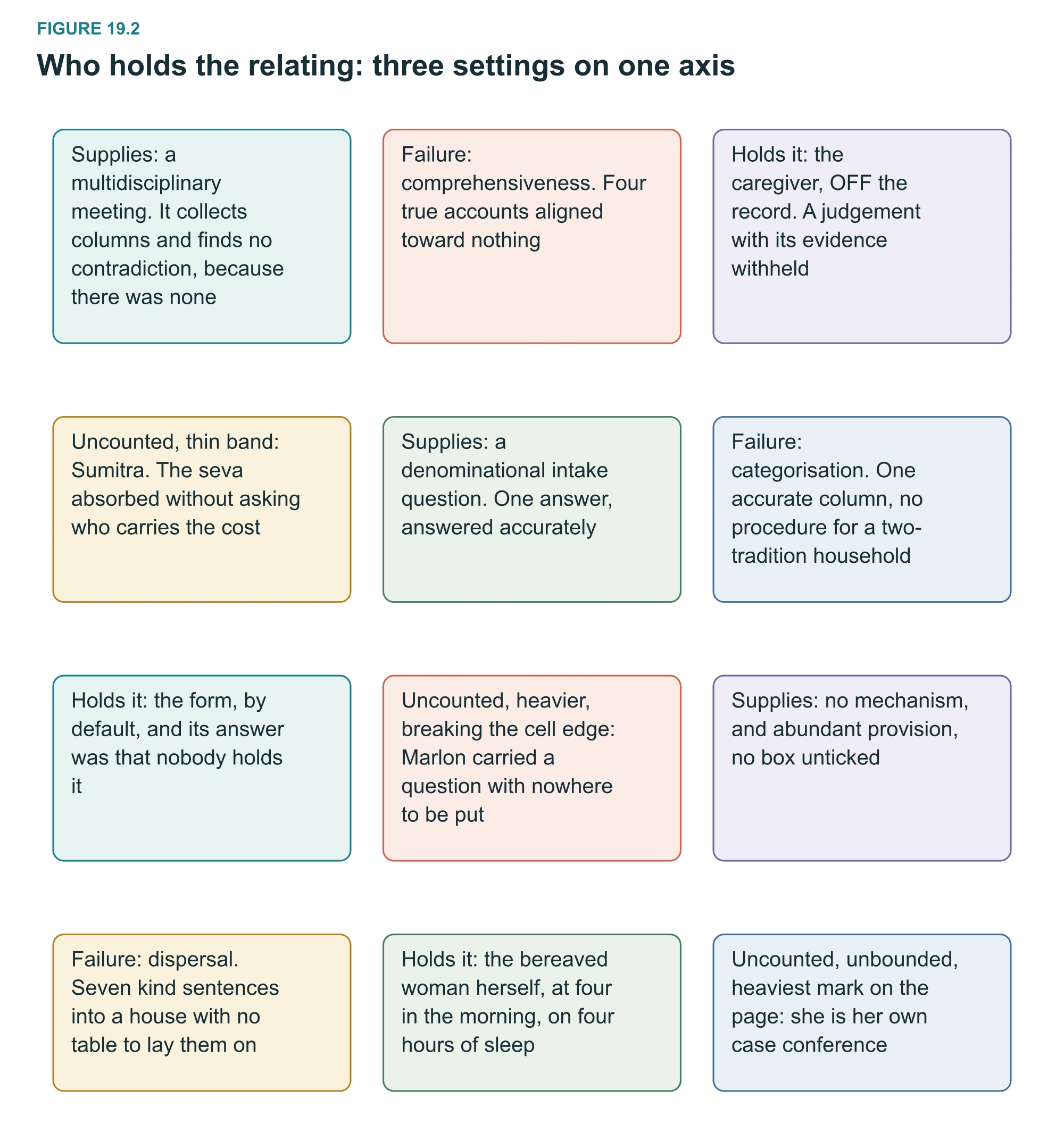
Figure 19.2. Who holds the relating: three settings on one axis.
Competence took a different form in each case, and none of the three is a technique. Nirmal's was a competence of position: he had something only he could offer, in a language only he spoke, and he offered it. Shalini's was a competence of restraint: she had a great deal to offer and withheld it three times, the third time in four seconds and at the cost of the most consoling sentence she owned. Anil's was a competence of subtraction: almost nothing he had was his to give, and his central acts are refusals made in a house where nobody would have known if he had done otherwise. A reader looking for the transferable skill will not find one here, because these are not three applications of a method. What the three share is smaller and harder: each caregiver could say afterwards what he or she had wanted to do and had not done, in the first person, without dressing it as a principle. That is a formation rather than a procedure, and what it costs to keep one is Chapter 23's subject rather than this chapter's.
All three caregivers audited what they offered. Two of the three were caught out by what they said. Nirmal's you have embraced nivrtti was a state offered as a standard, and he retracted it on the floor of a cell. Anil's loslaten was one word in a subordinate clause about the work in general, and it landed in a Dutch kitchen as an instruction about a dead daughter. Neither was an offer. Neither passed through any question of consent, adaptation or harm, because those questions attach to interventions and this was speech. The most practical single finding across the three cases is therefore about a class of thing the chapter's own apparatus does not cover: the words a caregiver has not noticed using are the ones to audit, and the only reliable audit is the one the care recipient performs, which requires that she be willing to contradict him. In the first case that took three months and lasted four seconds. In the third it took a fortnight and one flat sentence. In the second it never happened at all, and this chapter does not read that as a success.
One result is common to all three and is recorded here as a result rather than as a limitation. Each case discarded somebody. Marlon's father buried his wife alone and appears in the case only as a fact about his son's silence. Marlon's wife sold a business in a four-minute telephone call, complied with a request not to visit, and was never told he was sorry. Dropati is a bereaved grandmother, a cancer patient in remission, a household's childminder and the former care recipient of the woman now being cared for, and she is the one person in the case who can never be told that the charge exists. Devika's sister telephoned at nine every evening for four months without missing one, and nothing anywhere records who telephones her. And Sumitra's four silent children appear in this chapter only through her account of them and her silence about them. Not one of those five is anybody's remit in any of the three settings, and their absence is not a failure of the care described here but an accurate description of what care of this kind is currently for. Chapter 22 takes them up, and the honest thing for a results section to record is that Chapter 22 exists because these three cases, read closely, leave them out.
What the three cases do not establish, stated once for the set. They do not establish that anything works. Three cases show that three things are possible and how each of them went; not one has a control, a comparison, or an independent account from the person cared for. They also rest on unequal evidence, which is worth stating once for the set rather than three times over: Sumitra's case rests on three archive documents and about twenty thousand words, while the other two rest on archive summaries of under nine hundred words each, so that every scene, place and interval in those two is composed, and the chapter says so where each case begins rather than in a note at the back. What can honestly be said about an outcome is therefore not the same in the three, and where the evidence thins the three chapters say so rather than writing to a uniform length. All three caregivers are Hindu spiritual caregivers working in the Netherlands under a confidentiality regime that made the first disclosure in each case possible, and a reader working where a chaplain's notes are discoverable should assume that none of these three conversations would have happened at all. And all three cases are told by the caregiver who conducted them. The outcome measures in a case of this kind are supplied by the intervening party; it is a limitation this book cannot design away and can only declare.
7. Key learning points
Seven points, drawn from all three cases, and a distillation rather than a summary of everything above. The longer cluster-level reasoning stands at section 4 above, where it is argued at length and against the field's own literature; what follows is what a practitioner should be able to carry out of this cluster without the apparatus.
One. Mourning does not require a death, and where there is a death the setting's categories still decide what can be done about it. Sumitra lost a role, a household, a standing, a security and a place to be religious, and not one of those has a form to be recorded on. The caregiver's first act was not an intervention; it was to give the losses a name and to say out loud that they were losses. Marlon's loss was a death, recognised instantly, with the paperwork moving the same afternoon, and the categories still decided the shape of the mourning: the notification went where the intake form sent it, and the question he eventually needed to ask had, formally speaking, nowhere to be put. Devika had no categories at all and six people supplying them separately in seven sentences, none of whom knew what the others had said. Where a setting has no place for what a person is grieving, or a place that fits only part of it, supplying the account is care and not preamble.
Two. Grief is re-related, not discharged, and the measure of good mourning is not a restored baseline. The chapter's whole cluster turns on this. The bond, the guilt, the changed life and the unredeemed remainder are aligned toward a Coherent View the survivor can live within, and a mourning that has not returned somebody to who they were before is not for that reason a mourning that has failed.
Three. Say a person's progress as a practice and never as a state, and audit the words you did not decide to say. You have accepted it. You have found peace. You have embraced nivrtti. Offered as states they are received as standards, and the first bad day tells the person that the whole of it was false. Table 16.2, in Chapter 16, sets out the commonest of these sentences in both forms; the difference is usually a verb, and it costs nothing to change. The harder half of the point belongs to the third case. Loslaten was not offered to Devika at all and passed through none of the checks an offer passes through: it was said twice in passing, in a shared second language, about the work in general, and it arrived in a bereaved mother's kitchen as an instruction about her daughter. An intervention gets examined. Speech does not, which is where the damage in this chapter was actually done.
Four. A cessation is information, not progress. When a person stops raising something they raised at the beginning, the useful question is what account replaced it and who is more comfortable now that it has gone quiet. Sumitra stopped mentioning the theft after somebody handed her a complete and consoling reading of her situation in which theft has no place. Devika's three-part charge went quiet after a first visit in which a caregiver answered it with a verdict in the eleventh minute, and the difference in her case is only that somebody noticed seven weeks later, went back to it, and said out loud that he was going back to it. Nobody suppressed anything in either case. That is exactly why it is worth checking for, and the check is a return rather than a technique.
Five. Comprehensiveness is not direction, and this is the book's differentia at bedside scale. Four professions read the same woman correctly and produced four true accounts that were aligned toward nothing, and adding a fifth reading to the table would have made the file more complete without making the care more directed. A denominational intake form assigned Marlon one column accurately and had no procedure for the household he came from, and a further denomination would have been the same error repeating. Devika had six providers, every one of them kind, seven kind sentences and no table at all, so the relating fell to her. Ask, of any well-attended case, what the whole of it is directed toward and who decided; and where the answer is that nobody is doing the relating, notice that it is being done anyway, by the person least equipped to do it.
Six. Where grief is saturated with guilt, viveka runs three ways rather than two. The loss itself is borne and re-related; the disabling secondary suffering - the panic, the collapse, a surviving child's wish to follow the dead - is the clinic's and is routed there without hesitation; and the moral wound is sorted along its own seam, the proportionate part owned toward amends and kshama, the counterfactual remainder loosened as Moha, neither absolved by pronouncement nor confirmed.
Seven. Where a setting forecloses the rite, recover the rite's intent and never improvise its form. A prison that forbids flame, incense and water has not forbidden what the practice was for. The discipline is to ask what the foreclosed rite would have carried - staying in relation with the dead, restoring a purity that makes address possible - and to find a second way of carrying it inside the person's own frame. Trespass and the empty form are the two failures on either side.
The third and fourth of those are hardest to apply to oneself, because both concern an account that is working. Table 19.1 is the check, and it is written to be run in five minutes on a case that appears to be going well.
Run it on a case that is going well, which is the only case it is useful on. The right-hand column is what the answer sounds like when the account has bought its coherence by leaving something out.
Table 19.1. The without-discarding check: six questions to ask of any account that has made somebody calmer.
Ask | Why it is the question | What a bad answer sounds like |
|---|---|---|
What does this account leave out? | An account that relates everything is rare; one that consoles almost always omits. Name the omission before deciding whether it matters. | Nothing important. She has moved past all that. |
Who first said it, she or I? | A frame the person reached for and a frame she accepted from the only person who had one are different objects under the same words. | I offered it and she took it straight away. |
What did she stop saying after she accepted it? | The clearest evidence of a discarded aspect is a subject that used to come up and no longer does. | She does not go on about it any more, which is progress. |
Is there anything in this account she is still allowed to be angry about? | A reading that leaves a person nothing legitimate to resent has probably absorbed a real grievance into a spiritual explanation. | She has let go of the anger. |
Could she refuse it here, and what would refusing cost her? | Where the caregiver is the only source of a frame, agreement is weak evidence. Look for the one place she disagreed. | She has never had any objection to it. |
Say it back to her as a practice rather than a state. Does it still hold? | An account that only survives in the perfect tense will not survive her first bad week. | She has arrived at acceptance. |
How to use it. Ask the six in order, alone or in supervision, before writing the entry that says the work is going well. Where question one and question three produce the same subject, that subject is the discarded aspect and it belongs in the next conversation, said plainly: that you notice she has stopped raising it, that you are not sure whether that is because it has eased or because there is nowhere in this building for it to go, and that if it is the second, the fault is the building's and not hers.
8. Reflection questions
Six questions, and every one of them requires the reader to hold more than one of the three cases at a time. None has an answer this chapter would recognise.
1. Devika contradicted her caregiver on his own ground within a fortnight. Sumitra objected once in three months and the objection lasted four seconds. Marlon never objected at all. What in your practice makes a person able to contradict you, and how would you find out whether the people you care for can?
2. The three failures are a meeting that collects columns, a form that assigns one, and seven sentences with no table. Which of the three does your own setting most resemble, and what in it is doing the relating at the moment?
3. Position, restraint and subtraction are three different competences and none of them is a technique. Which of the three is yours, and what does it stop you seeing?
4. Two of the three caregivers were caught out by something they said rather than something they offered. What would it take for you to find out which of your own habitual sentences is doing that, and who would have to be willing to tell you?
5. Five people were discarded across these three cases and none of them was anybody's remit. Name the equivalent person in the case you are carrying now, and say whose job it would have to become.
6. All three of these cases are told by the caregiver who conducted them, and none has an independent account from the person cared for. What would the person you are working with say happened, and how much of the difference between their account and yours are you prepared to write down?
9. Practice questions and activities
Six activities. Three of them - the second, third and fourth - are the cross-case ones the individual chapters cannot set; the other three put the chapter's own instruments to the reader's own caseload.
1. Run Table 19.1 on your own caseload. Choose the case of yours that is going best and put the six questions to it. Bring the answer to question three to supervision.
2. Compare the three failures. Write one paragraph on each case setting out what a summative reading would have counted and what it could not register: a meeting that collects columns, an intake question with one answer, and seven sentences with no table. Then write the fourth paragraph this cluster does not have, on what the same failure looks like in your own setting and which of the three forms it most resembles.
3. Rank the withholdings. Across the three cases this cluster records seven things that were available, apt, and not offered: two in Sumitra's case, two in Marlon's (a private observance in a cell, and the sraddha offered as something a son can still do for the dead), and three in Devika's (a visit to the six-year-old, an answer to her question about where her sister is, and the whole karma and kshama apparatus). Take any three and write, for each, the case for offering it as the person in front of you would have made it. Then decide, and state what would have to be true of a different setting for your decision to change.
4. Write the fourth case. Take a setting you know that is neither a closed institution nor a private home - a hospice, a school, a workplace, a place of worship - and write, in one page, how the same failure would appear in it. Say what stands in for the meeting, the form, or the seven sentences, and who would be doing the relating.
5. Run the Bereavement Coherence Map on a case that is going well. Use the six moves in section 5 and the four guards, and stop at the point where the Map asks whose Coherent View is in view. Two of these three cases never supply an answer to that question and the chapters say so; check whether yours does.
6. The audit the apparatus does not cover. For a week, write down the encouraging sentences you say without deciding to say them. At the end of the week, put each one through the seven questions section 14 of any of the three case chapters asks of an intervention - why, consent, worldview, adaptation, benefits, harms, and where not to use it - and notice how many of them the question does not fit.
10. Read more
The works below are the ones this chapter actually leans on, and they are the cluster-level literature rather than the material any single case rests on; each of the three case chapters carries its own shorter list. A caution about their status is owed and is stated once here rather than repeated: the case archive was read at first hand, and the moral-injury and meaning literatures were read directly for Chapters 14 and 10, but a number of the bereavement and family-systems interlocutors are engaged here at the level of their standard scholarly statement because the archive does not hold them, and first-hand reading remains owed at Notes 1 and 8. Where that is the case, the annotation says so.
Spirituality and spiritual care. Frankl (1959) is the shortest route into meaning that holds suffering rather than closing it, and is the interlocutor Chapter 10 engages at length; read it for the distinction between a meaning discovered and a meaning supplied. Park (2010) gives the meaning-making machinery - global meaning, situational meaning, and the distress that lives in the discrepancy between them - and is worth reading alongside the observation in this chapter that the model is directionless by design.
Hindu spiritual care and the Dharmic sources. Kane (1953) remains the standard treatment of the antyeshti and shraddha corpus and is where the ritual claims in this chapter are grounded; read the shraddha material as a technology of the continuing bond rather than as a schedule of observances, and then read it a second time for its temporality, which is the reading the tenth claim depends on. For the scriptural loci themselves, the Bhagavadgita 2.20 to 2.25 carries the Atman teaching that the missed rite cannot touch, 2.54 to 2.72 the sthitaprajna equanimity this chapter says can be formed but never administered, and the Katha Upanishad 1.2.1 to 1.2.2 stages the tradition's own dialogue with death in Nachiketa's choice between shreyas and preyas.
Clinical and contextual literature. Doka (1989) names disenfranchised grief, which is the single most useful category in this chapter and covers all three of its kinds. Klass, Silverman and Nickman (1996) is the continuing-bonds turn and should be read for what it establishes and for what it leaves open, which is the direction. Stroebe and Schut (1999) supplies the dual-process model and the word restoration, which the thirteenth of this chapter's cluster claims argues is exactly the wrong horizon. Bonanno (2009) is the readable statement of the trajectory research and the retirement of the single normative timeline. Boss (1999) on ambiguous loss is the nearest the field comes to this book's posture and is worth reading for where it stops. Prigerson et al. (2009) is the prolonged-grief-disorder criteria and should be read by anyone who intends to refuse the diagnosis, so that the refusal is informed. Rosenblatt (2008) is the cross-cultural corrective and the reason this chapter is careful about translating a mourner's knowing into an instrument's terms. For the family as the unit of the wound, Shapiro (1994), Walsh and McGoldrick (2004), Nadeau (1998) and Kissane and Bloch (2002) are the four this chapter uses; all four are engaged at standard statement and primary text not independently checked. Jordan (2001) is the suicide-bereavement profile behind the guilt in Devika's case. Where a claim in section 4 rests on one of these at second hand, the note attached to that claim says so.
Ethical and professional guidance. Litz et al. (2009) and Shay (1994) are the moral-injury sources, read directly for Chapter 14, and they are what allow the ninth claim to treat a bereaved parent's I failed to see as a moral question rather than a symptom. Beyond the literature, the finding this cluster produces about professional guidance is an absence rather than a source. Three caregivers, in three different services, each made a consequential judgement that nobody else ever saw: a letter written in one caregiver's own hand, a note written about a man who was not told, and eight months of not answering an accusation. Not one of the three reached supervision, and in the third there was no supervision to reach. That is not a coincidence of three individuals, and the guidance a reader most needs here is their own service's answer to it.
Narrative and scriptural sources for the cluster. The Bhagavadgita opens in grief, and a reader who wants the tradition's own bereavement text rather than a commentary on one should begin at 1.47 and read to 2.30 before reading anything in this chapter's list. The Katha Upanishad stages its central teaching as a dialogue with Death itself, which is the other place the tradition puts the question the way a bereaved person actually asks it. Neither is offered here as a consolation, and the eleventh claim is about exactly the difference.
Notes
[The three case records were re-verified first-hand against the Dutch originals, and are cited by code only. The published bereavement interlocutors (Freud 1917, Bowlby 1980, Worden 2009, Stroebe & Schut 1999, Klass, Silverman & Nickman 1996, Neimeyer 2001, Prigerson et al. 2009, Doka 1989) are not held in the project archive; they are cited from their standard statements, cited at second hand wherever a copy can be obtained. The notes below record the pass in which each cluster claim was written and the interlocutors engaged in it.]
1. On the field's own correction of the grief-work model: Freud (1917) framed mourning as the withdrawal of libido from the lost object; Klass, Silverman and Nickman (1996) and Stroebe and Schut (1999) document the shift to continuing bonds and to an oscillating dual process. The chapter reads these as genuine corrections that nonetheless leave the direction of alignment unspecified - the gap the Integrative intent fills.
2. On the Gītā as grief-dialogue: BG 2.11 (aśocyān anvaśocas tvam prajñā-vādāṃś ca bhāṣase) is Kṛṣṇa's first instructional word, answering Arjuna's śoka (BG 1.47, 2.1-9) not with a process but with the Ātman-teaching (BG 2.12-30) and, later, the sthitaprajña (BG 2.54-72). The homecoming claim (the diagnosis recovered from within the domain) is carried from Ch 10 (heyaṃ duḥkham anāgatam, YS 2.16) and extended.
3. On disenfranchised grief and ritual: Doka (1989). The antyeṣṭi / śrāddha repertoire and the preta-to-pitṛ transition are read here as a technology of the continuing bond; the scholarly sourcing of the ritual detail is owed.
4. Primary reading of Freud 1917, Bowlby 1980, Worden 2009, Stroebe & Schut 1999, Klass et al. 1996, Neimeyer 2001, Prigerson et al. 2009 and Doka 1989 (all in the bibliography) is cited from standard statements, cited at second hand where a copy can be obtained.
5. Both case primaries re-read first-hand (python-docx) for the loci the development needs: from Case 013, the referral to a psychiatrist for trauma processing, the GP and prescribed medication, the aftercare insistence that 'it is essential that the mother continues to receive professional help from a psychiatrist and GP', the 'human plane' boundary, and the somatic list ('tingling, nerve failure, anxieties') read as the secondary suffering routed to the clinic; from Case 001, the foreclosure of the last rites ('could not attend her burial or take part in her last rites, which were performed in the Christian tradition'), the symbolic rituals (symbolische rituelen) of Shalini's satsaṅga repertoire, and Marlon's own-initiative request for the Hindu last rites and the cycle of life and death. Prolonged grief disorder is cited from its standard statement (Prigerson et al. 2009; DSM-5-TR; ICD-11); primary text not independently checked where a copy can be obtained.
6. IV, on śrāddha and antyeṣṭi) and on the classical locus of the preta-to-pitṛ doctrine in the Garuḍapurāṇa's Pretakhaṇḍa. Kane (1953) is cited from its standard statement and a primary text not independently checked, the archive not holding the volume. The preta-to-pitṛ doctrine has been read in the Sāroddhāra digest of the Purāṇa's Pretakalpa, Wood and Subrahmanyam (1911), at Ch. XII vv. 67-69 and Ch. XIII vv. 2, 36-40 and 94-110, as Chapter 17's Note 1 now records in detail; a critical edition of the Pretakhaṇḍa itself is not held.
7. The family-systems bereavement interlocutors (Shapiro 1994; Walsh & McGoldrick 2004; Nadeau 1998; Kissane & Bloch 2002) are engaged at standard scholarly statement; none is held in the project archive, and primary text not independently checked. The point ties the case to the unit-of-context question owned at Ch 1 §7 (and shaped by Ch 4 §4's restriction of the context in focus) and grounds the whole-family unit in Principle 5 (we are all connected; Shubh Laabh, Chapter 4).
8. Case 013 re-read first-hand (python-docx) for the moral-wound loci: the daily schuldgevoel ('guilty and sad every day that I did not give enough attention to my daughter'), the day-before shouting ('de dag voor het voorval geschreeuwd... op haar dochter'), the boyfriend learned of only after the death, the 'she could have listened more... then she might have had signs' hindsight, and the somatic list ('tintelingen, zenuwuitval en angsten') routed to the clinic. The moral-injury register is drawn from Ch 14's interlocutors (Litz et al. 2009, the definition at p. 700; Shay 1994, the biomedical frame's missing register), already read directly and in the bibliography; suicide bereavement's distinctive guilt/responsibility/'why' profile is engaged from its standard statement (Jordan 2001). The distinctive move: viveka runs three ways - the loss borne and re-related, the disabling secondary suffering routed to the clinic, and the moral wound sorted along its own seam (proportionate responsibility owned toward amends and kṣamā, the Ch 14 moral-repair register; disproportionate counterfactual guilt loosened as Moha, never confirmed, never argued away). The boundary to Ch 14 is stated as a principle keyed to whether the wrong is real-and-proportionate (Ch 14 governs) or counterfactual-and-bereavement-fused (this chapter governs), with the joint hardest case handed forward. Only the two owed refinements now stand carried to a later pass: the precise classical loci behind the sapiṇḍīkaraṇa / preta-to-pitṛ material (Note 6), and first-hand reading of the published bereavement and family-systems interlocutors (Notes 1, 8) wherever copies can be obtained.
9. (2007)** 'An Empirical Examination of the Stage Theory of Grief' - the empirical test (by the Prigerson group of Note 5 / point six) finding acceptance dominant from the first measurement and no stage-sequence. The distinctive move: the trajectory science corrects the field to Principle 1 (multiple trajectories = difference-of-perspective on one bond, ṚV 1.164.46) but supplies only a descriptive/predictive typology, no direction, and hardens - left whole - into a resilience-normativity that re-installs the deficit reflex one storey up ('has she bounced back?'); the Integrative aligns whatever shape the mourning takes toward a Coherent View the survivor can own (Chapter 4). The Dharmic resource is the śrāddha calendar read as a recurring temporality of the bond (an anniversary, not a deadline) - the daśagātra / māsika / sapiṇḍīkaraṇa / annual pratisāṃvatsarika śrāddha on the death-tithi / Mahālaya pitṛpakṣa structure, resting on the same standard treatment cited at Note 6 (Kane 1953), now read for its temporal rather than its continuing-bond structure and grounded in Principle 3 (sādhana as embodied knowing in time). No new appendix entry (the Bereavement Coherence Map already carries the 'grief is not a disorder to complete' guard, now deepened against the timeline as well as the endpoint).
10. Two grief-literature near-matches engaged at their standard scholarly statements (neither held in the project archive; primary text not independently checked): Boss (1999; 2006) on ambiguous loss and the 'myth of closure' - the field's nearest statement of loss without resolution, differentiated from samatva (BG 2.48) / sthitaprajña (BG 2.54-72) at tolerance-of-ambiguity (a mastery won against an unresolved state) versus equanimity whose ground the loss does not reach (BG 2.20); and Rosenblatt (2008) on the cross-cultural non-translatability of Western grief categories - near-match on the untranslatable, differentiated at descriptive relativism (which leaves the knowing merely 'other') versus appreciation of the non-translatable within a directional frame, Principle 1's ekaṃ sat (ṚV 1.164.46, inter-translatable perspectives on one truth) expressly distinguished from Principle 5's non-translatable remainder. No new appendix entry (the Bereavement Coherence Map's guards already carry the posture; the epistemic reading deepens the 'grief is not a disorder to complete' guard toward comfort-with-chaos and adds the non-commensuration discipline). Case-study hit of the Principle-5 epistemic-half probe, matching Chs 12, 15 and 20.
11. The undrawn-principle probe, matching Ch 10 §6 and Ch 14 cluster lesson ten, both filled by Principle 2 for the same reason. Differentia: reordering-not-restoration - a good stripped in Artha/Kāma re-weighted toward niḥśreyasa/Mokṣa, refusing both the Artha-only restitution (the restored worldly baseline) and the Mokṣa-only premature-transcendence summations. Near-matches: the restoration orientation of the dual-process model (Stroebe & Schut 1999, already engaged point one / Note 1) named as the field's own term for what Principle 2 reorders rather than restores; and Parkes (1996) Bereavement: Studies of Grief in Adult Life with the psycho-social transition concept (Parkes 1971) engaged fresh as the deepest statement of grief as the rebuilding of a life-structure, differentiated at restoration of a workable life-space versus reordering toward niḥśreyasa. Vaiśeṣika Sūtra 1.1.2 (yato 'bhyudaya-niḥśreyasa-siddhiḥ sa dharmaḥ) cited by locus (already in the bibliography, Ch 10 §6; bib +0). Placed last (no ordinal shift). With point thirteen the cluster names Principles 1, 2, 3 and 5; Principle 4 (action without doership) is enacted throughout but belongs to the caregiver-formation register (Ch 5), where it is developed, and is flagged rather than forced here so the principle-completion screen does not read the absence as a defect.
CHAPTER 20