
Figure 22.1. The one who lives nearest.
1. The domain and its dominant paradigm - the carer as the resource that care is made of
There is a person in almost every chapter of this book whom the book has not yet addressed. She is in the dying-phase chapter, standing at the foot of a bed she arranged. She is in the Parkinson's chapter, coming at weekends and going straight to the kitchen, because between her and the morning carer her mother's house runs, and nobody has asked what the running costs her (Case 15.3). He is the man in his thirties who has not begun a life because his mother's day has to be got through. In the Netherlands the word for this person is mantelzorger, which is usually rendered informal carer and which carries in the Dutch a sense the English loses - the mantel is a cloak, and the image is of someone who covers another. Across Europe the same population is counted under informal care, family caregiving and unpaid care, and everywhere the counting has the same purpose. It is done to establish how much of the care system's work is being done by people the care system does not employ.
The answer is: most of it. This is the first thing to say about the domain, and it is not a rhetorical flourish but the fact from which everything else in the chapter follows. The overwhelming majority of the hours of care given to frail, ill, disabled and dying people in every health system in the world is given by relatives and neighbours who are not paid, not trained, not supervised and not, in any operative sense, known to the system. Professional care is the visible minority of the total, and it is organised around episodes: an admission, a consultation, a visit, a shift. The invisible majority is organised around a life, and it does not stop when the shift ends.
The dominant paradigm addresses this population, and it addresses it seriously and with real solicitude, in three idioms. Each is a genuine achievement and each fragments in the same place.
The first idiom is burden. It is the oldest and by far the most productive: the carer's situation is construed as a load, the load is measured, correlates of the load are established, and interventions are trialled against the measure. This idiom has given the field its instruments, its epidemiology and its political leverage; when a health ministry funds carer support, it does so because somebody measured burden. Its power is that it makes an invisible thing countable. Its cost is written into its own central word. A burden is a weight borne on behalf of something else. To describe a woman's four years with her mother as a burden is to describe those years entirely by reference to the person she was caring for, and to leave no vocabulary at all for whatever else those four years were to her.
The second idiom is support. Here the carer is the object of provision: respite, a carer's assessment, a support group, a helpline, an allowance, a training course in transfers and pressure areas. This idiom has produced the actual services that actual carers actually use, and nothing in this chapter is a reason to fund less of them. Its characteristic fragment is subtler than the first. Support is provisioned in order to sustain the caring, and the sustaining is measured by whether the caring continues. A respite service is evaluated on admission avoidance and on placement delay. This is not corruption; it is what a commissioner can measure. But it means that the offer made to the carer is made, in the last analysis, on behalf of somebody else, and carers know this. It is not usually among the reasons they give for refusing - the reasons given are practical ones, and §2 takes up why - and §8 will show it operating in a case where no respite was ever offered at all.
The third idiom is wellbeing, and it is the newest. Here the carer is a person whose mental and physical health may be harmed by caring, and the response is a health response: screening for depression and anxiety, mindfulness courses, exercise referral, sleep advice. Its achievement is that it takes the damage seriously as damage rather than as the price of love. Its fragment is that it converts a situation into a symptom. A woman who has not had an uninterrupted night in two years and who scores in the clinical range on a depression screen does not have depression in the sense the screen was built for. She has a life in which sleep is not available, and treating the score treats the wrong thing while looking exactly like care.
Behind all three idioms stands a single construal, and the whole chapter turns on it. In each, the carer appears as an input to somebody else's care. Burden measures the input's load. Support maintains the input's function. Wellbeing repairs the input when it degrades. None of the three, on its own terms, has any way to ask what the carer's own life is aligned toward, because in none of the three is the carer the subject of the care being described. The Part opener stated this at the level of the Part. The rest of this chapter states it at the level of a practice.
2. The fragmentation diagnosis (4H) - a person described entirely by what they are for
The three idioms of §1 fragment along one seam, and the 4H diagnostic names it.
What is to be discerned and let go (heya) is the construal of the family carer as an input to another person's care - the construal that burden, support and wellbeing share and that none of them can see, because it is the ground on which all three stand rather than a claim any of them makes. The symptom by which the construal is recognised is simple enough to use at a desk: every fact recorded about the carer answers the question how well are they functioning in the role, and no fact recorded about them answers the question what are they trying to hold together.
Its cause (heya-hetu) is the unit of account. A care system's unit is the episode of care and the subject of the episode is the patient. This is not an error; an episode-based system is how a health service is planned, staffed, funded and audited, and no alternative unit has ever been made to work at scale. But everyone in the episode who is not the patient enters it under a role description, and a role description is a specification of usefulness. The family carer enters as availability and reliability. Nothing prevents a nurse or a chaplain from asking the carer how they are; a great many do. What the structure prevents is the answer having anywhere to go. There is no field for it, no plan it feeds, no review at which it is considered, and no person whose responsibility it becomes. The asking is real and the recording is impossible, and over time the asking adjusts itself to what can be recorded.
The fault opens in three places, one for each idiom.
Burden that cannot say what is being borne. The burden instruments are good instruments and they measure what they claim to measure. What they cannot do is distinguish two situations that score identically: the daughter who experiences the years with her mother as the worst thing that has happened to her, and the daughter who experiences them as the most important. Both are exhausted, both have given up work, both sleep badly, both score high. The difference between them is a difference in what the years mean, which is to say a difference in direction, and a scale that sums load has no place to put a direction. This matters practically and not only conceptually, because the two women need opposite things. One needs the load reduced and the other needs the meaning defended against everyone who keeps telling her the load should be reduced.
Support that arrives addressed to somebody else. The offer of respite is the clearest instance in the whole of care of a good thing refused for a reason its providers rarely hear. Carers refuse respite at rates that puzzle commissioners, and the explanations recorded are practical: the person will be distressed, the home is not suitable, nobody else knows the routine. Underneath the practical reasons sits a structural one. The offer is made by a service whose client is the cared-for person, in a conversation whose subject is the cared-for person, in terms of the cared-for person's continued residence at home. A carer who accepts it has agreed that she is the part of the arrangement that is failing. Refusing is not irrationality; it is the only available way of declining a description.
Wellbeing that treats the situation as a symptom. Screening finds the damage, which is a gain, and then routes it into a pathway built for individual disorder, which is a loss. The pathway offers therapy for how the carer is thinking about her situation, medication for how she is feeling in it, and mindfulness for how she is attending to it, and every one of those is an intervention on the carer while the situation is left exactly as it stands. There is a specific and avoidable harm here, and it is not hypothetical: a carer told that her exhaustion is a mental-health problem has been told that the problem is in her. She very often already believes this. The screening has confirmed it with an instrument.
The desired state (hāna) is not the abolition of any of the three. Burden must still be measured, support still provisioned, wellbeing still attended to. It is that the carer is additionally, and first, related to as a person whose own life has a direction - as an observer of the context in her own right, and not only as a condition of somebody else's care.
And the means (hānopāya) is a relation rather than a service, which is why this is a chapter in a book about spiritual care and not a chapter in a book about carer services. What the three idioms lack cannot be supplied by a fourth idiom of the same kind. It is supplied by somebody asking the carer a question that is about her, and being in a position to receive the answer - which is a position almost nobody in the care system occupies, and which the spiritual caregiver, having no assessment to complete and no placement to avoid, occupies almost by default. That is the chapter's central practical claim and §§7 and 8 work it out.
3. The Integrative reframe - the carer as an observer of the context, and the differentia
The reframe is one move and it is stated in the definition the book rests on. Integrative is the intent of relating all possible aspects, perspectives and purposes under holistic understanding of any context towards a Coherent View among all observers of the context in focus, without discarding any aspect, perspective and purpose (Bindlish 2026; Chapter 4). Take the phrase among all observers seriously and the family carer is one of them. She is not a feature of the context, like the stairs or the catheter or the rota. She is an observer of it, with a perspective and a purpose of her own, and the intent that defines Integrative care is an intent toward a Coherent View among all the observers - which is to say that a care arrangement in which the cared-for person's coherence is achieved at the cost of the carer's has not achieved what this book means by care. It has achieved something narrower and should be described in narrower words.
The differentia against the near-match is the same one the whole series turns on: an intention to align diverse perspectives and purposes, not necessarily a summation (Chapter 4). Applied here it is unusually sharp, because the summing is literal. A care plan that lists the carer under resources available has summed a person into an entry on an inventory. That is not a metaphor for what the plan does; it is what the plan does, and the plan is not wrong to do it, because a plan needs to know who will be there at night. The Integrative claim is not that the inventory should be abolished. It is that a person who appears on an inventory must also appear somewhere else, as an observer whose own purposes are part of what the care is trying to align.
Three differentiae make this concrete, taken differentia-first, as the method requires.
The first is against the burden paradigm. Burden is a scalar and the Integrative reading is directional. Where a burden instrument asks how much, the Integrative question is toward what - what this person is trying to hold together, and what would count for her as things having gone as well as they could. The two questions are not rivals and the second is not softer. It is, in fact, the more demanding of the two, because it can be answered wrongly and a load cannot. A carer can be mistaken about what she is holding together, and finding that out is work. What the directional question does that the scalar cannot is distinguish the two identically-scoring daughters of §2, and it does so on the only ground that separates them.
The second is against the support paradigm, and it concerns whose care the offer is part of. On the Integrative reading the offer made to a carer is care given to her, complete in itself, and not an intervention on the arrangement. This has an immediate and testable consequence, which is that it must remain worth making if the cared-for person dies tomorrow. A respite service fails that test by design; it has no content once there is nobody to be relieved of. What a spiritual caregiver offers a carer passes it, because what is offered is a relation, and the relation does not lose its subject when the arrangement ends. This is not a criticism of respite. It is the criterion by which the two kinds of offer can be told apart, and a carer who has refused every service in the borough may still accept this one, for exactly this reason, without either party quite being able to say why.
The third differentia is the sharpest and it is against the wellbeing paradigm. The wellbeing reading locates the problem in the carer and the situational reading locates it in the situation, and the field has an old argument between them which the Integrative reading declines to join on either side. Both are partial in the same way: each treats the carer's state as an effect of which something else is the cause, and neither treats her as someone with an intent. The Integrative move is to ask what she is aligned toward and to notice that in a great many cases the damage is not caused by the hours but by a misalignment inside them - by carrying a life she never assented to, or by holding a purpose that has quietly become somebody else's, or by having no account of what the years are for that she could state if asked. Reduce the hours of a carer in that condition and you will not have touched it. This is why a chapter on family carers belongs in a book about spiritual care: the fault the other paradigms cannot reach is a fault in direction, and direction is this book's subject.
One consequence of the reframe should be stated before it is discovered awkwardly in practice, because it is the point at which the reframe becomes uncomfortable. Treating the carer as an observer in her own right means that her purposes may turn out to conflict with the cared-for person's, and the Integrative intent forbids discarding either. A mother wants to stay at home and her daughter cannot go on. Alignment here does not mean that one of them yields; it means that the conflict is held as a conflict between two people with standing, rather than being resolved in advance by the assumption that one of them is the patient and the other is the arrangement. Most of the difficulty in real family care lives at exactly this point, and most professional practice resolves it silently in the patient's favour and calls the result person-centred care. It is person-centred. The question is which person.
4. Knowing in this domain (K1-K4) - what a family carer knows that nobody asks for
The knowledge model earns its place in this chapter more directly than in most, because family care is the one domain in this book where the highest levels of knowing are routinely held by the person with the least standing to be heard. In the terms of the model, the distribution is inverted with respect to every other chapter.
At K1, the informational level, the professional is secure and the carer is not. The professional has the diagnosis, the prognosis, the medication names, the pathway, the vocabulary. A carer's K1 is patchy, acquired from a leaflet and from whatever was said in a corridor, and it is the level on which carer education has concentrated almost all of its effort - which is reasonable, since it is the level at which a deficit is easiest to see and easiest to fill.
At K2, the skilful level, the picture is already mixed. A carer of four years' standing performs transfers, medication rounds, pressure-area care, catheter management and the reading of a deterioration, and performs them in a house that was not designed for it, alone, at three in the morning, with no colleague to check against. Professional training produces K2 faster and more reliably. It does not necessarily produce more of it.
At K3, the contextual level, the relation inverts, and the inversion is the whole point of this section. K3 is the level at which the knower occupies the other's standpoint - knows what it is like to be where the other is. A professional reaches it, when she reaches it, by discipline and formation, across a gap, in the time available. A carer who has lived with someone for thirty years and cared for them for four is at K3 by a route no training supplies. She knows which silence is pain and which is thought. She knows that the refusal of food this evening is not the refusal of food last Tuesday. She can tell from the first syllable of an aphasic sentence which of three things is being attempted. This knowledge is real, hard-won, and almost entirely unrecorded, and when it is offered it enters the professional record under the heading family reports, which is the heading for testimony of uncertain reliability.
At K4, the immediate-relational level, the carer is often the only person present who has it at all, and it cannot be transferred. K4 in this domain is the knowing that consists in the relation itself: a wife who knows her husband not as a case she has come to understand but as the person her own life has been formed alongside. No handover conveys it. This is the specific and terrible fact about the transition into residential care, and it is worth stating plainly rather than sentimentally: the move can be right, and can be necessary, and can still constitute the destruction of the only K4 knowledge of that person in existence, replaced by a competent K1 and K2 delivered by people working shifts.
Two consequences follow and both are practical.
The first is a claim about what the professional owes the carer epistemically. If the carer holds K3 and K4 that the professional cannot reach, then a professional who treats the carer as an informant of uncertain reliability is discarding, in the precise sense the core definition forbids, the best knowledge in the room. The corrective is not to believe everything a family says. It is to notice that family reports is a category error - it files a K3 contextual account under the heading of a K1 factual claim, and then discounts it for being an unreliable K1 claim, which it never was.
The second is a claim about what this does to the carer. To hold K3 and K4 about a person, continuously, for years, while being addressed only at K1 and K2 - being told what the medication is for, being trained in transfers - is a particular kind of loneliness that carers report constantly and that the burden instruments do not measure, because it is not a load. It is the experience of knowing something important that has no listener. A spiritual caregiver who does nothing else in a first meeting with a family carer but receive that knowledge as knowledge has already done something no other professional in the arrangement is positioned to do.
5. Western interlocutors - the science that made the carer countable
The knowledge inversion of §4 is not something the Western literature has failed to notice for want of trying. It is something four decades of careful work has approached from four directions and stopped short of, each time at the same wall, and the honest way to meet that literature is to take each direction at its strength and watch where it stops.
The cluster is the carer-burden and stress-process science, and its achievement is the one §1 named. It took a population no health system counted and made it countable, and every service a family carer is offered anywhere in Europe exists because somebody measured something. Four families of work matter here, and this section reads them in the order in which they arrive at the wall.
5.1 The instruments, and the item that will not behave
The field's workhorse is the Zarit Burden Interview, a twenty-two item self-report scale in use since 1980 (Zarit, Reever and Bach-Peterson 1980, named throughout this literature and not read at first hand for this chapter; the account here follows Boluarte-Carbajal, Paredes-Angeles and Tafur-Mendoza 2022 and Swinkels, van Tilburg, Verbakel and Broese van Groenou 2019, both of which were).
Boluarte-Carbajal and colleagues (2022) [observational/pilot] set out to establish which of the scale's published factor structures actually holds. They tested nineteen previously published models against data from 287 primary informal carers of people with intellectual disabilities in Peru. Five would not converge at all. Three returned negative variances. Eleven could be estimated, and of those the two-factor structure Zarit's own group had proposed fitted the data poorly; the best solution was a shortened thirteen-item scale with a single dimension. Their own summary of the prior literature is that there is no clear consensus on the instrument's dimensionality, and that studies reaching acceptable fit often do so by freeing residual covariances, which they warn may hide a misspecified structure rather than reveal a sound one.
That is a psychometric result and by itself it would be a footnote. What makes it a finding for this chapter is a single item. Item 20 asks the carer whether they feel they should be doing more for their relative. It returned the highest mean score of any item on the scale - it is, of everything the instrument asks, the thing carers most agree with - and an item-rest correlation of 0.17, well under the authors' own retention threshold, which is to say that it correlates hardly at all with the rest of what the scale is measuring. On the instrument's own arithmetic it is a bad item and the recommendation is to drop it.
Read that result the other way round and it is the chapter's argument arriving from inside the instrument's psychometrics. The most widely endorsed thing a family carer will say about their situation does not behave like burden, because it is not one. I should be doing more is not a report of load. It is a statement about a direction and about a standard, and it comes from the same place §6 will locate the icon. A scale built to sum a weight encounters it, records it faithfully, finds it uncorrelated with weight, and correctly discards it. Nothing has gone wrong; a well-built instrument has met something outside its construct and behaved exactly as it should. The item that has to be dropped for the scale to work is the item this chapter is about.
5.2 The stress process, and where the gender gap actually runs
The second family models caregiving not as a weight but as a process, and it descends from Pearlin, Mullan, Semple and Skaff (1990), whose distinction between primary stressors - the care recipient's impairment and the tasks it generates - and secondary stressors - role conflict, financial strain, the collision of care with the rest of a life - organises most of what has been done since. That paper could not be retrieved at first hand for this chapter and no page-level claim is made on its authority; the model is described here as it is reproduced and quoted by two studies that were read in full.
The first is Swinkels and colleagues (2019) [observational/pilot], a structural-equation study of 1,611 Dutch partner-caregiver couples drawn from the TOPICS-MDS survey, 2008 to 2015. On a single-item burden scale running from zero to a hundred, women scored 48.9 and men 42.4. Women were also worse off on nearly every input: 30.8 hours a week against 27.2, relational difficulties reported by 54 per cent against 37, difficulty combining care with daily life by 59 per cent against 40.
Then the finding. In the multivariate model there was no significant direct effect of gender on burden at all. The entire gap ran through the secondary stressors - the subjective ones, the appraisals - and not through hours, impairment or task load. The authors put it plainly: it was not the objective factors but the subjective ones that explained the gap. Two further results are worth carrying. More hours of care raised burden for men and did not do so significantly for women, which was the only pathway in the study that differed by sex. And help from others was associated with higher burden, not lower, which the authors read as partners accepting help only once things are already extreme, or experiencing the acceptance itself as a failure. That reading is speculative and they say so. It is also the closest thing in this literature to §2's account of why respite is refused, arriving independently and from a study that was not asking the question.
Swinkels and colleagues are candid about their own instrument, and their caution is the second half of §5.1's finding. A single global burden score, they argue, confounds two different evaluations - the appraisal of the caring and the appraisal of everything else in the life - and understanding what is happening requires separating them. They note that the Zarit scale folds precisely these things together into one number.
The second study is Blin, Bonin-Guillaume, Arlotto and Gentile (2026) [observational/pilot], seventeen interviews with family carers of people over eighty in south-eastern France, which uses the same primary and secondary vocabulary in a qualitative register. Its central descriptive result belongs to §8.6 and is stated here because it is evidence for it: twelve of the seventeen did not identify as carers at all, describing what they did as ordinary family duty. The authors treat that non-identification as itself a barrier to support, since almost every route to help requires a person to have first applied the word to themselves.
5.3 The health evidence, and the admission at the centre of it
The third family asks whether caring damages the carer, and the best synthesis is Bom, Bakx, Schut and van Doorslaer (2019) [review/trial], a systematic review restricted to the fifteen studies that had attempted causal rather than correlational estimation. Fourteen of the fifteen found a short-term negative health effect for at least some group. Mental-health effects were consistent; physical-health effects were not, and in a way that repays attention - measured by self-assessed health the short-run effect of caregiving is positive, while measured by pain and by medication intake it is negative. The explanation offered within the review is a reference-point effect: a carer rates her own health against the health of the person she is caring for. Effects were repeatedly larger in women, in married carers, and at higher care intensity.
The admission that matters most to this chapter is one the authors make against their own field. Only two of the fifteen studies separated the effect of caring for an ill relative from the effect of caring about one - what they call the family effect - and the rest, they say, may therefore be overestimating what caregiving does. The most methodologically disciplined body of evidence in the whole literature cannot cleanly tell the work apart from the love. That is not a defect to be corrected by better econometrics. It is §3's point stated in the vocabulary of causal inference: what is happening to a family carer is not an exposure with a dose, and a design that treats it as one will keep returning a number that is the sum of two things it cannot separate.
5.4 Gender, and the difference between incidence and intensity
The fourth family is the one this chapter's own §6 and §8 lean on, and it is the one where the literature is most often quoted carelessly. Two studies, read at first hand, point in what looks like opposite directions and in fact do not.
Verbakel, Tamlagsronning, Winstone, Fjaer and Eikemo (2017) [observational/pilot] analysed the European Social Survey's 2014 module across twenty countries, 28,406 respondents. 34.3 per cent of the adult population were informal carers and 7.6 per cent were intensive carers, giving eleven or more hours a week. Three of its results belong here. First, the gender odds: women had 1.33 times the odds of being a carer and 1.60 times the odds of being an intensive one. Second, an inverse pattern across countries that bears directly on what services do - the countries with the most carers had the fewest intensive ones, with intensive caregiving running at 11.6 per cent in Portugal against 3.9 per cent in Norway. Formal provision does not remove family care; it redistributes it from a few people doing a great deal to many people doing a little. Third, and this is a finding a book on spiritual care should not pass over: religious respondents had 13 per cent higher odds of being a carer and 14 per cent higher odds of being an intensive carer. What a religious construal of the work is doing inside that distribution is not a question this section can settle, and §6 is where it is put.
Two further results are worth carrying. Poor health did not deter caregiving; the likelihood of intensive care was higher among those in worse self-reported health. And on mental health, carers scored 0.26 points higher and intensive carers 0.61 points higher on a twenty-four point depression scale, with the effect for women more than twice that for men (0.35 against 0.15). The authors themselves grade this down, noting that these effect sizes are limited and that self-rated health and relationship status affect mental wellbeing more than caregiving does.
Against that, Sharma, Chakrabarti and Grover (2016) [commentary] - a narrative review, classified by its own journal as an editorial, and covering Indian as well as Western material - deflate the burden half of the gender claim thoroughly. They report that women are between 57 and 81 per cent of carers of older people across countries, and then set against it a meta-analysis of 229 studies finding that women's higher burden and lower wellbeing were real but small, barely reaching practical significance, with the authors' conclusion being that there are more similarities than differences between male and female carers. Their Indian evidence runs both ways: one spousal-carer study found significantly greater burden in wives across five domains, another found men and women equally vulnerable, and a third found women spending significantly more time on care with no significant difference in burden. They add that empirical support for the role-expectation theories usually invoked to explain gender differences is lacking. Their review also supplies the ladder this chapter has been describing without naming - role conflict, role strain, role overload, and finally role captivity, the sense of being trapped in a role, which is the closest term in this literature to what §8's anchor case exhibits.
The two studies are reconciled by a distinction the literature does not always draw and this chapter needs. The gender claim is about incidence, not about intensity. Verbakel establishes that women are substantially more likely to be doing this work and much more likely to be doing a great deal of it. Sharma establishes that once a man and a woman are both doing it, the difference in what they report is small and inconsistent. Both are true and neither is a rebuttal of the other, and taken together they are a stronger and more usable claim than either alone: the mechanism does not discriminate, and the allocation does. §8.5 states this in one sentence about a case in which the carer is a son, and it is stated here because that is where the evidence for it is.
5.5 The one trial in this chapter, and what it warrants
Black and colleagues (2013) [review/trial] is the only randomised evidence this chapter carries and it was read at first hand. Forty-five family dementia carers were randomised to twelve minutes daily of Kirtan Kriya, a chanted yogic meditation delivered by audio recording, or to twelve minutes of relaxing music, at the same hour each day for eight weeks; thirty-nine completed. Genome-wide transcriptional profiles from blood leukocytes at baseline and eight weeks showed, in the meditation arm and not the music arm, reduced pro-inflammatory NF-kB signalling and increased interferon-response-factor activity - a reversal of the pattern chronic stress produces.
What it warrants: a short practice, fixed in time and sustained for two months, produces a measurable change in the body of a family carer, in the direction opposite to the one the caregiving was producing. What it does not warrant: anything at all about the situation. Hours of care were not an outcome and did not fall. Participants were giving between forty-eight and sixty-three hours a week at baseline and nothing suggests they were giving fewer at the end. The study is evidence that something can be done for a carer inside an unchanged situation, which is a real and useful finding, and it is not evidence that the situation has been addressed. Three further limits the paper states of itself, and Appendix D.10 carries: the analysis is of completers only, the individual gene-expression changes were mainly small and are read as a pattern rather than one by one, and the authors say they cannot tell which component of the practice - the chant, the breath or the finger movements - was responsible.
Two features of the sample are used later in this chapter and both are graded down where they are used. Of the thirty-nine completers, thirty-seven were women. And the trial excluded anyone with a history of major depressive disorder or any other psychiatric illness, anyone in treatment for depression, anyone taking psychotropic medication and anyone with alcohol or substance dependence - the full list of eight criteria is at Appendix D.11.1 - so the sample is the healthier end of the population by construction. Carers with mild to moderate depressive symptoms were in; carers with the illness were not, and the paper's own limitations section says the result may not generalise to them. What was left still returned a mean mental-health functioning score around thirty-five on an instrument normed at fifty. One trial's incidental sample composition is not an epidemiology of gender in caregiving and §8.5 does not present it as one; the epidemiology is Verbakel's, above.
5.6 Where all four stop
The four families measure different things and they stop in the same place. Burden asks how much. The stress process asks through what pathway. The health literature asks with what effect. The gender literature asks on whom it falls. Every one of these is a question about the carer's state, and every one of them can be answered completely without anybody having asked the carer what she is trying to hold together.
This is not an oversight and it is not a failure of sympathy, and it would not be repaired by adding a fifth idiom of the same kind. It follows from the construal §1 identified: a science of an input will measure the input's condition, because the input's condition is what an input has. The Integrative question of §3 is not a better version of these four. It is a different question, addressed to a different subject, and it is available to the spiritual caregiver for the same reason it is unavailable to the instrument - because it can only be asked by somebody who is prepared to receive the answer for its own sake.
6. Dharmic resources, brought alongside
The tradition has a name for what a family carer does, and having a name for it is not a small thing. Sevā (selfless service) construes the work as meaningful in itself rather than as a cost incurred on somebody else's behalf, and that construal supplies precisely what §1 found the three Western idioms unable to supply. This section reads the resource at full strength first and then reads it for its shadow, in that order, because the reverse order produces debunking rather than reading, and because a caregiver who arrives at a Hindu family's house having read only the shadow will do harm.
At full strength, sevā does four things the burden idiom cannot. It gives the carer something to be rather than something to be at risk of - a woman told by a questionnaire that she is at risk of strain has been given a true description with no place in it for her to stand, and a woman whose work is named sevā has been given a place to stand. It locates the work inside a life that has a direction, which is exactly the toward what that §3 found the scalar idiom missing. It makes the care intelligible to the family and the community, so that the carer is doing something recognised rather than something merely happening to her. And it connects the work to niṣkāma karma (action performed without attachment to its fruit), which offers a carer something no support service can: a way of continuing that does not depend on the outcome improving, in a situation where the outcome will not improve.
None of that is conceded grudgingly and none of it is a cover for exploitation. A caregiver working with a Hindu family who treats sevā as ideology to be dismantled has misunderstood the resource and will be, correctly, distrusted.
Now the shadow, and it has three parts.
The first is that sevā is unequally distributed and the tradition's language does not mark the inequality. The word is the same whether the service is given by the daughter who lives in the same house or by the son who telephones on Sundays, and because the word is the same the difference in what is actually given becomes difficult to state without seeming to accuse. In practice, in Hindu families in India and in the diaspora alike, the work falls to whoever lives nearest and, within that, disproportionately to women - the daughter, the daughter-in-law, the wife. The claim is a claim about incidence and the evidence for it is at §5.4. The distribution is not a doctrine and no text prescribes it. It is a custom that has acquired the prestige of a doctrine, and the effect is that the person doing four-fifths of the work and the people doing one-fifth are all described as performing sevā, which makes the imbalance invisible in exactly the vocabulary the family has for talking about it. A spiritual caregiver who can say this to a family, without accusation, has performed a service the family cannot easily perform for itself.
And there is a finding at §5.4 that this section cannot walk past. Across twenty European countries, religious respondents had thirteen per cent higher odds of being an informal carer and fourteen per cent higher odds of being an intensive one, giving eleven hours a week or more (Verbakel et al. 2017). The study covers no Hindu population large enough to speak of and the finding is an association in a cross-sectional survey, so nothing causal follows and none is claimed. What does follow is that a religious construal of care is not a decoration on a distribution that would look the same without it. It is doing work - drawing people into the role and holding them at the intensive end of it - and a resource that does that much cannot be read only at its strength. That is why this section has a second half.
The second part of the shadow is the icon, and it must be read carefully. Śravaṇa Kumār is the tradition's image of filial devotion: the son who carried his blind parents in slings suspended from a pole across his shoulders, on pilgrimage, and who is invoked in Hindu families as the standard against which a child's care for a parent is measured. Read at full strength the story is not a demand. It is a portrait of a certain kind of love, and it has a feature most care arrangements never achieve, which is that the parents' needs are met without their dignity being touched; they are not managed, they are carried, and they are still on their pilgrimage.
Read for its shadow, three things are absent from the story and the absences are the whole of the difficulty. The son's own life is not in it - not going badly, simply not raised; the question of what he wanted does not arise, and a story in which the question does not arise is a story that teaches a young person that the question is not asked. Nobody in it asks him anything. And the story ends with his death, killed in error by a king's arrow aimed at a sound in the dark. That is the only ending the icon supplies. A young person handed Śravaṇa Kumār as a model has been handed a model with no exit written into it, and §8 is the case of a man who lived that model for years and whose arrangement ended not because anybody intervened but because his mother died.
The third part of the shadow concerns niṣkāma karma itself, and it is a mistranslation with a long history and a specific danger in this population. Non-attachment to the fruit of action is heard as detachment from the person, and detachment is then practised as a hardening. A carer who has been told to be unattached to outcomes, and who is exhausted, has been handed a spiritual permission for the numbness that is already arriving on its own. She will experience the numbness as progress. The teaching means the opposite of this: Principle 4 of the Integrative Paradigm describes the movement it belongs to, from Samarpan (devotional surrender) through Santulan (a coherently balanced existence) to Sukh (a conscious happiness that is not the absence of difficulty), and every term in that sequence describes a fuller relation rather than a thinner one. The practical rule for a caregiver is to be suspicious of non-attachment that has arrived without Samarpan - detachment that has been reached by subtraction rather than by surrender is not the teaching, and in a family carer it is very often the first sign that she is in trouble.
One more resource belongs here and is used at §8. The āśrama scheme, which orders a life into stages, contains an assumption the modern family-care situation silently violates: that the person giving care to elders is a gṛhastha, a householder, with a household of their own, and that the stage has a beginning and an end. A carer who has entered the work before establishing a household, and who is still in it fifteen years later, is not living a stage. The tradition's own architecture says so, and saying so is more use to such a person than any amount of encouragement, because it tells them that what has happened to them is a distortion of the pattern rather than the pattern itself.
7. Models, frameworks and practices (the chapter's contribution to the inventory)
What §§1 to 6 establish is that the family carer is reachable by a question nobody in the arrangement is positioned to ask. What this section adds is the practical apparatus for asking it: a sequence for an offer made to somebody who has not requested anything, the circumstances in which the offer should not be made, the handling of the point at which the carer becomes a patient, the particular case of the carer who is not in the room at all, and the reflexive test this Part is required to apply - whether the practices this book offers a care recipient are available to the carer too. The section closes with the chapter's three artefacts, of which Table 22.1 is written to be lifted and used on its own.
7.1 The sequence of an offer to someone who has not asked
Everything about this offer is unusual, and the unusualness is structural rather than delicate. There is no referral, no presenting problem, no consent to an episode of care, and no agreed ending, because the person has not asked for anything and does not think of herself as somebody who might. Twelve of the seventeen carers in Blin and colleagues' study did not use the word about themselves. An offer that requires her to accept the description first has asked for the one thing she will not give.
Five moves, in order.
First, finish what she came for. She is in front of you for a reason and the reason is real. Nikhil came about his brother, and had the caregiver in §8 treated the bereavement as a way in to the carer situation, the bereavement would have been the thing that went unattended. The carer question is asked inside an encounter that is already complete on its own terms, not instead of it and not as its purpose.
Second, ask one question that is about her. One, not four. The column of Table 22.1 headed The question that is about her gives four, and they are alternatives, not a schedule. The choice among them is a judgement about which one she can answer today, and the safest general opening is the second - what she knows about him that nobody has asked her - because it is the only one of the four that begins by treating her as competent rather than as possibly depleted.
Third, do nothing with the answer. This is the move on which the whole offer turns and it is the one most likely to be got wrong by a conscientious person. The answer does not generate a referral, does not open an assessment, does not become an entry under concerns, and is not relayed to the team without her agreement. If it does any of those things then the question was a screening question after all, she will discover this, and the next carer that caregiver meets will be talking to a professional who converts disclosures into actions. What is done with the answer is that it is received.
Fourth, say back what you heard, once. In her words and not in the vocabulary of this chapter. Not you are experiencing role captivity, not that sounds like anticipatory grief, but the thing she said, returned in a form that shows it arrived. This is what distinguishes receiving from merely permitting, and it is usually the point at which a carer who has held K3 and K4 knowledge for years without a listener finds that she has one.
Fifth, leave the offer open and make refusal genuinely available. Say what is on offer, say that it is hers and not part of anybody else's care plan, and say - before she has to work out how to decline - that not wanting it is a perfectly good answer. A carer's refusals have been read as denial by everybody who has offered her anything, and an offer that has an acceptable refusal built into it is a different kind of offer, which she will notice.
Refusal is an outcome and not a failure, and the record should say so in those terms. This matters beyond the individual encounter, because a service that records refusals as unmet need will eventually be redesigned to reduce them, and the redesign will consist in making the offer harder to decline.
The book's own case record shows what the sequence looks like when it is not run, and it is worth being exact about it because the caregiver in question did nothing wrong by the standards of his setting. In Chapter 11 a woman in her early thirties, Sujata, dies on a palliative unit some three weeks after the caregiver's first visit. Her husband, a man in his thirties about to raise two children alone, is present throughout and is, in that chapter's own words, given nothing to do until the last hour, when the heaviest intervention in the case is performed on him: he is asked, in front of her sister, to release her, and he does. The chapter records that he was afterwards glad, that he kept the recordings she had made for the children, and that the caregiver had no further contact with the family after the funeral, which it rightly calls the ordinary shape of hospital spiritual care in the Netherlands and declines to criticise. Read from this chapter, the same record shows a carer who received one instruction and no offer. Nobody asked him what he knew about her that nobody had asked; nobody said that anything was available to him on his own account; and the arrangement ended in a death, which is the form §7.3 describes as the one the system reads as resolution. That is not a charge against the caregiver, whose mandate ended where the chapter says it did. It is the reason this chapter exists. The first move above, finishing what she came for, is exactly what he did, and the four moves after it have no home in a service whose episode of care closes with the patient's.
7.2 Four contraindications
Do not use the shadow as a lever. The reading of sevā at §6 is for the caregiver's understanding and is not, in that form, an offering. A carer told that the tradition she lives inside has been used to allocate four-fifths of a family's work to her has been handed an analysis that is probably correct and that she can do nothing with, at a moment when the account of her own life is the only thing holding it together. The test is simple and it should be applied before speaking: would this still be worth saying to her if she were going to go on caring exactly as she is? If the reframe only helps on the assumption that she stops, it is not care. It is recruitment to somebody's conclusion.
Do not ask the distribution question in front of the family without her prior agreement, obtained in private. This is stated at Table 22.1 and repeated here because it is the contraindication most likely to be violated by a caregiver who is doing well. Making the imbalance visible is the point of the question, and the person who made it visible is the one who will still be in the house on Sunday.
Do not offer a practice in place of an obligation. Black and colleagues' trial is the exhibit and §5.5 grades it precisely. Twelve minutes a day changed something measurable in carers whose hours did not change at all, and that is a real good. It becomes a harm the moment it is offered by a service that owes a structural remedy it has not provided, because the practice will relieve exactly the distress that was recruiting attention to the problem. The rule is not that practices are suspect. It is that a practice offered where a service is owed should be named as what it is, out loud, to the carer: this will help and it is not what you are owed.
Do not open what you cannot stay for. The third question of Table 22.1 - what have you had to put down - reaches something a carer has often never said aloud, and a caregiver who asks it in a corridor and is not in the building next week has opened a subject and left. Where continuity is genuinely unavailable, the first or second question is the right one; both can be asked completely and closed completely in a single meeting. The rule is not a counsel of caution about depth. It is a rule about matching the depth of the question to the length of the relationship, which is a discipline this book asks for everywhere and which is easiest to forget with a person who is not on the caseload.
A fifth belongs here and is handed forward: the caregiver with an unresolved carer situation of their own, who will be doing something other than what they think they are doing in this conversation. That is not a contraindication so much as a subject in its own right, and it is Chapter 23's.
7.3 When the carer becomes the patient
The transition has a structural feature that a caregiver should understand before meeting it, because it determines what is possible at the moment it happens.
For most family carers the collapse of the arrangement is the first event that makes them visible to the care system at all. Until it happens there is no field, no assessment and no list; afterwards there is a bed, a referral and a diagnosis. Help therefore arrives at precisely the point at which it can no longer do what help would have done, and it arrives, moreover, through the only route the system has, which is the patient route. She becomes visible by being converted into the other role description, and the second description is no more capacious than the first. She was availability and reliability; she is now a presenting complaint.
Three forms of the transition, and what each asks of a caregiver.
The carer who is admitted. A person in a bed who is also somebody's only carer is a common and under-recognised event, and it produces an immediate practical question that nobody's job it is to ask: who is at home now. A spiritual caregiver meeting such a person can ask it, and should, and should expect the answer to be the most distressing thing in the encounter. The care she is receiving is real and it is being received by somebody who cannot use it, because her attention is seven miles away in a flat.
The carer who breaks down. Here the risk is the one §2 named in its sharpest form. She arrives at a service built for individual disorder, is assessed against criteria that fit her presentation well, and is treated for a condition she may well have - and the treatment is correct, and the situation is untouched, and she now has a diagnosis that confirms what she has believed throughout, which is that the failure was hers. What a spiritual caregiver can do here is small and is not a substitute for the treatment: hold the second description alongside the first, so that somebody in the room is relating to a person in an impossible arrangement rather than to a patient with a disorder. Both are true. Only one of them is being recorded. And one thing should not be handed to her here as though it were hers: the twelve minutes at §5.5, the only practice in this book measured in her population, was measured in carers who had not reached this point, the trial having excluded on precisely the criteria she now meets. What follows from that for anything that may be offered to her is §7.5's, and it is not a small qualification.
Appendix C carries the exhibit, at case C4, and it is instructive because the order is reversed. The carer is a son of sixty-two who, on his own account, already has great difficulty keeping himself stable; he becomes a carer when his mother's memory begins to fail, and the caring takes the condition he already has and worsens it - a relapse in an eating disorder, three kilos lost in a fortnight - while the mother, who scores well on a memory test, has no diagnosis at all. He is visible to the system as a patient and invisible to it as a carer, and the counsellor's work is to hold both descriptions at once, which he does with a timetable, a portion in the refrigerator, a note by the telephone and an application for a mentor, none of which a spiritual-care record would recognise as an intervention. The last of the practice questions attached to the case asks where spiritual care ends and case management begins. This chapter's answer is that for a carer the two do not separate, because the arrangement is the presenting problem.
The carer whose arrangement ends in a death. This is the form the system reads as resolution, and it is the form §8 exhibits. The carer is now a bereaved person, for whom there are routes, and the routes are decent. What none of them attends to is that the role ended at the same moment, that the years have no successor, and that the relief she feels is unspeakable in the setting where she is now being seen. Anticipatory grief and guilt about wanting it to end are the same material seen before and after, and the guilt outlives the wanting by a long way. A caregiver who can say, without flinching and without absolution, that wanting it to end was not a wish for a death but a wish for an end, has said the one thing that cannot be got from a bereavement pathway.
The inverse of all three should be recorded here, because this book carries an instance of it and no profession in that case reaches her. In Chapter 18 the care recipient's mother was treated for a cancer through the eighteen months before her granddaughter's death, was nursed through it by the daughter who is now that chapter's care recipient, came through it, and is in remission and cooking on Sundays and minding a six-year-old. She has moved from care recipient to carer without any transition being noticed by anybody, and she carries something no one in the household can help her with: her own survival is the first count of the indictment her daughter reads to herself at four in the morning, and she is the one person who can never be told that the indictment exists, because telling her would inform her of the sentence being passed in her name. She is a bereaved grandmother, a patient in remission and the household's childminder, and there is no remit anywhere in that case that reaches her. A caregiver working with a family should take from this the habit of asking who in the house was ill last year, because the person who recovered is very often the person now doing the caring, and the recovery is very often the thing the family has agreed not to weigh.
7.4 Caring at a distance
This chapter's anchor case has one absent sibling and not one word about her, and it would be dishonest to write the distance carer out of the case that does not contain her. What follows is built from the book's other material - the migration and telephone findings of the perinatal-loss chapter, the diaspora and cultural-location material of the plural-societies chapter, the generational constellation of Case 011, and two short cases in Appendix C that turn out to be the distance carer seen from the sending end - and from Verbakel and colleagues' cross-country data. It remains thinner than the rest of the chapter, because no carer in the archive is read at the receiving end of that distance, in a kitchen rather than a cell.
Begin with the asymmetry, because it is the whole of the difficulty. The near carer sees a sibling who is not there. The distant carer experiences an absence they cannot alter and are held responsible for. Neither has usually ever discussed it, and the single clause in the anchor record - the rest of the family was too busy with their jobs - is the entire documented content of a relationship between the two surviving adult children of the same woman. That clause is not an oversight in a short record. It is what such arrangements actually contain, and a caregiver will meet it as a silence that everyone can describe and nobody has entered.
The distant carer's work is real and is of a different kind: money, coordination, telephone calls, the annual visit that consumes an annual leave allowance, the research done at midnight into a service in another country. Its distinctive injury is that none of it is witnessed by the person doing the physical work, and that the channel available for it carries the wrong things well. The perinatal-loss chapter establishes this from the other end - that a family at a distance, in a crisis, presses on a grief rather than holding it, because a telephone line across a time difference carries expectation and judgement efficiently and carries comfort badly. The distance carer is on the sending end of that same line and can only put down it things that are expectation-shaped: advice, arrangements, money, questions about whether something has been done. She is not withholding presence. She is using the only channel there is, and it converts what she sends.
For the diaspora child there is a particular turn, and it should be named exactly. The distance very often exists because of a migration, and the migration was very often undertaken for the family, sometimes at the parents' urging and sometimes at their cost. The child is then held responsible, and holds herself responsible, for an absence produced by the thing that was done on the family's behalf. There is no available account within which this resolves, and a caregiver who offers one has produced consolation rather than care. What can be done is to say the shape of it out loud, which nobody in the family will do, because within the family it can only be said as an accusation or as a defence.
The book's own record does hold the distance carer, twice, and both times in the one setting where the channel is narrowest. Appendix C, at cases A4 and A12, carries two men of Surinamese descent in Dutch custody, and in each the whole of the case is a son's attempt to reach a mother who is dying somewhere else. Anand, at A4, was in Suriname, poor, with four children of whom one is severely disabled, when he heard that his mother in the Netherlands had cancer. He wanted to go to her and did not have the fare, and he swallowed the pellets that paid for it. Sanjay, at A12, was near the end of a sentence and on leave when he heard that his mother in Suriname was gravely ill; he left for her while she was still alive, was traced, was brought back under escort, and must now serve the whole term. Neither record uses the word carer, and neither man would. What each did was the only act the channel allowed - Anand sent himself as money, Sanjay sent himself as presence - and in each case the act was the offence.
Read from this chapter, the two records show what the asymmetry above looks like once somebody else has written it down. In the first, the caregiver worked with the tritāpa (the three sources of suffering) and placed the source in Anand: not in other beings, not in the forces of nature, but ādhyātmika, suffering that arises from within, since on hearing the news he chose without reflection. The appendix's own first practice question asks where poverty fits in that model, and this chapter's answer is that the reading has done with a scriptural instrument what the record of Nikhil's case did with a clause: it has located the whole of a distance carer's situation inside the carer. In the second, Sanjay's conclusion is that the country holding him can summon no understanding for family ties, and he means to leave it the day he is free. The caregiver brought him a verse on transience and the four aims of life; the record does not say whether anyone said back to him that he had done, at the cost of the rest of his sentence, the one thing a son where he stood could do. That is the fourth move of §7.1, and it is the move the record leaves out. Custody is not a separate subject here. It is the limiting case of distance, and the wall makes visible what the telephone line hides: that a distance carer's love arrives as a transaction or does not arrive, and is then judged as the transaction it arrived as.
The book's clearest instance of a distance carer who does reach is not in this chapter and is not in custody. In the case of Chapter 18 a woman in Rotterdam telephoned her bereaved sister at nine every evening and had done so for four months without missing one, which makes her the most reliable single element of the support in that case. She is in nobody's account of it, she is in no assessment, and nothing anywhere in that record says who telephones her. That is the asymmetry above in its ordinary form rather than its extreme one: the channel worked, the work was done nightly, and it was invisible in both directions at once, since the sister receiving the calls could not see what making them cost and no service knew that they were the arrangement. A caregiver who meets the near carer should assume that somebody is doing this and should ask who, because the answer is usually a name that has never been said aloud in front of a professional.
Three practical points follow.
The question to a distance carer is not whether she can come more often. It is what she is able to do from where she is, and whether anybody knows she is doing it. The second half is the one that matters; the invisibility, not the distance, is the injury.
An offer made to the near carer can include the absent one, and it is the only route by which the fourth question of Table 22.1 gets asked without becoming an accusation. Who is this arrangement fair to asked of the near carer alone produces a grievance. Asked in a way that treats the absent sibling as a person with a situation rather than as a defaulter, it produces a conversation, and it occasionally produces the first contact between two people who have been managing the same mother for four years without speaking about it.
And the structural fact should be stated to nobody's comfort. The cross-country pattern at §5.4 - the countries with the most informal carers having the fewest intensive ones - is the distance carer's question answered before she has asked it. Formal provision redistributes the work; it does not remove it. That redistribution is a real and defensible good, and it is the thing she is asking for when she asks whether there is any help available where her mother lives. The fair answer is that the help she is asking about changes how much falls on her sister and does not change the fact that it falls.
7.5 The reflexive test: what this book's practices actually offer a family carer
This Part is required to examine every practice the book offers a care recipient for whether it is available to the carer as well, and to say why wherever it is not. For the professional that test is Chapter 23's, at its §7.4.1, and it returns a reasonably generous answer. For the family carer it returns a harder one, and the reason is worth stating exactly, because it is not the reason a reader will expect.
Two things in the appendices are hers already. Appendix E's account of agni (digestive fire, and by extension what a person can metabolise) and ojas (vitality, the fine residue of good digestion) gives a family carer a way of naming her own condition that locates the trouble in the rate and quantity of what she has had to absorb rather than in her adequacy. That is the whole of this chapter's §2 diagnosis in a vocabulary she can use about herself without first conceding that she is failing, which is the concession she will not make and should not have to. The appendix reaches toward this chapter by name at its own E.8; the reference is returned here. And abhyaṅga (self-applied oil massage), at E.6, is the one hands-on practice anywhere in this book's practice material that belongs in a family member's hands rather than a professional's. In a book whose practices are otherwise things a caregiver offers, that reversal is worth noticing: here the carer's hands are the right hands, and a woman who has spent four years wanting something to do that is neither surveillance nor nagging has been given one.
One is hers with a caution that has to be said aloud. Karma yoga, at D.4, is the tradition's answer to a person immobilised by uselessness, and it is the wrong first offering to this population for a reason the appendix states itself: a person who is exhausted needs rest before service. That caution was written with a care recipient in view. It lands harder here than anywhere it was written for, because the family carer's difficulty is not that she has nothing to do.
Which leaves the question the caution raises and does not answer: if not this, then what. The answer is one this chapter has already given and should say here, because a reader who has reached §7.5 looking for something to offer will otherwise leave with a prohibition and nothing in its place. At the point where karma yoga would be offered, the thing to offer is not a practice at all. It is the sequence of §7.1 - one question that is about her, an answer that nothing is done with, a saying-back in her own words, and a refusal made genuinely available. That is not a lesser substitute for a practice, pressed into service because the practices do not fit. It is the offer this population's difficulty actually has the shape of: a woman whose days are already full of service does not need her service reframed as sādhana, and what she has not had is one person who asked her something and then did not convert the answer into a task.
Karma yoga becomes the right offering later, and on one condition, which Appendix D states and which this chapter can now locate precisely: after she has rested. In a carer giving forty-eight to sixty-three hours a week that condition is not a scruple to be noted and passed over on the way to the practice. Rest, for her, is not available without somebody else taking hours off her, and hours are what no practice supplies. So the condition on the practice turns out to name the obligation - which is where §7.2's third contraindication already puts it, and why the two must be read together: a practice offered where a service is owed should be named to the carer as what it is.
And one thing was not hers, and the record of how that changed is worth keeping. Table D.4 is Appendix D's dose-by-setting page, the page it expects to be photocopied. When this section was first written it had seven rows - a ward bedside, a person who cannot sit up, a home visit, a prison wing, a group or day room, a mental-health setting, and the caregiver's own practice - and a family carer had none. Six of the seven were settings a professional enters and leaves. The seventh described what is available as whatever is left at the end of a shift and handed the reader on to D.11, which is the professional's own sādhana and which Chapter 23 argues at length. A family carer has no end of shift. The home is not a setting she visits; the privacy the other rows assume is privacy from the person she is caring for; and the quarter of an hour is not left over at the end of anything, it is taken from something, usually from sleep. The practices were not being withheld from her. They had simply not been sized for her, and an omission of that shape is better named than papered over, because a carer handed a protocol built for somebody with a shift will fail at it and will add the failure to the account she already keeps. The appendix now carries a row for her, written from this chapter and set seventh, beside the caregiver's own practice, which now closes the table; and its own note under the table says why the last two rows are not the same row. What that row can hold is exactly what the next paragraph describes; what it cannot hold is the hour, because a row in a table gives nobody back an afternoon.
There is exactly one figure in this book's practice material that was measured in family carers rather than transposed to them, and a caregiver looking for something to put into a carer's hands should reach for it first. Black and colleagues' participants, at §5.5, were giving between forty-eight and sixty-three hours a week, and what they did was twelve minutes a day, at the same hour, from a recording, for eight weeks. Notice what that did not require: no floor, no posture, no privacy beyond a pair of headphones, no instructor, and no explanation to anybody. The only demanding thing in it is the fixed hour, which is also the only part that makes it a practice. The sample was the healthier end of the population by construction, and the limit is sharper than that phrase makes it sound. The trial excluded a history of depressive or any other psychiatric illness, current treatment for depression, psychotropic medication and substance dependence, and Appendix D.11.1 draws the consequence in terms: for the carer who is depleted and also depressed, it has no dose. That is the carer of §7.3, and she is exactly the one a caregiver will most want to hand something to. So the finding travels less far than it looks; it travels far enough to be worth offering to the carer who has not reached that point, and to the one who has it should be named as evidence about somebody else, which is D.12's second limit arriving in this chapter - a practice is not a clinical opinion.
Which returns the test to the contraindication at §7.2, and this section should not be lifted without it. A practice offered where a service is owed is named as what it is, out loud, to the carer. The reason this reflexive passage is shorter than its counterpart at Chapter 23 §7.4.1 is not that a family carer needs less. It is that the professional has an employer to address a demand to and she has nobody, so that everything this book can hand her directly is a practice and none of it is the thing she is owed. Those two must not be allowed to merge simply because only one of them is in the book's gift. Where a practice turns out to be unavailable to her, the obstacle is almost never the practice. It is the hour, and the hour is somebody else's to give back.
7.6 The chapter's artefacts
Figure 22.2, the chapter's infographic, shows one care arrangement twice. On the left, the arrangement as the care record holds it: the cared-for person at the centre, and around her the professional roles, with the family carer drawn as an arrow into the centre and labelled with the four things the record knows about her - available, reliable, coping, willing to continue. On the right, the same arrangement read Integratively: two people, each drawn as an observer with a perspective and a purpose of their own, the arrangement between them, and the alignment drawn as a relation between two directions rather than an arrow into one. The caption states the differentia in a sentence that can be read alone: a care system that counts the carer only as an input has summed a person into a function; aligning means asking what she is trying to hold together.
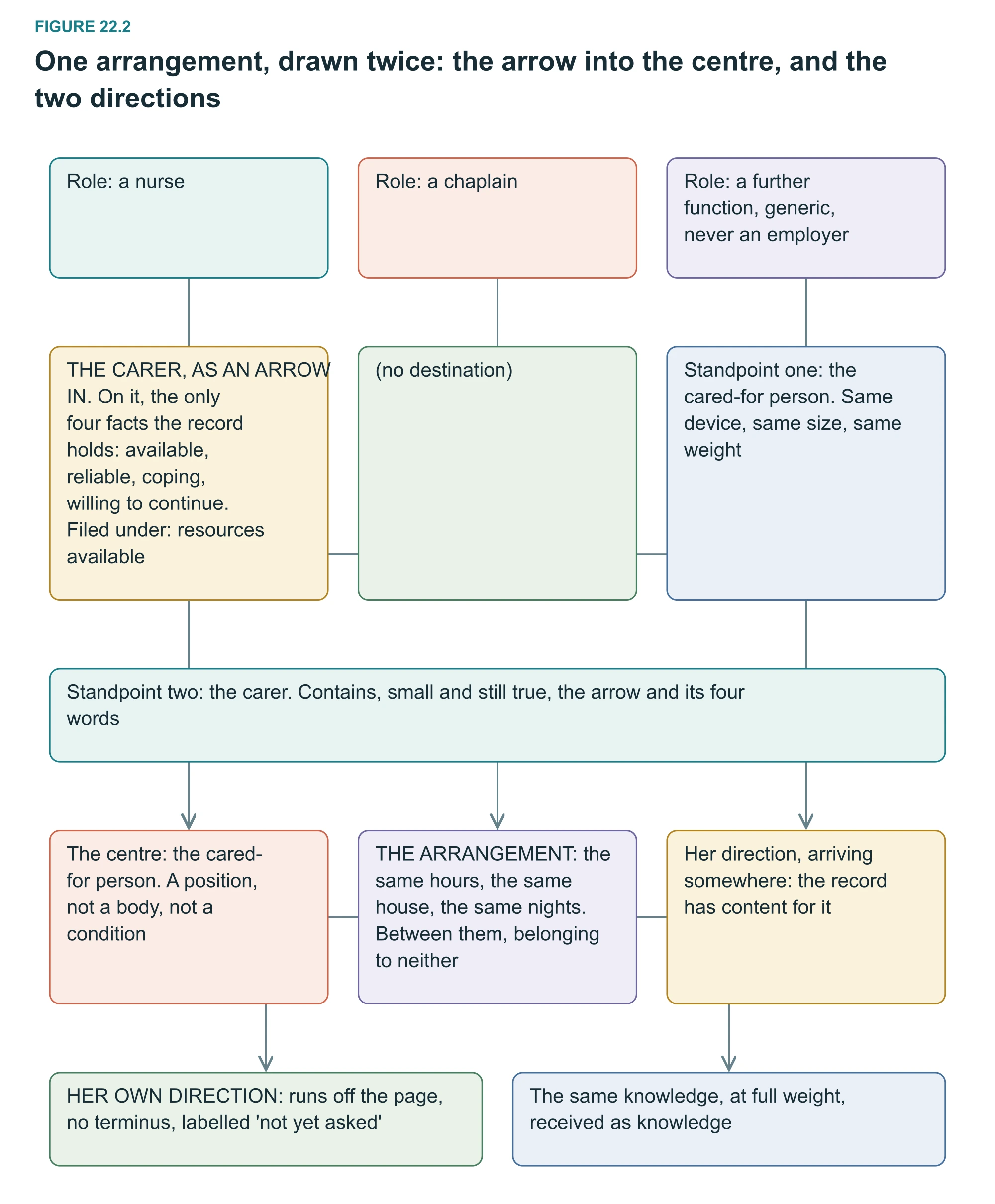
Figure 22.2. One arrangement, drawn twice: the arrow into the centre, and the two directions.
Figure 22.1, the drawing the chapter opens on, poses the chapter's tension and does not answer it; it is wordless, and it does not land on a vulnerable person. It shows a figure carrying another figure on their shoulders along a road, in the manner of the icon - and, walking beside them, a third figure who is offering something, holding it out, while the carrier has no hand free to take it. Nobody in the drawing is at fault. That is the chapter.
Table 22.1 is written to be lifted and used by a practitioner who has read nothing else in this chapter, and it must therefore be correct on its own: a reader who reads only the table should get something usable rather than a fragment that misleads. It follows here and is referred to again in §8.
Table 22.1 - The Carer's Four Questions: four questions that are about the carer, and the four that are not
The system's question | What it is really asking | The question that is about her | What an answer to it opens |
|---|---|---|---|
Are you managing? | Whether the arrangement will hold until the next review. It is answerable only yes, because no is heard as a request for the arrangement to end. | What is this year for, as you understand it? | Whether she has a direction she can state, and whether it is hers. A carer who cannot answer at all is the one to stay with. |
Do you need any support? | Whether a service should be offered, and whether its refusal can be recorded. | What do you know about him that nobody has asked you? | Her K3 and K4 knowledge, received as knowledge. This is usually the first time anyone has treated her expertise as expertise, and it is often where she begins to cry. |
How is your own health? | Whether the input is degrading. Screens for the damage and routes it to a pathway built for individual disorder. | What have you had to put down to do this? | What was set aside - work, study, a relationship, a practice, a faith she has not had time for - and whether she has ever been allowed to name it as a loss rather than as a choice. |
Have you thought about respite? | Whether admission can be avoided or placement delayed. Refusal is common and is usually read as denial. | Who is this arrangement fair to? | The distribution. It is the only one of the four that can be asked in front of the whole family, and it is the question that makes absent siblings visible without accusing them. |
How to use it. These are not a schedule and are not asked in one sitting; the last column, What an answer to it opens, is what to listen for, not what to extract. Ask one of the questions that are about her. The left-hand questions are not to be abandoned - somebody has to ask whether she is managing - but a caregiver who has asked only those has taken a reading of an input. The single most important line is the third. A carer who has never been permitted to name what she put down will describe it, when finally asked, as a choice she made freely, and will do so in a tone that does not match the words. That mismatch is the finding. Contraindications, set out in full at §7.2: do not ask the fourth question in front of the family unless the carer has agreed to it beforehand, in private, and do not ask the third at all if you will not be there again.
8. Applicability and cases
8.1 The situation
Nikhil was in his thirties. He had a degree from a university of applied sciences in Almere and a job he was good at, and for four years he had lived with his mother in the ground-floor flat she had moved into after the stroke.
The stroke had left Sarita with a weakness down one side and an expressive aphasia. She knew what she wanted to say. The words that arrived were not always the ones she had chosen, and the gap between the two was, for her, the daily fact of her life. Nikhil could close the gap. He had learned to hear the first syllable of an attempt and supply the rest, and to know from the way she stopped whether the word he had supplied was the right one or whether she was letting it stand because she was tired of correcting him. Nobody had taught him this and it was not written anywhere.
There were three children. One brother had died. Nikhil and a sister remained, and the sister worked, as the dead brother had worked. The record of this case, which runs to a little over three hundred words, disposes of the arrangement in a single clause: the rest of the family was too busy with their jobs. That clause is the entire account, in the only document that exists, of the one other living adult child of the same woman. And it is worth noticing what the clause does with her, because the grammar gives it away: the sentence is plural where the family is singular, the rest of the family and their jobs for one working sister. The people who are not carrying get recorded in the same undifferentiated way whether there is one of them or four, which is the same failure of counting this chapter has been describing from the other side. Nobody was counting the carer. Nobody was counting the non-carers either. Whether anyone had asked her, whether she had refused, what she believed was happening in the ground-floor flat - none of it was recorded, and this chapter does not invent it. The silence is itself the finding, and it is one a caregiver will meet again: the arrangement that everyone in a family can describe and nobody in it has ever discussed.
Nikhil had not begun a relationship. He did not go out. He had taken up a brahmacārī discipline - a life of celibate study and practice - and he had, once, taken his mother on a long-haul holiday to Malaysia, with the aphasia and the weakness and the wheelchair and the flight, because she had wanted to go.
The record has a heading for all of this. The heading is Opoffering: sacrifice.
8.2 The discernment
Hemant, the spiritual caregiver, had not been asked to see Nikhil about any of this. He had been asked to see him about his brother.
This is the first thing to notice and the chapter has been building toward it since §1. The referral was a bereavement referral. Nikhil had lost a brother and there was a route by which a person who has lost a brother can be seen, and he came down that route. His mother's care was not the reason for the appointment and had no route of its own. It surfaced, in the record's own words, during the guidance: bij begeleiding kwam naar voren. It emerged.
A carer had been in the system for years without being in it as a carer. The care system knew about Sarita, in detail. It knew nothing about the man who had organised his entire adult life around her, because there was no reason for it to know and no place for the knowledge. He became visible only when a different loss gave him a door, and he came through that door talking about his brother, which is what he had come to talk about.
So Hemant's first discernment was not about grief. It was about which of two losses was in the room. And the second, which is harder and which §2 predicted, was about what the record itself was doing. Every item under Opoffering is stated as an achievement. No relationship. No going out. Spiritual development instead. The grammar is the grammar of praise, and it is the grammar the family used, and the community, and very probably Nikhil himself. Nothing in three hundred words asks whether he had wanted any of it. The record does not describe a man who was asked and said yes. It describes a man about whom the question never arose - which is precisely the shape of the icon in §6, and it is worth being exact about the direction of the influence. Nobody sat Nikhil down and told him to be Śravaṇa Kumār. The story is not quoted at him anywhere in the record. It did not need to be. It was the available description of what he was doing, it was honourable, and it fitted, and a description that honourable and that available does not have to be imposed. It is simply the one that is there.
8.3 The Integrative move
Hemant did not challenge the sevā, and a caregiver who had read §6 badly would have. That is the contraindication §7.2 flags and it is worth stating why it would have been an error rather than merely a tactless move. The sevā was true. Nikhil's years with his mother were meaningful, they were his, and they were the most coherent thing in his life. To reframe them as oppression would have been to discard a perspective, which is the one thing the core definition forbids, and it would have taken from a tired man the only account of his life that made it bearable, in exchange for a better analysis.
The move was smaller and it went in the other direction. Hemant treated Nikhil as an observer of the context rather than as a feature of it - which meant, in practice, asking him questions of the kind Table 22.1's column The question that is about her contains, and then not doing anything with the answers except receiving them.
Three things came out of that, and only the third was a surprise.
The first was the knowledge. Asked what he knew about his mother that nobody had asked him, Nikhil talked for a long time, and what he described was the K3 and K4 of §4: the syllable, the tiredness behind a word left uncorrected, which silences were pain. He had held this for four years. It had gone into the record, when it went in at all, as son reports.
The second was what he had put down. He named it accurately and in the tone §7.6 warns about - as a series of free choices, in a voice that did not match. He had chosen not to have a relationship. He had chosen the brahmacārī discipline. Both were true and both were choices, and both had been made inside a set of options with one thing missing from it, and no one had ever said so out loud in his hearing.
The third was the holiday. Hemant had expected, and this is recorded as an expectation that was wrong, that the trip to Malaysia would turn out to be the clearest instance of the sacrifice - the enormous effort, the wheelchair, the flight, the impossibility of it. It was not. It was the thing Nikhil was proudest of and it was the one part of the four years that had been his idea. It was not something he had absorbed; it was something he had done. The distinction matters and it is the practical yield of §3's directional question: within a life that had been almost entirely allocated to him, there was one thing he had aimed at, and it turned out to be the load-bearing element of his whole account of himself. A burden instrument records that holiday as a peak of strain. It was the opposite.
8.4 What was done, and what was not
What was done is quickly told. Nikhil was seen, over some months, about his brother and then about himself. He was asked about his mother by someone who wanted the answer for its own sake. He was given a place to say what he had put down. The sevā was left standing and the āśrama point of §6 was made once - that a man in his thirties who has not established a household is not in the stage the pattern describes, and that this is a distortion of the pattern and not the pattern - which is the kind of thing that does nothing on the day and matters two years later.
What was not done is the more important half and this chapter will not smooth it over. No respite was arranged. None is mentioned anywhere in the record. The distribution was never addressed. The fourth question of Table 22.1 - who is this arrangement fair to - was not asked, the sister was not approached, and the clause about the family being too busy with their jobs stands unexamined in the only account that exists. Nothing was done about the hours.
And the arrangement ended. It ended because Sarita died.
The record's final section is headed Toekomstperspectief, future perspective, and it is a happy ending: after his mother's death Nikhil met someone in a bhakti community, became engaged, and hoped to marry the following year. It is a happy ending and it should be read as one; there is no reason to doubt that his life afterwards was good. But the mechanism of the resolution is a bereavement. His own life became available at the moment his mother's ended, and this is the second asymmetry of the Part opener - the family carer whose only exit is the death of the person they love - appearing not as an argument but as the plain shape of a case. Nobody in this record engineers Nikhil's release. Nobody could have engineered it under the arrangement as it stood, because no part of the system had him on a list.
8.5 Reflection
Two points about the evidence, and both are constrained.
Black et al. (2013), graded at §5, is the closest thing this chapter has to a controlled demonstration, and what it demonstrates fits Nikhil's case exactly - including its limits. Twelve minutes a day, at a fixed hour, sustained for eight weeks, changed something measurable in the bodies of family dementia carers whose hours of care did not change at all. That is what was available to Nikhil and it is not nothing; a practice that works inside an unchanged situation is precisely what a carer in an unchanged situation needs. It is also, exactly, not a change in the situation, and a service that offers only such practices to a population in Nikhil's position has offered a real good in place of an obligation.
On gender, the chapter must be careful and this is the place to be careful. Nikhil is a man, and the anchor case of a chapter that argues the work falls disproportionately to women is a case in which it fell to a son. That is not an embarrassment and it is not a counter-example to be explained away; it is a reminder that the claim is distributional and that distributions have people in them who go the other way. The claim rests on the gender-and-care evidence read at §5.4, and that evidence has a shape worth restating here because it is the shape of this case. Women have 1.60 times the odds of being an intensive carer across twenty European countries (Verbakel et al. 2017), and yet once a man and a woman are both doing the work, the measured difference in what they report is small, inconsistent and of doubtful practical significance across a meta-analysis of 229 studies (Sharma, Chakrabarti and Grover 2016). The allocation is gendered and the experience, so far as any instrument has been able to show, is much less so. Which is exactly what this case shows. The mechanism this chapter describes - the honourable description that is simply the one available, and that nobody has to impose - operated on Nikhil, a son, with the full force the literature attributes to it in daughters. The mechanism is not gendered. Its incidence is. A daughter in Nikhil's position would have been more likely to be there and would not have been having a different experience, and a chapter that argued the second thing on the strength of the first would have overreached where it did not need to.
8.6 The transferable principle
A family carer will almost never present as one. They present as a bereaved brother, as a relative asking about someone else's medication, as a person who wants to know whether the discharge date can be moved. The care they are given is care for the thing they presented with, and it is competent, and it is complete on its own terms, and it ends. The carer's own situation surfaces incidentally inside it or it does not surface at all.
What follows for practice is a single instruction and it is the chapter's contribution. When a relative is in front of you for any reason whatever, ask one question that is about them. Not a screening question; those are in the left-hand column of Table 22.1 and they are already being asked by somebody. One of the four under The question that is about her, or one like it. The whole of the offer this chapter has to make to a family carer who has not asked for anything can be carried in a single question, asked by whoever happens to have them in the room, and the reason it works is that it does not require the carer to have identified themselves as a carer first - which they will not do, because they do not think of themselves as one. They think of themselves as a son.
And it must be asked in a way that does not imply they are failing, which is the second half of the instruction and the harder half. The four questions under The question that is about her are drafted to make this possible: not one of them can be answered in a way that reveals inadequacy, because not one of them is about performance. What is this year for, as you understand it cannot be failed. That is not a stylistic nicety. It is the reason a carer who has refused every service in the borough will answer it.
8.7 What an artificial or agentic caregiver could carry here
Every chapter of the case Part closes by asking this, and the question belongs here too, because the family carer is the population that care technology addresses most often and understands least well.
What a machine can carry for a carer is real and should not be sneered at. It can hold the medication schedule. It can answer at three in the morning. It can notice a fall. It can remember what was said at the last appointment, which the carer, who has not slept, cannot. Every one of these is task-shaped, and the tasks are genuinely a part of what is crushing.
What it cannot carry is the position, and the position is what §§2 to 4 identified as the injury. A device on the landing does not change that the role was never chosen, does not change that the only door out is a death, and does not put the carer on anybody's list - it puts a sensor on a list, reporting to a service whose client is the person being monitored and not the person doing the monitoring. Worse, it is exactly the offer with the clearest business case: a system that makes the hours survivable makes the carer available for more of them, and relieves the symptom that was recruiting attention to the problem. Nikhil's arrangement, equipped with every device now on the market, would have been a better-instrumented version of the same arrangement, and it would have ended the same way.
The one thing in this chapter that a machine could conceivably carry is the third question of Table 22.1, and it is worth being precise about why it could not. A system could certainly ask what have you had to put down to do this. It could ask it more reliably than a busy ward, and at a better hour. What it could not do is be the thing that receives the answer - and §7.6's note on that question is that the finding is not the content of the answer but the mismatch between the words and the tone in which they are said. Detecting the mismatch is, in principle, a signal-processing problem. Having it matter that somebody noticed is not.
Notes
1. The English labels of the 4H diagnostic at §2 and the K1-K4 level labels at §4 - informational, skilful, contextual and realisational knowing - are the author's (Chapter 4). The Sanskrit terms are used alongside them, as elsewhere in this book.
2. The anchor case is Case 016 of the practitioner archive, read at first hand in the Dutch original for this chapter. All names, the institution, the city and the holiday destination are altered; the mapping is held outside the manuscript and is never published. The man's name in the archive record is the icon's own name used as a label rather than as a personal name, and the substitution made here is not only an anonymisation: retaining it would have made §6's argument unstateable, since a reader could not have distinguished the man from the story he was being read through.
3. The archive record is a little over three hundred words and closes, after a horizontal rule, with two scriptural passages - a verse from the Ayodhyā Kāṇḍa of the Rāmāyaṇa on the mother and the motherland being greater than heaven, and Bhagavad Gītā 2.22 on the soul exchanging worn garments for new ones - framed in the second person and addressed to mourners. They read as funeral-address material, composed for Sarita's death. This chapter uses them as evidence of the frame the case was read within and does not present them as its analysis.
4. Black, D. S., Cole, S. W., Irwin, M. R., Breen, E., St. Cyr, N. M., Nazarian, N., Khalsa, D. S. and Lavretsky, H. Graded [review/trial] at §5 and used within its warrant at §8.5. Baseline hours of care, the sample's sex composition and the exclusion criteria are all from the paper's own participants section and Table 1.
5. Six of the seven studies engaged at §5 are listed here; the seventh, Black et al. (2013), has Note 4 to itself. Two provenance qualifications are stated in the prose and repeated here. Pearlin, Mullan, Semple and Skaff (1990) could not be retrieved and was not read; §5.2 describes the stress-process model only as Swinkels et al. and Blin et al. reproduce and quote it, and no page-level claim is made on Pearlin's authority. Zarit, Reever and Bach-Peterson (1980) was likewise not read at first hand; the account of the instrument at §5.1 follows Boluarte-Carbajal et al. and Swinkels et al. Sharma et al. (2016) is written and universally cited as a narrative review and is classified by its own journal as an editorial, which is why it is graded [commentary] and used for the deflationary claim rather than for any estimate.
6. Further reading on caregiver burden includes the concept analysis by Liu, Heffernan and Tan in the International Journal of Nursing Sciences and Li et al. (2025) on primary and secondary stressors in Health and Social Care in the Community. Neither work is used as evidence in this chapter.
7. Owed in this chapter and named rather than left to be discovered. The distance-carer material at §7.4 is the thinnest thing in the chapter and is flagged as such in its own opening sentence: the anchor case contains one absent sibling and not one word about her. Both are men in custody, both records are under two hundred words, and neither is read here beyond what it says. A distance carer read outside a wall is still owed, and until one is found the section should not be strengthened by writing what such a carer would have said.
CHAPTER 23