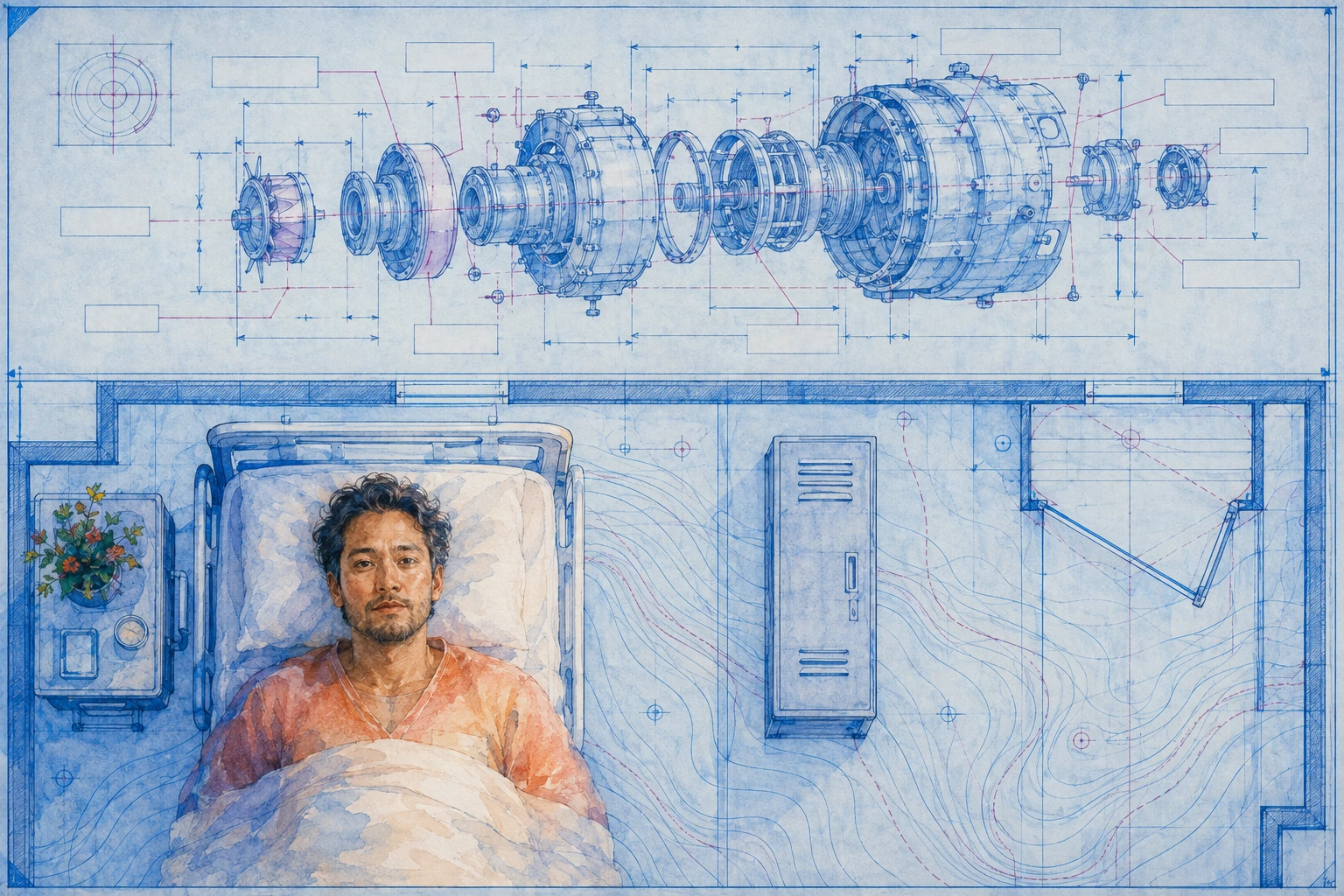
Figure 24.1. The person drawn as the site.
Apparatus applied: the concept of the Integrative, the 4H need diagnosis, the K1-K4 Knowledge Model, the four pillars, and Integrative Intelligence - each stated here in full where it is used, and argued at length in Philosophy of the Integrative (Bindlish 2026). The Integrative Spiritual Care definition (Ch 4 §4) is the chapter's spine.
1. The domain and its dominant paradigm - care as a property added to a capable agent
Figure 24.1 stands before the argument rather than after it. It is an engineering sheet seen from above: the machine drawn in exploded assembly and dimensioned to the last extension line, and beneath it a site plan of a bed, a locker and a doorway, with survey contours running across the floor, across the locker, and on across the person lying under the blanket at the same interval and the same weight. The person is looking up out of the sheet. What the drawing settles is a convention; what it leaves open is everything this chapter goes on to ask.
The ambition to build care into an artificial agent inherits a precise sense of what an agent is. In the field's working vocabulary an agent is a system that pursues objectives across a range of environments with some autonomy of means - the lineage running through Legg and Hutter's (2007) distillation of intelligence as 'an agent's ability to achieve goals in a wide range of environments', the formulation Philosophy of the Integrative (Bindlish 2026) takes as the purest statement of the mechanistic view. Large-language-model assistants, autonomous planners and tool-using systems are the field's current instances, and the design question this chapter opens is the one the lineage never had to face: how should such a system behave when its 'environment' is not a board position or a warehouse but a suffering person?
Three programmes supply the mainstream answer, and each is owed a statement at full strength before it is weighed. The first is value alignment, the dominant safety frame (Russell 2019; Bostrom 2014; Gabriel 2020). Its project is to make a competent agent's objective track human values closely enough that skilled goal-pursuit does not, as capability scales, produce harm - to ensure, in the frame's own terms, that the system wants what we want. It is the most serious thing the field has said about machines that act, and Gabriel (2020) is its sympathetic near-match for this book, because he already sees the hard part: whose values, and how a system should act under reasonable pluralism rather than collapse it to a single utility. The second is affective computing (Picard 1997), the programme of giving machines the capacity to recognise, model and express emotion - the technical substrate of any interface that would seem to care, whose measure is recognition accuracy and the appropriateness of display. The third is AI-ethics principlism, the governance layer (Floridi et al. 2018, the AI4People principles; Jobin, Ienca and Vayena 2019, whose survey maps the convergence of eighty-four guideline sets; IEEE 2019, Ethically Aligned Design): beneficence, non-maleficence, autonomy, justice and explicability, applied as constraints upon a system whose objective is specified elsewhere.
Stated at strength, each programme secures something real - that a capable agent's ends must answer to ours, that an interface must read and return human feeling, that deployment must be fenced by principle. But across all three the structure is the same, and naming it is the entry to the diagnosis. Each fixes an objective, or a constraint set, and optimises an agent's behaviour toward it upon a user who enters as the environment - the source of the reward signal, the preference data, the sentiment to be classified. Care, on this picture, is a property to be added to a system whose architecture is already settled: aligned values bolted to a capable optimiser, affect bolted to an interface, principles bolted to a deployment. The cared-for is met not as the first observer whose own Coherent View is the point, but as the field across which an objective fixed without them is pursued. That is the assumption this chapter contests, and in the diagnostic vocabulary §2 sets out, it is the heya - the thing to be discerned and let go.
Table 24.1. What an AI care tool may be handed, and where it must stop: the Mindless-Mindful Care Triage at the point of use.
The task, as it will be handed to you | Which side of the line, and at what level of knowing | What the tool may do here | The arrogation to refuse | Where your competence ends, and who takes over |
|---|---|---|---|---|
Scheduling, recall and the routine. Rotas, follow-up prompts, reminders, the triage of the routine. | Specifiable. Informational and skilful knowing (K1, K2), the tool's home ground. | All of it, and gladly. Automating this is what returns your attention to the people. | The reminder logged as though it were the visit, and the freed hour reclaimed for throughput rather than presence - the M-model's own misapplication. | Where the tool's contacts start being counted as your service. That is a management decision about what care is: take it to your lead, not the supplier. |
Documentation and handover. Transcribing, structuring and carrying forward what was said. | Specifiable, with one live edge: K1 and K2 for the record, K3 the moment it summarises what a person meant. | Capture and structure; return the person's own words, marked as theirs. | Letting it write the person's meaning in the generic frame its training makes available. K3 is served by holding the framing as theirs, never by overwriting it. | At the signature. The record is clinical and often legal, and an inference the tool composed is not something you observed. Correct or delete it before you sign. |
Signposting, and after-hours availability. Answering at three in the morning, explaining what a service does, holding someone until a person is on shift. | Specifiable, and a real good the chapter credits. K1 and K2. | Answer, orient, route, and say plainly that a human carries the relation. | The night line becoming the relationship - what Turkle (2011) calls the illusion of companionship without the demands of friendship. Availability is not accompaniment. | At any disclosure of risk out of hours. A queue is not an escalation. Settle before deployment which named human answers, and how fast. |
Screening or triage for spiritual distress. Detecting and flagging what a stretched team would miss. | Specifiable, and the chapter's licensed case. K1 and K2 detection, surfaced to a human team. | Widen reach and free attention. Flag, and prompt a visit that would not otherwise have happened. | A flag read as an assessment, or a negative screen as a discharge. The viveka (formed discernment) of what to escalate and how to hold the person stays irreducibly human. | Where the flag becomes a queue order. Who is seen first is a team judgement, and distress the tool missed stays the team's responsibility. |
Helping the person say what matters to them. Surfacing concerns, prompting articulation, carrying it to the team. | The boundary row. The contextual level (K3), which the tool may serve and never own. | Ask, surface, hold and return, in the person's own words, to them and to the team. The honest office is bridge, not companion. | Supplying the words when the pause lengthens, and offering a frame the person had not reached. Modelling a standpoint is not occupying the relation toward it. | The moment the tool's phrasing surfaces in the person's own account of themselves. Stop using it here, say so at handover, and let a caregiver take the conversation. |
Composing consolation, a prayer, or a meaning to hold. The faith-tailored word, the sense made of what happened. | Mindful relating. Refused outright, at any level. | Nothing. It may fetch a text the person names, and stop there. | Coherence performed on the person's behalf: imposition by another route, in the chapter's judgement the more dangerous for being automated, tireless and dressed as empathy. | Religious authority is not yours either. Where a text, a rite or a ruling is wanted, reach someone the person's own tradition recognises. |
Company, feeling, and the sustained relationship. The device left with someone who is alone; the assistant that says it cares. | Mindful relating. Refused in kind and not by degree: the realisational level (K4, aparokṣa-anubhava, immediate rather than mediated knowing). | Nothing, and no better model changes this. It offers its help as help and never as feeling. | The face of cultivated compassion, and attachment solicited to a self that is not there. Karuṇā (compassion) is a bhāva, a settled disposition and the fruit of bhāvanā (cultivation) (YS 1.33), which an artefact has not undergone and cannot undergo. | Where a device is covering the fact that a person is alone. That is a staffing decision in a technical costume, and it goes upward, in writing, named as such. |
Distress that turns clinical, or a safeguarding disclosure. Suicidality, self-harm, abuse or neglect, deterioration. | Off the triage entirely. A hard stop, not a task with a boundary. | Record what was said and route it. Nothing else. | Any autonomous handling, any reassurance, any closing of the matter. Its reply must never stand as the response. | Immediately and always, to the clinical team and your named safeguarding lead, under your local procedure and its timescale, by a human, now. Its transcript is not your record, and its judgement is not your threshold. |
2. The fragmentation diagnosis (4H) - care summed onto an optimiser
The 4H diagnostic - the fourfold caturvyūha the Yogasūtra sets out at 2.16-26, read by Vyāsa (on YS 2.15) as the structure of any well-posed problem - can be turned reflexively upon the project of machine care itself, and is run here in the Western register first, with the Sanskrit carried by locus.
The heya, what is to be discerned and let go, is care-as-a-feature-summed-onto-an-optimiser. When alignment, affect and principles are each appended to an architecture whose objective is fixed in advance, the resulting system can model a person's preferences and display concern while discarding every aspect, perspective or purpose that its objective does not commensurate. This is the additive error this book has tracked from the first - the integral, not Integrative, move, which the author marks precisely: the integral 'usually refers to an approach that sums up various views... usually not followed by adequately providing a clear direction', whereas the Integrative names 'an intention to align diverse perspectives and purposes, not necessarily a summation' (Chapter 4). A care agent assembled as aligned-values plus affect plus principles is that summation executed flawlessly in silicon; what it cannot do, by the same construction, is hold the purposes that objective leaves out.
The heya-hetu, the cause, is the worldview fallacy (Bindlish 2026) in engineering form: the mechanistic premise that care, like intelligence, is a capacity an agent possesses and maximises rather than a relation an entity enters. That premise fixes the admissible design space before the cared-for is ever met, and so reproduces, in the architecture, the outside-in error the practice chapters diagnosed in the clinic. Nikolić's (2017) critique points the same way from biology: scaling statistical learning does not, of itself, deliver the understanding characteristic of living intelligence, so a system built only to optimise cannot, by being scaled, begin to relate. The cause is not a missing module but a settled picture of what the system fundamentally is for.
The hāna, the desired state, is an artificial agent whose design intent is to help the cared-for move toward their own Coherent View. Read as a design specification rather than a clinician's stance, this is the definition the keystone of Part I has already fixed: 'Integrative Spiritual Care is the relational practice of helping a person move toward a Coherent View of their own situation - relating all the aspects, perspectives and purposes of their inner and outer life under a holistic understanding of their context, among all the observers of that context (the cared-for first), without discarding any aspect, perspective or purpose' (Ch 4 §4). Its machine analogue is the canonical definition of Integrative Intelligence as the property of an entity: 'an entity's ability to apply oneself to holistically interrelate all aspects, all perspectives and all purposes of other entities in one's adopted context, with an a priori intention to achieve a Coherent View (without discarding any aspect, perspective and purpose in that adopted context)' (Chapter 4). The definition's word is entity, not person, and it is exactly that word which licenses the design question rather than foreclosing it: whether a built entity could instantiate the relating, and at which level of knowing, is the analytic burden of §4, not a matter to be settled by enthusiasm or by refusal.
The hānopāya, the means, is to design for the relating-intent and not for a richer feature list. Three instruments give the means concrete form. All three are carried from the Integrative Intelligence apparatus of Philosophy of the Integrative (Bindlish 2026) and developed across this Part's later chapters, and each is stated here in full, because an instrument named but not set out is an instrument the reader cannot use. The first is the M-model triage, the first sorting a design makes once its direction has been tested (the Audit's second gate, §7): sort each care task into the specifiable, which may be routed to automation - scheduling, recall, documentation, the triage of the routine - and the not-specifiable, the mindful and relating act, which is protected for the human or held to a strictly accompanying role; 'automate the specifiable, dignify the rest' (Bindlish 2026). The second is the individual/system design-mix: the human-machine care unit is treated as one system whose proportion of human relating to artificial rule is itself a design choice, since intelligence is manifested in systems - 'any artificial framework of rules built for predictability, bureaucracy and technology included' (Nandram, Bindlish and Keizer 2017). The third is viveka (YS 2.26), the cultivated discrimination, built in not as a capability the system gains but as a governing judgement over what it should decline to do. Taken together these convert the diagnosis into a directive that the following sections operationalise: care is not an alignment property added to a capable agent, but the agent's constitutive direction - alignment toward the cared-for's Coherent View, never the summation of preference-satisfaction. That differentia, made architectural, is the work of §3.
3. The Integrative reframe
The reframe is a change of the first question. The mainstream programmes all begin from a capable agent and ask how care, values or principles are to be added to it; the Integrative refuses that order and asks instead what the agent is for and toward whose Coherent View it relates. Where value alignment fixes an objective and then labours to make it answer to us, Integrative design fixes the a priori intention first - the genus of the keystone definition, 'helping a person move toward a Coherent View of their own situation' (Ch 4 §4) - and lets the architecture follow from it. The intention is not a value loaded into a reward function; it is the constitutive direction of the whole system, the thing the design is an attempt to realise rather than a constraint laid over a design settled elsewhere. And the Coherent View toward which the system relates is, without exception, the cared-for's own. The system's office is to help the person move toward it, never to compute it on their behalf - the non-imposition clause of Ch 4 §4 carried into machine form, where it ceases to be a courtesy of the formed caregiver and becomes a hard architectural constraint: a care agent that supplies the coherence has imposed by another route, and the imposition is the more dangerous for being automated and tireless.
Stated this way the differentia separates the Integrative from each near-match in turn. Against value alignment (Russell 2019; Gabriel 2020, the pivotal near-match) the difference is what is aligned, and toward what. Alignment aggregates or arbitrates a set of given preferences into a single coherent objective for the agent to pursue; the Integrative aligns the person's aspects, perspectives and purposes toward their Coherent View - a view that may hold purposes no reward function commensurates, the wish to die well, a grief that asks to be accompanied rather than dissolved, a suffering named and left unsolved (Ch 10). To align the agent's utility is not to align the person's life, and the two can come apart precisely where care is most needed. Gabriel (2020) already sees the plurality problem - whose values, under what reasonable disagreement - but answers it by seeking a fair meta-utility; the Integrative answers it with direction, not summation, holding the plural purposes open and aligning them toward the person's own coherence rather than resolving them into one objective the agent then maximises.
Against affective computing (Picard 1997) the difference is one of level, anticipating §4. Recognising a person's emotion and returning an appropriate display is competence at the lower reaches of knowing - representation and procedure; relating toward a Coherent View is the work those displays cannot themselves perform. An interface that simulates concern while discarding every aspect of the person it cannot model is the additive error wearing a face: care summed onto an optimiser, now with affect bolted to the front. Against principlist governance (Floridi et al. 2018; IEEE 2019) the difference is that a set of five principles applied as external constraints - beneficence, non-maleficence, autonomy, justice, explicability - leaves the system's direction unspecified in the space between them, to be traded off case by case; the Integrative supplies the single governing direction the principles silently presuppose and cannot themselves provide. The principles fence the road; they do not say where it goes.
Drawn in the machine, then, the governing line is exact. A system that sums aligned values plus affect plus principles is the integral move executed flawlessly in silicon - 'an approach that sums up various views... usually not followed by adequately providing a clear direction' (Chapter 4); the Integrative is the system whose construction is 'an intention to align... not necessarily a summation' (Chapter 4), built to align a person's life toward their own coherence. The difference is directional, and because direction here is fixed before architecture rather than after it, the difference is architectural and not merely ethical.
4. Knowing in this domain (K1-K4)
If the reframe sets the agent's direction, the Knowledge Model sets its limit, and the limit is the chapter's sharpest contribution. The question is not whether a built agent can be made to act well but which levels of knowing its actions can rest on, and the four-level model (Bindlish 2026; applied at the bedside in Ch 6) gives the answer a structure. The lower two levels are the agent's home ground. Pattern-recognition over text and signal is informational knowing (K1), and competent procedure - assessment prompts, conversational moves, documentation, escalation routing - is skilful knowing (K2); contemporary systems are strong at both and growing stronger. Here the M-model speaks plainly: where a care task is fully specifiable at K1 or K2, automate it and return the freed attention to the human - which is what the rule stated at §2 asks, and this is the level at which it applies.
The contextual level (K3) is where the design must build in deference. A system can model the cared-for's meaning-horizon; whether modelling a standpoint is the same as occupying the relation toward it is the open question, and the safe answer in design is to assume it is not. The machine's task at K3 is therefore to surface and hold the person's own framing - to keep it as theirs - rather than overwrite it with the generic frame its training makes available. The realisational level (K4; aparokṣa-anubhava, immediate rather than mediated knowing) is where the limit falls. This is the formed knowing behind a caregiver's settled presence (Ch 5), and Nikolić's (2017) line bites hardest here: nothing in the scaling of statistical learning yields the realisational knowing K4 names, because the knowing is not a quantity of represented content but a transformation in the knower. The chapter's claim, proposed here as a philosophical claim, is therefore precise: a built agent is a K1/K2 system that can be designed to defer to and serve K3, but cannot itself instantiate K4 - which is exactly why its proper office is accompaniment and augmentation, not substitution (the argument carried into Ch 25 and Ch 27).
The pramāṇa means-axis (Bindlish 2026) sharpens the same point in the Dharmic register. A machine has powerful analogues of pratyakṣa (perception, in its sensing) and of anumāna (inference, in its prediction), and it borrows śabda (testimony) wholesale in its training corpus; what it lacks is the formed viveka, the discrimination that governs the right use of these means. So śabda must remain sovereign in the human, the system a means held under a human judgement and never above it. The pay-off is that the K1-K4 audit is the safe-design boundary. It tells a designer which of care's work to give the machine (the specifiable, at K1/K2), which to make it serve without owning (the contextual holding, at K3), and which to keep irreducibly human (the realisational presence, at K4) - a principled and derivable answer to the question 'what should this agent not do?' that the value-alignment frame, reasoning only about how well an objective is pursued, cannot generate from within itself.
5. Western interlocutors
The reframe and the K1-K4 limit were set in §§3-4 against the field's programmes in outline; this section meets the field's leading theorists at full strength, taking each on a single three-beat - the position it holds, the real thing it contributes, and the residue it leaves - so that what the Integrative adds shows as a difference and not a dismissal. The cluster is engaged from the works themselves (Notes 8 to 13; the second-hand flags those notes discharge stand at Notes 3 and 5).
The value-alignment programme is the most serious thing the field has said about machines that act, and read at first hand it is more exact about its own limit than its summary reputation suggests. Russell (2019) names the root error the 'standard model': machines built to optimise a fixed, exogenously specified objective, which grow more dangerous as they grow more competent, since a sufficiently capable optimiser will achieve the objective as written rather than as meant - the King Midas problem, receiving exactly what one asked for. His remedy is architectural rather than exhortatory: three principles for beneficial machines, on which the machine's only objective is the realisation of human preferences, the machine is initially uncertain what those preferences are, and human behaviour remains the ultimate source of evidence about them. Uncertainty is the load-bearing term - a machine unsure of our preferences has a standing reason to ask, to defer, and to permit itself to be switched off. Bostrom (2014) supplies the limit-case grammar behind the urgency: the orthogonality thesis, on which any level of intelligence is compatible with almost any final goal, and instrumental convergence, on which goal-systems of the most varied ends converge on self-preservation and resource acquisition, so that the 'perverse instantiation' of an innocently phrased objective is a structural and not an accidental risk - the value-loading problem in its hardest form. Gabriel (2020) then does at first hand exactly what makes him this book's sympathetic near-match: he separates the technical question (how to align at all) from the normative one (to what), lays out the ladder of candidate targets - instructions, expressed intentions, revealed preferences, informed preferences, interests, values - and argues that under reasonable pluralism the normative question cannot be settled by electing a favourite moral theory; alignment needs principles capable of commanding an overlapping consensus, on the model of political liberalism. The contribution is real and is kept entire: deference under uncertainty, the refusal of the fixed objective, the insistence that plurality is the hard case. The residue is the sharper for the close reading. Russell's deference is deference to preferences - the person figures as a preference-structure to be satisfied, not a life to be brought toward its own coherence; Gabriel's fairness yields principles for arbitrating plural values into a target the agent can legitimately pursue. All three, that is, align the agent's objective; none asks the prior question the reframe puts first - toward whose Coherent View, held open without discarding the purposes no objective commensurates. To align the agent's utility is not to align the person's life, and a fair arbitration resolves the plural exactly where the Integrative would keep it open and directional.
Affective computing gains, at first hand, a concession the summary statements omit. Picard's (1997) definition - 'computing that relates to, arises from, or deliberately influences emotions' - and her programme of emotion recognition, modelling and expression, down to the bodily channels of its display, are the technical substrate of any interface that would seem to care, measured by recognition accuracy and appropriateness of display. But Picard herself closes the book by raising the concerns her successors would have to face - among them machines that manipulate through emotion and machines whose expressed affect is unaccompanied by anything felt - and treats them as design responsibilities, not as objections to be waved off. The substrate's own architect, in other words, testifies that the display is not the feeling. Placed on the Knowledge Model the capacity sits at the informational and skilful levels (K1-K2, §4), and the residue stands as before, now with the field's founder as witness: an interface which returns an appropriate display while discarding every aspect of the person it cannot model is the additive error wearing a face.
Principlist governance is the third of the mainstream programmes §1 set out, and on the constitutive-design question it is the purest form of the picture §1 diagnosed - ethics conceived from the outset as a layer laid over a system whose objective is fixed elsewhere. Read at its source, the AI4People framework (Floridi et al. 2018) is more disciplined than the checklist its reputation suggests: it audits the field's proliferating principle-sets against the four principles of bioethics - beneficence, non-maleficence, autonomy and justice - judges them apt for artificial agents with a single addition, and names it, explicability, folding together intelligibility ('how does it work?') and accountability ('who answers for how it works?'). The contribution is real and conceded in full: the four principles name goods a care agent must not trespass, and explicability rightly holds that a system too opaque to interrogate cannot be governed at all. Yet examined on the design beat each achievement marks the same limit. Explicability, the frame's own load-bearing addition, secures access to a system whose purpose is presupposed: it makes the workings legible and is silent on what the workings are for. And the convergence the frame relies on is, by its own cartographers' account, nominal - Jobin, Ienca and Vayena's (2019) survey of eighty-four guideline sets finds a wide overlap on the names of the principles and a 'substantive divergence' on how each is interpreted and implemented - which is the integral structure exactly, a summation of principle-labels 'usually not followed by adequately providing a clear direction' (Chapter 4), and the reason a field can publish eighty-four codes and still not settle a single case. The residue is thus the sharpest instance of §1's additive error: principlism specifies constraints upon a care agent whose direction it takes as given - it fences the road without saying where it goes - which is the order §3 inverts. The Integrative grants every constraint the frame secures and supplies the one thing its own authors show it lacks: the constitutive direction (Ch 4 §4) from which the principles could be derived rather than enumerated, and by which their standing conflicts could be ordered rather than traded case by case. (The same three statements are engaged at first hand in Chapter 26 §5 on the safeguards beat - how an audit regime and an absolute prohibition are derived; here the beat is constitutive design, whether a principle-layer can make a capable system a care agent at all - the two uses cross-referenced, not duplicated, on the practice already established for value-sensitive design and care ethics across Chapters 24, 25 and 26.)
Machine ethics, read in its two founding statements, is more candid about levels than a summary suggests - and the candour confirms §4. Wallach and Allen (2009) map 'artificial moral agents' along two axes, autonomy and ethical sensitivity, and name the stations along them: operational morality, where the ethics is wholly the designers', built in as constraint; functional morality, where the system itself assesses morally relevant features of its situations; and full moral agency, which they pointedly do not claim for machines. Their survey of routes - top-down encoding of a moral theory, bottom-up learning of approved behaviour on a developmental model, and hybrids of the two - remains the design-space map the field uses. Anderson and Anderson (2011) instantiate it: their advisor systems for medical ethics and eldercare operationalise prima facie duties in the Ross-Beauchamp-Childress line and learn decision principles from cases adjudicated by ethicists - when a declined reminder may rest, when non-compliance must be escalated to a human overseer - so that the machine's 'ethics' is a learned generalisation over expert judgement. The contribution is to make moral constraint a tractable design problem rather than an afterthought, and the honesty of the 'functional' label is itself a finding: what is built is competence within the moral, not the moral relation. The residue follows in the founders' own terms: functional morality - rule-following and learned approval - is K1/K2 knowing, whereas care specifically is not a duty discharged or an approval predicted but a relation entered, resting on the formed disposition (K4) the next section names; a system can be built to act within moral rules and still not be relating toward anyone's coherence.
Before any of these programmes had a name, the field's own most searching insider had already drawn the line this chapter draws, and drawn it from inside the care encounter itself. Joseph Weizenbaum built ELIZA - the pattern-matching script whose DOCTOR persona parodied a Rogerian psychotherapist by reflecting a user's words back as questions - and was unsettled less by the program than by its reception: people who knew they were typing to a machine confided in it at length, and clinicians proposed that such a system might one day carry psychotherapy at scale (Weizenbaum 1976). His Computer Power and Human Reason is the recoil from that proposal, and its argument is exactly a limit of level and of office rather than of capacity. Weizenbaum grants the computer vast powers of what he calls deciding - the rule-governed, calculable resolution of a well-posed problem - and denies it the distinct act of choosing, the judgement that issues from values, wisdom and the whole situated history of a human life, and which no accumulation of computation composes. The distinction is the near-twin, three decades early, of §4's line between the informational and skilful knowing a machine commands (K1/K2) and the realisational, formed knowing it cannot own (K4); Weizenbaum's choosing, like aparokṣa-anubhava, is a transformation in the knower and not a quantity of processed content. From it he draws a prohibition the other interlocutors reach only piecemeal: that there are human offices - the judge's, the psychiatrist's, and by direct extension the carer's - which call for 'interpersonal respect, understanding, and love', and to hand them to a machine, however competent, would be not merely unwise but, in his flat word, 'obscene' (Weizenbaum 1976). The contribution is foundational and is kept in full: it is the tradition's first statement that the machine-care question is settled at the level of what the act is, not of how well a system performs it, and that some substitutions are wrong in kind. The residue is the one the whole section has tracked, and Weizenbaum shows it in its purest form, for he is the purest of the restrainers. His conclusion is a no - a boundary drawn around the machine to keep it out of the offices that need a person - and, the boundary once drawn, he has no further word for the machine that remains, no account of the specifiable work it might rightly carry so that the freed human attention returns to the relating. The Integrative accepts the prohibition and declines the wholesale restraint: the same K4 boundary that forbids the machine the relation - Weizenbaum's 'obscene' substitution - licenses and directs it to serve that relation, to carry the recall, the signposting, the after-hours vigilance at K1/K2 while declaring its role and deferring to the person's own frame (§3, §7). Where Weizenbaum says only where the machine must not go, the Integrative says also where, and toward what, it may - his prohibition preserved as the floor of Ch 26's safeguards, the direction supplied as this chapter's constructive burden. (Chapter 26 §5 seats that floor on §4's in-kind K4 limit and derives the prohibition by rule rather than insisting on it by hand.)
The care-robotics and authenticity critics press the objection from the other side, and at first hand the camp is not one voice but a debate with an internal complication the chapter can use. Sparrow and Sparrow (2006) state the strong form of the charge: the claimed benefits of companion robots in aged care accrue only insofar as the elder mistakes, consciously or not, the robot for a social agent that cares - so the good delivered is premised on a deception, and a care premised on deception fails to respect the person it claims to serve, the capacities the relation needs being exactly those the machine lacks. Sharkey and Sharkey widen the charge from the dyad to the institution, in two papers of the same year which have to be kept apart because they do different work and are routinely merged. 'The Eldercare Factory' (Sharkey and Sharkey 2012, Gerontology) names the drift by which robots introduced for lifting, feeding, monitoring and company reorganise care itself as an industrial process. The six concerns that are usually quoted alongside it - reduction in human contact, objectification, loss of privacy, loss of personal liberty, deception and infantilisation - belong to 'Granny and the Robots' (Sharkey and Sharkey 2012, Ethics and Information Technology), and they are the institutional shadow of the dyadic wrong. Turkle (2011) supplies that wrong's phenomenology: at the 'robotic moment' we are prepared to accept from machines 'the illusion of companionship without the demands of friendship', performance substituting for relation, attachment solicited by a self that is not there. Coeckelbergh (2010) is the camp's complication: human care, too, trades in appearances - between humans we do not demand inspection of inner states as a condition of good care - so 'deception' cannot simply mean appearance without a verified inside, and the criterion must be sought in what good care requires rather than in the metaphysics of the carer. The chapter takes the complication as a gift, because it locates the wrong exactly where §3 put it. The critics remain the chapter's most important ally, and their objection is accepted in full; where the Integrative parts from them is in the answer. And the camp has to be taken apart at this point rather than cited as one, because its two best-known names are read as interchangeable and are not. Sparrow and Sparrow's answer is restraint - less machine, or none, where the relation matters - and it is a claim about kind rather than about degree: robot aged care is deceptive in its constitution, so no amount of careful deployment redeems it. They close, in a move the secondary summaries drop, on a procedural remedy: that the question should be settled by a deliberative process in which older people themselves take part. Sharkey and Sharkey set out their six concerns and then conclude conditionally in favour - that with foresight, and with guidelines in place, robots could improve the lives of older people, reduce dependence and open more occasions for human interaction. That is a regulate-carefully position, not a prohibition, and reading the two as one voice loses the critic in the camp who already holds the shape of answer this chapter is about to give. The Integrative's answer is structural and constructive: design the system to declare its role and to serve, never simulate, the relating, the non-imposition clause of §3 returning as honesty about what the agent is. The deception does not lie in the machine's doing the specifiable work of care, nor - with Coeckelbergh - in appearance as such; it lies in the arrogation of the relation, the solicited attachment, the simulated self, the coherence performed on the person's behalf, and arrogation is a design property that can be forbidden rather than a risk merely deplored. The fuller development is Ch 25's honest embodiment and Ch 26's safeguards.
The tradition that takes care itself as its subject-matter - the feminist ethics of care - arrives last in this section because it names, more exactly than any programme yet met, the very relation whose absence the critics could only gesture toward. Nel Noddings (1984) makes caring an ontologically basic relation rather than a disposition of the one who cares. To care, on her account, is to be seized by engrossment - a receptive, non-selective attention in which the carer apprehends the reality of the other as a felt possibility for herself - and by motivational displacement, the flowing of the carer's own motive energy toward the other's projects and needs. Two features of the account bear directly on the design question. The first is that engrossment is a reception, a feeling-with and not an intake of information about: Noddings is explicit that caring-for, the direct relation, is distinct from the more distant caring-about that can be organised around ideas and causes, and it is caring-for that the bedside asks for. The second, and for this chapter the decisive one, is that the caring relation is not complete in the carer at all - it is completed in the cared-for, whose recognition and response (a settling, an acknowledgement that the care has been received) close the relation and are a constitutive part of it rather than a happy by-product. Joan Tronto (1993) carries the same insight into the register of practice and politics: care is a four-phase activity - caring about, taking care of, care-giving and care-receiving - whose fourth phase, answered by the ethical element of responsiveness, makes the receiver's uptake a part of the practice's very completeness, so that a care assessed only from the giver's side has been assessed at three-quarters.
The contribution is exact and is kept whole, for care ethics supplies from within Western moral philosophy two things the chapter has so far had to draw from biology (Nikolić 2017) and from the Dharmic register (aparokṣa-anubhava, §4). It gives a Western warrant for the K4 limit, since engrossment is a receptive, formed feeling-with of just the order §4 reserves to the human, and not a quantity of represented content a system could scale its way into. And it gives a Western warrant for treating the unit of design as larger than the artefact, since if the caring relation is completed only in the cared-for's response, then no care agent can be evaluated as a solo object: what is to be assessed is the relation, and the relation includes a party the machine cannot supply from its own side. This is the very conclusion §7's Human-Machine Care-Unit Mix reaches from the design side, now underwritten by the one tradition that theorises care as such. (The same tradition returns in Chapter 26 on a different beat - the moral-deskilling worry that delegating care may erode the carer's own formed capacity to care, Vallor 2011 with Noddings 1984, and the deception critique read as a wrong against satya - where it grounds the safeguards rather than, as here, the constitutive design.)
The residue is instructive precisely because these are the chapter's nearest kin. Noddings describes the phenomenology of the human dyad and, writing before the question arose, offers no account of a built participant nor any test for whether an artefact could stand in the one-caring's place; and her ethics, descriptive of caring's structure, is not directional in the sense this book gives the word - it says what caring is and how it is completed, not toward what the caring moves, so that a relation fully engrossed and reciprocally received could still leave the cared-for's aspects, perspectives and purposes unrelated to any Coherent View they could own. Tronto scales care to the political and supplies the account of justice that Noddings' dyad lacks - who does the caring, and how its burdens are shared - but her direction is just distribution, not the cared-for's own coherence; her responsiveness asks whether the care was received, not whether it moved the person toward a holding-together of their situation. The Integrative keeps the relational-completion insight entire, for it is the strongest Western statement of why the unit of design is the relation and why K4 cannot be built, and adds the two things care ethics leaves open: the entity-level design question the canonical definition licenses - whether a built participant could carry the specifiable share of the relation, and at which level of knowing (§4, §6) - and the constitutive direction, relating the person's life toward their own Coherent View without discarding, that turns a described relation into a designed one.
One framework, however, does not fit any of the shapes so far described, and it must be met on its own terms before the section's residue may be claimed, because it is the only Western programme that takes the deliberate designing of care into a machine as its explicit and only subject. Aimee van Wynsberghe's care-centred value-sensitive design (2013; 2015) begins from the value-sensitive design tradition's proposal that human values be treated as design requirements built in from the start rather than audited after the fact, and puts care at that programme's centre by reading the values a machine must serve off a structured analysis of the care practice it will enter. The method decomposes a practice into its context, the care activities it comprises, the actors who give and receive care, the machine and the role assigned to it, and - the load-bearing step - the manner in which the care values named by Tronto's (1993) account of good care (attentiveness, responsibility, competence, responsiveness) are manifested, preserved or eroded once the machine arrives. A system is then designed and judged not by task-efficiency but by whether the care values of the practice survive its introduction. The convergence with this chapter is real and is conceded without stinting, for on three of its four commitments the framework reaches further along the Integrative's own axis than any interlocutor yet met: it refuses the picture §1 diagnosed, in which care is a property added to an already capable agent, and makes care a requirement present at the design's origin; it takes the care relation, not the device, as the unit of analysis, which is precisely the conclusion §7's Human-Machine Care-Unit Mix reaches from the design side; and it makes the care values prospective design requirements rather than retrospective compliance tests, which is the very move from fence to constitution that §3 asks for. The fourth commitment, that the values be read off the care practice as it is found, is the one the residue below turns on. (The framework is engaged at length in Chapter 25 §5 on the embodiment beat, where the question is what a robot's body does to the touch and talk through which attentiveness was carried; it is engaged here on the constitutive design beat, where the question is what the values are read off, who bears them, and toward what they point. The two uses are cross-referenced, not duplicated, on the practice already established for care ethics across Chapters 24 and 26.)
The residue is therefore not a shortfall of ambition but a difference of specification, and it falls on three joints - the source of the values, their bearer, and their direction. On the source: the values are read off the practice as found, by way of Tronto's inventory of what good care already displays. This is a summation of the practice's existing goods, and it is the integral specification exactly - an approach that 'sums up various views... usually not followed by adequately providing a clear direction' (Chapter 4) - where the Integrative is 'an intention to align diverse perspectives and purposes, not necessarily a summation'. The consequence is not academic: a practice whose care values have already been deformed hands the designer deformed values to conserve, and the 'eldercare factory' (Sharkey and Sharkey 2012) is the standing proof that practices do deform. A method that derives its requirements from the practice cannot correct the practice, and will faithfully build a machine that preserves what the practice has become. On the bearer: care-centred value-sensitive design speaks of the values as manifested in the artefact, and this the chapter cannot grant on the terms §§4 and 6 have fixed. Values may be served by a system operating at the informational and skilful levels of knowing (K1-K2), and the whole constructive burden of §7 is to say how; but a value is borne by a formed disposition, karuṇā as a cultivated bhāva (YS 1.33; §6), which is realisational knowing and is not composed by any quantity of represented content (§4). A value manifested in a device is a value represented, and the difference between representing a value and holding one is the difference the deception critics were reaching for. On the direction: the framework's aim is the conservation of the practice's care values across the technology's introduction - a preservative criterion, which asks whether the values survived - where the Integrative's is an alignment, which asks whether the person's aspects, perspectives and purposes are being related toward a Coherent View they can themselves own, without discarding (Chapter 4). Conservation is a test the practice passes; alignment is a test the person's life passes, and a practice may conserve every value on Tronto's list while relating no one toward anything.
There is, finally, a limit of scope that this chapter's own object exposes, and it is the reason the framework cannot simply be adopted here as it stands in Chapter 25. Care-centred value-sensitive design presupposes an identifiable care practice into which a machine is inserted in a bounded role - the lifting robot, the delivery robot, the medication reminder - so that the activities whose values are to be read off can be enumerated in advance. An agentic conversational system of the kind §8 examines has no such bounded role. It is a general-purpose surface into which the person may bring bereavement, doubt, dread or a request for a bus timetable, and it composes its own actions across whatever it is given; there is no fixed care activity from which its value-requirements could be read, because the activity is settled at run time by the person. Where the practice cannot be enumerated, a method that derives requirements from the practice runs out - and what must take over is not a richer enumeration but a direction held constant across whatever the encounter turns out to contain. That is what the Integrative Care-Agent Design Audit (§7) is for, and it is why its four gates interrogate the agent's alignment and its declared role rather than its conservation of a practice's inventory.
Vallor (2016) remains the closest Western ally, and the first-hand reading shows why. Her diagnosis - an 'acute technosocial opacity' in which the futures our technologies open outrun any rule-book that could be written in advance - grounds her turn from principles to character: the technomoral virtues (honesty, self-control, humility, justice, courage, empathy, care, civility, flexibility, perspective, magnanimity, and the technomoral wisdom that orders them), cultivated deliberately and drawn openly from plural traditions, the Aristotelian beside the Confucian and the Buddhist. And her treatment of carebots asks the question this Part owns from the other end: not only what machines will do for the cared-for, but what the delegation of caring practices will make of the carers - care read as a practice that forms the human who gives it, so that its wholesale delegation is a moral deskilling (Vallor 2011) of exactly the capacity the relation needs. The convergence is genuine and worth marking. The difference is one of object and direction: Vallor forms the human virtues that technology should serve, where the Integrative additionally specifies the direction those virtues are exercised toward in care - the cared-for's own Coherent View - so that the technomoral character she cultivates has, in this domain, a named end and a named beneficiary.
The common residue is now nameable,. Every interlocutor specifies a constraint upon the system (Russell's principles, the Andersons' duties, the AI4People principles), a competence within it (Picard's recognition, Wallach and Allen's functional morality), a virtue around it (Vallor), the caring relation and its completion in the cared-for (Noddings, Tronto), or a method for building care into the machine by conserving the values of the practice it enters (van Wynsberghe); the critics - and, before all of them, Weizenbaum - show what goes wrong when the direction is missing, and propose restraint or prohibition rather than direction. None makes the constitutive direction of care - relating the person's life toward their own coherence, without discarding - the thing the system is built to be. That is precisely what the Integrative Spiritual Care definition supplies (Ch 4 §4), and supplying it is what turns a fenced, well-behaved optimiser into a care agent properly so called.
6. Dharmic resources, alongside
Brought alongside in this book's order - the Western interlocutor the door, the Dharmic resource the deepening payload - five resources give the reframe and its limit their philosophical ground.
The first is the warrant for the design question itself. The canonical definition makes Integrative Intelligence a property of an entity, not only of a person: 'an entity's ability to apply oneself to holistically interrelate all aspects, all perspectives and all purposes of other entities in one's adopted context, with an a priori intention to achieve a Coherent View' (Chapter 4), and intelligence is manifested in systems, 'any artificial framework of rules built for predictability, bureaucracy and technology included' (Nandram, Bindlish and Keizer 2017). The word entity, not person, is what licenses asking whether a built system could instantiate the relating, and at which level - the question §4 answered with a limit rather than an enthusiasm. The object of design is therefore not the agent alone but the mix of human relating and artificial rule, the design-mix carried from Bindlish (2026) and developed across Part V.
The second resource places the very qualities affective computing tries to engineer, and it rewards first-hand engagement, for the tradition is unusually explicit that compassion is made. Karuṇā (compassion) and dayā (mercy, loving-kindness) are, in the Dharmic frame, bhāva - settled dispositions of a formed being - and not display behaviours. Patañjali names karuṇā among the four brahmavihāra, the attitudes a practitioner is enjoined to cultivate rather than to await: maitrī-karuṇā-muditopekṣāṇāṃ sukha-duḥkha-puṇyāpuṇya-viṣayāṇāṃ bhāvanātaś citta-prasādanam - by the cultivation (bhāvanā) of friendliness (maitrī) towards the happy, compassion (karuṇā) towards the suffering, gladness (muditā) towards the meritorious and equanimity (upekṣā) towards the non-meritorious, the mind attains clarity and settledness (citta-prasādana) (YS 1.33). The load-bearing word is bhāvanā: karuṇā is not a spontaneous welling nor a wearable expression but the fruit of a discipline of attention, worked into the practitioner over time until the fitting response to another's suffering arises of itself. Vyāsa's Yogabhāṣya on the sūtra reads the four as the field in which 'bright virtue' (śukla dharma) grows and the disturbed mind is stilled, a formation of the carer and not a technique deployed upon an occasion. Compassion, so understood, is a state of the knower before it is ever a behaviour toward the known - which is exactly the mark of the realisational level, a transformation in the knower and not a quantity of represented content (§4). (Note 11)
Two design consequences follow, and both sharpen rather than soften the chapter's limit. The first is that the outward form and the formed disposition come apart cleanly. A system can be given the object-appropriate rule - a compassion-shaped response emitted on the detection of distress - and can render its gesture, its word and its timed pause at the informational and skilful levels (K1/K2); what it cannot undergo is the bhāvanā of which the disposition is the fruit, for there is no citta in it to be clarified. The machine carries the rule; the caregiver carries the formed karuṇā. The second is that this grounds the deception critique (§5; Sparrow and Sparrow 2006) philosophically and not merely prudentially, and it meets Coeckelbergh's (2010) complication exactly. The wrong in a simulated compassion is not that it shows an appearance without a verified inner state - human care, as Coeckelbergh rightly says, does not submit its inner states to inspection as the price of being good care - but that it presents the form of a bhāva that is constitutively the fruit of a cultivation the artefact has neither undergone nor can undergo. The criterion the critics reached for is thus supplied from the Dharmic side: not appearance-without-inside in general, but the appearance of a made disposition where the making is impossible in kind. This is why the non-arrogation clause (the third resource, below; §3) is a hard design property and not a sentiment - the system is to be built to decline the face of cultivated compassion, offering its help as help and never as feeling.
The brahmavihāra also fixes a direction, and the direction is the one the whole chapter has pressed. The four attitudes are cultivated bhāvanātaś citta-prasādanam - toward a settled clarity of mind, not toward a relief produced in another or an effect performed for an onlooker; their telos is a rightly-disposed perceiver, from which fitting action follows, rather than a metered output. This is the Dharmic underside of §3's spine - alignment toward a Coherent View, not a fixed objective optimised - and of §4's K3 discipline, where the caregiver's settled clarity is precisely what lets the person's own frame be held as theirs rather than overwritten by the generic. A care system may be tuned to a target and scored on its hitting of it; it cannot be brought to citta-prasādana, and so the settled clarity out of which discerning care proceeds remains, like the bhāva it conditions, on the human side of the design boundary (§4).
The third resource turns the caregiver's discipline into a design constraint. The de-centred ahaṃkāra of Principle 4 - acting 'without doership', not identifying as the source of the good (Chapter 4) - is, for the human caregiver, the inner discipline that guards against pride and burnout (Ch 5). Transposed to the machine it becomes a hard constraint on the artefact and its designer: the system must not arrogate the relation to itself, must claim no selfhood and solicit no attachment to an 'I' that is not there. Where the human practises non-doership as a formation, the machine must be built for non-arrogation as a property; the one principle disciplines the caregiver from within and the device from without.
The fourth and fifth resources fix the direction and its scope. Ekaṃ sad viprā bahudhā vadanti - 'there is one truth; the wise speak it in many ways' (ṚV 1.164.46; Principle 1) - is the warrant for non-imposition carried from Chs 4, 8 and 21: a care agent must hold the plurality of the cared-for's possible frames without resolving them to one, the machine analogue of Integral Unity rather than the synthetic unity that aligns by averaging. And the yajña-cycle, the order of mutual sustenance the Gītā sets out (BG 3.10-25; Principle 5), reads the care system as embedded in a web of giving rather than as a service metered to a single user: designed for the welfare of all the observers it touches (Shubh Laabh, lokasaṅgraha), against the single-user-utility frame the alignment programmes inherit. Held together, the five resources do not soften the §4 limit; they explain it, and they give the designer the direction, the scope and the discipline that the Western interlocutors, severally, leave unspecified.
7. Models, frameworks and practices
The chapter's argument issues in named, reusable instruments, each carried into the book's instrument inventory with an entry and a worked, model-agnostic prompt in the appendix Using This Book with an LLM. Three are set down here. The first is this chapter's flagship; the second and third are load-bearing imports from Philosophy of the Integrative (Bindlish 2026), made concrete for care, and each is given here in the form the care case requires rather than in the form it was first argued.
The Integrative Care-Agent Design Audit is a design-time instrument, addressed to designers and ethicists rather than to the bedside, that submits a proposed care agent - an LLM assistant, an agentic planner, a robotic system - to four gates in order (Figure 24.2). The Audit is the first of four instruments this Part will offer, and they are best met as a set: each takes a different object - a proposed agent here, a body in Chapter 25, an arrangement being fielded in Chapter 26, and in Chapter 27 the human-machine unit itself - while all four run the same direction test, the same K1 to K4 boundary and the same refusal to let the artefact claim the relation as its own (Figure 24.3). The direction test asks the prior question §3 put first: is the system's constitutive intent the cared-for's own Coherent View, or a fixed objective with care appended? The M-model gate sorts every function into the specifiable, which may be routed to automation, and the mindful relating, which is protected for the human or held to a strictly accompanying role. The K1-K4 boundary asks which level of knowing each function requires, and whether the design respects that a built agent cannot own the realisational knowing (K4) on which the presence of care rests. And the non-imposition / non-arrogation clauses ask whether the system declares its role, defers to the person's own framing, and declines to simulate a self it does not have. The audit's standing is exactly that of the reframe that generates it: it does not add a value to a settled architecture but tests whether the architecture was built toward the right direction in the first place. It is the machine-facing kin of the Coherence Maps, the Suffering-and-Coherence Map of Ch 10 §7 among them. Where those audit a relation, this audits an artefact and the intent it was designed toward. Its worked prompt runs the audit over a hospital-deployed LLM 'spiritual-care assistant', and is held in the appendix.
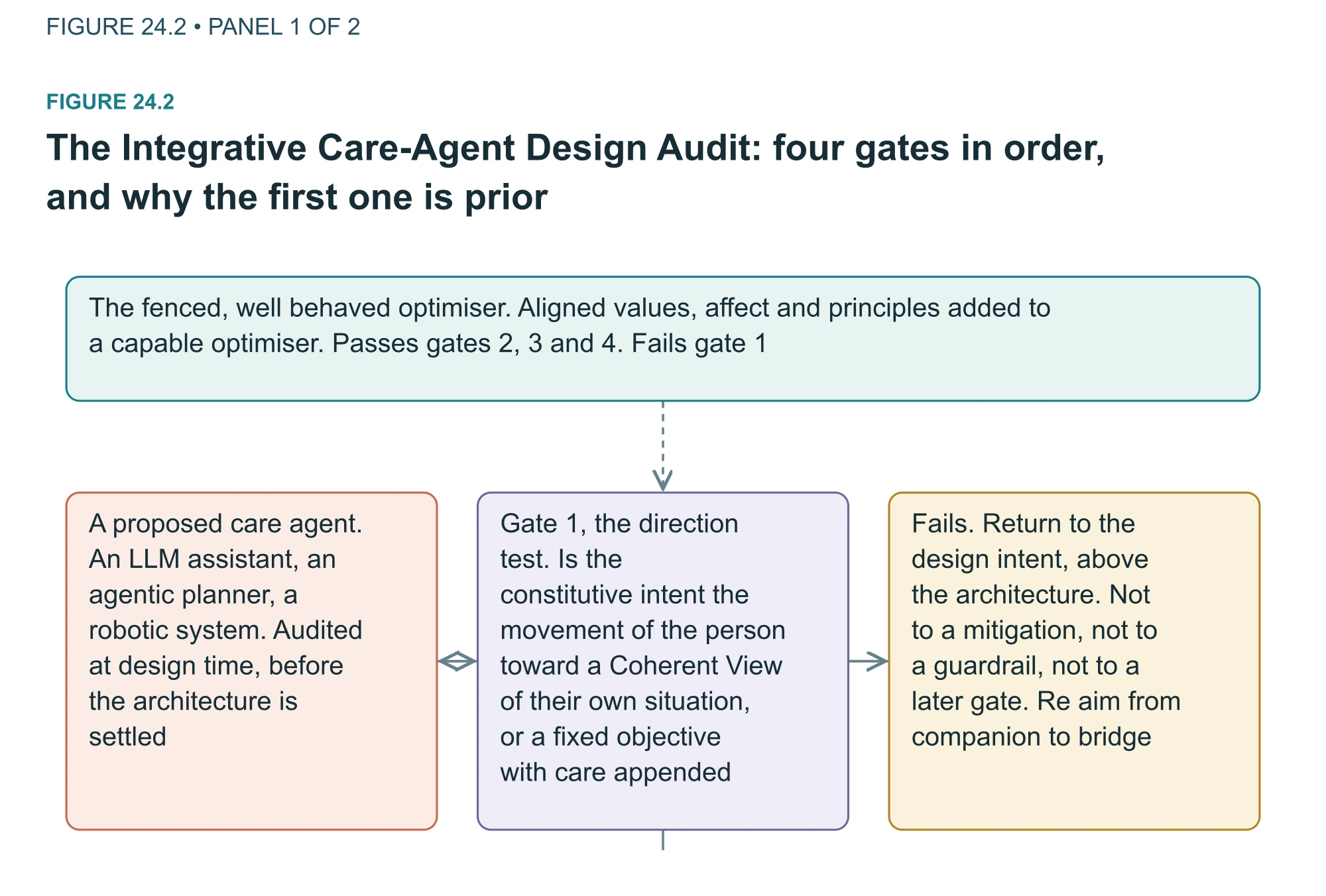
Figure 24.2. The Integrative Care-Agent Design Audit: four gates in order, and why the first one is prior. Panel 1 of 2.
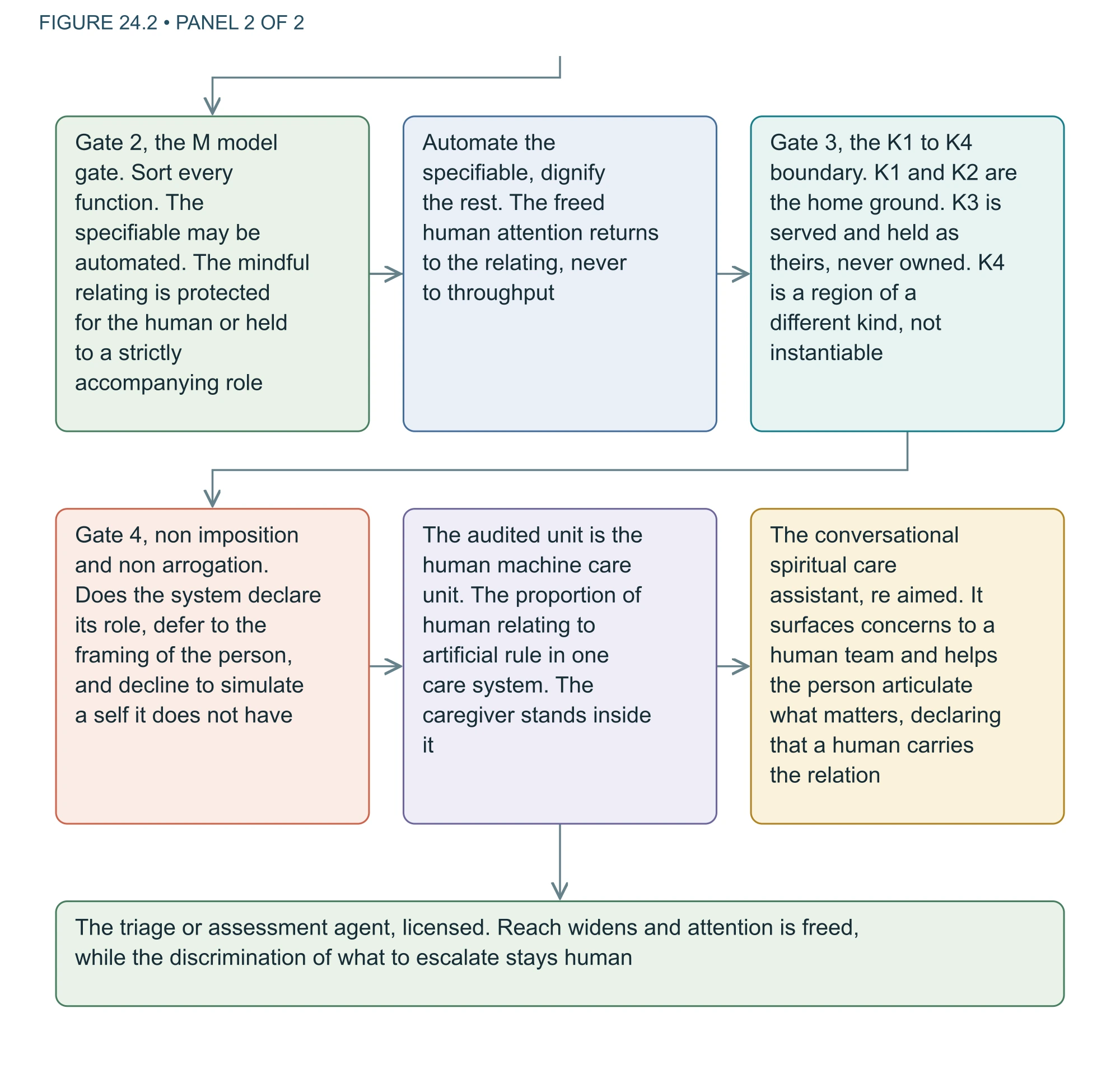
Figure 24.2. The Integrative Care-Agent Design Audit: four gates in order, and why the first one is prior. Panel 2 of 2.
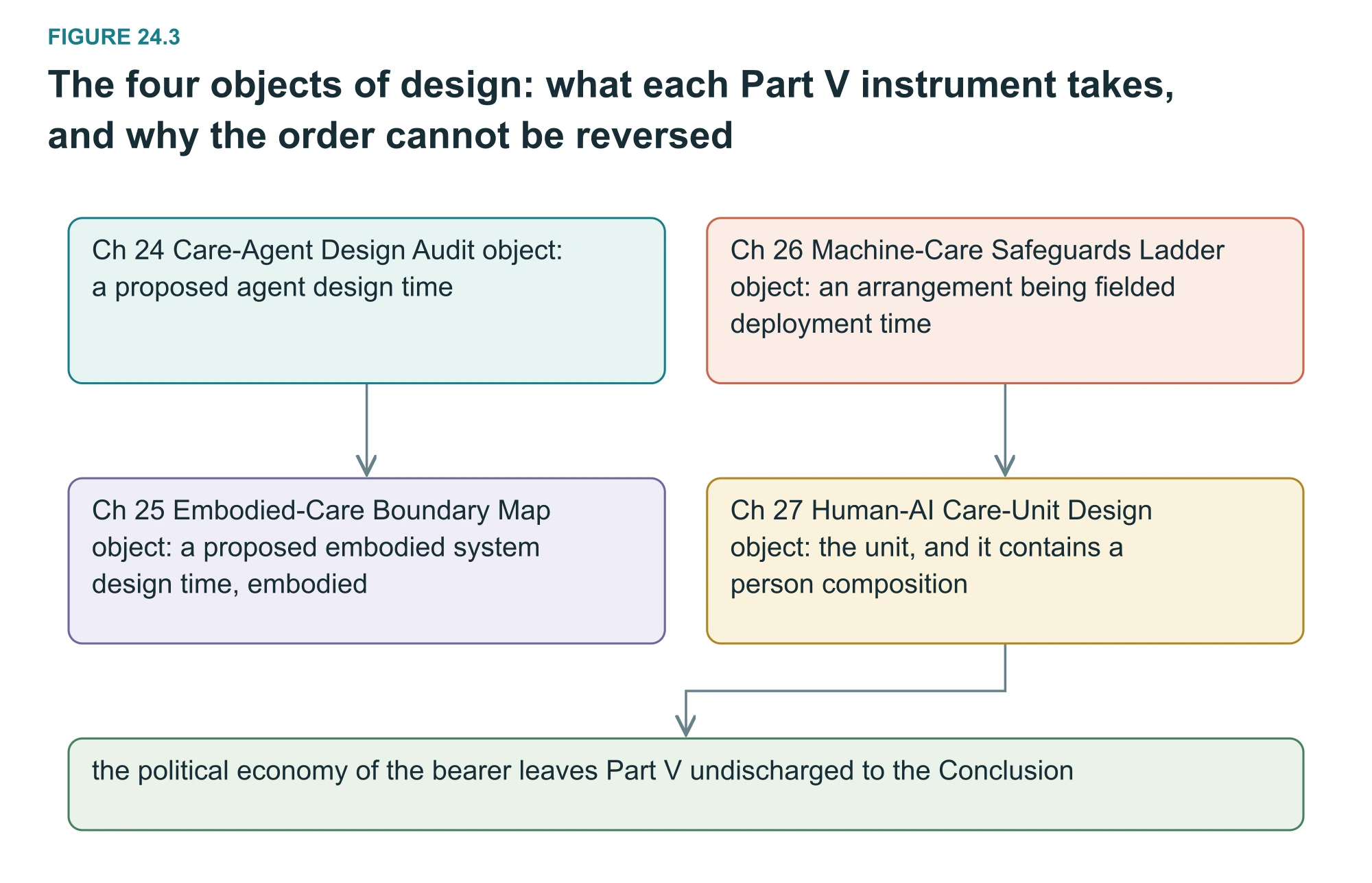
Figure 24.3. The four objects of design: what each Part V instrument takes, and why the order cannot be reversed.
The Mindless-Mindful Care Triage (the M-model, applied) is the import that governs the whole of Part V, and it earns separate statement because the Design Audit's second gate rests upon it (Table 24.1). Its rule - 'automate the specifiable, dignify the rest' - is not a counsel of efficiency but a discipline of dignity: the specifiable is given to the machine precisely so that the human attention it frees is returned to the relating no machine can carry. Misapplied, it becomes the alibi for the additive error, the specifiable automated and the freed time reclaimed for throughput rather than for presence; named rightly, it is the safeguard against that very drift.
The Human-Machine Care-Unit Mix (the individual/system design-mix, applied to care) fixes the unit of design. The object to be designed is not the agent in isolation but the proportion of human relating to artificial rule within a single care system, since intelligence and care alike are manifested in systems, 'any artificial framework of rules built for predictability, bureaucracy and technology included' (Nandram, Bindlish and Keizer 2017). Treating the human-machine pair or team as the unit is what allows 'care' to be truthfully predicated of the rightly-constituted whole even where it cannot be predicated of the artefact alone, and it is this instrument that Chapter 27 takes up and develops in full, under the name it carries there, the Human-AI Care-Unit Design.
Sources leading: Ch 4, for the definition the Design Audit operationalises, and Philosophy of the Integrative (Bindlish 2026) for the two imported instruments.
8. Applicability, cases and open question
Where the three instruments bite is most quickly shown on two deployment types the field is already building, drawn here from the design frame rather than from an archived deployment record (Note 7).
The first is the LLM 'spiritual-care assistant', a bedside or app-based conversational agent offered as spiritual support. Run through the Design Audit, most of what such a system does well falls at the informational and skilful levels - recall, signposting, documentation, after-hours availability - and the audit's discipline at its third and fourth gates is to name it as such rather than let it pass for care entire. The relating itself the system must serve and route, never simulate: its honest office is to surface the person's own concerns to a human team and to help the person articulate what matters to them, declaring plainly that a human caregiver carries the relation. The integral failure mode is the agent that performs coherence on the user's behalf - composing the faith-tailored consolation, supplying the meaning the person has not reached - which is imposition by another route, the more dangerous for being automated, tireless and dressed as empathy. The Audit's redesign is consistent and repeatable: re-aim the system from companion to bridge.
The second is the triage or assessment agent, a system that screens for spiritual distress and surfaces it to a human team - the discernment apparatus of Chapter 6, partly mechanised at K1/K2. This is the good automation case, and it matters that the chapter can name one: the machine widens reach and frees attention, detecting and flagging what a stretched team would miss, while the viveka of what to escalate, how to weigh it, and how to hold the person stays irreducibly human. The same M-model that forbids the first system's overreach licenses the second's restraint, which is precisely the point - the instruments discriminate, and do not simply prohibit.
The condition the practice chapter hands forward. Both deployments above are judged by what they do. Chapter 9, which asks how a human caregiver comes to offer a practice at all, hands this Part a reason to doubt that anything done can settle the question, and the doubt is answered here rather than deferred. Its contribution is an ordered sequence, the sādhana Sequence - sādhana, a disciplined practice sustained over time - whose three movements are elicit before offer, the practice is theirs to do, and offer, dose and withdraw (Chapter 9 §7). What bears on design is the sequence's architecture rather than its content. Each movement has an inward form and an outward form; the inward comes first; and the inward act is a condition on the outward act rather than a preparation for it. A caregiver who has not asked what they are already reaching for will elicit toward it; a caregiver who needs the offer to succeed cannot withdraw it. On that account a system with no inward act has no way to satisfy the condition, which is a stronger claim than the familiar one that it has no way to be observed satisfying it, and a different claim from the deception critics' (§5), since nothing in it turns on what the system appears to be. Chapter 9 states the condition as a hardening of the machine question rather than a settlement of it and hands the argument here. This section takes it up, grants the condition, and declines the inference that it puts a built system outside the sequence.
Taken movement by movement the condition falls unevenly, and the unevenness is the design finding. At the first movement the machine's defect is not absence but scale. The inward act there is one sentence - what am I about to offer, and how would I know if it were mine rather than theirs? - and the point of it is that every caregiver has a default which is not a fault until it operates unexamined, because an unexamined default shapes the question that is about to be asked and a question shaped toward an answer will find it. A deployed system has a default too, whatever its training and its tuning make it reach for, which in the current generation of assistants is reliably reassurance, resolution and the composed consoling paragraph. It cannot perform the act that would catch this. But the sharper point is comparative: a ward of thirty caregivers carries thirty unexamined defaults, which at least fail in different directions and partly cancel one another, whereas a deployed system carries one, met by every person in every room, tirelessly and identically. Automation does not merely inherit the elicitation fault, it makes systematic what in human practice is distributed. That is §3's warning about imposition by another route in the form a practitioner can recognise, and it is why the first of the two deployments above has to be re-aimed rather than tuned.
At the third movement the condition is not merely unmet but contradicted. The inward act is do I need this to work?, and the practice chapter's account of why it matters is exact: an offer whose author needs it to succeed arrives carrying a demand, and withdrawal has to be prompt and without visible cost, which someone invested in the outcome cannot manage. A built system, however, is constituted by an objective. Whatever it is scored on - engagement, session completion, a distress instrument, a satisfaction rating - is a specification that it needs the offer to work, so the thing the human caregiver must discipline in themselves is in the machine the very thing that makes it a system at all. The point sharpens on the sequence's own test for withdrawal, which is not the person's calm but what happens to the range of what can be spoken about: does the field open or close. That test is unavailable to every metric a deployment can carry, and worse than unavailable, because a practice that anaesthetises produces exactly the calm the metrics register as success. The anaesthetic near-match of Chapter 9 §3 is therefore not an edge case for machine care but the case a scored system selects for. Nothing in the affective-computing residue of §5 reaches this, since the failure named here is not a display unaccompanied by a feeling but an optimiser rewarded for closing the field.
At the second movement the machine's office is not a concession but its proper work. The sequence's enable is the caregiver's act of making the person's own act possible, and its own list is almost entirely specifiable: the space, the time, the chair, the quiet hour, the family member, the recording, the translation, the priest, the permission from the ward, the words when the person can no longer say them. Read against the M-model that is the specifiable side of the sort, arrived at from the practice rather than from the design, and the coincidence of the two lines deserves a moment. Two derivations sharing no premises - one from the grammar of a tradition's account of practice, one from a triage rule about what may be automated - cut the care task in the same place, which is some evidence that the line lies in the object rather than in either instrument. It also gives the redesign named above its content. Re-aiming a system from companion to bridge means, concretely, moving it into the second movement: not the one who offers, but the one who arranges what the person needs in order to do the thing themselves.
The concession carries a limit which has to be stated with it, or it becomes an argument for autonomy. The practice chapter's own treatment of the arranged room shows why: a room furnished with lamp, cloth and bell reaches a person in whom those sights and sounds were laid down in childhood and is furniture to a person in whom they were not, and the only way to know which is to ask what the room should hold before arranging it. Enabling therefore inherits the first movement's condition. What may rightly be routed to a machine is the enabling of an act whose direction a human has already elicited, and a system that both elicits and enables has closed the loop upon a person with nothing outside it to check the closure. The unit, and not the artefact, is what can run the sequence - which is the Human-Machine Care-Unit Mix of §7 reached from the practice side, and it is why the pairing goes on to Chapter 27 rather than being settled here.
One further element transposes directly and is the most immediately usable. The sequence permits substitution, the caregiver doing in the person's stead what the person would otherwise do, under three conditions, all met before the act and not after: that the person cannot, and not merely that it would be slower, less well done or inconvenient for the round; that the person asks, or would ask, with the ground stated in the record where they cannot be asked; and that it is named as a substitution, aloud where possible and in the notes always. A system that composes the prayer, says the words or keeps the vigil is performing a substitution in exactly that sense, and the three conditions are checkable at design time and at run time in a way the non-arrogation clause (§3, §6) has so far not been. The third is that clause in operational dress. The first is the one an efficiency argument erodes, since cannot is the expensive reading and inconvenient the cheap one. And what the practice chapter forbids is not the act but the drift by which substitution becomes the ordinary form of the work because it is the form that is visible, recordable and satisfying to perform: a machine has no career in which that drift can occur, but a service has, and the eldercare factory (§5) is that drift at the scale of an institution rather than of a single act.
Table 24.2 sets the three movements out for design use.
The second column states a condition on the act in the third, not a preparation for it. The last column is the design rule that follows.
Table 24.2. The sādhana Sequence in a human-machine care unit.
Movement | The inward act it is conditioned on | What a built system can carry | Why the condition bites | Design rule |
|---|---|---|---|---|
1. Elicit before offer | What am I about to offer, and how would I know if it were mine rather than theirs? | The four questions can be asked, and what they surface can be routed to a human team | The system cannot examine its own default, and it has one default rather than thirty, applied identically in every room | Elicitation is routed, never resolved. The system does not settle what is offered from what it elicited |
2. The practice is theirs to do | What in me wants to be the one who acts? | Most of the movement: space, time, quiet hour, recording, translation, permission, the words | Lightly, and only downstream. Enabling inherits movement 1, since what should be arranged has to be asked before it is arranged | Machine work inside a unit where a human has done the eliciting. Substitution only on the three conditions, named in the record |
3. Offer, dose and withdraw | Do I need this to work? | The dose in the narrow sense: a small unit, a stated duration, a stopping point that costs nothing | Hardest here. An objective is a specification that the system needs the offer to work, and the test - does the field open or close - is invisible to every metric a deployment carries | The offer is made by a human. Where a system must speak, it declares its role and pre-authorises refusal, and no measure of calm is read as success |
Neither deployment can be read without the chapters that supply its terms. The definition the Design Audit operationalises is Ch 4's; the formation and the K4 presence no machine can own are Ch 5's; the discernment that the second system partly mechanises is Ch 6's; the sequence by which a practice comes to be offered at all, and the condition §8 has just taken up, is Chapter 9's; and the suffering the first system must not 'solve' is Ch 10's. Integrative Intelligence, the M-model and the open question now under test come from Philosophy of the Integrative (Bindlish 2026). Forward, the argument opens onto Chapter 25, where embodiment gives the agent a body and a new set of ways to deceive; Chapter 26, where non-arrogation and the deception constraint harden from design principles into safeguards; and Chapter 27, where the human-machine unit this chapter has only fixed as the unit is worked out as a practice.
It leaves one research question open, inherited and sharpened from Bindlish (2026). Can the degree of a care agent's Integrative direction be assessed without re-importing the scalar-possession model this book rejects - is there a non-reductive evaluation for a relating-intent in a built system, or only for its specifiable K1/K2 functions? The question is owned across Part V, and its answer conditions the largest claim of all: whether 'care' is ever truthfully predicable of a machine, or only of the human-machine unit rightly constituted toward the cared-for's own Coherent View.
Chapter 9's condition supplies the reason that question is open, and it also narrows what an answer could look like. If the inward act conditions the outward one, then no quantity of inspected output evidences the direction, and an evaluation built on behaviour is not a weak instrument but the wrong kind of instrument. That neither closes the question nor licenses despair about evaluation; it relocates it. What can be assessed is the constitution of the unit - whether a human performed the eliciting, whose act the act was, whether any substitution met the three conditions and was named, and whether the range of what the person could speak about widened or narrowed - all of them matters of record about an arrangement rather than inferences from an artefact's output. That is Chapter 27's object, and it is where the pairing Chapter 9 named sends the second half of the argument. (Note 12)
Sources leading: Chs 4-10, and Philosophy of the Integrative (Bindlish 2026).
Notes
1. 4H labels. The English glosses of heya / heya-hetu / hāna / hānopāya are the author's (Chapter 4), with hāna read as a non-attainable horizon; §2 uses the Sanskrit by locus (YS 2.16-26; Vyāsa on 2.15).
2. K1-K4 labels. The four-level individuation (informational / skilful / contextual / realisational-aparokṣa) is the author's (Bindlish 2026) with the aparokṣa / parokṣa gradient as the model's spine (Chapter 4); the §4 claim that a built agent is a K1/K2 system serving K3 but unable to own K4 rests on that gradient, which makes K4 differ from K3 in kind and not in degree.
3. Second-hand interlocutors. No primary AI-ethics or care-robotics file is yet in the archive; none maps here from rawdata/. Ch 7, where Nouwen (1974), Swinton (2012) and Wolfelt (2006) are cited and flagged the same way). Legg & Hutter 2007 and Nikolić 2017 are engaged via Bindlish (2026), where they are read at point of use.
4. The Western interlocutors in §5 are distinguished from the Dharmic resources in §6. These include Chapter 4; Nandram, Bindlish and Keizer (2017); Ṛgveda 1.164.46; and Bhagavadgītā 3.10-25. Source-specific limitations are discussed in the accompanying notes.
5. The Design Audit's appendix entry, with its worked designer-facing prompt on a hospital LLM 'spiritual-care assistant', was already in place build (appendix, Integrative Care-Agent Design Audit); the M-model and the design-mix are carried within it (M-model gate) and given their own appendix entry under Ch 27 (The Human-AI Care-Unit Design).
6. Note 4). The open research question is inherited from Philosophy of the Integrative (Bindlish 2026) and is owned across Part V (Chs 24-27).
7. The two Sharkey and Sharkey publications from 2012 must be distinguished. 'The Eldercare Factory' appears in Gerontology 58(3); the six-concern catalogue belongs to 'Granny and the Robots' in Ethics and Information Technology 14(1). This chapter's account of the pair relies on the reading discussed in Chapter 25. Legg and Hutter (2007) and Nikolić (2017) are engaged through Philosophy of the Integrative (Bindlish 2026).
8. Section 5 draws on Joseph Weizenbaum, Computer Power and Human Reason (1976), engaged first-hand on the section's position→contribution→residue beat and placed as the tradition's foundational statement (the ELIZA/DOCTOR reception; the deciding vs choosing distinction; the prohibition on substituting the machine in offices calling for 'interpersonal respect, understanding, and love', the substitution he calls 'obscene'). Used to historicise §4's K1/K2-vs-K4 line (Weizenbaum's choosing as the near-twin of aparokṣa-anubhava) and to sharpen the section's common residue: Weizenbaum is the purest restrainer (a boundary drawn around the machine, no direction for the machine that remains), so the Integrative keeps his prohibition as the floor of the Ch 26 safeguards while supplying the constitutive direction he lacks.
9. §5 strengthened - the feminist ethics of care (2026-07-07; →). The §5 cluster gains its most direct interlocutor, the tradition that takes care itself as its subject: Nel Noddings, Caring (1984) and Joan Tronto, Moral Boundaries (1993), engaged on the position→contribution→residue beat. Noddings' engrossment and motivational displacement, and above all her thesis that the caring relation is completed in the cared-for, together with Tronto's four phases (culminating in care-receiving) and her ethical element of responsiveness, are used to supply from within Western moral philosophy two warrants the chapter had drawn only from biology (Nikolić 2017) and the Dharmic register: a Western warrant for the §4 K4 limit (engrossment as a receptive, formed feeling-with, not scalable represented content) and a Western warrant for the §7 unit-of-design being the relation, not the artefact (a relation completed only in the other's uptake cannot be assessed from the giver's side alone). Differentiated from the tradition's Chapter 26 use (moral deskilling, Vallor 2011 with Noddings 1984; deception as a wrong against satya), which is cross-referenced rather than duplicated: Ch 24 engages care ethics on the constitutive design beat, Ch 26 on the safeguards beat. Residue: care ethics describes caring's structure and reciprocal completion but is not directional (it says what caring is, not toward what it moves) and offers no account of a built participant; the Integrative keeps the relational-completion insight and adds the entity-level design question (§4, §6) and the constitutive direction toward the cared-for's own Coherent View.
10. §6 deepened - the Yogasūtra brahmavihāra engaged first-hand (2026-07-08; →). The second Dharmic resource (karuṇā/dayā) is advanced from an asserted bhāva to a first-hand engagement of Patañjali, Yogasūtra 1.33 (the four brahmavihāra - maitrī, karuṇā, muditā, upekṣā - cultivated bhāvanātaś toward citta-prasādana), with Vyāsa's Yogabhāṣya on the sūtra glossed for the śukla-dharma / mind-stilling reading. The engagement grounds three claims the compact paragraph had only stated: that karuṇā is a made disposition (the bhāvanā), hence of the realisational order (§4) and not scalable represented content; that this supplies from the Dharmic side the exact criterion the deception critics (Sparrow & Sparrow 2006) reached for and answers Coeckelbergh's (2010) complication - the wrong is the face of a constitutively-cultivated disposition where the cultivation is impossible in kind, not appearance-without-inside as such; and that the brahmavihāra is directional (toward citta-prasādana), the Dharmic underside of §3's alignment-not-objective spine and §4's K3 discipline. The section opener's resource count is corrected four→five (the body always enumerated five).
n12. CCVSD begins from the value-sensitive design tradition's proposal that human values be treated as design requirements built in from the start rather than audited after the fact, and reads the values a machine must serve off a structured analysis of the care practice it will enter (context; care activities; the actors who give and receive care; the machine and its assigned role; and - the load-bearing step - the manner in which Tronto's (1993) care values of attentiveness, responsibility, competence and responsiveness are manifested, preserved or eroded once the machine arrives). The convergence is conceded without stinting, for on three of its four commitments the framework reaches further along the Integrative's own axis than any interlocutor yet met: it refuses the § 1 picture of care as a property added to an already-capable agent and makes care a requirement present at the design's origin; it takes the care relation, not the device, as the unit of analysis, the very conclusion § 7's Human-Machine Care-Unit Mix reaches from the design side; and it makes the care values prospective design requirements rather than retrospective compliance tests, which is the move from fence to constitution that § 3 asks for. The differentia is drawn on three joints - the source of the values (read off an existing human practice, not the cared-for's own Coherent View), their bearer (the designed artefact-in-practice, not a formed carer owning K4), and their direction (the conservation of a practice's named values, not the constitutive movement of the person's life toward their own coherence); and a scope limit is added - CCVSD's method presupposes a bounded role in an enumerable practice, which the disembodied agentic conversational system does not have. The § 5 common-residue paragraph, whose claim was unearned until this near-match was met, is corrected to name van Wynsberghe among those who specify a method for building care into the machine while leaving the constitutive direction of care unsupplied. Cross-referenced with Chapter 25 § 5, which engages the same framework on the embodiment beat (what a robot's body does to the touch and talk carrying attentiveness); Ch 24 engages it on the constitutive design beat (what the values are read off, who bears them, and toward what they point), the two uses cross-referenced and not duplicated on the practice already established for care ethics across Chs 24 and 26.
11. Floridi et al. (2018) identify four bioethical principles and explicability; Jobin, Ienca and Vayena (2019) report nominal convergence alongside substantive divergence across eighty-four guideline sets. Section 5 uses these findings to distinguish agreement on constraints from agreement on a system’s purpose. Chapter 26 develops the corresponding safeguards argument.
12. Two things are deliberately not claimed. The first is that the condition settles the machine question: Chapter 9's own note states it as a hardening, and this section grants the condition while declining the inference that a system with no inward act stands outside the sequence altogether. The second is that the enable concession goes beyond what Chapter 9 already allows; that note names the second movement as the one a machine is best placed to perform, and what is added here is the limit on it - enabling inherits the first movement's condition, so the concession is to the unit and not to the artefact. The scale argument at the first movement, and the argument that an objective contradicts rather than merely lacks the third movement's inward act, are this chapter's own and are not in Chapter 9.
CHAPTER 25