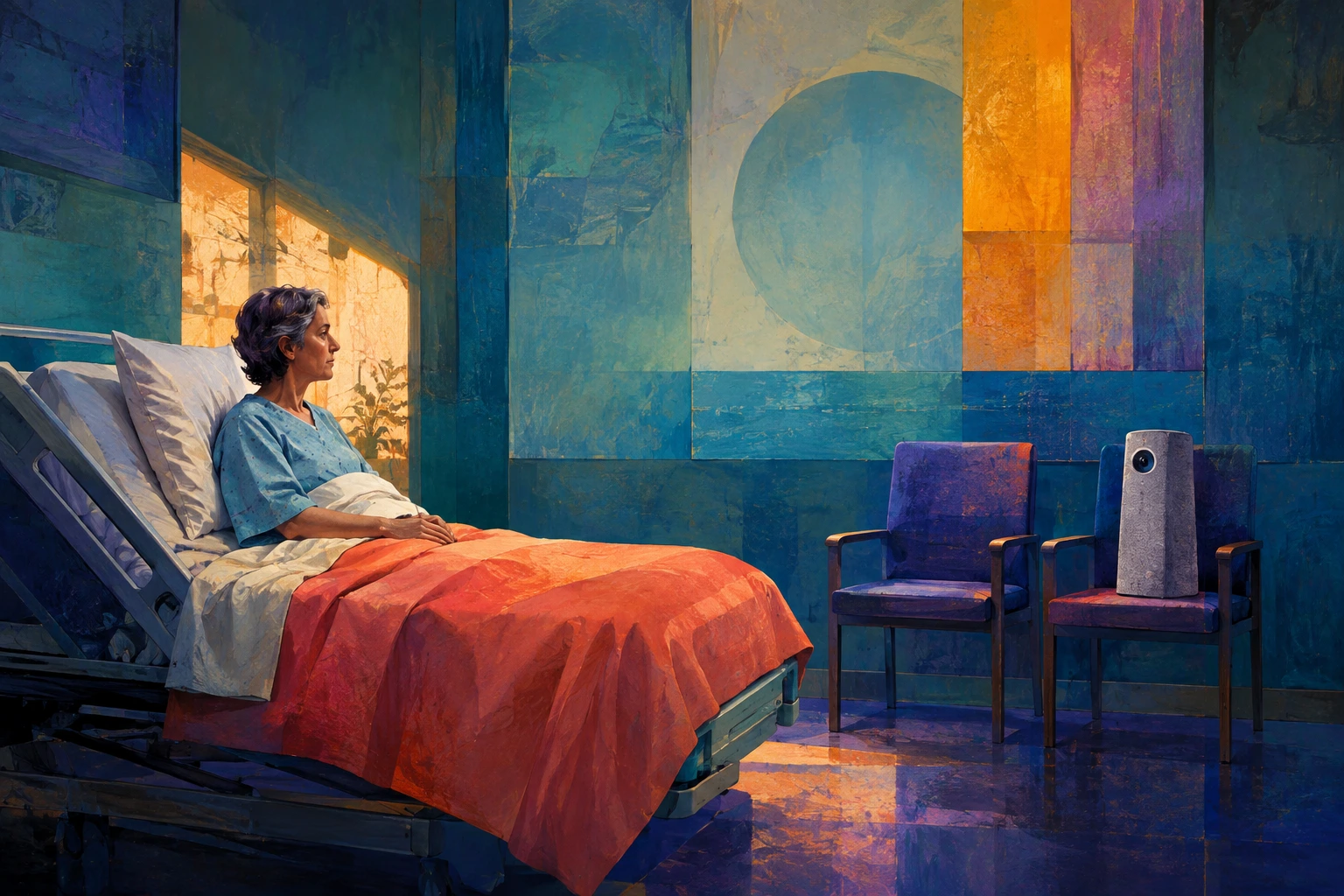
Figure 25.1. Two chairs at a bedside.
Apparatus applied: the concept of the Integrative, the 4H need diagnosis, the K1-K4 Knowledge Model, the four pillars, and Integrative Intelligence - each stated here in full where it is used, and argued at length in Philosophy of the Integrative (Bindlish 2026). The Integrative Spiritual Care definition (Ch 4 §4) is the chapter's spine; Ch 24 (agentic design) is its immediate predecessor and this chapter adds the body.
1. The domain and its dominant paradigm - the body as a platform for care
Figure 25.1 puts the question before the argument does: someone has drawn a second chair up to a bedside for a thing that has no body to tire and nothing that needs to sit. Where Chapter 24's agent reasons and converses, the agent of this chapter occupies space and touches. A social robot meets a gaze; a companion device is held; an assistive system lifts, walks beside, feeds or monitors a body. The design claim particular to this field is that care is not only informational but bodily - that presence, touch and co-location are part of what caring is, and that a machine must therefore be given a body if it is to deliver them. The motivating fact is real and rising: ageing populations, a deepening scarcity of human caregivers, and the documented loneliness of institutional life supply a demand the field proposes to meet with embodied machines (Sharkey and Sharkey 2012). Before that proposal is weighed it is owed a statement at full strength, and it comes in three exhibits.
The first is embodied cognition and sociable robotics. Brooks's (1991) thesis that intelligence is situated and bodily rather than represented, and Breazeal's (2002) programme of Designing Sociable Robots, share an engineering claim the Integrative will largely grant: that social presence arises through a body interacting with a world, so that a face, a gaze and a posture are not decoration but the very substrate of relation. This is the field's strongest card. The second is therapeutic and companion robotics in practice, of which Wada and Shibata's (2007) study of Paro - the seal-shaped companion robot deployed with people living with dementia - is the canonical case: a measured, deployed device that demonstrably lowers agitation, soothes distress and draws withdrawn people back into interaction. Here care is operationalised as a measurable affective and behavioural benefit. The third is assistive and service robotics: the lifting, mobility, monitoring and delivery systems surveyed in the eldercare literature (Sharkey and Sharkey 2012), where care is the reliable performance of physical tasks a human body would otherwise do, freeing scarce human hours for other work.
Stated at strength, each exhibit secures something real - that presence is bodily and can be engineered as such, that an engineered presence can measurably comfort a person in distress, that a machine body can carry out physical labour a person needs done. But across all three the structure is the same, and naming it is the entry to the diagnosis. The body is treated as a platform for delivering care-functions to a user-as-recipient: presence is engineered as behaviour (gaze, expression, proximity), touch as actuation, benefit as a measured outcome. Care's bodily dimension becomes something a well-built mechanism can produce and a well-designed study can score. The cared-for enters as the body acted upon and as the source of the benefit-metric, not as the first observer whose own Coherent View the body's work is meant to serve. That is the assumption this chapter contests, and in this book's diagnostic vocabulary it is the heya - the thing to be discerned and let go.
Table 25.1. What a machine body may do with this person, and where it must stop: the Embodied-Care Boundary Map at the bedside.
The act, as it will be proposed for this person | Which sheath it touches, and at what level of knowing | What the body may do here | The arrogation to refuse | Where your competence ends, and who takes over |
|---|---|---|---|---|
Lifting, transfer, repositioning, walking beside. | Annamaya (the food-formed physical body), the outer sheath. Touch-as-task, fully specifiable: the machine's home ground. | All of it, generously: handing it over returns human hours to the relating, and sevā (selfless service) is honoured by being resourced. | That a well-handled body has been cared for. The lift is the labour of care, not the relation. | At the clinical judgement beneath it - skin, fracture, pain, weight-bearing, a person who resists mid-transfer. The clinician sets the plan, and nobody is moved by a device no human present can stop. |
Washing, dressing, feeding, toileting. The intimate labour. | Still annamaya touch-as-task, but running into what this person's body means to them: a site of dignity, shame, history or faith. | The specifiable part, where they have agreed on this occasion. A body serving their framing asks before it touches and yields when they reframe. | That admission-time agreement is standing permission. Consent is per occasion and revocable mid-act; continuing through a refusal is the harm ahiṃsā (non-harm) names, however gentle the actuation. | Where the person cannot consent, or consents then resists. Not yours to settle alone and not a relative's to settle for them: the clinical team, and where a body is handled against an objection, the safeguarding lead. |
Monitoring, and after-hours physical reach. Vital signs, movement sensing, a machine in the room at three in the morning. | Annamaya and prāṇamaya (the vital-breath body). Sensing, and a real good the chapter credits. | Watch, alert, and be physically present when no person can be - saying plainly what it is. | That being watched is being attended to. Loss of privacy and of personal liberty are two of the six concerns the field's own survey names (Sharkey and Sharkey 2012). | At who authorised the watching and what becomes of the record. Consent to observation, data handling and restriction of liberty belong with the person, the clinical team and institutional governance - legal questions before care ones. |
Affective touch, and the gaze that meets yours. Stroking, warmth and pressure built to comfort through the skin; a face and voice that answer you. | Outer-sheath signal at the annamaya surface, reaching the prāṇamaya, and real rather than imagined: a slow channel in hairy skin answers gentle skin-temperature stroking (McGlone, Wessberg and Olausson 2014), and the eye-contact system answers an engineered eye from birth (Farroni et al. 2002; Admoni and Scassellati 2017). | Soothe, orient, address, and be met - openly as a machine. Dṛṣṭi, mere looking, is buildable and useful, and both goods are conceded without hedging. | That the caress or the gaze is somebody's. An identical touch is felt differently when the person believes a different toucher gave it (Gazzola et al. 2012); darśana, the mutual seeing-and-being-seen of true co-presence, is reciprocal or it is nothing. The remedy is declining the simulation, never a better face, and the duty rises with capability. | Where the person reaches for a hand rather than comfort, or has come to believe someone is there: a hand is owed a hand, the belief is not to be maintained, and whether the device stays is a decision above your grade. Where someone cannot be told what is touching them, it is the clinical team's call. |
A companion device left with someone who is alone. The seal-shaped comfort object on a dementia ward. | Outer sheaths, and its good is real: lower agitation and, in its own evidence base, stronger ties between residents (Wada and Shibata 2007) - a catalyst of human relation, not a supplier of it. | Be a comfort object, held and enjoyed, placed within human presence and never instead of it. | That a falling distress score is care delivered. Staff and family treat it as a comfort object and not a carer, and it is never made to claim that it cares. | Where it is used to thin human contact hours - a staffing decision, not a care one. Escalate in writing to the ward manager and whoever holds the establishment; it will not look like harm from inside. |
Being with. Holding a hand at bad news, sitting with a dying person, bearing what cannot be fixed. | Manomaya (mind-and-emotion body) and vijñānamaya (discriminative-intellect body) inward - sheaths the machine does not inhabit. Touch-as-presence and darśana, the realisational level (aparokṣa-anubhava, immediate rather than mediated knowing): refused in kind, not by degree. | Nothing. It may steady a chair, fetch a person, and stop there. | All of it. Touch without an indwelling presence is contact, not communion, and the gap is not an engineering shortfall awaiting a better body. | Not a limit of your competence but of the artefact's kind, and the exit runs toward you: a person is owed a person. Where you cannot be that person, name who can - a colleague, the family, a chaplain, their own tradition. |
Restraint, containment, or a body used to keep a person somewhere. Blocking a way out, holding a body still, continuing through a refusal. | Off the map. Not an act with a boundary but a hard stop. | Nothing, at any level, on any authority available in the room. | That a machine only guiding, reminding or waiting in a doorway is not restraining. Ahiṃsā is not softened by gentle actuation. | Immediately. Restricting a person's liberty by a machine body is a legal and safeguarding matter before a clinical one. Stop the device, record what happened in the person's words, and route it to the clinical lead, the safeguarding lead and whoever is accountable for the deployment. Neither a ward nor a family carer may authorise it. |
2. The fragmentation diagnosis (4H) - presence engineered as behaviour
The 4H diagnostic - the fourfold caturvyūha the Yogasūtra sets out at 2.16-26, read by Vyāsa (on YS 2.15) as the structure of any well-posed problem - turns reflexively upon the project of embodied machine care, and is run here in the Western register first, with the Sanskrit carried by locus.
The heya, what is to be discerned and let go, is care-by-simulated-embodiment: giving a machine a face, a touch and a proximity so that it can perform presence, while discarding the relation the body is the vehicle of. A device can hold a gaze and be held, and can register the soothing it produces, while none of the aspects, perspectives and purposes of the person that it cannot commensurate enter its account. This is the additive, integral-not-Integrative error now wearing a body, and the author marks the line precisely: the integral 'usually refers to an approach that sums up various views... usually not followed by adequately providing a clear direction', whereas the Integrative names 'an intention to align diverse perspectives and purposes, not necessarily a summation' (Chapter 4). The seal that calms a frightened person is a real good at the surface; mistaken for the relation, it becomes the polished form of discarding.
The heya-hetu, the cause, is the worldview fallacy, met here in embodied form. The fallacy is that an inference about anything interpretable is treated as settled by the phenomenon, the method and the observer, while the fourth sphere that in fact decides it goes unexamined: the worldview of the one doing the inferring, which selects the construal dominant within it and discards the others without ever weighing them (Bindlish, Nandram and Keizer n.d.). The construal it selects here is embodiment as a property an agent possesses - sensors, actuators, an expressive face - rather than as the lived body, the corps propre, through which one person is present to another (Merleau-Ponty 1945). Dreyfus's (1972) critique of disembodied AI points the same way: skilled, situated coping is acquired by a body absorbed in a world, and a system that only represents cannot, by representing harder, come to dwell. The mechanistic premise fixes the design space - a body is hardware for executing care-functions - before the cared-for is met, the outside-in error the practice chapters diagnosed in the clinic now given limbs. The cause is not a missing actuator but a settled picture of what a body in care fundamentally is.
The hāna, the desired state, is embodied care whose design intent is to help the cared-for move toward their own Coherent View - care in which physical presence, touch and the machine's body genuinely serve the relation, and in which the design places the robot exactly where its body helps (transfer, mobility, monitoring, after-hours physical reach) without pretending the body carries the relation. Read as a design specification, this is the keystone definition of Part I applied to hardware, and its machine analogue is the canonical definition of Integrative Intelligence as the property of an entity: 'an entity's ability to apply oneself to holistically interrelate all aspects, all perspectives and all purposes of other entities in one's adopted context, with an a priori intention to achieve a Coherent View (without discarding any aspect, perspective and purpose in that adopted context)' (Chapter 4). The definition's word is entity, not person, and the body names the site of this entity's most honest contribution and its hardest limit.
The hānopāya, the means, is to design for honest embodiment and not for a richer behavioural repertoire. Three instruments give the means concrete form. The first is the M-model triage (Philosophy of the Integrative, Bindlish 2026) applied to the body's work: sort bodily care into the specifiable - lifting, transfer, navigation, delivery, vital-sign monitoring, after-hours physical reach, which may be routed to the machine - and the not-specifiable - the relating presence and touch-as-communion, protected for the human or held to a strictly accompanying role; 'automate the specifiable, dignify the rest'. The second is the pañcakośa boundary, developed in §6, used as a design gate over which sheath of the person a function actually touches. The third is viveka (YS 2.26), the cultivated discrimination, built in not as a capacity the machine gains but as a governing judgement over what its body should decline to do - above all over simulated presence and over non-consented touch, where the discipline of ahiṃsā (non-harm) governs. Taken together they convert the diagnosis into a directive the following sections operationalise: an embodied care system's body is not a platform onto which presence is summed, but a means under a human-carried relation, aligned toward the cared-for's Coherent View rather than optimised for a measured soothing. That differentia, made architectural, is the work of §3.
3. The Integrative reframe
The reframe is a change in the first question the designer is allowed to ask. The field begins with 'how do we build a body that delivers care, or presence, or comfort?' and proceeds to engineer toward a measured benefit. Integrative design begins instead with 'what is this body for, and toward whose Coherent View do its presence and its touch relate?' The order is not cosmetic. To fix the a priori intention first - the genus of the Integrative Spiritual Care definition, the cared-for's own movement toward coherence (Ch 4 §4) - and then let the embodiment follow, is a different engineering discipline from fixing a measurable bodily outcome and building a body to maximise it. On the first discipline the Coherent View is the cared-for's, and the machine's body is a located means that serves the person's movement toward it; on the second the body is a platform and the person a recipient of its output. The non-imposition clause that governs Integrative care in the clinic is therefore carried, unchanged in principle, into the hardware - where it becomes a non-arrogation constraint on presence and touch rather than a bedside courtesy: a body may help, but it may not arrogate to itself the relation it helps to carry.
The differentia becomes concrete against the three nearest approaches, and in each case the Integrative move is to re-aim rather than to reject. The pivotal near-match is therapeutic-companion robotics, of which Paro is the canonical instance (Wada and Shibata 2007). The companion robot optimises a measured affective benefit on a user - less agitation, more engagement - and counts that benefit as care delivered. The Integrative asks the prior question: does the soothing serve this person's aspects, perspectives and purposes toward their coherence? For a frightened person that coherence may consist in being helped to grieve, to remember a life, or simply to be with another human being - none of which a comfort-metric commensurates, and any of which a well-soothing device can quietly displace. The benefit is real and may be kept; the Integrative re-aims and re-places it within a human-carried relation rather than banning it. This is the integral-not-Integrative line of §2 drawn in the body: the device that lowers a distress score has summed a good at the surface without supplying the direction the good was meant to serve.
The second near-match is the embodied-cognition and sociable-robotics thesis (Brooks 1991; Breazeal 2002). Here the Integrative grants the field its strongest claim: that intelligence and social signalling arise through a body interacting with a world, so that gaze, expression and posture are genuine and useful achievements. But this is embodiment at the informational and skilful levels - K1 and K2 in the Knowledge Model of §4 - and presence in care is the K3/K4 relation that an engineered gaze can route a person toward but cannot itself be. A face that signals an attention it does not hold is the additive error given features: more convincing signalling does not cross the line from performing presence to bearing it.
The third interlocutor is the authenticity and deception critique itself (Sparrow and Sparrow 2006; Turkle 2011; Coeckelbergh 2010), and the Integrative's relation to it is unusual: it accepts the diagnosis in full. A machine that performs a care it does not have can wrong the cared-for; a relational body invites attachment to a self that is not there. But the Integrative answers the critique structurally rather than by reassurance or by prohibition. The design is required to declare its body for what it is, to perform the specifiable bodily tasks openly, and never to simulate the relating. Honest embodiment dissolves the deception not by making the simulation more lifelike but by removing the pretence - the seal is allowed to soothe, and is never made to claim that it cares. The differentia, in sum, is directional and it is built into the chassis: a robot that sums a soothing face, a capable hand and a measured benefit has executed the integral move in hardware, whereas the Integrative system is designed to align a person's bodily and inner life toward their own coherence, its body a means held under a relation it does not own.
4. Knowing in this domain (K1-K4)
The Knowledge Model, applied here, asks which levels of embodied knowing a machine body can reach and which it cannot - the chapter's sharpest analytic contribution, and the place where the pañcakośa (§6) does load-bearing work.
The embodied agent's home ground is K1 and K2, and the body broadens both beyond their reach in Chapter 24. K1, the informational, is sensing - vision, audio, pressure, the tactile and the vital signs a body can register. K2, the skilful, is competent bodily procedure - safe lifting and transfer, navigation, delivery, the reliable mechanics of contact. Contemporary systems are real and improving here, and the M-model (§2) gives the constructive rule: where a bodily care task is fully specifiable at K1/K2, give it to the machine and free human attention for what is not specifiable. Automating the lift is what protects the relating.
K3, the contextual, is the cared-for's own meaning-horizon as it bears on their body - how this person wishes to be touched, seen, moved, exposed or left alone, and what their body means to them as a site of dignity, shame, history or faith. A system can model such preferences, and a well-designed one should. The open question is whether modelling a bodily standpoint is the same as occupying the relation of presence toward the person whose standpoint it is. The Integrative design does not wait on the answer: it builds in deference, requiring the machine to surface and respect the person's bodily framing rather than overwrite it with a generic protocol. The body that serves K3 is one that asks before it touches and yields when the person reframes.
K4, the realisational - aparokṣa-anubhava, immediate rather than mediated knowing - is the formed, unmediated presence behind a caregiver's settled being-with (Ch 5, Ch 7; and Philosophy of the Integrative, Bindlish 2026), the presence that touch in care is the vehicle of. Here Nikolić's (2017) argument and Dreyfus's (1972) converge most sharply: nothing in the scaling of statistical learning, and nothing in giving a system a body it does not inhabit, yields the realisational knowing that K4 names. The chapter's central claim, proposed here as a philosophical claim, is therefore that a robot is a K1/K2 embodied system that can be designed to defer to and serve K3 but cannot itself instantiate K4 - which is precisely why its body is for accompaniment and augmentation, never for substitution. Touch without an indwelling presence is contact, not communion; the engineering question is not how to close that gap but how to design so the gap is never disguised.
The point can be put through the pramāṇa test of the epistemology set out in Philosophy of the Integrative (Bindlish 2026). A robot commands powerful analogues of pratyakṣa (perception, now including the tactile) and of anumāna (inference), and it borrows śabda (testimony) wholesale from its training corpus; what it lacks is the formed viveka (discriminative discernment) that governs the right use of touch and presence. The discernment of when and whether to touch - and of when presence is wanted and when solitude is - must therefore remain sovereign in the human. The pay-off is that the K1-K4 audit, sharpened by the pañcakośa, simply is the safe-design boundary for the body: it tells a designer which bodily work to give the machine (the specifiable, at the annamaya and prāṇamaya surfaces, §6), which to make it serve without owning (K3, the person's bodily meaning), and which to keep human (K4, presence). It is a principled answer to the question a body in care most needs answered - not 'what can this body do?' but 'what should this body decline to do?'
5. Western interlocutors
The field's leading voices gather into six conversations, a design programme and a descriptive coda, and the Integrative joins each by granting what it has secured before marking what it leaves undone. The cluster is engaged from the works themselves rather than from their standard summaries (Notes n4, n6, n9). The pattern the first-hand reading returns is unchanged but sharpened: the robotics literature engineers presence, measures its benefit, or critiques its pretence, and at its sources each of these hands the Integrative its own distinction - between a body operated and a body dwelt in - in the field's own words.
The first conversation is embodied cognition, and it is here that direct reading pays most. Brooks's (1991) 'Intelligence without Representation' decomposes intelligence not into functional modules mediating between perception and action but into layered, complete activities, each coupling sensing to acting directly, on the ground that it is better to use the world as its own model than to compute over a representation of it; his mobile Creatures cope with a real world in real time with no central model at all. And the paper concedes, in its own closing reflections, the premise the chapter needs: intelligence, Brooks allows, is in the eye of the observer - a property attributed by watchers to a total performance. Merleau-Ponty (1945), read directly, supplies the anatomy of what the engineering lacks. His corps propre, the own or lived body, is a body one is rather than has; the body schema is not a stored representation of limb positions but a pre-objective grip on a situation; and his celebrated habit analyses - the blind man's cane that ceases to be an object and becomes an area of sensitivity at its point, the organist who masters an unfamiliar instrument in an hour by dwelling in it rather than memorising its geometry - describe incorporation, the taking-up of an instrument into the body's own intentional arc, summed in his dictum that the body 'is our general medium for having a world'. Dreyfus (1972) turns exactly this phenomenology against the computational programme: the four assumptions he isolates (biological, psychological, epistemological, ontological) all suppose that intelligent behaviour can be reconstructed from context-free elements, whereas human understanding presupposes a situation organised by bodily needs, skills and concerns - a background of coping that cannot be exhaustively represented because it is not a body of facts but a way of inhabiting a world. The Integrative grants the whole line and turns it, and the first-hand reading makes the turn tighter than the standard summary allows. Brooks's own engineering relocates intelligence into the observer's attribution, which is precisely the critics' worry about engineered care; Merleau-Ponty's incorporation is what an actuator array does not do - in his terms the robot has the cane's status, an instrument awaiting a body to be taken up by, not the blind man's; and Dreyfus's target was never the absence of a chassis but the absence of dwelling, which a chassis does not supply. Embodied cognition, read at its sources, is the Integrative's ally against simulated presence rather than a licence for it.
The second conversation is sociable and affective robotics. Read first-hand, Breazeal's (2002) Designing Sociable Robots is more instructive than its summary, because its design template is openly relational: Kismet is modelled on the infant-caregiver dyad, a deliberately infant-like system whose proto-social repertoire - gaze that meets and breaks, facial affect, vocal prosody tuned to be read - is engineered not only to be legible but to recruit the human into scaffolding the interaction, as an infant recruits a parent. The achievement is real and precisely locatable: the social surface is buildable, K1 and K2 in the Knowledge Model (§4), and the loop is completed by the human's own relational disposition. But that is also the admission, and it is Breazeal's design insight rather than her critics' polemic that makes it: what the engineering recruits is the human caregiving reflex itself, so the design achievement and the deception worry of the fourth conversation are one fact under two descriptions. A face that displays a concern it does not bear is the additive error given features; more convincing signalling does not cross from signalling attention into holding it; and Turkle's (2011) charge that such systems school us to accept the performance of relation in place of the thing itself names the schooling exactly.
The third conversation is therapeutic and companion robotics, whose canonical evidence base rewards direct reading. Wada and Shibata's (2007) study placed Paro, the seal-shaped device, into the common life of a care house and measured, across an extended residence, not only the residents' self-reported mood but their urinary stress-hormone profiles and - the finding the summaries flatten - their social network: interaction with and around the seal strengthened the residents' ties with one another. The device's best-documented good, in its own evidence base, is that it occasioned more human relation, not that it supplied relation; the seal was a catalyst, not a companion. Sharkey and Sharkey (2012) are likewise more discriminating at first hand than the 'eldercare factory' epithet suggests: their survey sorts the field's promises against six concerns - reduction in human contact, objectification, loss of privacy, loss of personal liberty, deception and infantilisation, and the control of robots by the elderly themselves - and concludes that the judgements are deployment-relative, the same device able to increase or decrease human contact depending on how it is placed. Both studies, that is, arrive from within the field at the chapter's own placement rule (§3): the good is real and surface-level - a good at the annamaya and prāṇamaya sheaths (§6) - and its moral valence is settled by the human-carried relation within which it is kept, never by the device alone.
The fourth and most important conversation is the authenticity and deception critique (Sparrow and Sparrow 2006; Turkle 2011; Coeckelbergh 2010), read first-hand at its design-facing front in the preceding chapter (Ch 24 §5) and carried here by cross-reference. Its charge is that robotic care substitutes simulation for the relation care requires and wrongs the cared-for by inviting attachment to a self that is not there; at source, Sparrow and Sparrow's argument is the sharper for being conditional - the robot's benefit is premised on the elder's mistake about what it is, so the more the device comforts, the more it deceives - while Coeckelbergh complicates the camp from inside by observing that human care too is given through appearances, which relocates the wrong from appearance as such to the arrogation of a relation no one bears. The Integrative's relation to the cluster is unchanged: it accepts the diagnosis in full and answers it structurally rather than by reassurance or prohibition (§3; the rules follow in Chapter 26). Honest embodiment - declare the body for what it is, perform the specifiable openly, never simulate the relating - dissolves the deception not by perfecting the illusion but by removing the pretence. The seal is allowed to soothe; it is never made to claim that it cares.
The fifth conversation is the youngest and, for this chapter, the most exacting, because it takes up head-on the modality the earlier four skirt: touch itself. Three literatures have converged on it. The first is the affective neuroscience of the skin. McGlone, Wessberg and Olausson (2014), reviewing two decades of microneurography, distinguish two touch systems in the same skin: the fast, thickly myelinated Aβ afferents that carry discriminative touch - location, texture, the grip that lets a hand find a button - and a separate population of slow, unmyelinated C-tactile (CT) afferents, found only in hairy skin, tuned with striking specificity to gentle, skin-temperature stroking at the velocity of a caress (roughly one to ten centimetres a second) and projecting not to the somatosensory cortex where touch is localised but to the posterior insula, the cortex of interoception and feeling. Their 'social touch hypothesis' is that evolution built a dedicated channel for the affiliative dimension of touch - a system whose business is not to tell the skin what it has met but to register that it has been met tenderly. The second literature draws the design consequence. Hertenstein and colleagues (2006), in a now-canonical experiment, had strangers try to communicate distinct emotions to another person by touch alone, to a bare forearm, screened from sight: recipients decoded anger, fear, disgust, love, gratitude and sympathy at rates well above chance, establishing that touch is not a vague channel of arousal but a semantically rich medium that carries particular emotions between two people. And the third, the mediated-touch strand within human-computer interaction (van Erp and Toet 2015) surveys the growing engineering of artificial social touch - warmth, pressure and stroking actuators, haptic sleeves, huggable devices - and argues, soberly, that a machine can indeed generate signals the CT system reads as affiliative, that mediated touch can raise trust and lower stress, and that its effect is powerfully modulated by what the recipient believes about its source.
For the robotics of care this convergence is double-edged in exactly the chapter's way, and it is the strongest empirical case yet that a machine body might reach the register the earlier conversations reserved for persons. If the affective valence of touch is carried by a specifiable afferent channel tuned to specifiable stimulus parameters - velocity, temperature, pressure, the caress geometry - then those parameters can be engineered, and a soft actuator stroking a forearm at six centimetres a second at skin temperature will drive the CT system much as a human hand does. The comfort is not a trick of the resident's imagination; it is a real event at the annamaya and prāṇamaya sheaths (§6), the same surface register in which Paro's good was located, now reached through the skin's own affective wiring rather than through a seal's lifelike movement. The Integrative grants this without hedging: touch-as-task reaches further into the affective than a cruder body-as-platform account allowed, and a well-built care body may soothe through the skin as it lifts and steadies.
The differentia falls, once more, on the joint the whole chapter turns on, and here the touch science supplies the evidence itself. What the CT channel registers is the stimulus form of an affiliative touch, not the presence of an affiliate; the same literature that maps the channel also shows that its felt meaning is settled from further in. When subjects receive a physically identical caress but are led to believe it comes from a different toucher, their cortical and their affective response shifts with the belief and not with the stimulus (Gazzola et al. 2012) - the sensory event is constant, and the relation it is taken to bear is what changes what is felt. This is the sheath-boundary of §6 read off a scanner: the outer sheaths receive the stroke, but whether the stroke is communion or mere contact is decided at the manomaya and vijñānamaya sheaths, by whom the touch is believed to be from and what is taken to be borne in it. Hertenstein's strangers communicate emotion by touch because a person is there bearing the emotion the touch conveys; strip the bearer and you keep the actuation and lose the message - the very arrogation the honesty rule forbids (§6). A machine can therefore be built to drive the affective channel of touch, and precisely because it can, the non-arrogation duty is owed most stringently here: the more convincingly a body can deliver the sparśa the skin reads as care, the more scrupulously its design must refuse to let that touch pass itself off as the presence it is not. Far from dissolving the chapter's open question (§8), the touch science states it in its sharpest form - the CT channel proves the signal of caring touch is buildable, and leaves untouched whether the presence a caress signals can ever be borne by a body that does not dwell in itself. Touch-as-task now reaches the skin's affective wiring; touch-as-presence remains, on this evidence, an inner-sheath act the actuator serves but cannot perform.
The sixth conversation completes the sensory pair the fifth opened, turning from the skin that is touched to the face that is seen, and it is on this axis that §6's second Dharmic term - darśana, the mutual seeing-and-being-seen of true co-presence (§6) - stands or falls. Two literatures converge here, as on touch. The first is the developmental science of the eye. Farroni and colleagues (2002), testing infants only days old, found that a newborn looks longer at a face whose gaze meets its own than at one whose gaze is averted: eye contact is not a learned social convention but a channel the human is built to detect and to prefer from birth. Senju and Johnson (2009), reviewing the two decades of work that followed under the name they gave it - the 'eye contact effect' - trace the fast, partly subcortical route by which a meeting gaze recruits social attention and modulates the processing of the very face that bears it, so that being-looked-at is registered before it is interpreted and then colours how all else about the other is read. The second literature draws the engineering consequence. Admoni and Scassellati (2017), surveying social eye gaze in human-robot interaction, document that a robot's gaze can be built to do much of this work: mutual gaze, gaze-following and the timing of joint attention are specifiable behaviours that measurably raise a person's engagement, trust and felt sense of being addressed, so that a well-aimed pair of eyes recruits the human social response much as Kismet's face (§5, second conversation) recruits the caregiving reflex.
For the robotics of care the convergence is double-edged exactly as the touch science was, and the recurrence is itself the finding: the visual case and the tactile one break at the same place. If the felt fact of being-met is carried by a detectable geometry - a gaze directed at the eyes, made contingent on the person's own movements, held and released with the right timing - then that geometry can be engineered, and a care robot can be built to meet a resident's gaze in a way the resident's own eye-contact system reads as address. The recognition is not a projection the resident should be talked out of; it is a real event at the outer sheaths, the visual sibling of the caress that drives the CT channel (§5, fifth conversation), and the Integrative grants it without hedging: an engineered gaze reaches further into the register of encounter than a body-as-platform account allowed, and a well-built care body may be met, and not merely seen, by the person it attends.
The differentia falls on the same joint, and here the field supplies its own witness that the joint is real - the uncanny valley. Mori's (1970) conjecture, that as an artefact approaches human likeness affinity rises, then plunges into unease just short of the human before recovering, is, read for this chapter, the engineering literature's own registration that the appearance of a beheld presence is a distinct variable that can be manufactured and can misfire. The valley is what befalls a face that signals a presence the perceiver's deeper faculties cannot confirm: the gaze is met at the annamaya surface and found empty at the manomaya and vijñānamaya sheaths (§6), and the felt result is not neutral but wrong. That dissonance is the sheath-boundary of §6 read off a face rather than a scanner - the eye can be aimed, but whether the meeting is darśana or mere dṛṣṭi, being-beheld or only being-in-view, is settled from further in, by whether a beholder is there to do the beholding. Darśana in its own tradition is never one-way looking but a reciprocal grace between two presences who behold and are beheld; strip the beholder and the gaze is kept while the beholding is lost - the arrogation the honesty rule forbids (§6), now in the visual register. The design consequence mirrors the touch conversation's exactly. A machine can be built to meet a gaze, and precisely because it can - because the human eye-contact system will answer an engineered eye almost as readily as a real one, and from birth (Farroni et al. 2002) - the non-arrogation duty is owed most stringently here, for a body that can be met invites the belief that someone is meeting. The remedy is not to climb out of the uncanny valley by perfecting the face until the dissonance disappears, which would only make the arrogation more convincing, but to decline the simulation the valley warns against: an honestly embodied care robot does not counterfeit the look of a beholder it does not house. Touch-as-task found its visual counterpart in a gaze the machine may direct; darśana, like touch-as-presence, remains an inner-sheath act the engineered eye can solicit but cannot perform.
Apart from these six conversations, and closest of all to the chapter's own question, stands the design programme that takes designing care into a robot as its explicit and only subject: the care-centred value-sensitive design of Aimee van Wynsberghe (2013; 2015). Value-sensitive design had already proposed that human values be treated as design requirements to be built in from the start rather than audited after the fact; van Wynsberghe's contribution is to put care at the centre of that programme by reading the values a robot must serve off a structured analysis of the care practice it will enter. Her method decomposes a practice into its context, the care activities it comprises, the actors who give and receive care, the robot and the role assigned to it, and - the load-bearing step - the manner in which the care values named by Tronto's account of good care (attentiveness, responsibility, competence, responsiveness) are manifested, preserved or eroded once the machine is introduced. A patient-lifting or a hospital-delivery robot is then to be designed and judged not by task-efficiency alone but by whether the care values of the practice survive its arrival: does the lifting machine that spares a nurse's back also strip out the touch and talk through which attentiveness was carried, or can it be built and placed so that the freed human hours are returned to that attentiveness? Of all the Western literature this is the framework that most nearly does what the chapter urges - it refuses to treat the body as neutral hardware, it takes the care relation rather than the device as its unit of analysis, and it makes care values a design requirement rather than an afterthought - and its convergence with the constructive instruments of the next-but-one section (§7) should be stated without stinting.
The differentia is nonetheless exact, and it falls on the three joints already marked. First, on the source of the values: care-centred design reads the values to be embedded off an existing practice and a settled normative account of care, then builds a robot to manifest them - a care specification fixed in advance and instantiated in the artefact, the integral move of summing a pre-given value-set into hardware (Chapter 4), where the Integrative aligns this cared-for's aspects, perspectives and purposes toward their own Coherent View, which no manual of the practice-type can supply in advance and which may require the practice itself to be re-aimed rather than conserved. Second, on the bearer: the method speaks of a robot that embodies or manifests care values, relocating care - however carefully - back into the design of the artefact, where the sheath-boundary of §6 and the K4 limit of §4 hold that the constitutive relating cannot be borne by the machine at all, but at most deferred to and served by it. Third, on telos: its criterion is the preservation or promotion of a practice's existing care values, a conservation of a normative order, not a direction toward a coherence the cared-for owns. Care-centred value-sensitive design is thus the near-match that reaches furthest into the chapter's own workshop and halts one turn short at its bench: it designs for care values, admirably and concretely, but it fixes those values from the practice and lodges them in the artefact, where the Integrative fixes the direction from the cared-for and lodges the relating in a human whom the design is built to defer to. Its underlying care ethic is Tronto's, engaged in its own right at Chapter 24 §5 and carried here only in its design-facing form, so the two treatments are coordinated rather than doubled.
A descriptive truth runs beneath them all, owned by a further set of voices, and here first-hand reading reverses a polarity. Darling's (2021) The New Breed documents the human disposition to bond with lifelike machines - soldiers holding funerals for blown-up bomb-disposal robots, households naming their vacuum cleaners, workshop participants refusing to strike a toy dinosaur that whimpers - but her thesis, read whole, is a prescription the second-hand citation omits: stop comparing robots to humans and compare them to animals, the nonhuman partners with whom humans have always worked - oxen, pigeons, dogs - without confusing the partnership for a friendship between equals or a replacement of one by the other. Her own frame refuses the substitution question in favour of a partnership question, which is the accompaniment-not-substitution rule (Ch 24 §8; Ch 27) reached from ethnography rather than metaphysics. Nyholm (2020) does the same work in the register of agency: robot agency, he argues, is best understood as embedded within human-robot collaborations, with the humans who initiate, supervise and can stop the machine bearing the responsibility - the unit-move of Chapter 27 made by an ethicist deciding of whom the predicates are true. Far from softening the Integrative's constraint, the disposition both authors document raises it: the more readily a body invites attachment, the more honesty its design owes, and the non-arrogation duty (§6) is owed in proportion to a machine's relational pull. The closest Western ally remains Vallor (2016; read first-hand at Ch 24 §5), whose technomoral virtue ethic reads good technology through cultivated character and draws, as the Integrative does, on traditions beyond the West - and whose earlier warning that delegating care deskills the carer (Vallor 2011) is the automation irony of Chapter 27 in the moral register. The convergence is real; the difference is that the Integrative additionally specifies the direction virtue is exercised toward - the cared-for's own Coherent View - and a sheath-boundary on which part of the person a machine body may carry. That boundary is the Eastern resource the next section brings alongside.
6. Dharmic resources, alongside
The resource this chapter brings alongside is an indigenous anatomy of the embodied person, precise enough to draw the boundary the Western literature gestures at but cannot fix. The Taittirīya Upaniṣad (Brahmānanda Vallī, TaU 2.1-2.5) articulates the person as five concentric kośa (sheaths): annamaya (the food-formed physical body), prāṇamaya (the vital-breath or energy body), manomaya (the mind-and-emotion body), vijñānamaya (the discriminative-intellect body) and ānandamaya (the bliss body). Read at first hand, the text does not merely list the five; it builds them in a particular order and with a repeated figure, and both the order and the figure carry the design lesson. The order is a descent: from Brahman, glossed satyaṃ jñānam anantam (the real, the knowing, the infinite), the passage traces a graded emanation down through space, air, fire, water and earth to plants, to food, and only at the far outer end to the food-formed person, annarasamaya, whose life is announced in the plain register the field itself trusts - annād vai prajāḥ prajāyante, 'from food, truly, creatures are born' (TaU 2.1-2.2). The physical body is real, dignified and indispensable in this account; it is also the outermost and most derived of the sheaths, animated from within rather than self-standing. That is already a caution to a paradigm that treats the body as the platform on which care is delivered: in the text's own anatomy the body worked upon is the surface of a person whose life is given to it from sheaths further in.
The figure is what turns the anatomy into a boundary. Each sheath is drawn with the same bodily schema - a head, two sides or wings, a trunk-self, and a puccha pratiṣṭhā, a tail that is also the foundation - and each interior sheath is introduced as anyo 'ntara ātmā, 'another self, further within', which fills the one outside it (TaU 2.2-2.5). The sheaths are thus not stacked layers but nested animations: the prāṇamaya fills the annamaya, the manomaya fills the prāṇamaya, and so inward. Read as a design map rather than a metaphysics to be asserted, this gives §4's K1-K4 claim a precise anatomical edge. A machine body can sense and act at the annamaya sheath, and it can support the prāṇamaya - regulating activity and rest, soothing arousal, which is exactly the register in which Paro's comfort operates. It does not inhabit the manomaya, vijñānamaya or ānandamaya sheaths, where the relating, the discernment and the indwelling presence of care actually live - and, on the text's own showing, those inner sheaths are what animate the outer ones a machine can reach. The boundary is therefore not a moralist's prohibition imposed from outside the engineering, but a reading of which sheath of the person a given function touches: the machine serves the outer sheaths, the human carries the inner, and the inner is precisely where the outer's life comes from (Figure 25.2).
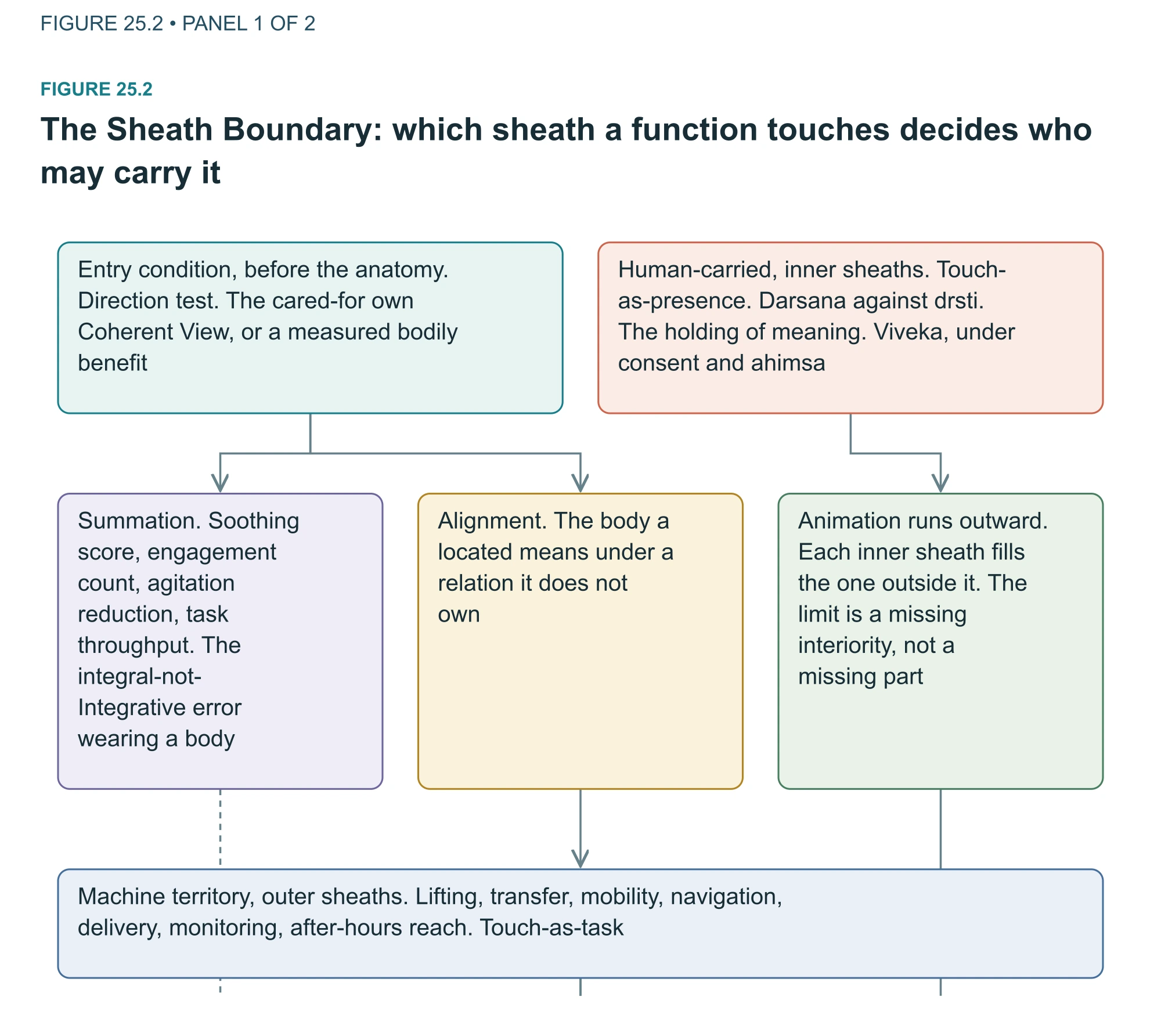
Figure 25.2. The Sheath Boundary: which sheath a function touches decides who may carry it. Panel 1 of 2.
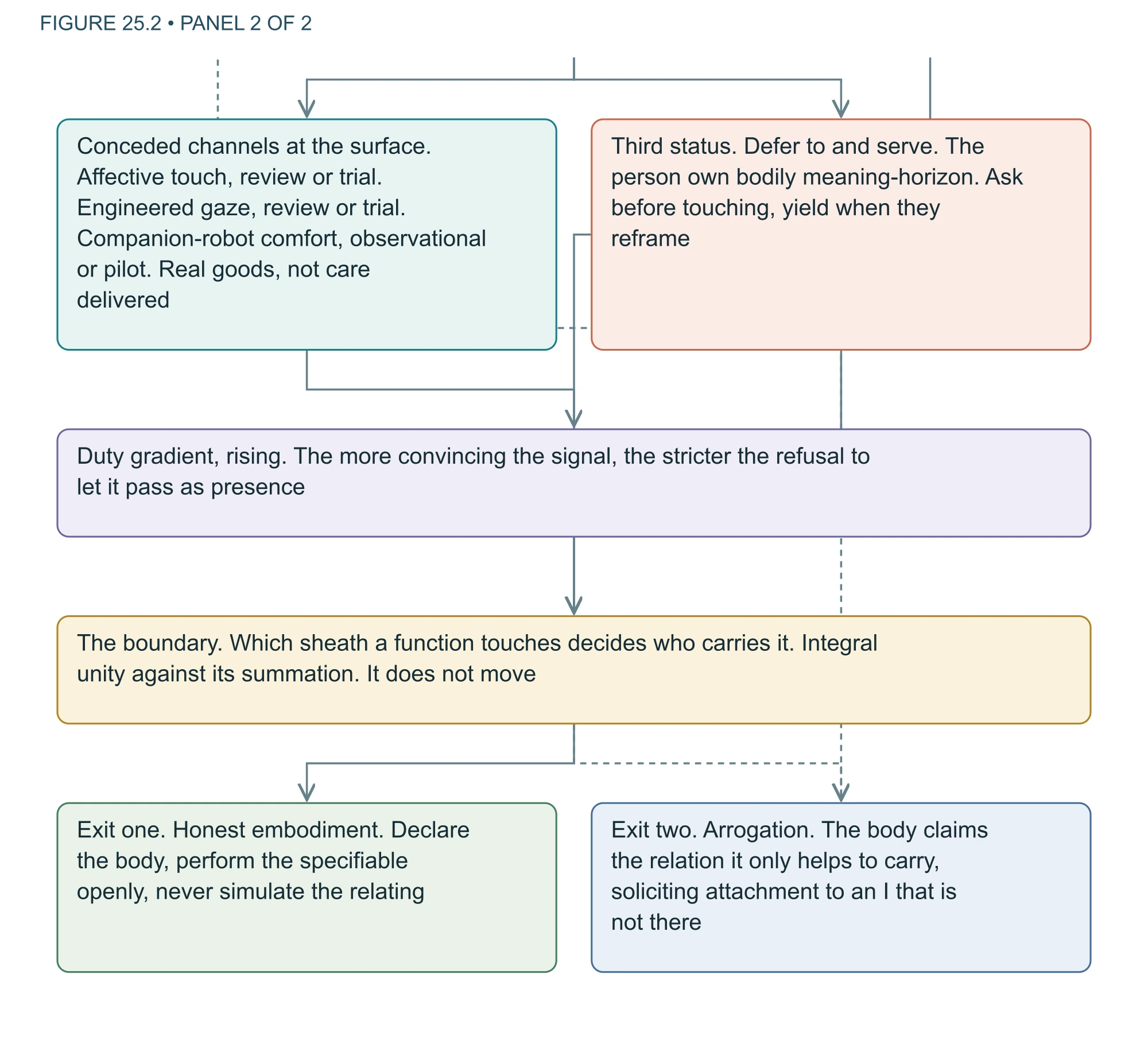
Figure 25.2. The Sheath Boundary: which sheath a function touches decides who may carry it. Panel 2 of 2.
The text also names, in its own words, why the inner boundary cannot be crossed by building outward. Of the reality behind the sheaths it says yato vāco nivartante, aprāpya manasā saha - 'that from which words turn back, together with the mind, not having attained' (TaU 2.4, repeated at 2.9). The innermost sheaths are marked by the Upaniṣad itself as what speech and mind do not reach; they are, in this book's vocabulary, unmediated, the very aparokṣa register §4 assigns to K4. A system that knows only by representing - however much tactile sensing and expressive actuation it is given - is a system of vāc and manas, of word and modelled mind, and the text's warning is that these turn back at exactly the sheaths where the relating and the indwelling presence of care reside. This is the Dharmic charter for the chapter's central limit: the gap between contact and communion is not a temporary engineering shortfall to be closed by a better body, but the boundary the tradition draws where representation ends. Notably, it is the vijñānamaya sheath - discriminative intellect, headed by śraddhā (faith) and flanked by ṛta and satya - that the text says 'conducts the sacrifice and conducts the works', yajñaṃ tanute karmāṇi tanute (TaU 2.4): discernment is figured as what governs right action, the anatomical seat of the viveka (YS 2.26) §2 keeps sovereign in the human. The machine may carry the annamaya labour; the vijñānamaya discernment of whether and how that labour should touch a person is, in the text's own placement, an inner-sheath act.
Touch is where this boundary is most easily transgressed and most in need of discipline. Sparśa (touch) is one of the five sense-objects - śabda, sparśa, rūpa, rasa, gandha (sound, touch, form, taste, smell) - and in care it is never mere mechanical contact but a carrier of presence, which is why ahiṃsā (non-harm) and consent govern it. A robot can perform the action of contact at the annamaya surface (K2); whether that contact can ever be the vehicle of presence is precisely the open question §8 carries forward. What the Dharmic frame settles now is the designer's duty in the meantime: touch that is not the bearer of an indwelling presence must not be passed off as if it were. Touch-as-task may be given to the machine; touch-as-presence may not be simulated by it.
The philosophical reason the authenticity critique is right, and not merely a sentiment about machines, is supplied by the Integrative's own third paradigm principle: our actions follow embodied knowing. The principle holds that knowing in action amalgamates gyaan (knowledge), karma (action) and bhakti (dedication) in a knowing had through the body rather than stored above it and executed by it (Chapter 4). A knowing that is constitutively embodied-and-dedicated cannot be delivered by a body that is operated rather than dwelt in; Principle 3 is thus the Integrative's own warrant for the limit the robotics critics reach by other routes. The body that carries care is the body of a gyaan-karma-bhakti knower, and that is not a specification a chassis can be built to meet.
The constraint this places on the artefact is named by the fourth principle. The human caregiver's discipline is to act 'without doership', not identifying as the source of the good (Chapter 4; Ch 5). Transposed from the caregiver to the machine, the de-centred ahaṃkāra (ego-sense) becomes a non-arrogation constraint on the body: the artefact may not arrogate presence to itself - no body that claims to be the one who cares, no face that solicits attachment to an 'I' that is not there. Where for the human the discipline is a spiritual self-emptying, for the machine it is a hard design rule; the resource disciplines the designer and the artefact, never the cared-for.
Two further terms place the body's honest work. Sevā (selfless service) is often the most bodily of cares - feeding, washing, lifting, holding - and is honoured, not disdained, in the tradition; that honouring is what licenses handing its specifiable labour to a machine so that the freed human hours go to the relating, the M-model's constructive rather than merely restrictive use (BG 3.10-25, lokasaṅgraha, carried from Chapter 24). Darśana - the mutual seeing-and-being-seen of true co-presence - names exactly what the engineered gaze cannot be, however well it is built. Between the sevā that a body may rightly give and the darśana that it cannot manufacture runs the line this chapter asks every embodied design to respect.
Beneath the boundary lies the principle that draws it, and it is the first of the Integrative Paradigm's five, unnamed until now in this chapter though its argument has carried the whole of the sheath-reading. Principle 1, respect for Integral Unity - ekaṃ sad viprā bahudhā vadanti, 'there is one truth, the knowledgeable speak it in many ways' (ṚV 1.164.46; Chapter 4) - holds that difference is difference of perspective on one reality, and that the manifestations of a thing are manifestations of a thing and not the thing assembled out of its parts. The pañcakośa is that principle given an anatomy. The five sheaths are not five persons, nor a person summed from five components; they are one person - satyaṃ jñānam anantam, the real, the knowing, the infinite (TaU 2.1) - manifest at five depths, each inner sheath filling and animating the one outside it (anyo 'ntara ātmā, TaU 2.2-2.5). To read the machine-reachable body as the outermost animation of an integral unity is a different act from reading it as the platform on which the person's other functions are mounted, and that difference is the whole of the chapter's quarrel with the paradigm §1 named.
For the platform ontology is a synthetic unity in the exact sense Principle 1 refuses - Integral Unity 'contrasted with synthetic unity' (Chapter 4), the integral-not-Integrative error (Chapter 4) read now at the level of the body rather than the care plan. It conceives the person as an assemblage of separable capacities - a sensing layer, an actuation layer, an affect-display layer, a modelled-cognition layer - each specifiable and, in principle, buildable, such that a sufficiently complete body would sum to a carer. The sheath map denies exactly this. The outer layers do not stand alongside the inner as co-equal modules to be totalled; they draw their life from the inner, so the sum of every buildable layer is not a person but a person's surface, and the animating within it was always drawing on is not one more component still to be added but the source the added components borrow from. The machine's limit is therefore not a missing part but a missing interiority, and interiority is not a part.
Naming the principle does more than the boundary alone could. Taken by itself, the sheath-boundary reads as a map of which functions are hard to build - a frontier a better engineering might push outward, annamaya today and manomaya tomorrow. Principle 1 says the frontier does not move, because it is not a line between easy and difficult functions but the difference between an integral unity and its summation, and no accumulation of summed parts crosses into the unity whose parts they are. This is the ontological ground the Embodied-Care Boundary Map (§7) stands on: its direction test and its pañcakośa gate presuppose that the person is one whole to be aligned, not a set of services to be allocated; strip that presupposition and the Map collapses into the task-throughput checklist its first gate exists to expose. The chapter's three principle-warrants now stand together and in their proper offices - Integral Unity (Principle 1) names what the person is that care touches, one whole and not a platform; embodied knowing (Principle 3) names how care is carried, through a body dwelt in and not operated; and without-doership (Principle 4) names the constraint on the artefact, a body that may not arrogate the presence it cannot own. The first was doing its work through every line of the sheath-reading; it is only now given its name.
7. Models, frameworks and practices
This chapter contributes three named, reusable instruments to this book's inventory, and each carries its differentia in its design rather than appending it as a caveat: an embodied care system is built to align a person's bodily and inner life toward their own Coherent View, not to sum a soothing surface onto a measured benefit.
The flagship instrument is the Embodied-Care Boundary Map, the embodied sibling of Chapter 24's Integrative Care-Agent Design Audit. It is a design-time review that runs a proposed robotic or embodied care system through four gates. The first is the direction test: is the body's intent the cared-for's own Coherent View, or a measured bodily benefit - a soothing score, an engagement count, an agitation reduction, a task-throughput figure - with care appended afterward? Naming the live objective is what exposes the integral-not-Integrative error before it is built into hardware. The second is the pañcakośa / M-model gate (§§2, 6): for each function, name which sheath it touches and whether it is specifiable - the outer-sheath physical tasks of lifting, transfer, mobility, monitoring, delivery and after-hours physical reach (annamaya / prāṇamaya, safe to automate) set against the functions reaching for the inner sheaths and the relating (presence, touch-as-communion, the holding of meaning), which stay human or, at most, accompanying. The third is the K1-K4 boundary (§4): name the knowing each function requires, and test that the design respects a body's inability to own K4 - touch without an indwelling presence is contact, not communion. The fourth is the non-arrogation / honest-embodiment clause: does the system declare its body for what it is, refrain from simulating presence or soliciting attachment to a self that is not there, and govern touch by consent and ahiṃsā (non-harm)? The Map's distinctive contribution is that it locates the limit anatomically rather than by a moralist's prohibition: the sheath a function touches decides who may carry it. Its appendix entry carries a model-agnostic worked design-review prompt, cross-referenced to Chapter 24's Care-Agent Design Audit and the M-model entry; the worked case is a companion robot proposed for a dementia ward (§8).
The second instrument is the Touch-and-Presence Discrimination, a practice-level rule for the question a body in care raises most sharply: where do a machine's hands belong? It separates touch-as-task - the specifiable contact of transfer, repositioning, washing, feeding, which is machine-eligible at K2 and the annamaya surface - from touch-as-presence, the sparśa that is the vehicle of an indwelling being-with and is therefore K4 and human-only. The discrimination travels with two guards that the Western authenticity critics reach for but cannot anchor: consent, because touch in care is never the carer's to take; and ahiṃsā, because non-consented or pretended-relational touch is a harm however gentle its actuation. The rule is for caregivers deciding what a deployed robot may do with a person's body and for designers deciding what to build into its hands (Table 25.1).
The third contribution is the pañcakośa Sheath-Boundary itself, lifted out as the analytic import the whole of Part V can reuse. Read as a design map rather than a metaphysics to be asserted (TaU 2.1-2.5), it states the K1-K4 boundary in anatomical terms - the machine serves the outer sheaths, the human carries the inner - and so gives a designer a principled, non-arbitrary place to draw the line wherever the body of a care system is in question. It is carried forward to Chapter 26, where the K1-K4 boundary it restates hardens into a safeguard (the Hard-Limit Test of that chapter's §4, which takes the boundary and not its anatomical form), and to Chapter 27, where the human-machine unit - of which the human-robot pair is the embodied case, worked there only in its disembodied form - becomes the bearer of the relation the machine body cannot own.
8. Applicability, cases and open question
Two cases show where the apparatus bites, both drawn from the field met in §§1-6 and run through the Boundary Map.
The first is the companion robot on a dementia ward - a Paro-type seal that responds to stroking with lifelike movement and sound, measurably lowering agitation and drawing a withdrawn resident back into interaction (Wada and Shibata 2007). The Map's direction test returns a conditional: the soothing is a real good, but the live objective is an agitation-score, so the deployment must be re-aimed to serve each resident's own settling and placed within, not instead of, human presence. The pañcakośa gate names the soothing for what it is - a genuine benefit at the annamaya and prāṇamaya surfaces, to be kept and named as such, never counted as care delivered nor used to thin human contact hours. The K1-K4 gate fixes the device's responsiveness at K1/K2 and denies it the K4 presence a resident may believe it holds. The honest-embodiment clause locates the remedy for the deception not in a better illusion but in the surrounding human practice staying truthful: staff and family treat the seal as a comfort object, not a carer, and the device is never made to claim a relation. The integral failure mode is the ward that substitutes the seal for human presence and books the falling agitation-score as care delivered - a good summed at the surface with the direction it was meant to serve quietly discarded.
The second is the assistive transfer-and-mobility robot that lifts, transfers, walks beside a person and monitors vital signs. This is the constructive case, where the same instruments that constrain the companion robot license the machine generously: the specifiable bodily tasks (K1/K2, annamaya) are handed to the robot precisely so that the freed human hours go to presence and relating, touch-as-task given to the machine and touch-as-presence kept human. Here the M-model and the sheath-boundary do constructive, not merely restrictive, work - sevā, the bodily labour of care, is honoured by being well-resourced, and the darśana of true co-presence is protected by being left to those who can give it.
Both cases are constructed from the design frame and the published Paro evidence rather than from a documented deployment, and are flagged for grounding against a real case in a later revision. The chapter links backward to Philosophy of the Integrative (Bindlish 2026, for Integrative Intelligence, the M-model and the open question under test), Ch 4 (the definition the Map operationalises), and Chapters 5, 7 and 10 (the formation, presence and unrelieved suffering a body must not 'soothe away'); and forward to Chapter 24 (the agentic sibling, to which this chapter adds the body), Chapter 26 (where honest embodiment and consent harden into safeguards) and Chapter 27 (the human-robot care unit). It carries one open research question of its own, inherited and sharpened from Chapter 24 and Philosophy of the Integrative (Bindlish 2026): can robotic touch ever be a genuine vehicle of presence, or is bodily co-presence in care in principle K4-bound and therefore human-only? And - the embodied form of Part V's standing question - is there a non-reductive way to assess honest embodiment in a built body, or only its specifiable K1/K2 functions? The answer conditions whether 'presence' is ever truthfully predicable of a machine body, or only of the human-robot unit (Ch 27).
Notes
1. K1-K4 labels. The four-level individuation (informational / skilful / contextual / realisational-aparokṣa) is the author's (Philosophy of the Integrative, Bindlish 2026) with the aparokṣa / parokṣa gradient as the model's spine (Chapter 4); the §4 claim that a robot is a K1/K2 embodied system serving K3 but unable to own K4, mapped onto the pañcakośa sheaths in §6, is proposed as an interpretation, not treated as a settled result.
2. Pañcakośa attribution. The five-sheath analysis (annamaya, prāṇamaya, manomaya, vijñānamaya, ānandamaya) follows the Taittirīya Upaniṣad (Brahmānanda Vallī, 2.1-2.5) and its Vedāntic commentarial development. Engaged at first hand in §6: the graded emanation to the annarasamaya person and annād vai prajāḥ prajāyante (2.1-2.2); the repeated head/wings/trunk/puccha pratiṣṭhā schema and the anyo 'ntara ātmā nesting by which each inner sheath fills the outer (2.2-2.5); yato vāco nivartante aprāpya manasā saha (2.4, repeated 2.9) read as the text's own marking of the inner sheaths as unmediated (the aparokṣa/K4 register of §4); and vijñānamaya as yajñaṃ tanute karmāṇi tanute (2.4), the anatomical seat of viveka-governed action. The mapping onto the K1-K4 boundary is this chapter's construction rather than part of the level definitions in Chapter 4; the pañcakośa attribution and verse loci are cited by canonical reference per house style.
3. Second-hand interlocutors. The the Western robotics and embodiment literature is therefore engaged from its standard statements rather than the archive, the established practice for the Part V AI chapters (cf. Ch 24 n3; Ch 7). Nikolić 2017 is engaged via Philosophy of the Integrative (Bindlish 2026).
4. No bibliography change: every §§5-6 work (Brooks 1991, Merleau-Ponty 1945, Dreyfus 1972, Breazeal 2002, Wada & Shibata 2007, Sharkey & Sharkey 2012, Sparrow & Sparrow 2006, Turkle 2011, Coeckelbergh 2010, Darling 2021, Nyholm 2020, Vallor 2016; TaU 2.1-2.5; Chapter 4) is already in back-matter/the References. No source bearing on §§5-6 silently dropped.
5. §7 inventory record. The three named instruments - the Embodied-Care Boundary Map (flagship), the Touch-and-Presence Discrimination, and the pañcakośa Sheath-Boundary - are reusable across Part V and carry their differentia in their design (Chapter 4).
6. The open research question is owned across Part V (cf. Ch 24 §8; Ch 27).
7. Sources for §5 include Brooks 1991 ('Intelligence without Representation' - activity decomposition; the world as its own best model; intelligence in the eye of the observer); Merleau-Ponty 1945 (corps propre; body schema; the habit analyses - the blind man's cane, the organist - and the body as 'our general medium for having a world', Smith translation); Dreyfus 1972 (the four assumptions - biological, psychological, epistemological, ontological - and Part V on the body); Breazeal 2002 (the infant-caregiver design template and the proto-social repertoire engineered to recruit human scaffolding); Wada & Shibata 2007 (the care-house study design: urinary stress-hormone assays and the social-network finding - ties among residents strengthened); Sharkey & Sharkey 2012 (the six concerns and the deployment-relative, both-directions conclusion on human contact); Darling 2021 (the animal analogy as an explicit refusal of the substitution frame); Nyholm 2020 (agency embedded in human-robot collaborations, responsibility with the initiating and supervising humans). Sparrow & Sparrow 2006, Turkle 2011, Coeckelbergh 2010 and Vallor 2016/2011 were read first-hand at Ch 24 §5 and are carried here by cross-reference.
8. §5's design programme, seventh in order and standing apart from the six conversations - care-centred value-sensitive design. Van Wynsberghe's care-centred value-sensitive design (van Wynsberghe 2013, 'Designing Robots for Care: Care Centered Value-Sensitive Design', Science and Engineering Ethics 19(2), 407-433; 2015, Healthcare Robots: Ethics, Design and Implementation) is engaged from its standard scholarly statement ; It extends Friedman's value-sensitive design by centring Tronto's (1993) account of care (the phases culminating in care-receiving, and the moral values attentiveness / responsibility / competence / responsiveness) and prescribes designing and evaluating care robots by whether a practice's care values are preserved or promoted; her worked cases include patient-lifting and hospital-delivery robots. Placed as the §5 interlocutor that reaches furthest on the chapter's own axis - the deliberate designing of care into the artefact - and differentiated on the three standing joints: source of the values (read off the practice and a settled account = the integral specification, Chapter 4), bearer (values 'manifested' in the artefact vs the sheath-boundary and K4 limit, §§4, 6), and telos (conservation of the practice's values vs alignment toward the cared-for's own Coherent View, Chapter 4). The underlying Tronto/Noddings care ethic is engaged in its own right at Ch 24 §5 and cross-referenced here to avoid double-counting. No archive source consumed; none dropped.
n11. §5 fifth interlocutor - the science and phenomenology of touch. The touch conversation is engaged from the standard scholarly statements of its sources ; Three convergent literatures: the affective-touch neuroscience of the C-tactile (CT) afferent system (McGlone, Wessberg & Olausson 2014, 'Discriminative and Affective Touch: Sensing and Feeling', Neuron 82(4), 737-755 - the CT population in hairy skin tuned to caress-velocity, skin-temperature stroking and projecting to posterior insula; the 'social touch hypothesis'); the communicative-touch finding (Hertenstein, Keltner, App, Bulleit & Jaskolka 2006, 'Touch Communicates Distinct Emotions', Emotion 6(3), 528-533 - above-chance decoding of anger, fear, disgust, love, gratitude and sympathy by touch to the forearm alone); and mediated/artificial social touch in HCI (van Erp & Toet 2015, 'Social Touch in Human-Computer Interaction', Frontiers in Psychology 6:1494 - artificial social touch conveys affiliative signals, its effect modulated by the recipient's beliefs about the source). The believed-source modulation is Gazzola, Spezio, Etzel, Castelli, Adolphs & Keysers 2012 ('Primary Somatosensory Cortex Discriminates Affective Significance in Social Touch', PNAS 109(25), E1657-E1666 - a physically identical caress felt differently according to the believed toucher). Placed as the fifth §5 conversation, after the authenticity/deception critique and before the van Wynsberghe design programme, because it bears on the touch axis that §6 (sparśa; touch-as-presence), §7 (the Touch-and-Presence Discrimination) and §8 (the open research question) turn on but which §5 had addressed only glancingly. Conceded: the CT channel makes the affective register of touch a specifiable, engineerable stimulus - the strongest empirical case that a care body reaches beyond mere mechanical contact into the annamaya/prāṇamaya good of §6. Differentiated on the standing joint: the channel codes the stimulus form of affiliative touch, while its felt valence is set from the inner sheaths by the believed bearer (Gazzola et al. 2012), so the science itself draws the §6 sheath-boundary - contact at the outer sheaths, communion decided at manomaya/vijñānamaya - and sharpens rather than dissolves the §8 open question, raising the non-arrogation duty (§6) in proportion to a touch's affective power. No archive source consumed; none dropped.
9. Principle 1 (Integral Unity) named as the sheath-boundary's warrant. The pañcakośa reading of §6 (Note 2) enacts Respect for Integral Unity - the first principle of the Integrative Paradigm (Chapter 4) - throughout, but the principle stood unnamed while Principles 3 (embodied knowing) and 4 (without doership) were drawn explicitly; names it and draws the integral-vs-synthetic-unity differentia (Chapter 4) against the platform ontology of §1, tying the Embodied-Care Boundary Map (§7) to the ontology its gates presuppose. ekaṃ sad viprā bahudhā vadanti (ṚV 1.164.46) is cited by canonical locus per house style (cf. Note 2 on the TaU); no bibliography change (the verse is cited by locus and the principle text is quoted from Chapter 4). No archive source consumed; none dropped.
10. §5 sixth interlocutor - the science of gaze and the uncanny valley. Engaged, like the fifth conversation (Note n11), from the standard scholarly statements of its sources ; The developmental leg: Farroni, Csibra, Simion & Johnson 2002 ('Eye Contact Detection in Humans from Birth', PNAS 99(14), 9602-9605 - newborns prefer a direct over an averted gaze) and Senju & Johnson 2009 ('The Eye Contact Effect: Mechanisms and Development', Trends in Cognitive Sciences 13(3), 127-134 - the fast route by which a meeting gaze recruits social attention). The engineering leg: Admoni & Scassellati 2017 ('Social Eye Gaze in Human-Robot Interaction: A Review', Journal of Human-Robot Interaction 6(1), 25-63 - mutual gaze, gaze-following and joint-attention timing as specifiable, engagement-raising robot behaviours). The uncanny-valley witness: Mori 1970 ('The Uncanny Valley', trans. K. F. MacDorman & N. Kageki 2012, IEEE Robotics & Automation Magazine 19(2), 98-100). Placed as the sixth §5 conversation, after the fifth (touch) and before the van Wynsberghe design programme, as the visual sibling of the touch axis: it fills the darśana / gaze axis that §6 (which names darśana as 'what the engineered gaze cannot be') and §1 ('a social robot meets a gaze') turn on but which §5 had asserted without drawing from the field. Conceded: the eye-contact channel is innate and detectable (Farroni et al. 2002), so an engineered gaze recruits the human social response as reliably as a real one - the visual counterpart of the CT channel's affective touch (Note n11). Differentiated on the standing joint: the gaze codes the stimulus geometry of being-met while the felt meeting is set from the inner sheaths by whether a beholder is present, the uncanny valley (Mori 1970) being the engineering literature's own registration that a manufactured appearance-of-presence can misfire when the outer-sheath signal outruns the inner-sheath reality; darśana (reciprocal beholding) is thereby distinguished from dṛṣṭi (mere looking), the honest-embodiment remedy is to decline the simulation rather than perfect it, and the non-arrogation duty (§6) is raised in proportion to a gaze's relational pull. No archive source consumed; none dropped.
CHAPTER 26