F.0 Before you use this appendix
This book does not get to decide whether jyotiṣa is true, and it must not appear to.
That sentence is the whole condition on which the rest of these pages are usable. Jyotiṣa - the Indic science of light and time, of which the reading of birth charts is one branch - is held, among the people this book is written for and about, in every position on the range. Many care recipients live by it. So do many caregivers: some hold it as valid knowledge, some are trained in it, some work closely with paṇḍits, and some are paṇḍits. Others, equally within the tradition, hold it as cultural inheritance rather than as knowledge. Others reject it. A caregiver who feels judged by an appendix will stop reading it, and an appendix that quietly sides with the sceptics has excluded a large part of its own readership from the safety guidance further down the page.
So the appendix describes the range and adjudicates none of it. What it does adjudicate is role, money, safety and the point at which a delay becomes a risk - and none of those four depends on anyone's view of the grahas.
Three rules govern everything below.
• The question is never whether you believe. It is which chair you are sitting in. A spiritual caregiver in that role does not become their care recipient's astrologer. F.4 states why, and it is not a scepticism argument.
• Attend to the use, not the chart. Not whether the reading is right, but what this person is doing with it and what it is doing to them. F.5 turns that into questions a caregiver can actually ask.
• Non-imposition runs in both directions. A caregiver may not press a tradition on a secular person, and equally may not press disenchantment on a believing one. Debunking at the bedside is imposition. F.9.
What this appendix is for. A caregiver in a Hindu, Hindustani-Surinamese, Indo-Caribbean or South Asian setting will meet jyotiṣa whether or not they go looking for it, and will meet it most often at the hardest moments: a diagnosis, a marriage, a birth, a death, a date for an operation. The appendix exists so that the conversation can be followed rather than nodded through. A caregiver who does not know what a daśā is will hear I am running a hard period as a figure of speech and will miss that the person has been given an end date.
How it is laid out. F.1 sets out what is actually held, and by whom. F.2 puts the two accounts of what a chart does side by side and rules on neither. F.3 is the working vocabulary, and is the section to read before a visit. F.4 is the role boundary. F.5 is the discernment aid - resource or verdict. F.6 and F.7 are the two risks, named as the tradition's own serious practitioners name them. F.8 is where this meets clinical care, and carries the escalation triggers. F.9 is non-imposition in both directions. F.10 reads this book's own two cases through the appendix. F.11 states the appendix's limits.
F.1 What is actually held, and by whom
The single most common error a caregiver makes here is to assume a position from a demographic. Hindu does not entail jyotiṣa; nor does Hindustani-Surinamese, nor Indian, nor devout. Educational attainment predicts almost nothing: the people who hold it most firmly include physicians, engineers and lawyers, and the people who reject it most firmly include some of the most observant temple-goers a caregiver will meet.
Five positions are common, and a caregiver will meet all five, sometimes in one family and occasionally in one person on different days.
• Held as knowledge. A real science of time with its own texts, its own mathematics and its own lineage of transmission, learnt and practised as a discipline. People in this position will often be precise about the difference between a competent jyotiṣi and an incompetent one, and impatient with newspaper astrology.
• Held as practice without a settled epistemology. The chart is consulted at the junctions - birth, marriage, a house move, a death - because that is what is done, and the question of whether it works is not one the person has needed to settle.
• Held as inheritance. Real as a family's language is real, and honoured for that reason. A person in this position may keep a horoscope in a drawer for forty years and never look at it, and be disturbed if it is thrown away.
• Held sceptically but observed anyway, usually for someone else: a mother's insistence, a grandmother's fear, a spouse's family. This position generates a particular kind of distress and is easy to miss, because the person will present the practice as something they do not believe while going to considerable trouble to do it.
• Rejected, and sometimes with heat, by people within the tradition who regard predictive astrology as a corruption of it. This position is old and internal to the tradition; it is not an import.
The same range runs among caregivers, and this is the fact that makes an even-handed appendix necessary rather than merely polite. In the settings this book describes, the paṇḍit and the spiritual caregiver are sometimes different people, sometimes colleagues, and sometimes the same person. This book's own archive contains a case in which the caregiving is done by a household paṇḍit and the astrological reading is part of it. A book which treated the astrological frame as an embarrassment would be telling a substantial part of its readership that their own practice is the problem, and would then have no standing to say the things about money and delay that actually need saying.
One consequence for practice, stated now because it governs F.5. Because the range is this wide, a caregiver cannot infer from this person consults a jyotiṣi anything at all about how they are holding it. The consultation is not the finding. What the person does with what they are told is the finding.
F.2 Two accounts of what a chart does, set side by side
This is the section a clinically trained reader will test the appendix against, and it is the section a believing practitioner will test it against, and both tests are fair.
The research position. The empirical literature that has examined astrological prediction has not supported it. The better-known studies are double-blind matching designs - astrologers asked to match charts to psychological profiles or to biographies - and large-scale record studies asking whether people born at nearly the same moment resemble each other in measurable ways. The results have been null or close to it. A reader with a clinical training will expect this appendix to know that, and it does.
Three honest qualifications on that literature, none of which is a dodge and all of which a careful sceptic would grant.
• Almost all of it tests Western tropical astrology, not jyotiṣa, which uses a sidereal zodiac, a different house system in common use, and above all the daśā system, which has no Western counterpart at all. Whether the null results transfer is an empirical question that has not been much asked.
• The designs test prediction of measurable outcomes from a chart. That is one claim among several the tradition makes, and it is not the one most adherents rest on.
• No study in this literature has been read at first hand. The paragraph above describes the shape of a literature, and this appendix does not cite what it has not opened. Primary-source verification of these references remains necessary.
The adherent's position, stated in its own strongest form rather than a weak one. Educated adherents very often do not hold that a chart forecasts an external fate. They hold that a chart is a reading of what is ripening from what was already set in motion - a map of the portion of one's own past action now coming due. On that account the chart does not cause anything and does not predict an event in the way a weather model predicts rain; it describes the terrain of a period, in the idiom of a karmic framework the tradition holds independently. Its warrant is textual and lineage authority, and the long practical experience of practitioners who have read many thousands of charts. Its use is orientation and timing, not forecast.
The structure of the disagreement, which is the useful thing here. For yoga and Ayurveda the research is thin and lagging: it is trying to see the same thing the practitioner sees, and has not yet managed it. Here that is not the situation. The tradition's own account of what a chart does is largely not the claim the research tests. Saying so is more accurate than saying either that the research has refuted jyotiṣa or that jyotiṣa has evidence behind it. It is also what allows this passage to be honest without being dismissive.
Where the two accounts do meet, and it matters. They meet on any claim that a chart forecasts a specific external event - a date of death, the sex of a child, the failure of an operation. That is a predictive claim in the research literature's sense, the literature does not support it, and it is the claim that does the most harm in a care setting. Serious practitioners are frequently the first to refuse it, and section F.7 says so. So a caregiver does not have to adjudicate the tradition in order to be worried about a specific fatal prediction: the tradition's own better practitioners are worried about it too.
And the book's own commitment, which is not a verdict on the grahas: the Coherent View that governs the care is the cared-for's own. If a person's coherence runs through a chart, the caregiver's work is inside that frame, not against it. Table F.1 puts the two accounts in adjacent columns for exactly that purpose: not so that a caregiver can settle between them, which is not the caregiver's job, but so that a sentence said in the room can be recognised as belonging to one column or the other before anything is said back.
For a caregiver who wants to be able to hold both in mind in a conversation. Neither column is this book's position; the book's position is the row at the foot.
Table F.1. The two accounts, and what each does and does not claim.
The research position | The adherent's position | |
|---|---|---|
What a chart is taken to be | A set of variables from which outcomes are predicted | A reading of what is ripening from what was already set in motion |
What is tested | Whether chart data predict measured outcomes above chance | Not tested in this sense; warranted by text, lineage and long practice |
The finding, or the ground | Null or near-null in the studies that exist, almost all of them on Western tropical astrology | Coherence of the system, and the practitioner's own accumulated reading |
What it says about a hard period | Nothing; the category is not one it recognises | A stretch in which particular material comes due, with a beginning and an end |
What both would refuse | A specific fatal prediction | A specific fatal prediction, in most serious practice - see F.7 |
What the caregiver does | Neither adjudicates. The caregiver attends to the use (F.5), holds the role boundary (F.4), and escalates on clinical grounds alone (F.8) |
F.3 The working vocabulary: what to know before a visit
Read this section for recognition, not for competence. Nothing here trains anybody to read a chart, and a caregiver who begins interpreting one has walked across the boundary F.4 draws. What it does is let a caregiver follow a sentence rather than nod through it.
Jyotiṣa (ज्योतिष) is one of the six vedāṅgas, the auxiliary disciplines attached to the Veda, and the one concerned with light and time. Its original and defining work was calendrical: fixing the times at which rites are performed. The tradition classically divides it into three - the mathematical astronomy of positions and calendars, the saṃhitā branch concerned with collective and mundane matters, and horā, the branch that reads individual charts. Almost everything a caregiver meets is the third branch, and it is worth knowing that the discipline's own self-understanding is much larger than the birth chart.
The classical literature most often named is the Bṛhat Parāśara Horā Śāstra, attributed to Parāśara, which is the standard reference work of the natal branch; and the Bṛhat Jātaka of Varāhamihira, who also compiled the Bṛhat Saṃhitā on the mundane branch. Later handbooks in wide practical use include the Sārāvalī and the Phaladīpikā. None of these has been read at first hand, and this appendix therefore names them and quotes none of them; a caregiver who wants to know what a text actually says should ask the person's own jyotiṣi, which is in any case a better conversation than a citation.
The chart's furniture. A birth chart, janma kuṇḍalī, is a map of the sky at a moment and a place. Four kinds of thing sit in it.
• Grahas (ग्रह), conventionally translated planets, but the word means seizer or grasper, and the translation loses something a caregiver should keep. Nine are counted: Sūrya (Sun), Candra (Moon), Maṅgala (Mars), Budha (Mercury), Bṛhaspati or Guru (Jupiter), Śukra (Venus), Śani (Saturn), and Rāhu and Ketu, which are not bodies at all but the two points where the Moon's path crosses the Sun's. In Sarnami and Surinamese-Dutch speech the word is commonly heard as garah.
• Rāśis (राशि), the twelve signs, on a sidereal zodiac tied to the fixed stars rather than to the equinox - which is why an Indian chart usually puts a person in a different sign from a Western one, and is a frequent source of confusion in a mixed family.
• Bhāvas (भाव), the twelve houses, which are the domains of a life: body and self, family and speech, siblings and effort, home and mother, children and merit, illness and enmity and debt, marriage and partnership, longevity and upheaval and inheritance, fortune and teachers, work and standing, gain and networks, and loss, expenditure and release. Table F.2 sets these out with what people actually bring to each, and it is the single most practically useful page of this appendix, because it lets a caregiver hear which department of a life a person is worried about.
• Nakṣatras (नक्षत्र), the twenty-seven lunar mansions. These matter to a caregiver for two reasons: the daśā system is keyed to the one the Moon occupied at birth, and a small number of them carry rites attached to birth in them - which is the whole substance of one of this book's own cases.
Daśā (दशा), the period systems, and this is the thing to understand if you understand only one. The most widely used is the Viṃśottarī daśā, which divides a notional hundred and twenty years among the nine grahas in fixed spans, beginning from the nakṣatra of the Moon at birth, and subdivides each span into sub-periods. When a person says I am running a hard period, or I have four more years of this, this is what they mean. They have been given a beginning and an end. That is not a figure of speech and a caregiver who hears it as one will miss both the fear in it and, very often, the consolation.
Gocara (गोचर), transits: where the grahas are now, against where they were at birth. Three transit phenomena are so widely felt in these communities that a caregiver will hear them named without explanation.
• Sāḍesātī (साढ़ेसाती), the roughly seven-and-a-half-year passage of Śani through the sign before, the sign of, and the sign after the natal Moon. It is spoken of as a long, heavy, formative stretch. It is also the single most common frame in which a person will describe several years of accumulated difficulty as one thing.
• Kāla sarpa, the configuration in which the seven bodies fall on one side of the axis between Rāhu and Ketu. Worth knowing for a reason that is itself useful: many serious practitioners hold that it is not in the classical literature at all and regard its current prominence as a modern and largely commercial construction. A caregiver who has heard that will understand why one jyotiṣi dismisses what another charges for.
• Maṅgala doṣa, also maṅgalik or kuja doṣa: a placement of Mars held to afflict a marriage. This is the attribution that does the most social damage in this book's communities and it falls hardest on women in marriage negotiation. F.7 returns to it.
Muhūrta (मुहूर्त), the choosing of auspicious times. This is the branch that most often arrives inside a care setting, because a treatment, an admission, an operation, a discharge or a funeral can all be timed, and F.8 is about what to do when one is.
Upāya (उपाय), the remedial repertoire. What is prescribed when a chart shows difficulty: mantra japa, the repetition of a formula keyed to the graha concerned; dāna, giving, often of a specified substance on a specified weekday; vrata, a fast or vow; pūjā and homa, offering rites; śānti rites, propitiations attached to particular configurations; and gemstones, which are the part of the repertoire that costs money and are therefore the part F.7 attends to. Most of the repertoire is inexpensive, repeatable and performed by the person themselves, which is worth saying plainly, because a caregiver who has only heard about gemstones will have a distorted picture of what a jyotiṣi usually recommends.
A recognition aid. Read the middle column when a person names a house number, and the right-hand column for what the concern usually turns out to be in a care setting. Not a diagnostic tool, and nothing in it licenses an interpretation.
Table F.2. The twelve bhāvas, and what people actually bring to each.
House | Classical domain | What a person is usually worried about when they name it |
|---|---|---|
1 (tanu) | Body, self, constitution, the shape of a life | Their own health, and who they have turned out to be |
2 (dhana) | Family of origin, speech, wealth held | Money, and what the family will say |
3 (sahaja) | Siblings, courage, effort, short journeys | A brother or sister, and whether they have the nerve for something |
4 (sukha) | Mother, home, land, inner ease | A mother's health, a house, and homesickness |
5 (putra) | Children, learning, merit carried forward | Fertility, a child in trouble, an examination |
6 (ripu) | Illness, enemies, debt, service | A diagnosis, a creditor, a workplace |
7 (kalatra) | Marriage, partnership, the other | A marriage being arranged, or coming apart |
8 (āyus) | Longevity, upheaval, the hidden, inheritance | Death - their own or another's - and things that cannot be said aloud |
9 (dharma) | Fortune, father, teachers, pilgrimage | A father, a faith that has gone quiet, a journey not made |
10 (karma) | Work, standing, action in the world | A job, a reputation, a career ending |
11 (lābha) | Gain, networks, elder siblings | Whether the thing hoped for will come |
12 (vyaya) | Loss, expenditure, seclusion, release | Money going out, a hospital or prison, and letting go |
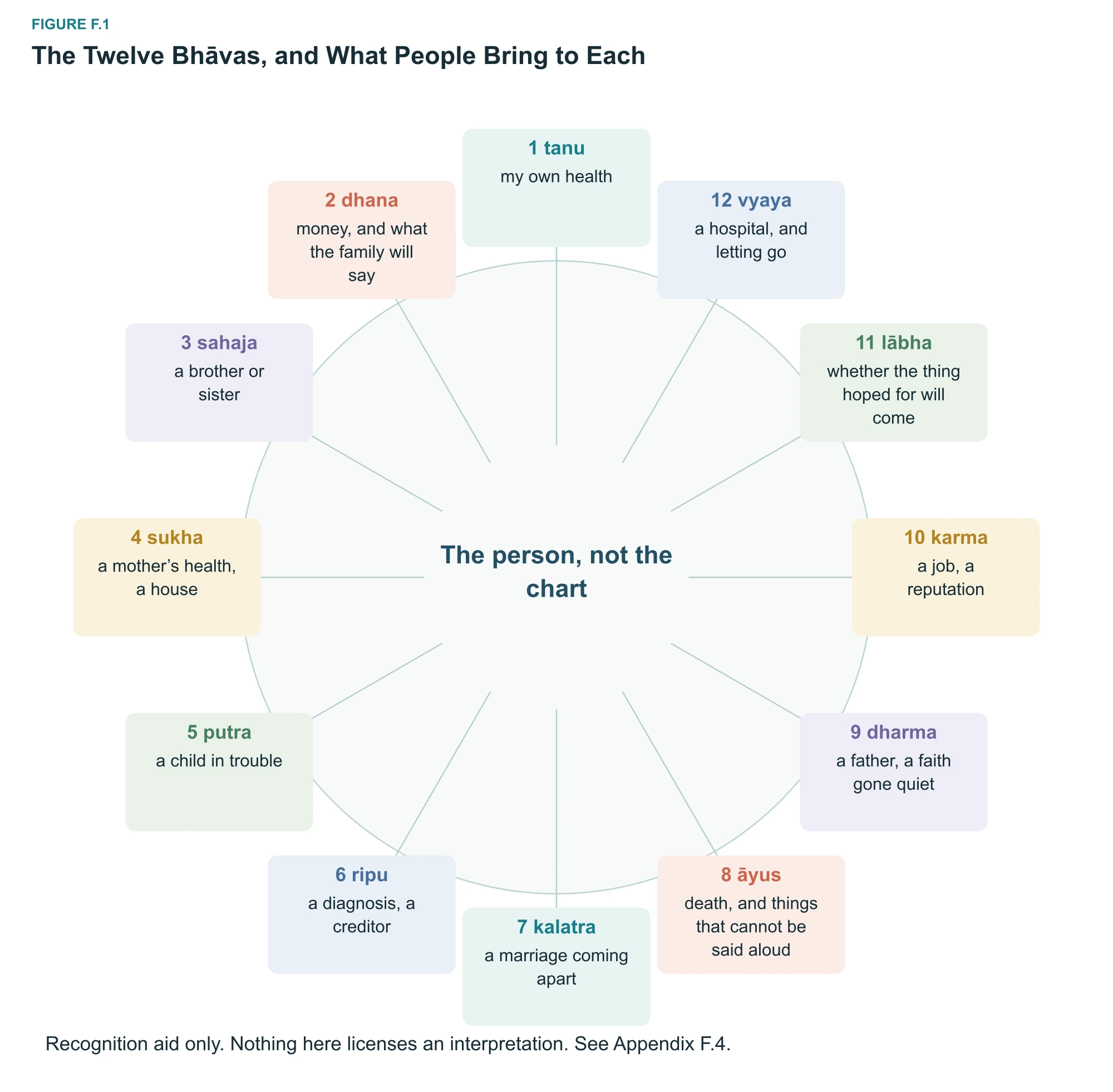
Figure F.1. The Twelve Bhāvas, and What People Bring to Each.
The Sanskrit is in the books; the speech is Sarnami, Hindustani and Surinamese Dutch. A caregiver who knows only the IAST will not recognise the word when it is said to them. This strip is for scanning before a visit.
Table F.3. What you will hear, and what it is.
What you will hear | What it is | IAST |
|---|---|---|
garah, grah | A graha; often meaning "which one is currently operating" | graha |
jaap, mantra jaap | Repetition of a formula, usually a fixed count | japa |
surya jal | The morning offering of water to the sun | sūrya jala |
mool, mool puja, mool shanti | The propitiation attached to birth in certain nakṣatras | mūla śānti |
sade sati, sarhe sati | Saturn's seven-and-a-half-year passage over the natal Moon | sāḍesātī |
dasha, mahadasha | A planetary period, and the major one currently running | daśā, mahādaśā |
kundli, janam patri, horoscoop | The birth chart itself, often a physical document | janma kuṇḍalī |
pandit, pandit ji, huispandit | The officiant; huispandit is the household's own | paṇḍit |
shanti, shanti karma | A propitiatory rite; also simply "peace" | śānti |
upay, remedie | The remedy prescribed | upāya |
muhurat | The chosen auspicious time | muhūrta |
One caution on this table. These are the forms this book's own case material uses, in a Dutch Hindustani-Surinamese setting. Other communities say them differently, and Tamil, Telugu, Gujarati and Bengali usage will not match this strip. Ask.
F.4 The boundary is about role, not about belief
The question is never whether the caregiver believes. It is which chair they are sitting in.
This is stated first because every other formulation of the boundary fails. Do not do astrology excludes the caregivers who are trained in it and reads as a verdict. Keep your beliefs out of the room is unworkable and untrue to how care is actually given. Role clarity is the formulation that a believing caregiver can use, and it is also the one that is actually correct.
What goes wrong when the roles collapse. A spiritual caregiver and a jyotiṣi are two relationships with different authority, different accountability and - decisively - different money.
• Authority. A caregiver's authority is to accompany. A jyotiṣi's is to read and to tell. A person who came for the first and receives the second has been given something with more weight than they consented to, from someone they had already decided to trust with their fear.
• Accountability. A caregiver in a formal setting is accountable to an institution, a code and often a complaints procedure. A jyotiṣi in most of these settings is accountable to their own lineage and reputation. When the two are the same person, it becomes unclear which accountability a given sentence was spoken under, and a person who is unhappy with a reading has nowhere to take it.
• Money. A care relationship is either free or paid for by a third party. A consultation is paid for by the person. Nothing the person pays for is arranged through the care relationship. This is the hardest line and the one that most needs to be plain, because it is the one that will be crossed by accident and with good intentions.
Where a caregiver is also a paṇḍit or a jyotiṣi - which in these communities is common, is often a real asset, and is not a problem in itself - three things make it safe.
1. The role change is made explicit. Said aloud, in words the person can repeat back. What you are asking me now is not something I can do as your caregiver. I can do it in my other capacity, and if you want that, we should say so and arrange it separately.
2. It is consented to, at a moment when the person is able to decline without cost, which is not the same moment as the one in which they asked.
3. It is never made inside a care encounter the person came to for something else. A visit arranged to sit with a frightened woman is not a visit in which a chart is read, however naturally the request arises.
And one that is not negotiable: the money is arranged elsewhere, by someone else if possible, and never in the room. Table F.5 sets the three conditions and the money rule out as a working page, with what each looks like when it is met and what to do when it cannot be.
This is not a special rule for astrology. It is the discipline this book applies to any dual relationship - the caregiver who is also a relative, also a neighbour, also a member of the same congregation, also the person who will officiate at the funeral. Stating it as role clarity rather than as scepticism is what makes it usable by a caregiver who believes, and it is also what makes it apply symmetrically to the caregiver who does not.
Table F.4. Role-clarity prompts. Six questions to ask yourself, not the person. Any no in the right-hand column is the signal to stop and name the role change aloud. Useable on any dual relationship, not only this one.
Table F.5. The dual role: the three conditions, and the one that is not negotiable.
Ask yourself | You are still in the caregiver's chair if |
|---|---|
What did this person come for today? | What is happening now is what they came for, or something they have explicitly asked to change to |
Whose expertise is being used? | The expertise being used is accompaniment, not interpretation of a chart |
Am I telling or accompanying? | You are not making claims about what will happen to them |
Would I say this in a case note? | The sentence you are about to say could be written down and read by a colleague |
Does any money attach to what happens next? | No, and nothing that happens next has been arranged by you |
Could they decline right now without cost? | Yes, and they know it |
For a caregiver who is also a paṇḍit, a jyotiṣi, a relative, a neighbour, a member of the same congregation, or the person who will officiate at the funeral. This is a dual-relationship instrument and not an astrology one; nothing in it turns on whether the second role is one this book has an opinion about. Table F.4 tells you whether you are still in the caregiver's chair. This table is what to do once you know you are not.
Table F.6. Resource, or verdict?
What must be true | Done properly, it looks like this | If it cannot be met |
|---|---|---|
1. The role change is said aloud, in words the person can repeat back to you | What you are asking me now is not something I can do as your caregiver. I can do it in my other capacity, and if you want that, we should say so and arrange it separately. | Do not proceed. A role change nobody named was not consented to, however willingly the person asked for it |
2. It is consented to at a moment when the person can decline without cost - which is not the moment they asked | The asking and the agreeing are separated, and the person has been told in terms that declining changes nothing about the care they are already receiving | Do not proceed yet. Come back to it when the person is not frightened, not mid-crisis, and not waiting on you for something else |
3. It is never made inside a care encounter arranged for something else | The second role happens at a different time, in a different arrangement, with the person's understanding that this is what it is | Do not proceed. A visit arranged to sit with a frightened woman is not a visit in which a chart is read, however naturally the request arises |
4. NOT NEGOTIABLE. The money is arranged elsewhere, by someone else if possible, and never in the room | No fee, no gift and no obligation is discussed, set, accepted or implied inside the care relationship or by you | There is no safe version of this. If the money cannot be arranged outside the care relationship, the second role is not available in this case, and that is the end of it |
Read the fourth row first. It is the one that will be crossed by accident and with good intentions, because a person who trusts you will offer, and refusing money feels like refusing the person. The other three protect the person's consent; this one protects the fact that your care was never for sale, which is the thing they cannot check for themselves.
F.5 What the caregiver actually attends to: the use, not the chart
Not whether the reading is right. What this person is doing with it, and what it is doing to them.
This is the appendix's central practical move and it is the one that lets a caregiver of any conviction work well. It also happens to be exactly the discipline this book applies everywhere else: the caregiver is not in the business of assessing whether a person's frame is correct, but of noticing whether the person is being carried by it or crushed under it.
Very often it is carrying them, and the appendix says so without embarrassment. A daśā that has a name and an end date turns four formless years of misery into a stretch of weather with a far edge, and that is not a small thing to be given. A remedy performed daily gives a person something to do at five in the morning when there is nothing to do. A rite performed for a frightened child gives a family a way to act in love rather than in helplessness. A caregiver whose first instinct is to be worried about all of this has misread the ordinary case.
The failure mode is different, and it is specific: the frame stops being a resource and becomes a verdict. The distinguishing marks are not about content. They are about what has happened to the person's own agency.
Read down both columns; a person is usually somewhere on a line between them, and can move along it in either direction within a week. This is a discernment aid and not a screening instrument: no count of ticks means anything, and no cell in the right-hand column, on its own, is a reason to do anything at all except pay attention.
The frame as a resource | The frame as a verdict |
|---|---|
The period has an end, and the person can say when | The prediction has no end, or the end is a death |
The person still makes decisions, and consults about timing | Decisions have stopped; everything is deferred to the next reading |
Practice is something they do | Practice is something they must do or something terrible follows |
One reader, consulted at junctions | Several readers, consulted with rising frequency |
Cost is stable, modest, and known to the family | Cost is rising, is concealed, or is borrowed |
The reading is one voice among several they weigh | The reading has overruled their doctor, their family and their own sense |
They can describe what they would do if the reading were wrong | The question is unintelligible to them |
Relief, order, patience | Dread, secrecy, urgency |
Questions a caregiver can actually ask. These are ordinary and can be said aloud without either endorsing or doubting the frame. They are worth learning by heart, because the point at which they are needed is not a point at which anyone composes well.
• What did they tell you, in their own words? Not what is your chart - what was said. The gap between the two is frequently the whole finding.
• When does this period end? If there is an end, the person almost always brightens saying it. If there is not, that is worth knowing.
• What has it made easier? Asked before anything else, and asked sincerely. It gets an honest answer, and it establishes that you are not here to argue.
• Is there anything you have stopped doing because of it? This is the load-bearing question, and it is where a deferred treatment surfaces.
• Who reads for you, and how did you come to them? Reputation, family, lineage, an advertisement, a phone number given by a stranger. These are very different situations.
• What does it cost, and how are you managing that? Asked plainly, as one would ask about any other outgoing. Not asked with an eyebrow.
• What would your [mother, husband, son] say about all this? Opens the family field, where the coercion, if there is any, usually lives.
• If it turned out differently from what they said, what would you do? The gentlest test of whether agency is intact. A person holding it as a resource has an answer.
One thing not to ask. Do you really believe that? It ends the conversation, it makes the caregiver's own position the subject, and it does not even elicit the information - because the five positions in F.1 do not sort into believers and non-believers.
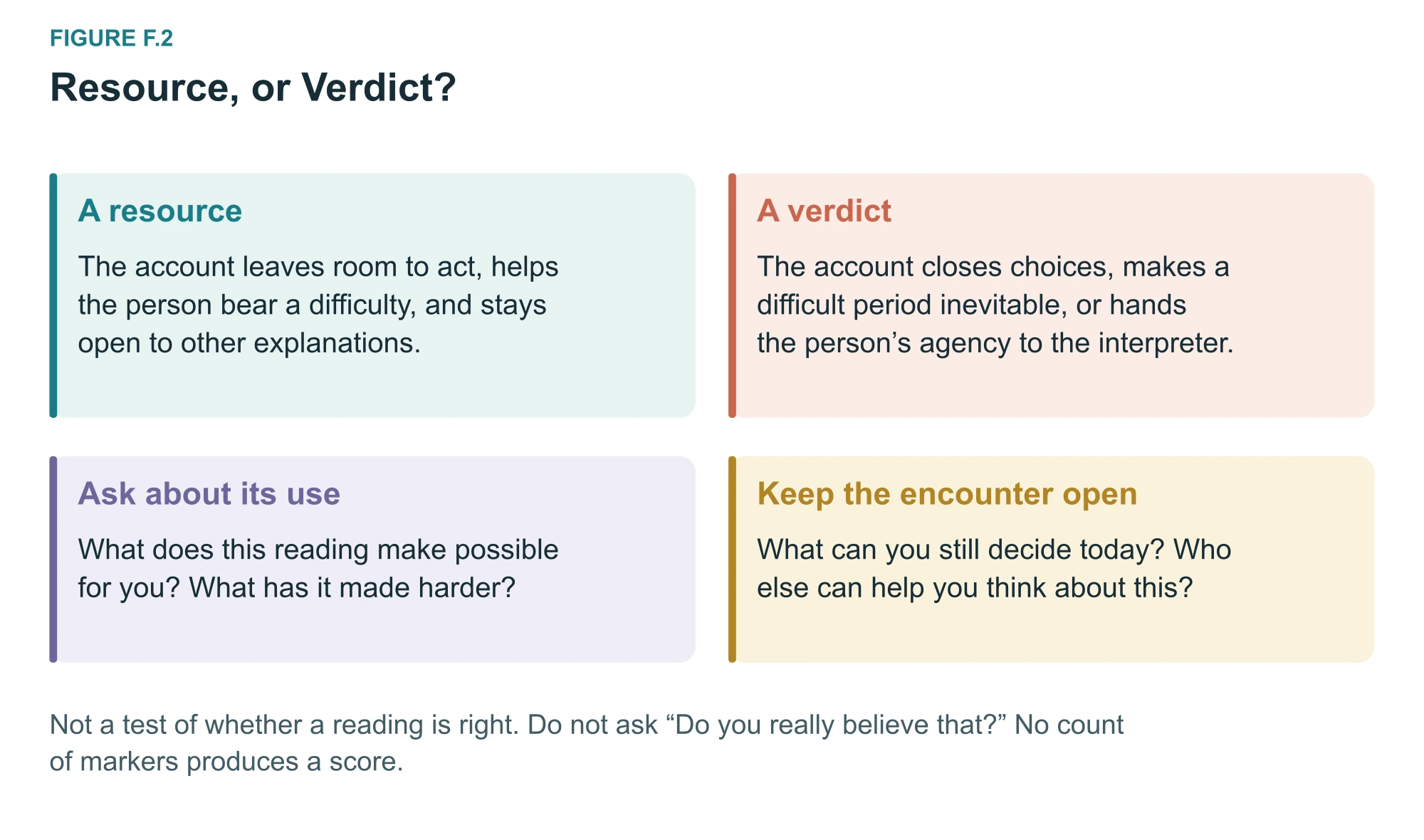
Figure F.2. Resource, or Verdict?.
F.6 Fatalism, and the tradition's own correction
A hard period heard as a sentence. This is the first of the two risks, and it is the one a caregiver will meet most often.
The shape is always the same. A person is told that a difficult stretch is running. What they hear is that nothing they do will matter until it ends. The practical consequence is not metaphysical - it is that a person stops applying for the job, stops the physiotherapy, stops speaking to the estranged son, on the grounds that this is not the time. Two years later the period ends and the losses are real.
The correction is already in this book, and it is in the tradition's own idiom rather than an outsider's. The tradition divides karma into three:
• Saṃcita - the whole accumulated store, everything not yet come due.
• Prārabdha - the portion now ripened and being lived through. This is what a chart is held to describe.
• Āgāmī - what is being made now, by what this person does today.
What is being borne is not the same as what is being decided. Prārabdha is the weather. Āgāmī is the walking. On the tradition's own account the chart addresses the first and says nothing whatever about the second, and agency stays exactly where it always was. A reading that is heard as covering both has been misheard, and the misreading is a mistake within the tradition, not a correction imported from outside it.
This matters for how a caregiver says it. You shouldn't let astrology run your life is an outsider's sentence, it will be received as an attack on the frame, and it will not work. Which of this is prārabdha and which is āgāmī? is an insider's sentence. It concedes everything the person holds and still opens the whole question of what they are going to do this week. Many jyotiṣis say precisely this themselves, often in stronger terms than a caregiver would use, and where a person has a reader they trust, the most effective move available is frequently to ask them to put the question to that reader. Table F.7 is that insider's sentence turned into something a caregiver can draw on the back of an envelope, and it is short on purpose: the whole of its use is that the right-hand column stays available whatever is running on the left.
The two columns a caregiver can draw on the back of an envelope. Every row on the right is available today, whatever is running on the left.
Table F.7. What is being borne, and what is being decided.
Prārabdha - what is ripening | Āgāmī - what is being made |
|---|---|
The period, its length, its weather | What you do on any day inside it |
The diagnosis you were given | Whether you attend the appointment |
That the estrangement happened | Whether you write the letter |
The loss already suffered | How it is carried, and who is told |
That this stretch is heavy | Whether it is spent alone |
Not chosen, and not your fault | Chosen, and yours |
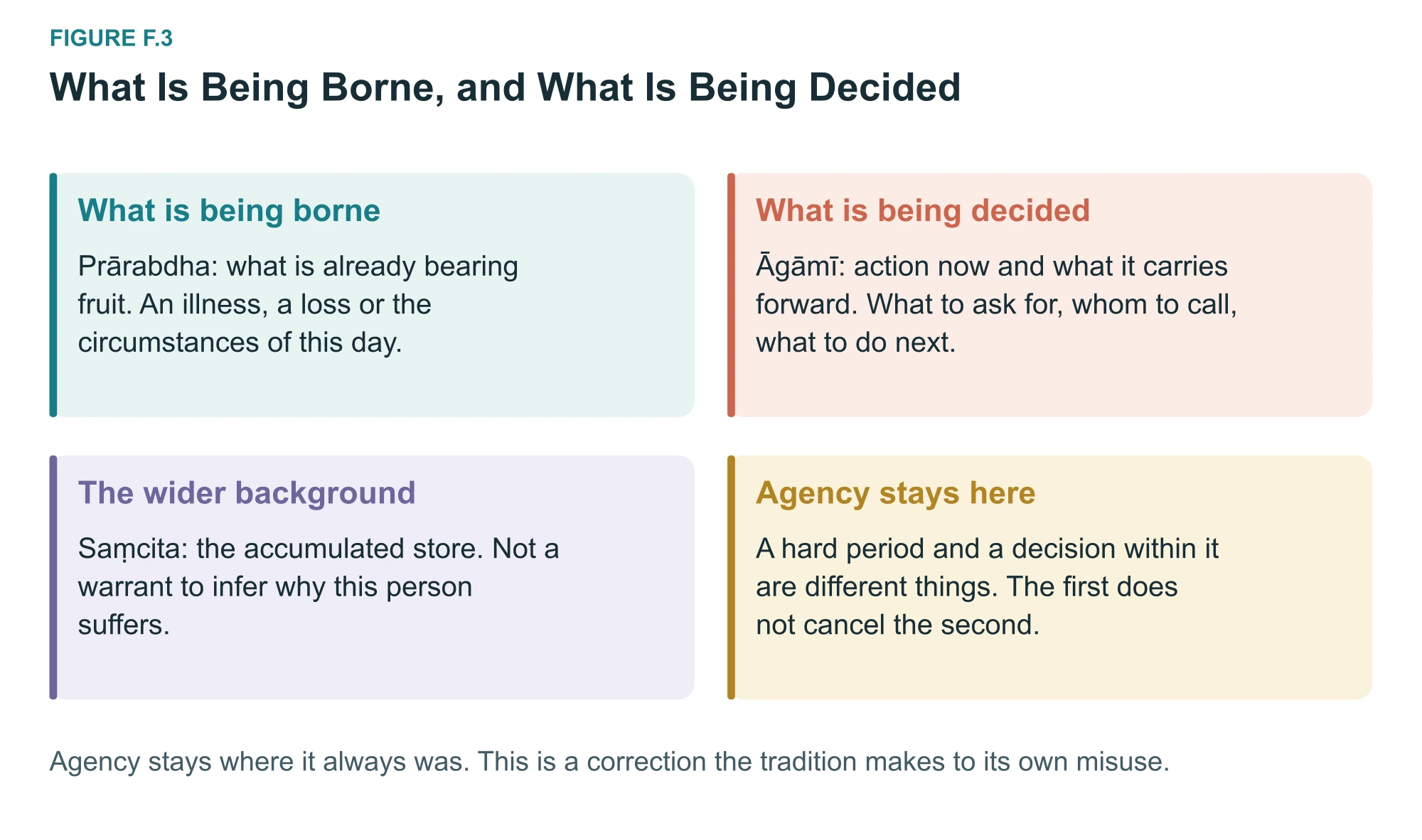
Figure F.3. What Is Being Borne, and What Is Being Decided.
One caution about using it. This is not a technique for talking a person out of despair, and offered as one it will fail. It is a distinction the person's own tradition holds, offered to a person who may already know it and may simply not have thought of it in the last six weeks. If it is going to help, it usually helps immediately. If it does not, the problem is not that it was explained badly.
F.7 Exploitation, named as practitioners themselves name it
The second risk is money, and the framing matters as much as the content.
These are harms that the tradition's own serious practitioners deplore, and framing them that way is both truer and more persuasive than framing them as what astrology does to people. A jyotiṣi of standing will speak about the industry in terms sharper than anything in this appendix. The person a caregiver most wants on their side, when a family is being milked, is another practitioner.
Four patterns, and the first three run together.
• Escalating fees. A first consultation at a modest price, followed by a recommended remedy at a much higher one, followed by a further reading to check whether the remedy worked.
• Fear-driven repeat consultation. The reading that must be renewed, the configuration that must be watched, the appointment made because the person cannot bear not to know.
• Remedies sold to the frightened.Gemstones are the usual vehicle, because they carry a price a mantra does not. A japa, a fast, a weekly gift of a small quantity of some substance to someone who needs it - the ordinary repertoire is cheap and is performed by the person themselves. A four-figure stone is a different kind of object, and the honest thing to say about it is that the classical repertoire does not require it.
• Doṣa attributions in marriage negotiation, which are a different harm and fall overwhelmingly on women. Maṅgala doṣa is the common instance: a young woman told that her chart afflicts a marriage, and priced accordingly in a negotiation, or refused, or married under a compensating rite. A caregiver working with a young woman in a marriage negotiation should know that this is a live mechanism and should hear a phrase like there is a problem with her horoscope as the social event it is.
What a caregiver can and cannot do about it. Cannot: adjudicate whether a fee is fair, or tell a person their reader is exploiting them. That is not their standing and it will not be believed. Can, and these are worth having ready:
• Ask the ordinary financial questions in an ordinary voice, as one would about any outgoing. Concealment is the finding, not the amount.
• Notice who else knows. A cost hidden from the family is a different situation from one the family has agreed.
• Name the classical repertoire's cheapness, which is a factual point inside the tradition and not a challenge to it: most upāya is done by the person, at home, for nothing.
• Involve a second practitioner, where the person has one they trust, or where the community has one whose standing is not in doubt.
• Escalate as safeguarding when it is safeguarding, which it becomes when there is coercion, when an adult at risk is being financially abused, or when a person is borrowing to pay. That threshold is the ordinary one and does not depend on anyone's view of astrology.
Table F.8 carries the four patterns against what a caregiver can do about each, with the two things a caregiver cannot do stated on the table itself and the safeguarding threshold printed beneath it.
That is not their standing and it will not be believed. Everything in the third column is available to them anyway. These are harms that the tradition's own serious practitioners deplore, and saying so is both truer and more persuasive than framing them as what astrology does to people.
Table F.8. Financial harm: the four patterns, what a caregiver can do, and where it stops.A caregiver cannot adjudicate whether a fee is fair, and cannot tell a person their reader is exploiting them.
The pattern | How it shows | What a caregiver can do about it |
|---|---|---|
Escalating fees | A first consultation at a modest price, then a recommended remedy at a much higher one, then a further reading to check whether the remedy worked | Ask the ordinary financial questions in an ordinary voice, as about any outgoing. Concealment is the finding, not the amount |
Fear-driven repeat consultation | The reading that must be renewed, the configuration that must be watched, the appointment made because the person cannot bear not to know | Notice who else knows. A cost hidden from the family is a different situation from one the family has agreed |
Remedies sold to the frightened | Gemstones are the usual vehicle, because they carry a price a mantra does not | Name the classical repertoire's cheapness - a factual point inside the tradition, not a challenge to it. Most upāya is done by the person, at home, for nothing |
Doṣa attributions in marriage negotiation | Maṅgala doṣa is the common instance: a young woman told her chart afflicts a marriage, and priced accordingly, or refused, or married under a compensating rite. It falls overwhelmingly on women | Hear there is a problem with her horoscope as the social event it is. Where the person has a practitioner they trust, or the community has one whose standing is not in doubt, involve a second practitioner |
The threshold, and it is the ordinary one.Escalate as safeguarding when it is safeguarding - when there is coercion, when an adult at risk is being financially abused, or when a person is borrowing to pay. That threshold does not depend on anyone's view of astrology, and a caregiver who waits until they are sure about the tradition has waited too long.
F.8 Where it meets clinical care
The place this most often reaches a ward is muhūrta: a date.
A caesarean asked for on a particular day. An operation deferred to a better time. A discharge held until after a rite. A diagnosis withheld from a patient until an inauspicious period has passed. A death read as foretold and therefore not fought.
The caregiver's job here has two halves and they must not be collapsed into one.
The first half is to keep the person's frame intact. The frame is not the problem, and a team that treats it as an obstacle will simply stop being told about it - after which the delays continue and nobody knows why. A caregiver is very often the only person in the building who can hear we are waiting for a date as a meaningful sentence rather than as non-compliance.
The second half is to make sure the clinical team hears what is actually driving the delay. Not the caregiver's interpretation of it - the fact of it, in the person's own terms, with the person's knowledge. A team that knows a delay is a timing request can often meet it. This is the single most useful thing in this section: a great many muhūrta requests are satisfiable. An operating list has slack in it. A discharge can move by a day. An induction has a window. The request is usually for a time, not for an omission, and the two are constantly confused by teams that have not asked.
Say plainly what the caregiver is not doing. Not endorsing the timing, not vouching for it, and not asking the team to accept a rationale. Translating, with consent, so that a negotiation can happen between the person and their clinicians rather than around them.
And be clear about the threshold at which a delay stops being a preference. This is a clinical judgement and it belongs to clinicians. It does not depend on anyone's view of astrology, and it is not softened by respect for a frame. The caregiver's obligation is to make sure the question reaches the people who can answer it, early, while there is still room to move.
No row here is about whether jyotiṣa is true. Every row is about time-critical care.
Table F.9. Escalation triggers.Any one of these is escalated on clinical grounds, to the clinical team, the same day.
Trigger | Why it is time-critical, and to whom |
|---|---|
A treatment with a clinical window is being deferred to a date | The window may close. Clinical lead, same day |
A diagnosis is being withheld from the patient by others | Consent and capacity. Clinical lead and, where relevant, safeguarding |
Medication has been stopped or changed on the strength of a reading | Immediate clinical risk. Prescriber, same day |
A birth is being timed against obstetric advice | Obstetric lead, immediately |
A person is refusing all treatment because a death has been foretold | Clinical lead and psychological support; assess for hopelessness in the ordinary way |
A child's treatment is being deferred by an adult | Paediatric lead and safeguarding. The threshold here is lower |
Money is being borrowed, or an adult at risk is paying | Safeguarding, adult at risk |
A rite is being performed on a person without their understanding or consent | Consent. Clinical lead, and safeguarding if the person is a child or lacks capacity |
One thing to say to the team, and one thing not to. Say: there is a timing question here and it is worth asking whether the date can move. Do not say: the family believes in astrology. The second sentence puts the frame on trial, tells the team nothing actionable, and will be remembered by the family long after the operation.
F.9 Non-imposition runs in both directions
The rule that a caregiver may not press a tradition on a secular person is stated across this book. Its mirror is stated less often and is broken more.
Debunking at the bedside is imposition. A caregiver who corrects a person's cosmology at a moment of fear has done exactly what this book forbids the devout caregiver from doing, with the direction reversed, and has usually done it while feeling responsible rather than intrusive. The tell is the impulse to be helpful about the truth. It is worth noticing that impulse and doing nothing with it.
Pretending is the other error, and it is the more tempting one. A caregiver who does not hold the frame and performs holding it will be caught, usually quickly, and will lose the relationship and the standing to say anything useful when a delay becomes dangerous.
The honest sentence sits between the two, and a caregiver should have a version of it ready in their own words. Something close to: I don't read charts, but I want to understand what this one is telling you. It concedes nothing false, it claims no expertise, and it puts the person's account at the centre, which is where the useful information is anyway.
Three further sentences that work, offered because the moment they are needed is a bad moment to compose one.
• What did they say to you? - which is not agreement, and is the most useful question in the appendix.
• That sounds like a heavy thing to be carrying for four years. - which responds to the weight and not to the claim.
• Can I ask what you would want to do if it were not running? - which restores the future without arguing about the past.
And the reverse case, which a caregiver who holds the frame should hear as addressed to them. A person who does not hold it, offered a reading or a remedy by a caregiver who does, is in exactly the position of a secular person offered a prayer. Whatever is meant by it, what arrives is the caregiver's tradition entering a room that did not invite it, carried on the authority of the role. F.4 is the safeguard, and it points both ways.
F.10 Two shapes this appendix was built for
These are shapes, not cases. Both are drawn from records this book's archive holds and both are engaged in the chapters, the first at Chapter 8 §8 and the second at Chapter 15 in What the cluster teaches, point 8; no further particulars of either record appear here, and the chapters carry the cases properly, anonymised, with the caregiving worked through. What is set out below is the structure each one has, because the structure is what a caregiver will recognise in a different person next month.
Shape one: the remedy that is working, and the test that has not been done
A person consults regularly, has been given a remedy keyed to which graha is currently operating, performs it daily and faithfully, and reports that a physical symptom has eased. There is also an unexamined physical complaint of some standing.
Almost everything here is fine, and an appendix that led with the risk would have taught the wrong lesson. A daily practice performed with devotion, in a frame the person holds, followed by relief, is a good outcome and the caregiver should say so. The relief is not something to be explained away, and a caregiver who treats it as a symptom of credulity has lost the relationship and will not be listened to about anything else.
The one thing that actually needs to happen is that a persistent physical complaint gets looked at by a clinician. Note what that is and is not. It is not a challenge to the remedy, it does not require the person to stop anything, and it is not conditional on anyone's view of the chart. It is the ordinary rule that applies to a persistent symptom whatever a person is doing about it.
The caregiver's own failure mode here is the interesting one, and it is not scepticism. It is the reverse: a caregiver who finds a holistic account congenial, joins the person inside it, and never asks the dull question about whether a doctor has seen the neck pain. The record behind this shape has the caregiver getting that right, and it is worth stating as the positive lesson it is: keep doing what is helping you, and let us also get the headaches looked at properly is a sentence that costs the frame nothing.
Where it could go wrong, and the caregiver should know the marks from Table F.6: consultation frequency rising, cost rising, or the remedy beginning to be offered as the reason not to attend an appointment.
Shape two: a rite sought for a child, on an adult's belief
A child is behaving in ways an adult finds alarming after a disruptive period in the family's life. The adult reaches a religious explanation, approaches an officiant, and a propitiatory rite is proposed together with attention, listening and simple calming practice.
This shape is harder than the first and it is harder for reasons that have nothing to do with astrology.
• The person whose frame this is is not the person the care is for. The book's rule is that the Coherent View which governs the care is the cared-for's own, and here the cared-for is a child and the frame belongs to an adult. That is a consent question before it is anything else, and this appendix's escalation table (Table F.9) carries the row: a rite performed on a person without their understanding or consent. A rite explained to a child in words they can follow, which they are free to decline, is a different act from one performed on them.
• A religious explanation of a child's distress can displace an assessment of it. After migration, family breakdown and a new household, there are ordinary and well-understood reasons a young child may be dysregulated, and they are assessable. The rite and the assessment are not alternatives, and the caregiver's contribution is very often to make sure the second happens without disparaging the first.
• The attribution itself can do harm. A child told they are possessed has been given an account of themselves that is difficult to put down later. This is a harm the tradition's own practitioners recognise, and the record behind this shape has the officiant setting the attribution aside gently and in the child's hearing rather than confirming it - which is the right move and is worth naming as the skilled act it was.
• And a technical point that is genuinely useful. The rite named in these situations is classically a birth rite, attached to a child born in one of a small number of nakṣatras and performed in the first weeks of life. Sought years later for a behavioural difficulty, it is being re-purposed. A caregiver who knows this does not use it to argue - they use it to understand what is actually being asked for, which is usually protection and a way to act, not a calendar correction.
What the caregiver does. Support the family's need to act, which is real. Make sure the child is heard directly and separately. Make sure a developmental and emotional assessment happens. Hold the consent question about the rite explicitly rather than letting it pass. And note that the paediatric threshold in Table F.9 is deliberately lower than the adult one. Table F.10 sets the four out in order, with what each one is for and what going wrong looks like, and it is written to be lifted out of the book on its own.
The Coherent View that governs the care is the cared-for's own, and here the cared-for is a child while the frame belongs to an adult - so this is a consent question before it is anything else. The paediatric row of Table F.9 is deliberately lower than the adult one, and a rite performed on a person without their understanding or consent is on it. The rite and the assessment are not alternatives, and the caregiver's contribution is very often to make sure the second happens without disparaging the first.
Table F.10. A rite sought for a child, on an adult's belief: four moves, in order.The person whose frame this is, is not the person the care is for.
Move | What it is | Why it is in this position | Going wrong looks like |
|---|---|---|---|
1. Support the family's need to act | The need is real. An adult who has found a religious explanation has found a way to do something in love rather than sit in helplessness | First, because everything after it depends on the family still talking to you. A caregiver who opens by querying the frame will not be present for moves 2 to 4 | Correcting the attribution before anything else, and being shut out of the case |
2. Make sure the child is heard directly, and separately | The child says what is happening to them, out of the adult's hearing, in words of their own | Second, because it is the only move that puts the cared-for's own account into the room, and moves 3 and 4 both need it | The child's state known only through the adult who is arranging the rite |
3. Make sure a developmental and emotional assessment happens | After migration, family breakdown or a new household there are ordinary, well-understood and assessable reasons a young child may be dysregulated | Third, because a religious explanation of a child's distress can displace an assessment of it, and displacement is quiet - nobody refuses the assessment, it simply never gets arranged | The rite is booked, the assessment is not, and no one notices which of the two had a date |
4. Hold the consent question about the rite explicitly | A rite explained to a child in words they can follow, which they are free to decline, is a different act from one performed on them | Fourth, because it needs moves 2 and 3 behind it. Raised cold it sounds like an objection to the rite; raised here it is a question about the child | Letting it pass. A child told they are possessed has been given an account of themselves that is hard to put down later |
One technical point that is useful and is not an argument. The rite named in these situations is classically a birth rite, attached to a child born in one of a small number of nakṣatras and performed in the first weeks of life. Sought years later for a behavioural difficulty, it is being re-purposed. A caregiver who knows this does not use it to argue - they use it to hear what is actually being asked for, which is usually protection and a way to act, not a calendar correction. The tradition's own practitioners recognise the harm in the attribution: in the record behind this shape the officiant set it aside gently, and in the child's hearing, rather than confirming it, which was the skilled act in the case.
F.11 What this appendix does not do
Stated plainly, because an appendix that hides its limits is more dangerous than one that has them.
• It does not rule on jyotiṣa, and any reading of it that finds a verdict has misread it. It rules on role, on money, on consent, and on the point at which a delay becomes a clinical risk. Those four are not disguised scepticism; they are the same four this book applies to every frame it meets.
• It does not train anybody to read a chart, and nothing in it licenses an interpretation. Table F.2 exists so that a caregiver can hear which department of a life a person is worried about. A caregiver who uses it to say something about a person's chart has done the thing this appendix forbids.
• It has read none of the classical literature at first hand. The texts are named in F.3 and none is quoted or cited by locus. Where a reader would expect chapter and verse, the appendix supplies none deliberately, because an invented locus is the single greatest fabrication risk in a book of this kind. A first-hand reading of the Bṛhat Parāśara Horā Śāstra and the Bṛhat Jātaka is owed before this appendix cites either.
• It has read none of the empirical research at first hand. F.2 describes the shape of a literature and cites no study, for the same reason. The studies a later pass should verify are on the sources queue and are marked there as unread.
• The largest gap is the ethnography. How jyotiṣa is actually lived in contemporary Hindu communities and in the diaspora - who consults, at what junctions, at what cost, and what changes across a generation - is documented in a scholarly and ethnographic literature that this account does not evaluate at first hand. The result is that the account of the five positions in F.1 rests on this book's own case archive and on the structure file's description of the communities, which is a narrower base than it should be, and is stated so that nobody mistakes it for a survey finding.
• It carries no illustrations yet. Three figures are specified in figures/ and all are author-gated commissions. They must be drawn originally.
• It does not know what a Tamil, Telugu, Gujarati or Bengali family will say. Table F.3's vocabulary strip is Hindustani-Surinamese and Dutch, because that is what this book's case material is. Elsewhere, ask.