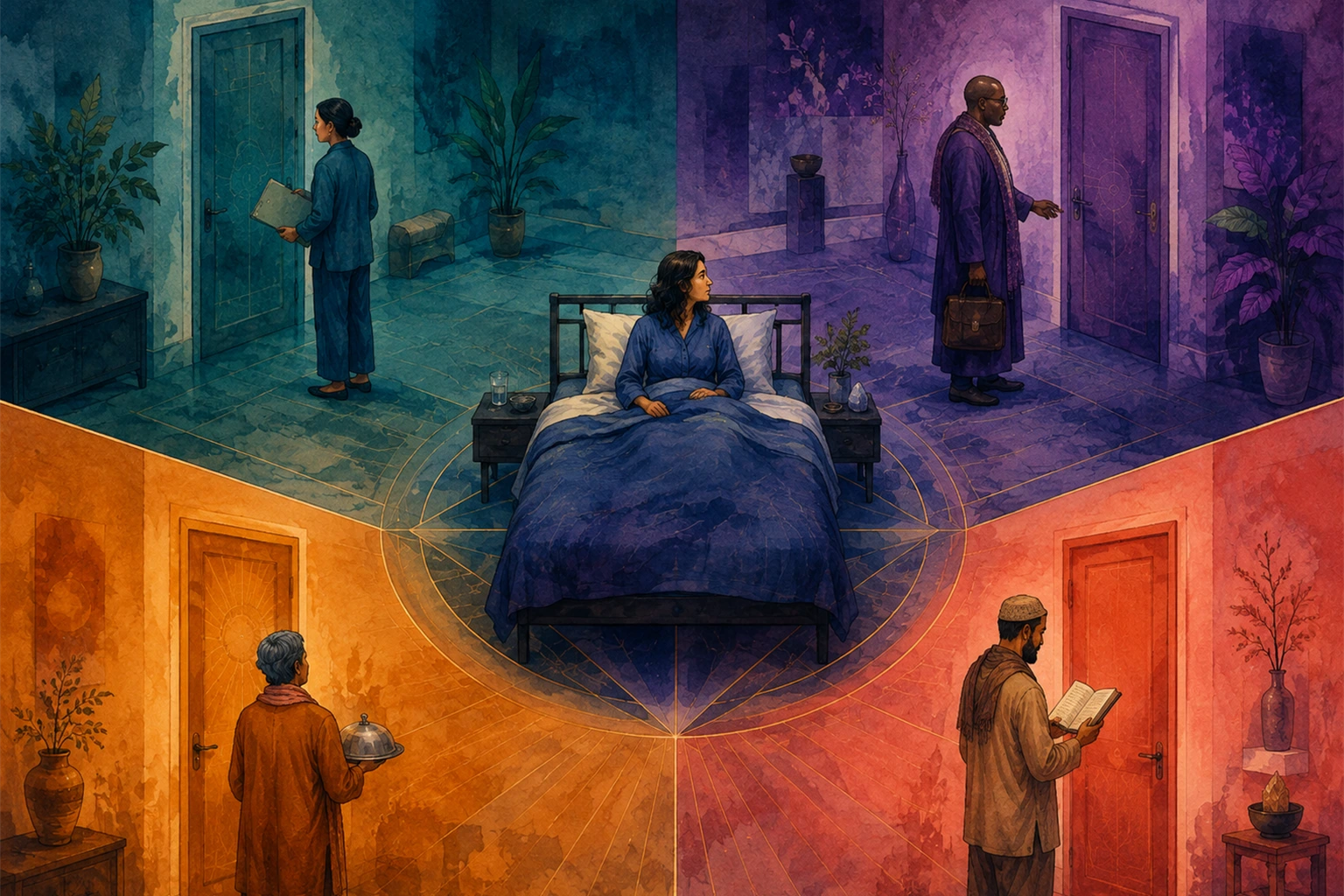
Figure 3.1. Four visitors, four doors.
1. The question and why it matters now
Spiritual care is, by now, something the institutions of health recommend. The World Health Organization counts spiritual well-being among the constituents of quality of life; the holistic-health consensus treats it as integral to whole-person care; and professional bodies across nursing, medicine and chaplaincy increasingly require it (Erşahin 2021). And yet, when those same institutions are asked what spiritual care is, they answer ostensively - by lists of interventions - and jurisdictionally - by whose profession owns it - far more readily than they answer it foundationally. Chapter 2 mapped the field and its fault lines and reached a single diagnosis: holism espoused, fragmentation operative. This chapter asks the prior question those fault lines force. Not 'what does spiritual care do?', nor 'who should deliver it?', but: on what foundation can care actually be holistic - holistic in operation, and not only in aspiration?
The strongest available evidence that the field lacks such a foundation is the field's own best attempt to define itself. Hummel, Galek, Murphy, Tannenbaum and Flannelly (2009) conducted an electronic search for the words 'spiritual care' in the titles of articles published between 1980 and 2005, retrieving 101 articles, 'the majority of which were from nursing journals'. Content analysis of the 28 judged most relevant 'yielded 250 unique descriptions of interventions, which were subsequently consolidated to form 66 discrete interventions'; rated by twenty-five professional chaplains, these fell into 'ten major categories and a few minor categories, with only two of the major categories being explicitly religious in nature'. The field, in other words, can say what spiritual care does - an open and lengthening list - far more confidently than it can say what it is. Tellingly, Hummel et al. open not with a definition but with a worry: 'questions abound about the commensurability... of discourses and practices that occur in differing life-worlds', a 'speculative concern of philosophers (e.g. Habermas, 1981; Bernstein, 1984)' now pressing on health-care professions that 'often claim proprietary interests in the constructs and practices of religion/spirituality'. This is a foundations question wearing methodological clothes: an intervention list cannot state why an item belongs to it, and so cannot say when something new is care and when it is not.
Three pressures make the missing foundation acute rather than merely academic, each carried forward from Chapter 2 and forward again into later Parts. The first is pluralisation and the secular seeker: a foundation tied to one tradition's theology will not travel across the 'global, culturally entwined, and pluralistic world' in which care is now given (Schipani 2024), yet a foundation emptied of all content cannot orient a caregiver at all. The second is the individualisation burden: absent a shared foundation, 'spiritual care' becomes whatever the individual practitioner improvises, which both raises the risk of burnout and lowers accountability - the integration gap Chapter 2 located as fault line four. The third is machine care on the horizon (Part V): an agentic or robotic carer can instantiate only what has been made explicit, so a foundation that lives solely as tacit professional craft cannot be designed into a system, however skilfully it is practised by a person.
The move this chapter makes can therefore be stated at the outset. The apparatus it builds on is named straight away: the concept of the Integrative, the four pillars - Ontology, Epistemology, Axiology and Praxeology - the 4H need-diagnosis and the K1-K4 knowledge model. Each is stated in this chapter in the form care needs, and each is argued at length, for the reader who wants the full philosophical case, in Philosophy of the Integrative (Bindlish 2026). This chapter puts that apparatus to work as the foundation for care, and argues that it answers 'what makes care spiritual?' without an intervention checklist and without parochial creed. The differentia, previewed and then earned across §§3-4, is a change of question: not 'which interventions count as spiritual care?' - the ostensive frame Hummel et al. exemplify - but 'under what intent is any intervention care at all?' The Integrative answer is that an act is spiritual care when it is performed under the intent of relating all the aspects, perspectives and purposes of the cared-for person toward a Coherent View among all the observers of their situation, the cared-for's own view first among them.
Table 3.1. From foundation to bedside: seven commitments, and what each rules in and out.
The commitment, stated plainly | What it rules in at a bedside | What it rules out, including moves that look like good care | The question that tells you whether you are standing on it | Where it stops, and what begins there |
|---|---|---|---|---|
The intent, not the inventory. An act is spiritual care because of the intent it is performed under, not because it appears on a list of recognised interventions. The intent is to relate all the aspects, perspectives and purposes of this person's situation toward a Coherent View among its observers. | Acts nobody has catalogued. Sitting with a man while he works out what to tell his employer, or helping a woman put a family quarrel back in order, is spiritual care here, because the test is what the act relates and toward whose coherence rather than whether an inventory has recognised it yet. The same commitment lets you say that a provision faultlessly delivered has failed as care - a judgement no list and no workflow can reach. | Certifying an act as care because it was on the form and the form was completed. The same outward act - inquiring about a patient's relationship with God is the field's own example (Hummel et al. 2009) - is care under one intent and colonisation under another, so having performed it settles nothing. The reverse move is ruled out just as firmly: declining to count something as care because no list has yet named it. | Can I say in one sentence what this act relates, and toward whose coherence? If the honest answer is that it is what one does at this point, the intent is missing and only the motion is left. | It fixes what makes an act care; it does not tell you which act to perform. Finding what this case requires is the diagnostic work of the sixth row, and the levels of knowing that discernment runs on belong to assessment and discernment (Chapter 6). |
The Coherent View is the cared-for's own. The foundation fixes the intent of relating and never the content related. The direction of care is this person's own coherence, in their own terms, and their view stands first among the observers of their situation. | Eliciting rather than supplying. You may ask what holds this person's life together and then wait, without needing a view of your own to offer and without owing them one. It licenses you to leave a coherence standing that is unfinished, untidy or unlike yours, because its being theirs is the whole of what the foundation asks of it. | Installing your own coherence and calling it theirs. Imposition is not a hazard running alongside the stance's proper operation; it is the precise name of its failure, since a coherence reached by overriding the person is not a weak instance of the stance but its contrary. The field names the danger as pastoral power (Bull 2015, in Poncin et al. 2019) and as assessment that imposes a definition of spirituality instead of eliciting what gives coherence to a person's life (Rumbold 2007, in Poncin et al. 2019). Both are ruled out at their gentlest as well as their gravest: the reassuring frame offered before it was asked for is still a frame supplied. | Whose coherence is getting clearer as this goes on, theirs or mine? And would this person recognise, in their own words, the account of their situation I am now carrying to the team? | A principle does not enforce itself across a power gradient, and the foundation does not claim that it does. The concrete protection is formation (Chapter 5), assessment as elicitation (Chapter 6) and accompaniment that follows rather than directs (Chapter 7), stress-tested where the gradient is steepest and the worldviews least shared (Chapters 8 and 21). |
One relationally constituted life, related from the start, with nothing discarded. The person is not a bundle of biological, psychological, social and spiritual parts. Whole means related, not summed, and no aspect, perspective or purpose is dropped in the relating. | Treating a bill, a body, a job, a daughter's anger and a question about God as already one situation, so that a conversation which begins with money is not a detour from spiritual care but an instance of it. It also lets you keep in play the perspective you privately think mistaken: the relative whose account you find wrong remains an observer of the situation rather than an obstacle to it. | Bolt-on holism - meeting the spiritual in its own column while the other columns are met in theirs, which divides a person well rather than understanding them whole. The opposite error is ruled out with equal force: fusing the views in the room into one tidy account. The stance aligns differing perspectives toward a coherence and does not sum them, and what synthesis flattens, alignment preserves. | Am I adding a box or relating what is already there? And when the accounts in this room differ, am I holding them together, or quietly dropping the one that will not fit? | Relating is not treating. The clinical, financial, psychological and social work stays with those whose competence it is; the commitment governs how a life is held together, not who performs the provisions within it. |
The goods at stake are plural, and they hold together. What is at stake when illness disrupts a life is never the spiritual alone. The four life-goals (puruṣārtha) - dharma (righteousness), artha (the means of prosperity), kāma (worldly desire and relationship) and mokṣa (liberation) - name goods that belong together and are weighted by this person in this situation. Right conduct is itself glossed as what secures both abhyudaya (worldly flourishing) and niḥśreyasa (the higher good). | Asking about rent, work, desire, an estranged son and shame over past conduct as spiritual questions in their own right, rather than as referrals held at arm's length. The chapter's own instance is decisive: a person dying in poverty, estranged from family, ashamed of past conduct and unsure of any larger meaning is not suffering in four separable registers but living one life whose goods have come apart, and this commitment licenses you to meet it that way. | The clinical reflex that treats comfort and function as the only goods in play, and the devout reflex that treats material security and ordinary desire as beneath the real question. Both discard, and both are forbidden. It also rules out ranking the four on the person's behalf: the weighting is theirs and it is contextual, not a hierarchy you bring with you. | Which of the four have I not asked about - and which have I decided in advance is somebody else's department? | Naming a good is not supplying it. You can surface what matters and carry it accurately; you cannot authorise a resource or promise an outcome. Where care meets what no provision reaches, the work passes to suffering, meaning and the limits of care (Chapter 10). |
Care follows embodied knowing, and is offered without doership. Care is action flowing from a knowing in which you are already implicated, performed without taking yourself to be the doer of this person's healing. The movement named is Samarpan (devotional surrender) to Santulan (balanced existence) to Sukh (conscious happiness), and its discipline is niṣkāma karma - the work done fully and its fruit held lightly. | Offering rather than applying. An intervention is chosen for an outcome and judged by whether it lands; care under this foundation is offered toward the person's own coherence and remains care whether or not it is received, because its ground is the intention with which it was performed. This is what lets you stay, without pretence, with a person nothing you do will fix. | Both of the failures that shadow this work: the cool professional applying an item selected from an inventory, and the over-identified helper who makes the patient's outcome the measure of her own worth. It rules out claiming the cure and being owed the gratitude, which are a mind grasping after a result rather than the steadied action the situation is actually asking for. | Which of my movements here is reaching for something I want - the cure claimed, the thanks owed, the conversation that went well - and which is what this person asked for? | Non-doership is accurate self-location, not self-effacement, passivity or a licence to withhold effort. It is formed rather than decided, and the formation belongs to the caregiver's stance and its cultivation (Chapter 5); the commitment names the burnout burden it protects against, and does not by itself relieve it. |
Diagnosis before means. State the need before reaching for the remedy. In any encounter, ask what in this person's suffering is heya, to be discerned and let go; what its cause is (heya-hetu); what the desired state would be (hāna); and by what means it might be reached (hānopāya). The form is the same in every encounter and the content is particular to each. | Working from a need you can state to a means you can justify, which is what lets a caregiver act well in a case no protocol anticipated. The diagnosis travels: it holds at a bedside, in a kitchen and on a telephone, and it needs no instrument, no scoring sheet and nobody's permission. | The reverse order, which is the habitual one: the means settled first - the prayer, the referral, the chaplain called, the leaflet left - and the need described afterwards so that it fits what was already going to happen. It rules out enumeration standing in for discernment, since a list can record which acts were counted as care but never what care here requires. | Can I say what is to be let go, what causes it, what the better state would be, and by what means - or have I gone straight to the fourth? | The 4H glosses follow Chapter 4. Assessment and discernment, including the levels of knowing, are developed in Chapter 6. |
A stance, so it is shareable without being emptied. Because the foundation fixes only the intent and never the content, it can be held without anyone subtracting a conviction or adopting one - and it therefore reaches all three registers in which spiritual care is actually given: formally, by trained providers in institutions; non-formally, through religious and spiritual communities; informally, by family and society (Bindlish, Nandram & Joshi 2025). | It puts the nurse with ten minutes, the volunteer, the community and the daughter sitting through the night inside the account rather than outside it, each holding the same intent and instantiating it with the means available to them. The pastoral theologian enters it surrendering no conviction, because the stance prescribes no content to give up; the secular clinician is handed a stance and not the remains of somebody else's ground. | Reserving spiritual care to whoever is staffed to deliver an enumerated protocol, which is all an inventory foundation can underwrite and which writes off the greater part of the care most people receive. It rules out the entry price in either direction: requiring a caregiver to hold a creed to qualify, or requiring them to empty themselves of one to count as neutral. | Could the person beside me hold this stance? If my answer needs my creed or my job title, I am standing on something narrower than the foundation. | Holding the stance is not competence in every role. Who may lead a rite, give a prognosis or carry a clinical decision is a question of role and referral rather than of foundation, and it is worked out in the practice chapters, and across traditions and worldviews (Chapter 8) most of all. |
2. The state of the Western debate
Foundations have been offered for spiritual care; the field's difficulty is not a vacuum but a plurality. Seven positions are live in the contemporary literature, and this section states each fairly in its own terms before §3 shows where each thins. As in Chapter 2, the argument stays in the Western clinical and pastoral-theological register throughout, per the book's method; the Dharmic resource is brought alongside only in §§4-5.
The biopsychosocial-spiritual model is the dominant foundation in medical and palliative settings. Extending Engel's (1977) bio-psycho-social account of 'the whole person' - which 'brought a more relational discourse into medical care' while retaining its 'positivist roots' (Swinton 2007, 2012, in Erşahin 2021) - it adds spiritual as a fourth domain of the person alongside the biological, psychological and social. Its strength is institutional legibility: it gives 'the spiritual' a recognised place on the chart and a column in the assessment. Read at first hand through the field's own expositors, the model locates the spiritual precisely as one need among others. Rumbold (2013, in Erşahin 2021) holds that any healthcare model 'should employ biomedical, bio-psycho-social, and social characteristics, with different weights of each', and places spirituality within the bio-psycho-social frame 'as an ontological need on the same level as the social and psychological needs of human nature' - a further item in a weighted list. Its 'generic nature … continues to identify spirituality as a universal human characteristic with no identifier of a culture, class, religion or specific content' (Swinton 2012, in Erşahin 2021), and the space it is granted is conditional on utility: it 'only has room in the treatment encounter where the professional seeks to understand whether it interferes with the patient's response to the treatment procedure or/and outcome' (Erşahin 2021). Whether that placement grounds whole-person care or merely files the spiritual alongside the rest is the question §3 puts to it.
The person-centred or humanistic foundation grounds care not in a domain but in a quality of relationship - unconditional positive regard, empathy and congruence in the carer - and supplies the counselling root of much modern chaplaincy training (Rogers, named here for direct reading at a subsequent pass). Where the biopsychosocial-spiritual model locates the spiritual in the patient's chart, the person-centred foundation locates it in the encounter itself.
The pastoral-theological foundation is the chaplaincy tradition's own: spiritual care as the heir of pastoral care, grounded in a theology of the person before the transcendent and, in Tillich's method of correlation, in the mutual interpretation of human question and revealed answer. It is the frame within which Hummel et al. (2009) themselves discuss their findings, 'within the context of pastoral care', and they record the chaplains' argument that other professions' adoption of the term spiritual care only underlines 'the distinct character' of chaplaincy as a calling rather than a technique.
The relational-domains and spiritual-well-being foundation is the most explicitly relational of the Western positions, and the closest near-match to the Integrative. Following the National Interfaith Coalition on Aging, Fisher (2010, in Erşahin 2021) defines spiritual well-being as 'the affirmation of life in a relationship with God, self, community and environment that nurtures and celebrates wholeness', articulated across four relational domains - personal, communal, environmental and transcendental. Ellison's (1983) earlier proposal that spiritual well-being is 'an indication of individuals' quality of life, much like a pulse rate is an indicator of good health' (Erşahin 2021) gave the construct its clinical foothold, and Tillich (1967) lends the communal domain its theological depth. This foundation names the relations a holistic care must honour; §3 asks whether naming them is the same as grounding them.
The holistic-health foundation is the one that licenses the very word 'holistic'. On Gordon's (1988) account, as Erşahin (2021) reports, care 'considers the whole person and how they interact with the environment rather than illness or... specific parts of the body'; this is the foundation behind the late-twentieth-century shift in which 'the emphasis began to move from curing to caring'. Its virtue is its refusal to reduce the patient to a presenting complaint; its open question, taken up in §3, is what holds 'the whole person' together as a whole rather than as a sum.
The process or procedural foundation grounds spiritual care neither in a domain of the person nor in a quality of the encounter but in a defined sequence of phases, and it is the foundation most explicit about how care is delivered rather than what it is. Damberg Nissen, Viftrup and Hvidt (2021) set out spiritual care 'as a process involving a number of organically linked phases: (1) the identification of spiritual needs and resources, (2) understanding the patient's specific needs, (3) developing the individual spiritual care treatment plan..., (4) the provision of spiritual care, and (5) evaluating the spiritual care provided'. Its strength is operational: 'working within a defined conceptual framework for providing spiritual care' is offered as 'a recommendable default position for any institution' where such care is routine, and the account is unusually candid about its aim, holding that 'spiritual care has only one ambition; to help the individual human being through crisis'. It is also, of the seven positions, the most alert to pluralism: to keep the sequence from imposing a template it introduces the concept of the patient's ontological grounding - a notion 'inspired partly by Giddens (2018) concept "ontological security"' - so that identification and provision stay 'sensitive to the secular and pluralistic character of a culturally entwined world' and, in the authors' words, 'appropriate, inclusive, empowering, and, not the least, recognizable to the patient'. Whether a sequence of phases, however well framed, can say what makes an act within it care - as against merely when to perform it - is the question §3 puts to it.
The organizational and collective-spirituality foundation extends the concept beyond the individual encounter, and is imported here because care is delivered not only by persons but by institutions. Rocha and Pinheiro (2020) theorise organizational spirituality as an identity 'resulting from its values, practices, and discourse', one that can generate 'value and social good'; a foundation for care, on this view, must reach the collective carrier and not only the dyad. The same study supplies §3's sharpest diagnostic, for it concedes that there is 'no agreed-upon, unique concept of spirituality' at all.
Stated charitably, the seven foundations each name something real - a domain, a relationship, a calling, a set of relations, a whole, a process, a collective - and each is partly right. The difficulty, taken up in §3, is that they do not compose. The field has foundations in the plural where it needs a foundation that makes 'whole' mean related from the start.
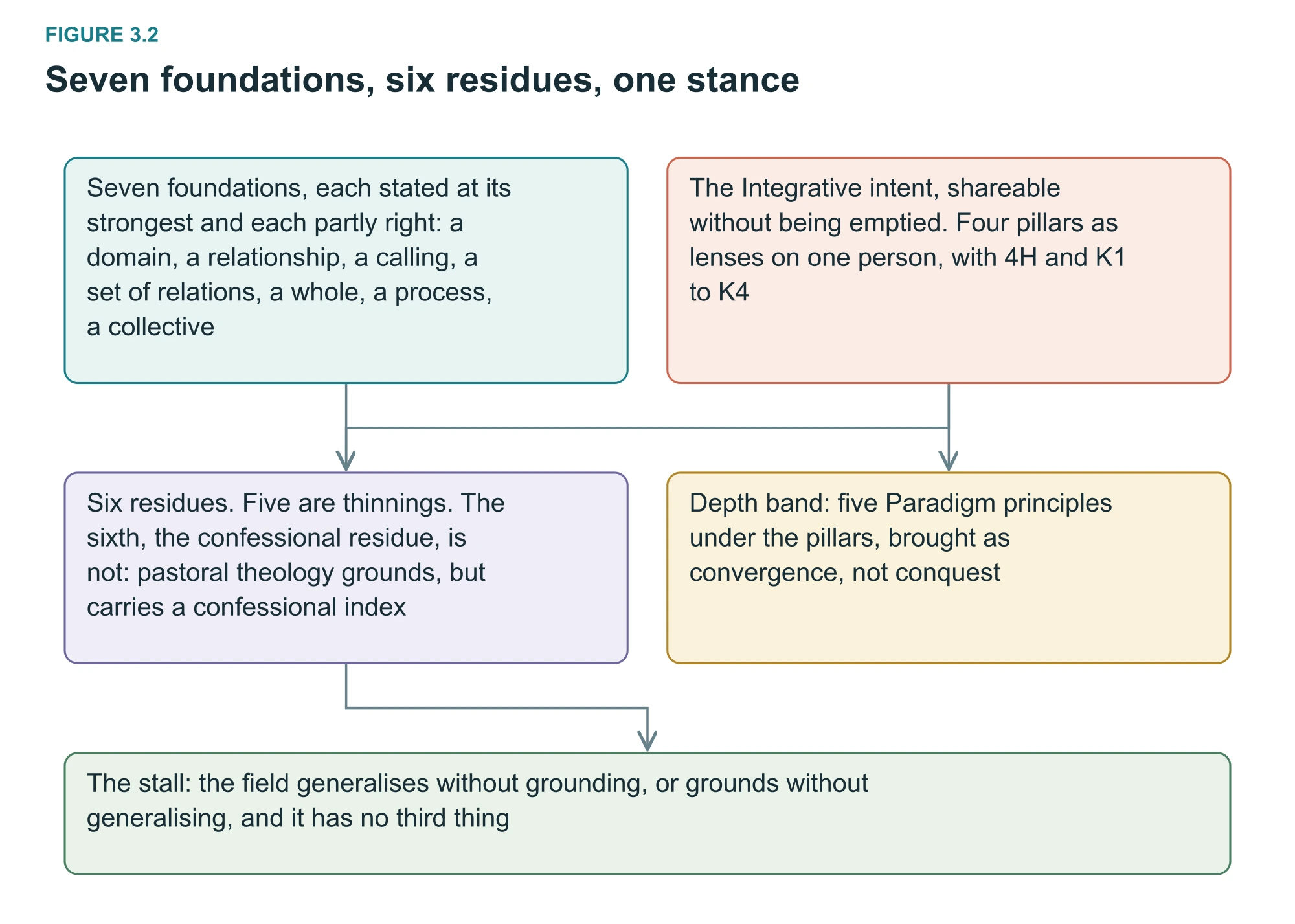
Figure 3.2. Seven foundations, six residues, one stance.
3. Where the debate fragments or stalls
The seven foundations of §2 are not false; each names something real, and the difficulty begins only when one asks each to do the work a foundation must do - to say why the disparate things it gathers belong to one practice. Pressed on that question, each thins in a characteristic way, and the six residues that result share a single shape. The sixth is the exception that fixes it: the one foundation that does not thin turns out to be the one that cannot be generalised, and it is by seeing why that the shape of the other five becomes legible.
The first is the ostensive-definition residue, and Hummel et al. (2009) exhibit it in its purest form. Their careful method yields not a definition but an inventory: 250 descriptions consolidated to 66 interventions across ten categories. An inventory, however long and well sorted, cannot say why an item belongs to it. It can record that chaplains classed a given act as spiritual care; it cannot state the principle by which a new act - one not yet on the list - would be care or fail to be. This is why the field's commensurability anxiety, which Hummel et al. trace to Habermas (1981) and Bernstein (1984), cannot be answered from within the ostensive frame: commensurability 'across differing life-worlds' is asserted whenever disparate lists are aggregated into one, but it is never grounded, because aggregation is not the account of belonging that grounding would require.
The second is the domain-addition residue, and it belongs to the dominant foundation, the biopsychosocial-spiritual model. Adding 'spiritual' as a fourth term alongside the biological, psychological and social secures it a place on the chart, but at a cost the model cannot itself see: the spiritual becomes a separable module, a box that sits beside the others rather than a dimension that runs through them. This is bolt-on holism - holism by addition - and it reproduces at the level of foundations the very fragmentation that whole-person care was introduced to heal. A person whose 'spiritual' needs are met in one column while the others are met in theirs has been divided well, not understood whole. The residue is not the Integrative's imputation but the field's own diagnosis. John Swinton, its foremost pastoral theologian, reads exactly this model's spirituality as 'generic' and treated 'only as an add-on to the biomedical model in understanding healthcare' (Swinton 2007, in Erşahin 2021) - the box-beside-the-others named from within the literature the box belongs to. Erşahin's (2021) own genealogy makes the persistence of the reflex legible as a history: modern health care passes through four successive models - biomedical, bio-psycho-social, social and holistic - each defined by the room it is willing to give the spiritual, which gains standing at every step, from no room at all, to a generic add-on, to 'an inherent part of cultural identity', to a voice of its own. Yet even the holistic model, which lets spirituality speak 'in its own voice' toward 'the humanness and wholeness of the individual' (Swinton 2012, in Erşahin 2021), offers wholeness as an aspiration without saying toward what the widened whole is aligned; it enlarges the resources brought to the bedside without supplying a uniting horizon. The additive reflex thus survives its own correction: lengthening the list of what is gathered is not yet grounding why the gathered belongs to one life. That genealogy is carried to the bedside in Chapter 13; here it fixes the domain-addition residue as the field's settled inheritance, not a stage it has left behind.
The third is the conceptual-vagueness residue, named most candidly by the foundation that extends spirituality to the collective. Rocha and Pinheiro (2020) concede outright that there is 'no agreed-upon, unique concept of spirituality; its dimensions and characteristics depend on the approach used'. Their remedy - systematic review toward a unified concept - is valuable lexicography, but a summary of how the word is used is not a stance on what care is for. It tells us the range of the term; it does not orient an action. Where each profession imports its own concept, the foundation is profession-relative, and a profession-relative foundation cannot settle a dispute between professions about the same patient.
The fourth is the individual-interiority residue, and it afflicts even the most relational of the §2 positions. The person-centred and well-being foundations locate the spiritual in the individual's interior, and although Fisher's (2010, in Erşahin 2021) four domains - personal, communal, environmental and transcendental - name relations beyond the individual, they name them rather than derive them. The domains are listed side by side; nothing in the foundation says why these four belong together, or why they are relations of one life rather than four adjacent measurements. The relational vocabulary is present and ungrounded, which is why Rocha and Pinheiro's collective turn feels at once necessary and unmoored.
The fifth is the procedural residue, and it is the temporal cousin of the first. Where the ostensive foundation offers a list of interventions, the process foundation offers a sequence of phases; but a sequence, like a list, records order without stating ground. Damberg Nissen, Viftrup and Hvidt's (2021) five phases move the caregiver from identification through understanding and planning to provision and evaluation, yet each phase presupposes the very account the foundation was meant to supply. Phase one, 'the identification of spiritual needs and resources', can begin only once 'the spiritual' has been fixed, and so inherits the concept-follows-instrument circularity Chapter 2 traced: the needs a framework identifies are the needs its instrument was built to see. Phase four, 'the provision of spiritual care', is precisely the intervention-slot Hummel et al. (2009) enumerate, now time-stamped within a workflow rather than grounded by it. The account's own honesty makes the residue plain: how to provide care from an understanding of the patient 'is not easily put into formulae or practice' (Damberg Nissen et al. 2021), which concedes that the framework routes the caregiver to the moment of care without saying what, at that moment, makes the act care. Even the process foundation's finest instincts confirm the point. Its single stated ambition - 'to help the individual human being through crisis' - reaches for an intent the other foundations leave tacit, and its concept of 'ontological grounding' reaches for the patient's own frame as the thing care must honour; but 'help through crisis' does not say help toward what, and 'ontological grounding' names a sensitivity the caregiver must have without supplying the horizon that would order the phases toward it. The process foundation, in short, has the right instinct and the wrong category: it makes care a procedure sensitive to the patient when what a holistic care needs is a stance related to the patient's own Coherent View from the start.
The sixth is the confessional residue, and it is the only one of the six that is not a thinning. The pastoral-theological foundation is the one position in §2 that can answer the question this section puts to the others. Asked why a prayer at a bedside, a silence held, a life reviewed and a quarrel forgiven belong to one practice, it has a determinate reply: they are moments of a single relation, the person's standing before the transcendent, and the practice that tends that relation is the cure of souls. Tillich's (1967) method of correlation gives the reply its architecture - the human question drawn out in its own terms, the answer supplied from revelation, the two held in mutual interpretation - and the architecture supplies exactly what the ostensive list, the added domain and the phase-sequence lack: a ground for belonging, and not merely a record of it. This foundation is not vague, not additive and not procedural. It grounds.
Its residue is therefore of the opposite kind, and it is the more instructive for that. The ground it supplies carries a confessional index: it grounds the practice for those who stand where the answer is given, and for no one else. This is not an external objection but the position's own self-understanding, and the field's literature records it being pressed as a virtue. Hummel et al. (2009) report the chaplains' argument that the adoption of the term spiritual care by other professions only underlines 'the distinct character' of chaplaincy - a calling, not a technique. The claim is true, and conceding it costs the foundation the very thing a foundation was wanted for. A calling can ground a practice for the called; it cannot ground the practice for the nurse who is not called and is at the bedside anyway, for the physician on whom the question is pressed nonetheless, or for the daughter sitting through the night. Those are, on the field's own accounting, the places where most care is actually given. A foundation that grounds only its own guild leaves the greater part of the practice it grounds without a foundation - which is why the field's response has not been to abandon the pastoral-theological ground but to keep the practice and quietly lift the ground out of it.
That subtraction produces the very defect the field then complains of, and seeing this is the point of the residue. Strip the confessional content from the pastoral-theological foundation so that a plural and largely secular workforce may share it, and what remains is attention to the transcendent dimension of the person - which is precisely the generic spirituality Swinton indicts, 'with no identifier of a culture, class, religion or specific content' (Swinton 2012, in Erşahin 2021). The much-lamented vagueness of 'spirituality' in the clinical literature is not, then, a failure of nerve or of definition-making. It is the predictable residue of universalising a confessional foundation by subtraction: what is left of a ground when the thing that made it a ground has been removed. Rocha and Pinheiro's (2020) finding that there is 'no agreed-upon, unique concept of spirituality' is the measurement of that subtraction, and the field's turn to interventions, competencies and phases is the search for a replacement ground in the only registers still available once the original one has been set aside.
So the pastoral-theological foundation confronts the field with a dilemma rather than a deficiency, and the dilemma is the sharpest thing in §2. Keep the confession and the foundation is sound but inextensible: a real ground for the chaplain, and none at all for the practice as it is now delivered. Drop the confession and the foundation is extensible but empty: shareable by everyone precisely because it has ceased to say anything. Every other position in §2 can be read as an attempt to escape the dilemma by its second horn - to build, out of domains, relations, wholes, sequences and collectives, a ground that a plural workforce could share - and §3 has now shown, one by one, why none of them grounds. The field generalises without grounding, or grounds without generalising, and it has no third thing. Supplying the third thing is what §4 must do, and the test a candidate foundation must pass is now exact: it must be shareable without being emptied.
These six residues compress to a single stall-statement, and it is the Chapter 2 diagnosis relocated one level down. The field has foundations-by-enumeration (Hummel et al.), foundations-by-addition (the biopsychosocial-spiritual model) and foundations-by-sequence (Damberg Nissen et al. 2021), and even its relational foundations list relations rather than ground them (Fisher; Rocha and Pinheiro). It has, besides, foundations-by-confession (the pastoral-theological), which do ground but cannot be shared, and it is the long attempt to keep that practice while lifting out its ground that produced the generic spirituality the field now deplores. None of them makes care holistic in operation - holistic in the only sense that matters at a bedside, where the aspects of a person are not assembled after the fact but met already related. Holism espoused, fragmentation operative was Chapter 2's verdict on the field's practice; here it is shown to be inherited from the foundations themselves. What is needed is not a longer list, a further box, or a tidier lexicon, but a foundation that holds the aspects of a person related from the start.
4. The Integrative move
The foundation the field reports it lacks has already been built. It is developed in full in Philosophy of the Integrative (Bindlish 2026); the task here is to state it in the terms care requires, and to show that when the Integrative concept is applied to the inner life of a person in need it answers each of §3's residues at its root. The move is best made by quoting the concept exactly, then reading the definition slowly against the bedside.
The Integrative is 'the intent of relating all possible aspects, perspectives and purposes under holistic understanding of any context towards a Coherent View among all observers of the context in focus, without discarding any aspect, perspective and purpose' (Chapter 4). Read as a foundation for spiritual care, every clause does work. The 'context in focus' is the cared-for person's whole situation - their illness, their relationships, their fears and hopes, the institution treating them. The 'observers of the context' are all who stand in that situation: the patient first, then family, clinicians, chaplain, community. The 'Coherent View' they are related toward is not a doctrine imposed on the patient but an alignment that holds the patient's own view at its centre. And 'without discarding any aspect, perspective and purpose' is the precise negation of the fragmentation residue: where the domain-addition model divides the person into separable columns, the Integrative foundation forbids the division at the level of intent. Care is spiritual, on this account, not because it adds a spiritual domain but because it relates every aspect of the person toward a Coherent View that is theirs.
The four pillars give this foundation its structure, and it is essential that they be read as four lenses on one relationally constituted person, not as four boxes restored under new names. Ontology takes the person to be relationally constituted - an Integral Unity - rather than a bundle of bio, psycho, social and spiritual parts; this is what makes 'whole person' mean related, not summed. Epistemology, stated here as the K1-K4 knowledge model, describes how a caregiver comes to know this person - across levels of knowing, as discernment rather than data-collection. Axiology names the goods genuinely at stake when a life is disrupted by illness or crisis - read, in §5, through the four life-goals rather than through 'the spiritual' alone. Praxeology describes care as action that follows embodied knowing, performed without doership (Philosophy of the Integrative, Bindlish 2026). The pillars are not a new partition of the person; they are four questions - what is real, how is it known, what is it worth, how is it enacted - asked of a single life.
Alongside the pillars, the 4H diagnostic supplies what the intervention checklist could not: a statement of need that is the same in form for every encounter yet specific in content to each. In any meeting the caregiver asks what in this person's suffering is heya, to be discerned and let go; what its cause is (heya-hetu); what the desired state would be (hāna); and by what means it might be reached (hānopāya). This diagnosis-then-means structure replaces enumeration with discernment: it does not tell the caregiver which acts count as spiritual care, but how to find, in this case, what care here requires.
The differentia can now be stated three times, once against each of §3's principal residues. Against domain-addition, the Integrative adds no box; it is the stance under which all aspects are already related - spiritual care is the Integrative applied to the inner life, and its holism is operative rather than bolted on. Against the ostensive list, the foundation is the intent toward a Coherent View, and interventions are instances of that intent, never its definition - which is exactly why the list of interventions may stay open and lengthening without the concept ever dissolving. Against individual-interiority, the relations that Fisher could only list - personal, communal, environmental, transcendental - are here grounded: they follow from Integral Unity and from the principle that we are all connected (developed in §5), so the four domains belong together by derivation and not by enumeration. The contrast running through all three is the primary differentia of the Integrative: the Integrative aligns toward a Coherent View; it does not sum perspectives into one. It is integrative, not integral - directional, not merely additive (Chapter 4).
One residue of §3 remains, and it is drawn last because the foundation it belongs to comes nearest of the seven to the Integrative and so needs the differentia stated most carefully. The procedural residue attaches to the process foundation (Damberg Nissen, Viftrup and Hvidt 2021), and that foundation is distinctive among the seven in that it does not merely gesture at what the others leave tacit but reaches for it explicitly, in two places. It reaches for an intent: alone of the seven it states a single ambition, 'to help the individual human being through crisis'. And it reaches for the patient's own frame: to keep its sequence from imposing a template it introduces the patient's ontological grounding, a notion drawn from Giddens's 'ontological security' (Giddens 2018, via Damberg Nissen et al. 2021), so that identification and provision stay 'recognizable to the patient'. These are the two finest instincts in the §2 literature, and they are precisely the two things the Integrative foundation supplies. The differentia is therefore not that the Integrative offers a better sequence, but that it grounds the sequence the process foundation can only run - it is the horizon the ambition reaches toward and the ground the sensitivity reaches for, and neither is a further phase.
Taken at the first joint, 'help through crisis' names an intent and then stops at 'help', which cannot say help toward what. A sequence can move a caregiver from identification to evaluation without the account ever stating the end the movement serves, and Damberg Nissen et al. concede as much when they admit that how to provide care from an understanding of the patient 'is not easily put into formulae or practice'. The Integrative completes the reach: care relates the person's whole situation toward a Coherent View that is theirs, so that the 'toward what' the ambition leaves open is filled without being filled in - the direction is fixed as the cared-for's own coherence, never a content the caregiver carries to the bedside. At the second joint, 'ontological grounding' reaches for the patient's own frame as the thing care must honour, but leaves it a sensitivity the caregiver is asked to have rather than a ground the foundation supplies; ontological security, borrowed as a temperament of the patient, tells the caregiver to be attentive to that frame without saying why the frame is authoritative or how attention to it is more than tact. The Integrative grounds exactly this: the cared-for's view stands first among the observers of the context (Chapter 4), and Respect for Integral Unity (§5, Principle 1) makes that primacy a foundational commitment and not a courtesy - one reality seen from many standpoints, the patient's least dispensable of all. Sensitivity to the patient's frame becomes the patient's frame grounded.
Beneath both joints lies the residue's root, and it is the one §3 named: a sequence organises care in time, and the Integrative organises it by intent. The process foundation is a good answer to the question when to do what - a real and useful answer, and the only one of the seven that is candid about delivery - but time-order is not ground, and 'the provision of spiritual care' is phase four precisely because the sequence cannot say what, at that phase, makes the provided act care; it is the Hummel et al. (2009) intervention-slot time-stamped within a workflow. The Integrative is accordingly not a sixth phase to be appended to the five, nor a rival workflow to displace them, but the intent under which each of the five is already care or fails to be. This is why the differentia here is the gentlest of the four and the most consequential: the process foundation is not refused but founded. Its five phases are retained as the operational scaffolding of formal provision - they order the caregiver's hours well - and what the Integrative adds is the horizon they presuppose and the ground they borrow, relating the phases from the start toward the cared-for's Coherent View. It is integrative, not integral: it does not sum a stance onto a sequence, it aligns the sequence's motions toward the coherence that was the sequence's unspoken aim all along.
This foundation does not arrive in the field unannounced. The project this book grows out of has already proposed, in the peer-reviewed literature, a meta-definition of integrative spiritual care - 'a holistic approach that synthesizes religious, philosophical, and secular perspectives to provide comprehensive support for individuals' spiritual well-being' (Bindlish, Nandram & Joshi 2025, 173) - advanced precisely to supply the 'common ground in the form of a meta-definition' that a plural, multi-religious field of care was found to lack (Bindlish, Nandram & Joshi 2025, 152). That published account rests on the same root this chapter imports: it glosses 'integrative' by quoting, verbatim, the Nandram et al. (2017) definition of the term - the intent of relating all aspects, perspectives and purposes toward a Coherent View 'without discarding any aspect, perspective and purpose' (Bindlish, Nandram & Joshi 2025, 153; Chapter 4). The continuity is therefore exact and not merely thematic. What the present foundation adds is a sharpening the published meta-definition leaves implicit. Its working formula says the approach synthesizes perspectives; the root definition it cites says the approach relates and aligns them toward a Coherent View without discarding any. On the differentia drawn above these are not the same: synthesis sums, and may homogenise, where the Integrative aligns and preserves. Reading the meta-definition back onto its own cited root resolves the tension in favour of alignment - the foundation is integrative, not integral (Chapter 4) - and it is this resolved, paradigm-grounded version that the four pillars, the 4H diagnostic and the K1-K4 model give structure to. The field-internal seed and the foundation are one line of thought, carried from a single published definition to the full apparatus that grounds it.
This is why the foundation answers §3 point for point: enumeration gives way to intent, addition to relation-from-the-start, profession-relative vagueness to a shared and non-proprietary stance, sequence to the ground each phase presupposes, and ungrounded relations to derived ones. The confessional dilemma is dissolved rather than split, and this is the hardest of the five things §4 must do. The Integrative fixes only the intent under which the aspects of a life are related, never the content they are related to, and the Coherent View it aligns toward is the cared-for's own (Chapter 4). A foundation of that form can be shared by a nurse, a physician, a chaplain and a daughter without any of them being asked to subtract a conviction or to adopt one - which is precisely the third thing §3 found the field to lack: a ground that is shareable without being emptied. The pastoral theologian gives up nothing on entering it, because the stance prescribes no content to give up; and the secular clinician is not handed a residue, because what she is handed is a stance and not the remains of someone else's ground. It is abstract enough to be portable across traditions and into machine care - the burden §1 placed on it - and structured enough, through the pillars, the 4H diagnostic and the K1-K4 model, to be operationalised in the practice chapters of Part II. The two objections that abstraction and portability invite - that the foundation is parochial, and that it is too general to act on - are taken up in §6, after §5 has shown the deep structure that the five principles of the Integrative Paradigm give to each pillar.
5. The Dharmic resource, brought alongside
The four-pillar foundation of §4 has a deep structure, and it is the five principles of the Integrative Paradigm that supply it (Chapter 4). They are brought here not as authority-by-assertion but as a deepening of the Western relational and well-being literature already set out in §2 - the move's licence having been established in Chapter 2, where the field's own competencies note drew the Dharma bridge. Each principle is transliterated and glossed so that a reader with no background in Indian philosophy can follow it as philosophy, and each is read as converging with, not correcting, the relational foundations the Western literature reaches for but cannot ground.
The first principle, Respect for Integral Unity, holds that 'There is one truth, the knowledgeable speak it in many ways' (ekaṃ sat viprā bahudhā vadanti, ṚV 1.164.46). It grounds the ontology of the cared-for: one reality seen from many standpoints, so that no observation - the patient's least of all - is invalid. This is precisely what Fisher's (2010, in Erşahin 2021) four relational domains needed and lacked. Where the well-being literature lists the personal, communal, environmental and transcendental as four readings set side by side, Integral Unity makes them four perspectives on one life, related from the start. It also turns non-judgemental presence from a temperamental virtue into a foundational commitment: the caregiver withholds judgement not out of professional courtesy but because the principle forbids treating any genuine perspective as a mistake to be corrected. The differentia is carried in the adjective: this is Integral Unity, an alignment of differing views toward a Coherent View, not synthetic unity, which would fuse or sum them into one homogenised account.
The second principle, the holistic attainment of the four life-goals or puruṣārtha - Dharma (righteousness), Artha (the means of prosperity), Kāma (worldly desire and relationship) and Mokṣa (liberation) - supplies the axiology of care. Dharma is glossed in the tradition as that which secures both abhyudaya (worldly flourishing) and niḥśreyasa (the higher good): yato'bhyudaya-niḥśreyasa-siddhiḥ sa dharmaḥ (VaiśS 1.1.2). Read at the bedside, this rebuts the domain-addition foundation directly. The goods genuinely at stake when a life is disrupted by illness are never 'the spiritual' alone, sequestered in a fourth column; they are material security, relationship and desire, right conduct and ultimate meaning, held together and contextually weighted. A person dying in poverty, estranged from family, ashamed of past conduct and unsure of any larger meaning is not suffering in four separable registers but in one life whose goods have come apart - and the puruṣārtha names them as belonging together, which 'the spiritual' as a single box never could.
The third principle, that our actions follow embodied knowing - the amalgamation of gyaan (knowledge), karma (action) and bhakti (dedication), with the equanimity it requires itself termed yoga - supplies the praxeology of the caregiver. Care is not a technique selected from an inventory and applied, but action that flows from a knowing in which the carer is already implicated; this grounds, in the care context, the account of action-without-attachment developed in Philosophy of the Integrative (Bindlish 2026). The fourth principle, that our activities are without 'doership' - the awareness of 'the observer in us', and the movement Samarpan (devotional surrender) → Santulan (balanced existence) → Sukh (conscious happiness) - is the foundation for sustainable care. The caregiver who acts without identifying as the doer of the patient's healing is protected against the individualisation and burnout burden named in §1, and, more importantly for the foundation, keeps the Coherent View the patient's rather than the carer's achievement to be claimed. The fifth principle, that we are all connected (Shubh Laabh, welfare-for-all), supplies the relational ontology that grounds the communal, environmental and transcendental domains the Western literature could only list. If we are in truth connected, those relations are constitutive of the person and not optional extensions of an interior self - which answers the individual-interiority residue of §3 at its root, and converges with Rocha and Pinheiro's (2020) reach toward a collective spirituality the field could not otherwise underwrite.
These principles are not left as assertions the reader must take on trust: the Bhagavad-gītā carries a worked psychological model beneath them, and it is instructive to see the model set out in a register a health scientist will recognise. Bhawuk (2011, 127-30), reading the text as indigenous psychology rather than as devotional literature, reconstructs from it a general model of peace and happiness in which śānti (peace) and sukha (happiness) are not moods to be induced or outcomes to be delivered but the terminal states of a determinate causal process. Dwelling on an object of sense breeds attachment (saṅga); attachment breeds desire (kāma); thwarted desire breeds anger (krodha), which clouds discrimination, unseats memory and finally undoes the buddhi itself (BG 2.62-63) - the descending spiral the care field knows as spiritual distress, here given its generative structure rather than its symptoms. The ascending path reverses it: the person who meets pleasant and unpleasant outcomes with equanimity, the senses under the direction of a steadied buddhi, arrives at prasāda - which Śaṅkara glosses as at once joy and health - and in that clarity 'all sorrows are destroyed' (BG 2.64-65). The Gītā then states the relation categorically: without a settled buddhi there is no peace, and without peace there is no happiness (BG 2.66). For a foundations chapter this is exactly the direction the well-being literature of §2 reaches for and cannot supply. That literature can measure 'spiritual well-being' as an outcome and score its presence or absence; it cannot say what peace is or how it is generated, and so must take it as a datum to be assessed. The Dharmic resource supplies the missing account - well-being as the fruit of a mastered relation between desire and discrimination - and in doing so keeps the foundation's differentia visible: a direction toward the cared-for's own steadied coherence, not a further outcome-box added to the assessment form.
The same source grounds the fourth principle's talk of 'the observer in us' in a specific architecture of the self. Bhawuk (2011, 79-81) draws from the second and third cantos the tradition's ordering of the inner instrument: above the body and the senses stands manas (the sensory-processing mind and the seat of desire), above manas stands buddhi (discriminating judgement), and above buddhi the ātman - the witness that is not itself any of the faculties it observes (BG 3.42). The sthitaprajña, the person 'of steady wisdom', is defined precisely as one who has given up the desires resident in manas and rests satisfied within the self (BG 2.55); Śaṅkara reads this as the one who, having relinquished the cravings for family, wealth and fame, remains 'in the service of people at large without any expectation'. This is the psychological content of the movement Samarpan → Santulan → Sukh, and it does real work at the foundation of care. It explains why the caregiver's non-doership is not self-effacement but accurate self-location: to act as the witness of the caring rather than its proprietor is to see clearly which movements are manas grasping after a result - the cure claimed, the gratitude owed - and which are the steadied action the situation actually asks. And Śaṅkara's gloss fixes the direction of the whole: care 'without any expectation' is care that leaves the Coherent View the patient's own, the very safeguard the doership-free principle was introduced to protect.
Between these two - the model of peace and the architecture of the self - sits the practice that joins them, and it is the one the third principle names. Bhawuk (2011, 105-13) reconstructs niṣkāma karma, action without desire for its fruit, not as the renunciation of work but as a discipline of intention: the same act may be performed either with the mind bound to its result or released from it, the second slowly eroding the acquisitive self while the work itself goes on undiminished (BG 2.47; 3.7). Read into the foundation of care, this is what keeps the third principle's 'embodied knowing' from collapsing into either detachment or technique. The caregiver is neither the cool professional applying an intervention selected from Hummel et al.'s (2009) inventory nor the over-identified helper who makes the patient's outcome the measure of her own worth; she is the karmayogin who does the work fully and holds its fruit lightly. The differentia the field cannot otherwise state falls out here: an intervention is chosen for an outcome and judged by whether it lands, whereas Integrative care is offered toward the patient's own coherence and remains care whether or not it is received - because its ground is the intention with which it is performed, not the result it secures.
These five are brought as convergence, not conquest. That a Western moral tradition independent of India - Stoicism - arrives at a comparably plural and relational account of the goods of a life (Bishop 1970) is itself evidence that the resources are not tradition-locked, and prepares the reply to the parochialism objection that §6 now takes up.
6. Objections and replies
Six objections press on a foundation that is at once abstract and drawn from a particular tradition, and each is answered from within the account rather than waved aside.
The first is parochialism: importing a Dharmic foundation, the objection runs, makes spiritual care parochial - the opposite of the portability §1 demanded. The reply is that the foundation is the Integrative stance - the intent of relating all perspectives toward a Coherent View - which is non-parochial by construction, since it is defined by the refusal to discard any perspective, the cared-for's first of all. The Dharmic resources of §5 are one articulation of that stance brought alongside the Western relational-domains literature, never a creed the patient must hold; and the Coherent View toward which care relates is always the cared-for's own, in their own terms. The convergence with Stoic ethics (Bishop 1970) shows the resources are not tradition-locked, and the sustained treatment of interreligious and cross-worldview care in Chapter 8, building on Schipani (2024), discharges the worry in practice rather than merely promising to.
The second is that the foundation is too abstract to act on - that a stance this general gives the practitioner nothing to do. The reply is that the foundation cashes out as a definite apparatus: the four-pillar diagnostic, the 4H statement of need and the K1-K4 model of knowing, operationalised through Part II in formation (Chapter 5), assessment and discernment (Chapter 6) and presence and accompaniment (Chapter 7). Abstraction at the level of foundation is exactly what buys portability across the case range of Part III and into the machine care of Part V; it is the price of reach, not a failure of rigour.
The third is that the foundation is merely 'the biopsychosocial-spiritual model with Sanskrit' - a relabelling of the dominant view. The reply turns on the differentia of non-addition. The four pillars are four lenses on one relationally constituted person held together by Integral Unity, not four separable domains; and the puruṣārtha account replaces the single 'spiritual' box with four interwoven goods rather than adding a fifth. The Sanskrit is doing argumentative work - grounding the relations the Western model can only list - and not decorating a model left otherwise intact. The foundation that results aligns the aspects of a person toward a Coherent View; it does not sum them. It is integrative, not integral (Chapter 4).
The fourth is that spiritual care is practised well without theory - that good carers need no foundation. The reply is that the field's own difficulties are the visible cost of having none. Hummel et al.'s (2009) ostensive definitions, and the commensurability anxiety they inherit from Habermas (1981) and Bernstein (1984), are not accidents of a young field but the predictable result of a practice that cannot say what it is: turf disputes between chaplaincy, nursing and medicine, the instrument fragmentation Chapter 2 named, and no principled answer to the question of what makes care spiritual. A foundation does not replace skilled presence; it makes presence teachable, accountable and portable - including, as Part V will test, to systems that cannot inherit tacit professional craft.
The fifth objection is the gravest, because it turns the foundation's own language against it at the bedside. Grant that the stance forbids imposition in principle; the objection presses that in practice it cannot. Spiritual care is given across a steep gradient of power - a frightened, dependent, often dying person on one side, a professional vested with institutional authority and the vocabulary of meaning on the other - and a foundation whose defining move is to relate the person's situation toward a Coherent View supplies exactly the warrant a caregiver needs to install a coherence of their own and call it the patient's. The worry is not external to the field but its own sharpest self-criticism. Bull's (2015, in Poncin et al. 2019) analysis of chaplaincy as a site of pastoral power names the danger precisely: the carer who tends the soul acquires, in that very tending, a power over the one cared for. Rumbold (2007, p. S61, in Poncin et al. 2019) locates the same danger in the ordinary instrument, observing that spiritual assessments 'tend to impose particular views or definitions of spirituality, instead of eliciting "the thoughts, memories and experiences that give coherence to a person's life"'. A foundation built on the word coherence must answer the charge that it, too, imposes.
The reply has three moves, and it begins by conceding what a rule cannot do. A power gradient is not neutralised by a principle forbidding its abuse; the foundation does not claim that the intent toward a Coherent View is self-enforcing, and any account that did would be the more dangerous for it. What the foundation claims is narrower and answerable. First, imposition is not a hazard the stance runs alongside its proper operation but the precise name of its failure: to install the caregiver's coherence is to discard the cared-for's perspective, and discarding is what the definition rules out at the level of intent - 'without discarding any aspect, perspective and purpose', the cared-for's own view first among them (Chapter 4). The Coherent View is theirs or it is not the Coherent View; a coherence reached by overriding the patient is not a defective instance of the foundation but its exact contrary, an integral summation of the encounter into the stronger party's account (Chapter 4). The concept therefore does the one thing the objection needs and a checklist could never do: it distinguishes eliciting from imposing at the root, and marks which of two outwardly identical acts - Hummel et al.'s (2009) own religious item, 'inquiring about a patient's relationship with God', is care under one intent and colonisation under another - has failed.
Second, the safeguard is not left as a rule to be remembered but is built into the caregiver, and here the Dharmic resource of §5 does load-bearing work the Western statement of the worry reaches for and cannot supply. The fourth principle - action without doership, the awareness of 'the observer in us' - is precisely a discipline against the ego that would impose. Śaṅkara's gloss on the sthitaprajña, care given 'without any expectation' (§5; Bhawuk 2011, 79-81), fixes the caregiver's self-location as the witness of the caring rather than its proprietor, so that the movement toward coherence is the patient's to make and never a result the carer claims. Pastoral power is answered not by denying the gradient but by forming a carer who does not grasp the authority it offers - the karmayogin who does the work fully and holds its fruit, including the fruit of the patient's assent, lightly (niṣkāma karma, BG 2.47; §5). Bull names the danger; the non-doership principle supplies the interior remedy the naming leaves open.
Third, the protection is not merely intended but operationalised, and the foundation hands the concrete work to the practice chapters rather than pretending to complete it here. The discernment that separates eliciting from imposing is the K1-K4 model applied as viveka at the bedside (Chapter 6, its labels still to be fixed by the author); it is instilled through formation, not assent (Chapter 5); it is enacted as accompaniment that follows rather than directs (Chapter 7); and it is stress-tested where the gradient is steepest and the worldviews least shared - the interreligious encounter (Chapter 8) and the secular seeker who holds none of the caregiver's commitments (Chapter 21). Rumbold's demand that assessment elicit rather than impose 'coherence to a person's life' is, read on the differentia of this chapter, not a caution the foundation must accommodate but the foundation's own instruction stated in the field's vocabulary: the Coherent View is elicited from the cared-for, never installed in them. That the field can state the danger so exactly and yet, on its ostensive foundations, has no principled resource against it is one more measure of the foundation it lacks.
A sixth objection returns to the near-match the foundation stands closest to, and it is the sharpest test of the differentia §4 drew last. Of the seven foundations surveyed, the process foundation (Damberg Nissen, Viftrup and Hvidt 2021) comes nearest to the Integrative, and §4 conceded as much: its five phases are retained as the operational scaffolding of formal provision, and what the Integrative adds is a horizon and a ground, not a further phase. The objection presses on exactly that concession. If the five phases run unchanged - identification, understanding, planning, provision, evaluation - then at the bedside the Integrative caregiver and the process caregiver do the same things in the same order; the 'horizon' and the 'ground' are additions no observer of the encounter could detect, unfalsifiable glosses on a workflow that was already complete. This is the third objection's complaint - 'the model with Sanskrit' - transposed from the domain foundation to the process one, and it is graver here, because the process foundation is candid where the domain model was not: it already states an ambition ('to help the individual human being through crisis') and already honours the patient's frame (through the ontological grounding it borrows from Giddens 2018), so the two instincts §4 claimed as the Integrative's own contribution appear to be present in the near-match before the Integrative arrives. On this reading the foundation is either a sixth phase after all, quietly appended to the five, or it is nothing operational whatever - a re-description that leaves the practice exactly as it found it.
The reply grants the premise and denies that it yields the conclusion. It is true, and §4 says so, that the Integrative displaces no phase and adds none; the two accounts converge on the sequence because the sequence was reaching for the coherence the Integrative names. But convergence on the phases is not identity of verdict, and the difference shows precisely where the objection says it cannot: at phase four. A sequence can certify that provision was delivered - the step was reached, an act was performed, the workflow advanced - but it cannot say, of the act it time-stamps, whether that act was care or its opposite, because the same outward provision (Hummel et al.'s 2009 own religious item, 'inquiring about a patient's relationship with God') is care under one intent and colonisation under another. The horizon is therefore not undetectable; it is the thing that sorts two identical acts into care and non-care, and a foundation that issues a different verdict on the same completed sequence is making an operational difference, not a decorative one. What the objection mistakes for an idle gloss is the only resource that lets the field say when a phase-four provision, faultlessly delivered, has failed as care - a judgement the process foundation, by its own admission that provision 'is not easily put into formulae or practice', cannot reach from the sequence alone.
The two instincts the near-match displays do not close this gap but confirm it. That the process foundation reaches for an intent and reaches for the patient's frame is exactly §4's point: it reaches and stops. 'Help through crisis' states that there is an end without stating the end; ontological grounding asks the caregiver to be sensitive to the patient's frame without saying why the frame is authoritative or how attention to it is more than tact. An account that names the direction it cannot supply, and the ground it can only borrow, is not a rival to the foundation that supplies them; it is the evidence that the foundation is needed. The candour the objection credits to the near-match is, read on the differentia, the near-match testifying against itself.
Finally, the dichotomy the objection closes on - sixth phase or nothing - is the integral assumption in miniature, that to ground a series is to add a member to it. A ground is not a further step in the process it grounds, any more than the direction of a journey is a further stage of the journey; the intent under which the five phases are already care or fail to be is not sequentially locatable among them, and asking which phase it is mistakes an alignment for an addition (Chapter 4). That a candid delivery-sequence and the Integrative arrive at the same phases is not the foundation's embarrassment but its vindication: the sequence's unspoken aim was the cared-for's own coherence all along, and to make that aim explicit, answerable and teachable is the whole of what a foundation is for. The convergence here is of a piece with the Stoic convergence of §5 and the secular convergences conceded throughout - evidence that the stance is reached from more than one direction, not that it says nothing.
7. What this commits us to
This foundation is a debt the rest of the book is written to discharge. Chapter 4 builds the definition of Integrative Spiritual Care directly upon it: the displayed definition there is the Integrative concept resting on the four-pillar, 4H and K1-K4 foundation laid here, so that the definition inherits its holism-in-operation rather than asserting it. Part II then puts the foundation to work as practice. Chapter 5 (the caregiver's stance and formation) instantiates Principles 3 and 4 - embodied knowing, and action without doership - and the praxeology pillar; Chapter 6 (assessment and discernment) is the K1-K4 model applied, with the level-labels still to be fixed by the author before that chapter advances; Chapter 7 (presence, dialogue and accompaniment) is the Coherent-View intent enacted in sustained relation; Chapter 8 (working across traditions and worldviews) applies Principles 1 and 5 and answers the parochialism objection at length; Chapter 9 (practices and interventions) is where the intent meets a repertoire, and is written so that a practice is matched to a person rather than prescribed from a tradition; and Chapter 10 (suffering, meaning and the limits of care) draws on the puruṣārtha axiology, and especially on Mokṣa and niḥśreyasa, where care reaches its limit.
The foundation also fixes the scope of the care whose practice the rest of the book describes, and here the published account supplies a distinction the chapter is committed to carrying. Spiritual care, Bindlish, Nandram and Joshi (2025, 157) observe, is provided not in one register but three: formally, through the professional practice of trained chaplains and spiritual-care providers in hospitals, hospices and other institutions; non-formally, through engagement with religious or spiritual institutions and communities; and informally, through the care that family and society give as a matter of course. A foundation built as an intervention checklist - the Hummel et al. (2009) residue this chapter was written to escape - can only ever underwrite the first register, since only formal practice is staffed to deliver an enumerated protocol; the non-formal and informal registers, which carry the larger part of the spiritual care most people actually receive, would fall outside the account altogether. A foundation built as a stance - the intent of relating a person's situation toward a Coherent View that is theirs - underwrites all three at once, because the stance can be held by a chaplain, a temple community or a daughter at a bedside alike, each instantiating it with the means available to them. This is the structural reason the foundation must be abstract, and it turns the abstraction objection of §6 into a requirement: only a foundation pitched above any particular provider can reach 'formal, informal, and non-formal ways' of care together (Bindlish, Nandram & Joshi 2025, 171). The commitment falls due in Part II, where formation (Chapter 5) and accompaniment (Chapter 7) are written for formal and non-formal providers; again in Part III, where the case studies repeatedly turn on the informal carers - family, friends, community - around the cared-for; and a third time in Part IV, where the informal register acquires a bearer of its own and the family carer is treated as someone owed care rather than as the unpaid resource by which an arrangement holds. It sets the hardest term of the Part V portability test, since an agentic or robotic system enters as a fourth mode of provision the typology did not anticipate, to be admitted only if it can hold the same stance.
Part III (Chapters 11-21) carries the foundation under load, each case study testing whether the four pillars and the 4H diagnosis hold in a concrete encounter - palliative, mental health and moral injury, chronic illness and disability, grief, crisis and trauma, and the secular seeker. Part IV (Chapters 22-23) turns the same foundation on the ones who carry it: a foundation that grounds care for a person in need and cannot ground it for the person giving that care was never a foundation for care at all. Part V (Chapters 24-27) is the foundation's hardest portability test: whether an agentic or robotic system can instantiate the Integrative stance - the intent toward a Coherent View - rather than merely execute interventions drawn from a list. This is where the 'machine care' pressure of §1 and the reply to Objection 4 are cashed out or fail.
One research question is left open, and it is the sharpest the foundation faces. Can the four-pillar foundation be operationalised into an assessable competency set without collapsing back into an intervention checklist - that is, without re-entering the very Hummel et al. (2009) trap this chapter was written to escape? The competency work flagged in Chapter 2 through the SpiCaQuest note is the test bed, and the charge falls to Chapter 6. Holding that question open, rather than closing it prematurely with a scorable instrument, is itself a commitment the foundation imposes.
Notes
1. Hummel et al. (2009) is exemplary rather than deficient: it does carefully and explicitly what the field does generally and tacitly, and its 66-intervention / ten-category result is the strongest available evidence that the field lacks a foundation distinct from its practices. The point pressed here is structural, not a criticism of their method. Their framing of the underlying problem as one of 'commensurability... of discourses... in differing life-worlds' (citing Habermas 1981 and Bernstein 1984) is precisely a foundations question: commensurability across life-worlds cannot be asserted by aggregating intervention lists, only grounded in a stance that says why disparate acts belong to one practice. Habermas and Bernstein are named here via Hummel et al.; both are to be captured as primary entries when read directly.
2. The biopsychosocial-spiritual model (Sulmasy 2002, extending Engel 1977) is the foundation most worth engaging at the next pass, because it is at once the dominant institutional foundation and the clearest instance of what §3 calls the domain-addition residue: adding 'spiritual' as a fourth box leaves it a separable module rather than a dimension of one relationally constituted life. Engel (1977) is engaged here via Erşahin (2021), and the model is now read at first hand through Erşahin's exposition and Swinton's in-field critique of it (Swinton 2007, 2012, in Erşahin 2021; Rumbold 2013, in Erşahin 2021) - see Note 9.
3. The commensurability problem Hummel et al. (2009) inherit from Habermas (1981) and Bernstein (1984) is not dissolved by the Integrative foundation so much as relocated. The Integrative does not claim that all life-worlds reduce to a common measure; it claims that genuinely different perspectives can be aligned toward a Coherent View without being made commensurable in content. This is the integrative-not-integral point (Chapter 4) operating at the level of method, and it is what an aggregated intervention list cannot supply: a list records co-occurrence, not the intent under which disparate acts belong to one practice. The point is developed for inter-tradition care in Chapter 8.
4. 'Integral Unity' is used here in the technical sense fixed as Ontology in Philosophy of the Integrative (Bindlish 2026) and in Chapter 4, Principle 1: a unity of relation among genuinely different perspectives on one reality, contrasted with synthetic unity, which fuses or sums them. The distinction is what keeps 'the whole person' from collapsing back into either a single homogenised account or an aggregate of domains; it is the ontological counterpart of the integrative-not-integral differentia, and it is carried into §5 as the ground from which the four relational domains are derived rather than listed.
5. The four puruṣārtha reading of the goods at stake in care is taken from the axiology of Philosophy of the Integrative (Bindlish 2026), where the twin ends abhyudaya (worldly flourishing) and niḥśreyasa (the higher good) are developed; the defining locus is yato'bhyudaya-niḥśreyasa-siddhiḥ sa dharmaḥ (VaiśS 1.1.2). The point pressed here is that the fourfold scheme dissolves the material/spiritual split the domain-addition foundation depends on: 'the spiritual' was never one good among others but the name, in the field's vocabulary, for goods that the puruṣārtha holds together from the start. Bishop (1970) supplies the Stoic-Hindu convergence cited in §5 and §6 as evidence that a plural, relational account of a life's goods is not tradition-locked. The convergence is structural and not merely a convergence of content: the Stoic account is plural in its own architecture - preferred indifferents, Panaetius' four personae, Hierocles' circles - and it differs from the puruṣārtha at ordering and at ground, which is what makes the agreement worth something rather than a coincidence of lists.
6. The K1-K4 level labels and the English glosses of the 4H need-diagnosis are the author's and stated in Chapter 4 alongside the concept of the Integrative, the integrative-not-integral differentia, Integrative Intelligence and the five Paradigm principles: K1 informational knowing, K2 skilful knowing, K3 contextual knowing, K4 realisational knowing, the levels ordered by depth and not by content, with the aparokṣa / parokṣa gradient as the model's spine; and Hāna read as a non-attainable horizon rather than a target state. Chapter 6 (Assessment and Discernment) is the K1-K4 model applied.
7. Bindlish, Nandram and Joshi (2025) is the project's own published meta-definition of integrative spiritual care, derived by design-science research and the Tarka method and validated with field practitioners (2025, 151-182). It is engaged here at first hand. Its working meta-definition (p. 173) uses 'synthesizes'; its gloss of the term 'integrative' (p. 153) quotes the Nandram et al. (2017) definition that Chapter 4 fixes as authoritative, in which the operative verb is 'relating' and the orientation is 'towards a coherent view... without discarding'. The chapter treats the synthesis-wording as the looser surface and the cited root as the controlling intent, resolving the two toward alignment on the integrative-not-integral spine (Chapter 4) - the same synthesis→alignment sharpening made in Chapter 1 §4 and Chapter 4 §4. No paraphrase of the canonical definition is introduced; where that definition is quoted it is quoted from the paper, which reproduces it exactly.
8. The formal / non-formal / informal typology of care provision is taken from Bindlish, Nandram and Joshi (2025, 157, 171): formal = professional practice in hospitals, hospices and institutions; non-formal = engagement with religious or spiritual institutions and communities; informal = the care of family and society. The paper presses it for the Hindu case - that the formal professional practice of Hindu spiritual care in the Western context 'often inadequately acknowledges traditional sources of care, including informal and non-formal practices' (2025, 157) - and this book carries it as a general scope-condition on any foundation for care. The fourth, machine, mode named in §7 is this book's extension, not the paper's; it is taken up in Part V.
9. Erşahin (2021), 'Care, Spiritual Care, and Modern Health Care: Developments, Concepts, and Debates' (ch. 4 in Weiss, Federschmidt, Louw & Sauer Bredvik, eds, Care, Healing, and Human Well-Being within Interreligious Discourses, African Sun Media), was read at first hand for (the chapter was already read directly for Ch 13). Taken directly: Rumbold's (2013) weighting of biomedical / bio-psycho-social / social characteristics and his placement of spirituality 'as an ontological need on the same level as the social and psychological needs of human nature'; Swinton's (2007) verdict that bio-psycho-social spirituality is 'generic' and 'only … an add-on to the biomedical model', and (2012) that the holistic model lets spirituality speak 'in its own voice' toward 'the humanness and wholeness of the individual'; and the four-model genealogy (biomedical → bio-psycho-social → social → holistic), each model 'defined by the room it is willing to give' the spiritual. The use here is analytic (the domain-addition residue named from inside the field; the additive reflex persisting through the genealogy) and distinct from the bedside deployment in Ch 13 (the helping/fixing/serving fork, Remen 1997). Swinton 2007, Swinton 2012 and Erşahin 2021 are already bibliographed; Rumbold (2013) is added as a secondary entry cited via Erşahin 2021. Sulmasy's (2002) primary biopsychosocial-spiritual paper is not in the archive; the model is therefore engaged through Engel's (1977) parentage and Swinton's pastoral-theological critique rather than through Sulmasy directly, and the primary-reading flag is retained.
10. Three of its models are used: the 'general model of peace and happiness', whose four paths to śānti begin with kāmasaṃkalpavivarjana, the shedding of desires (Bhawuk 2011, 127-30, on BG 2.55-2.70); the manas - buddhi - ātman ordering of the inner instrument (Bhawuk 2011, 79-81, on BG 2.55, 3.40-42), consonant with the antaḥkaraṇa faculties treated in Philosophy of the Integrative (Bindlish 2026) and in Bhawuk (2020); and niṣkāma karma as a discipline of intention (Bhawuk 2011, 105-13, on BG 2.47, 3.7). Verse numbering follows Bhawuk's edition; Śaṅkara's glosses are quoted as Bhawuk reports them (Bhawuk 2011, 128). The soteriological horizon of the text - mokṣa as release from rebirth - is bracketed here, as in §5's treatment of the puruṣārtha: the model is used for its psychology of desire, discrimination and peace, which stands independently of the metaphysics of liberation.
11. Damberg Nissen, Viftrup and Hvidt (2021), 'The Process of Spiritual Care', Frontiers in Psychology 12, 674453, was read at first hand for this chapter (the paper was engaged for Chapters 1 and 2 as a process model and an instrument-fragmentation datum, but never brought into the foundations survey as a distinct foundation in its own right). Taken directly: the five 'organically linked phases' (identification of needs and resources; understanding; treatment-planning; provision; evaluation); the recommendation of 'a defined conceptual framework' as an institutional 'default position'; the stated single 'ambition; to help the individual human being through crisis'; and the concept of the patient's ontological grounding, 'inspired partly by Giddens (2018) concept "ontological security"', introduced to keep the sequence 'sensitive to the secular and pluralistic character of a culturally entwined world'. The use here is analytic: the process foundation is the temporal cousin of the ostensive (§3, first residue), sequencing care without grounding it, and its two finest instincts - the single ambition and the ontological grounding - are read as reaching for the intent and the patient's-own-frame that only the Integrative stance supplies (§4). The paper's own admission that provision 'is not easily put into formulae or practice' is quoted as the residue stated from within. Damberg Nissen, Viftrup & Hvidt (2021) is already bibliographed; the annotation is extended to record this first-hand Ch 3 §§2-3 engagement.
12. The pastoral-power critique is taken from Bull (2015), cited via Poncin, Brandt, Rouiller, Drouin and Dandarova Robert (2019), the chaplaincy-literature field-map already read at first hand for Chapters 1 and 2; Rumbold's (2007, p. S61) demand that assessment elicit rather than 'impose particular views or definitions of spirituality' the 'thoughts, memories and experiences that give coherence to a person's life' is drawn from the same review. Both are re-deployed here for the first time in the foundations chapter and are already bibliographed via the Poncin et al. The reply deliberately concedes that no principle is self-enforcing against a power gradient: the foundation's claim is that it (i) names imposition as its own failure mode rather than an external risk, (ii) locates the interior safeguard in the non-doership principle and the sthitaprajña's 'service without expectation' (§5), and (iii) remits the concrete protection to formation (Ch 5), assessment-as-elicitation (Ch 6) and accompaniment (Ch 7), tested at the steepest gradients in Chapters 8 and 21. The convergence of a Western in-field critique (Bull; Rumbold) with the Dharmic non-doership safeguard is itself further evidence, per §6's parochialism reply, that the resources are not tradition-locked.
13. Hummel et al. (2009) supply the chaplains' own report that other professions' adoption of spiritual care only underlines 'the distinct character' of chaplaincy - 'a calling, not a technique' - the concession by which the ground reveals its confessional index (the same paper engaged for the ostensive residue at Note 3). Swinton's (2012, in Erşahin 2021) indictment of generic spirituality 'with no identifier of a culture, class, religion or specific content' and Rocha and Pinheiro's (2020) finding of 'no agreed-upon, unique concept of spirituality' are re-deployed from §2 and Note 9 to measure what remains of the confessional ground once it is universalised by subtraction. The use is analytic: the residue is presented not as a thinning but as a dilemma rather than a deficiency - ground without generality, or generality without ground - which fixes the exact test §4 must pass, that a foundation be shareable without being emptied, and which §4 discharges by fixing only the intent of relating and never the content related (Chapter 4).
14. This fourth differentia discharges a forward-promise the chapter already carried but had not cashed out. Note 11 (added at v6, when the process foundation and its procedural residue were supplied to §§2-3) states that the process foundation's 'two finest instincts - the single ambition and the ontological grounding - are read as reaching for the intent and the patient's-own-frame that only the Integrative stance supplies (§4)'; and the v6 status record makes the same claim ('the process foundation reaches for intent... and for the patient's frame... but supplies neither the horizon nor the stance the Coherent View gives'). Yet §4, through v8, drew its differentia three times only - against domain-addition, the ostensive list and individual-interiority - and its 'point for point' summary answered five of §3's six residues while passing over the procedural one in silence, so the near-match that comes nearest of the seven was the one §4 never met. The paragraph added here draws that differentia and the summary sentence is corrected to name it. Sources are all already engaged and already bibliographed, and no new entry is added: Damberg Nissen, Viftrup and Hvidt (2021) was read at first hand for §§2-3 (Note 11); Giddens (2018) is cited via Damberg Nissen et al. as in §2 and §3, and remains flagged there for direct reading; Hummel et al. (2009) is re-deployed from Notes 1 and 3.
15. This objection completes the pairing §6 left open. The third objection voices the domain-addition near-match (the biopsychosocial-spiritual model) talking back; this one voices the process near-match (Damberg Nissen, Viftrup and Hvidt 2021), the foundation §4 draws its fourth and most careful differentia against as the one that 'comes nearest of the seven to the Integrative'. The objection is added rather than the §4 differentia corrected: §4's differentia against the process foundation, drawn at v9, is sound; §6 had simply omitted the corresponding challenge, so that the nearest of the seven near-matches was the one no objection pressed. The reply reuses the chapter's own apparatus - the phase-four eliciting-versus-imposing distinction of §6's fifth reply and §4 (the same Hummel et al. 2009 religious item, care under one intent and colonisation under another); the reach-and-stop reading of the process foundation's two instincts (Note 11; §4); and the integrative-not-integral differentia against additive grounding (Chapter 4). Sources are all already engaged and bibliographed - Damberg Nissen, Viftrup and Hvidt (2021) at first hand (Note 11); Hummel et al. (2009) re-deployed from Notes 1, 3 and 13.
CHAPTER 4