I.1 What this appendix is for, and the rule it keeps
A book that asks caregivers to hold their conclusions lightly owes the same discipline to its own evidence. This appendix sets out where the material in this book came from: four pieces of research, the instruments they used, what they found, and - the part that takes up most of these pages - what they did not record.
The rule this appendix keeps is simple and it is worth stating at the front, because it explains a tone that will otherwise read as apologetic.
Everything in this appendix is either documented in the research record or marked as absent. Nothing is reconstructed from what a study of this kind would normally have done.
That rule has a cost and the cost is visible throughout. Three of the four studies described here have no written methods section, and one of them has no analysis at all. Where a sample size, a fieldwork date, a recruitment procedure or an ethics approval is not in the record, this appendix says so in those words rather than supplying the sentence a reader expects. A methods appendix that quietly fills its own gaps is worse than useless, because it teaches the reader to trust the parts that were invented along with the parts that were not.
There is a second reason for the rule, and it is the reason this appendix belongs in a book about care rather than in a research report. The failure mode this book spends twenty-eight chapters describing - summing a person from the attributes on the file, and calling the sum a person - has an exact methodological twin. A study is summed when its readers take its themes, its quotations and its confident prose as evidence of a procedure nobody has seen. The remedy is the same in both cases: go back and ask what is actually known, and be willing to hear that the answer is less than you assumed.
A reader who wants only the practical residue of this appendix should turn to Table I.8, the pre-registration checklist, and to section I.9, which states in one page what this book's evidence can and cannot be asked to support.
I.2 The four studies, and what each can carry
Four distinct pieces of research stand behind this book. They are not equally documented, and they are not equally strong. Conflating them is the most likely misreading of this appendix, so they are separated here before anything else is said. Table I.1 makes that separation, and the column to read first is the fourth, what is not documented, because a study that holds data and no documented method supports description and not inference.
Read this table before citing any of these studies. The third and fourth columns are the ones that matter: a study with data and no documented method supports description, not inference.
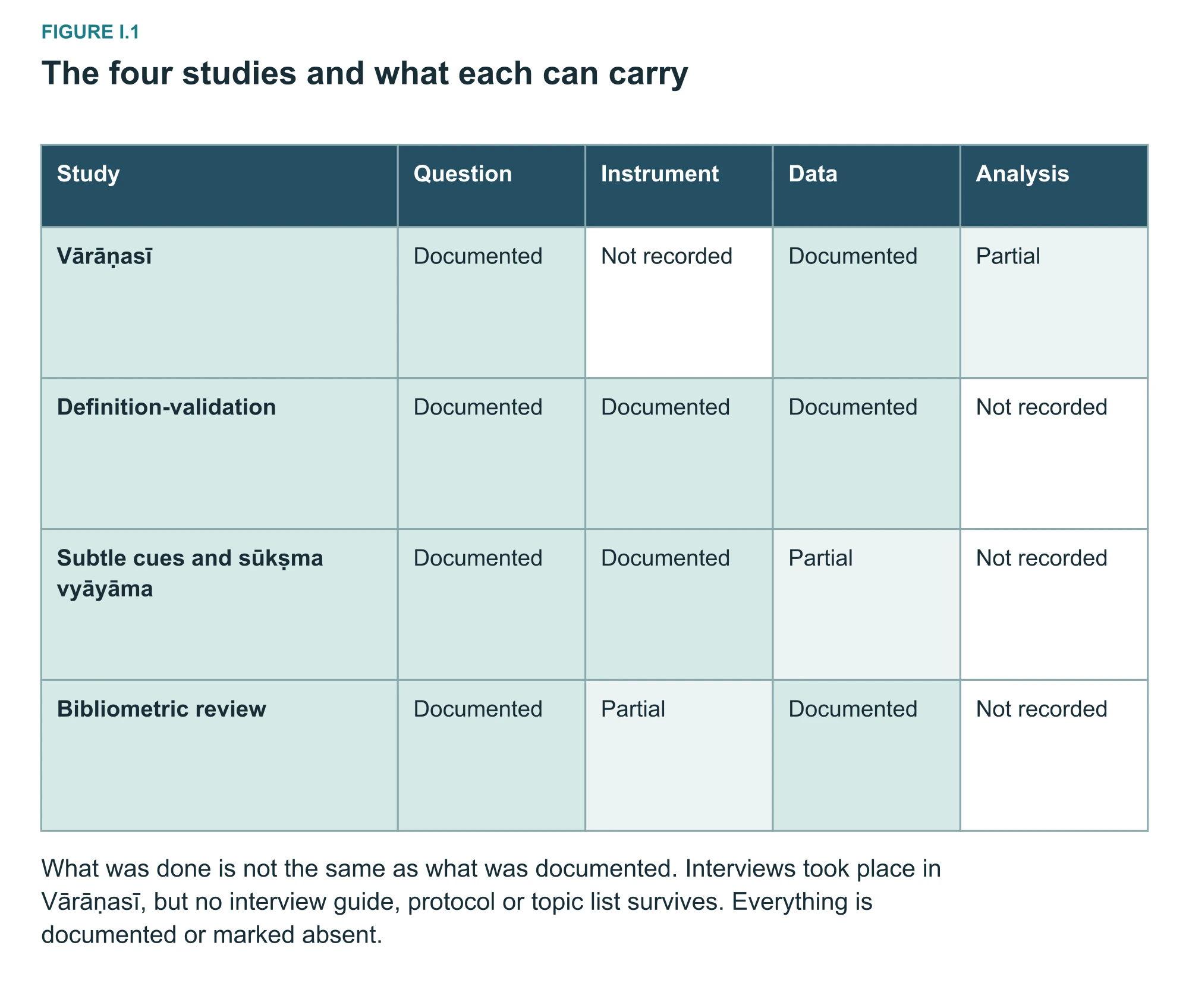
Figure I.1. The four studies and what each can carry.
Table I.1. The four studies: what exists, what is documented, and what each can support.
Study | What exists in the record | What is documented | What is NOT documented | What it can support |
|---|---|---|---|---|
The Vārāṇasī study (section I.3) | A written-up findings chapter: research question, five inductively derived themes, twenty-one attributed interview extracts, an interpretive mapping onto an eight-term model | The research question and four sub-questions verbatim; the themes; the field settings by type and by name; the analytic stance toward the model | Sample size, fieldwork dates, recruitment, interview guide, consent and ethics, translation and transcription procedure, coding procedure, number of coders, software, limitations | Description of what participants said and how the authors read it. Not prevalence, not generalisation, not a claim that the themes are exhaustive |
The definition-validation study (section I.4) | Five participants' submissions, ten case write-ups, thirteen peer responses, one consolidation worksheet | The written assignment verbatim; participant and peer counts; dates spanning February to June 2022; every peer objection; the definition under test in two languages | Any rubric for judging fit or failure; any revision protocol; sampling frame for peers; consent; coding; inter-rater step | Evidence that the definition was put to practitioners and contested. Not evidence that it survived, because no revision was ever made |
The subtle-cues study and the sūkṣma vyāyāma experiment (section I.5) | Four instruments, a protocol, an exercise sequence in eighty-one steps, and the raw returns of six participants | The full instrument text; the intervention protocol; the planned schedule; the returns, with their dates | Ethics approval, consent records, any scoring, any analysis, any result, any adherence record for the intervention itself | The instruments themselves, which are reusable. No outcome claim of any kind is available from this study |
The bibliometric apparatus (section I.6) | Four bibliographic corpora totalling more than fifty thousand records, a written protocol, a screening workbook, and a research log | Export dates; corpus sizes; the databases and candidate terms considered, with exclusions and reasons; the planned analyses and software; one complete screening funnel for a sub-study | The executable search strings for the two main corpora; the field specification; the filters applied; de-duplication and screening counts; who screened; any computed result | Description of the corpora and their known limits. Not a reproducible search, and not any finding about the field's structure, because no analysis was run |
Three observations follow from this table and each of them governs a later section.
First, the studies are independent of one another. The Vārāṇasī fieldwork, the definition-validation coursework, the Netherlands instrument study and the bibliometric review were conducted at different times, by different people, in different countries, with no shared protocol. Nothing in the record links them into a programme. A reader who meets them in one appendix will be tempted to read them as four arms of one design; they are not, and this appendix does not present them that way.
Second, the pattern across all four is the same, and it is the finding. In every case the project holds instruments and raw material, and in every case the analytic step that turns raw material into a finding is either missing or undocumented. This is a common condition in practitioner-led research and it is not a scandal. It is, however, a fact, and it sets a ceiling on what this book may claim.
Third, the machine-generated material is not a fifth study. It is discussed in section I.7 as method and as caution, and it must never be read alongside the four above as though a language model's output were a further source of evidence. The rule is set out at that section and repeated at the close of this appendix.
I.3 The Vārāṇasī study
I.3.1 What it asked
The Vārāṇasī research is the one piece of fieldwork behind this book; the chapters draw on it by intention rather than by citation, and it is reported in full only here. Its governing question, as the analysis states it:
How is dharma enacted in Vārāṇasī, India as a coping resource under conditions of rapid technological change and volatility?
Four sub-questions follow. How is dharma lived by the residents of Vārāṇasī according to Sanātana Dharma practices; how does dharma shape care there; how does dharma negotiate care there; and how does lived dharma align with, challenge or refine the model the authors bring to it. A fifth sub-question, on how dharma contests care, stands in the source in parentheses and no theme answers it. It is reported here as it stands rather than silently dropped, because a bracketed question is usually a question somebody could not answer and it may be the most interesting one in the set.
I.3.2 The setting, and who spoke
Interviews were conducted across bhavans, āśramas, hospitals and community settings. Three sites are named in the record: the Kāśī Lābh Mukti Bhavan, a house where people come to die; and the cremation grounds at Manikarṇikā and Harishchandra ghāṭs. Participants are described by role rather than by demographic - residents, family carers, āśrama residents and staff, healthcare professionals, palliative care workers, and staff of the Mukti Bhavan.
The number of participants is not recorded. Twenty-one extracts are quoted under eleven distinct respondent codes, and the highest code used is thirteen, which implies a pool of at least thirteen units with several codes never quoted. Some codes are subdivided, and at least one such pair is a married couple interviewed together, the second speaking directly after the first. None of this is a sample size, and this appendix does not print one. Anyone citing the study should say interviews conducted in Vārāṇasī and not a number.
Nor is there a fieldwork date, a recruitment method, an interview guide, a consent statement, or a note on the language of interview and the route by which the quotations reached English. Each of those is a live author gate and each is listed in Table I.9.
I.3.3 What it found
Five themes were derived inductively from the interviews. The eight-term model the authors then read them through was, in their own explicit statement, not used as a coding frame during analysis but applied afterwards as an interpretive lens. That distinction is worth preserving, because it is the difference between finding a pattern and imposing one, and the source is unusually candid in drawing it: the analysis concedes that respondents did not themselves use the model's vocabulary. Table I.2 keeps the two apart on the page, the study's own findings in the left two columns and the mapping applied afterwards in the third, so that a reader can see which of the two they are being asked to accept.
The left two columns are the study's findings. The right column is an interpretation applied after analysis, by the authors, using vocabulary the participants did not use. Do not cite the right column as a finding.
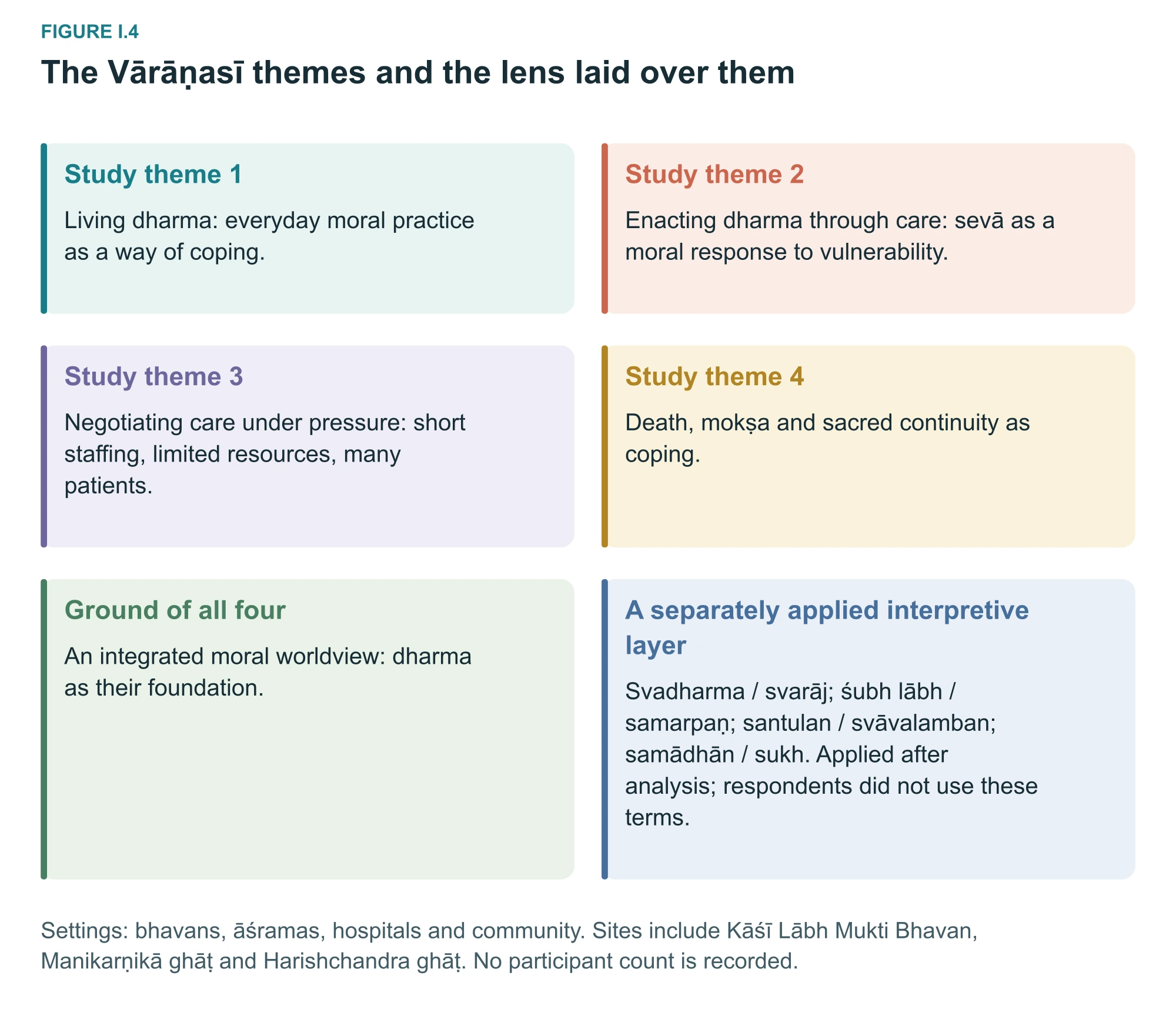
Figure I.4. The Vārāṇasī themes and the lens laid over them.
Table I.2. The five Vārāṇasī themes, and the interpretive mapping laid over them.
Theme | What it reports | Terms mapped onto it afterwards |
|---|---|---|
1. Living dharma | Everyday moral practice as a way of coping: the pre-dawn bath, the observance kept, the duty discharged because it is one's own | svadharma (one's own duty), svarāj (inner self-governance) |
2. Enacting dharma through care | Sevā as the moral response to human vulnerability, including feeding, giving and the collective provision that carries no expectation of return | śubh lābh (collective wellbeing), samarpaṇ (self-offering) |
3. Negotiating care under pressure | What happens to care when staff are short, resources are limited and the number of patients is large. The theme is about constraint, and it is the one that most resembles the institutional material of this book's case chapters | santulan (balance), svāvalamban (responsible self-reliance) |
4. Death, mokṣa and sacred continuity | Dying in a place chosen for dying; the rites that follow; the periods of ritual impurity; continuity understood as sacred rather than as consolation | samādhān (harmonious resolution), sukh (enduring wellbeing) |
5. An integrated moral worldview | Dharma as the foundation on which the other four rest rather than as one coping resource among several | all of the above, described as mutually reinforcing |
What this table is good for, and what it is not. It is a legitimate account of what a group of people in one city said about living, caring and dying, read by researchers who state their own interpretive move. It is not evidence about Hindus in general, about Vārāṇasī in general, or about the frequency of anything. The study reports no counts and this appendix supplies none.
One methodological caution the source does not make about itself, and it belongs here. The five themes and the eight mapped terms are close to the argument the book was already making. That is not evidence of circularity - the model was applied after the themes were derived, and the source says so - but it is the condition under which circularity is hardest to detect, and no independent coder, no member check and no negative-case analysis is recorded. A reader is entitled to ask whether a different analyst would have derived these five themes, and the record does not let anyone answer.
I.3.4 A note against a likely confusion
There is, separately in the project archive, a two-year project proposal for fieldwork on integrative spiritual care in Europe, the United Kingdom and India. It has a different scope, a different framing and a different vocabulary, it names no Vārāṇasī site, and it is written entirely in the future tense. It is a plan and not this study. Nothing in the record connects them, and they should not be cited as phases of one programme.
I.4 The definition-validation study
I.4.1 What was tested, and how
Between February and June 2022, five practitioners in training on a Dutch post-academic ministerial programme were asked to test a candidate definition of Hindu spiritual care against cases from their own practice, and to put it to peers. The definition under test, in the Dutch in which it was drafted:
Hindoe spiritual care is een vorm van professionele hulpverlening, begeleiding en advisering, door academisch opgeleide geestelijk verzorgers bij betekenisgeving, zingeving, levensbeschouwing en spiritualiteit gebaseerd op een hindoe wereldbeeld.
In English: Hindu spiritual care is a form of professional assistance, guidance and counselling, by academically trained spiritual caregivers, in meaning-attribution, meaning-in-life, philosophy of life and spirituality, based on a Hindu worldview.
The participants also worked with an English version of their own. The two are not translations of each other, and three separate peers noticed this independently. One of them identified the specific slippage: the Dutch says a Hindu worldview and the English drops the article, which silently converts a claim about one worldview among several into a claim about the Hindu worldview. That is the single most consequential difference in the whole exercise and it was found by a reviewer, not by the design.
The written assignment survives verbatim in one participant's submission, which is why it can be quoted at all. Its two parts:
A) Two case validations: give two descriptions of cases from your own practice - they may be cases you have used before - in which you let all the elements of the definition recur in the description.
B) Two peer validations: find out from a spiritual caregiver and a non-spiritual-caregiver what they think of this definition. Read it out and let people respond. Ask whether they recognise it. Discuss each component with them; ask whether they are missing anything, or find anything in the definition unrecognisable.
I.4.2 The defect in the instrument, stated plainly
Part A does not ask whether the definition fits the case. It asks the participant to write the case up so that all the elements of the definition recur in it. That is confirmation by construction. A case that could not be so written was, by the rubric's own wording, not a case to submit.
This matters because of what the results then look like. Four of the five participants returned a verdict of full fit, two of them in sentences copied word for word between their own two cases. There are no recorded failures and no modifications. A design that instructs its participants to demonstrate fit and then reports that fit was demonstrated has measured its own instruction. Table I.3 takes the study apart element by element, and its last column is put as a question rather than as a verdict, because the same question can be asked of any validation exercise, including one the reader is running.
Table I.3. The definition-validation study: design, and where each element fails.
A worked example of how to read a validation study that was not built to disconfirm. The right-hand column is the question to ask of any similar exercise, including one you are running yourself.
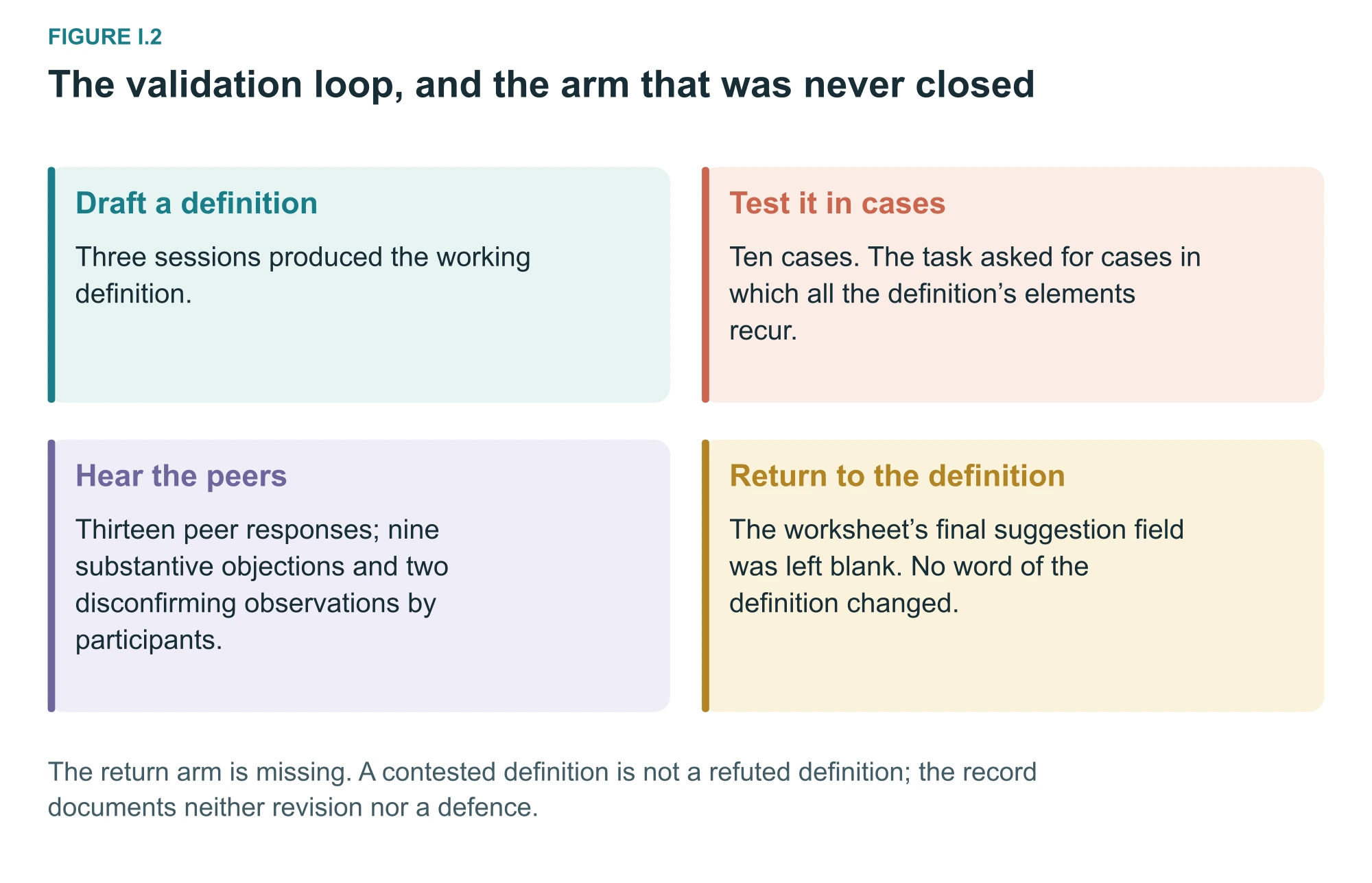
Figure I.2. The validation loop, and the arm that was never closed.
Table I.4. The definition audited clause by clause: what practitioners contested.
Design element | What was done | What is missing | The question it raises |
|---|---|---|---|
The object under test | One definition, in two non-equivalent language versions | Any record of how the wording was arrived at, beyond an incidental reference to three drafting sessions | Who wrote what is being tested, and were they the same people who tested it? |
The participants | Five, all students on the same programme, all of whom had taken part in drafting the definition | Any independent tester | Is anyone testing this who did not build it? |
The case task | Two cases each, ten in all, from the participants' own practice | Any criterion for fit, any threshold, any instruction on what to do with a case that did not fit | Could this task have produced a negative result at all? |
The peer task | Thirteen peer responses, unevenly distributed: one participant supplied six, another supplied one | Any sampling frame; any standardisation of the stimulus | Did every reviewer see the same thing? |
The stimulus | Read aloud twice by telephone to one reviewer, never supplied in writing; a materially different wording shown by another participant to both of hers | Any control on this at all | Are the responses to one definition or to several? |
The consolidation | A worksheet dated 14 June 2022, with twelve pasted comments | Two of the thirteen responses, including the only fully drafted alternative definition, and every one of the ten case verdicts | Does the summary contain what the study found? |
The revision | None | Everything | Was the definition changed by anything that was learned? |
I.4.3 What the peers actually contested
The peer material is the strongest part of this study and the part most worth a practitioner's time, because it is a clause-by-clause audit of a definition by people who would have to live under it. Thirteen responses produced nine distinct substantive objections. Not one of them changed the definition. Table I.4 sets those objections against the clauses they land on, with a count of how many of the thirteen raised each, and it is the one instrument in this appendix a service can lift whole: any team writing a definition of what it provides can run its own wording down the first two columns and see which of these objections it has invited.
This table is reusable. Any service writing a definition of what it provides can run its own wording down the first two columns and see which of these objections it has invited. The last column records how many of thirteen reviewers raised each point, so that a reader can weigh a widely shared objection against a single voice.
Clause | The objection | Raised by |
|---|---|---|
based on a Hindu worldview | There is no single Hindu worldview to be based on. One reviewer put the difference concretely: an Indian Hindu worldview and a Surinamese-Hindustani Hindu worldview are not the same thing, and the second is the one caregivers in the Netherlands will meet. Alternatives proposed: rooted in the Hindu traditions, on the basis of Hindu dharma, inspired by Hindu philosophy | 9 of 13 |
academically trained | Three incompatible positions, and this is the study's sharpest disagreement. That it is superfluous, since the field already assumes it, and that stating it implies the opposite is true here. That it is a good addition, precisely because the professional standard does not carry it. And that it excludes people already doing the work: one reviewer asked whether serving caregivers without a degree would henceforth be regarded as quacks, and another argued the clause should be adopted in ten years, by which time those it would exclude will have retired | 8 of 13 |
a form of | Weakens the claim, and implies there are other forms without saying what they are. Delete | 3 of 13 |
assistance, guidance and counselling | The three are not parallel; assistance is the umbrella term and the other two fall inside it | 3 of 13 |
counselling / advising | Dangerous if it points at the client. One reviewer, invoking a well-known Dutch case in which a patient abandoned conventional treatment, warned that advising invites a treatment-like liability a spiritual caregiver has no standing to carry. He allowed advising upward, to the institution | 1 of 13, and it is the most practically consequential objection in the set |
spirituality | Unclear, and possibly already covered by the two meaning terms. One reviewer reported that in practice the word ends conversations: people answer that they are not religious and decline | 4 of 13 |
the missing recipient | The definition says what, by whom and on what basis, and never says for whom or where. One reviewer called it a list of nouns and adjectives with no target group | 3 of 13 |
the exclusivity claim | The deepest objection, and unanswered. Contemporary guidance treats spiritual care as a task of every discipline, and of volunteers; the specialist has a special position but not an exclusive one. A definition that reserves spiritual care to one profession contradicts that | 1 of 13 |
supply-led framing | The definition describes what a caregiver offers rather than what a person asks for. One reviewer proposed a demand-led rewording built around at the request of the client | 1 of 13 |
Two further objections came from participants rather than peers, and both are disconfirming evidence that the consolidation did not carry.
The first: in practice the elements almost never all occur in one case. One participant refused the task's premise directly, reporting that a real case usually involves only assistance, or only guidance of colleagues, or - least often - only advising the organisation. If that is right, the three verbs describe a repertoire held across a caseload and not a property of any encounter, and the whole case-testing exercise was built on a category error.
The second: a participant recorded that his own post does not meet the definition's qualification clause and moved on without drawing the conclusion. He works in a setting requiring a professional rather than a university degree, and with clients for whom Hinduism is not the basis of their worldview. He rescued the worldview clause by relocating it from the client to the practitioner. That is a defensible move and an interesting one, but it is a change to the definition's meaning made silently inside a case write-up, and nobody adjudicated it.
One reviewer asked the question that the study never answered, and it deserves to be quoted as the honest close of this section: is it scientifically responsible, on the basis of the input gathered, to make a fundamental statement about what Hindu spiritual care is?
I.4.4 What the study is evidence of
It is evidence that the definition was put to practitioners and vigorously contested, and the contest is recorded in enough detail to be useful. That is a real and citable thing, and it is more than most definitions in this field have had done to them.
It is not evidence that the definition survived a test. The document built to receive the revision - a worksheet whose final field is headed your new definition suggestion, followed by eight blank rules - is empty. A validation study whose revision field is blank has run its first half. This book uses the definition, and this appendix records what happened when it was examined, so that a reader can weigh the one against the other.
A note on naming. The five participants and most of the peers are identifiable in the research record. They are not named here. Their cases describe living and recently deceased people in prisons, forensic clinics, hospitals and homes, in enough detail to identify them, and no consent or ethics statement exists anywhere in that record. Section I.8 sets out what follows from that. Contributors are thanked collectively at the front of this book.
I.5 The subtle-cues study and the sūkṣma vyāyāma experiment
I.5.1 What was proposed
The third study is the most fully instrumented and the least concluded. Its question, as the protocol states it, is how to increase the perception of subtle cues in spiritual caregivers by enhancing the growth of consciousness, and how to measure that increase. Subtle cues is the project's term for the conscious emotions, thoughts, perceptions and pieces of information a caregiver registers but does not always attend to; the associated process is one of discovering, following and making use of them.
The intervention was sūkṣma vyāyāma, a subtle-exercise practice taught live in the pre-dawn window, followed by meditation, with seven attentional parameters held simultaneously: sthiti (posture), bandha (lock), mudrā (hand position), dṛṣṭi (eye gaze), dhyāna (mind gaze), śvāsa (breath pattern) and saṅkhyā (count). The protocol survives in full: eighty-one steps in four named parts, each part preceded by a reset, with counts specified and with an opening invocation and a closing śānti verse.
Four instruments were designed:
1. A twice-weekly reflective diary, fielded every Friday and Monday for the run of the programme.
2. A pre-and-post course instrument, twice for each of eleven courses, asking what the caregiver did for a particular client, what information was used, where it was found, what was decided, and - the key item - what they now notice that they were not noticing four weeks ago.
3. A video-based perception assessment across seven categories of care setting, asking the caregiver to describe what they see, what they deduce, and which signs matter to them and why.
4. A quarterly battery of validated scales, one keyed to each kośa (sheath): sleep quality to the physical, subjective vitality to the vital, mindfulness to the mental, resilience to the psychic, and an integrative-orientation measure to the whole.
That last design move is the intellectually interesting one and it is worth recording even though the study produced nothing: it is an attempt to operationalise the pañcakośa by assigning one established psychometric instrument to each sheath.
I.5.2 What actually happened
The attrition here is the finding. Read the last two columns together: an instrument built into a form but never completed by anybody is not a limitation of the study, it is an absence of the study.
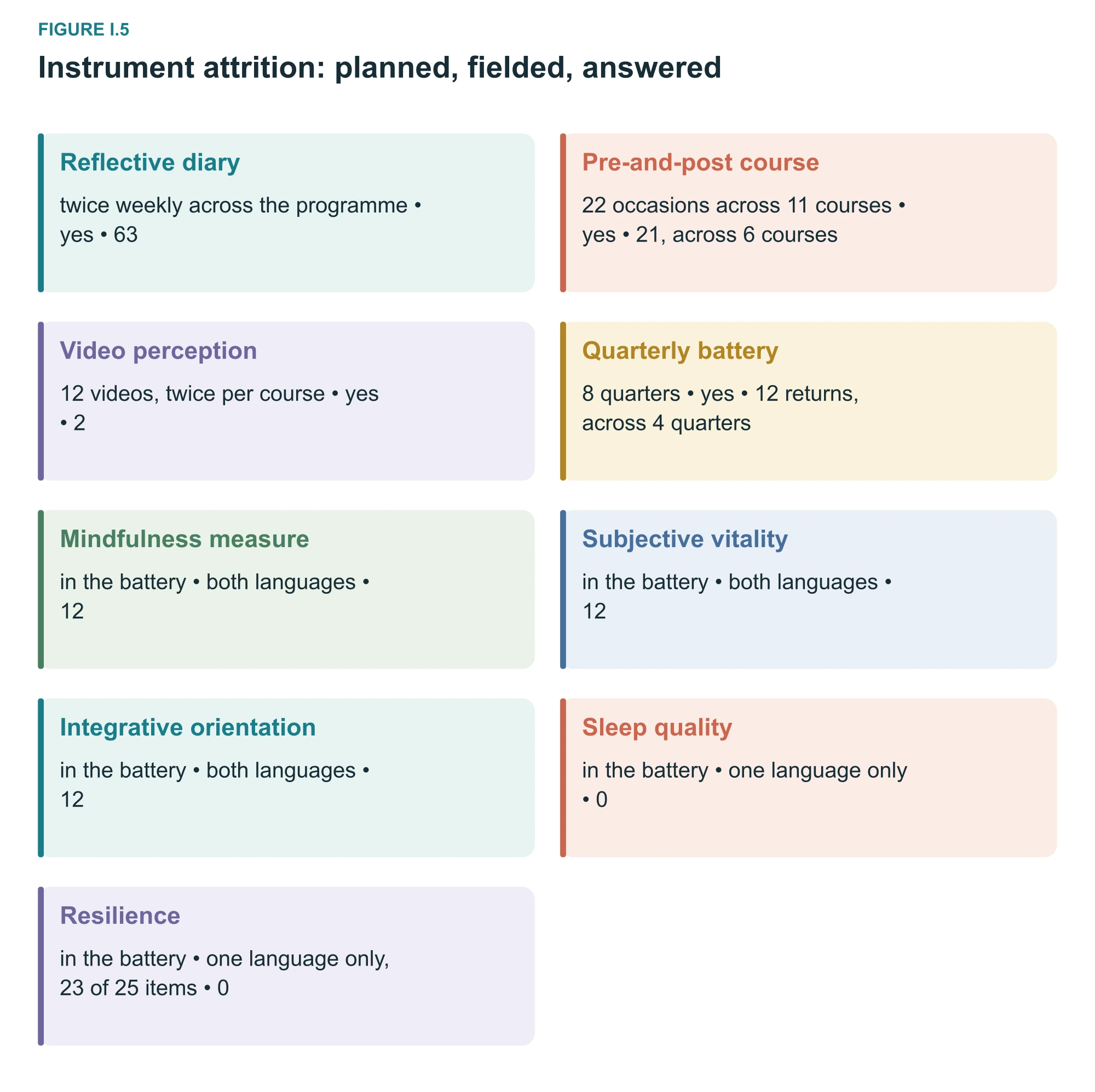
Figure I.5. Instrument attrition: planned, fielded, answered.
Table I.5. The instrument study: planned, fielded, and answered.
Instrument | Planned | Fielded | Answered | Note |
|---|---|---|---|---|
Reflective diary | Twice weekly across the programme | Yes | 63 submissions, September 2020 to August 2021 | Every submission used the Dutch fields; the English arm was never used |
Pre-and-post course | Twice for each of eleven courses | Yes | 21 submissions across six of eleven courses | Distribution very uneven; one course accounts for ten |
Video perception | Twice per course, across twelve videos | Yes | 2 submissions | Effectively not fielded |
Quarterly scales | Eight quarters over two years | Yes | 12 submissions across four of eight quarters, all filed by April 2021 | A complete baseline of six, then 2, 2, 1 and 1. The two later-labelled returns were filed before the periods they are labelled with |
Mindfulness measure (39 items) | In the battery | Dutch and English | Dutch only, 12 returns | Usable |
Subjective vitality (7 items) | In the battery | Dutch and English | Dutch only, 12 returns | Usable |
Integrative orientation | In the battery | Dutch and English | Dutch only, 12 returns | Usable |
Sleep quality | In the battery | English only | Zero | No Dutch version existed in the form, and every respondent worked in Dutch. It could not have been completed |
Resilience | In the battery | English only, and only 23 of its 25 items | Zero | Same defect, plus an incomplete instrument |
Six people enrolled. No scoring was performed, no reverse-keyed items were reversed, no subscale was computed, no pre-and-post comparison was made, and no result of any kind exists. The archive holds the instruments and the raw returns and nothing downstream of them.
And the intervention itself was never measured. Nothing anywhere records who practised the sūkṣma vyāyāma, how often, or for how long. Without an adherence record there is no dose, and without a dose there is no dose-response claim available even in principle. The three hypotheses exist in note form, one of them with an unresolved bracket still in it.
I.5.3 What survives, and it is not nothing
Three things survive this study and all three are usable.
The exercise protocol. Eighty-one steps with their postures, gazes, breath patterns and counts is a complete and teachable sequence, and it is the most detailed practice document the project holds. It exists in three versions - a full master, a student handout with the technical parameters stripped, and a two-column crib made at a student's request - and the difference between them is itself instructive about what a practitioner actually needs at hand.
The reflective diary prompts, which are a better instrument than the study that failed to analyse them. They ask how you feel now; how you felt today emotionally; how energetic you felt; what you noticed during the day; which one thing made the most impact and what it was about; when it happened; how effective it was; what your role was; who else was involved and what theirs was; and what you were grateful for. That sequence is a usable supervision aid whatever happens to the research, and it is printed here rather than in Appendix B, whose supervision aid (Table B.6) asks a different question.
The one item that was the point of the whole design: do you notice things that you were not noticing four weeks ago in your approach - in your decision-making, in the type of information you use? Describe each with an example. A caregiver can ask themselves that question on a four-week cycle without any of the apparatus around it.
I.5.4 A caution about a document filed alongside these
A questionnaire on subtle cues sits in the same folder and is easily mistaken for this study's instrument. It is not. It was built four years earlier for entrepreneurs, its items refer throughout to business and business potential, its response scale was still undecided at the point the draft stops, and two of its nine constructs were never given items at all. Nothing indicates it was ever administered to spiritual caregivers, and no column in the response data corresponds to it.
I.6 The bibliometric apparatus behind The Field in Map Form
I.6.1 What was planned
Behind the front-matter piece The Field in Map Form stand two things that must not be confused. The eight exhibits the piece prints (Figures M.1 to M.8) come from a Biblioshiny run over 17,521 Scopus records, 1835 to 2026, whose query string, field tags and retrieval date are not held in the project's record either; they are descriptive and are presented as such. The bibliometric review described in this section is the project's own protocol, which was designed, partly executed, and never analysed. The protocol is explicit about its intentions: three databases, literature on spiritual care across a long span, twenty listed keywords, and four analyses - co-word analysis, citation analysis, co-authorship and collaboration networks, and visual maps of keyword co-occurrence. Two software packages are named for the mapping.
A screening workbook records the preparatory thinking in more detail than the protocol does, and it is the more honest document of the two. It holds forty-three candidate search terms, of which eighteen are marked for exclusion with the reason written beside them: several as too Christian in connotation, four Dutch terms excluded for language, three as too narrow, two as too broad, and three marked both too narrow and too broad at once. Thirteen candidate databases were assessed and eleven marked for inclusion. A research log records the working decisions: to exclude workplace spirituality; not to restrict the review to healthcare, because the aim was to describe spiritual care as a profession across its fields; and, in a comment thread, a decision to work with the period from 2000 rather than the longer span the protocol still names.
That is a real and defensible piece of review design, and this appendix records it with respect. What follows is the difficulty.
I.6.2 What can and cannot be reproduced
Table I.6 sets the four corpora side by side with what each can and cannot carry, and the last column is the one to read before quoting any of these numbers in an argument. The sizes and export dates are exact, having been arrived at by counting records rather than by reading a label, and the corpus that looks newest is the one that supports least.
Sizes and dates are exact and were verified by counting the records rather than reading a label. Read the last column before using any of these numbers in an argument.
Table I.6. The four bibliographic corpora: what each holds, and what each can support.
Corpus | Size | Exported | What it holds | What it can support |
|---|---|---|---|---|
Scopus, keyword set | 18,366 records | 29 February 2024 | The full retrieval, spanning the 1920s to 2024, with the great majority after 2000 | The only complete-corpus Scopus retrieval the project holds. This, not the smaller and later file, is the operative corpus for any trend claim |
Scopus, exact-phrase set | 5,768 records | 29 February 2024 | The subset in which the phrase itself appears | The comparison with the line above, and see I.6.3 |
Scopus, later slice | 2,000 records | 9 July 2024 | An export truncated at the platform's cap, of which 1,996 are from a single year, and in which four records in five have never been cited | Almost nothing. It is a most-recent-first slice, not a sample, and it will not support co-citation or coupling analysis |
ATLA religion database | 12,792 records | 22 July 2024 | 1850 to 2024, in twelve languages, heavily weighted toward the psychology of religion | Description of a different literature from the Scopus one. It carries no abstracts at all, so no co-word analysis of this half is possible |
Two limits govern all four and neither is recoverable from the record.
The search strings for the main corpora are not recorded anywhere. Not in the protocol, not in the workbook, not in the log, not in the export headers, which do not carry the query. What can be inferred from filenames is the term and the fact that all fields were searched; the field specification, the date limits, the language and document-type filters, and the exact Boolean are gone. A search that cannot be restated cannot be reproduced, and this appendix does not print a plausible reconstruction of one. This is the largest single author gate in the appendix.
No screening was recorded and no analysis was run for the main review. There is no de-duplication count, no inclusion or exclusion tally, no record of who screened or whether any record was screened twice, and no result: the protocol's findings section consists of four headings with nothing under them. There are no clusters, no author rankings, no keyword tables and no maps in the project's own data files; the exhibits in The Field in Map Form come from the separate run named in I.6.1.
One thing was done properly and completely, and it is the model for the rest. A small sub-study on Hindu spiritual care specifically records its full funnel: nine databases, twenty-eight searches with every search string written out, 1,117 hits, reduced to 24 after title-and-abstract screening and de-duplication, and to 12 after screening the full content, with the exclusion reason recorded for individual items. That is a reproducible search. It also carries the study's most sobering number: after searching nine databases for the intersection of Hinduism and spiritual care, twelve items remained.
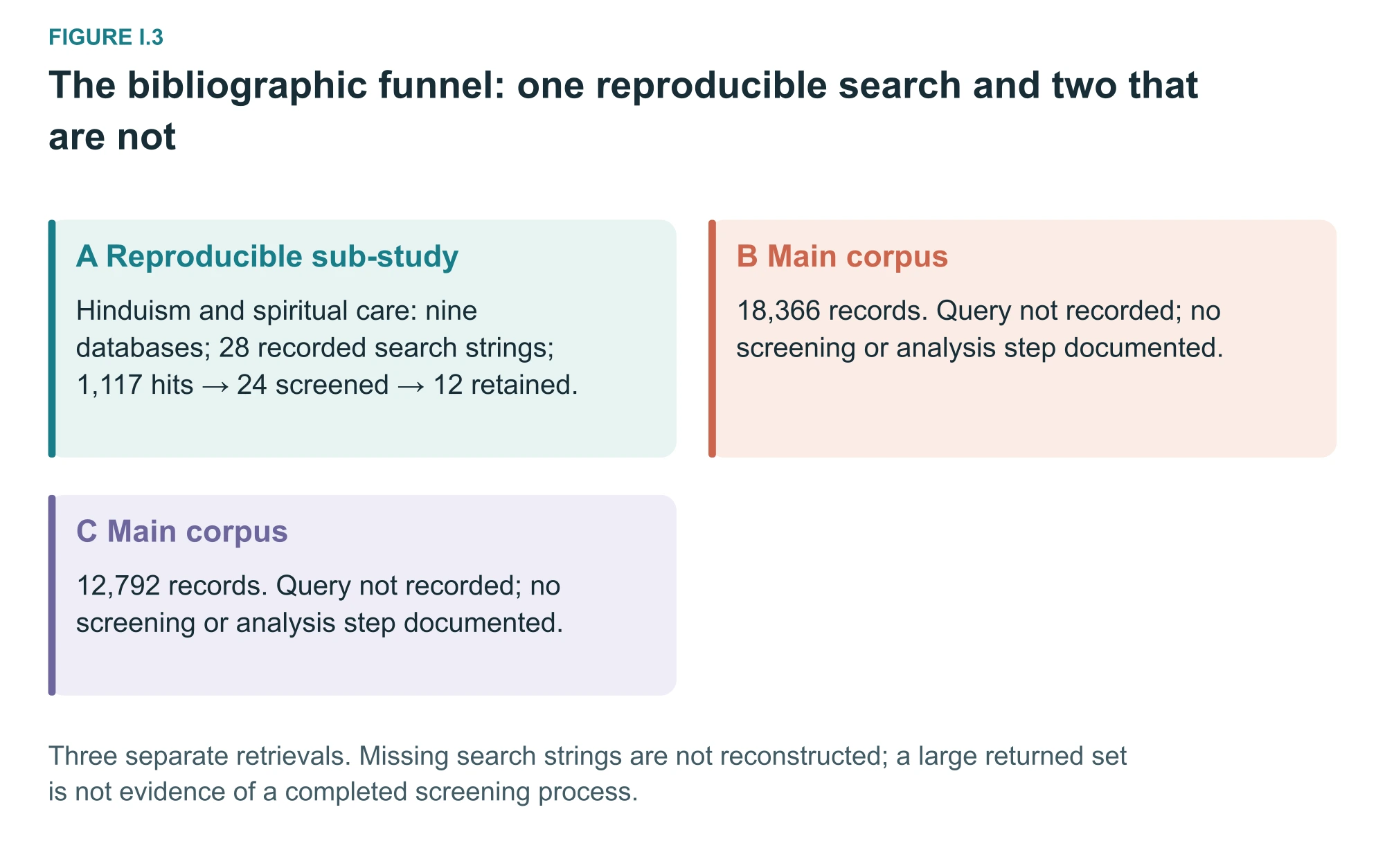
Figure I.3. The bibliographic funnel: one reproducible search and two that are not.
I.6.3 The one exhibit this material honestly supports
Set the keyword corpus beside the exact-phrase corpus, both exported on the same day from the same database: 18,366 records against 5,768. Roughly two thirds of what a broad search retrieves as the literature of this field never uses the phrase spiritual care at all.
That single ratio is worth more than the analysis that was never run, and it says something the book argues elsewhere: the field is assembled out of adjacent literatures - nursing, palliative medicine, psychology of religion, chaplaincy studies - that do not share a name for what they are doing. The ATLA corpus makes the same point from the other side: fewer than one record in ten there carries the subject heading for spiritual care in the medical sense, and the largest heading by far belongs to the psychology of religion.
What the ratio does not support is any claim about what those two thirds contain, how they cluster, or how the field has changed. It is one measurement, honestly obtained, and it should be cited as one.
The review's own drafted limitation should be recorded alongside it, because it is well judged and the authors wrote it themselves: given the number of publications included, they could not assess how central professional spiritual care was to any individual publication, so work by nurses, physicians, psychologists, social workers, clergy and teachers is included throughout.
I.7 Machine-generated cases and definitions: method, and caution
I.7.1 The rule, stated before the description
The project archive contains a file of cases and definitions produced by a general-purpose language model in 2023. It is discussed here as method and as a caution. It is never presented as, blended into, or cited alongside a practitioner case, and no sentence of it appears in the case chapters of this book. Chapter 26 states the same rule for machine-made care in general; the file itself is discussed only here.
The reason for the rule is not squeamishness. It is that the material is filed in the same folders as the human coursework, and its five candidate definitions are numbered in one list with the human-drafted ones and no marker of origin. Three of the five are recastings of the practitioners' draft; two were written by the model and no human being ever saw them. The mixing has already half happened at the level of the definition list, which is exactly how this kind of contamination occurs: not by anyone deciding to pass off machine output as human, but by a numbered list.
I.7.2 What the record does and does not document
The prompts were preserved, pasted above their outputs: thirty-one of them, producing thirty-two responses. That is more than most such records keep and it deserves credit. Everything else about the run is unrecorded - the model and its version, the date, the settings, whether outputs were regenerated, and whether anything was discarded. A transcript with prompts and no model version is not reproducible either.
I.7.3 The failure modes, and the check each one implies
This is the part with practical value. The material is a naturally occurring specimen of what a language model produces when asked for spiritual-care case studies, and its defects are legible and general. Table I.7 names each failure mode, shows what it looks like in the specimen, and gives the check that catches it. The checks are not tests for machine authorship, since a thin human case fails several of them too; they test for the marks of real practice, which is what a reader of case material actually needs to know.
Built for anyone who commissions, receives or marks case material and needs to know whether a human practice stands behind it. The checks in the third column are not tests for machine authorship as such - a thin human case fails several of them too - and that is the point: they test for the marks of real practice, which is what actually matters.
Table I.7. Machine-generated case material: how it fails, and the check that catches it.
Failure mode | What it looks like in the specimen | The check |
|---|---|---|
Volume without content | Nine thousand words that reduce to about three cases with the setting noun swapped. More than half the paragraphs are duplicates of another paragraph once prison, hospital, military and palliative are normalised out; one paragraph occurs four times identically | Sort the paragraphs and count the duplicates before reading a word |
Everything resolves | Every case ends on the caregiver providing the support that was needed. Nobody refuses care, no visit is cut short, no intervention misfires, and ambivalence is raised and dissolved inside one paragraph | Ask of each case: what went wrong, and what did the caregiver not get to do? |
The caregiver is a posture, not a practitioner | The same repertoire in prison, hospice, military and police: listen patiently, offer words of wisdom from scripture, encourage practice. No supervisor, no caseload, no note to write | Ask what this caregiver's Tuesday looks like |
No institutional friction at all | Not one form, protocol, referral, colleague, time limit, permission to obtain, or date. Compare any real case, where a caregiver emails a director to get a detainee to a funeral, or runs past a prescribed forty-five minutes and has to ask for an extension | Search the text for a document, a colleague and a clock. Real practice has all three |
Generic and unattributable tradition | Hindu scriptures invoked eight times and never once a named text. Doctrinal vocabulary thin and asserted with false confidence; wellness vocabulary outnumbers it roughly two to one | Ask which text, which verse, which practice, whose lineage |
Competence errors that look like fluency | A woman given a name reserved in Sikh practice is presented as a Hindu client. An instruction to answer in Dutch is ignored, and the mismatch sits uncorrected in the record | Check the one fact you happen to know well. Fluency and accuracy are unrelated here |
Nobody read it | A corrupted non-word appears twelve times across successive outputs, uncaught | Read the artefact you are about to file |
It fails the wrong test | Asked to show the definition failing, the model twenty times produced a staffing shortage instead - no trained caregiver was available - which is a workforce fact and not a defect in a definition. Twice it faulted a definition of Hindu spiritual care for being about Hinduism | Ask whether the failure demonstrated is a failure of the thing under test |
A reviewer that never says no | In the companion file the model reviews the five definitions in twenty-three passes and returns a positive verdict every time, including on two definitions it wrote itself. It never distinguishes between them, though two are mutually incompatible on who may provide care. Its criticisms are two recurring phrases | An instrument that returns approval for every input, including its own output, is measuring nothing |
I.7.4 The correction this appendix must make to the project's own record
The project's archive inventory describes this material as available for discussion as method - what a language model produced when asked, and how practitioners judged it. The second half of that description is not supported. No practitioner was ever shown the machine's output. The human corpus in these folders, across eleven files and some twenty-nine thousand words, contains no mention of the model, of artificial intelligence, or of machine generation of any kind. The file named for peer validation does not record humans validating the machine; it records the machine performing the role of the peer.
So nobody judged it, nobody rated it, and the question of whether a practitioner would have detected it never arose. That is worth stating precisely, because practitioners judged the machine output and found it wanting would be a useful finding and it is one this project does not have. What it has instead is a cleaner and more uncomfortable one: the machine reviewed the humans, approved everything, and no human reviewed the machine.
I.8 Ethics, consent and the handling of this material
This section is short and it is the most operationally important in the appendix.
No ethics approval is recorded for any of the four studies. No committee, no protocol number, no reference of any kind appears in the research record. No consent form and no consent record exists. The single consent-adjacent sentence in the whole archive is a statement in one protocol that data will be used for research after seeking permission from each participant; whether that permission was sought, and whether it was given, is nowhere recorded. There is no data-management plan, no anonymisation policy and no pseudonym key.
Two consequences follow and neither is optional.
First, identifiable personal data sits unprotected in the research files. Participant names appear beside personal email addresses; one worksheet is a per-person compliance ledger recording who failed to respond on which date; and the pre-and-post course returns contain first-person clinical accounts of identifiable clients. The definition-validation cases describe recently deceased and highly identifiable people, including one death by suicide following an intervention the case describes. None of this may be reproduced, quoted, or paraphrased closely enough to identify anyone, in this book or anywhere else, and this appendix has reproduced none of it. That is why the participants are unnamed here and why no case from that corpus is narrated.
Second, the gap has to be closed before publication rather than noted in it. Table I.9 lists it as the first author gate, ahead of every methodological one, because a missing sample size delays a claim whereas a missing consent record can prevent the material being used at all.
Written from the four studies' own gaps, in the order the gaps bite. Designed to be copied and worked through before fieldwork rather than after it. Every row here corresponds to something at least one of the studies above did not record.
Table I.8. Before you publish, run, or reuse a study like these: a pre-registration and reporting checklist.
# | Settle this before you begin | Why - the failure it prevents |
|---|---|---|
1 | Ethics approval and consent, in writing, covering secondary use and publication | Without it the data may be uncitable however good it is. None of the four studies here has one |
2 | A data-management plan: where identifiers live, who holds the key, when they are destroyed | Names and emails otherwise sit in the working file for years |
3 | What exactly is being tested, and who wrote it | A definition tested only by its authors has not been tested |
4 | Whether the design can produce a negative result. Write down now what a disconfirming case would look like | The instruction show the elements recurring guarantees its own answer |
5 | The rubric: what counts as fit, what counts as failure, and the threshold between | Four of five verdicts here were fully covered, against no criterion at all |
6 | The revision protocol: what happens to the object if the test goes against it, and who decides | The revision field was left blank and the exercise stopped half way |
7 | The search string, in full, with field, filters and date limits, saved the day you run it | Two corpora here cannot be reproduced. The export does not save the query |
8 | The screening record: counts in, counts excluded with reasons, counts remaining, who screened, whether doubled | 1,117 to 24 to 12 is a method. An unrecorded funnel is not |
9 | The sample, recorded as you recruit, not reconstructed afterwards | An analysis with no N supports description only |
10 | Instrument fielding checks: does every respondent have a version they can complete, in their language, with every item present | Two scales here were fielded in a language nobody used, one of them missing two items |
11 | Adherence to the intervention, logged per participant | No dose, no dose-response, however good the outcome measures |
12 | Who codes, and whether anyone codes independently | A single analyst finding the themes their model predicts cannot be checked |
13 | The provenance marker on every generated artefact, at the moment it is filed | Machine and human definitions otherwise end up in one numbered list |
14 | The limitations paragraph, drafted at the design stage | It is honest at the start and defensive at the end |
I.9 What this book's evidence can and cannot be asked to support
A single page, for a reader deciding how much weight to put on any claim in this book that carries an empirical flavour.
It can support an account of what a group of people in Vārāṇasī said about dharma, care and dying, and how the authors read it. It can support the statement that a candidate definition of Hindu spiritual care was put to practitioners and contested clause by clause, and it can reproduce the contest. It can support the observation that the field's literature is largely assembled from sources that do not use its name. It can support the practice protocols and the instruments, which are complete and reusable. And it can support the caution in section I.7, which is grounded in a specimen rather than in an opinion about machines.
It cannot support any claim about prevalence, proportion or frequency among Hindus, among caregivers, or among anyone else. It cannot support any outcome claim for sūkṣma vyāyāma, for meditation, or for any practice in Appendix D or Appendix E, because the study designed to test one was never analysed and its intervention was never measured. It cannot support the claim that the definition was validated. It cannot support any structural finding about the field's literature, because the analysis was not run; the thematic map in The Field in Map Form (Figure M.8) is descriptive and rests on a run whose query is not held. And it cannot support a comparison between any two of these studies, which share no design.
The honest summary is this. The project holds four sets of raw material of real quality and almost no analysis, and the strongest empirical statement it can currently make is a description rather than a finding. This book's argument does not rest on these studies; it rests on the case material, on the traditions it reads, and on the reasoning in its chapters, and it is stated in a form that a reader can test against their own practice. The studies are offered here as what they are, which is a beginning that has been documented honestly rather than a foundation that has been overstated.
I.10 The open questions, and what would close them
Each row names something that is missing from the research record, what depends on it, and what would close it. Rows 1 to 3 must be closed before publication; the rest can be closed in a second edition or left standing as recorded gaps.
Table I.9. Author gates in this appendix, in the order they bite.
# | The gap | What it blocks | What would close it |
|---|---|---|---|
1 | Ethics approval and consent for all four studies | Any quotation, any reuse, arguably any citation of participant material | The approvals if they exist; a documented decision on secondary use if they do not |
2 | The identifiable data in the working files | Nothing in this book, which quotes none of it. It blocks any deposit, any archive and any data statement | Redaction, a held key, and a retention decision |
3 | A data statement for the book saying what exists, where, and on what terms | The publisher will ask | An author decision, informed by rows 1 and 2 |
4 | The Vārāṇasī sample, dates, recruitment and interview guide | Any sentence in this book that implies a number of participants | The fieldwork records, if they were kept |
5 | The Vārāṇasī consent and translation route | Direct quotation of participants in the chapters | As above |
6 | The Scopus and ATLA search strings, fields and filters | Any reproducible statement of method for The Field in Map Form | Re-running and saving the searches, which also refreshes them |
7 | Whether the bibliometric analysis will be re-run from a saved query | Every structural claim about the field, and the eight exhibits (Figures M.1 to M.8) in The Field in Map Form | A decision: re-run it with the query recorded, or leave the front matter's map as descriptive, which is how it now presents itself |
8 | Whether the definition will be revised in the light of the nine peer objections | Section I.4's standing as validation rather than as consultation | An author decision. The exclusivity objection and the demand-led objection are the two that would change the definition most |
9 | Whether the instrument study will be scored | Any use of the pañcakośa battery as more than a design idea | Twelve returns is a small but real dataset; scoring it is a day's work |
10 | The provenance marking of the five candidate definitions | The risk that a machine-authored definition is cited as a study output | Mark each of the five at source with its origin |
I.11 Figures for this appendix
Figures I.1-I.5 accompany the research designs and instruments described in this appendix.
• Figure I.1 The four studies and what each can carry.
• Figure I.2 The validation loop, and the arm that was never closed.
• Figure I.3 The bibliographic funnel: one reproducible search and two that are not.
• Figure I.4 The Vārāṇasī themes and the lens laid over them.
• Figure I.5 Instrument attrition: planned, fielded, answered.